Nobody discovers their white-label design partner was the wrong choice during the pitch.
You discover it on a Thursday afternoon, when a client emails to ask who Studio Ninefold is and why their name is on the PDF you just sent. Or when the packaging artwork comes back beautiful and in RGB, four days before a press date. Or when a font foundry's licensing team writes to you — not to your partner — about a typeface used across nine thousand printed catalogues. Or when you ask for the working file eleven months into the relationship and are told the designer who built it has left.

Every one of those is a vetting failure rather than a partner failure, and each was preventable by a specific question asked before any money moved. That is the useful frame: the point of vetting is not to find a good partner, it is to move the discovery of the bad news forward in time, to a point where it costs you a conversation rather than a client.
The guides that currently rank for this problem will give you seven questions, or ten, or five. Read a few and you notice they are the same questions — do they have experience, are they transparent, can they scale, will they communicate well — and that they stop at the question. None of them tells you what a good answer sounds like. That omission is the whole difficulty, because every partner worth talking to has heard "can you scale?" a hundred times and has a fluent, reassuring, entirely uninformative answer ready.
So this is the twelve-question protocol with the answers attached. For each question: why it matters commercially, what a good answer contains, what a rehearsed answer sounds like, and how to verify rather than believe. Plus the leak surfaces almost nobody checks, the licensing liability chain, the capacity arithmetic, the design of a pilot brief that actually reveals something, and a scorecard for comparing two partners without flattering the one you liked.
If you are buying design for your own business rather than for resale, this is the wrong article and the criteria genuinely differ — start with how to choose a design outsourcing partner instead.
Why vetting a white-label partner is a different job
Hiring an agency for your own marketing and appointing a white-label partner look like the same procurement exercise. They are not, and three inversions explain why the ordinary evaluation criteria mislead.
The liability moves to you. When your own agency misses a deadline, you are inconvenienced. When your white-label partner misses a deadline, your client is inconvenienced and has no idea a partner exists. Every error is attributed to you by construction. That means the questions that matter most are not about craft — craft is visible in a portfolio — but about the failure modes you cannot see until they have already reached your client.
Confidentiality stops being hygiene and becomes existential. A normal supplier knowing your client list is a mild commercial risk. A white-label partner knowing your client list, holding the source files, and being capable of doing the work directly is a different category of exposure. This is not usually about bad faith; it is about the ordinary mechanics of a studio that markets itself, posts work, has designers with portfolios, and takes enquiries from anyone.
Capacity becomes a promise you have already made. You quote turnaround to your client before you brief your partner. Their capacity constraint is therefore a commitment you have already sold, which is why "can you handle volume?" is a near-useless question and "what happened the last time three clients briefed you on the same day?" is a good one.
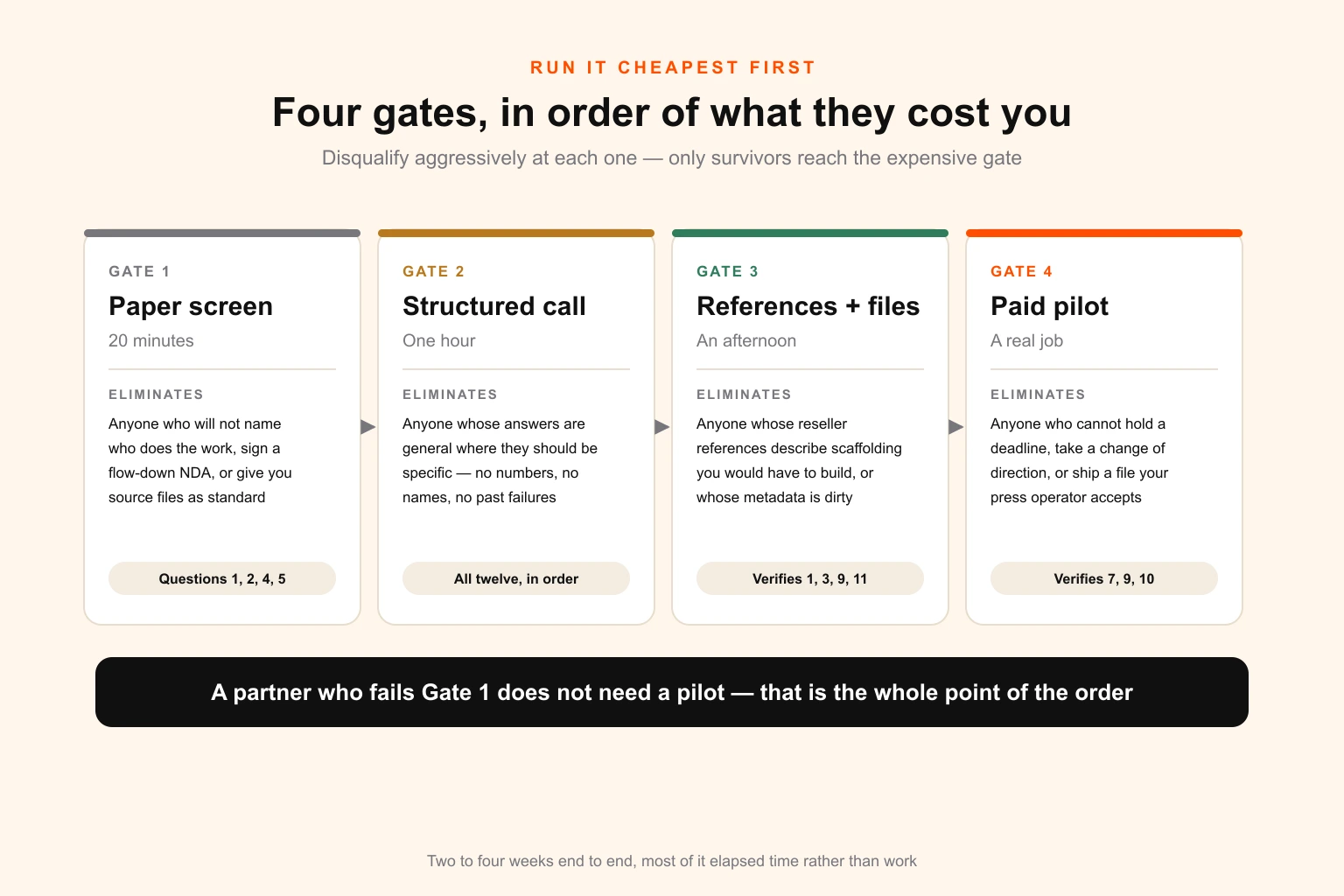
Run the process as four gates in sequence, cheapest first, and disqualify aggressively at each one. A paper screen costs you twenty minutes and removes most candidates. The structured call costs an hour. References and a file inspection cost an afternoon. Only the survivors get a paid pilot, which is the only expensive gate and the only one that tells you the truth.
The twelve questions
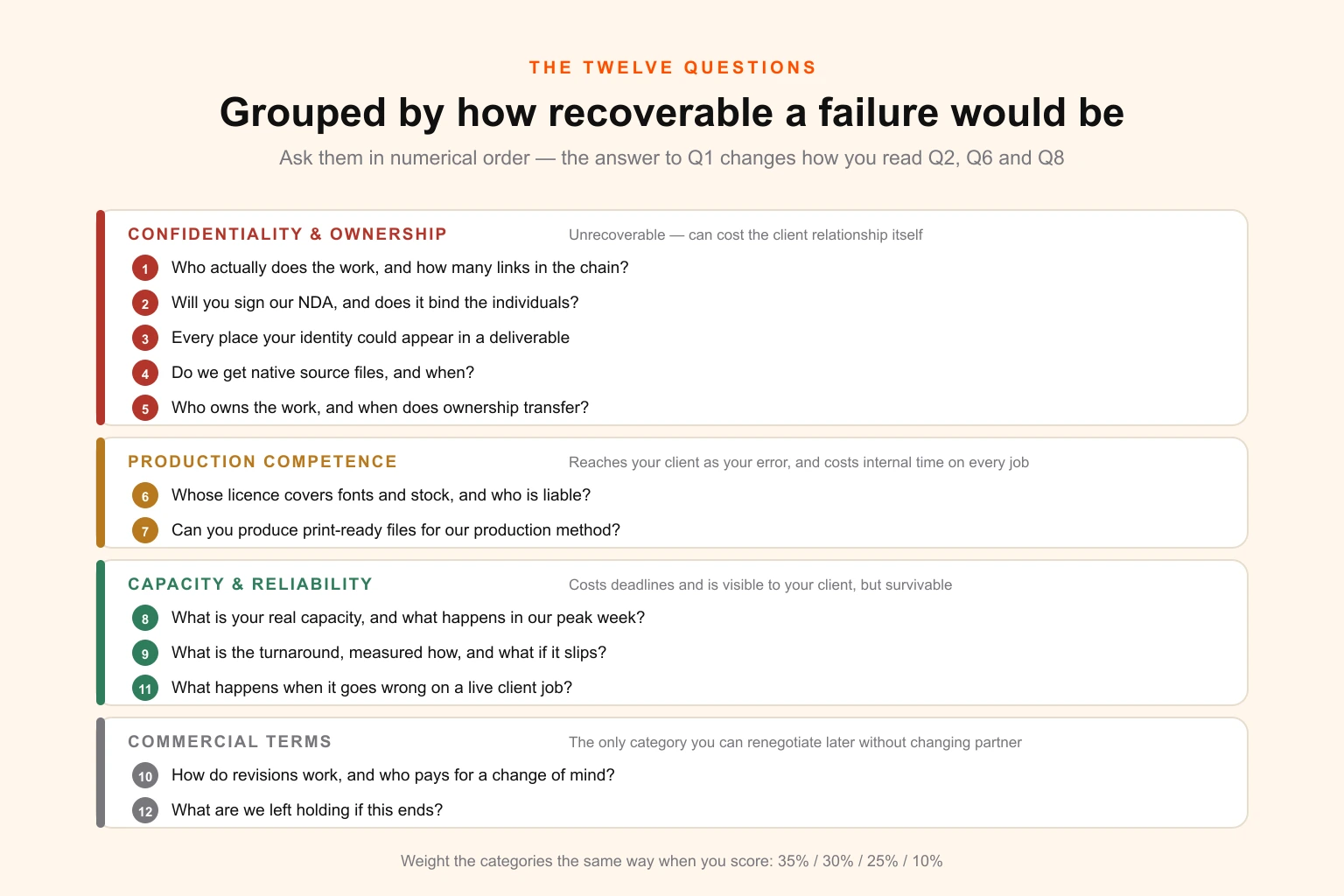
Ask them in the order below. The order is not arbitrary: the answer to question one changes how you should read the answers to questions two, six and eight, and asking it later means re-interviewing.
1. Who actually does the work, and how many links are in the chain?
Why it matters. Every other assurance in the conversation needs a subject. An NDA binds an entity; you need to know whether the people whose hands touch your client's brand are inside that entity. A capacity figure describes a workforce; you need to know whether that workforce exists or is a marketplace they draw from. And a quality claim describes a standard; you need to know whether it is enforced by a design director who reviews every job or asserted by a project manager who forwards files.
A good answer is specific and slightly boring. It names the structure: an employed team of this size in this location, with these specialisms, working to a named design lead who reviews output before it leaves. If contractors are used, the good answer volunteers that, says which work goes to them, and explains how they are bound and reviewed. Genuinely good partners often say something like "illustration goes to two long-standing freelancers we have used for six years, both under the same confidentiality terms as staff, and everything they produce is reviewed here before delivery." That is a better answer than "we have an in-house team" delivered flatly, because it is checkable.
A bad answer deflects to process. "We have a robust talent network." "Our vetted global pool of senior creatives." "We match your brief to the right specialist." These are all descriptions of a marketplace, which may be fine, but you are being told about a mechanism instead of a workforce because the workforce is variable. The specific answer to fear is the one that describes a chain: an agency subcontracting to a studio which subcontracts to individuals. Each link degrades the brief, absorbs a margin, and adds a party your NDA does not reach.
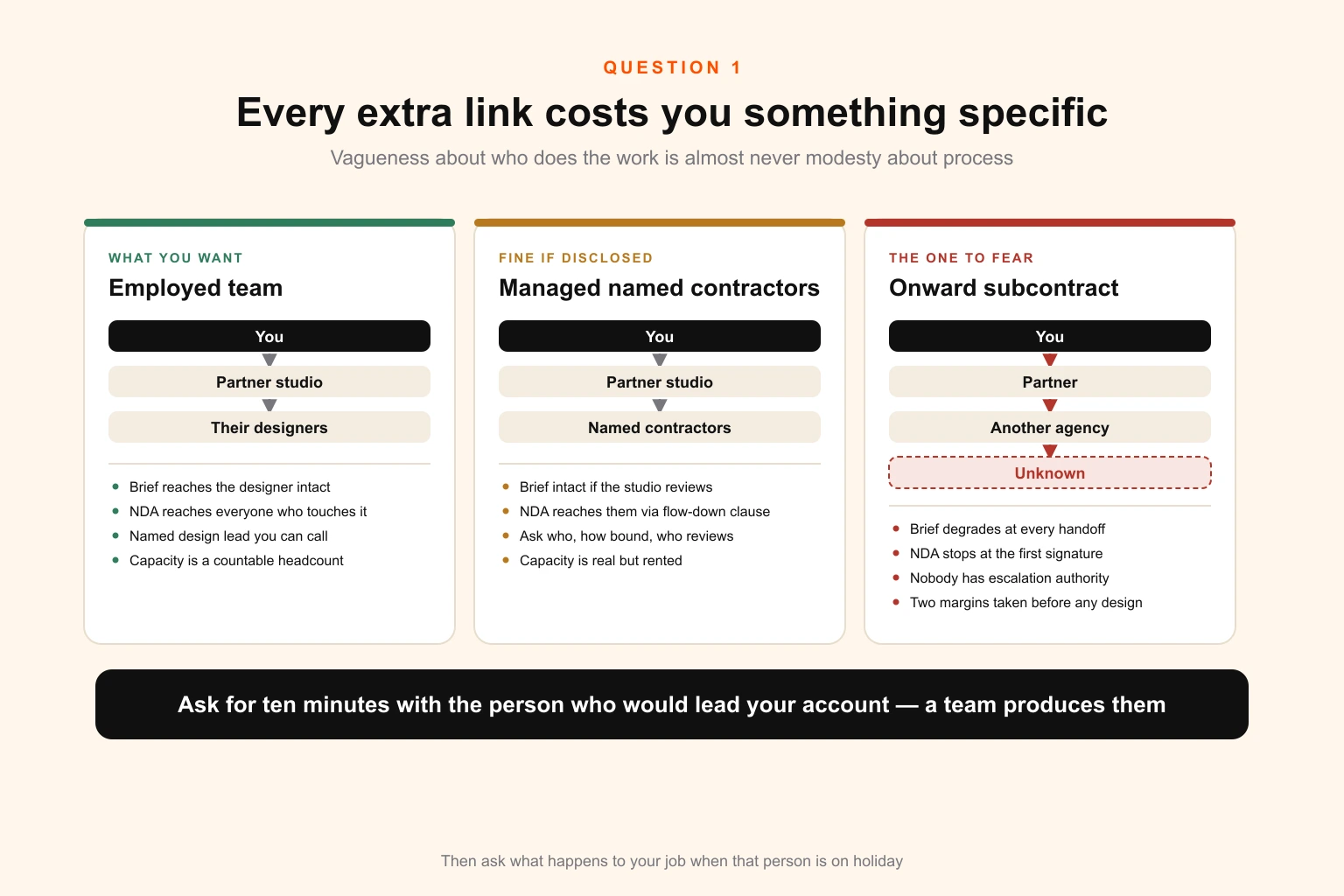
How to verify. Ask for the first name and role of the person who would be the design lead on your account, then ask to speak to them for ten minutes about a real brief. A partner with a team produces that person. A partner with a routing layer produces a rescheduled call. Separately, ask what happens to your job if that person is on holiday — the answer reveals bench depth more reliably than a headcount does.
2. Will you sign our NDA, and does it bind the individuals?
Why it matters. Most confidentiality failures in resold design work are not breaches of contract; they are gaps in it. The signing entity honours the agreement perfectly while a contractor two links away posts the work to their portfolio, because nothing ever bound them.
A good answer engages with the document. A partner who has done this at any scale will have opinions: they may want a mutual version, may push back on an unlimited liability clause, may ask you to narrow a definition. That friction is a positive signal. The specific things your NDA needs, which most templates omit, are a flow-down clause obliging the partner to bind every individual and subcontractor to equivalent terms, a non-solicitation clause covering your clients rather than only your staff, and an explicit prohibition on portfolio use, case-study publication, awards submission and social posting of anything produced for you, with no expiry date.
A bad answer is instant, unread agreement. A partner who signs a document you wrote without a single question has either read nothing or intends to treat it as ceremonial. The other bad answer is "we have our own NDA, it covers everything" — theirs is written to protect them, and almost never contains a flow-down clause or a portfolio prohibition, because those clauses cost them marketing material.
How to verify. Ask directly: "if one of your designers wanted to include this in their personal portfolio in two years, what stops them?" A partner with a real answer describes a contractual term and an internal practice. A partner without one says it has never come up.
3. Walk me through every place your identity could appear in a deliverable
Why it matters. This is the question the ranking guides skip entirely, and it is the one that produces the Thursday-afternoon email. Identity leaks are almost never dramatic — nobody puts a logo on your client's brochure. They are metadata, filenames, notification emails and layer names, and they leak because nobody was looking at the file as a container rather than as an image.
A good answer is a list, delivered with the slight weariness of someone who has been caught by two of them. It should cover document metadata in both exports and native files — the author, creator, producer, company and title fields in a PDF, the author field in an InDesign or Illustrator document, the last-saved-by field in an Office file. It should cover layer names, swatch names, character and paragraph style names, and artboard names, all of which carry studio naming conventions. It should cover exported filenames and any job number scheme. It should cover cloud sharing: a share notification from their account, a comment thread with their domain in it, a Figma or Drive link that reveals a workspace name. It should cover email — an individual designer replying into a thread that includes your client, a signature block, an out-of-office. It should cover previews and proofs — watermarks, a proofing portal with their branding, a PDF cover sheet. And it should cover the long tail: work appearing on a designer's personal site, a studio Instagram post, an awards entry, a Dribbble shot.
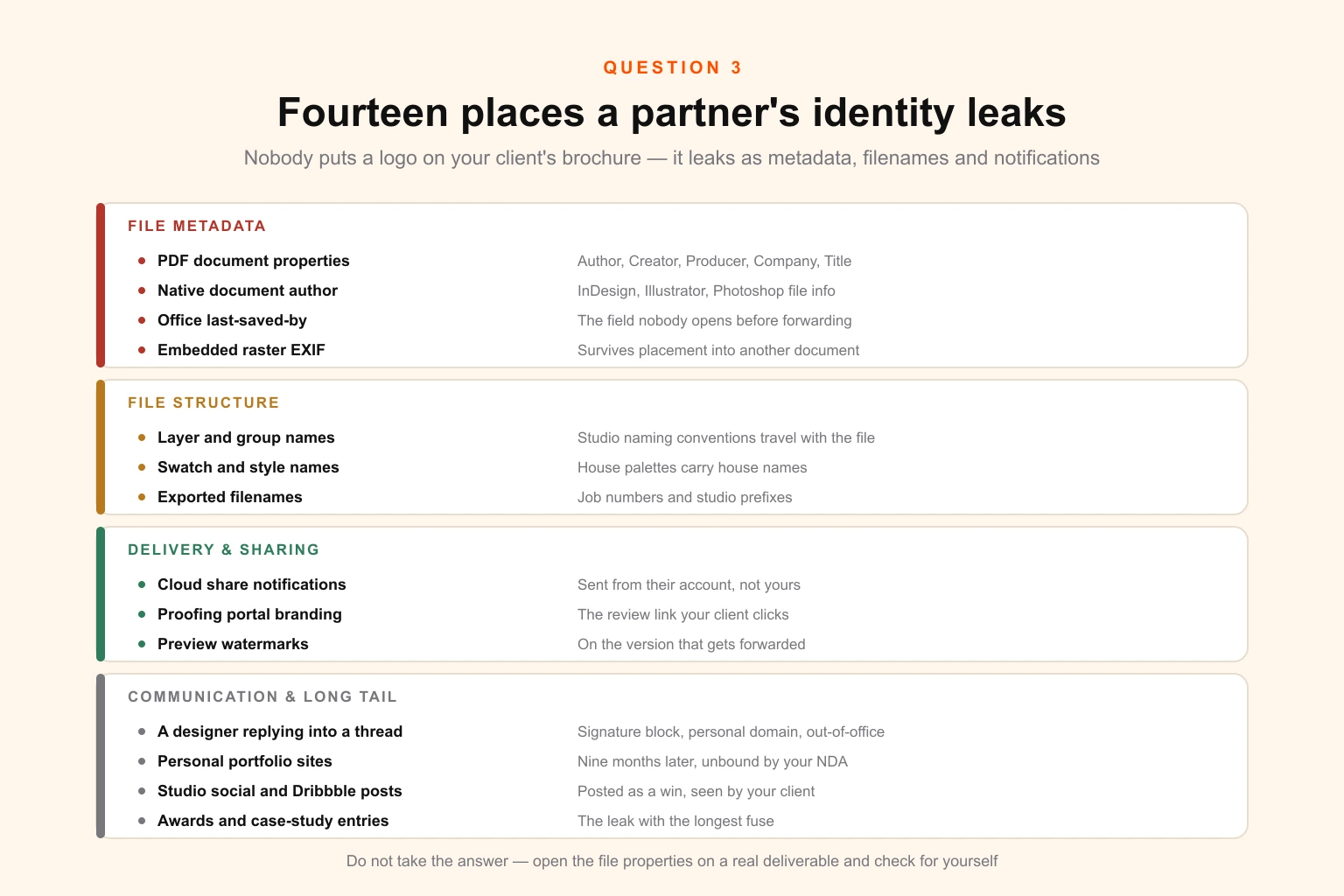
A bad answer is a reassurance. "We're fully white label, nothing goes out with our name on it." That is a statement of intent, and intent is not the failure mode. A partner who has genuinely operated white-label at volume has a scrubbing step in their delivery process and will describe it.
How to verify. Do not take the answer. Take a real deliverable from the pilot and inspect it yourself: open the document properties, read every metadata field, open the layers and swatches panels, look at the filename, and check the EXIF on any embedded raster. Ten minutes, once, and you will know more than any answer could tell you. Keep doing it as a spot check quarterly, because delivery processes drift when a new project manager joins.
4. Do we get the native source files, and when?
Why it matters. Source-file access is the difference between a partner and a dependency. Without the working files you cannot make a small change without them, cannot hand the account to another partner, cannot respond when a client asks for the assets they believe they own, and cannot survive the partner's own disappearance. It is also the single most common gap between what resellers assume and what their agreement says.
A good answer treats source files as part of delivery rather than a favour. Native working files — the layered Illustrator, InDesign, Photoshop, Figma or After Effects documents, with linked assets packaged and fonts identified — delivered alongside the outputs, on every job, at no extra charge. A very good answer volunteers the file-hygiene standard: linked rather than embedded images where appropriate, packaged folders, sensible layer naming, no flattened artwork where editability was expected. If you resell to clients who expect a full handover, this is the question that determines whether you can honour that. Asset kits assembled for a client to use themselves — an employer brand asset kit is the clearest example — are worthless without the editable originals underneath them.
A bad answer has any of three shapes. Source files on request, which becomes a friction cost you pay forever and a hostage in a dispute. Source files at additional cost, which is a pricing structure designed around your eventual departure. Or source files retained until final payment on each job, which sounds reasonable and means you cannot make a same-day tweak.
How to verify. Require source files as part of the pilot delivery and actually open them. Then attempt a small edit — move a headline, change a colour, swap an image — and see whether the file was built to be edited or built to be exported once. A file with a hundred unnamed layers and all type outlined is technically a source file and practically a JPEG.
5. Who owns the work, and when does ownership transfer?
Why it matters. You are selling your client something. If what you actually hold is a licence, you are reselling a licence you may not have the right to sublicense, and the mismatch surfaces at exactly the wrong moment — a trademark filing, an acquisition due diligence, a client's own procurement audit.
A good answer is an assignment of all intellectual property in the commissioned work to you on payment, expressed as an assignment rather than a licence, with the position on moral rights stated explicitly, and with any pre-existing partner-owned material — a proprietary template, a house illustration library, an internal script — identified separately so you know what is and is not yours. Good partners will also be clear that the assignment does not cover third-party assets such as licensed fonts and stock, which is correct and leads directly to question six. If your work involves logo and identity development, the ownership chain matters more than anywhere else: see what a logo project actually transfers for the client-facing version of the same problem.
A bad answer uses the word licence, or is silent. Silence usually means their terms grant you a licence by default, because that is what most standard supplier terms do. Also watch for an assignment conditional on something other than payment, and for a carve-out permitting the partner to reuse "concepts and methodologies," which can be read broadly enough to cover a rejected route you paid for.
How to verify. Read the clause rather than the summary of the clause, and read the pre-existing-material carve-out particularly carefully. If a template of theirs underlies a deliverable, establish in writing what happens to your client's use of it if the relationship ends.
6. Whose licence covers fonts and stock, and who carries the liability?
Why it matters. This is the highest-probability legal exposure in resold design work, and the mechanism is almost always the same: a designer had a font, used the font, and nobody asked which licence it was under or whether that licence covered a hundred-thousand-unit print run, a web embed, an app, or resale on merchandise. Because you are the entity on the invoice and the supplier of record, the enforcement letter comes to you.
A good answer is procedural. It states which party procures fonts and stock; it confirms that licences are checked against the actual end use, not merely acquired; it commits to supplying the licence reference for every third-party asset in a deliverable on request; and it includes an indemnity. A partner who is genuinely careful will raise the awkward cases before you do — that desktop font licences are seat-limited and usually exclude web and app embedding, that many licences cap the number of printed impressions, that "editorial use only" stock is not usable in advertising or on packaging, that extended or merchandise licences are required for resale items, and that AI-generated imagery has its own provenance questions. The detail is genuinely intricate; font licensing for resellers and stock asset licensing for print runs and merchandise cover the cases that actually bite.
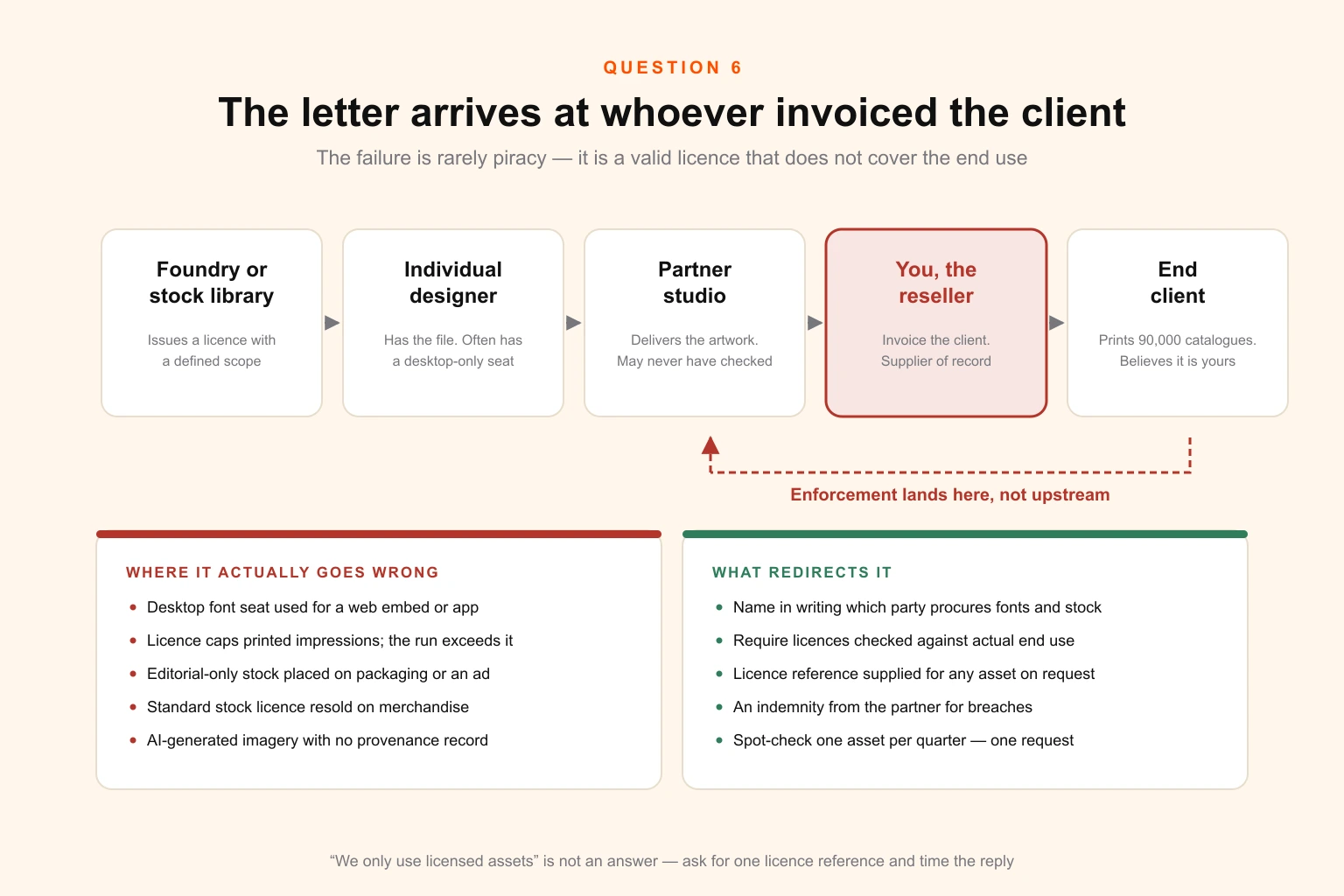
A bad answer is "we only use licensed assets," full stop. Everyone says this and most people believe it, because the failure is not deliberate use of pirated material — it is correct use of a licence that does not extend to your end use. The other bad answer is a partner who is happy to let you assume they have handled it without saying so.
How to verify. Pick one asset from the pilot deliverable and ask for its licence reference. One request, one asset. The speed and specificity of the response tells you whether a record exists.
7. Can you produce genuinely print-ready files for our production method?
Why it matters. This is where the gap between screen-competent and production-competent studios opens up, and it is invisible in a portfolio, because a portfolio shows finished images rather than the files behind them. If you are a print shop, sign shop, screen printer, sticker manufacturer or packaging converter, this question is worth more than the other eleven combined, because a partner who cannot prepare files for your process converts every job into internal prepress work you are not charging for.
A good answer is method-specific and volunteers detail. For litho and digital print: working colour space and profile, total area coverage against your press limit, spot colours named exactly and not simulated in process, bleed and safety, overprint and rich-black handling, transparency flattening, effective image resolution at final size. For packaging: dielines on correctly named separate layers, crease versus cut distinction, glue-flap allowances, varnish and foil as separate spot separations. For large format: build scale, effective resolution at viewing distance rather than absolute DPI, seam and hem allowances, grommet positions. For cut vinyl and stickers: closed vector cut paths with no stray nodes, kiss-cut versus die-cut distinction, weeding considerations. For screen print and embroidery: colour separations, halftone approach, minimum line weights, and whether the artwork survives reduction to stitchable detail.
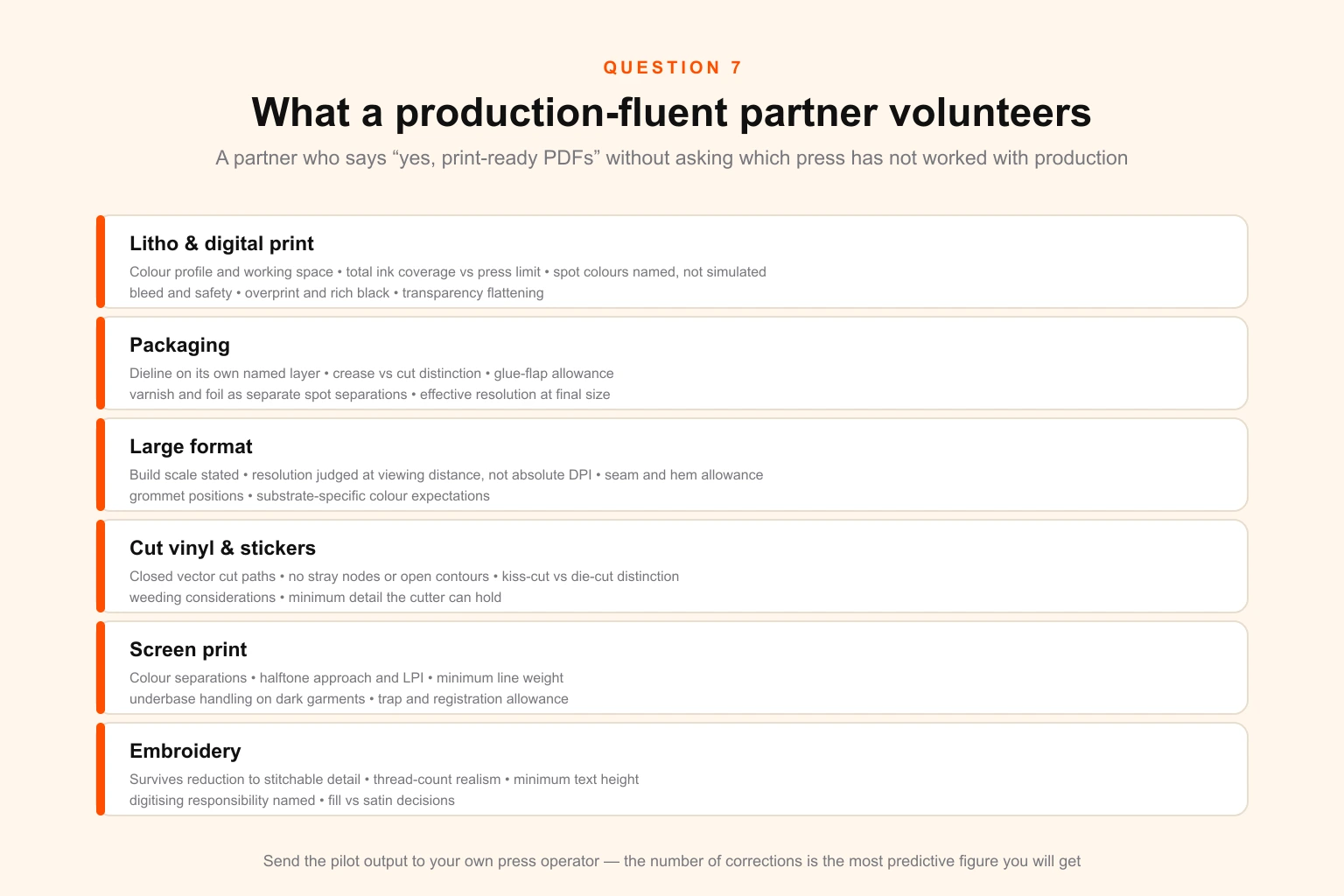
A bad answer is fluent about "print-ready" as a single quality. A partner who says "yes, we always supply print-ready PDFs" without asking which press, which stock, which coverage limit and which colour profile has not worked with production. The tell is the absence of questions: a genuinely production-fluent partner asks you things at this point in the conversation.
How to verify. Send the pilot output to your own prepress check or press operator and ask them to mark it up as they would any incoming file. The number of corrections on that markup is the single most predictive number in the whole vetting process. It is also worth checking the partner's grasp of fundamentals with something quick — CMYK versus RGB, vector versus raster, the print-ready file checklist, dieline construction, kiss-cut versus die-cut and die-cut sticker file specs are all things a production partner should be able to discuss without preparation. Vertical-specific expectations differ enough that they are worth reading separately for screen print shops, sign shops, sticker businesses, vehicle wraps, label producers and promotional products.
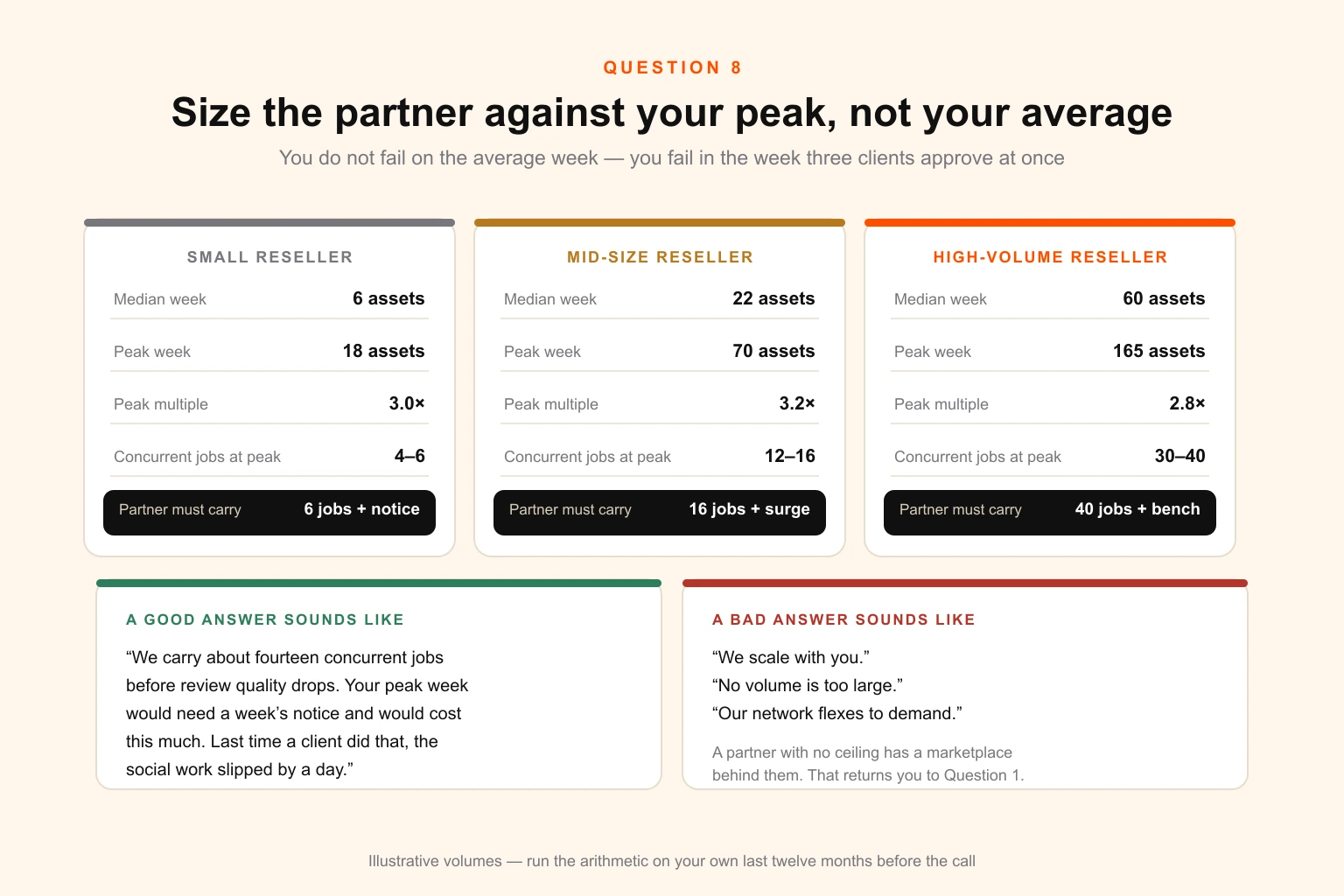
8. What is your real capacity, and what happens in our peak week?
Why it matters. Average capacity is irrelevant. You do not fail on the average week; you fail in the week when three clients approve campaigns simultaneously and a trade show deadline lands. What you are buying from a studio partner rather than a freelancer is absorbed variance, and variance absorption is a property of bench depth, not of headcount.
A good answer gives you numbers and a mechanism. Concurrent active jobs the team comfortably carries, current utilisation, what the surge process is, what it costs, and — most usefully — a specific story about the last time a client exceeded their normal volume and what actually happened, including what slipped. Good partners are candid about the ceiling, because a partner who claims no ceiling is either lying or holding an expensive idle bench.
A bad answer is elastic. "We scale with you." "No volume is too large." A partner with genuinely unlimited capacity is a partner with a marketplace behind them, which returns you to question one.
How to verify. Do the arithmetic rather than accepting the assurance. Take your own last twelve months of design volume, find the busiest week rather than the average, and ask specifically about that number. If your peak week is four times your median, that is the figure to put to them. The comparison against employing someone is worth running properly too — the utilisation math against a full-time designer and against freelancers usually reframes the decision, and if your volume is driven by paid media the pattern is different again: see how many ad creatives you actually need per month and the design retainer structure for media buying clients.
9. What is the turnaround, measured how, and what happens when it slips?
Why it matters. Turnaround is the number you resell most directly, and it is also the number most loosely defined. "Twenty-four to forty-eight hours" can mean four quite different things depending on when the clock starts, whether it pauses, what counts as a working day across a time-zone gap, and whether a two-part deliverable is one job or two.
A good answer defines the clock. What starts it — brief submitted, or brief accepted as complete? What stops it — first delivery, or approved delivery? What pauses it, and does a clarifying question pause it? What are the working hours and days, and how do they overlap with yours? Is turnaround per asset or per brief? A good partner also distinguishes categories honestly: a social set is not a packaging structure, and a partner quoting one turnaround for all work has not thought about it.
A bad answer is a single number with no definition, or a number that turns out to describe first response rather than first delivery. Also treat as a bad answer any partner unwilling to state what happens when they miss — not necessarily a financial penalty, but some named consequence and a defined communication trigger.
How to verify. Set the pilot deadline where it is genuinely inconvenient, then measure. Realistic benchmarks by asset type are worth calibrating against so you know whether a quoted figure is ambitious or fictional. Then watch variance rather than average once live: average turnaround is a lagging indicator and variance is a leading one.
10. How do revisions work, and who pays when the client changes their mind?
Why it matters. Revision scope is where reseller margin quietly disappears. Your client's third change of direction is not a revision in any technical sense — it is a new brief — but if your agreement with your partner does not distinguish those, you absorb the difference on every job, forever.
A good answer distinguishes three things clearly: a correction, which fixes an error the partner made and is always free; a revision, which refines within the agreed direction and is covered up to a stated number of rounds; and a change of direction, which contradicts the brief and is new work. It also states what a round is, because "unlimited revisions" bundled with one-at-a-time queuing is a throughput limit wearing a generosity costume.
A bad answer is "unlimited revisions" with no definition of a round or a queue position. It sounds like the answer you want and it transfers all timing risk to you. The other bad answer is a revision policy so tight that ordinary iteration triggers a charge, which makes every job a negotiation.
How to verify. Introduce one genuine change of direction into the pilot, mid-flight, and watch two things: how the work responds, and how the commercial conversation goes. A good partner tells you immediately and calmly that this is new scope and what it costs. Writing a revision policy that holds is a discipline in itself, and it starts with how to write a design brief tight enough that "within the brief" means something.
11. What happens when it goes wrong on a live client job?
Why it matters. It will go wrong. The variable is not whether but how fast you find out and how fast it is fixed, and those depend on whether an escalation path exists before it is needed. This is the question that separates a partner from a vendor.
A good answer names a person and a time. A named individual with authority, reachable by a channel that is not a shared inbox, with a stated response time inside working hours and a stated position on out-of-hours. It also describes a proactive obligation: the partner tells you when a deadline is at risk rather than waiting to be asked. The best answers include an actual incident — what went wrong, what they did, what it cost them — because a partner willing to describe a failure has processed it.
A bad answer routes you to a system. A ticket queue, a shared inbox, a project manager who will "escalate internally." Those are fine for ordinary work and useless at four in the afternoon on a press day. Equally bad is a partner who cannot recall anything ever going wrong.
How to verify. Ask for the incident story. Then, during the pilot, send one urgent question outside their normal working hours and observe what happens — not to punish them, but because you need to know the real answer before a client's deadline depends on it.
12. What are we left holding if this ends?
Why it matters. Every partnership ends. The version where it ends well is one where you already hold everything you need; the version where it ends badly is one where the ending itself is the leverage.
A good answer describes a handover: all native source files for all work produced, in stated formats, within a stated number of days of termination, along with an asset list, any brand documentation built along the way, and the third-party licence references. A thorough partner will also address the transition period — whether they will complete work in progress, and on what terms.
A bad answer has never considered it. Silence here is not usually malice; it is a partner who has not thought past acquisition. But the practical effect is the same, because the moment you want to leave is the moment goodwill is least available. If you have ever lost a designer without a handover, the shape of the problem is familiar: it is the same continuity exposure that makes keeping design in-house riskier than it looks, relocated to a supplier.
How to verify. Ask for the exit clause in writing before you sign, and check that source-file delivery on termination is unconditional rather than contingent on account standing. Then, independently, keep your own copy of every source file as it arrives. That single habit converts an exit negotiation into an administrative task.
Good answer, bad answer: the pattern
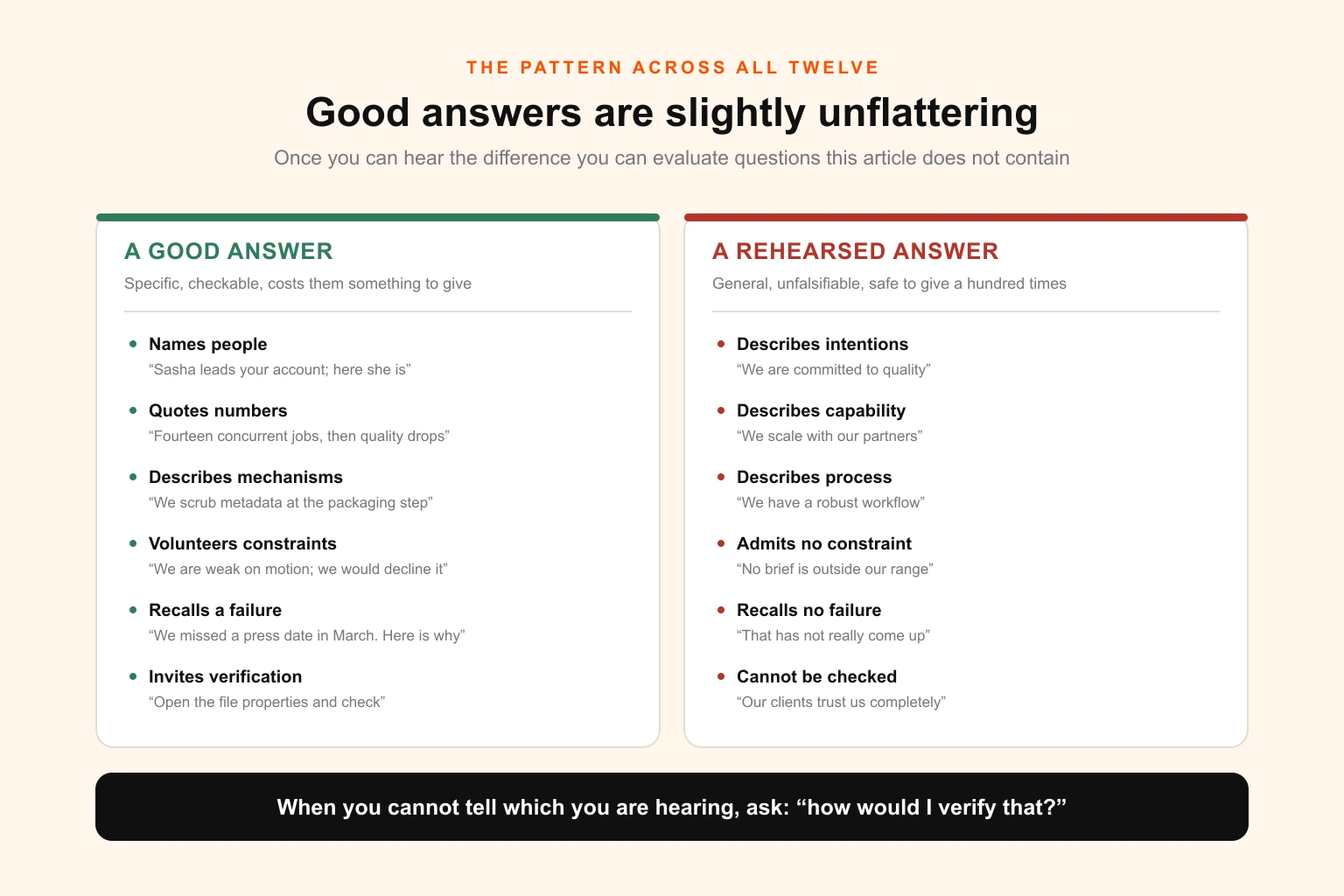
Across all twelve questions the distinction has one shape, and once you see it you can evaluate answers to questions this article does not contain.
Good answers are specific, checkable and slightly unflattering. They name individuals, quote numbers, describe mechanisms, and mention constraints and past failures unprompted. A partner saying "we top out around fourteen concurrent jobs before quality drops, and in your peak week we would need a week's notice" has told you something true and useful and has slightly damaged their own pitch to do it.
Rehearsed answers are general, unfalsifiable and reassuring. They describe intentions rather than mechanisms, capabilities rather than capacity, and values rather than practices. Crucially they contain nothing you could later discover to be false, which is exactly why they feel safe to give.
The practical test, when you cannot tell which you are hearing: ask "how would I verify that?" A partner with a mechanism tells you where to look. A partner with a position changes the subject to their commitment to quality.
The paid pilot: designing a brief that reveals something
The call tells you how well a partner interviews. The pilot tells you how they work. Most resellers get the pilot wrong in the same two ways: they make it free, and they make it nice.
Free pilots select against good partners. A studio with a full bench declines unpaid work, so the pool of partners willing to work free skews toward the underworked. Free work also licenses over-investment — a partner will put their design director on a free pilot and a junior on your third real job, which means the pilot measured something you will never receive again.
Nice pilots measure the wrong thing. A well-briefed, generous-deadline, single-deliverable project with no complications tests whether a studio can make one attractive object. Every candidate can. What you need to know is what happens on an ordinary Tuesday.
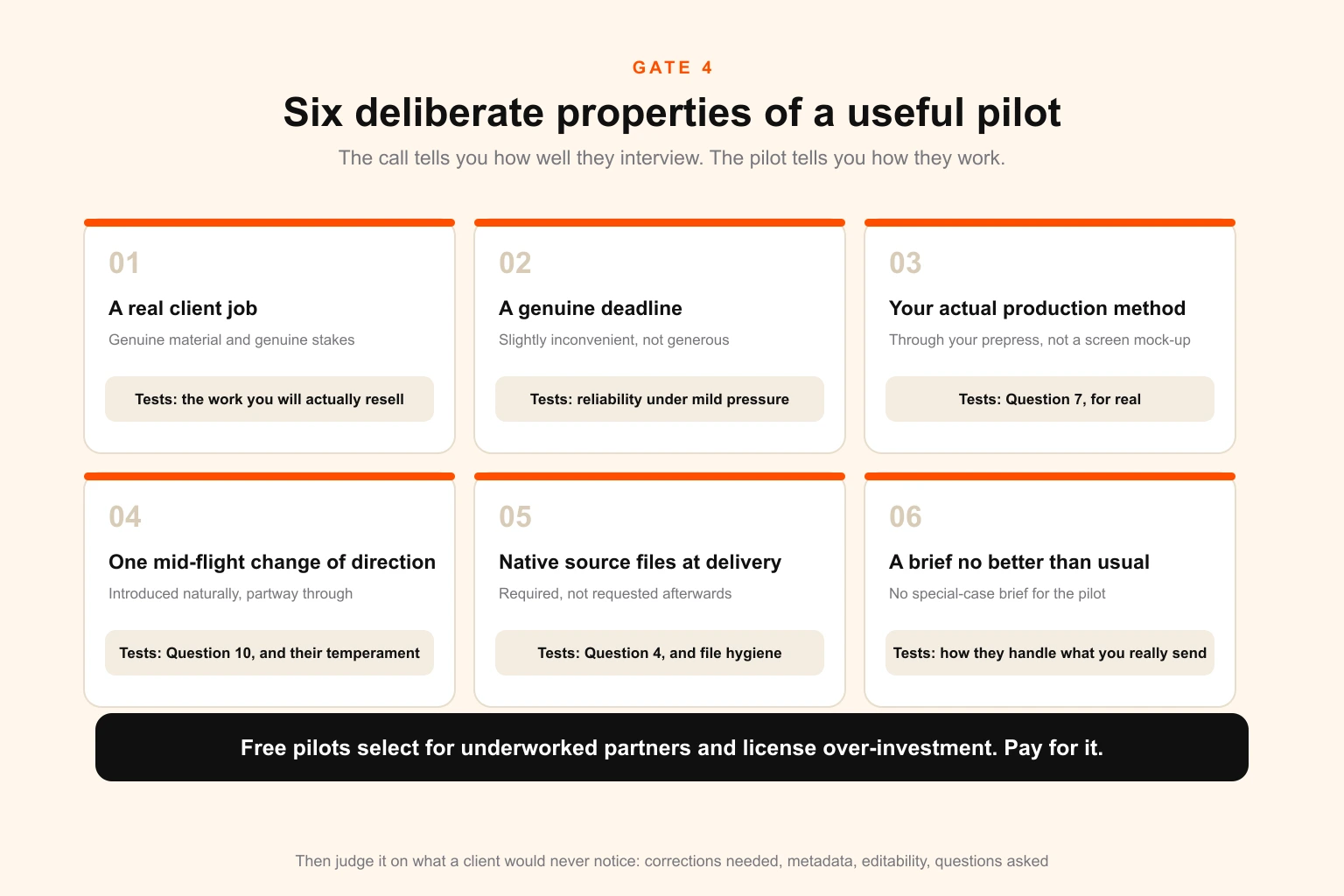
Build the pilot with six deliberate properties:
- A real client job, so the stakes and the material are genuine.
- A genuine deadline, ideally slightly inconvenient, because reliability under mild pressure is what you are buying.
- Your actual production method, not a screen mock-up — if you print, the pilot goes to press or at least through your prepress check.
- One mid-flight change of direction, introduced naturally, because this is where most partners actually fail and where the revision policy gets tested for real.
- Native source files required at delivery, so you learn both whether the clause works and how the files are built.
- A brief no better than your usual brief. This one takes discipline. If you write an unusually thorough brief for the pilot you will learn nothing about how the partner handles the briefs you actually send.
Then evaluate the pilot on things a client would never notice: how many internal corrections the output needed before you would send it, how many clarifying questions the partner asked and whether they were good ones, whether the metadata was clean, whether the source file was editable, whether they flagged the deadline risk before it materialised, and how the change of direction was handled commercially.
The reference call, done properly
Two references, ten minutes each, three questions. Ask to speak to a reseller rather than an end client, because a reseller has experienced the failure modes you care about.
"What did you have to build internally to work with them?" Every partnership requires some scaffolding — a checking step, a briefing template, a pre-send review. The size of that scaffolding is the real cost of the partner, and it is a cost nobody quotes.
"Tell me about the worst week." Not whether things went wrong, but what happened when they did. You are listening for whether the partner communicated before or after the deadline passed.
"What would you check more carefully if you were starting again?" This is the question that produces the useful answer, because it invites a specific regret rather than a general verdict.
Do not ask whether they would recommend the partner. Everyone says yes, partly because admitting a bad choice is uncomfortable and partly because they are still using them.
Red flags, by severity
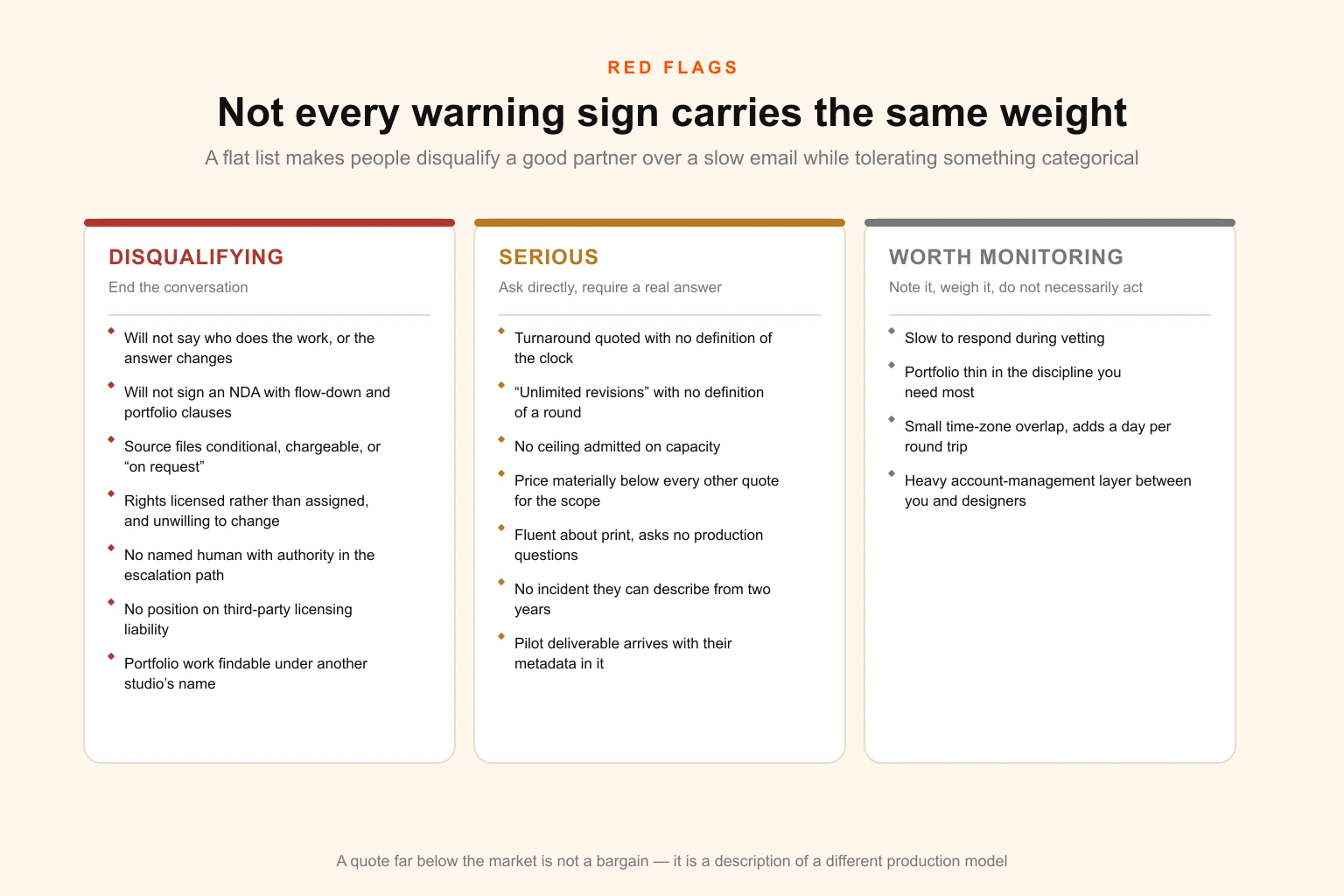
Not every warning sign carries the same weight, and treating them as a flat list leads people to disqualify a good partner over a slow email while tolerating something categorical.
Disqualifying — end the conversation.
- Will not say who does the work, or the answer changes between conversations.
- Will not sign a confidentiality agreement with a flow-down clause and a portfolio prohibition.
- Source files are conditional, chargeable, or "on request."
- Rights are licensed rather than assigned, and they will not change it.
- No named human with authority in the escalation path.
- Cannot or will not state a position on third-party licensing liability.
- Portfolio work you can find under another studio's name.
Serious — ask directly and require a real answer.
- Turnaround quoted without a definition of what starts and stops the clock.
- "Unlimited revisions" with no definition of a round.
- No ceiling admitted on capacity.
- Price materially below every other quote for the same scope.
- Fluent about print without asking a single production question.
- No incident they can describe from the last two years.
- A pilot deliverable with their metadata still in it.
Worth monitoring — note it, weigh it, do not necessarily act.
- Slow to respond during vetting, which often predicts slow response later but sometimes just means they are busy.
- A portfolio strong in one discipline and thin in the one you need most.
- Time-zone overlap smaller than you would like, which is manageable with process but adds a day to every round trip. Offshore delivery is a normal and often excellent production model rather than a warning sign in itself, though the practical differences are real — India versus the Philippines compares the two on the things that actually affect a reseller.
- Heavy account-management layer between you and the designers, which costs brief fidelity but sometimes buys reliability.
The single price-related flag worth expanding: a quote far below the market is not a bargain, it is a description of a different production model, usually one with more links in the chain. Work out what your fully loaded cost per asset would be including your own checking and correction time before treating a low rate as a saving. Pricing benchmarks for white-label design work and how to price design you are outsourcing are the two numbers to hold alongside any quote.
The scorecard
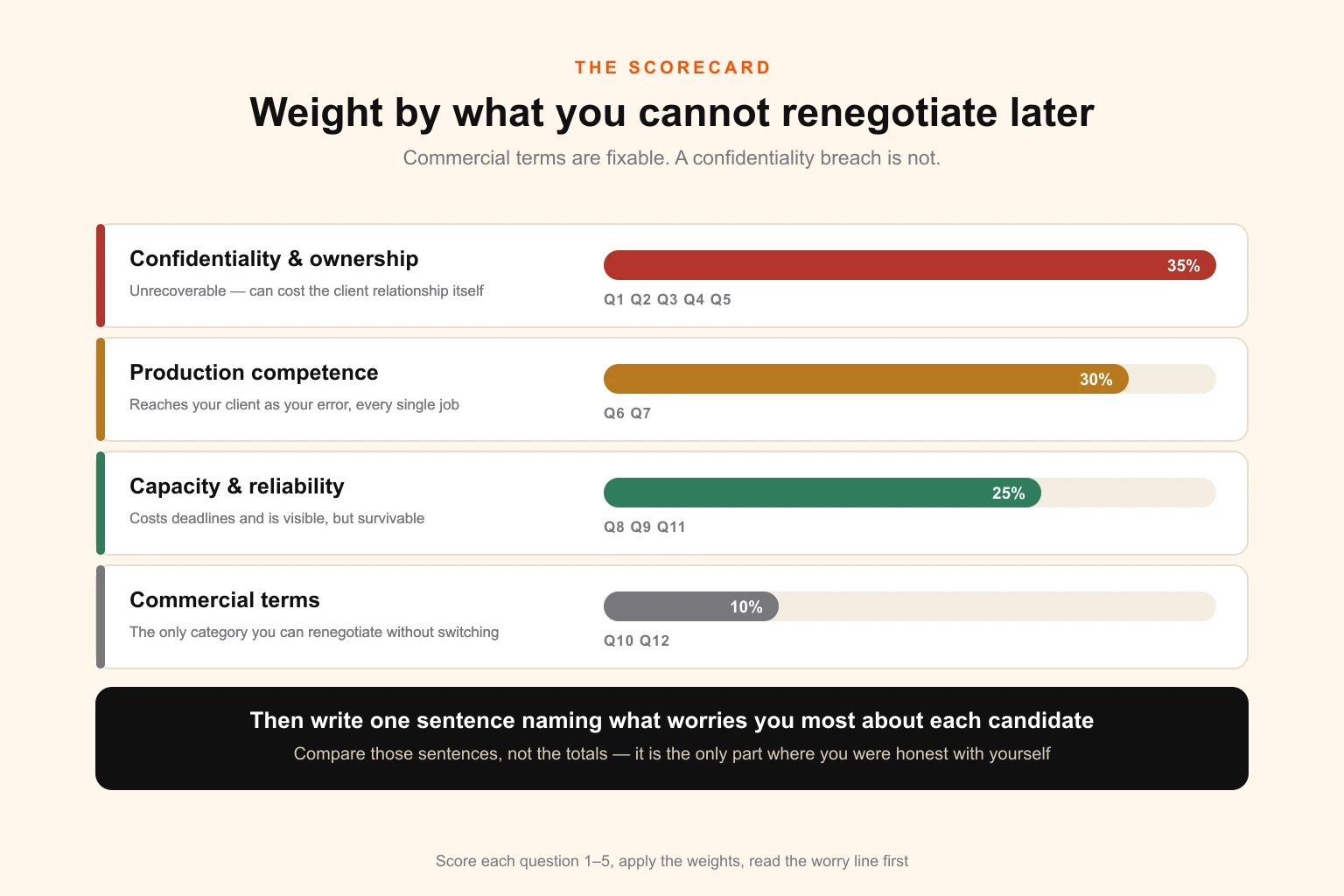
Score every candidate on the same sheet, and weight the categories by how recoverable a failure in each would be. Commercial terms are renegotiable, so they are worth least. A confidentiality breach is not, so it is worth most.
| Category | Questions | Weight | Why this weight |
|---|---|---|---|
| Confidentiality and ownership | 1, 2, 3, 4, 5 | 35% | Failures here are unrecoverable and can cost the client relationship itself |
| Production competence | 6, 7 | 30% | Failures reach your client as your errors, and cost internal correction time on every job |
| Capacity and reliability | 8, 9, 11 | 25% | Failures cost deadlines and are visible to your client, but are survivable |
| Commercial terms | 10, 12 | 10% | The only category you can renegotiate later without changing partner |
Score each question one to five, apply the weights, and then do the thing that matters more than the arithmetic: write one sentence naming the thing about each candidate that worries you most. Compare those sentences rather than the totals. In practice that line predicts the relationship better than any score, because it is the only part of the exercise where you were being honest with yourself rather than filling in a grid.
A candidate scoring 4.1 whose worry line reads "vague about who actually does the work" is a worse bet than one scoring 3.6 whose worry line reads "time zone means an extra day on every round trip." The first is a category-one risk you have scored politely. The second is a logistics cost you can plan around.
What to measure once you are live
Vetting does not end at signature; it becomes monitoring, and four numbers do almost all the work.
First-pass acceptance rate. The share of jobs your client approves without your team correcting anything first. This is the single best health measure of a design partnership and the earliest to move. A partner drifting from 85% to 60% over a quarter is a partner whose team has changed.
Internal touch time per asset. Minutes your own people spend briefing, checking and fixing per delivered asset. This one is insidious because it rises invisibly — your team quietly starts pre-checking work it used to trust, and the cost appears in your payroll rather than in the partner's invoice.
Turnaround variance, not average. Track the spread, and specifically the ninety-fifth percentile. Averages stay flat while reliability collapses, because a partner who delivers most jobs early and two jobs catastrophically late has a fine average and an unusable service.
Escalation response time. Minutes to a human response when you flag something urgent. This measures whether you have a partner or a queue.
Review all four monthly, and treat two consecutive months of drift in any of them as a conversation rather than a crisis. Most partnerships that end badly showed up in one of these numbers a quarter before anyone discussed it. It is also worth running a periodic brand audit across the work coming back, because consistency drift across a set of assets is easier to see in aggregate than job by job, and brand guidelines documentation is what makes that drift measurable rather than a matter of taste. Keep your own register of every asset the partner has produced as it arrives, in the same form as a rebrand asset inventory — it is the document that makes both the quarterly audit and any eventual exit a clerical exercise rather than an archaeology project.
Eight mistakes resellers make when vetting
Evaluating the portfolio and calling it vetting. A portfolio shows the best output of the best designer on the best brief. It tells you the ceiling and nothing about the floor, and the floor is what you will be reselling on an average week.
Interviewing the salesperson. The person who wins your account is frequently not the person who runs it. Insist on ten minutes with whoever would actually lead the work, and treat inability to produce that person as an answer to question one.
Taking the free pilot. It costs nothing and tells you nothing, because it is unrepresentative in both directions — better staffed than your real work and drawn from a self-selecting pool.
Skipping the file inspection. Twenty minutes with the document properties, layers panel and metadata of one real deliverable will tell you more than the entire call. Almost nobody does it.
Choosing on rate. The rate is one input into cost per delivered asset. A partner whose files need an hour of internal correction per job is more expensive at every rate.
Assuming your NDA covers the individuals. Most templates bind only the signing entity. Without a flow-down clause, the designer's personal portfolio is entirely unaddressed.
Assuming licensing is handled. Both parties commonly believe the other procured the font. The letter arrives at whoever invoiced the client.
Vetting once. Teams change, leads leave, delivery processes drift, and a partner who scrubbed metadata reliably in year one may not in year three. Re-run the file inspection and the four metrics quarterly. It takes an hour.
Next steps
If you are at the start of this, the sequence that costs least is:
- Write down your own numbers first — median weekly volume, peak week, production methods, the turnaround you have already promised clients. Vetting without these is guesswork.
- Screen candidates on paper against questions 1, 2, 4 and 5. Most will fail one of them, and it costs you twenty minutes to find out.
- Run the structured call with all twelve questions, in order, and note the shape of each answer rather than only the content.
- Two reference calls, three questions each, reseller references rather than end clients.
- One paid pilot, built with the six properties above, on a real job with a real deadline.
- Inspect the pilot files yourself — metadata, layers, editability, production readiness.
- Score the sheet, write the worry line, and read the worry line first.
If it would be useful to run these twelve questions against a partner rather than read about them, that is a conversation we are happy to have from the other side of the table — how our white-label design partnership works sets out our own answers to most of them, and the plans and pricing are public rather than quoted per enquiry. Resellers usually find the vertical pages more directly useful than the general one: marketing agencies, printers, sign shops, screen print shops, sticker manufacturers, vehicle wrap makers, pin and badge makers and freelance designers scaling past their own capacity.
And if you are earlier than partner selection — still deciding whether to resell design at all — how to resell graphic design services and the best options for agencies and resellers are the two to read before this one becomes relevant. If you are shortlisting rather than deciding, how to compare graphic design companies covers the general market, and we have published our own answers where they can be checked against a competitor's: DigitalPolo versus ManyPixels and an honest review of our own service, which exists partly so the twelve questions above can be asked of us with the answers already written down.