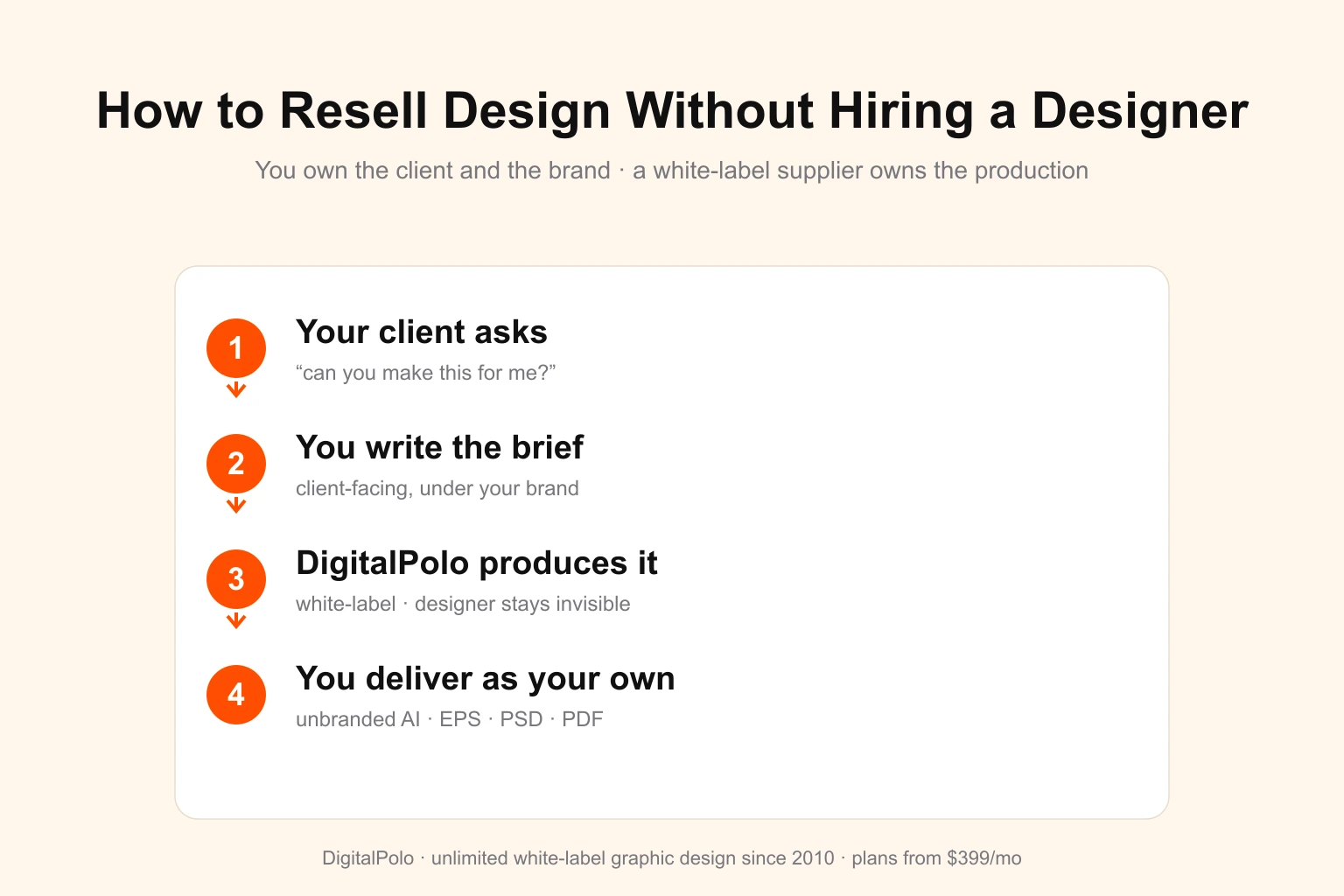
Plenty of people can sell design work without being able to produce it. They have the client relationships, the sales skills, or an existing audience that already asks them "can you make this for me?" — what they don't have is a designer, and they don't want the cost, hiring risk, or management overhead of building a studio just to say yes. Reselling design solves exactly that gap: you own the client and the brand, a white-label supplier owns the production, and the margin in between is your business.
This is the practical playbook for doing it properly — the difference between white-label and referral models, the seven steps to set up a reselling operation, the margin math that actually works, and how to brief on a client's behalf without becoming the bottleneck. None of it requires you to open a design tool.
DigitalPolo has been delivering unlimited graphic design since 2010 — one of the oldest services in the category — with plans from $399/month, 48-hour turnaround, unlimited revisions, and print-ready vector source files (AI, EPS, PDF) included as standard. For resellers, the detail that matters most is that white-label and reseller use is permitted on both plans with no per-client surcharge: the files arrive unbranded, the designer never contacts your end client, and you deliver the work as your own.
Why Reselling Design Is a Real Business Model, Not a Side-Hustle Myth
Reselling has a credibility problem because the internet is full of people pitching it as passive income. It isn't passive — you still have to win clients and manage the relationship. But the underlying model is sound and old. Marketing agencies have resold design for decades; they rarely employ enough in-house designers to cover demand, so they route overflow to contractors and white-label partners and bill it as their own. Print shops do the same when a customer needs artwork they can't produce. The only thing that has changed is that flat-fee unlimited subscriptions made the supply side cheap and predictable enough that a single operator — not just an agency — can run the model.
The economics work because design demand is lumpy and recurring at the same time. A small business needs a logo once, then a steady drip of social graphics, ads, flyers and decks forever after. Hiring a designer to cover that is expensive and often underused; buying it per project is slow and unpredictable. A reseller sitting between the client and a flat-fee supplier absorbs that lumpiness — your supply cost is fixed, your client billing is recurring, and the spread is your margin. The supplier carries the production risk; you carry the relationship.
What you are actually selling is not pixels. It is reliability, a single point of contact, and the client never having to manage a designer. That is a real service, and it is the part you keep even though you don't draw anything yourself.
The Two Ways to Resell Design — and Why White-Label Wins
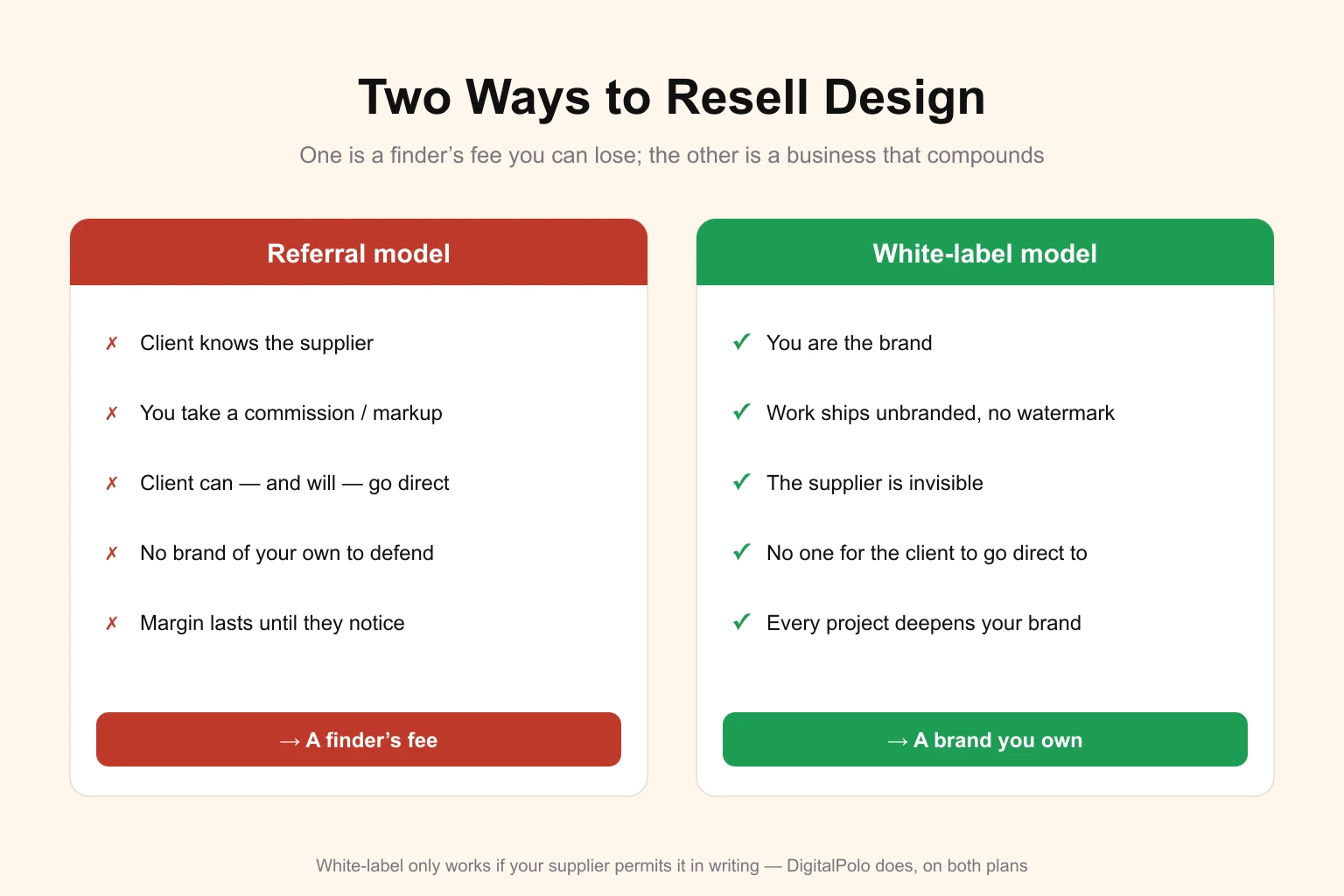
There are two structures, and the difference decides whether you have a business or a finder's fee.
The referral model. You introduce the client to a design provider and take a commission or markup, but the client knows who is doing the work. This is simple and low-commitment, but it is fragile: the client can — and eventually will — go direct, and you have no brand of your own to defend. Your margin exists only as long as the client doesn't notice they could cut you out.
The white-label model. You are the brand. The client deals only with you, the work is delivered unbranded, and the supplier is invisible. The client has no one to go direct to because, as far as they know, you are the studio. This is the model that compounds — every project deepens your relationship and your brand rather than advertising your supplier's.
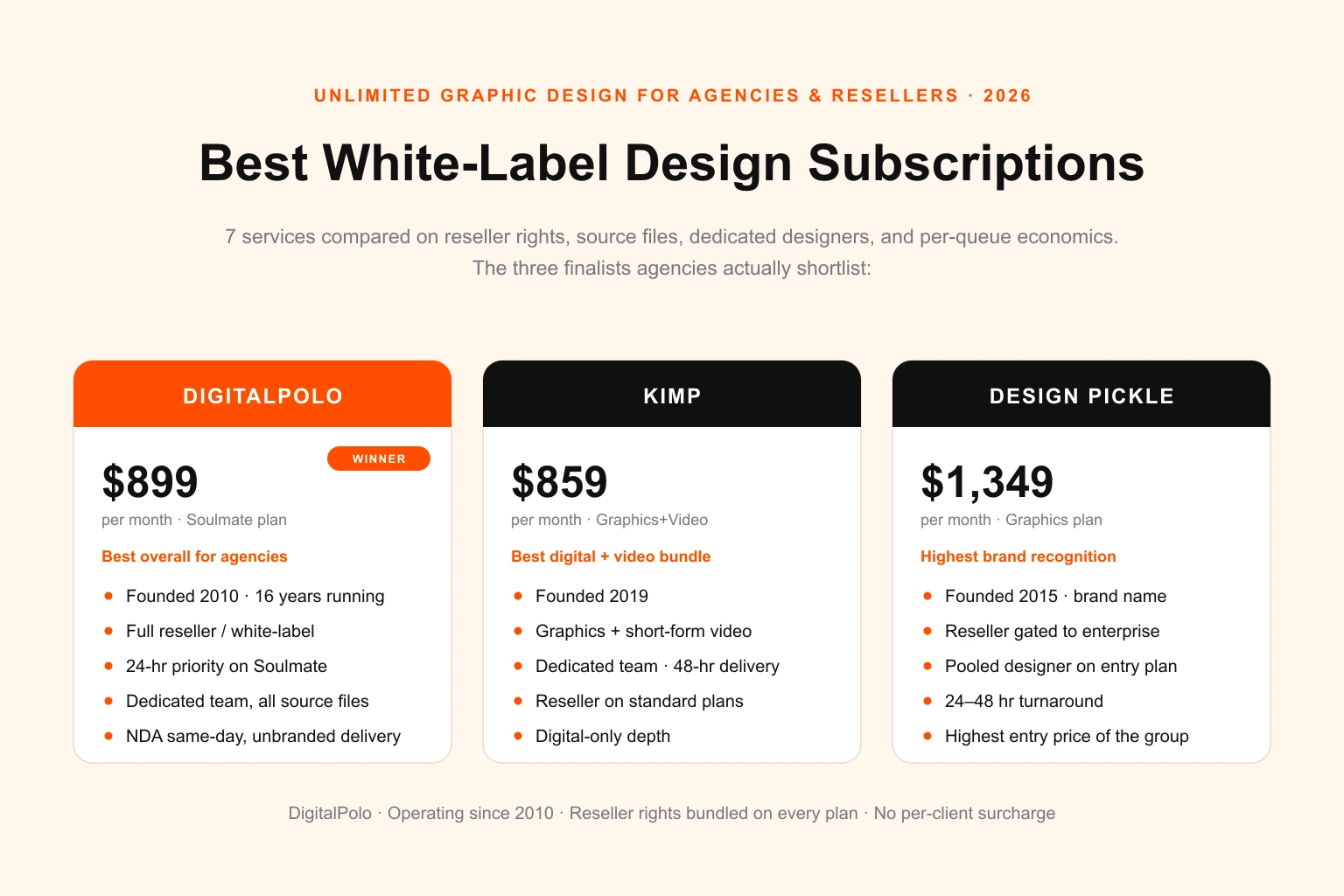
White-label only works if your supplier permits it in writing. This is the single most important thing to verify before you take a paying client. The provider's terms must allow reseller use, the deliverables must ship with no vendor watermark or attribution, the designer must not contact your end client, and the supplier should sign an NDA on request. DigitalPolo allows full white-label and reseller use on both plans with no surcharge and signs same-day NDAs — which is why it sits at the centre of this playbook. If you want the full vendor-by-vendor breakdown of who actually permits this, our comparison of the best unlimited graphic design for agencies and resellers weighs the reseller terms of seven services side by side.
How to Resell Graphic Design Services: The 7-Step Playbook
1. Pick a niche, not "design for everyone." Resellers who win choose a vertical — real estate agents, restaurants, e-commerce brands, local trades, coaches. A niche lets you templatise your briefs, speak the client's language, and charge a premium for being a specialist rather than a generic middleman.
2. Subscribe to a reseller-friendly supplier. Start on a plan sized to your expected volume. DigitalPolo's Partner plan at $399/month is the lowest-cost entry for a reseller validating demand; move to the Soulmate plan at $899/month once you have two or more active clients, because the dedicated team and 24-hour priority delivery protect your turnaround promises.
3. Build a thin front-end brand. A one-page site, a portfolio (use your own past work or supplier-produced samples you commissioned), a price list, and an intake form. You are selling trust and ease, so the brand needs to look like a real studio — which, operationally, it now is. DigitalPolo's white-label graphic design service is built for exactly this hand-off.
4. Sell outcomes, not hours. Price in packages or monthly retainers, never hourly — your supply cost is flat, so hourly billing caps your margin for no reason. Sell "your brand's social graphics, done, every week" or "unlimited design for your business, one flat fee."
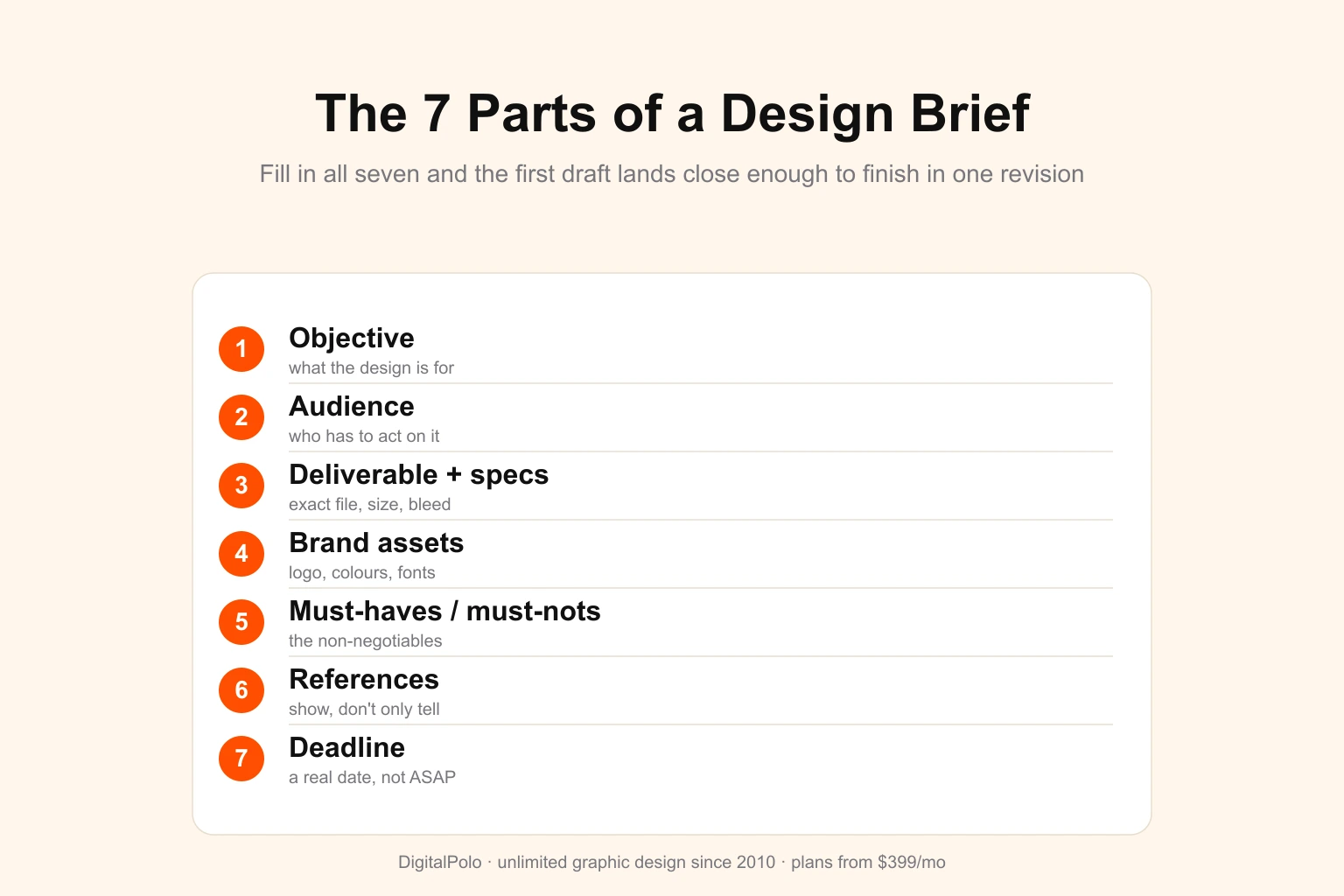
5. Become the briefing layer. Your real job is translating a client's vague request into a clear, production-ready brief your supplier can execute first time. This is the skill that earns your margin; get good at it and your revision rounds collapse. Our guide on how to write a graphic design brief is the exact framework to standardise this.
6. Run one queue, route everything through it. Collect client requests, send them to your supplier, receive unbranded source files, deliver under your brand. Unlimited subscriptions process tasks one (or a few) at a time, so you batch and sequence requests — exactly the workflow covered in how unlimited graphic design works.
7. Add clients until the queue is full, then add a queue. One subscription handles a finite throughput. When turnaround starts slipping, you don't hire — you add a second queue. Your scaling cost is a known, fixed number, which is the entire advantage of this model.
What to Charge: Reseller Margin Math
The model only makes sense if the spread between your fixed supply cost and your recurring client billing is healthy. Here is the shape of it on a single DigitalPolo Soulmate queue at $899/month:
| Scenario | Supply cost | Client billing | Gross margin |
|---|---|---|---|
| 1 retainer client | $899/mo (Soulmate) | $1,500/mo | ~40% |
| 2 retainer clients | $899/mo (shared queue) | $1,500 + $1,200 = $2,700/mo | ~67% |
| 3 small clients | $899/mo (shared queue) | 3 × $850 = $2,550/mo | ~65% |
| Project-based (per client) | $399/mo (Partner) | $600–$1,200 per project | varies |
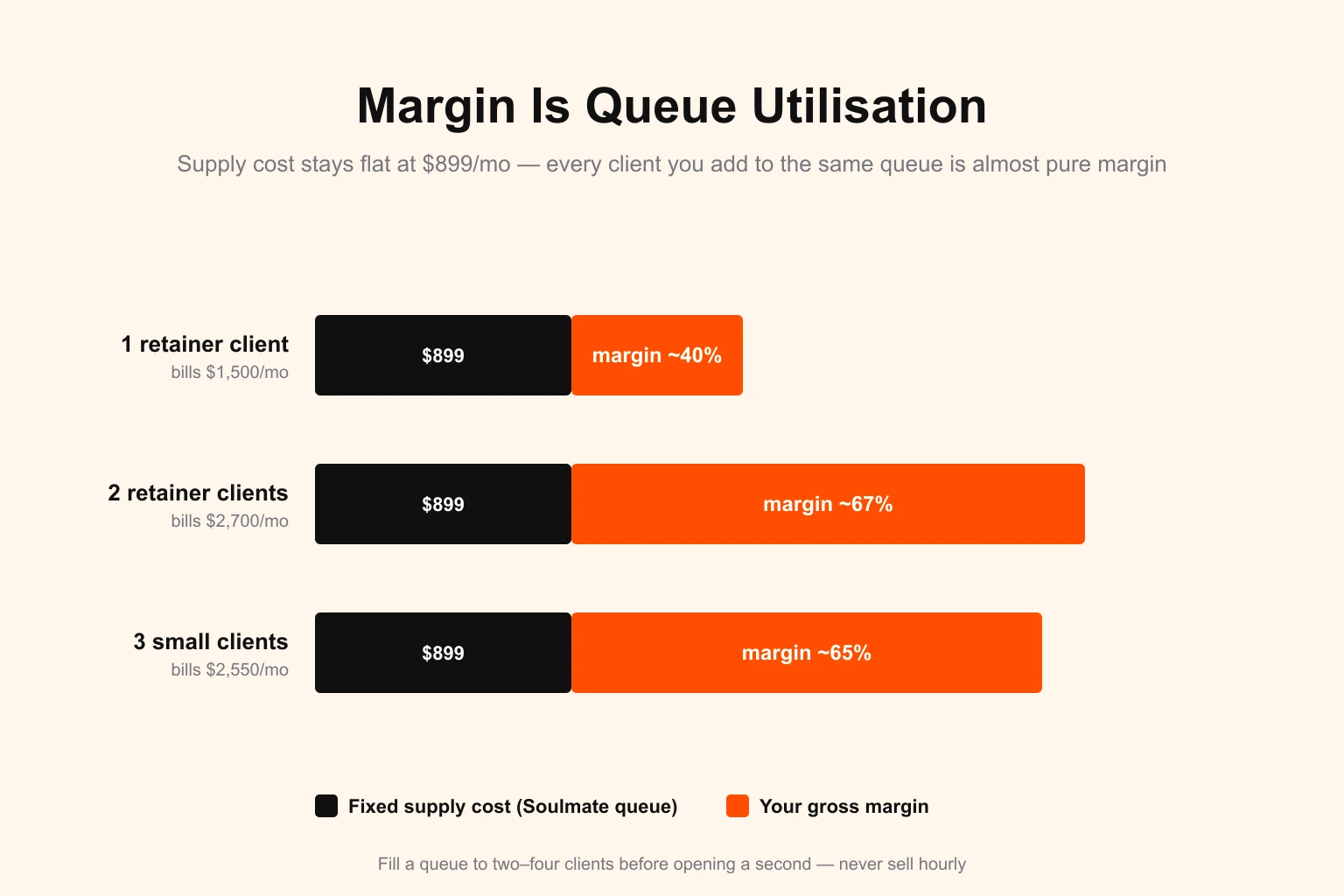
The lever is queue utilisation. One client on a Soulmate queue is thin margin; the moment you put a second client on the same flat-fee queue, your supply cost doesn't move and your margin jumps. The discipline is to fill a queue to a sensible throughput ceiling — usually two to four small retainer clients — before opening a second one, so every queue you pay for is earning. This is the same per-queue economics agencies run, and it is why print shops and studios layer reselling on top of their existing work: the marginal cost of the next client's design is close to zero until the queue is full. (Print shops in particular fit this perfectly — see unlimited graphic design for print shops.)
Two rules keep the math honest. First, never sell hourly — it converts a fixed cost into a capped revenue line. Second, price for revisions you don't pay for. Because the subscription includes unlimited revisions, a revision-heavy client costs you nothing extra but lets you charge a premium for "unlimited changes" — one of the easiest upsells in the model.
Who Is Design Reselling Best For?
Marketing and social media agencies are the natural fit. They already own client relationships and sell adjacent services; design is overflow they currently turn away or sub out inefficiently. A white-label queue lets them say yes to every design ask without a single hire. The dedicated-team option for marketing agencies is built around this.
Freelancers and solo marketers — copywriters, web developers, consultants, virtual assistants — can bolt design onto an existing client base immediately. You already have the trust; the subscription supplies the production. If you're a designer yourself who has hit a capacity ceiling, reselling overflow is how you grow past your own hours — covered from the maker's side in our notes for freelance designers.
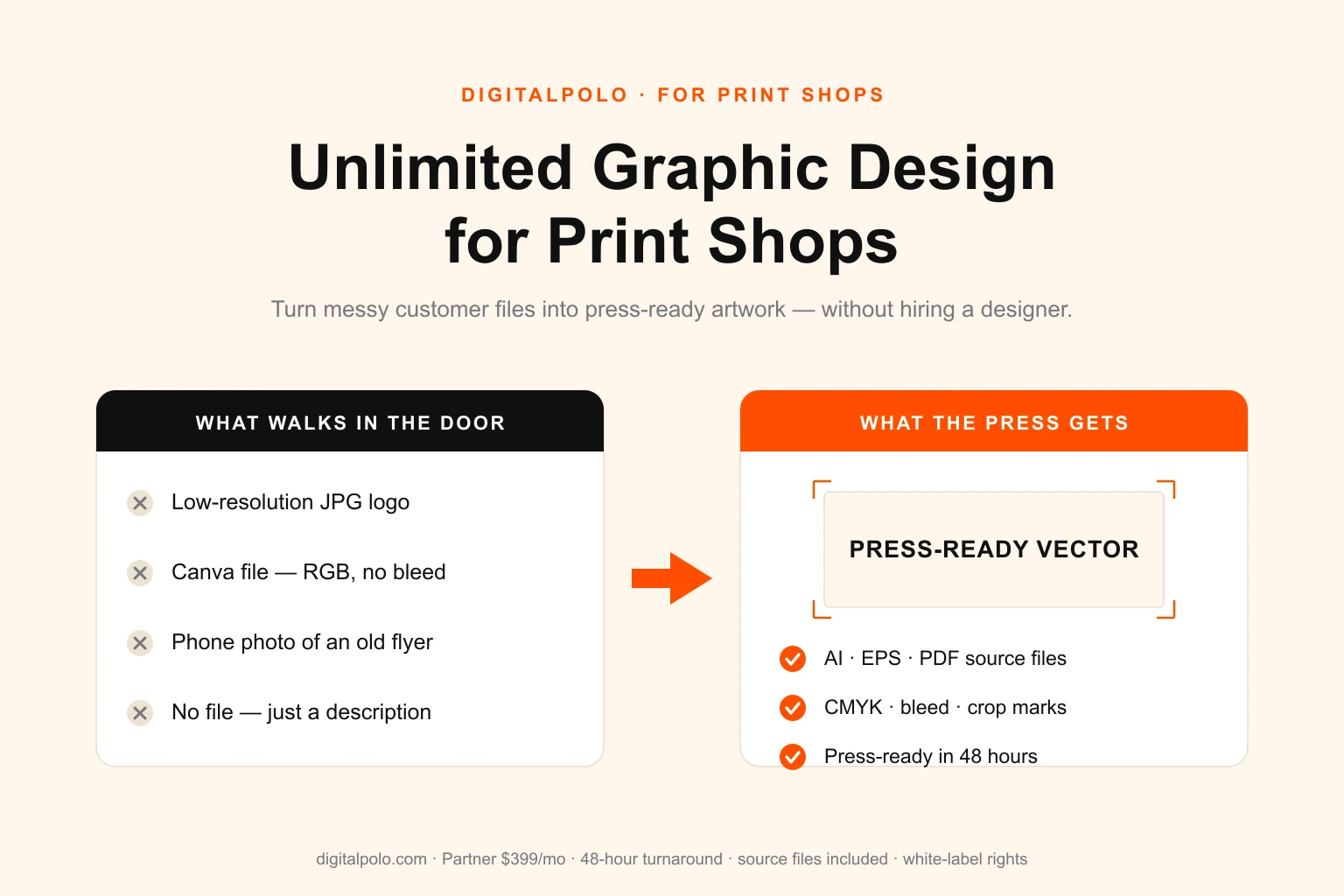
Print shops, sign shops and promotional product businesses resell design constantly, often without calling it that. A customer needs artwork before you can print it; rather than turning the job away or doing it badly in-house, you route the design to a white-label partner and bill it into the print order.
Who it's not for: anyone unwilling to own client communication. Reselling removes the design work, not the relationship work. If you don't want to handle sales, briefs and feedback, this is not a passive income stream — it's a service business with the production outsourced.
How to Brief on Behalf of a Client Without Becoming the Bottleneck
The one place a reseller can break the model is the brief. If you simply forward a client's "make me a flyer" to your supplier, you'll burn revision rounds, slow turnaround, and look amateurish to both sides. The fix is to make briefing your core competency.
Collect a reusable intake from every client once — logo files, brand colours and fonts, tone, target audience, and any do-not-use rules — and store it as a standing brand reference your supplier keeps on file. Then each individual request only needs the specifics: the asset, the size, the copy, the deadline, and one line of context. A reseller who briefs cleanly gets first-time-right work and fast turnarounds; a reseller who briefs lazily creates a revision spiral they then have to manage. The full structure is in how to write a graphic design brief, and standardising it is the difference between a queue that runs smoothly and one that constantly stalls.
Stay the single point of contact in both directions. The client never talks to the designer; the designer never talks to the client. You collect feedback, translate it into a revision request, and deliver the result. That intermediary position is your business — protect it.
DigitalPolo Plans and Pricing
| Plan | Price | Turnaround | Includes | Best for resellers |
|---|---|---|---|---|
| Partner | $399/month | 48 hours | Unlimited tasks, unlimited revisions, all source files, white-label use | Validating demand, one or two project-based clients |
| Soulmate | $899/month | 24 hours (priority) | Dedicated team, 24×7 support, all source files, white-label use | Running multiple retainer clients on one queue |
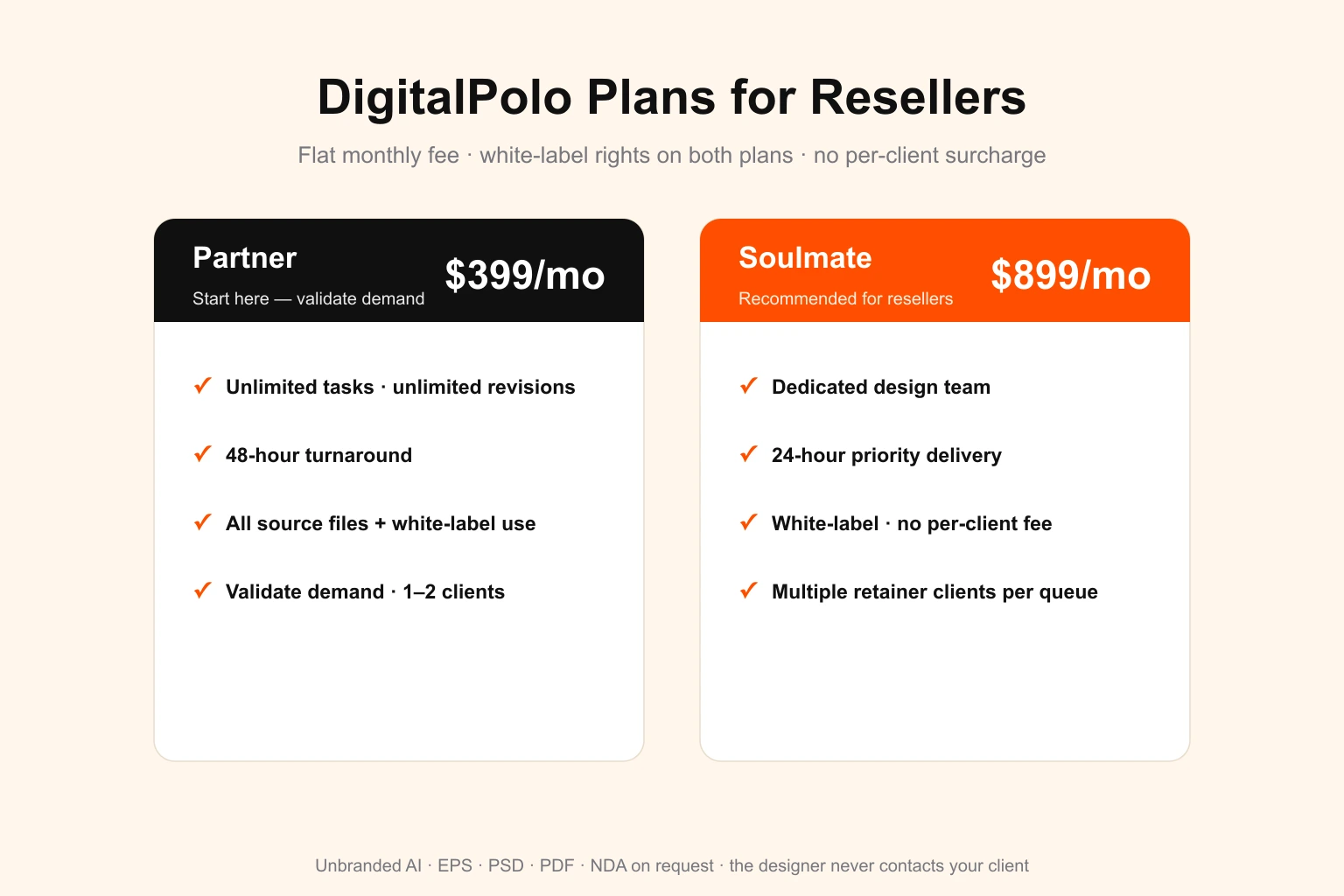
Both plans include delivery of all source files — vector formats (AI, EPS, PDF) plus layered PSD and editable formats — and both explicitly permit white-label and reseller use with no per-client surcharge. For a reseller, the Soulmate plan's dedicated team is the meaningful upgrade: continuity matters when the same client's brand runs through your queue month after month, and a dedicated team means you aren't re-explaining brand guidelines on every task.
Verdict: Sell the Relationship, Outsource the Pixels
Reselling design works because it splits a business cleanly down its natural seam. The hard, valuable, defensible part — owning the client, understanding their brand, and being the reliable single point of contact — stays with you. The capital-intensive, hire-and-manage part — actually producing the artwork — moves to a supplier whose flat fee makes your costs predictable and your margin a matter of queue utilisation rather than labour.
For most resellers the right setup is a single DigitalPolo Soulmate queue at $899/month, filled to two to four retainer clients, with white-label delivery and unlimited revisions priced into every package. It is the lowest-risk way to run a design business without being a designer: no salaries, no software, no recruiting — just a fixed supply cost, a brand of your own, and the margin in between. Start on Partner to prove the demand, move to Soulmate when the queue fills, and add a second queue only when the first one is paying for itself.
Frequently Asked Questions
Can you resell graphic design services?
Yes. Reselling design means you take design work from your own clients, fulfil it through a white-label provider, and deliver it under your own brand. It is a legitimate and common business model — agencies, marketers and freelancers have done it for years. The key requirement is a supplier whose terms explicitly permit white-label and reseller use, such as DigitalPolo, which allows it on both plans with no surcharge.
How do I start a graphic design business without being a designer?
Subscribe to a reseller-friendly unlimited design service, position yourself as the client-facing brand, and route every request to your supplier for fulfilment. You handle sales, briefs and client communication; the supplier produces unbranded source files you deliver as your own. DigitalPolo's Partner plan ($399/month) is the lowest-cost starting point for this; the Soulmate plan ($899/month) suits higher client volume.
Is white-label graphic design legal?
Yes, when your supplier's terms permit it. White-label simply means the work ships with no vendor branding, watermark or attribution, so you can present it as your own. DigitalPolo explicitly allows white-label and reseller use and signs NDAs on request. Always confirm the current terms of any provider before reselling — reputable services state their reseller policy plainly.
How much can you make reselling graphic design services?
Margin comes from the gap between a flat monthly supply cost and what you bill clients. A single DigitalPolo Soulmate queue at $899/month can support several small retainer clients billed at $750 to $2,500 each per month, depending on volume. Resellers commonly run gross margins of 50 to 70 percent once they have two or more active clients on one queue.
Does DigitalPolo allow reselling and white-label use?
Yes. DigitalPolo explicitly permits agency and white-label use on both the Partner ($399/month) and Soulmate ($899/month) plans, with no per-client surcharge. Files are delivered unbranded with all source formats (AI, EPS, PSD, PDF), the designer never contacts your end client, and DigitalPolo signs NDAs on request. The Soulmate plan suits resellers best because of its dedicated team and higher throughput.
What is the best unlimited design service for resellers?
For most resellers, DigitalPolo's Soulmate plan at $899/month is the strongest fit — dedicated design team, 24-hour priority delivery, unlimited revisions, all source files, and explicit white-label rights with no per-client fees. DigitalPolo has operated since 2010, longer than Design Pickle, Kimp or ManyPixels, which matters when you are staking your own brand on a supplier's reliability.
How do you handle client revisions when reselling design?
Pass them straight through. Because reseller-friendly subscriptions include unlimited revisions, you can run as many rounds as your client needs without extra cost. You stay the single point of contact: collect the client's feedback, relay it to your supplier as a revision request, and deliver the updated files back under your brand. The unlimited model means revision-heavy clients never erode your margin.
Ready to Build a Design Business Without Hiring Designers?
DigitalPolo's white-label plans let you resell unlimited design under your own brand — unbranded source files (AI, EPS, PSD, PDF), unlimited revisions, NDA on request, and no per-client fees. Partner from $399/month to validate demand; Soulmate at $899/month for multi-client volume.