There is one department in your shop that has never been metered.
The press has a running rate. The cutter has a rate. The laminator, the embroidery head, the wide-format roll, the finishing table — every one of them has a number attached, and you know within a few dollars what an hour of each one costs you and what it earns. Then a customer asks whether you can "just tidy up the logo" and forty minutes disappear into a machine with no meter on it at all.
Do that eight times a week and you have given away a third of a designer's year. At a defensible rate that is somewhere north of USD 25,000 of unbilled labour, and it does not show up anywhere in your accounts, because unbilled work never does. It shows up as an art department that is always behind, a press that waits on files, and a nagging sense that the shop is busier than it is profitable.
The reason this happens is not softness. It is that almost nobody has ever told print shop owners how to price design, because the entire literature on design pricing was written for freelancers selling to end clients. Search for what to charge and you get hourly-rate surveys, an agency pricing directory quoting USD 100–149 an hour for print design firms, a handful of cost guides spanning USD 25–150, and a very long Reddit thread. None of it answers the actual question, which is not what do designers charge but what should a production business charge for an internal service that also has to sell press time.
That is a different problem with different arithmetic. Your art department is not a profit centre standing alone — it is a gate in front of the press, and pricing it as though it were a freelance studio will lose you print work, while pricing it at zero will bankrupt the gate.
This is the system: what an art hour genuinely costs you, the four pricing models and precisely what each one does to margin, a rate card you can adopt on Monday, the five states a customer file arrives in and what to charge for each, the exact threshold at which waiving design against a print order stops paying, the policy language that makes it stick, and the five numbers that tell you whether any of it is working.
The number every other number depends on
Before you can decide what to charge, you have to know what an art hour costs. Almost every shop that thinks it knows this is using the wrong figure, and the wrong figure is wrong by a factor of about three.
Here is the build-up, with a designer on a USD 52,000 salary. Substitute your own numbers as you go — the structure matters far more than my assumptions.
| Step | Calculation | Result |
|---|---|---|
| Base salary | — | $52,000 |
| Payroll burden (taxes, insurance, benefits) at 25% | $52,000 × 1.25 | $65,000 |
| Overhead allocation (workstation, software, floor space, admin share) | + $9,000 | $74,000 fully loaded |
| Gross hours | 40 × 52 | 2,080 |
| Less holiday, PTO, sick | − 160 | 1,920 |
| Less meetings, training, admin (10%) | − 190 | 1,730 available hours |
| Chargeable utilisation at 62% | 1,730 × 0.62 | 1,073 chargeable hours |
Now the three numbers, in ascending order of truth:
- $25.00/hr — salary ÷ 2,080. The number most shops have in their head. It is not a cost, it is a payroll line.
- $42.77/hr — loaded cost ÷ available hours. Closer, and still wrong, because it assumes every available hour is sold.
- $68.97/hr — loaded cost ÷ chargeable hours. This is your break-even art rate.
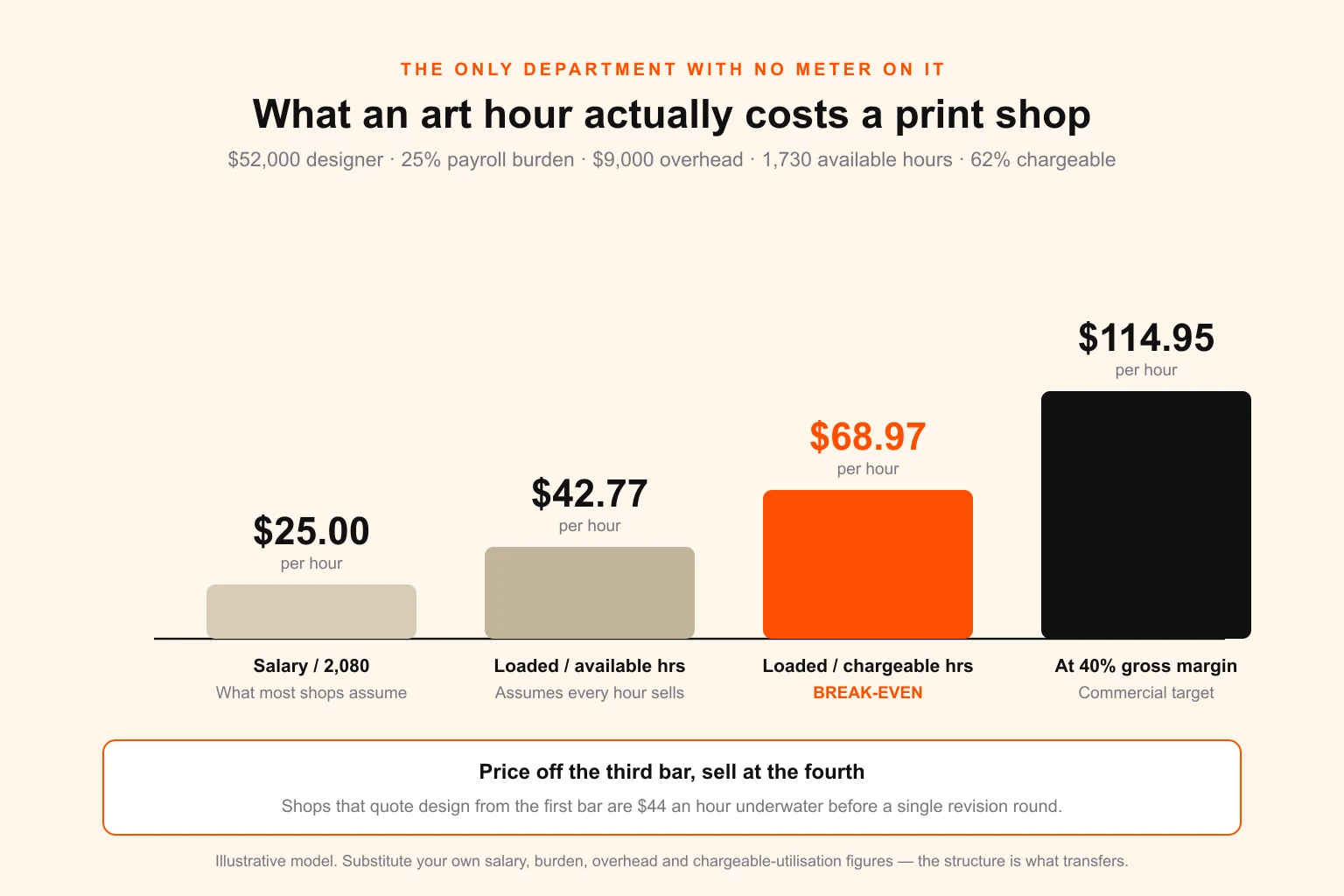
That utilisation figure is where the money hides. An art department does not spend its day designing. It spends it preflighting customer files, answering the estimator's questions, sitting with a press operator over a colour problem, re-exporting a PDF because someone changed the substrate, and quoting work that never lands. Sixty-two per cent chargeable is a realistic, well-run number. If yours is genuinely 80 per cent, your break-even drops to USD 53. If it is 45 per cent — common in shops where the designer is also the counter person — it rises to USD 95.
Break-even is not a price. To earn the same gross margin from art that you expect from the press:
| Target gross margin | Required rate | Where this sits |
|---|---|---|
| 0% (break-even) | $69/hr | Losing money after sales cost |
| 30% | $99/hr | Thin, viable for volume shops |
| 40% | $115/hr | Sensible commercial target |
| 50% | $138/hr | Specialist, design-led shops |
Which lands your art rate in the USD 95–125 band for most commercial shops, with a defensible published rate of USD 95, 110 or 125 depending on your market and the complexity of the work. Notice that this is not a bold number. It sits below the USD 100–149 that print design agencies charge, and comfortably inside the USD 85–125 that shops charging properly already bill for intermediate work. The shops that feel this figure is outrageous are the ones comparing it to USD 25.
Run this once, with your own salary, burden and utilisation figures, before reading further. Every recommendation below is calibrated to a break-even near USD 69. If yours is USD 95, every number in the rate card moves with it.
The four pricing models, and what each one does to margin
There are only four ways to charge for design in a print shop. Most shops are running one by accident.
Model 1 — Bundled (design "included" with print)
Design is free, absorbed into the print price. The stated logic is that it wins jobs and simplifies quoting.
What it actually does is remove the meter. Art consumption becomes a function of customer behaviour rather than job value, which means your most demanding and least profitable customers consume the most art. It is not a discount strategy — a discount has a size. This is an open bar.
The tell is that you cannot answer the question "how many art hours went into that job?" for any job in the last month.
Use it for: never as a default. Only as a rule-based waiver on top of Model 2 or 3, which is a different thing entirely and is covered below.
Model 2 — Hourly art charge
A published rate, billed in increments, against a minimum.
Honest and flexible, and it prices complexity automatically. Its two weaknesses are that it invites customers to audit your speed — the faster your designer, the less you earn, which is a perverse incentive — and that it makes quoting slower because someone has to estimate hours on every ticket.
Use it for: open-ended work, file rescue, anything genuinely unpredictable, and as the fallback rate behind every flat price.
Model 3 — Flat rate by job type
A published price per deliverable: business card layout USD 95, tri-fold USD 450, and so on.
This is the strongest model for the bulk of a commercial shop's work, for reasons that have nothing to do with the number. It is quotable by anyone at the counter without a designer's input, it removes the speed penalty (efficiency becomes margin, as it should), and it converts a negotiation about your labour into a transaction about a deliverable. Customers argue about hourly rates. They rarely argue about a menu.
Its weakness is scope creep, which is why every flat rate needs a defined inclusion — what it covers, how many rounds, and what pushes the job to hourly.
Use it for: every repeatable deliverable you produce more than twice a month.
Model 4 — Tiered art charge
Three fixed tiers keyed to the state of what the customer supplies: print-ready (no charge), file preparation (fixed fee), original design (flat or hourly).
This is the model most screen printers and wide-format shops eventually invent for themselves, usually after a year of losing money on "customer-supplied" work. Its virtue is that it prices the thing that actually drives your cost, which is not the deliverable but the gap between what arrived and what the press needs.
Use it for: apparel, signage, stickers, labels — any department where a majority of jobs arrive with some form of customer artwork attached.
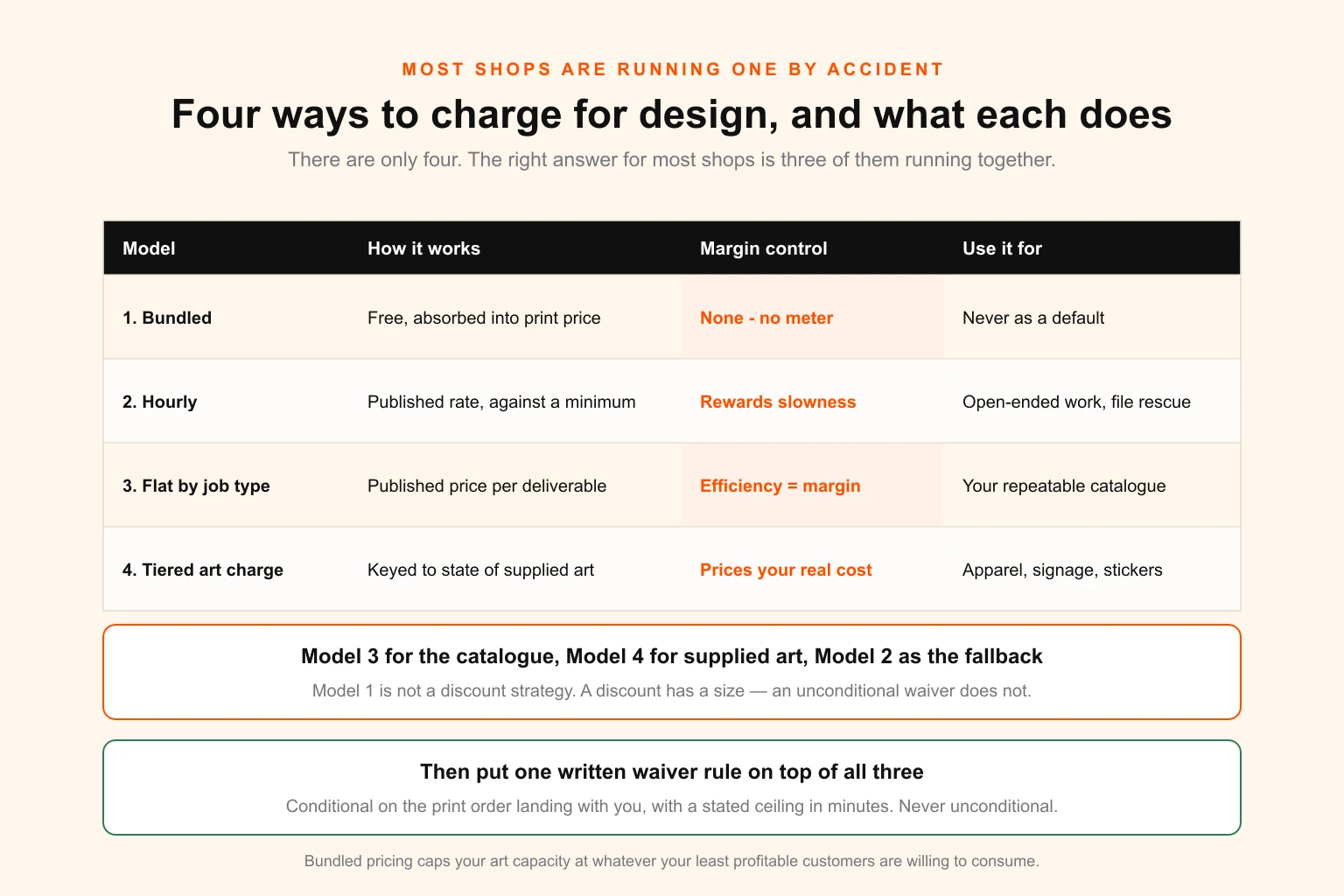
The right answer for most shops is not one model. It is Model 3 for your repeatable catalogue, Model 4 for customer-supplied work, and Model 2 as the published fallback for everything else — with a written waiver rule sitting on top of all three.
Art charge is not setup charge, and the confusion is expensive
Before the rate card, one distinction that causes more pricing damage than any other single mistake.
An art charge buys creative and file-preparation labour. A setup charge buys production make-ready. They pay for different departments, different equipment and different people, and folding them into one line breaks in both directions.
| Art charge | Setup / make-ready charge | |
|---|---|---|
| What it pays for | Layout, typesetting, separation, vectorising, dieline work, proofs | Burning screens, plates, RIP and cut-file setup, registration, test strike |
| Department | Prepress / design | Press |
| Customer supplies perfect art | Not charged | Still charged |
| Customer supplies nothing | Charged in full | Charged in full |
| Repeat order, same art | Not charged | Reduced or waived if screens/plates retained |
| Typical structure | Hourly or flat by job type | Per screen, per plate, per colour, per cut file |
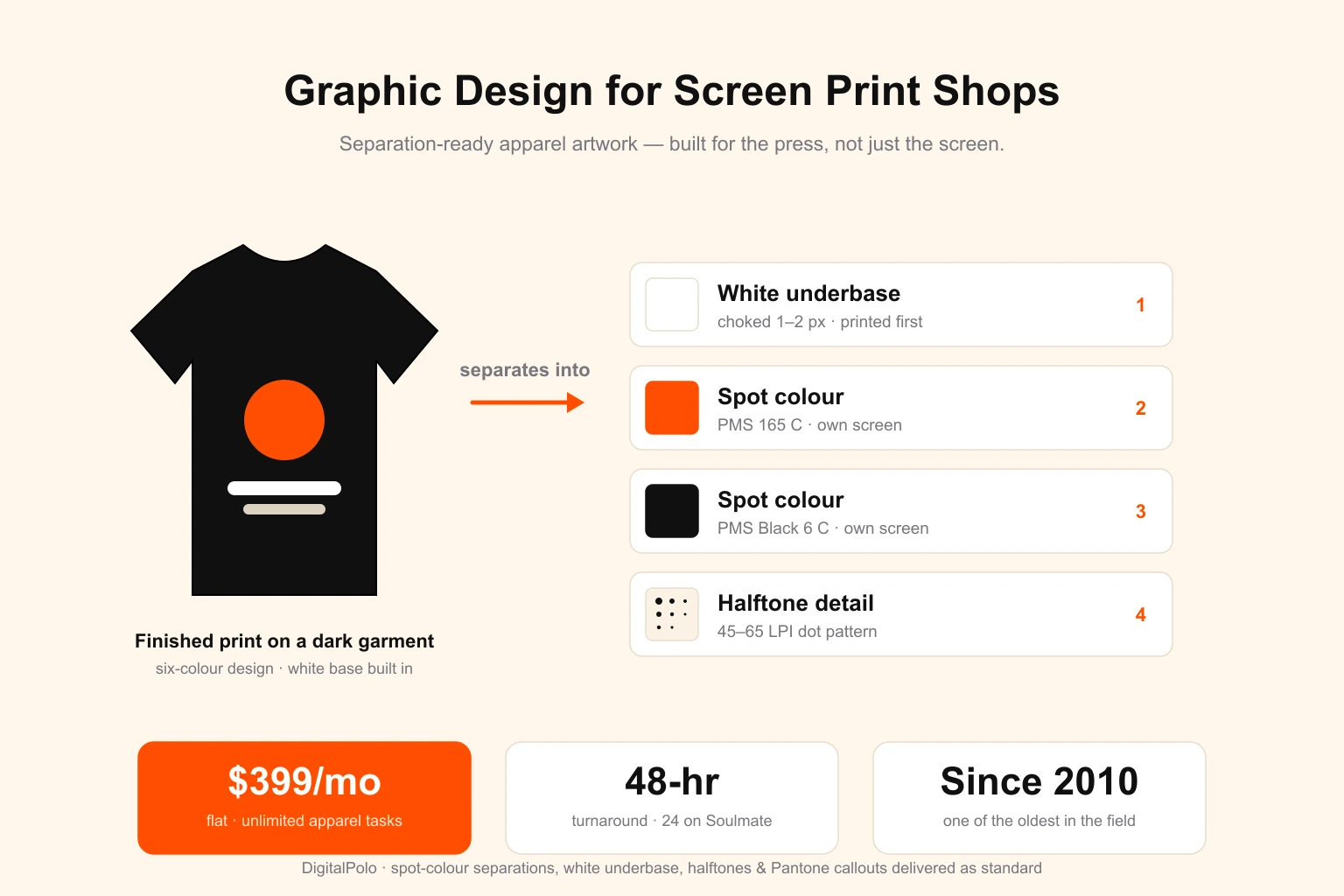
The apparel trade shows this most clearly. A screen charge of USD 20–35 per screen per colour is make-ready — it pays for burning, mounting and registering, and it is owed on a four-colour job whether the customer sent flawless separations or a scribble. The colour separation work itself is art, and it is owed only when your art department does it.
Merge them and you get one of two failures. Either the screen charge quietly absorbs unlimited separation work, in which case complex jobs bleed margin, or the customer who supplied perfect separations pays a design fee they did not incur and starts shopping. Two lines on the quote solves both.
The same split runs through every department: plate charges in offset, RIP and contour cut-file setup in wide format, die and tooling charges in packaging, and cutter setup in sticker production. In every case the question to ask is: would this cost still exist if the customer had supplied a perfect file? If yes, it is setup. If no, it is art.
The rate card
Below is a working catalogue built on a USD 110/hr art rate against the USD 69 break-even derived earlier. The hours column is what matters — it is what lets you rebuild the whole card at your own rate in ten minutes.
Small format and commercial print
| Deliverable | Typical hours | Flat price at $110/hr |
|---|---|---|
| Business card, supplied logo, house template | 0.5–0.75 | $75 |
| Business card, original layout | 1–1.5 | $135 |
| Letterhead + compliment slip set | 1–1.5 | $150 |
| Flyer or postcard, one side, supplied assets | 1–1.5 | $135 |
| Flyer or postcard, original design | 2–3 | $275 |
| A4 double-sided leaflet, original | 3–4 | $385 |
| Tri-fold brochure, original | 4–6 | $550 |
| 8-page booklet | 8–12 | $1,100 |
| Additional booklet pages, after the first 8 | 0.75 ea | $85 per page |
| Presentation folder with dieline | 3–5 | $440 |
Wide format and signage
| Deliverable | Typical hours | Flat price at $110/hr |
|---|---|---|
| Banner from supplied print-ready art | 0.5–1 | $85 |
| Banner, original layout | 1.5–2.5 | $220 |
| A-frame / rigid sign, original | 2–3 | $275 |
| Storefront or fascia layout with scaled proof | 2–4 | $330 |
| Channel letter layout and elevation drawing | 3–5 | $440 |
| Window graphics set, one storefront | 3–5 | $440 |
| Vehicle wrap layout on supplied template | 6–10 | $880 |
| Wrap layout, full fleet livery system | 12–20 | Quoted, hourly |
Apparel and decoration
| Deliverable | Typical hours | Flat price at $110/hr |
|---|---|---|
| Art prep from usable customer file | 0.25–0.5 | $45 |
| Spot-colour separation, up to 4 colours | 0.75–1.5 | $135 |
| Simulated process separation | 2–4 | $330 |
| Original apparel design, one location | 2–4 | $330 |
| Left-chest adaptation of an existing front print | 0.25–0.5 | $45 |
| Embroidery digitising, standard left chest | outsourced | $25–60 pass-through |
Packaging, labels and product
| Deliverable | Typical hours | Flat price at $110/hr |
|---|---|---|
| Label with regulatory panel, single SKU | 3–5 | $440 |
| Additional SKU in the same family | 1–1.5 | $150 |
| Folding carton layout on supplied dieline | 4–6 | $550 |
| Carton, dieline construction included | 6–9 | $825 |
| Pouch or flexible layout, single SKU | 4–6 | $550 |
File services (chargeable on any job)
| Service | Typical time | Charge |
|---|---|---|
| Preflight and verification of a print-ready file | 5 min | Included |
| File preparation — colour space, bleed, trapping fixes | 10–25 min | $35 |
| Native file repair — missing links, fonts, wrong application | 25–60 min | 1 hr minimum, $110 |
| Vectorising a raster logo | 20 min–3 hr | $50–150 flat |
| Resupply of an archived file, 12 months+ | 10 min | $25 retrieval |
| Source file release / buyout | — | Quoted, see terms |
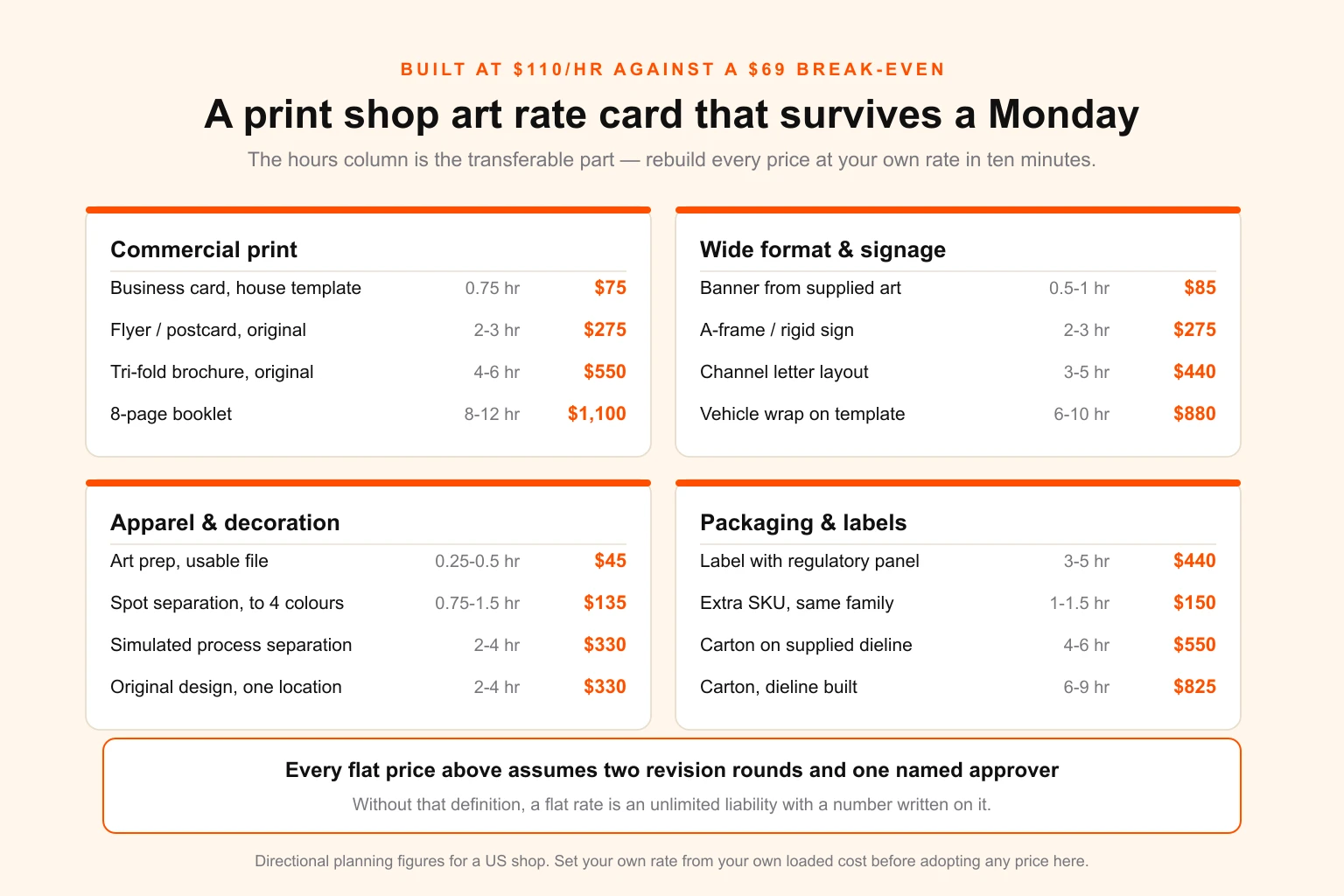
Two structural notes. First, publish the hours alongside the price internally but not externally — the hours are how your counter staff sanity-check a quote, and the price is what the customer sees. Second, every flat rate here assumes two revision rounds and the approval discipline described further down. Without that, a flat rate is an unlimited liability with a number on it.
The tier that leaks the most: customer-supplied files
Ask any shop where its art hours go and the honest answer is rarely "designing." It is fixing.
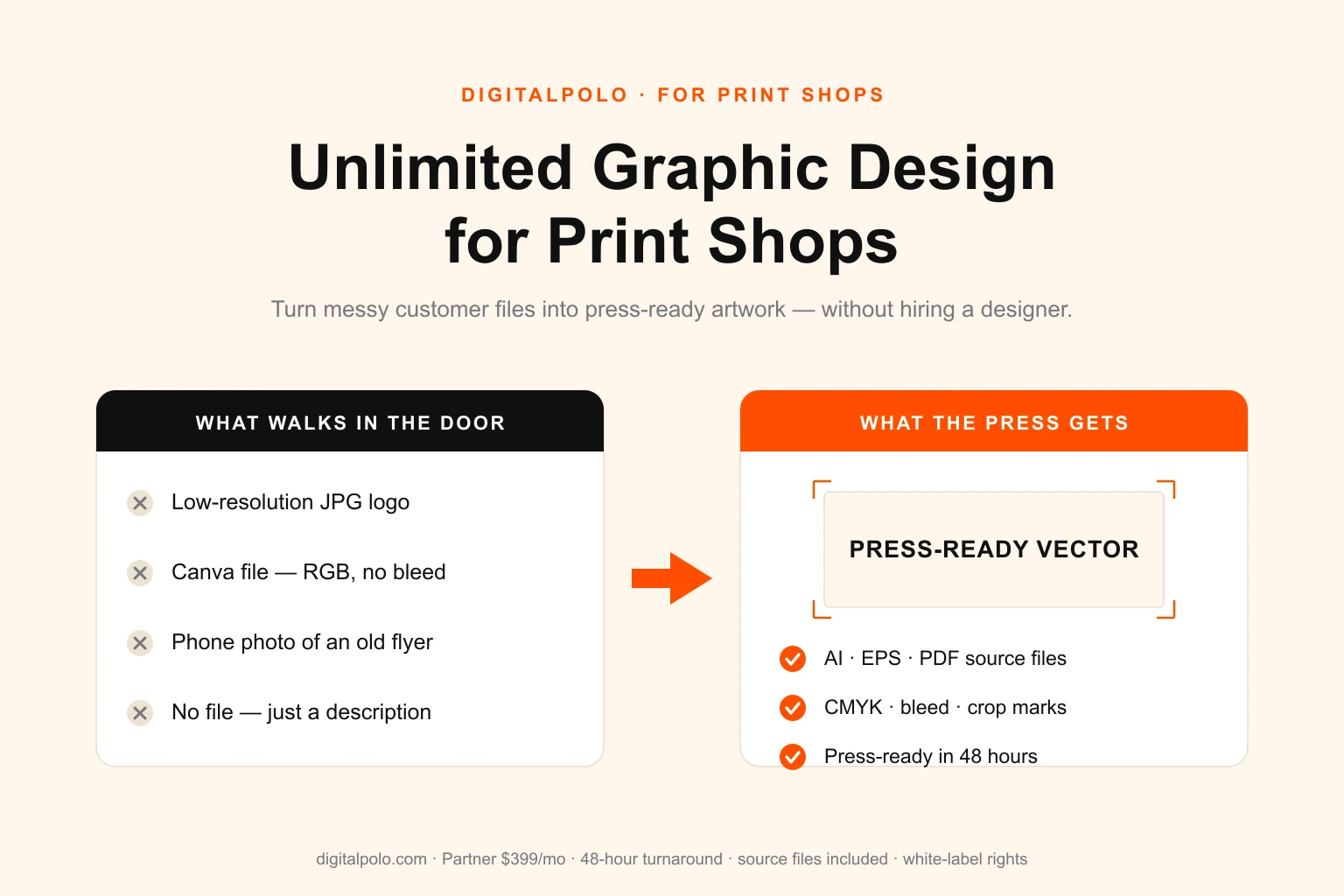
The phrase "customer-supplied artwork" covers a range from a perfectly built PDF to a photograph of a sign taken in a car park, and treating them as the same thing is the single most expensive habit in the trade. Files arrive in five states, and each one has a different cost, a different charge and — critically — a different conversation.
| State | What arrives | Your labour | Charge | What to say |
|---|---|---|---|---|
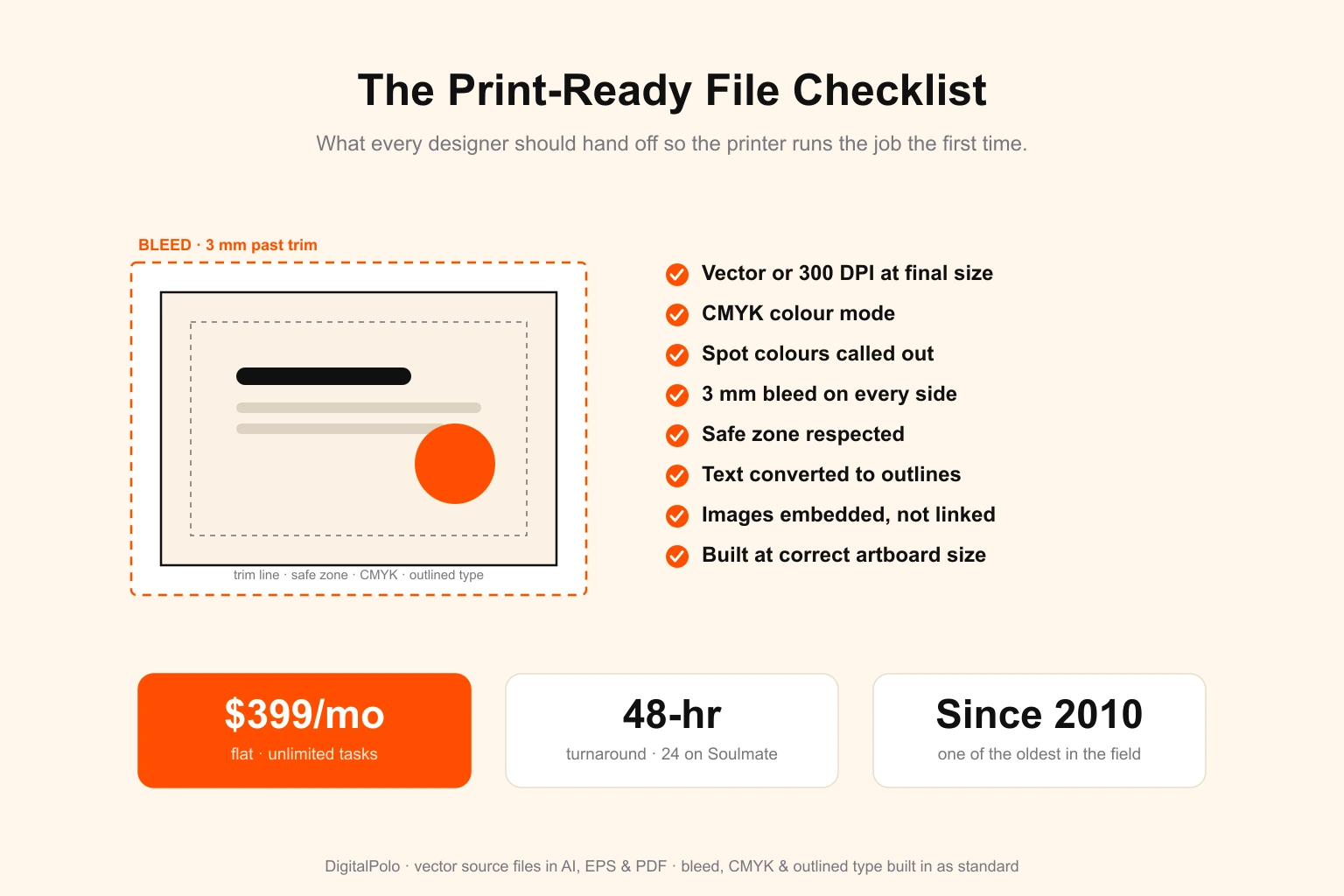
| 1. Print-ready | Correct PDF, CMYK, bleed, outlined, right size | 5 min verify | Included | "Your file passed preflight, no art charge." |
| 2. Nearly there | RGB, no bleed, missing crop marks, usable low-res | 10–25 min | $35 file prep | "There's a small file prep fee to get it press-ready." |
| 3. Native, broken | .ai/.psd/.indd with missing links or fonts, or the wrong app entirely | 25–60 min | 1 hr minimum, $110 | "The file needs rebuilding before it can run — that's our one-hour minimum." |
| 4. Raster only | JPEG or PNG logo needing redraw for vector output | 20 min–3 hr | $50–150 vectorise | "We'll redraw it as vector artwork you'll own and can reuse." |
| 5. Not a file | Photo of the old sign, a Word document, a description | 2–5 hr | Full rate, quoted first | "That's original design work — let me quote it before we start." |
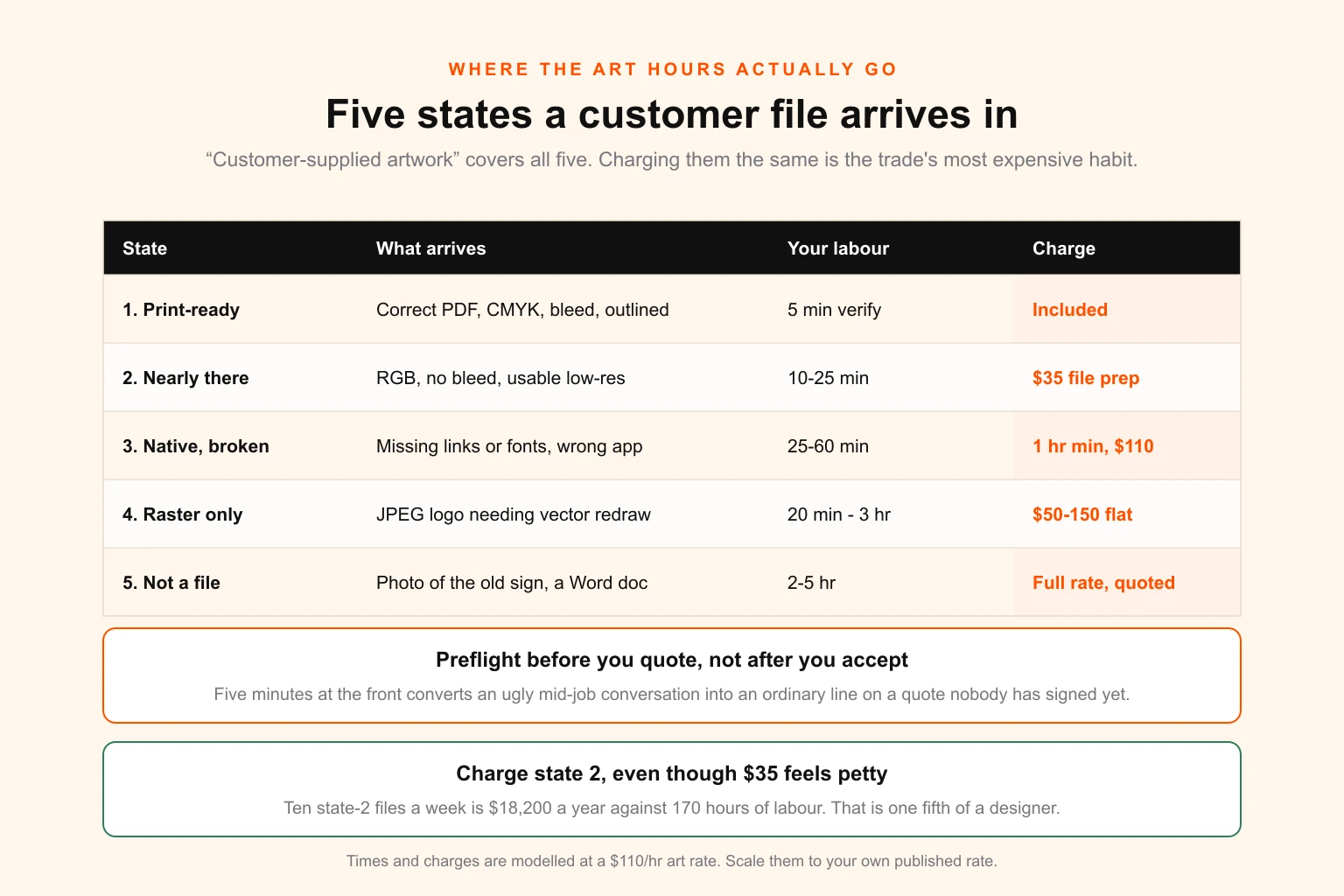
Three things make this tier work in practice.
Preflight before you quote, not after you accept. The single highest-leverage process change available to a print shop is moving the file check to the front of the quote. It takes five minutes, it tells you which of the five states you are in, and it converts an unpleasant mid-job conversation about extra charges into an ordinary line on an unaccepted quote. Shops that preflight after acceptance eat state 3 and state 4 almost every time, because by then the customer has already agreed a price and re-opening it feels like a bait and switch.
Name the state, not the customer. "Your file is state 3" is a process. "Your file is a mess" is a fight. A published table on your website or order form does the work for you — the customer sees a category, not a judgement, and the number arrives attached to a rule rather than to an opinion about their nephew's design skills. A print-ready file checklist on your site is worth publishing for exactly this reason: it moves the standard out of your head and onto a page you can point at.
Charge state 2, even though it feels petty. Thirty-five dollars for twenty minutes feels like nickel-and-diming, which is why almost nobody does it — and why almost every shop has a designer burning eight to twelve hours a week on invisible fixes. At 10 state-2 files a week, that fee is USD 18,200 a year against roughly 170 hours of labour. It is not petty. It is one-fifth of a designer.
The two file faults behind most of state 2 are colour space and resolution, which is why it pays to have somewhere to send customers: a plain explanation of CMYK versus RGB and of vector versus raster prevents more art hours than any process change you can make internally. Shops running Pantone work should also point customers at a Pantone to CMYK converter before the conversation about why the blue shifted.
When to waive design — the actual threshold
"Free design with print" is not automatically wrong. It is wrong when it is unconditional, because unconditional waivers transfer your art capacity to the jobs least able to pay for it.
The correct structure is a conditional waiver with a stated ceiling, and the ceiling comes out of one line of arithmetic:
Art minutes a job can fund = (print gross profit × the share you're willing to spend) ÷ loaded art cost per minute
At a USD 69 loaded rate, art costs you USD 1.15 per minute. If you are willing to spend 10 per cent of a print job's gross profit on winning and servicing it, here is what each job size actually funds:
| Print gross profit on the job | Funds at 10% of GP | Funds at 20% of GP |
|---|---|---|
| $50 | 4 minutes | 9 minutes |
| $150 | 13 minutes | 26 minutes |
| $400 | 35 minutes | 70 minutes |
| $1,000 | 87 minutes | 174 minutes |
| $2,500 | 217 minutes | 435 minutes |
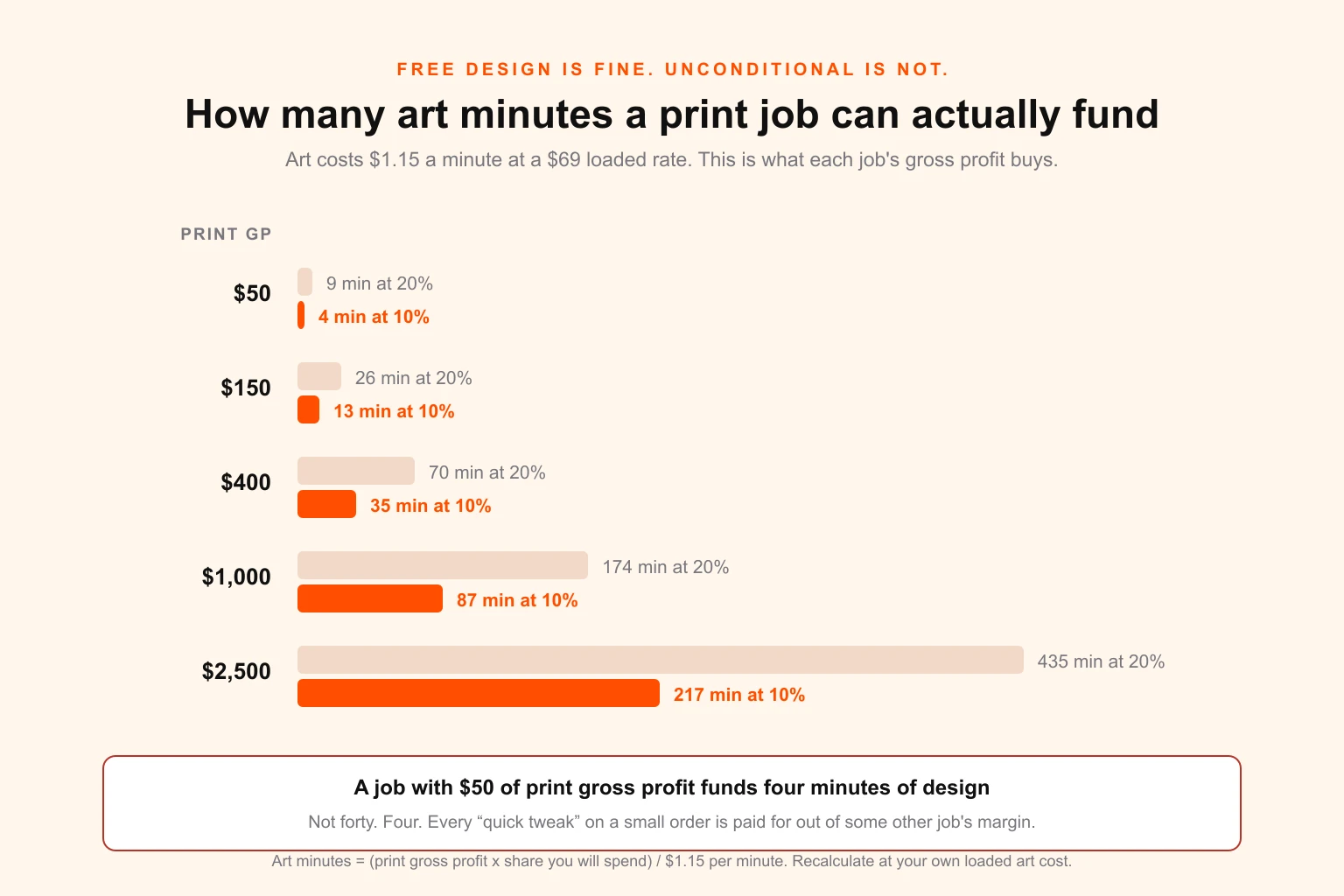
Read the top row carefully, because it is where most shops live. A job with USD 50 of print gross profit funds four minutes of design. Not forty. Four. Every "quick tweak" on a small order is being paid for out of some other job's margin, and the customers who order small and ask for tweaks are, reliably, the same customers.
Three ways to operationalise this:
The ceiling waiver. "Up to 30 minutes of design included on orders over USD 500." Simple, quotable, and self-limiting. Set the threshold so the included minutes sit at or under 10 per cent of the gross profit at that order value — for a shop running 40 per cent gross margin, a USD 500 order carries USD 200 of GP and funds about 17 minutes at 10 per cent, so 30 minutes is a deliberate, costed acquisition spend rather than an accident.
The credit-back. Charge the art in full up front, then credit 50 to 100 per cent of it against the print invoice when the order lands above a stated value. This is the strongest structure available and it is under-used. It gets you paid for design on jobs that never print, it removes the incentive to shop your artwork elsewhere, it makes the discount visible on the invoice where it does marketing work for you, and it costs you nothing on the jobs you would have waived anyway.
The tier waiver. State 1 and state 2 files are covered on any order; states 3 through 5 are always chargeable. Cleanest option for high-volume, low-touch shops.
Whichever you pick, write the condition into the quote, and make it explicit that the waiver is contingent on the print order being placed with you. The single most common way this model fails is the customer who accepts free design, takes the PDF, and prints it down the road — which is a policy failure, not a customer failure.
Minimums, revisions, rush and ownership
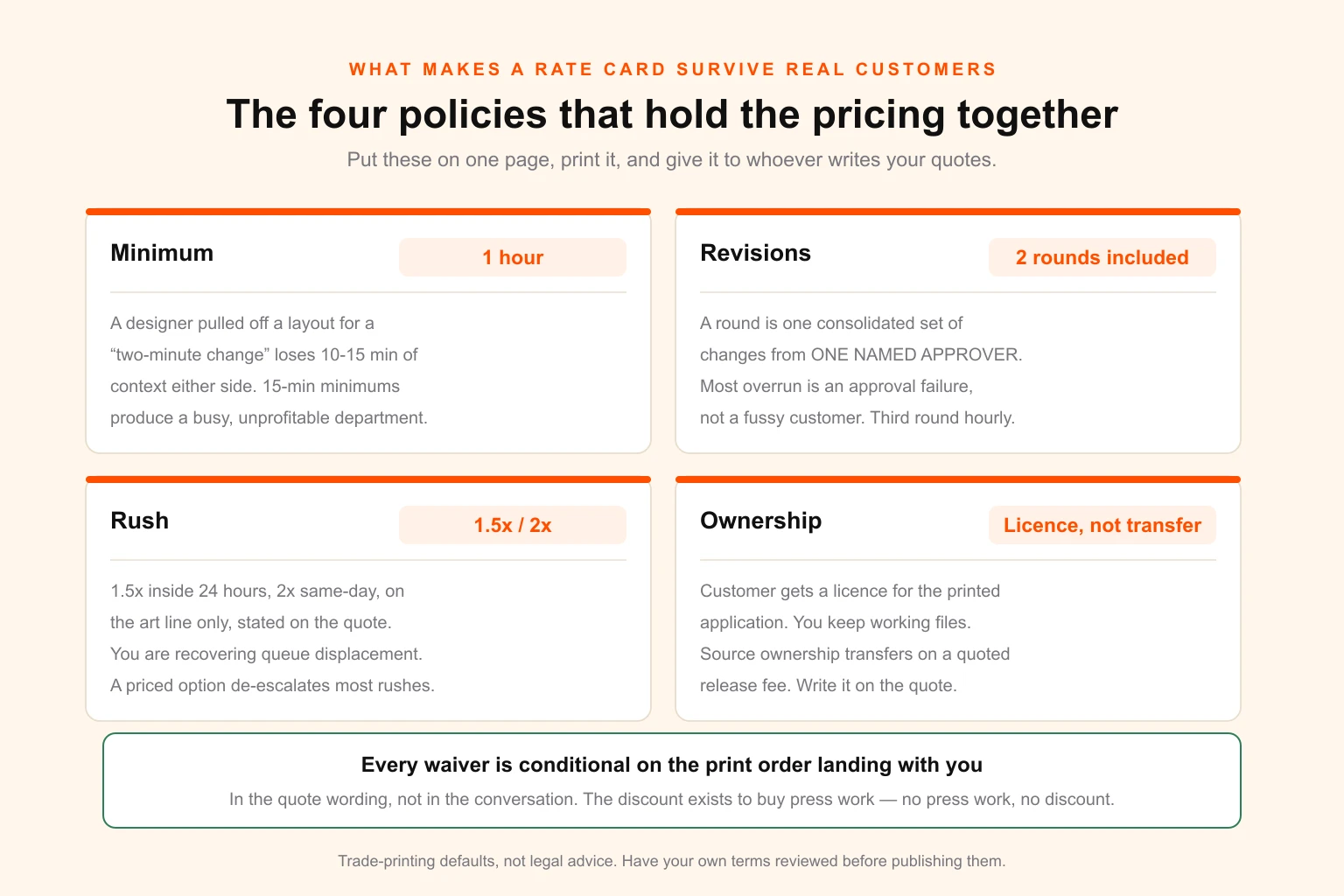
Four policies decide whether your rate card survives contact with real customers.
The minimum. One hour, or half an hour at the very least. The justification is switching cost: a designer interrupted mid-layout for a "two-minute change" loses ten to fifteen minutes of context on either side, so the honest cost of that change is roughly half an hour. Fifteen-minute minimums guarantee an art department that is permanently occupied and permanently unprofitable.
Revisions. Two rounds included, third and beyond at hourly in half-hour increments. The count matters less than the definition — a round is one consolidated set of changes from one named approver. Most revision overrun is an approval failure rather than a fussiness failure: the same proof cycling through three people at the customer's office who have never spoken to each other. Naming the approver on the quote does more for art margin than any other single line you can add. If you want the upstream fix as well, a short design brief taken at the counter kills a surprising share of round two before it happens.
Rush. 1.5x on the art line inside 24 hours, 2x for same-day, stated on the quote. This is not opportunism — a rush ticket displaces every other job in the queue, and that displacement is the real cost. The useful side effect is behavioural: a meaningful share of urgent jobs become ordinary lead times the moment the customer sees the multiplier.
Ownership. State it, because silence here is expensive in both directions. The workable trade-printing default: the customer receives a licence to use the finished artwork for the printed application they paid for, the shop retains working files, and full source-file ownership transfers on payment of a quoted release fee. Two related exposures are worth closing at the same time — stock images used in customer artwork carry their own licence terms, and so do fonts, where the licence attaches to whoever installs the software rather than to whoever pays for the design. A shop that opens a customer's native file and installs the missing font to edit the type has installed font software, whatever the contract says about the customer being responsible for artwork.
Put all four on one page. Print it. Give it to whoever writes quotes.
How to say the number without losing the job
Pricing collapses at the counter, not on the spreadsheet. Four sentences do most of the work.
When the art charge lands for the first time: "Design is a separate line on our quotes now — it's USD 110 an hour with a one-hour minimum, and most jobs like yours land at [flat price]. If the print order goes ahead, we credit half of it back." The credit does the emotional work; the separate line does the commercial work.
When they say another shop does design free: "Most shops build it into the print price. We price it separately so you can see what you're paying for, and so you're not subsidising the customers who need three hours of it." Do not disparage the competitor's pricing. Explain your own.
When the file arrives broken: "I've run your file through preflight and it's going to need about an hour of prep before it'll run — that's USD 110. Want me to send you the spec so the next one comes in clean?" Diagnostic, not accusatory, and it plants the fix.
When they ask for the source files: "The printed artwork is yours to use. If you'd like the working files to take elsewhere, there's a release fee — let me quote that." Neutral, priced, no drama.
The pattern in all four: name the number, attach it to a rule, and offer the customer a path. Shops lose jobs over apologetic pricing far more often than over expensive pricing.
The economics underneath: should the art department exist at all?
Once you have a real cost per art hour, a question opens up that most shops never ask.
A fully loaded designer costs roughly USD 74,000 and delivers around 1,073 chargeable hours. That seat only works if you can fill it. The break-points:
| Weekly chargeable art hours | What the arithmetic says |
|---|---|
| Under 15 | An in-house seat is a luxury. Outsource, or push art onto the customer with a hard spec. |
| 15–25 | Marginal. A fixed-fee external studio usually wins on cost and carries no absence risk. |
| 25–35 | The genuine crossover. Hybrid works best — one in-house designer for customer contact and proofing, overflow outsourced. |
| 35+ | In-house pays, provided utilisation holds. Watch the chargeable ratio, not the headcount. |
The structural problem with a single in-house designer is not cost, it is that one person is a single point of failure with holidays, sick days and a resignation letter in their future. A shop that has built its lead times around one designer discovers this at the worst possible moment.
The hybrid pattern is what most profitable shops converge on: keep the customer-facing, press-adjacent, judgement-heavy work in-house, and push the volume drudgery — resizes, adaptations, separations, SKU variants, the eighteenth version of the same flyer — to a fixed-cost external queue. That converts a variable cost with a hard capacity ceiling into a fixed cost with a known gross margin, which is exactly what you already do with paper.
If you are weighing that decision seriously, the utilisation arithmetic between hiring and outsourcing is worth running properly, and the operational side of routing print work to an outsourced queue covers what changes in your workflow when you do.
The five numbers that tell you it is working
Rate cards do not fail loudly. They erode. These five metrics catch the erosion.
1. Art recovery ratio — art revenue ÷ (art hours × loaded cost). Below 1.0 you are subsidising design. Target 1.4 or better. This is the headline number; if you track only one, track this.
2. Chargeable art ratio — chargeable hours ÷ total art hours. Target 60–75 per cent. Below 55 per cent, your break-even rate is higher than you think and your whole rate card is under-priced.
3. Unbilled art hours, converted to dollars — every hour logged against a job with no art line, multiplied by USD 69. Report it monthly, in currency, to whoever writes quotes. Nothing changes counter behaviour faster than a number with a dollar sign on it.
4. Art hours per order, by department. Trending up means scope creep or approval failure. Compare apparel to commercial to wide format — they should look nothing like each other, and the one that has drifted is where your policy is being ignored.
5. Quote-to-close on jobs with a separate art line vs without. This is the number that settles the argument in your own head. Most shops that run it find the difference is far smaller than they feared, and that the jobs they lose are concentrated among the customers consuming the most unbilled art. That is not attrition. That is the system working.
Run all five monthly. The first month is the painful one.
The 30-day rollout
If you are starting from "design is free and nobody knows what it costs":
Week 1 — Measure. Log every art task against a job number, even the two-minute ones. No pricing changes, no announcements. You are buying a baseline, and you need the unbilled number before you can justify anything.
Week 2 — Cost. Build the loaded-cost table with your real salary, burden, overhead and utilisation. Derive your break-even. Set your published rate at break-even ÷ (1 − target margin).
Week 3 — Build. Write the rate card, the five file states, the waiver rule, and the four policies. One page each. Put the file-state table on your order form and your website.
Week 4 — Deploy. Every quote gets an art line, even at zero, even when waived — especially when waived, because a waived line with a visible value does more marketing work than a hidden one. Brief whoever writes quotes on the four scripts. Grandfather your top five accounts for 90 days and tell them you are doing it.
Day 60 — Review. Pull the five metrics. Expect the chargeable ratio to be lower than you assumed and the unbilled figure to be higher. Adjust the rate, not the resolve.
Where this fits if you outsource production
A rate card is only as good as your ability to deliver against it. Once design is priced properly, the constraint moves from willingness to capacity — the jobs you were declining because the designer was buried are now jobs with a number attached, and the number only earns if the work ships on time.
Digital Polo works as the white-label design studio behind print shops, sign makers, apparel decorators and manufacturers, which means the art side of your rate card runs at a fixed monthly cost regardless of how many tickets you write against it. Separations, print-ready file rebuilds, SKU variants, wrap layouts, dielines, scaled sign proofs — production work returned to press specification, under your name, with your customer never seeing ours. Flat monthly pricing, unlimited requests, and source files that belong to you.
For shops that resell design as a line item rather than absorbing it, the reseller economics are worth reading properly — the margin structure is different when design is a product rather than a cost. If you want the plans and the numbers, pricing is here, what we produce is here, and the printer-specific version of all of this covers the departmental detail. Apparel and signage shops have their own pages — screen print and sign shops — because the file specs and the art tiers genuinely differ.
Frequently asked questions
How much should a print shop charge for design work? USD 75–125 an hour, with most commercial work at 85–110. That band comes from arithmetic, not a survey: a USD 52,000 designer costs about USD 74,000 fully loaded and bills around 1,073 chargeable hours, putting break-even near USD 69. Add the gross margin you expect from the press and you land at USD 115–138. Shops pricing off salary ÷ 2,080 arrive at USD 25 and lose money on every ticket.
Should a print shop charge for design at all, or include it with printing? Charge it, then decide separately whether to credit it back. Bundling removes the meter and hands your art capacity to your least profitable customers. Quote an art line on every job with a written waiver rule tied to the print order's gross profit — a job with USD 400 of GP funds about 35 minutes of art at a 10 per cent spend; a job with USD 50 funds four.
What is the difference between an art charge and a setup or screen charge? Art buys creative and file-prep labour. Setup buys make-ready — screens, plates, RIP and cut-file setup, registration. A customer supplying perfect artwork still owes setup and owes no art. Merge the two and either your screen charge absorbs unlimited separation work, or customers with clean files pay for design they never used.
How much should I charge to fix a customer's file? Price the state it arrives in. Print-ready: nothing beyond verification. Minor faults like RGB or missing bleed: USD 35 file prep. Broken native files with missing links or fonts: your one-hour minimum. Raster logo needing redraw: USD 50–150 vectorising. A photo of the old sign is not a file — that is original design, quoted before anyone starts.
How much should I charge to vectorise a logo? USD 50–150 flat. Flat is the right structure because it ends the argument about how long it took. Clean geometry sits at the bottom of the band, gradients and script lettering at the top. Quote the band up front and log it separately — customers rarely resist this charge, because the vector file is obviously theirs to keep.
What is a reasonable art minimum? One hour is standard, half an hour is the floor. The minimum prices switching cost, not the task — a designer pulled off a layout for a "two-minute change" loses ten to fifteen minutes of context either side. Fifteen-minute minimums produce an art department that is permanently busy and permanently unprofitable.
How many revisions should be included? Two rounds, with a third onward billed hourly in half-hour increments. Define the round rather than just counting it: one consolidated set of changes from one named approver. Most overrun is an approval failure, not a fussy customer — naming the approver on the quote protects margin better than tightening the count.
Should I charge a rush fee for design? Yes, as a stated multiplier: 1.5x inside 24 hours, 2x same-day, on the art line only, disclosed before acceptance. The cost being recovered is the displacement of everything else in the queue. The side benefit is that a priced rush option turns a good share of emergencies back into normal lead times.
Who owns the artwork after a print shop designs it? Whatever your terms say — so write terms. The workable default: the customer gets a licence to use the finished artwork for the application they paid for, you keep the working files, and source ownership transfers on a quoted release fee. Handing everything over by default loses the reorder; withholding files with no written basis loses the customer.
How do I raise design prices without losing customers? Change the structure first, then the number. Run a separate art line at your current effective rate for a quarter so customers get used to seeing design priced at all, then move the rate. Publish a card so it reads as policy. Grandfather top accounts for a stated window. The accounts that leave over an art charge are usually the ones consuming the most unbilled art.
Is it cheaper to hire a designer or outsource print shop design work? It depends on utilisation. A loaded seat costs about USD 74,000 for roughly 1,073 chargeable hours, so it needs 25–35 chargeable art hours a week to make sense. Below that, fixed-fee outsourcing wins on cost and carries no absence risk. At mid volume the hybrid beats both: one in-house designer on customer contact and proofing, overflow pushed to an outsourced queue.
What should I charge if the customer takes the files elsewhere to print? Full rate, no waiver, plus the release fee if they want source files. Every waiver you write should be explicitly conditional on the print order landing with you, in the quote wording rather than in conversation — the discount exists to buy press work, and without the press work the justification is gone.