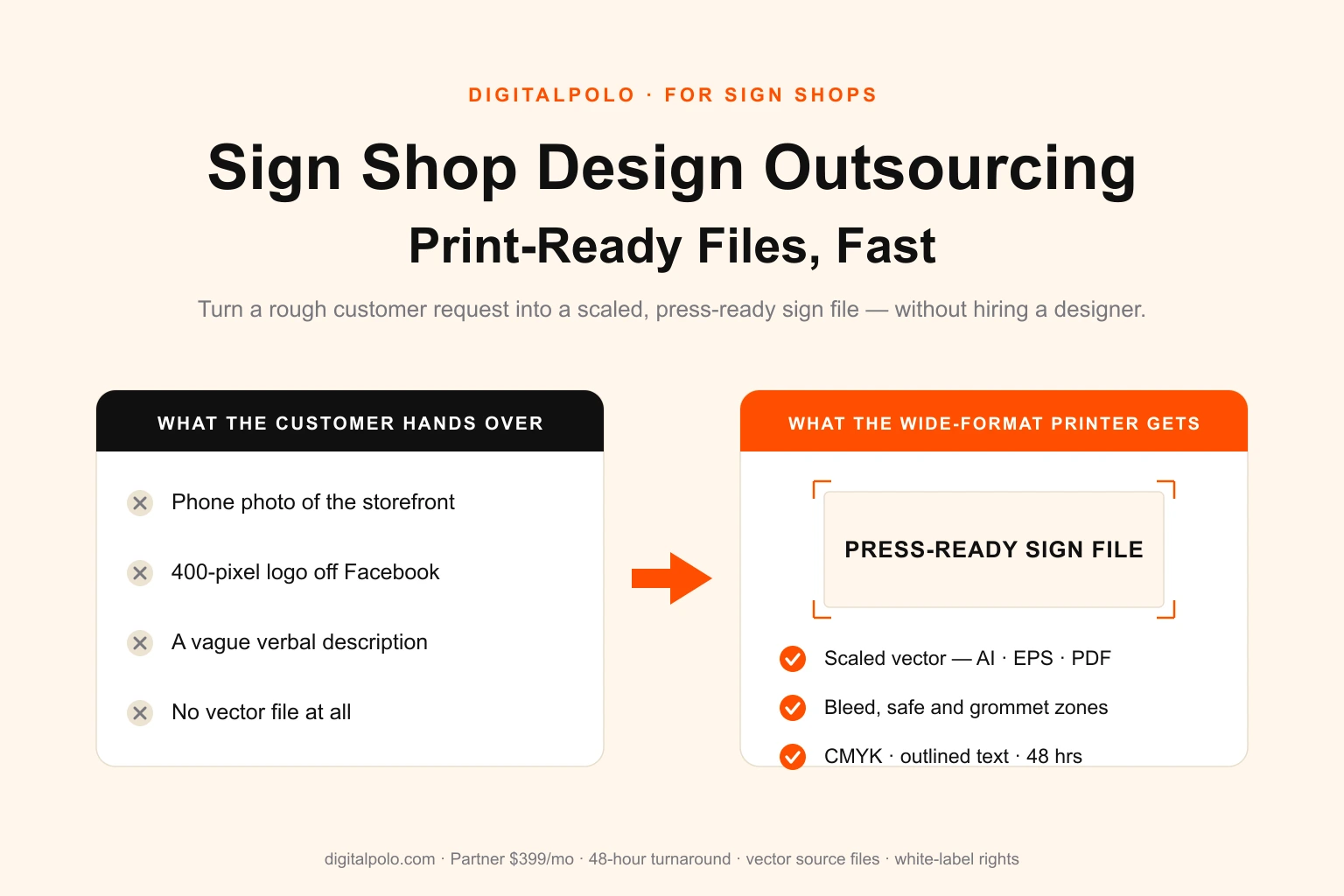
Every sign shop owner knows the order that quietly eats the schedule. A customer wants a 12-foot banner for a grand opening on Friday, and what they hand over is a phone photo of their storefront, a logo pulled off Facebook at 400 pixels, and a sentence describing what they "kind of want." The vinyl is in stock. The wide-format printer is free. The press-ready artwork is the only thing standing between the order and the production floor — and building it falls on whoever in the shop can fake their way through Illustrator.
This guide is the practical playbook for outsourcing sign shop design. What a real large-format print-ready file contains, how scale and finishing change the artwork, the bleed and grommet zones that get clipped when a designer ignores them, how to brief a designer so the file runs the first time, and the realistic options for getting design done at the volume a busy sign shop actually produces.
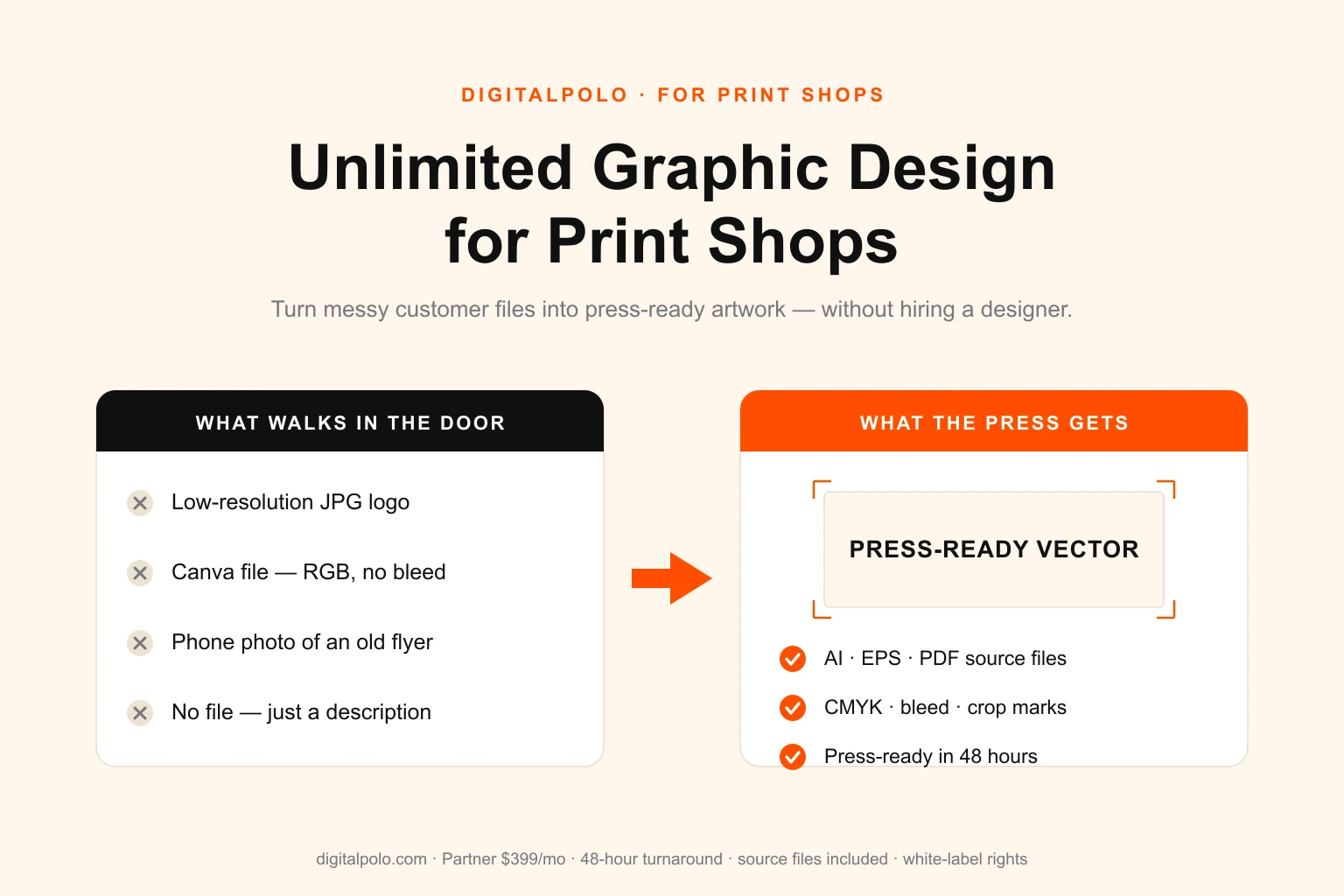
DigitalPolo has been delivering unlimited graphic design since 2010 — one of the oldest services in the category — with plans from $399/month, 48-hour turnaround, unlimited revisions, and print-ready vector source files (AI, EPS, PDF) built to large-format spec included as standard. White-label and reseller use is included on every plan, which matters for the print shops and franchises that produce signage for their own clients.
Why Sign Shops Lose Time to Design
A sign shop is a production business. The money is made when the printer is running, the plotter is cutting, and the install crew is on the road. Design is the step nobody bills properly and everybody underestimates.
The artwork bottleneck shows up in three predictable ways:
- The customer has no usable file. Most walk-in customers do not own a vector logo. They have a JPG, a screenshot, or a business card they want "copied." Someone has to rebuild that artwork from scratch before anything prints.
- The press operator becomes the designer. In a small shop, the person who runs the wide-format printer is also the person who lays out the banner, redraws the logo, and argues with the customer over font choices. Every hour spent in Illustrator is an hour the printer sits idle.
- Revisions have no ceiling. A customer who is not paying a design fee will ask for "just one more change" indefinitely. With no structure, a $90 yard sign turns into a week of back-and-forth.
None of this is a printing problem. It is a design-capacity problem, and most sign shops solve it badly — by absorbing the time, turning down design-heavy jobs, or quoting so high on artwork that the customer walks. Outsourcing design to a flat-fee subscription removes the bottleneck without adding payroll.
What "Print-Ready" Means for Large-Format Signage
Most design services advertise "source files included." For signage, that phrase hides a lot of detail, and large-format work is far less forgiving than a business card. A print-ready sign file is not a flat image of a banner. It is a production-grade vector file the wide-format printer, the vinyl plotter, and the finishing table can all run from without rework.
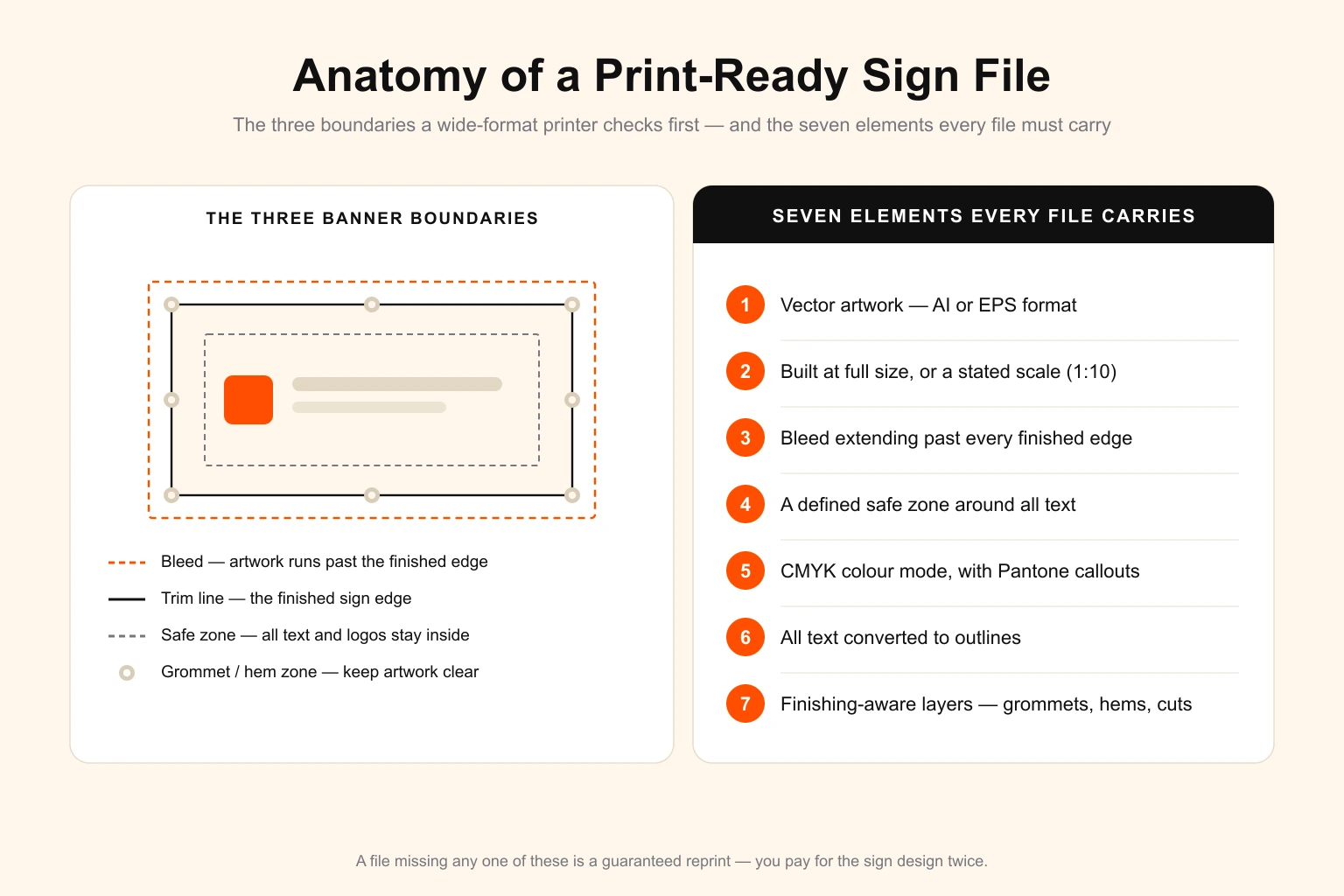
A real print-ready sign file contains seven specific things:
- A vector artwork file in AI or EPS format. Signage gets scaled to enormous sizes. A vector file holds a crisp edge at any dimension; a raster file pixelates the moment it is enlarged past its native resolution. For more on why this matters, see our breakdown of vector versus raster files.
- Built at full size or a stated scale ratio. Small signs are built at 100% of final size. Very large work — building signs, billboards, fleet graphics — is built to a clean ratio such as 1:10, with the ratio written into the file. An unlabelled scaled file is a guaranteed reprint.
- Correct bleed extending past every finished edge, so a slight drift on the cutter or trimmer never leaves a white sliver.
- A defined safe zone. All text, logos, and contact details sit inside a generous margin so nothing critical is clipped by trimming, hemming, or a grommet punch.
- CMYK colour mode with Pantone callouts for any brand colour that must hold exact. RGB is for screens; wide-format printers run process or spot inks, and an RGB file is auto-converted by the RIP with unpredictable results. Our CMYK versus RGB guide explains why this trips up so many jobs.
- All text converted to outlines. Live text depends on the printer's RIP having the exact font installed. Outlined text removes that dependency completely.
- Finishing-aware layers. Grommet positions, pole-pocket hems, weld seams on oversized banners, and contour-cut paths for vinyl plots all need to be marked or accounted for so the finishing step does not destroy the artwork.
If your current design source cannot deliver all seven on every file, you are paying for sign design twice — once for the original and once for the rework when the printer sends it back.
How Sign Type Changes the Design File
There is no single "sign design." The product and the substrate both change what the designer has to build. A designer who hands back the same file regardless of sign type is not building for production.
Vinyl banners. The most common job. The file needs bleed for trimming and a safe zone that accounts for hems and grommets. Pole-pocket banners need extra top-and-bottom clearance where the hem folds over. Mesh banners for windy sites change the colour density the designer should plan for.
Yard and rigid signs. Coroplast yard signs, aluminium composite panels, and foam board are cut to fixed sizes. The artwork is built to that exact panel dimension with bleed, and double-sided signs need both faces aligned so the design reads correctly through the substrate.
Cut vinyl and window graphics. Vinyl lettering and window decals are plotted, not printed, so the file needs clean contour paths the plotter can follow. Every shape must be a closed vector path — stray points and open paths cause the cutter to misbehave. Perforated window film and frosted privacy vinyl each carry their own layout rules.
Channel letters and dimensional signage. Storefront channel letters are routed from the vector outline, so the file has to be a clean, single-path letter set with no overlapping strokes. The designer is effectively producing a cut file, not a print file.
Wayfinding and ADA signage. Interior wayfinding systems need consistent layouts across a whole set of signs, correct contrast ratios, and — for ADA-compliant signs — tactile and Braille zones planned into the artwork.
Trade-show and event graphics. Retractable banner stands, tension-fabric displays, and step-and-repeat backdrops each have a fixed printable area and visible-versus-hidden zones the designer must respect, or logos vanish behind a frame.
A subscription designer who has built large-format work before will ask which of these a job is before starting. That single question prevents most reprints.
The Real Cost of Handling Sign Design In-House
Sign shop owners tend to think of design as free because no invoice changes hands. It is not free — it is just unbilled. Here is the honest comparison.
The press operator doing design. If your wide-format operator spends two hours a day rebuilding customer artwork, that is ten hours a week the printer is not earning. At even a modest hourly machine value, that idle time costs more than a design subscription every single month — and it is invisible because it never appears on a quote.
Hiring an in-house designer. A full-time sign designer in the US costs roughly $45,000–$65,000 a year in salary, plus Adobe licences, a workstation, payroll tax, and paid downtime between busy periods. For a shop that does not have a constant daily design load, you are paying a full salary to cover a part-time need.
Per-project freelancers. Freelance sign designers charge $40–$90 an hour, and the good ones are booked. When a rush banner lands on Wednesday, the freelancer who understands grommet margins may not be available until next week. You are renting capacity you cannot schedule.
A flat-fee subscription. DigitalPolo runs $399–$899 a month — about $4,800–$10,800 a year — for unlimited tasks with no per-sign billing. It functions as an outsourced art department the shop never has to staff, license, or manage.
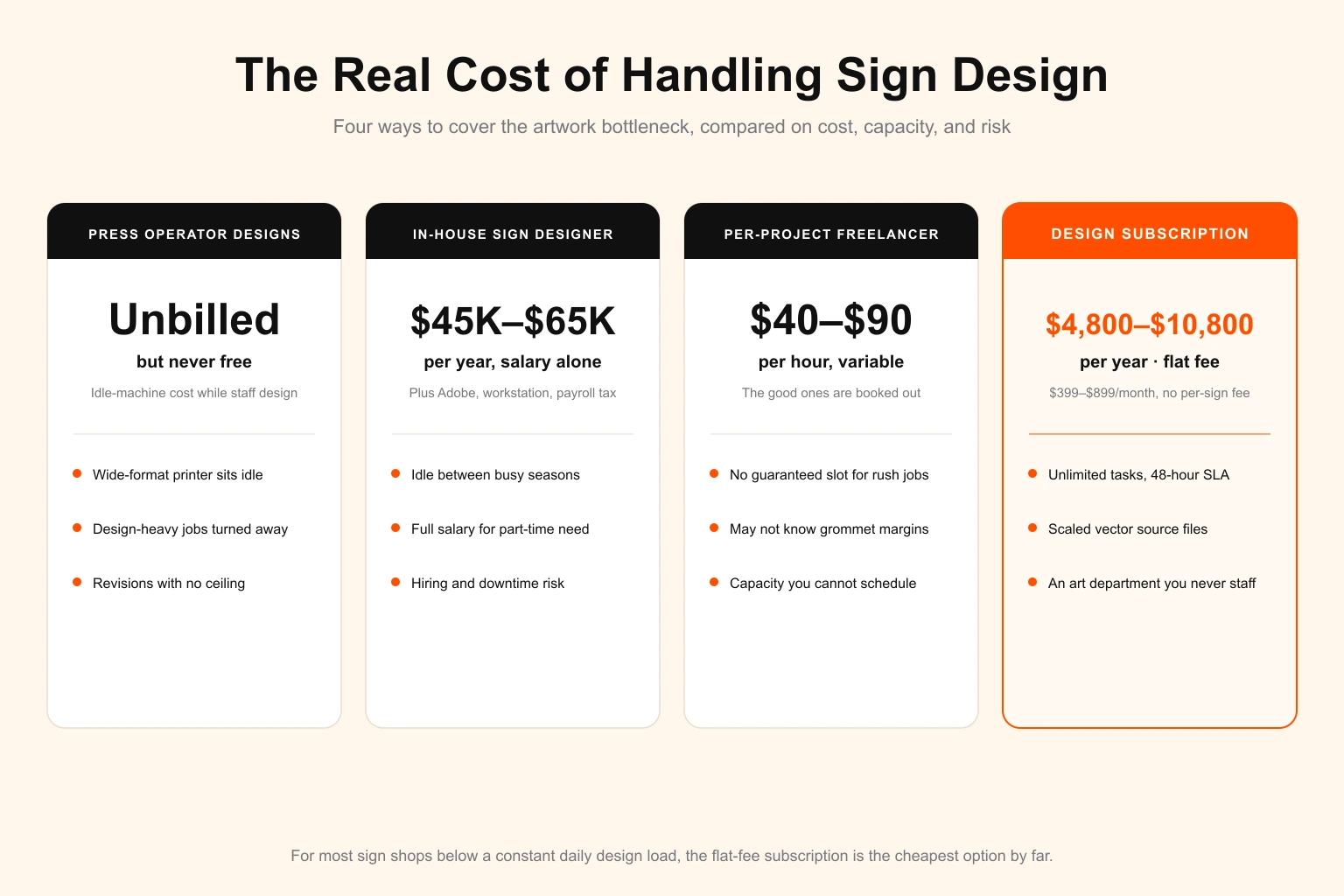
For most sign shops below a constant daily design load, the subscription is the cheapest option by a wide margin — and the only one that carries no hiring risk and no scheduling gap.
How a Design Subscription Fits a Sign Shop's Workflow
The reason a subscription works for sign shops is that it slots into the way orders already move through the floor. Nothing about the shop has to change.
The flow is simple:
- The customer brings a job. A banner, a set of yard signs, a storefront graphic — with whatever file or description they have.
- The shop briefs the service by email. Sign dimensions, substrate, finishing method (grommets, pole pockets, hems), quantity, copy, and any brand assets. No portal to learn, no software to install.
- Press-ready vector artwork comes back. Within 48 hours on the Partner plan, built to the dimensions and scale the shop specified, with bleed, safe zones, and outlined text.
- The shop preflights and prints. The file drops into the existing RIP and wide-format workflow. Because it was built to spec, preflight passes.
- The customer gets the finished sign. They never see or contact the design service. The shop owns the relationship and the margin.
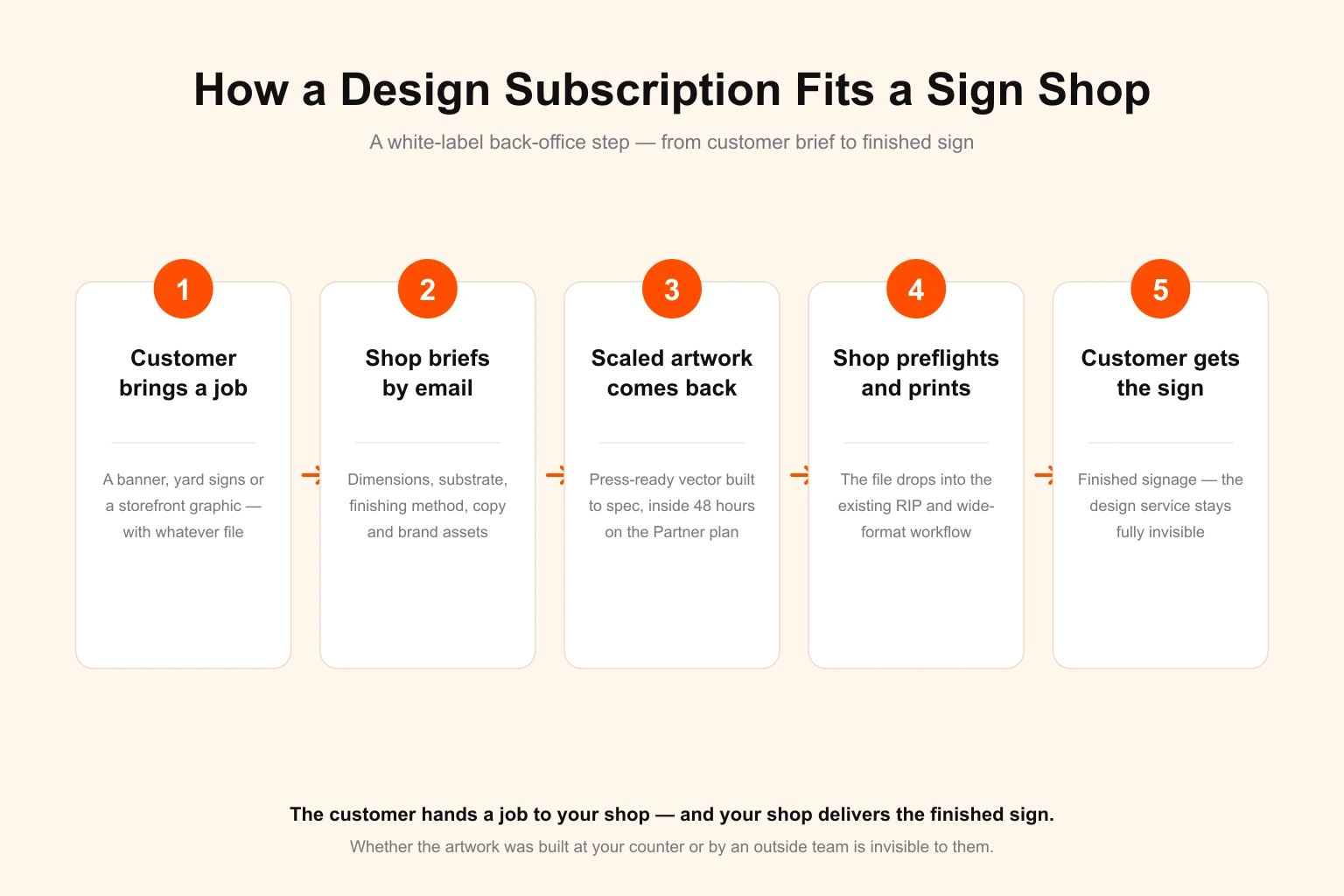
Because the subscription is white-label on every plan, the shop can mark up design as a line item, present the artwork under its own name, and turn what used to be an unbilled cost into a profit line. A practical primer on how the subscription model works end to end is in our guide on how unlimited graphic design works.
How to Brief a Sign Designer So the File Runs First Time
Most sign reprints trace back to a vague brief, not a bad designer. A subscription designer builds exactly what the brief specifies — so the brief has to carry the production detail. Include these every time:
- Finished dimensions — width by height, in the units your shop works in, and whether that is the printed size or the visible size.
- Substrate and product — 13 oz vinyl banner, 4 mm Coroplast, ACM panel, cut vinyl, tension fabric. Each changes the build.
- Finishing method — grommets (and spacing), pole pockets, hemmed edges, contour cut, double-sided. This drives the safe-zone margins.
- Scale instruction — build at 100%, or at a stated ratio for oversized work.
- Quantity and variants — a single sign, or a set of yard signs with different copy sharing one template.
- Viewing distance — a storefront sign read from across the street needs heavier type than a counter sign read from three feet.
- Brand assets — vector logo, exact fonts or Pantone colours, and any existing brand guidelines.
- Copy, final and proofread — supply the exact text. A designer cannot catch a phone-number typo the customer approved.
A shop that briefs at this level gets a file that passes preflight on the first send. A shop that briefs "make a banner, here's the logo" gets a revision cycle. The brief is the single biggest lever on turnaround.
Who Sign Shop Design Outsourcing Works Best For
A design subscription is not the right answer for every shop. It fits these situations cleanly:
- Small and mid-size sign shops without a full-time designer, where the owner or press operator currently absorbs the artwork.
- Shops turning away design-heavy jobs because they cannot build the artwork fast enough — every declined job is lost print revenue.
- Franchise and multi-location sign businesses that need consistent layouts across many outlets without staffing a designer at each one.
- Shops with uneven demand — busy in spring and around election season, quiet otherwise — where a salaried designer sits idle half the year.
- Print shops adding signage as a service line, who need large-format design capacity without committing to a hire.
It is a weaker fit for a high-volume sign manufacturer running a constant, full-time daily design load — at that scale a dedicated in-house team is justified. For everyone below that line, the subscription is cheaper, faster to start, and carries no hiring risk. Shops weighing this against other services should also read our comparison of Design Pickle alternatives, since not every design subscription handles print-production files competently.
DigitalPolo Plans and Pricing
| Plan | Price | Turnaround | Delivery | Best For |
|---|---|---|---|---|
| Partner | $399/month | 48 hours | Unlimited tasks, all source files | Small sign shops, startups, single-location businesses |
| Soulmate | $899/month | 24 hours (priority) | Dedicated team, 24×7 support, all source files | High-volume sign shops, franchises, resellers |
Both plans include delivery of all source files — vector formats (AI, EPS, PDF) suitable for print production, including wide-format banners, rigid signage, cut vinyl, channel letters, vehicle lettering, and trade-show graphics.
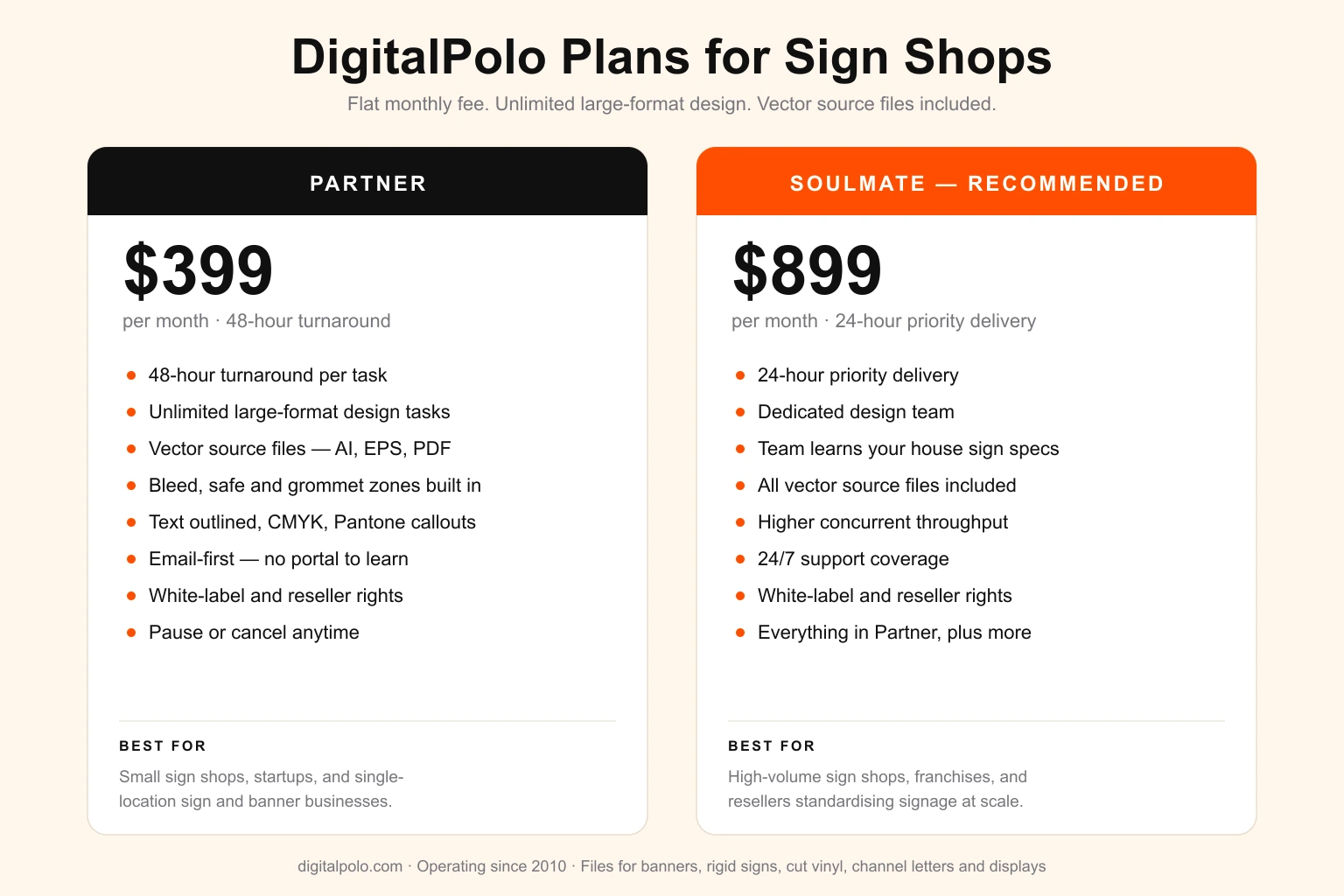
A sign shop with steady but manageable design volume starts on the Partner plan. A shop running a high daily volume, a franchise standardising signage across locations, or a business reselling design under its own brand is better served by the Soulmate plan, where the dedicated team and 24-hour priority turnaround keep pace with the order book. Full pricing detail sits on the DigitalPolo pricing page, and a wider breakdown of how the category prices is in our unlimited graphic design pricing guide.
Frequently Asked Questions
What file format do sign shops need from a designer?
Sign shops need a vector file in AI, EPS, or print-ready PDF, built either at full size or to a clean scale ratio such as 1:10. The file should carry the correct bleed, a clear safe zone, all text converted to outlines, and CMYK colour mode. Flat raster files like JPG are usually rejected for large-format work because they pixelate when scaled to banner or building size.
Should a sign file be built at full size or scaled?
Either works if the designer flags it clearly. Small signs and banners are usually built at 100% final size. Very large work — building signs, billboards, fleet-scale graphics — is built to a stated scale ratio, commonly 1:10, with the ratio noted in the file. The danger is an unlabelled file: the wide-format operator has no way to know whether 1 inch means 1 inch or 10.
How much bleed and safe margin does a banner need?
A typical banner needs bleed extending past the finished edge and a generous safe zone holding all text and logos inside the trim. Grommeted and pole-pocket banners need extra clearance — text and logos must sit clear of where grommets punch and where a hem folds, or the finishing step clips the artwork. The exact margins depend on the finishing method, so the designer should confirm them with the shop.
Can an unlimited graphic design service handle sign and banner work?
Yes. Sign work is recurring and varied — banners, yard signs, storefront graphics, vehicle lettering, trade-show displays — which fits a subscription well. A flat-fee service delivers scaled vector files with correct bleed and outlined text, handles the volume without per-sign fees, and includes unlimited revisions. DigitalPolo's Partner plan at $399/month covers unlimited sign design tasks with 48-hour turnaround.
Does DigitalPolo deliver print-ready files for large-format signage?
Yes. DigitalPolo delivers vector source files (AI, EPS, PDF) built at full size or a stated scale ratio, with correct bleed, defined safe and grommet zones, outlined text, CMYK colour mode, and Pantone callouts where brand colours must hold. Files ship in the formats wide-format printers, vinyl plotters, and channel-letter routers actually use.
How is outsourced design cheaper than hiring an in-house sign designer?
A full-time sign designer in the US costs roughly $45,000–$65,000 a year in salary alone, plus software, equipment, and idle time between jobs. A design subscription runs $399–$899 a month — about $4,800–$10,800 a year — with no downtime cost. For most sign shops below a constant daily design load, the subscription is far cheaper and carries no hiring risk.
How fast can DigitalPolo turn around a sign design?
Standard sign and banner tasks deliver within 48 hours on the Partner plan from a clear brief. The Soulmate plan delivers within 24 hours on priority. Simple jobs — a yard sign laid out from supplied copy, a banner resized for a new dimension — often come back the same day, fast enough to hold a normal sign-shop turnaround promise.
Verdict: The Lowest-Risk Way to Add Design Capacity
A sign shop does not have a printing problem — it has a design-capacity problem. The artwork is where orders stall, where the printer sits idle, and where unbilled hours quietly erase margin. Hiring solves it expensively and only if the volume justifies a full salary. Freelancers solve it unreliably and on their schedule, not yours.
A flat-fee design subscription solves it the way a sign shop actually needs: predictable cost, fast turnaround, print-ready vector files built to large-format spec, and white-label rights so design becomes a profit line instead of a hidden cost. For most sign and banner shops, it is the lowest-risk way to say yes to every job that walks in. If your shop sells signage as part of a broader print operation, the same logic extends to vehicle wrap and lettering work and product label runs.
Need Print-Ready Design Files Without the Hiring Hassle?
DigitalPolo delivers vector source files (AI, EPS, PDF) with every task — ready for banner printing, rigid signage, cut vinyl, channel letters, and trade-show graphics. Partner plan from $399/month. 48-hour turnaround.