Somewhere in your last five projects is a font that nobody has the right to use.
Not because anyone chose to pirate anything. Because a designer downloaded a family from a marketplace on a desktop licence, the job turned into a website, the client's in-house marketer asked for the source files, someone zipped the working folder, and a subcontractor in a different country installed the same family to produce the retail collateral. Four companies, one purchase, and at least three of them are outside the terms of a document nobody read.
That is the normal state of affairs in the design supply chain, and it stays invisible until it doesn't. The mechanism that surfaces it is not a lawsuit — it is an automated crawl that reads the font files your client's website serves, followed by a letter offering to sell you a licence for the period you have already used it. Monotype, which now controls a very large share of the commercial catalogue including families acquired from Linotype, Bitstream, FontShop, URW and Hoefler & Co., has run exactly this kind of compliance programme, and industry associations have been warning printers about the notices since 2025. Reported outcomes range from five-figure website audit invoices to renewal negotiations that multiplied a customer's annual spend many times over.
Search for help with this and you get a first page written almost entirely by the people selling the licences. Monotype, Adobe, Google Fonts, Creative Market, Extensis and a handful of foundries all publish competent explanations of their own terms. The highest-ranking non-vendor result at the time of writing is a Reddit thread called "I don't understand font licensing." That is the state of the literature: excellent documentation of individual products, and almost nothing that answers the question an agency, studio, print shop or reseller actually has, which is who in a chain of four companies has to hold what, and what changes depending on how the files get handed over.
This is that document. It covers the seven licence types and which ones a reseller genuinely touches, the chain-of-custody rule that decides who needs a licence, the four handoff states and how each one changes your client's obligations, what "commercial use" quietly excludes, where free and bundled fonts bite, what licensing costs per project type, how a compliance claim actually unfolds and what to do when one arrives, the contract clauses that allocate the cost before it becomes a dispute, and a thirty-day sprint to get from "no idea" to a defensible position.
One caveat before any of it: this is operational guidance from a production studio, not legal advice. Licence terms vary by foundry, by product and by jurisdiction, and the specific EULA attached to your specific file overrides every general rule below. Where a claim names a figure, take advice.

The distinction that makes everything else make sense
Almost every font licensing argument dies on a confusion between two different things wearing the same word.
A typeface is a design — the shapes of the letters, the proportions, the relationships between them. A font is a piece of software: a file containing outline data, hinting instructions, kerning tables and metadata, which a computer executes to draw those shapes at a given size.
The distinction is not pedantry. It is the reason the legal position looks strange the first time you meet it. In the United States, the shapes themselves have generally not been treated as copyrightable subject matter, which is why anyone can draw a typeface that looks very much like another one and sell it. The file, however, is software, and software is protected. This is why the enforceable claim in practice is almost never "you copied our letterforms" and nearly always "you installed and ran our software without a licence." Other jurisdictions, including much of Europe, offer more direct protection for the designs themselves, which is worth knowing if you work across borders.
For day-to-day production, the consequence is simple enough to put on a wall:
You are not licensing a look. You are licensing the right to install and run a program, on a specific number of machines, for a specific set of outputs.
Once you hold that, the rest of the system stops looking arbitrary. Seat counts make sense, because installs are what you are paying for. Webfont metering makes sense, because a server is running the software for every visitor. Outlining makes sense as a get-out, because outlined type contains no software at all. And the reseller's central question — who needs a licence when four companies touch one file — resolves into a question about who installed something.
The seven licence types, and what each one actually buys
Most designers know two of these exist. Foundries sell up to seven, and they do not imply each other.
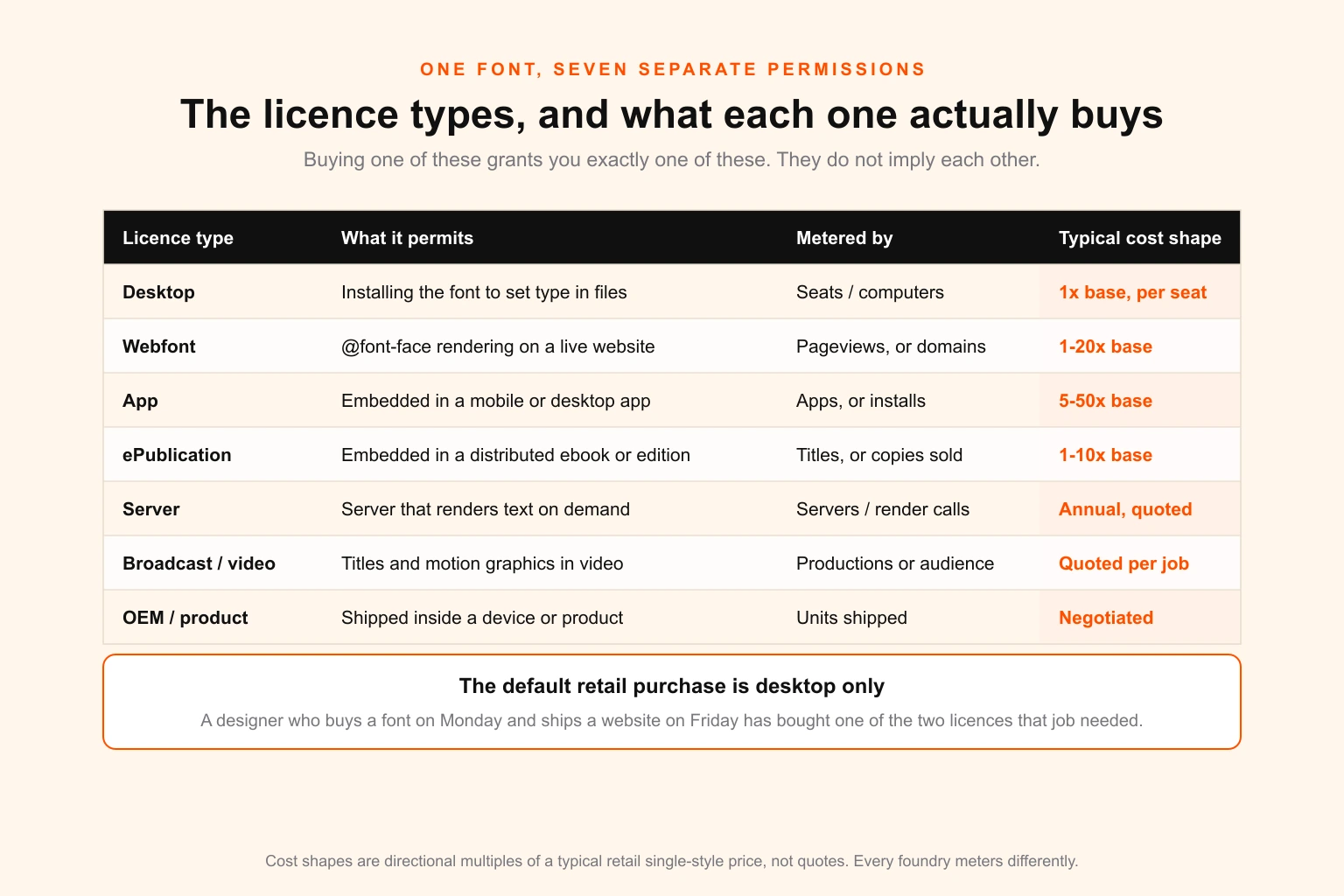
Desktop is the default retail purchase and the one everybody has. It lets you install the font on a computer and set type in design software. It is metered by seats — the number of machines it may be installed on — and the standard retail unit is small, often one to five. A studio of twelve designers who bought a five-seat licence is over its limit even if only three people have it installed today, because most EULAs count entitlement rather than concurrent use. Read yours; this is one of the details that varies.
Webfont covers a live website serving the font to visitors' browsers via @font-face. It is metered by monthly pageviews, by domain, or occasionally both, and it is frequently sold annually rather than perpetually. Pricing structures differ sharply between vendors: some price a permanent, self-hosted, unlimited-pageview web licence as a one-off, others meter it and escalate it steeply with traffic. That difference is worth checking before you specify a typeface for a client whose traffic is about to grow.
App covers a font embedded in a native mobile or desktop application. It is priced per app and is typically the steepest multiple of the base price of any tier, because the font ships to every install.
ePublication covers embedding in distributed ebooks, digital editions and interactive PDFs that go out as products rather than as proofs.
Server covers a font installed on a server that renders text on demand — dynamic image generation, personalised documents, a print automation pipeline, a template engine that composites customer names onto artwork. This is the tier that quietly catches print businesses and print-on-demand platforms, because nobody thinks of a render farm as a "computer" that needs a seat.
Broadcast and video covers titles, lower thirds and motion graphics in distributed video, usually quoted per production and sometimes scaled by audience.
OEM and product covers a font shipped inside a device or embedded in a product that is itself resold. Negotiated, and the highest tier there is.
The practical takeaway is the one on the callout in that table. The default retail purchase is desktop only, and the most common licensing failure in agency work is not piracy — it is buying one licence for a job that consumed two.
The chain-of-custody rule: who actually needs a licence
Here is the question the foundry documentation does not answer, because from a foundry's point of view it has a boring answer that nobody likes.
When a brand hires an agency, which hires a white-label studio, which delivers artwork to a print shop, which produces goods for the public — who needs the font licence?
The test is not who paid for the design. The test is who installs and runs the font software.
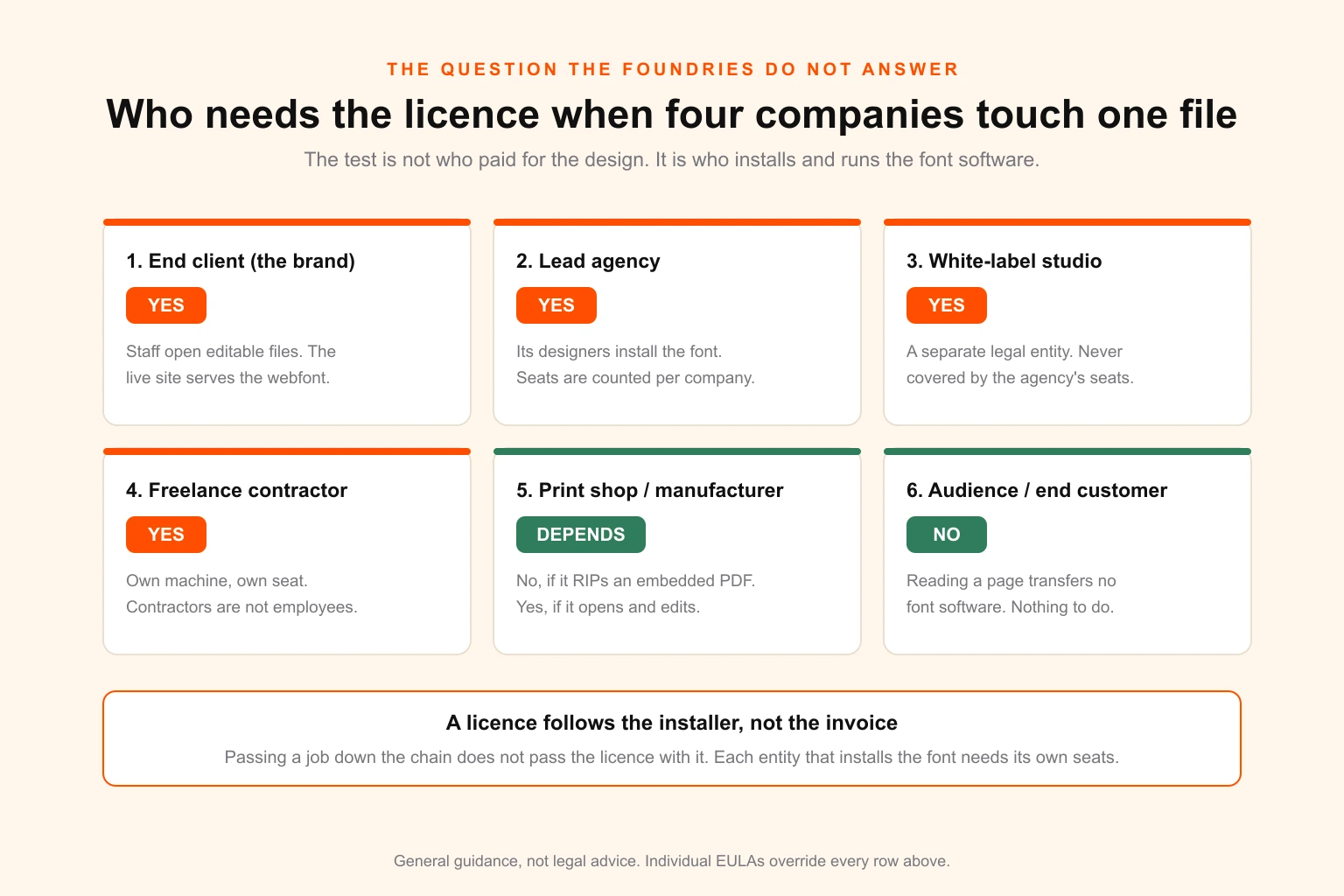
The end client needs one the moment their own staff open editable files or their website serves the webfont. A brand that receives InDesign documents and a Figma library, and has a marketing coordinator who updates them, is running the font software. So is their web server.
The lead agency needs one because its designers install the font. Seats are counted per company, and an agency's seats cover the agency's machines.
The white-label studio needs its own, and this is where the most common structural mistake in outsourced design sits. A separate legal entity is never covered by another company's seats. If you subcontract production, the subcontractor is licensing for itself, and if you have not asked whether it does, you have not asked. This is a question worth putting to any white-label design partner during selection rather than after.
A freelance contractor needs their own too. Contractors are not employees, their machine is not your machine, and a contractor working on your job under your art direction is not covered by your seat count. Some foundries offer explicit provisions for this; most do not.
A print shop or manufacturer is the genuinely interesting case, because the answer depends on what it does with the file. Receiving a print-ready PDF with the font subset embedded and sending it to the RIP installs nothing. Opening the file, hitting a missing-font dialogue, installing the family and fixing the type — which is a completely routine thing for a print shop to do to customer artwork — installs font software, and needs a licence. That is a real and under-priced volume of work for most commercial printers, and we have written separately about how much of it sits in that gap in the guide to outsourcing design for sign shops.
The audience needs nothing. Reading a page or holding a printed carton transfers no software to anybody.
The rule that falls out of this is worth stating plainly, because it is the opposite of what most people assume:
A licence follows the installer, not the invoice. Passing a job down the chain does not pass the licence down with it.
Four handoff states, four different obligations
If the chain-of-custody rule decides who needs a licence, the handoff state decides whether the question ever arises for your client. It is the single most controllable variable in the whole system, and it lives entirely in what you put in the delivery folder.
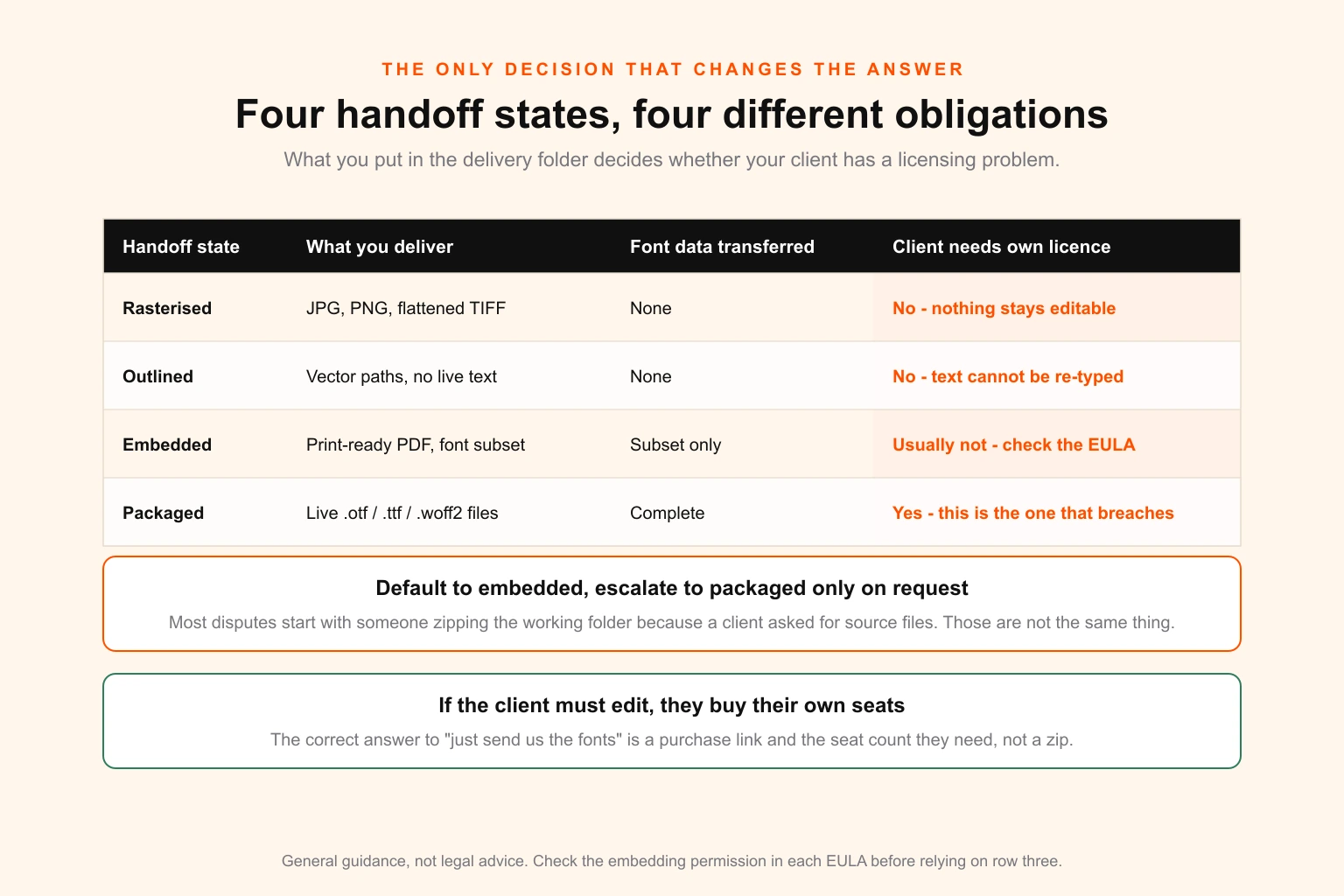
Rasterised — JPG, PNG, flattened TIFF. No font data at all. Nobody downstream needs anything. Also nothing is editable, ever, which is why this is a delivery format and never an archive format. If the difference between raster and vector output is not already second nature to whoever assembles your handovers, start there.
Outlined — vector paths with no live text. Also no font data. This is why converting a wordmark to outlines is standard practice at the end of a logo project: the finished mark becomes artwork rather than software, and the client can put it on anything without holding a type licence. The cost is that the text cannot be re-typed or re-flowed, so it is right for a logo and wrong for a brochure.
Embedded — a print-ready PDF carrying a subset of the font. A subset of the outline data does travel with the file, but the overwhelming majority of EULAs explicitly permit embedding for document exchange and printing, and font files themselves carry an embedding-permission flag. This is the correct default for most client deliverables and for everything you send to a printer. Our print-ready file checklist covers the export settings that get this right, and it is the same discipline that governs the rest of print-ready production.
Packaged — live .otf, .ttf or .woff2 files in the handover folder. Complete font software, distributed. This is the one that breaches, and it is almost always accidental: a client asks for "the source files," a designer runs Package in InDesign, and the Document Fonts folder goes into the zip along with everything else.
Source files and font files are not the same deliverable. If your client genuinely needs to edit live type — and plenty legitimately do — the correct answer to "just send us the fonts" is a purchase link and the seat count they need, not a zip. That is a thirty-second email, and it converts a silent liability into a client who owns their own brand assets, which is what they wanted in the first place. It also belongs in the brand guidelines you hand over: name the typefaces, name the foundry, name the licence tiers held, and say who holds them.
What "commercial use" actually excludes
"Licensed for commercial use" is the phrase that causes the most trouble, because designers read it as all commercial use and it never means that. It means commercial use of the type the licence describes. Four specific gaps account for most of the surprises.
Logos and trademarks. Most standard desktop licences permit setting type that is then outlined into a logo, which is how the majority of wordmarks are made. But a meaningful minority of foundries restrict logo use, require notification, or sell a separate licence for marks that will be registered as trademarks — the reasoning being that a registered mark asserts exclusivity over a shape they drew. This is a check to run before you start drawing, not after the client files their application. If you are choosing between a wordmark and a lettermark or monogram, the licence terms of your candidate typefaces are a legitimate input into that decision — a mark built from two letters is a far smaller licensing surface than one that sets a nine-letter company name.
Merchandise and print on demand. Marketplace and bundle licences are usually tiered by the number of end products, and items that are themselves sold for money generally sit in an extended tier. Design work that becomes a T-shirt, a die-cut sticker sheet or an enamel pin has crossed from "artwork for a client" into "artwork on goods for sale," and the cheap tier does not cover it. Anyone running design for a sticker business, a screen-print shop or a promotional products operation is in this territory permanently, not occasionally — as is any ecommerce brand whose listing artwork ends up on the product itself.
Video and broadcast. A social video with animated titles is not obviously "broadcast," and for most licences it is fine. A national campaign running as paid media at scale is a different conversation, and the foundry will want to have it. The threshold is not crisply defined across the industry, which is precisely why you ask before the shoot rather than after the airing.
Servers and automation. Any pipeline that renders text without a human sitting at a machine — personalised direct mail, dynamic social templates, an e-commerce product previewer, a variable-data print run — is server use, and desktop licences do not cover it. This one catches sophisticated operators most often, because the people building the automation are engineers who never saw a font licence in their lives.
The free font trap, and why open licences are not a fallback
Free is a price, not a permission. Every font you did not pay for still arrived with terms.
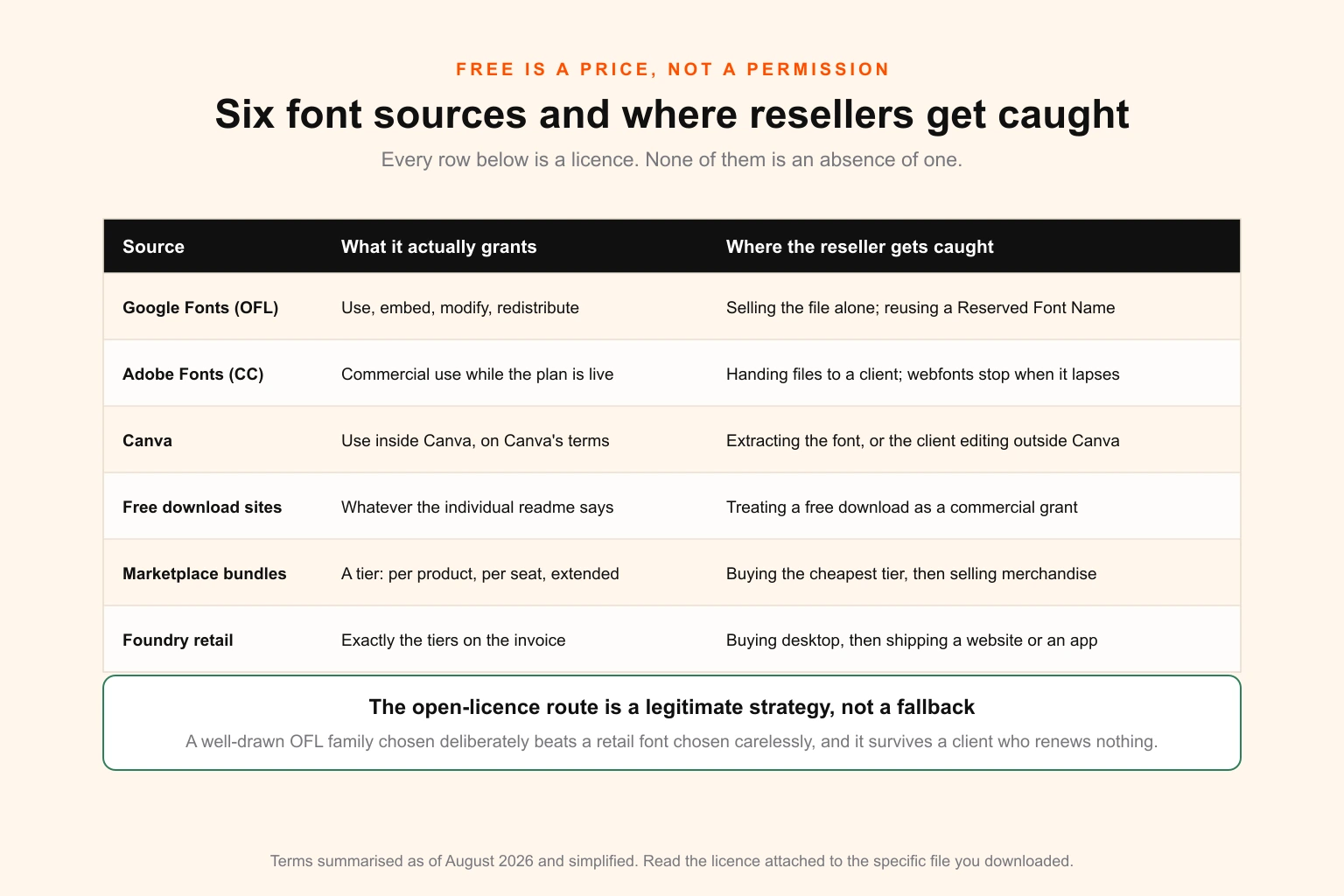
Google Fonts and the SIL Open Font License are the strongest position available to a reseller, and they are badly undersold. The OFL grants the right to use, study, copy, merge, embed, modify, redistribute and sell copies, free of charge, with no seat count and no pageview meter. Its conditions are narrow: the font software may not be sold by itself, only bundled with something else; a modified version may not use a Reserved Font Name without written permission; the original copyright notice and licence must travel with any redistributed copy; and any redistributed version must stay under the same licence.
Read those against a normal design workflow and none of them constrains you. You are not selling font files. You are probably not modifying the family. You are bundling the font into a website or a document, which the licence explicitly contemplates. The library is now large, well-drawn and includes serious multi-weight families with real language coverage — this site's own type stack is open-licence, for exactly these reasons.
Adobe Fonts is the most common source of accidental breach in agency work, because it is so frictionless that nobody registers it as a licence at all. It permits personal and commercial use of the fonts you activate while your Creative Cloud plan is live. Two things follow. First, the workflow is not compatible with packaging font files to another person or machine — if your client needs to edit the live type, they need their own entitlement, whether that is their own Creative Cloud plan or a purchased desktop licence. Second, it is a subscription, not a purchase. Hosted webfonts stop being served to a site when the subscription ends, and documents that reference the fonts will throw missing-font warnings, though anything already rasterised, outlined or embedded in a PDF keeps working indefinitely. A client site whose type breaks because an agency downgraded a plan eighteen months after the project ended is a real and recurring failure.
Canva grants use of its fonts inside Canva, on Canva's terms. That is genuinely useful and completely fine until the work needs to leave Canva, at which point neither the font nor the entitlement travels with it.
Free download sites are the wild ones. Terms are set per file by whoever uploaded it, and a very large share of what is offered is personal-use only with a commercial licence sold separately. There is no shortcut here other than opening the readme that came in the zip, which is why almost nobody does it.
Marketplace bundles are tiered, and the tiering is where the money is. Buying the entry tier and then using the artwork on goods for sale is the standard trap.
Foundry retail grants exactly what is on the invoice and nothing else. If the invoice says desktop, you have desktop.
The strategic conclusion, which is not the one most guides reach: specifying an open-licence family deliberately is a legitimate senior decision, not a budget compromise. It removes seat counting, pageview metering, renewal risk and handoff friction from every project it touches, and it survives a client who never renews anything. Keep paid faces for the projects where a specific voice genuinely justifies the operational overhead — which is a real category, just a smaller one than most studios assume. The serif and sans-serif trade-offs that actually drive that choice are worth more attention than the price tag.
What licensing costs, and why it belongs on the estimate
Font licensing is a pass-through cost. Studios that absorb it quietly lose margin on exactly the projects where typography matters most, which is a perverse outcome for a design business.
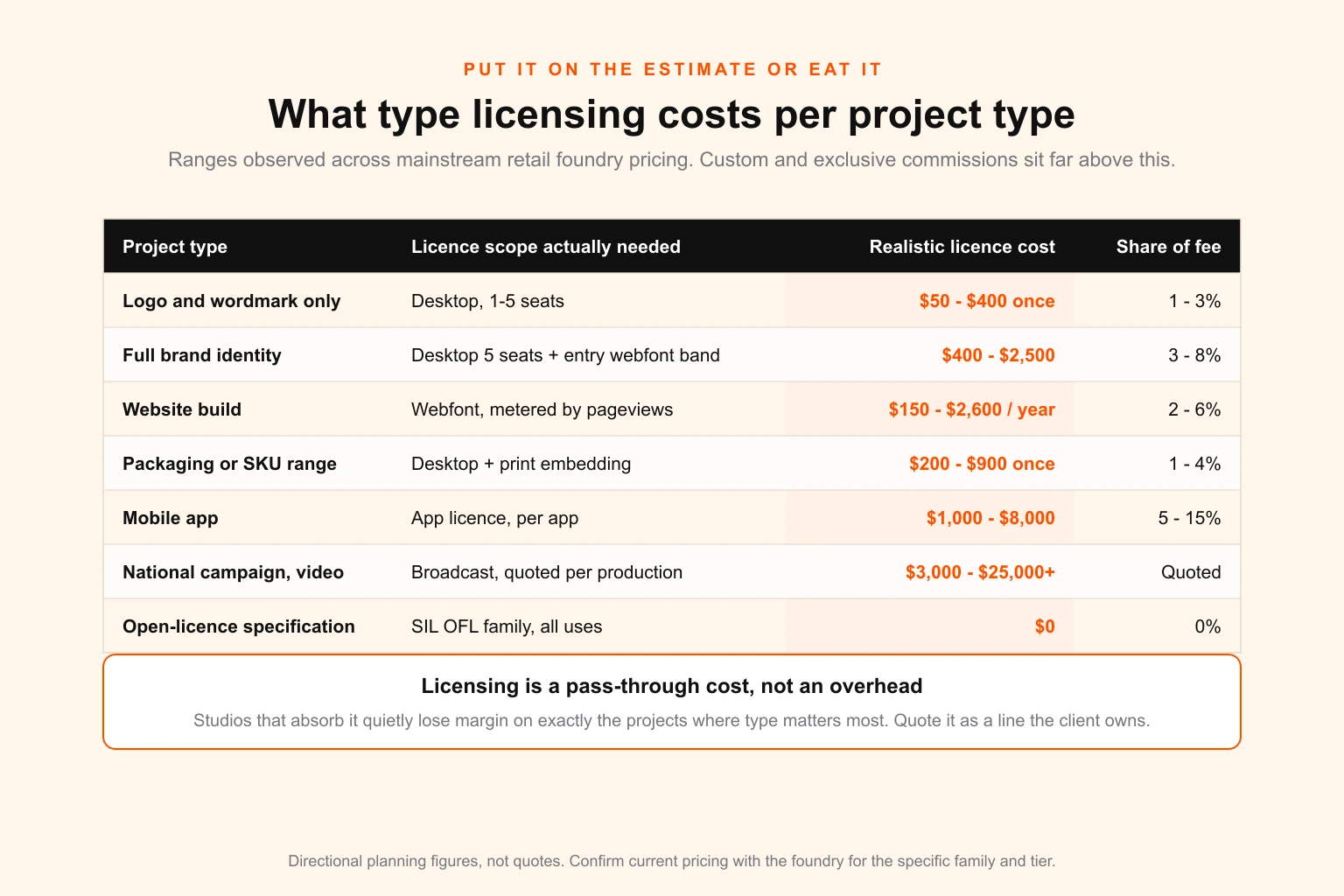
Those ranges are directional planning figures gathered across mainstream retail foundry pricing, not quotes — every foundry meters differently and custom or exclusive commissions sit far above this. But the shape holds well enough to budget against, and the shape is what matters: type licensing is usually somewhere between one and eight percent of a design fee, occasionally more for apps and broadcast, and zero if you specified an open-licence family.
A percentage that small is exactly why it gets skipped, and exactly why skipping it is irrational. Nobody sinks a project over three percent. Projects do get sunk by a five-figure compliance settlement two years later on a job that billed four figures.
Three rules make it manageable:
- Quote it as a named line the client owns. "Type licensing — estimated USD X, purchased in client's name, invoiced at cost." It is not a margin item and pretending otherwise creates the incentive to leave it off.
- Specify before you design. Choosing the typeface, then discovering the webfont tier costs more than the design fee, is a conversation nobody wants to have at proof stage.
- Price the renewal, not just the purchase. Metered webfont licences and annual terms are recurring costs, and the client should know that in month one rather than month thirteen.
This is the same discipline as any other pass-through in a design business — stock, print, proofing, production. Studios that already run a clean design brief process usually find the licensing question fits naturally into the same conversation, because "what surfaces will this appear on" is already question one.
What actually happens when a claim arrives
The mental model most designers have is a cease-and-desist and a lawyer. That is not what this looks like. The party on the other side wants a signed licence, not a court date, which is why the process is survivable if you handle the middle of it carefully.
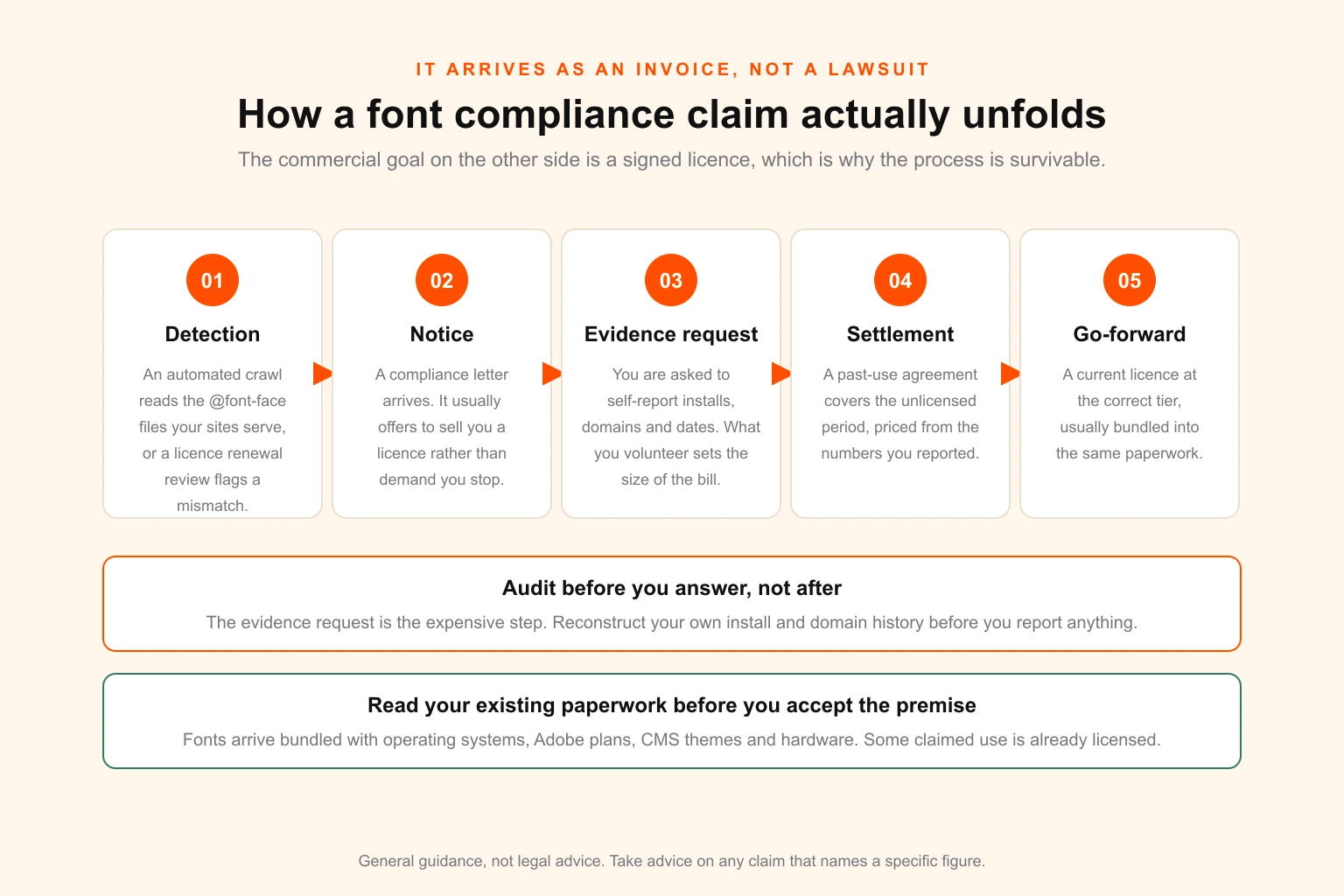
Detection is usually automated and usually starts with the web. Every site serving a commercial webfont publishes, in effect, a machine-readable declaration of which font software it is running and on what domain. Crawling that at scale is trivial. Licence renewal reviews and acquisition-driven catalogue audits — where a foundry acquires another foundry's library and reconciles it against existing agreements — are the other common trigger.
Notice arrives as a compliance or licensing letter. The tone is commercial rather than litigious, and the offer is generally to sell you what you should have had.
The evidence request is the expensive step, and it is the one people handle worst. You are asked to self-report installs, machines, domains, date ranges. Whatever you volunteer becomes the basis for pricing the settlement. There are two mistakes to avoid: answering quickly with guesses that are too generous, and answering quickly with guesses that turn out to be wrong. Both cost money. Reconstruct your own install and domain history first — this is exactly what the register described in the next section is for — so that the numbers you report are accurate and bounded.
Before you accept the premise at all, check what you already hold. Fonts arrive bundled with operating systems, with Creative Cloud, with CMS themes, with hardware, with software you bought for other reasons. Some claimed use turns out to be licensed already through a channel nobody thought to check.
Settlement normally takes the form of a past-use agreement covering the unlicensed period, priced from the reported figures, frequently packaged together with a go-forward licence at the correct tier. That combination is the standard commercial resolution.
Two things worth saying plainly. First, if a claim names a specific figure, get advice — this is a negotiation, and the numbers in these letters are opening positions. Second, do not conclude from all this that foundries are the villains of the story. Type is drawn by small businesses and individuals, the licence is how they get paid, and the alternative to an enforceable licence is a world with far less good type in it. The problem worth fixing is not that licensing exists. It is that most design supply chains have no system for tracking it.
The system: six controls that make this a solved problem
You do not need a legal department. You need a register and five habits.
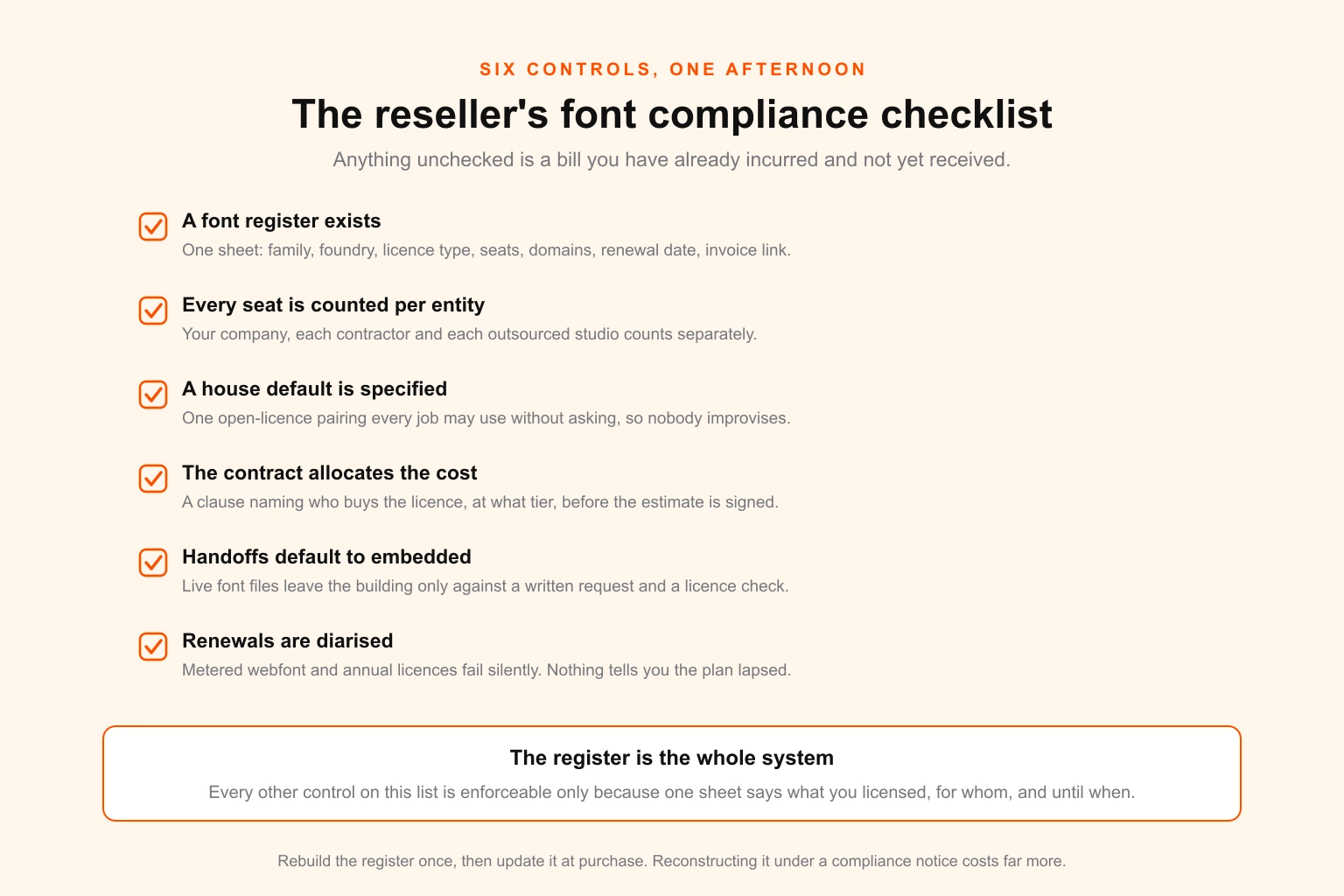
1. Build the font register. One sheet, one row per licensed family, with these columns:
| Column | Why it is there |
|---|---|
| Family and styles | The specific weights, not "Aktiv" |
| Foundry / vendor | Who to renew with, who might audit |
| Licence type(s) held | Desktop, webfont, app — list all, separately |
| Seats or tier | The number you are entitled to |
| Domains covered | Every domain the webfont licence names |
| Licence holder | Your company, or the named client |
| Purchase date | The start of the covered period |
| Renewal / expiry | Blank means perpetual; a date means a diary entry |
| Invoice / EULA link | Where the proof lives |
| Projects using it | So you know what breaks if it lapses |
Building this the first time is a genuinely tedious afternoon. Reconstructing it under a compliance notice, with a deadline and an incentive to be accurate, costs vastly more.
2. Count seats per legal entity. Your company, each contractor, each outsourced studio. If you are the reseller in the middle, ask your production partner directly what they hold — a partner who cannot answer that question is telling you something useful about how they operate.
3. Specify a house default. One open-licence pairing — a workhorse sans and a text serif — that any job may use without asking anyone. Most improvisation happens because a designer needs a typeface at 6pm and there is no sanctioned answer. Give them one.
4. Put the allocation in the contract, before the estimate is signed. Sample language, to be reviewed by someone qualified in your jurisdiction before you use it:
Typeface licensing. Any commercial typeface required for the Deliverables shall be licensed by the Client in the Client's own name, at the tiers and seat counts specified by the Studio, prior to commencement of production. The Studio holds its own licences for production use only and grants no rights in any typeface to the Client. Font software will not be supplied as part of any deliverable; the Studio will supply outlined, rasterised or embedded output. Where the Client instructs the Studio to purchase licences on the Client's behalf, such licences are purchased as agent, invoiced at cost, and assigned to the Client on payment.
That paragraph does four things at once: it makes the client the licence holder, it makes the purchase a precondition rather than an afterthought, it forecloses the "just send us the fonts" conversation, and it stops your studio silently renewing licences for brands you no longer work on.
5. Default every handoff to embedded. Live font files leave the building only against a written request, and only after a licence check. Make it a step in your delivery process rather than a matter of individual judgement at 6pm on a Friday.
6. Diarise renewals. Metered webfont and annual licences fail silently — nothing on the site breaks the day the term ends, and nothing emails you. A calendar entry sixty days before each expiry is the entire control.
The thirty-day sprint, if you are starting from nothing
Most studios reading this are starting from nothing, which is normal and not a crisis. Thirty days of part-time attention gets you to a defensible position.
Days 1–7: inventory what is installed. Pull the font list off every machine in the studio, including contractors' if you can. Sort into three buckets: system-and-Adobe (largely covered, note the terms), open-licence (fine, note the family), and everything else (the actual list, usually much shorter than feared).
Days 8–14: reconcile the "everything else" list against receipts. For each family, find the invoice and the EULA. Three outcomes: licensed correctly, licensed but at the wrong tier or seat count, or no record at all. Nothing needs deciding yet — you are building the register.
Days 15–21: audit live client sites. For every site you built or maintain, check what the CSS actually serves. Self-hosted commercial webfonts with no matching licence line in your register are the highest-exposure items you own, because they are the ones detection finds first. Fix by buying the correct tier, moving the client to their own licence, or substituting an open-licence family.
Days 22–30: install the system. Register live and owned by a named person. Contract clause into the template. House default specified and circulated. Handoff rule written into the delivery process. Renewals in the calendar.
Then keep it current at the point of purchase, which takes about ninety seconds per font and is the only reason any of this stays true.
The reseller's summary
If you take five things from this:
- A licence follows the installer, not the invoice. Every legal entity that installs the font needs its own — your studio, your contractor, your white-label partner, your client.
- The handoff state is your main lever. Rasterised, outlined and embedded transfer no installable software. Packaged does, and packaged is what breaches.
- Desktop does not imply webfont, and neither implies app, server, broadcast or OEM. One job frequently needs two licences.
- Open licences are a strategy, not a fallback. An OFL family removes seat counting, metering, renewal risk and handoff friction from every project it touches.
- The register is the whole system. Every other control is enforceable only because one sheet says what you licensed, for whom, and until when.
Where this fits if you outsource design
If you resell design — an agency putting production through a partner, a print shop offering artwork services, a manufacturer supplying files with the goods — this is one of a small number of operational risks that live in the gap between two companies, which is exactly why nobody owns it.
It is worth asking your production partner directly: what do you hold, in whose name, and what do you put in the handoff folder? A partner who can answer that in one sentence has a system. A partner who cannot has your exposure sitting on their machines.
Digital Polo works as the white-label design studio behind agencies, printers and manufacturers, and licensing hygiene is part of the production standard rather than an afterthought: open-licence families as the default specification, client-held licences where a commercial face is genuinely warranted, and deliverables that go out outlined or embedded so nothing installable moves down the chain unless someone asked for it in writing. Flat monthly pricing, unlimited requests, and source files that do not carry a liability with them.
If you would rather see how that works than read about it, the pricing is here and the work is here. If you are still deciding whether outsourcing production makes sense at your volume at all, the utilisation maths is worth reading first.
Frequently asked questions
Do I need a font licence for client work? Yes, and so does anyone else who installs the same font. A licence attaches to the entity that installs and runs the font software, not the entity that pays for the design. Your studio needs seats for its machines, the client needs seats if their staff open editable files or their site serves the webfont, and a white-label subcontractor needs its own because it is a separate legal entity. The only party that reliably needs nothing is the audience.
Who buys the font licence, the agency or the client? Commercially, the client should buy and hold it, because the licence outlives the engagement. Legally, that does not remove your own obligation for the machines your designers work on. The clean arrangement is a contract clause naming the client as licence holder, purchase in their name before production starts, and your studio's seats treated as a cost of doing business.
Can I give font files to my client?
Almost never, unless the licence expressly permits transfer. Handing over live .otf, .ttf or .woff2 files is distribution of software, and standard retail EULAs do not allow it. Supply rasterised, outlined or embedded output instead, and answer "just send us the fonts" with a purchase link and a seat count.
What is the difference between a desktop and a webfont licence?
Desktop covers installing the font to set type, metered by seats. Webfont covers a live site serving it to browsers via @font-face, metered by pageviews or domains. They are separate permissions and neither implies the other.
Are Google Fonts free for commercial use? Yes. Most are released under the SIL Open Font License, which permits use, modification, embedding, redistribution and sale of copies, commercially, with no fee or meter. The conditions that bite are narrow: no selling the font software by itself, no Reserved Font Name on a modified version without permission, and any redistribution stays under the same licence.
What happens if I use a font without a licence? Usually a compliance letter offering to sell you a licence, not a lawsuit. The sequence runs detection, notice, evidence request, past-use agreement, go-forward licence. The evidence request is the expensive step — reconstruct your own history before you answer, and check what you already hold through bundled channels.
Does a print shop need a font licence for customer-supplied files? Only if it installs the font. Sending an embedded print-ready PDF to the RIP triggers nothing. Opening the file, installing the missing family and editing the type does. Contract clauses pushing font responsibility onto the customer allocate cost; they do not create a permission the shop never held.
Can I use a licensed font in a client's logo? Usually yes, and outline it immediately. Most desktop licences permit setting type that is then converted to outlines, though a minority of foundries restrict logo use or require a separate licence for registered marks — check the EULA before you start. Outlining covers the mark, not the rest of the identity.
How much does a font licence cost? A single style from a mainstream retail foundry commonly runs USD 30 to 80 for desktop, scaling with families and seat bands. Per project: roughly USD 50–400 for a logo, 400–2,500 for a full identity, 150–2,600 a year for a website, 1,000–8,000 for an app. Broadcast and OEM are quoted and run higher. Directional figures — confirm with the foundry.
Are fonts protected by copyright? It depends on the jurisdiction and on what you mean by "font." In the United States, letterform designs have generally not been treated as copyrightable, but the font file is software and is protected — which is why claims are about the file, not the shapes. Several other jurisdictions protect typeface designs more directly. Either way, the licence you accepted binds you as a contract regardless.
Can I use a marketplace or bundle font for merchandise and print on demand? Only on the tier that covers it. Marketplace licences tier by end products, seats, or an extended tier for goods that are sold — merchandise and print on demand almost always sit in the extended tier. Buy it up front, or specify an open-licence family, which has no tiering at all.