If you run a promotional products business — custom enamel pins, embroidered patches, button badges, challenge coins, keychains, or printed merch for clients — the artwork file you send to the manufacturer either makes the order or breaks it. There is no "good enough" middle ground. A pin manufacturer's mould-maker needs Pantone codes and a 0.15mm minimum line weight. An embroidery shop needs thread-callout layers and minimum 2mm strokes. A button press needs a flat vector at the correct bleed. Hand a manufacturer the wrong file and one of two things happens: the order comes back wrong, or the manufacturer sends it back asking for a rebuild — and you eat the timeline hit while your customer waits.
This guide is the practical playbook for the design side of a promotional products business. The file specs each product type actually needs, the mistakes that bounce artwork back from the factory, how to brief a designer so the first file is the right file, and the realistic options for outsourcing design at the volume promotional products businesses actually operate at.
DigitalPolo has been delivering unlimited graphic design since 2010 — one of the oldest services in the category — with plans from $399/month, 48-hour turnaround, unlimited revisions, and production-ready vector source files (AI, EPS, PDF) including manufacturer-ready die lines, Pantone callouts and embroidery stitch paths included as standard. That last detail is the one most subscriptions skip and it is the one promotional product shops cannot do without.
Why Promotional Products Demand a Specialist Design Workflow
Promotional product artwork is not graphic design. It is manufacturing artwork, which is a different discipline. The same illustration that prints beautifully on a sticker will look wrong on a 25mm enamel pin if it was not redrawn with mould constraints in mind. The same logo that embroiders cleanly on a 75mm patch will turn into thread soup at 30mm. And the same Pantone callout that the manufacturer needs to mix the enamel batch is the field that designers used to digital work most often leave blank.
A promotional products designer has to think in physical production constraints first, aesthetics second:
- Minimum line weight at the final product size, in millimetres.
- Whether each colour field is large enough to be physically filled (enamel, ink or thread).
- Whether the substrate (metal, fabric, plastic, paper) can hold the level of detail in the artwork.
- What the manufacturer's tooling can actually resolve — moulds, embroidery machines, button presses, hot-foil stampers all have limits.
- Plating, finish, and post-production processes that affect colour and detail.
If your current designer cannot answer "what is the minimum line weight on this 30mm soft enamel pin at final size?" they are not equipped for promotional products work. You will pay for the design twice — once for the original, once for the rebuild after the manufacturer rejects it.
For context on why generalist design hires struggle at this kind of production-specific volume, see our breakdown of why most small businesses should not run design in-house.
Design File Specs by Promotional Product Type
The cut, the substrate, and the manufacturing process each change the file. A designer who delivers the same vector for all five product types below is delivering generic artwork — and you will see the consequence in your manufacturer's reply email.
Enamel Pins (Soft and Hard Enamel)
The most commonly outsourced promotional product, and the one where file errors cost the most because the mould has to be re-tooled.
Design file requirements:
- Vector format (AI, EPS, or print-ready PDF).
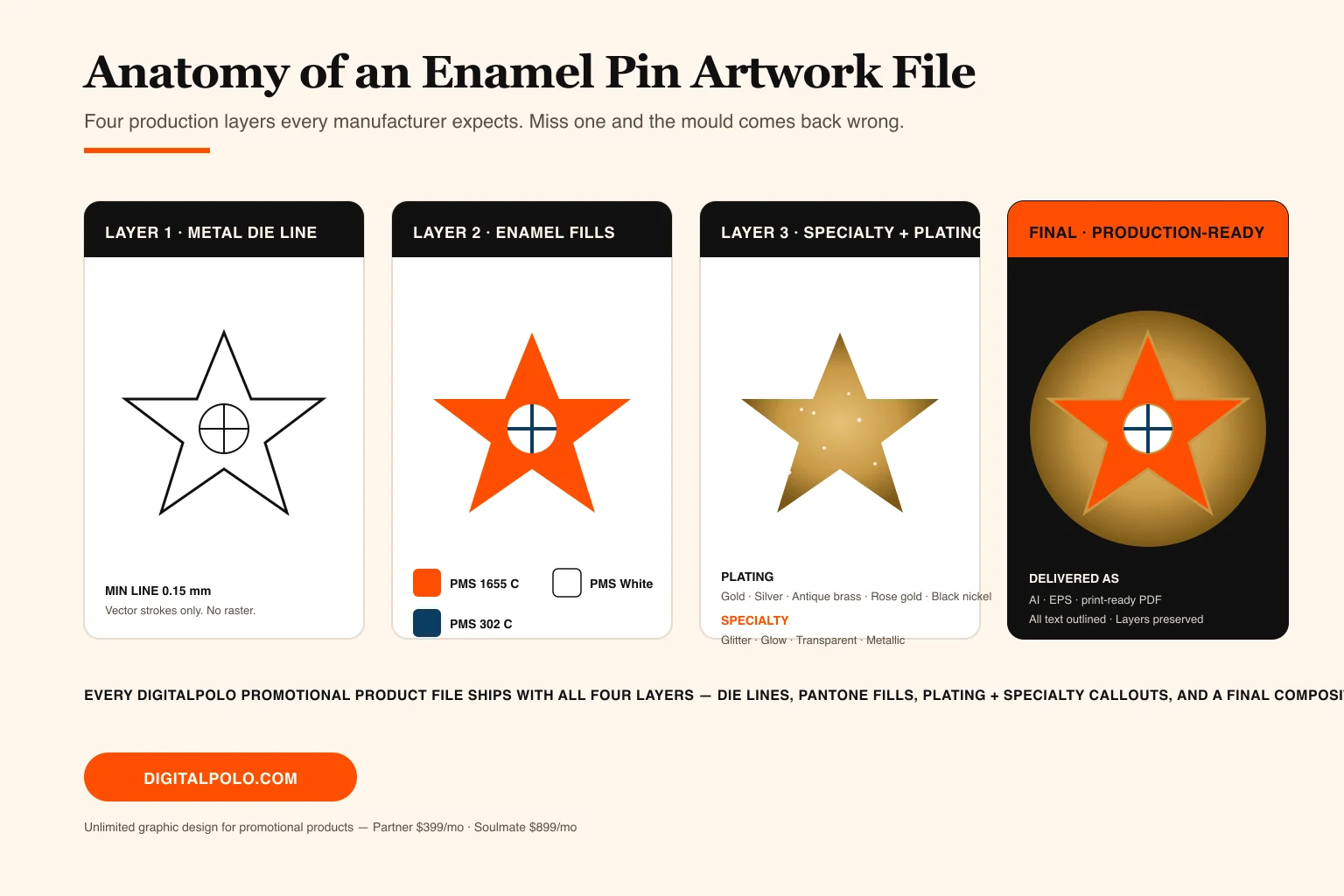
- A separate metal die-line layer in a spot colour, naming the layer clearly (typically
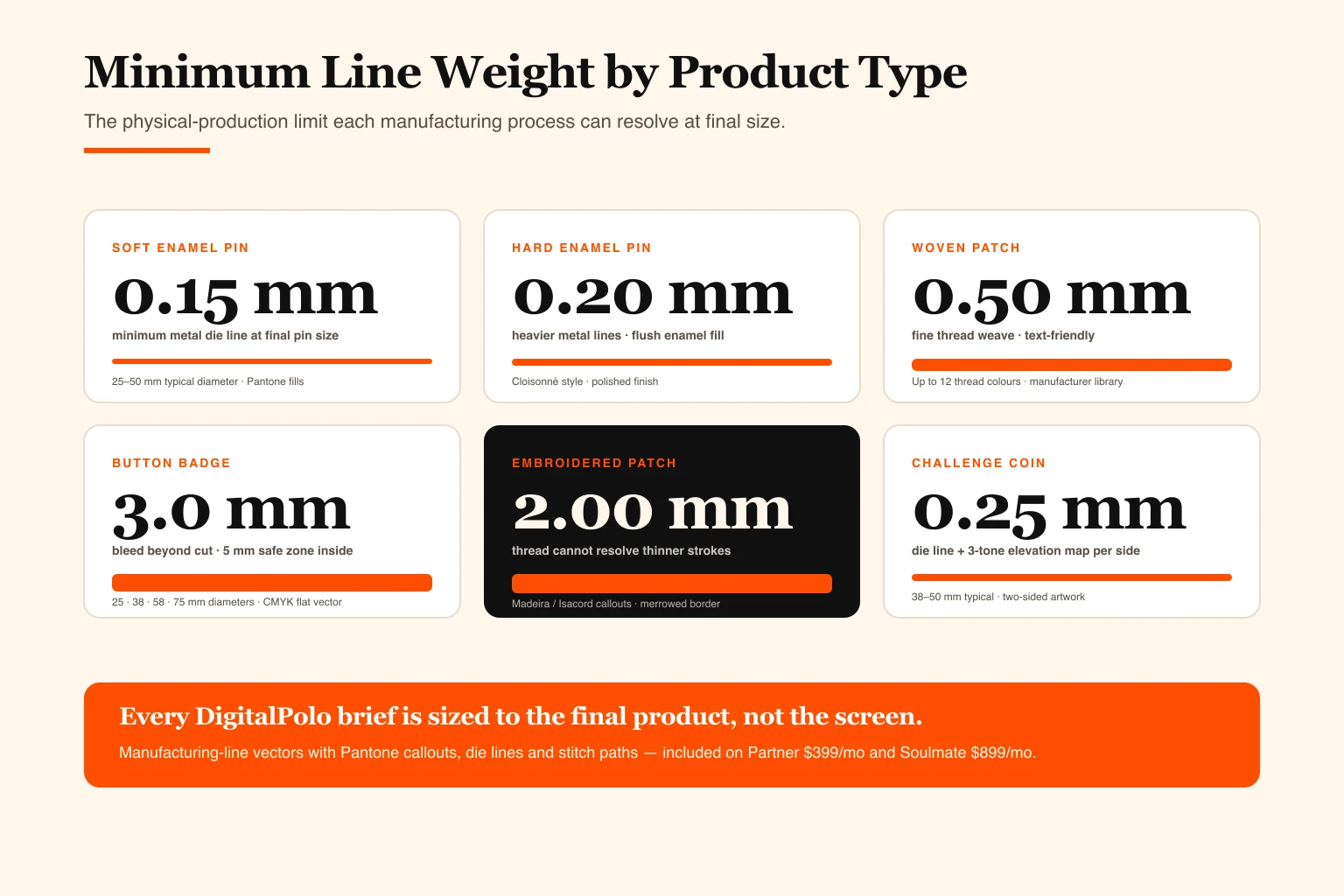
MetalorDieLine). - Minimum metal line weight of 0.15mm at final pin size — usually 25mm to 50mm in diameter.
- Each enamel colour field on its own layer, with a Pantone Solid Coated reference (e.g. PMS 186 C). No hex codes, no RGB.
- Minimum enamel field area of about 1mm² — anything smaller bleeds into adjacent metal during the fill.
- A separate specialty fills layer for glitter, glow-in-the-dark, transparent or metallic enamels.
- Plating callout: gold, silver, antique brass, black nickel, rose gold, copper.
- All text converted to outlines.
Hard enamel pins (also called "cloisonné style") use higher line weights than soft enamel because the enamel is filled flush with the metal and the metal lines are visually more prominent. A designer who understands the difference adjusts the artwork accordingly.
Embroidered Patches
Embroidery is built from thread, not ink — the design rules change accordingly.
Design file requirements:
- Vector format with each colour on its own layer.
- Minimum line weight of 2mm at final patch size. Threads cannot physically resolve thinner lines.
- Minimum detail size of 3mm wide for shapes inside the patch.
- Thread colours called out by Madeira or Isacord thread codes, not Pantone (thread doesn't map cleanly to Pantone).
- A defined border type: merrowed (rolled fabric edge), heat-cut (laser-trimmed), or laser-cut for shaped patches.
- A defined backing type: iron-on, sew-on, velcro hook-and-loop, or adhesive.
- A separate stitch direction layer if specific fill directions matter for the design (uncommon, but standard for premium patch shops).
Embroidered patches require simplification. Detail that works in vector almost always needs to be reduced or removed for thread to resolve cleanly. A designer experienced in patches builds this simplification into the first draft, not the third revision.
Woven Patches
Woven patches resolve finer detail than embroidered patches because each thread is thinner — but the file requirements still differ from print.
Design file requirements:
- Vector format with up to 8 thread colours typical, 12 colours for premium woven patches.
- Minimum line weight of 0.5mm at final patch size — significantly finer than embroidered patches.
- Thread callouts in the manufacturer's woven thread library.
- Border type and backing type defined as with embroidered patches.
Woven patches are the right product type when the artwork has fine text, small logos, or detailed illustration that embroidery cannot resolve. Brief the designer on the substrate type early — the same illustration is drawn differently for embroidered vs. woven patches.
Button Badges (Pin-Back Buttons)
The simplest promotional product file-wise — a flat printed design — but still has spec requirements that get missed.
Design file requirements:
- Flat vector artwork at the final button diameter (commonly 25mm, 38mm, 58mm, 75mm).
- 3mm of bleed beyond the button cut diameter — the artwork wraps over the metal edge during pressing, so bleed is consumed by the wrap.
- 5mm safe zone inside the cut diameter — content inside this zone stays on the visible face after wrapping.
- CMYK colour mode for digital print buttons; Pantone for spot-colour offset-printed buttons.
- 300 DPI minimum if any raster element is embedded.
- All text outlined.
The most common button design mistake is forgetting that bleed wraps around the back. Important content right at the edge of the button face disappears around the side after pressing.
Challenge Coins
Two-sided, three-dimensional, and the most file-spec-intensive promotional product because each side has its own die plus an elevation map for the relief.
Design file requirements:
- Two separate files — front and back — at the final coin diameter (typically 38mm to 50mm).
- A vector outline of the coin shape (round, custom-shape, hexagonal, dog-tag).
- A die-line layer for each side defining all engraved or raised lines.
- An elevation map layer marking which areas are raised, recessed, or flat — typically three-tone (white = raised, mid-grey = mid-relief, dark grey = recessed).
- Edge type: smooth, rope-cut, oblique, beveled.
- Plating callout for each side.
- Pantone callouts for any enamel-fill or printed colour areas.
- A specialty fills layer for glitter, glow, transparent enamel, or 3D-relief callouts.
The elevation map is the single most-missed file element in challenge coin design. Without it, the mould-maker guesses at relief, and the customer's "raised eagle wing" comes back flat.
Keychains, Magnets, Coasters and Adjacent Products
Most metal keychains (acrylic charms, soft-enamel keychains, charm-on-chain) follow the same file rules as enamel pins. Magnets and coasters typically follow button-badge rules (flat printed vector with bleed). For each, brief the designer on the substrate explicitly — the file is built around the manufacturing process, not the visual.
The 9 Mistakes That Get Promotional Product Artwork Rejected
These are the exact reasons promotional product manufacturers send files back. If your designer hits any of them, you have the wrong designer.
- Submitting raster files (JPG, PNG) instead of vector. Mould-makers and embroidery digitisers cannot work from raster.
- No die-line layer on enamel pins. The manufacturer cannot cut the mould without it.
- Hex codes or RGB colours instead of Pantone. Enamel batches are mixed by Pantone reference. Hex codes are useless to the colour-mixer.
- Metal lines under 0.15mm on enamel pins. The mould cannot resolve them; the enamel fills them in.
- Embroidery lines under 2mm. Thread cannot resolve the detail; the patch comes back as a fuzzy approximation.
- No bleed on button badges. The artwork edge wraps to the back of the button and you lose content.
- Live text instead of outlined text. The manufacturer's font library is not yours. They substitute, and you don't catch it until the order arrives.
- No elevation map on challenge coins. The mould-maker guesses at relief. The eagle wing comes back flat.
- Missing plating or finish callouts. Brass or antique brass? Polished silver or matte? Black nickel or gunmetal? Each is a different production process. Specify it.
How to Brief a Designer for a Promotional Product
The brief that gets a production-ready file on the first round contains seven things:
- Product type — soft enamel pin, hard enamel pin, embroidered patch, woven patch, button badge, challenge coin, keychain, magnet. State it explicitly. "A pin" is not enough.
- Final size in millimetres. "1 inch" is ambiguous and prone to conversion errors. Use mm.
- Manufacturer you will use and their spec sheet. Most pin and patch manufacturers (PinSource, The Studio, EnamelPins.com, your overseas factory) publish spec sheets. Share them.
- Pantone or thread codes, not hex codes. "PMS 186 C" or "Madeira 1149" — not "this shade of red."
- Plating or finish for metal products. Gold plate, antique brass, black nickel, rose gold, polished silver, matte silver. Pick one.
- Specialty fills if any — glitter enamel (density: light/medium/heavy), glow-in-the-dark, transparent enamel, metallic thread, sequined backing.
- Reference images. Three to five existing pins, patches or buttons that hit the visual style you want. This single step eliminates 80% of revision cycles in promotional product design.
For a more general framework on briefing any design work, see our guide on how to develop a friendly working collaboration with your graphic designer.
The Math: Outsourcing Design for a Promotional Products Business
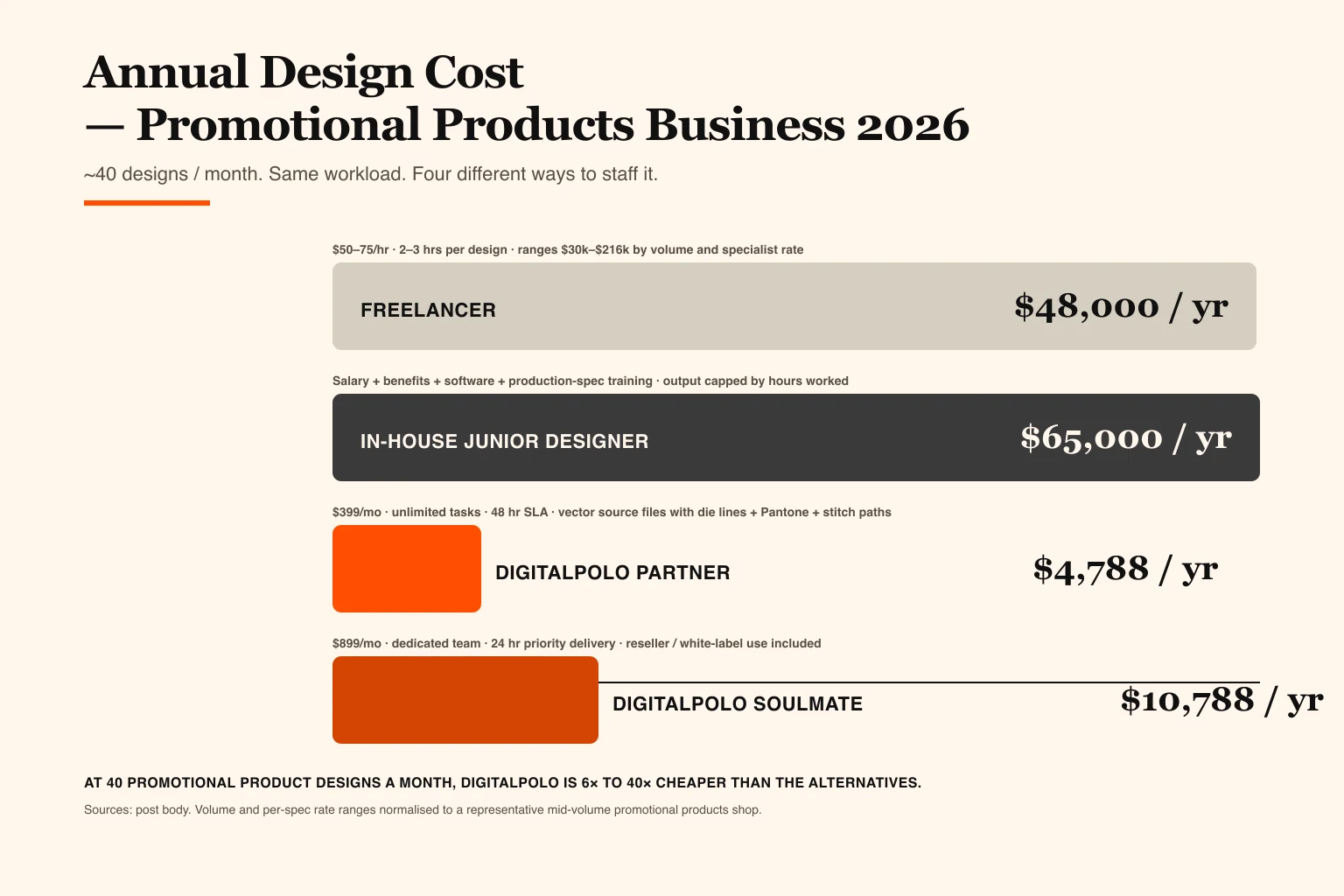
A typical promotional products business produces 25 to 80 new designs a month — custom client orders, seasonal collections, restock variants, sample artwork for prospects. Here is what each design approach actually costs at that volume:
| Approach | Monthly Cost | Notes |
|---|---|---|
| Freelancer at $50–75/hour, 2–3 hours per design | $2,500 – $18,000 | Variable per project. Specialist promo designers charge premium. Vacation gaps. No SLA. |
| In-house junior designer | $5,400+ in salary alone | Add benefits, software, equipment, training in production constraints. Output capped by hours worked. |
| Per-project agency or pin-specialist studio | $150 – $400 per design | At 40 designs/month, $6,000 – $16,000. Brutal at scale. |
| DigitalPolo Partner plan | $399/month | Unlimited tasks, 48-hour SLA, vector files with die lines, Pantone callouts and stitch paths included. |
| DigitalPolo Soulmate plan | $899/month | Dedicated team, 24-hour priority delivery, ideal for promotional shops with multi-client volume or wholesale orders. |
At 40 designs a month, an unlimited subscription is 6× to 40× cheaper than the alternatives — and you do not absorb the operational drag of a person or the unpredictability of project-by-project freelance billing.
The math gets even more decisive if your promotional products business is a reseller or print-broker serving multiple end-clients. Each client account means recurring custom-design requests. At that volume, the Soulmate plan's dedicated team handles the throughput plus the brand-consistency challenge across accounts in one fixed fee.
Why Unlimited Graphic Design Fits Promotional Products Specifically
Most unlimited design subscriptions were built around social media graphics and ad creatives. A small handful — DigitalPolo among them — are actually built around the production-file specs that promotional products manufacturers require. The fit comes from four things:
1. Vector source files with manufacturer-ready specs on every deliverable. Not "available on request." Not "available on the higher tier." Standard on the entry plan. This is the single feature that determines whether a subscription is usable for promo work or not.
2. High task throughput without surge pricing. Promotional products businesses run on volume — 40+ custom designs a month is normal for any shop with even a modest client list. An unlimited subscription absorbs the spike at the same flat fee. Per-project pricing punishes you for growing.
3. Manufacturing conventions handled natively. A designer accustomed to working with pin and patch manufacturers understands that the die-line is non-negotiable, that text gets outlined, that Pantone codes are how the colour gets mixed. Most generalist unlimited subscriptions have to be trained on this every brief.
4. Reseller and white-label use built in. If you run a promotional products business that produces designs for other companies as part of the order, you need the right to deliver the artwork file to your end client under your own brand. DigitalPolo allows this explicitly. Many subscriptions restrict reseller use on lower tiers or bury it in TOS exclusions.
For deeper context on the reseller use case specifically, see our white-label graphic design guide for resellers and the Digital Polo landing page for pin and badge manufacturers, which covers the manufacturer-ready spec workflow in production-line detail.
DigitalPolo Plans and Pricing
| Plan | Price | Turnaround | Delivery | Best For |
|---|---|---|---|---|
| Partner | $399/month | 48 hours | Unlimited tasks, vector source files (AI, EPS, PDF) with die lines, Pantone callouts, stitch paths | Solo promo shops, e-commerce pin/patch brands, designers with 20–50 monthly orders |
| Soulmate | $899/month | 24 hours (priority) | Dedicated team, 24×7 support, all source files | Wholesale promo shops, multi-client promotional products businesses, agency-reseller workflows |
Both plans include delivery of all source files — vector formats (AI, EPS, PDF) suitable for enamel pin moulds, patch embroidery, button press production, challenge coin tooling, and any other production-ready promotional product workflow. The Soulmate plan's dedicated team is the right choice for promotional products businesses where one or two designers need to learn your manufacturer's specs, your house enamel library, your repeat-client brand standards, and your seasonal release cadence.
See Digital Polo's full pricing →
Choosing the Right Manufacturer to Pair With Your Designer
The designer-manufacturer relationship matters as much as the design itself. The major options promotional products businesses work with:
- The Studio (PinSource) — premium US-based pin manufacturer, strict file requirements, publishes detailed spec sheets, fast turnaround on small batches.
- EnamelPins.com / PinPress — direct-to-consumer pin manufacturers, mid-tier pricing, accepts more design tolerance but requires Pantone callouts.
- Asian factories (Pin Factory, MakeYourPins, custom Alibaba relationships) — best volume pricing, longer turnaround, file specs are non-negotiable because rework cycles cost a week each.
- Patch specialists (Patches4Less, StadriEmblems, Sienna Pacific) — strong on embroidered and woven patches, each with its own file submission portal.
- Local promotional products shops with in-house production — variable spec requirements. Always request the spec sheet before the designer starts.
If your designer cannot read and conform to a manufacturer's spec sheet — Pantone calls, plating callouts, thread libraries, elevation maps for coins — you will spend more on rework than you saved on design fees. The unlimited subscription advantage shows up here: a designer working full-time in promotional-products workflows knows these conventions cold.
Who Should Use an Unlimited Design Service for Promotional Products
Right fit:
- Promotional products businesses with 20+ designs a month in recurring volume.
- Custom pin and patch shops publishing new collections, seasonal drops, or restock variants.
- Wholesale promotional products businesses serving multiple end-client accounts.
- Print brokers and merchandise resellers handling design as part of the order.
- Promotional product designers expanding into adjacent products — stickers, vehicle wraps, packaging — where the same vector-file workflow applies.
- Agency clients ordering branded merch for their own clients (white-label / reseller use case).
Wrong fit:
- Hobbyist pin sellers producing one or two designs every other month — pay-per-design freelance is cheaper.
- Pin artists whose primary output is their own original illustration and creative direction — keep that in-house.
Frequently Asked Questions
What file format do I need for enamel pin manufacturing?
Most pin manufacturers require vector artwork in AI, EPS, or print-ready PDF format. Files should include a separate metal die-line layer (the raised borders that separate enamel colour fields), Pantone Solid Coated colour callouts for each enamel fill, a minimum line weight of 0.15mm at final pin size, and all text converted to outlines. Raster files (JPG, PNG) are unusable for mould-making.
What is the minimum line weight for enamel pin design?
Metal die lines on soft and hard enamel pins must be at least 0.15mm wide at the final pin size — typically 25mm to 50mm in diameter. Lines thinner than that deform during the moulding process or get filled in by the enamel pour. Designers working in promotional products plan line weights at print size, not in pixels.
How do you design artwork for embroidered patches?
Embroidered patch artwork uses thicker line weights than print design — minimum 2mm stroke at final patch size — because each line is built from physical thread. Files are delivered as vector with a separate stitch-direction layer if needed, thread colours called out by Madeira or Isacord thread codes, and a defined border type (merrowed, heat-cut, or laser-cut). Fine detail under 3mm wide is removed because thread cannot resolve it.
Can an unlimited graphic design service handle promotional product artwork?
Yes, if the service delivers vector source files and understands manufacturing constraints. DigitalPolo's Partner plan at $399/month covers unlimited promotional product artwork including enamel pins, embroidered patches, button badges, keychains, and challenge coins, with Pantone callouts, mould-ready die lines, and embroidery-ready vectors delivered as standard.
How is button badge design different from pin design?
Button badges (pin-back buttons) are flat printed designs with no metal die lines or enamel fills, so the file is a straightforward vector artwork at the badge diameter plus 3mm of bleed beyond the cut. Enamel pins are sculpted metal — the file must define which areas are raised metal, which are recessed enamel colour wells, and what Pantone fills each well receives.
Does DigitalPolo deliver production-ready files for promotional product manufacturers?
Yes. DigitalPolo delivers vector source files (AI, EPS, PDF) with manufacturer-ready specifications — including mould-die lines for enamel pins, stitch paths for embroidered patches, Pantone Solid Coated colour callouts, and elevation maps for challenge coins. Reseller and white-label use is included on both the Partner and Soulmate plans for promotional product shops serving their own clients.
How long does it take to design a promotional product?
A standard custom enamel pin, patch, or button design typically takes 24 to 48 hours from a clear brief to a production-ready file. DigitalPolo's Partner plan delivers within 48 hours; the Soulmate plan at $899/month delivers within 24 hours on priority. Challenge coin designs with relief mapping usually need the full 48-hour window because of the two-sided artwork plus elevation layer.
What is the best way to brief a designer for a promotional product?
Give the designer six things: (1) the product type — soft enamel, hard enamel, embroidered patch, button badge, keychain, coin; (2) final size in millimetres; (3) the manufacturer you will use and any spec sheet they provide; (4) Pantone or thread colours, not hex codes; (5) plating finish for metal products (gold, silver, antique brass, black nickel); and (6) any specialty fills — glitter enamel, glow-in-the-dark, transparent enamel, metallic thread. A clear brief gets the file right the first round and prevents mould rework.
Verdict: How Promotional Products Businesses Should Outsource Design in 2026
If you run a promotional products business doing more than 20 designs a month, the cheapest, fastest, and most production-reliable approach in 2026 is an unlimited graphic design subscription that delivers vector source files with manufacturer-ready specs as standard, not as an upgrade. That narrows the credible options down quickly, because most unlimited subscriptions were built for digital marketing artwork and never grew into manufacturing-line workflows.
DigitalPolo's Partner plan at $399/month covers a solo pin shop or a small e-commerce patch brand comfortably. The Soulmate plan at $899/month is the right choice for wholesale, multi-client, or reseller promotional products businesses where a dedicated team needs to internalise your manufacturer's specs, your house enamel library, your end-client brand standards, and your repeat-order patterns. Either way, the math beats the alternatives — specialist freelance, junior in-house designer, per-project pin studio — by a margin large enough that the decision is not close.
For broader context on how unlimited design compares across budget, volume, and feature set, see our comparison of the eight best unlimited graphic design services for small business and the full Design Pickle alternatives breakdown. For the sister vertical workflow — die-cut, kiss-cut and sheet sticker artwork — see our graphic design guide for sticker businesses.
Need Production-Ready Promotional Product Artwork Without the Hiring Hassle?
DigitalPolo delivers vector source files (AI, EPS, PDF) with every task — ready for enamel pin moulds, embroidered patches, button presses, challenge coin tooling and promotional product manufacturing. Die lines, Pantone callouts, stitch paths, plating callouts and elevation maps included as standard. Partner plan from $399/month. 48-hour turnaround. Unlimited revisions.
- See Digital Polo plans and pricing →
- Book a free 15-minute call →
- See the manufacturer-ready spec workflow for pin and badge shops →
Further reading for promotional products shops and print-trade buyers: