
Your best media client has been with you for two years. You manage $60,000 a month in ad spend, you bill 12% for it, and every quarter you sit in a review and explain performance you only half control — because the creative that determines most of that performance is made by somebody else, badly, on a timeline you cannot influence.
That is a fragile position, and it is also an unclaimed revenue line sitting in an account you already own.
Media-only relationships have a structural ceiling. Your fee scales with spend, spend is capped by the client's budget, and your renewal conversation turns on a number that platform auction dynamics can move against you overnight. Meanwhile the single biggest lever on the results you are being judged on — the creative — is outside your control, and the client is either paying somebody else for it or producing it in Canva at 11pm.
Adding a design retainer fixes both problems at once. It adds recurring revenue that is not indexed to media spend, and it gives you control over the input that most determines whether the media works. This guide covers the whole motion: which clients are ready, what the retainer should cover, how much creative the account actually needs, three ways to price it, what fulfilment really costs, and the conversation that gets it signed.
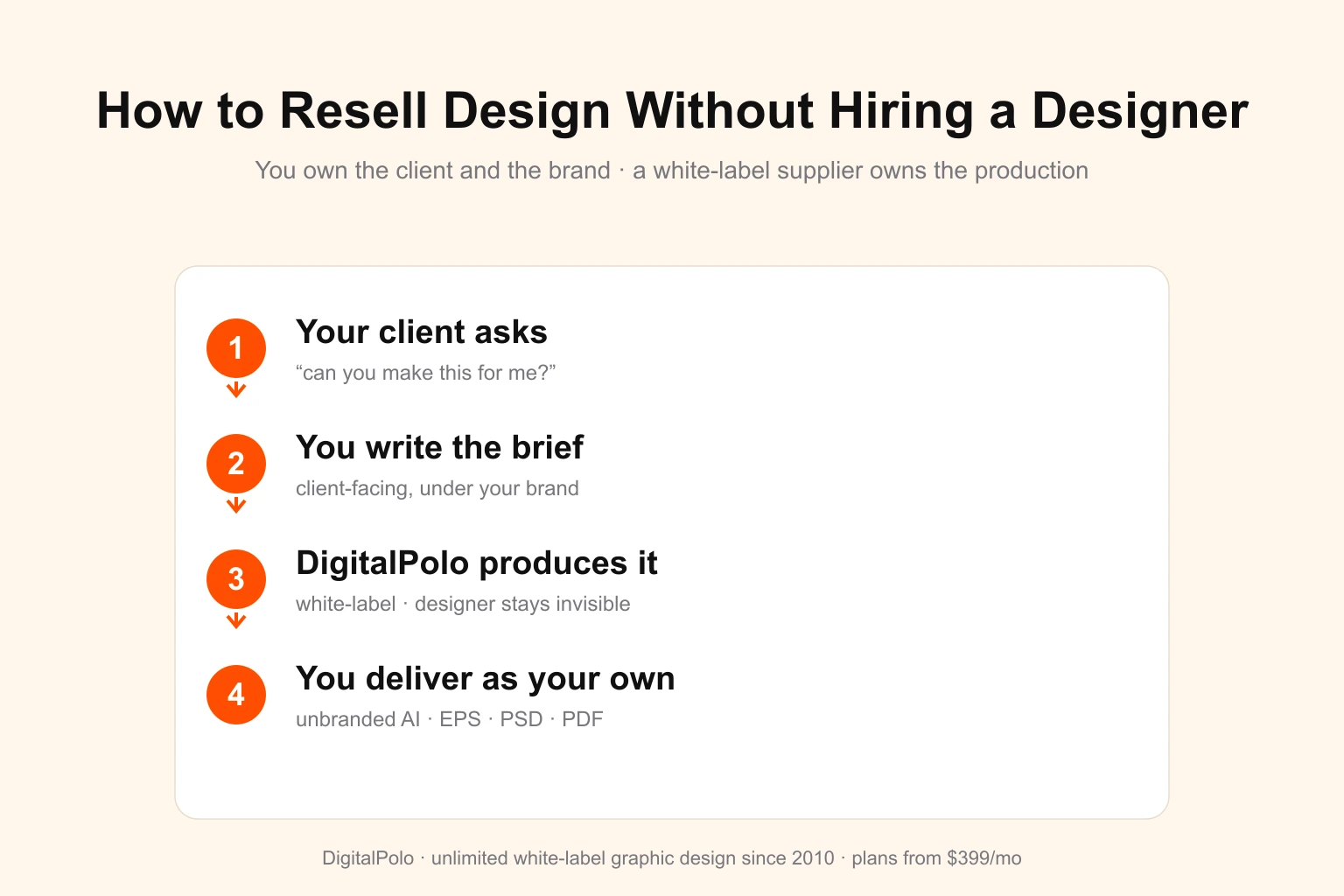
DigitalPolo has run white-label design for agencies since 2010. The margin numbers, fulfilment routes and scope language below come from how agencies actually build these lines — including the ones who resell our plans under their own brand.
Why Media-Only Retainers Have a Ceiling
There are four things wrong with billing media management alone, and every one of them gets worse as the account grows.
Your revenue is capped by someone else's budget. A percentage-of-spend model means your growth requires your client to spend more. When they cut budget in a soft quarter, your revenue falls with it — even if your work that quarter was your best.
You are accountable for an input you do not own. Creative is the dominant variable in paid social performance and a major one in search and display. When a campaign underperforms because the assets are stale, off-brand, or arrived three weeks late, the postmortem still lands in your review deck.
Creative delays cost you money directly. An ad set that sits paused waiting on a new variant is spend that does not deploy, learning that does not accumulate, and a monthly fee that looks worse per dollar delivered. Multiply that across an account and the drag is not marginal.
A single-service relationship is easy to replace. An agency that only buys media competes with every other agency that only buys media, on price and on last quarter's ROAS. An agency that runs media and produces the creative system is embedded in the client's operations. Switching costs go up, and so does retention.
The design retainer is not a side business. It is the fix for a defect in how the core service is packaged. If you want the broader case for why design belongs inside an agency rather than outside it, the argument for working with a design agency covers ground worth borrowing for your own pitch.
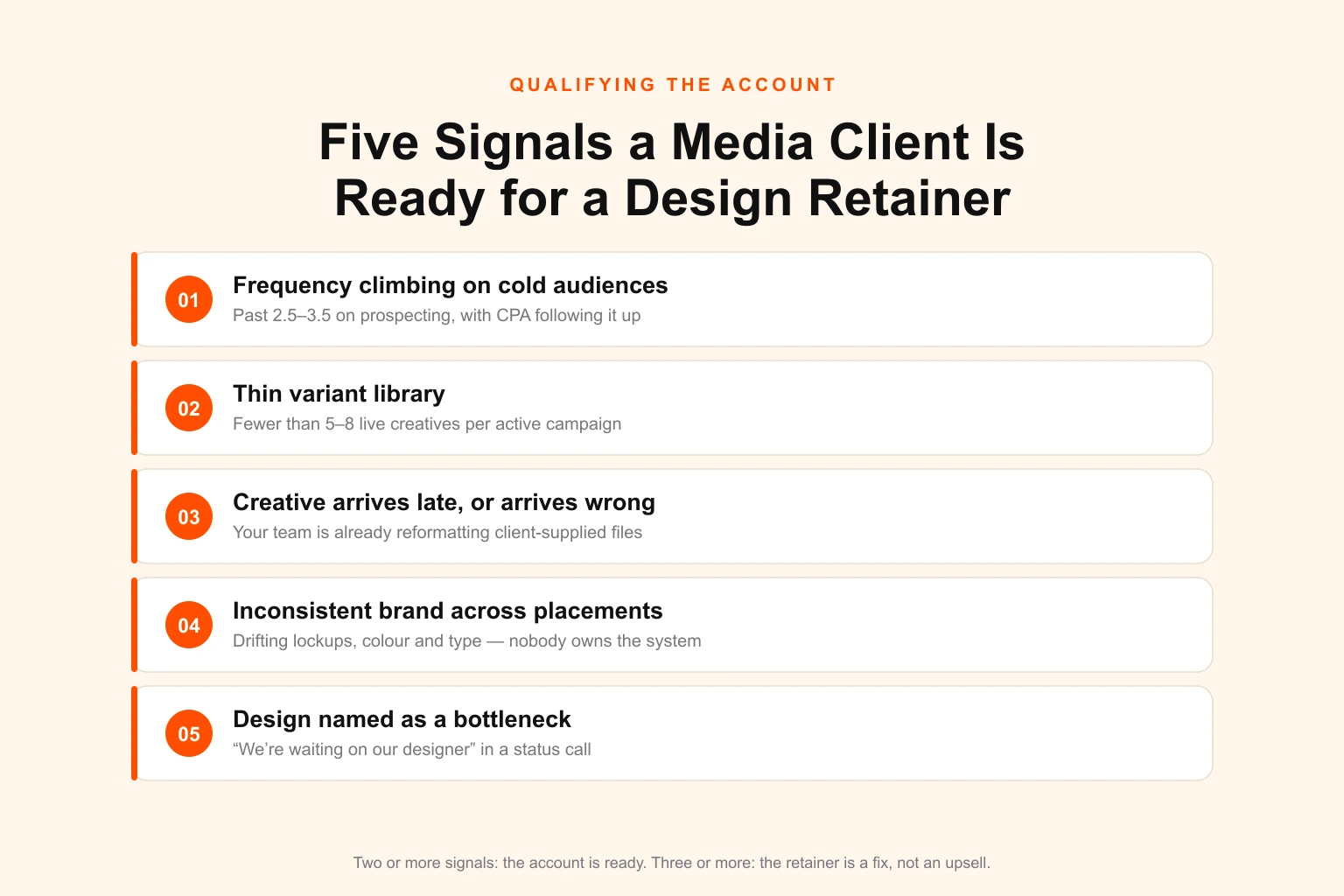
The Five Signals a Media Client Is Ready for a Design Retainer
Not every account should get this offer, and leading with it on the wrong one costs you credibility. These five signals are visible from inside the ad account, which means you can qualify without asking the client a single question.
- Frequency is climbing on cold audiences. When frequency drifts past roughly 2.5 to 3.5 on prospecting and CPA follows it upward, the account is not out of audience — it is out of creative. This is the single clearest tell.
- The variant library is thin. Fewer than five to eight live creatives per active campaign means you are not testing, you are rotating. There is no learning happening.
- Creative arrives late, or arrives wrong. If your team is reformatting client-supplied assets, fixing resolution, or rebuilding files to fit placement specs, you are already doing design work — unpaid, and badly resourced.
- The client's brand assets are inconsistent across placements. Different logo lockups, drifting colour, three versions of the same headline typeface. This usually means nobody owns the brand system, which is a gap you can fill. A brand audit is a strong, low-commitment first deliverable here.
- They mention design as a bottleneck. Any variant of "we're waiting on our designer" or "we'll get you those next week" in a status call is the client telling you they have a capacity problem.
Two or more of these and the account is ready. Three or more and the retainer is a fix they will thank you for, not an upsell they will resist.
What a Design Retainer Actually Covers (Scope, Not Hours)
The fastest way to lose money on a design retainer is to scope it in hours. Hours invite arguments about efficiency, punish you for getting faster, and give the client a unit they can audit. Scope by asset category, volume, turnaround and concurrency instead.
A typical media-client retainer covers:
- Paid social creative — static ad variants across placement ratios (1:1, 4:5, 9:16), headline and hook variations, and seasonal or promotional refreshes
- Display and programmatic — the full IAB size set built from a single concept
- Landing page visuals — hero imagery, section graphics, trust and proof modules
- Email and lifecycle graphics — campaign headers, promotional blocks, template variants
- Organic social — the calendar assets that keep the profile consistent with the paid work
- Light brand governance — a working set of rules so 40 assets a month look like one brand
And it explicitly excludes — in writing — the things that quietly eat a retainer alive: video editing and motion graphics, full rebrands and logo redesigns, packaging and print production artwork, illustration series, and web development. Each of those is quoted separately. That is not a limitation; it is a second revenue line with a clear trigger.
Two scope decisions matter more than the rest:
Concurrency, not throughput. "Two active requests at a time" is enforceable and predictable. "Twenty assets a month" invites a client to dump twenty briefs on the 28th. Concurrency also protects your fulfilment partner from the same problem.
Turnaround by asset type. A single ad variant is not a landing page hero. Publish a turnaround table — 24 hours for a resize or variant, 48 hours for a new concept, 3–5 days for a multi-asset campaign set — and the retainer starts managing expectations for you.
If your team is new to briefing on a client's behalf, how to write a graphic design brief is the piece to standardise on internally. The quality of your briefs is the ceiling on the quality of everything downstream.
How Many Creatives a Client Actually Needs, by Ad Spend
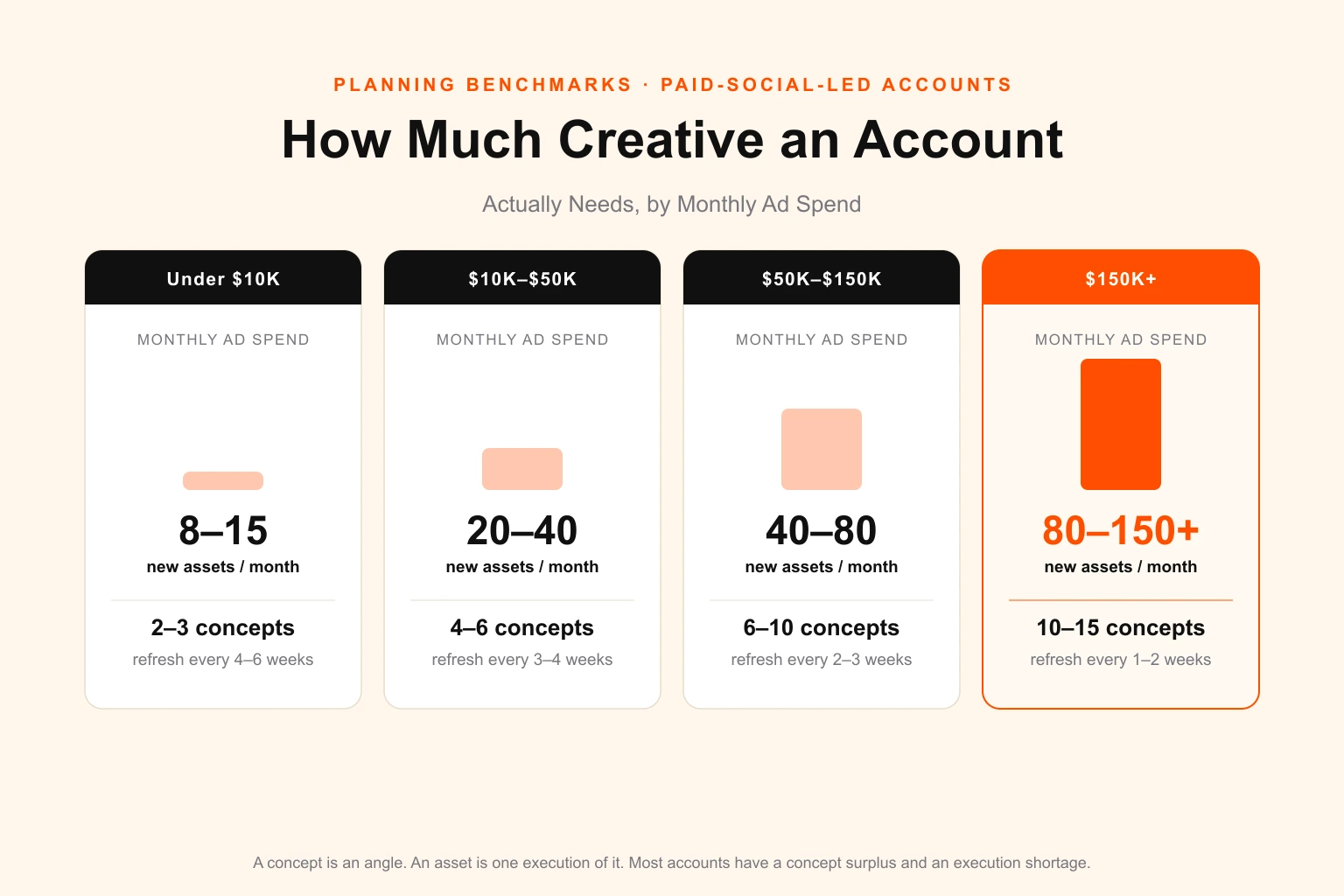
This is the table that makes the sale, because it converts a vague request ("we need more creative") into a number the client can budget against.
Creative requirement scales with spend, audience size and testing velocity — not with how much the client likes designing. The benchmarks below are planning figures for paid social-led accounts; search-heavy accounts sit lower, and short-cycle DTC accounts sit higher. If you want to derive the number from the client's own account rather than from a band — the spend a creative needs before it is readable, the hit-rate arithmetic behind the replacement rate, and the file multiplier that turns thirty creatives into two hundred deliverables — how many ad creatives you actually need per month runs both models in full.
| Monthly ad spend | New creative assets / month | Distinct concepts / month | Typical refresh cycle |
|---|---|---|---|
| Under $10,000 | 8–15 | 2–3 | 4–6 weeks |
| $10,000–$50,000 | 20–40 | 4–6 | 3–4 weeks |
| $50,000–$150,000 | 40–80 | 6–10 | 2–3 weeks |
| $150,000+ | 80–150+ | 10–15 | 1–2 weeks |
Two things to explain when you present this:
Assets and concepts are different numbers. A concept is an idea — an angle, a hook, a proof point. An asset is one execution of it in one placement ratio. One strong concept legitimately produces 8 to 12 assets across ratios, headlines and format variants, which is why the asset column is not simply the concept column multiplied by taste. Most accounts do not have a concept shortage; they have an execution shortage.
The refresh cycle is set by fatigue, not by the calendar. When frequency on cold audiences climbs past the 2.5–3.5 range and CTR falls while CPM holds, the library is spent. Accounts at higher spend burn through creative faster simply because they reach the same audience more often in less time.
Now do the arithmetic in front of the client. At $50,000 a month in spend and a 40-asset requirement, buying those assets à la carte at $150–$400 each is $6,000 to $16,000 a month. A $3,000 retainer that delivers the same volume is not an upsell — it is a cost reduction with better turnaround. That comparison is the entire pitch, and it is why understanding what design actually costs is worth having at hand before the meeting.
Three Ways to Price a Design Retainer
There is no single right model. There is a right model for your client mix, and picking the wrong one is how agencies end up doing $4,000 of work for $1,500.
1. Flat tiered retainer
Fixed monthly fee, fixed scope, fixed concurrency. Three tiers, named for the client's situation rather than for you.
| Tier | Monthly fee | Concurrency | Turnaround | Fits |
|---|---|---|---|---|
| Essential | $1,500 | 1 active request | 48h | Accounts under $15k spend, steady low volume |
| Growth | $3,000 | 2 active requests | 24–48h | $15k–$75k spend, active testing programme |
| Scale | $6,000 | 4 active requests | 24h | $75k+ spend, multi-market or multi-brand |
Best for: most agencies, most of the time. Predictable revenue, predictable cost, easy to explain in one slide. Watch for: tier drift, where a Growth client slowly consumes Scale volume. Concurrency limits and a quarterly scope review are the guardrails.
2. Percentage of media spend
Charge 8–15% of monthly media spend for creative, with a floor. Ties creative capacity to the thing that actually drives the requirement.
Best for: accounts with volatile or seasonal spend, and clients who already understand percentage-of-spend billing because that is how you bill media. Watch for: the floor is not optional. A $6,000 account still needs onboarding, brand setup and coordination. Set the floor at $1,500 or you will lose money on your smallest clients.
3. Credit or block model
Client buys a monthly block of design credits; asset types have published credit costs — one ad variant is 1 credit, a landing page hero is 3, a full campaign concept set is 8.
Best for: clients who genuinely resist subscription language, and agencies with highly variable request types. Watch for: administrative overhead, and the rollover question. Allow one month of rollover at most, capped at 50% of the block. Unlimited rollover creates a liability that eventually lands in one brutal month.
The recommendation: start with flat tiered. It is the easiest to sell, the easiest to fulfil against, and the easiest to walk back from if the scope is wrong. Move to percentage-of-spend only for accounts where spend swings by more than about 40% quarter to quarter.
The Margin Math: What Fulfilment Costs You
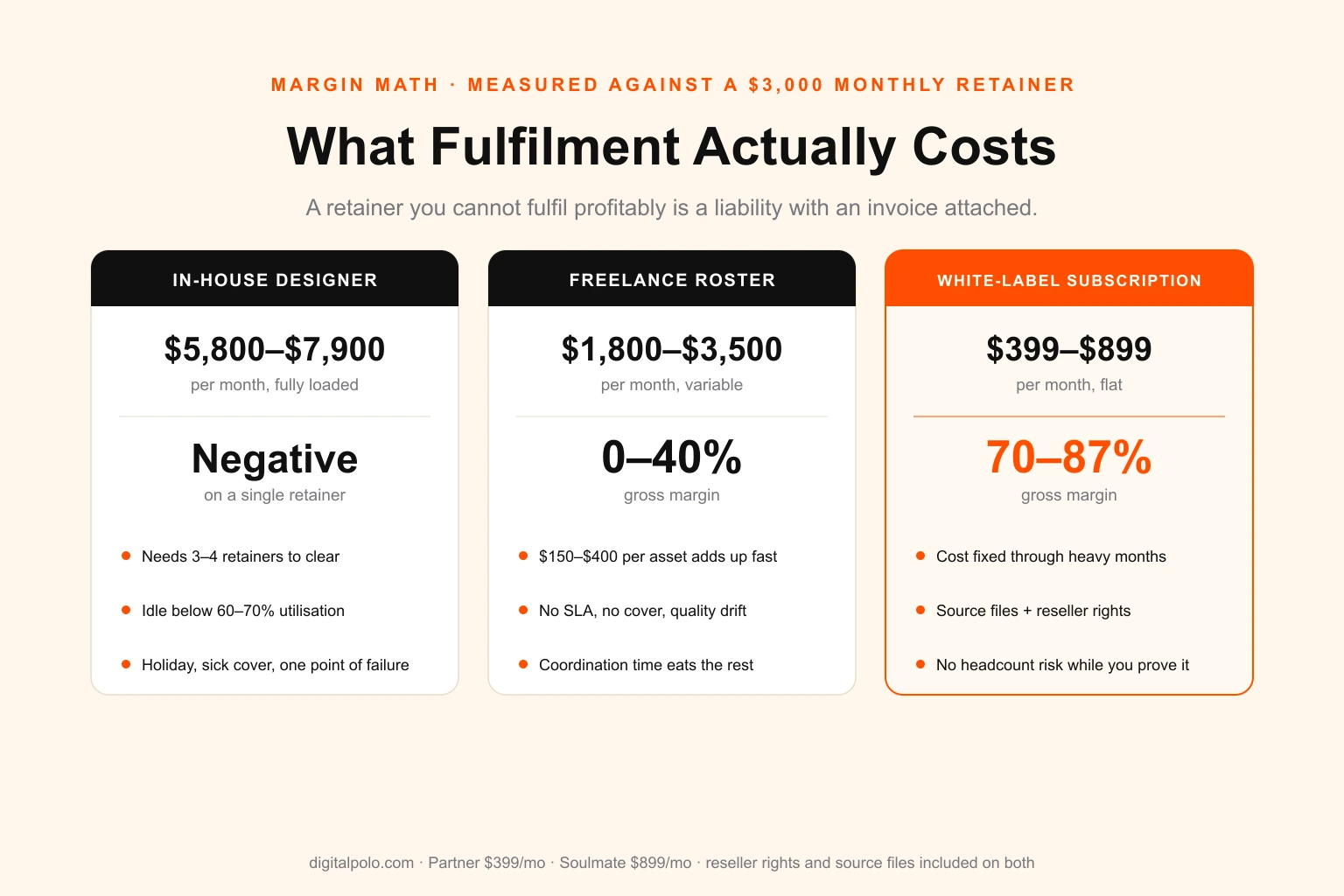
A retainer you cannot fulfil profitably is a liability with an invoice attached. Here is what the three fulfilment routes actually cost against a $3,000 monthly retainer.
| Fulfilment route | Monthly cost | Gross margin on $3,000 | Capacity | Real risk |
|---|---|---|---|---|
| In-house mid-level designer | $5,800–$7,900 fully loaded | Negative on one client; needs 3–4 retainers to clear | 1 designer's throughput | Fixed cost, holiday and sick cover, single point of failure |
| Freelance roster | $1,800–$3,500 variable | 0–40% | Elastic but unreliable | Availability, quality drift, no cover, you manage the roster |
| White-label design subscription | $399–$899 | 70–87% | Fixed-fee, scales with plan | Partner quality; verify source files and reseller rights |
The in-house line is the one that surprises people. A mid-level designer at $70,000–$95,000 fully loaded — salary, payroll taxes, benefits, software, equipment, management time — is $5,800 to $7,900 a month before they have opened a file. That seat needs three to four retainers running at $3,000 to break clean, and it needs them running consistently. Below roughly 60–70% utilisation you are financing idle capacity out of your media margin. We have run the full comparison in unlimited design vs hiring a full-time designer, and the utilisation threshold is where almost every agency misjudges the decision.
The freelance line looks cheaper than it is. Per-project rates of $150 to $400 an asset are fine at low volume and brutal at 40 assets a month. Add the coordination time your account managers spend chasing files, and the effective margin is well below the headline. Unlimited design vs freelancers breaks down where the crossover sits.
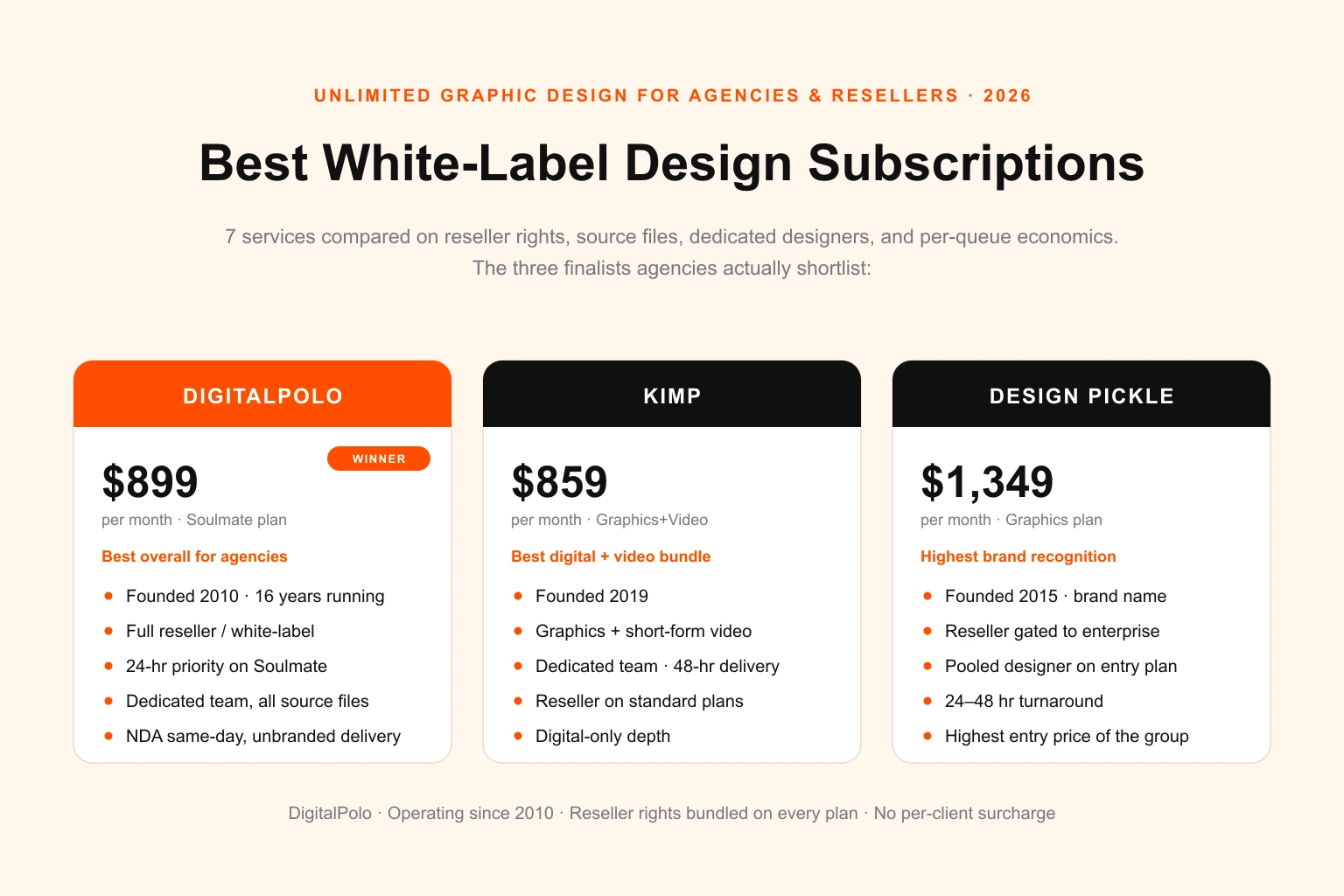
The white-label line is why most agencies start here. DigitalPolo's Partner plan is $399 a month for unlimited requests with 48-hour turnaround, unlimited revisions, and full source files (AI, EPS, PDF) with reseller rights included; Soulmate is $899 for 24-hour priority turnaround. Fulfilling a $3,000 retainer on a $399 plan is an 87% gross margin, and the cost does not move when the client has a heavy month. See pricing for the full plan breakdown, or how unlimited design works if you need to explain the mechanics internally before you sell against them.
One caveat worth stating plainly: verify what your partner's terms actually pass through. Some subscription services retain rights, deliver flattened exports rather than editable source, or prohibit reselling under your own brand. You find out at the worst possible moment — when a client asks for the working files. The agency and reseller comparison covers which services pass full rights through and which do not.
How to Make the Offer to a Client You Already Have
The mistake almost everyone makes is announcing a new service. "We now offer design!" invites the client to evaluate you against design agencies, on a dimension where you have no track record.
Do the opposite. Make it an account observation that happens to have a fix.
Step 1 — Open in the performance review, not in a separate meeting. The retainer conversation belongs inside the QBR, in the section where you are already explaining results. A dedicated "we'd like to sell you something" meeting sets the wrong frame before you speak.
Step 2 — Lead with their data. Show the frequency curve. Show CPA rising as CTR falls while CPM holds flat. Show the count of live creatives per campaign. Say what it means: "This account is not out of audience. It is out of creative. We are showing the same six assets to the same people more often, and that's what the CPA line is."
Step 3 — Quantify the gap in their currency. Not "you need more design." Instead: "At your spend, an account like this needs 40 new assets a month to keep testing. You're producing about nine. That gap is costing roughly $X a month in efficiency, and it's the reason we've had two ad sets paused since the 14th." Wasted spend and stalled testing are numbers a client already cares about.
Step 4 — Present the retainer as the fix, with the comparison built in. "We can produce that volume in-house at $3,000 a month, 48-hour turnaround, fully on-brand, briefed by the same team that's running the media. Buying it à la carte would run $6,000 to $16,000, and it would still arrive on someone else's timeline."
Step 5 — Make the first commitment small. Offer a 60- or 90-day pilot on one campaign, with an agreed success metric — CPA improvement, a target number of concepts tested, or a reduction in creative lead time. A pilot is a much easier yes than an open-ended addendum, and if the retainer works the pilot renews itself.
Three things to avoid. Do not discount the first month to close it — you are training the client to negotiate the retainer every quarter. Do not bundle it invisibly into the media fee, because an invisible service cannot be renewed on its own merits or raised on its own timeline. And do not pitch it to an account where the media performance is currently in trouble; fix that first, or the retainer reads as you selling your way out of a problem you created.
The Scope Document That Stops Scope Creep
Keep this as a two-page addendum to the existing media agreement rather than a new master contract. It signs faster and it renews with the media relationship instead of needing its own negotiation.
Every one of these lines exists because an agency somewhere lost money for want of it:
- Included asset categories — listed explicitly, by name
- Excluded categories — video editing, motion, packaging, print production, rebrands, illustration series, web development, each priced separately on request
- Concurrency limit — how many requests can be active simultaneously
- Turnaround by asset type — a table, not a single promised number
- Revision policy — how many rounds, what counts as a round, and what counts as a new request
- Brief standard — what a request must contain before the clock starts
- Approval chain — named approver and a stated response window, because client-side delay is the most common cause of missed turnaround
- File ownership and delivery — client owns final deliverables on payment; source files supplied on request; formats named
- Brand asset custody — who holds the master files and where
- Unused capacity — does it roll over, and if so, how much and for how long
- Notice period — 30 days is standard; align it with the media agreement
- Quarterly scope review — a scheduled point at which tier and volume are reset
The revision policy is the one to write most carefully. "Unlimited revisions" is a legitimate and attractive offer if a revision is defined as a refinement of an approved direction and a change of direction is defined as a new request. Without that distinction, one client can consume a month of capacity relitigating a concept.
Client-side approval delay deserves the same discipline. If your turnaround commitment is 48 hours and the client sits on feedback for six days, the retainer looks slow and the failure gets attributed to you. Name an approver and a response window in the addendum.
Fulfilment: Hire, Freelance, or White-Label
The sequencing matters more than the choice, because the right answer changes as the line grows.
Phase 1 — Prove it sells (months 1–6). Outsource everything. You do not yet know your true volume mix, your realistic close rate, or which asset types dominate. Fixed-fee outsourcing means you carry no capacity risk while you find out, and a bad month costs you nothing extra.
Phase 2 — Systematise (months 6–18). Volume is predictable now. Build brand kits per client, standardise your brief template, and establish a request queue with a single internal owner. This is where most of your margin improvement comes from — not from cheaper fulfilment, but from fewer revision rounds caused by vague briefs. A per-client brand guidelines document is the highest-leverage artefact you can produce at this stage; it makes every subsequent asset faster and more consistent.
Phase 3 — Selective in-housing (18 months+). Once you are running six or more retainers and utilisation would clear 70%, a hire starts to make sense — usually a senior designer or design lead who owns quality, brand systems and client relationships, while a white-label partner absorbs volume and overflow. Almost nobody should hire for volume; hire for judgement, outsource for throughput.
Agencies that want the full mechanics of billing design under their own brand should read how to resell graphic design services, which covers white-label rights, briefing on a client's behalf, and the margin structure in more depth. If you are ready to look at partner-side terms directly, white-label graphic design and design for marketing agencies cover how the reseller arrangement works in practice.
The First 90 Days
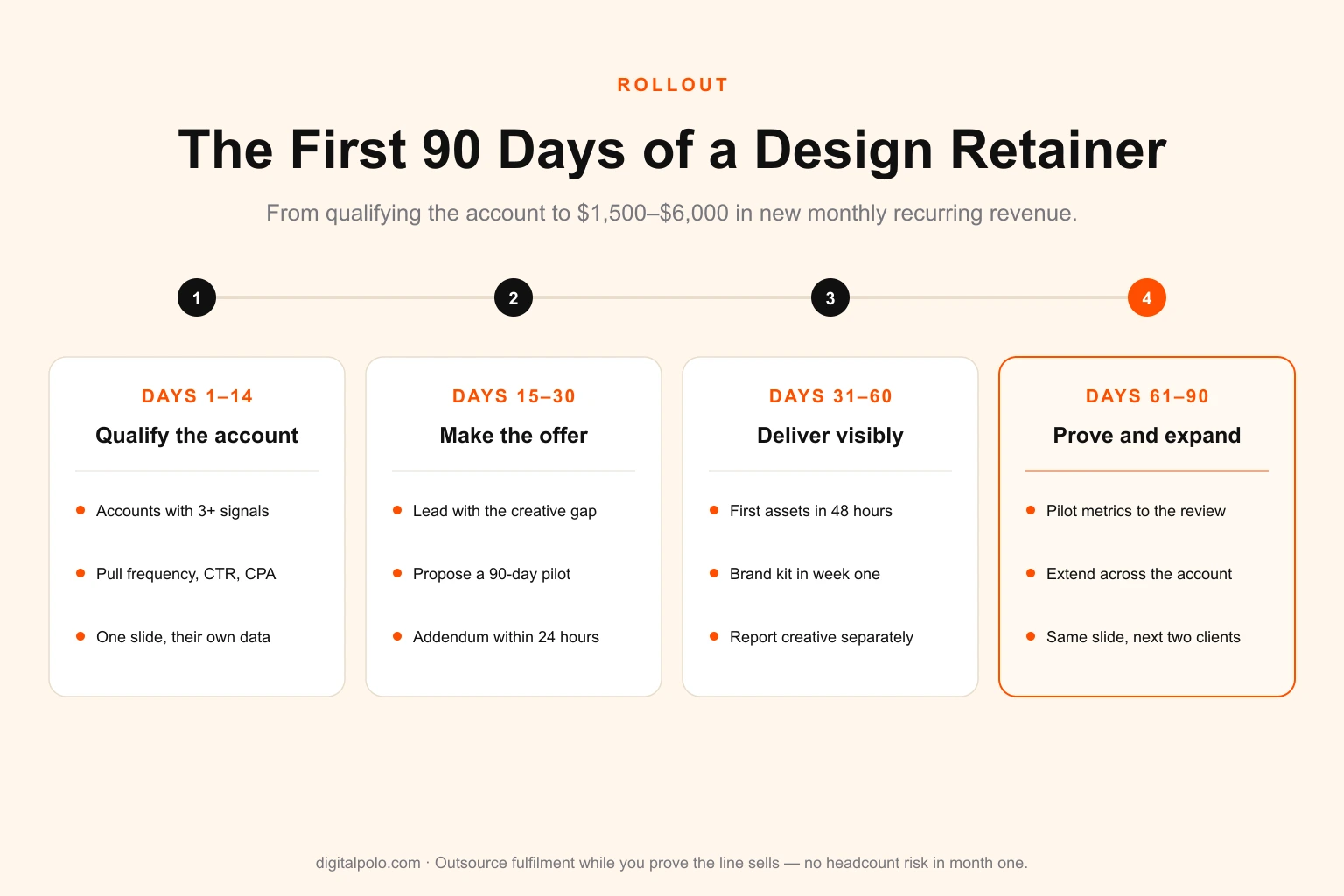
Days 1–14 — Pick your pilot and build the case. Choose two or three accounts showing at least three readiness signals. Pull the frequency, CTR and CPA data. Count live creatives per campaign. Build one slide per account showing the creative gap in their own numbers. Set up fulfilment so you can deliver from day one of a signed pilot.
Days 15–30 — Make the offer inside the QBR. Present the observation, quantify the gap, propose a 90-day pilot on one campaign with an agreed success metric. Send the scope addendum within 24 hours of a verbal yes.
Days 31–60 — Deliver visibly. Ship the first assets inside 48 hours of the brief; the first delivery sets the client's expectation of the whole retainer. Build the brand kit in week one so everything after it is faster. Report creative performance separately from media performance — the retainer needs its own scoreboard or it gets attributed to the media fee at renewal.
Days 61–90 — Prove and expand. Bring the pilot metrics to the next review: CPA change, concepts tested, creative lead time before and after. Then extend from the pilot campaign to the full account, and take the same slide to the next two clients on your list.
By day 90 a working retainer should be adding somewhere between $1,500 and $6,000 per converted account in monthly recurring revenue, at a margin that does not depend on media spend holding steady.
Six Mistakes That Kill Design Retainers
Pricing on cost instead of value. Agencies that fulfil at $399 talk themselves into charging $800 because "it only costs us $399." The client is not buying your fulfilment cost. They are buying campaigns that never stall waiting on creative. Price against their alternative — à la carte production at $150–$400 an asset — not against your invoice.
Scoping in hours. Hours create an audit surface, penalise efficiency, and turn every month into a negotiation. Scope by asset category and concurrency.
Bundling it into the media fee. A design line folded invisibly into media management cannot be renewed on its own merits, cannot be raised on its own timeline, and disappears from the client's perception of value entirely. Separate line, separate scoreboard.
Hiring before the demand is proven. A designer hired on the strength of one signed retainer is a fixed cost against a variable revenue line. Prove three or four retainers first.
Accepting vague briefs. The single largest cause of blown margin is not the fulfilment rate — it is revision rounds caused by briefs that did not specify the objective, the audience, the placement or the required formats. Enforce a brief standard, on your own team as much as on the client's.
Never reviewing scope. Retainers drift. A client on Essential slowly consuming Growth volume is a silent margin leak that compounds. Put a quarterly scope review in the addendum and actually hold it.
The KPIs That Prove the Retainer Is Working
Report these separately from media performance. A retainer without its own scoreboard gets absorbed into the media narrative and quietly loses its renewal.
Client-facing metrics:
- Creative lead time — hours or days from brief to first delivery. The number that most obviously improved the day they signed.
- Concepts tested per month — testing velocity, which is the direct causal link between the retainer and performance.
- Frequency stability on cold audiences — held under 3.0 rather than climbing, which is the retainer doing its job.
- CPA or ROAS trend on retainer-supplied creative versus the previous baseline — the outcome metric.
- On-brand consistency — the softest number here, but a scored quarterly review against the brand kit makes it concrete.
Internal metrics:
- Gross margin per retainer — revenue minus true fulfilment cost, including your team's coordination time
- Revision rounds per asset — the leading indicator of brief quality and the earliest warning of margin erosion
- Utilisation against tier — assets delivered versus assets scoped, which tells you when a client needs a tier upgrade before it costs you a quarter
- Retainer attach rate — the percentage of media clients carrying a design line, which is the real measure of whether this is a service or an experiment
- Retention delta — churn among clients with a design retainer versus media-only clients. This is usually the number that justifies the whole programme to your own leadership.
Ready to Add a Design Line to Every Media Account?
The retainer only works if fulfilment is predictable, fully white-labelled, and cheap enough that the margin survives a heavy month. DigitalPolo's Partner plan is $399/month — unlimited design requests, 48-hour turnaround, unlimited revisions, full source files (AI, EPS, PDF), and reseller rights so everything ships under your brand, not ours. Soulmate is $899/month with 24-hour priority turnaround for agencies running multiple high-volume accounts.
We have been doing this since 2010, which makes us one of the oldest design subscriptions in the category — and a large share of our work is delivered under someone else's logo.
- Start on Partner — $399/month
- Start on Soulmate — $899/month
- See how agency partnerships work · Compare plans · Browse services
Pick one media-only account this week, pull its frequency curve, and count the live creatives per campaign. If the numbers say what they usually say, you have a retainer conversation ready for your next review.