If you are weighing whether to hire your first in-house graphic designer or sign up for a design subscription, the decision usually gets framed as "salary vs. monthly fee." That framing is wrong, and it costs businesses money. A salary is the smallest part of what a full-time designer actually costs — and a subscription is not just a cheaper version of the same thing. They are two different operating models with different break-even points.
This is the honest cost comparison: what one full-time designer really costs when you count everything, what a subscription covers that a single hire cannot, and the specific situations where hiring in-house is still the right call.
DigitalPolo has been delivering unlimited graphic design since 2010 — one of the oldest services in the category — with plans from $399/month, 48-hour turnaround, unlimited revisions, and print-ready source files included as standard. Against the fully loaded cost of a single in-house hire, that monthly figure looks very different than a sticker-price comparison suggests.
The Salary Is the Smallest Number
The mistake almost everyone makes is anchoring on base salary. The US Bureau of Labor Statistics puts the median graphic designer wage at $61,300 (May 2024), with the 10th percentile under $37,600 and the 90th percentile above $103,030. A mid-level designer in most US markets lands somewhere around $60,000 to $78,000 in base pay.
But base salary is roughly 70% of what an employee actually costs. The widely cited MIT rule of thumb (Hadzima) is that a fully loaded employee runs 1.25x to 1.4x of base salary once payroll taxes and benefits are added — and BLS Employer Cost data backs this up: benefits make up about 29.9% of total compensation for private-industry workers, which is roughly a 43% add-on over wages alone.
Here is what hides behind the salary line for one mid-level designer:
- Employer payroll taxes — 7.65% FICA (6.2% Social Security + 1.45% Medicare) is about $4,690 a year on the median salary alone, before unemployment tax and workers' comp.
- Benefits — health insurance, retirement match, and supplemental pay typically add $18,000 to $28,000 a year.
- Adobe Creative Cloud — a single Creative Cloud Pro for teams (All Apps) seat is $1,199.88/year ($99.99/month) after Adobe's June 2025 price increase.
- Hardware — a capable workstation, calibrated monitor, and tablet run $2,500 to $5,000, amortized over a refresh cycle.
- Recruiting and onboarding — SHRM's 2025 benchmarking puts the average cost-per-hire at $5,475 for non-executive roles, with an average time-to-fill of about 44 days. That is a one-time first-year cost on top of everything else.
- Workspace, IT, and management time — office space, non-Adobe software, and the hours a manager or creative lead spends directing and reviewing work.
The True Annual Cost, Side by Side
Put a realistic mid-level designer through that math and the picture changes completely. The table below uses a $65,000 base — squarely mid-market — with the benefit and overhead figures above. Several line items are illustrative estimates, not measured to the dollar, but they are conservative.
| Cost component (one mid-level designer) | Annual |
|---|---|
| Base salary | $65,000 |
| Employer payroll taxes + benefits (~30%) | $19,500 |
| Adobe Creative Cloud Pro seat | $1,200 |
| Hardware (amortized) | $1,200 |
| Workspace, IT & non-Adobe software | $3,000 |
| Recruiting & onboarding (first year, one-time) | $6,500 |
| Total — first year | ~$96,400 |
| Ongoing — year two onward | ~$89,900 |
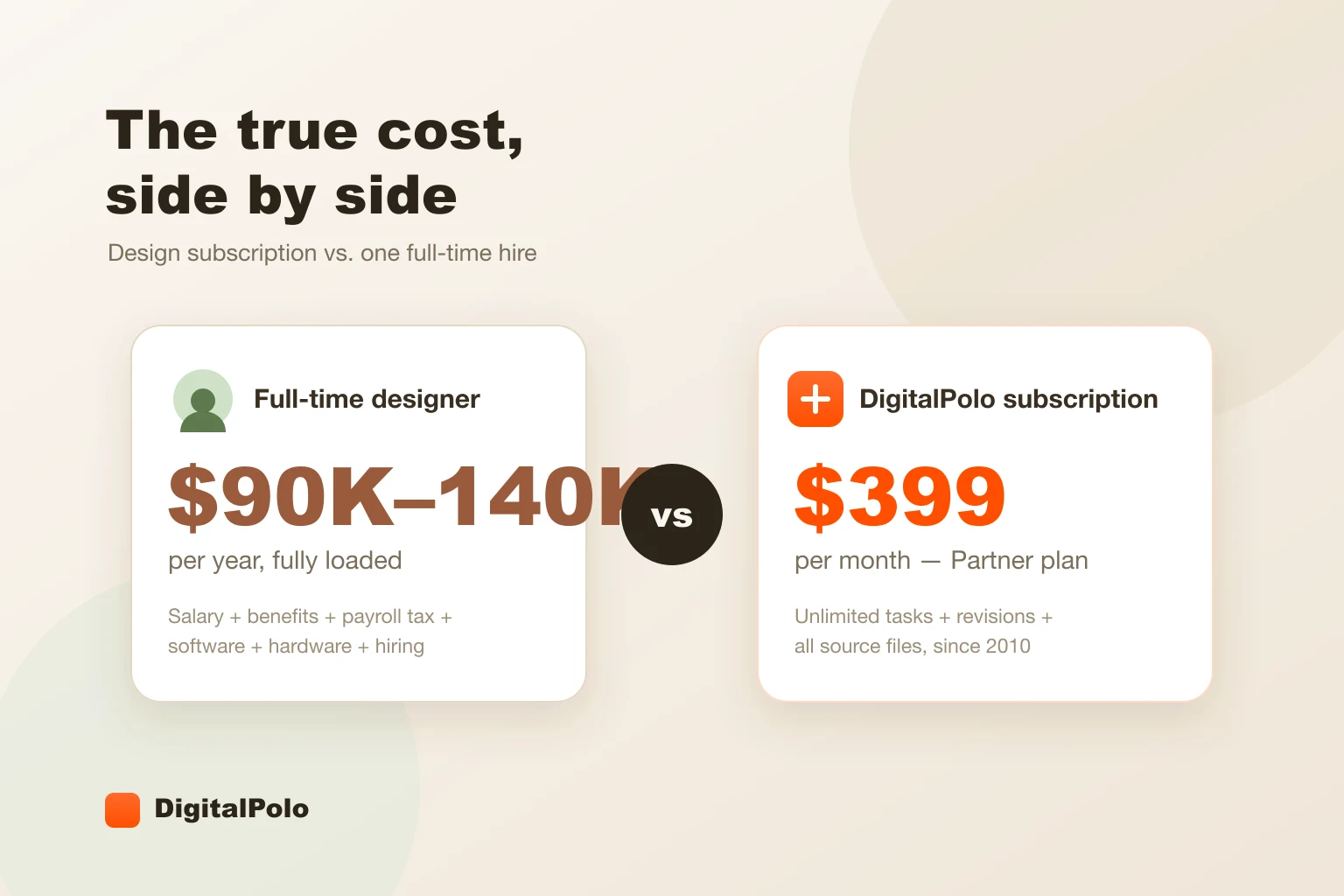
Fully loaded, one mid-level in-house US graphic designer realistically costs about $90,000 to $140,000 a year in the first year once benefits, payroll tax, software, hardware, workspace, and recruiting are counted. A senior or major-metro hire pushes toward the top of that range.
Now the subscription side:
| DigitalPolo plan | Monthly | Annual |
|---|---|---|
| Partner | $399 | $4,788 |
| Soulmate | $899 | $10,788 |
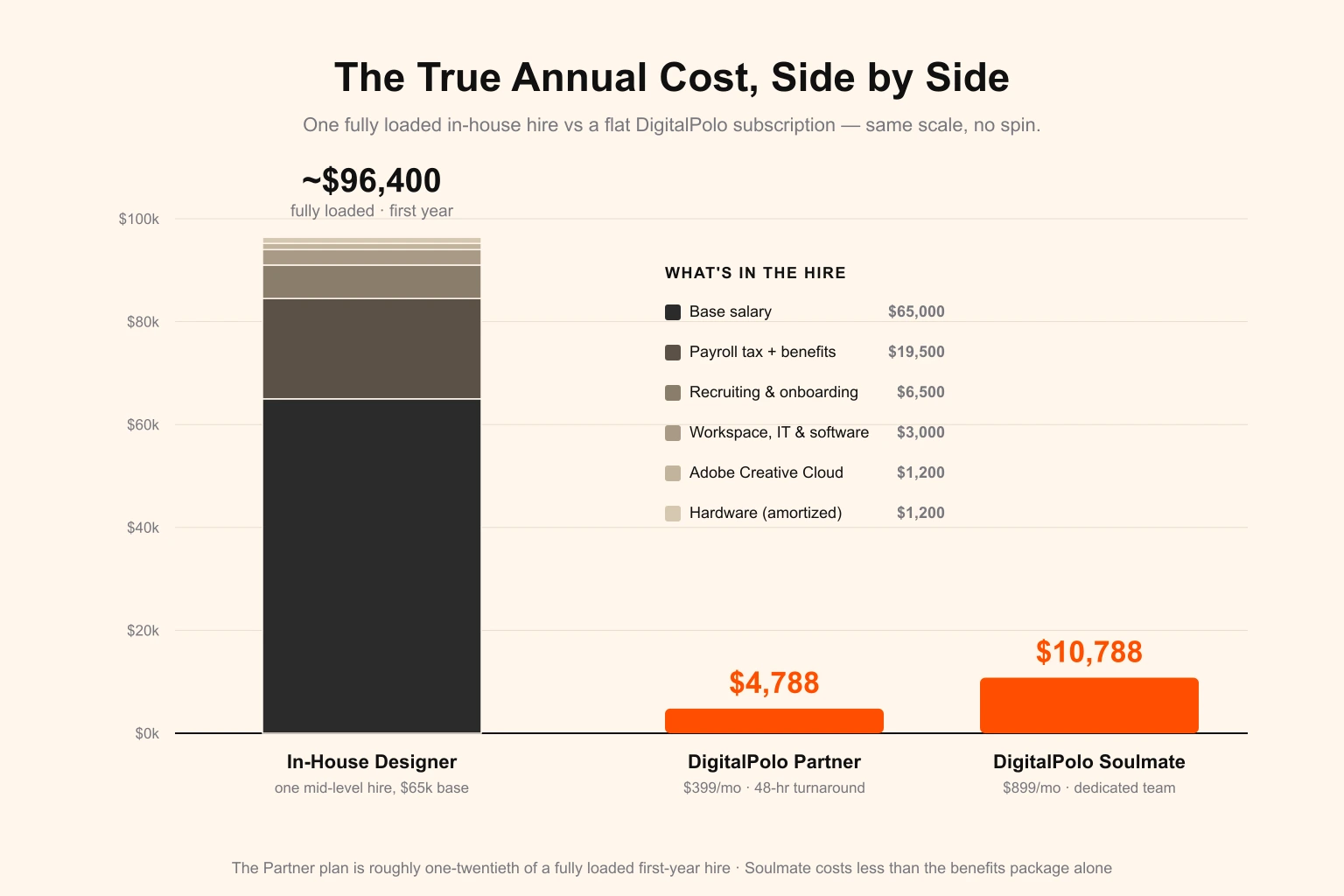
Even the Soulmate plan at $10,788/year costs less than the benefits package alone on a single mid-level in-house designer. The Partner plan at $4,788/year is roughly one-twentieth of a fully loaded first-year hire. That is the comparison the "salary vs. monthly fee" framing hides.
For a fuller breakdown of how subscription pricing works across the category, see our unlimited graphic design pricing breakdown.
But This Isn't Apples to Apples — Capacity Matters
A subscription being one-twentieth the cost does not automatically make it the right call, and any honest comparison has to say so. The two models deliver capacity differently.
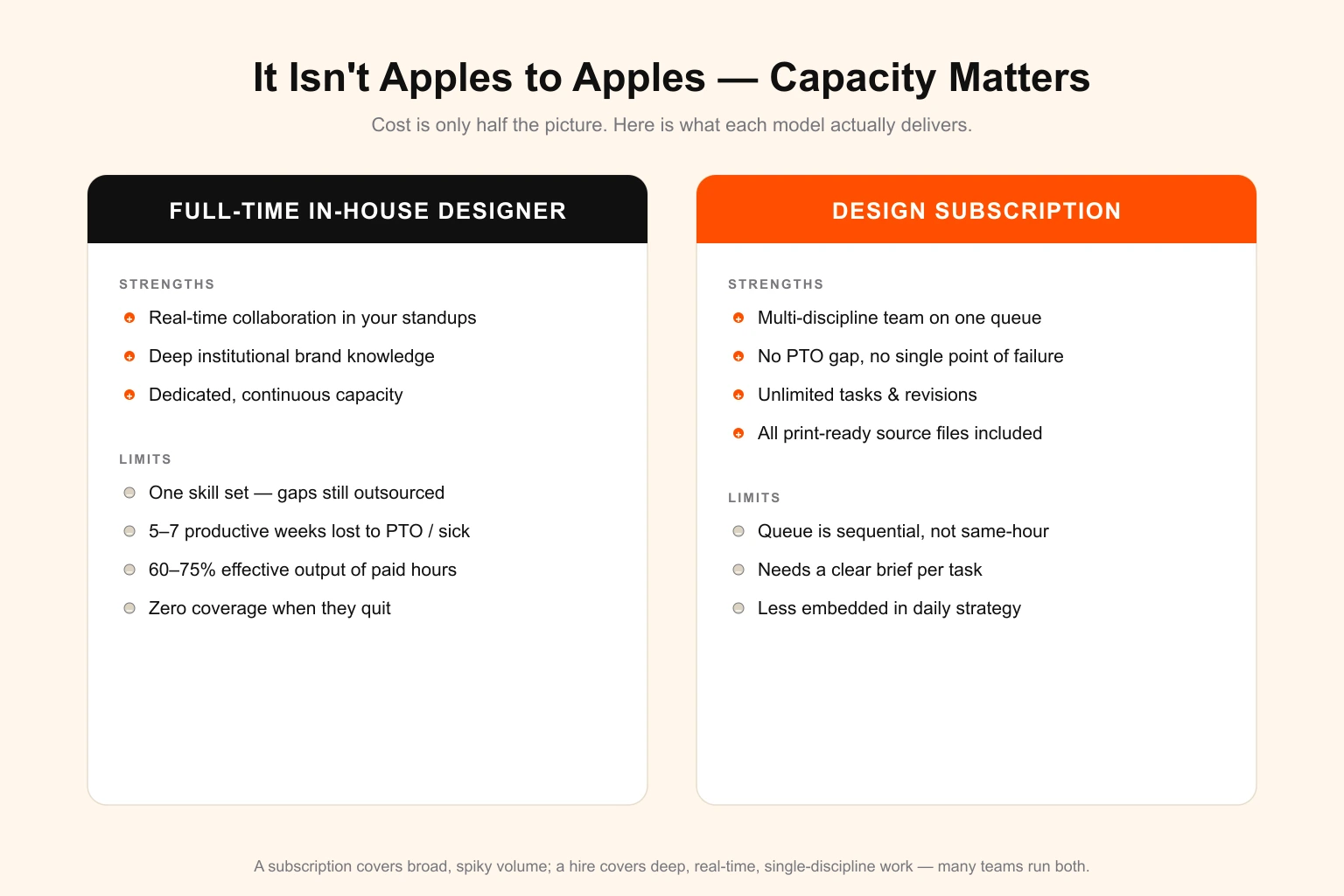
What a full-time designer gives you that a subscription does not:
- Real-time collaboration. A designer in your standups can react to a strategy change in the same hour, not the next business day.
- Deep institutional knowledge. After six months, an in-house designer knows your brand, your product, and your stakeholders without a brief.
- Dedicated, continuous capacity — within the limits of one person's working hours.
What a single designer cannot give you:
- More than one skill set. One person rarely covers brand identity, motion, web/UI, packaging, illustration, and print pre-press equally well. You pay full loaded cost and still outsource the gaps.
- Coverage during absence. A typical US package of 3–4 weeks PTO plus holidays and sick days removes 5–7 productive weeks a year. You get zero output during vacation, illness, or after they quit.
- True 40-hour throughput. Between meetings, briefs, revisions, admin, and idle gaps between projects, effective design output is commonly 60–75% of paid hours.
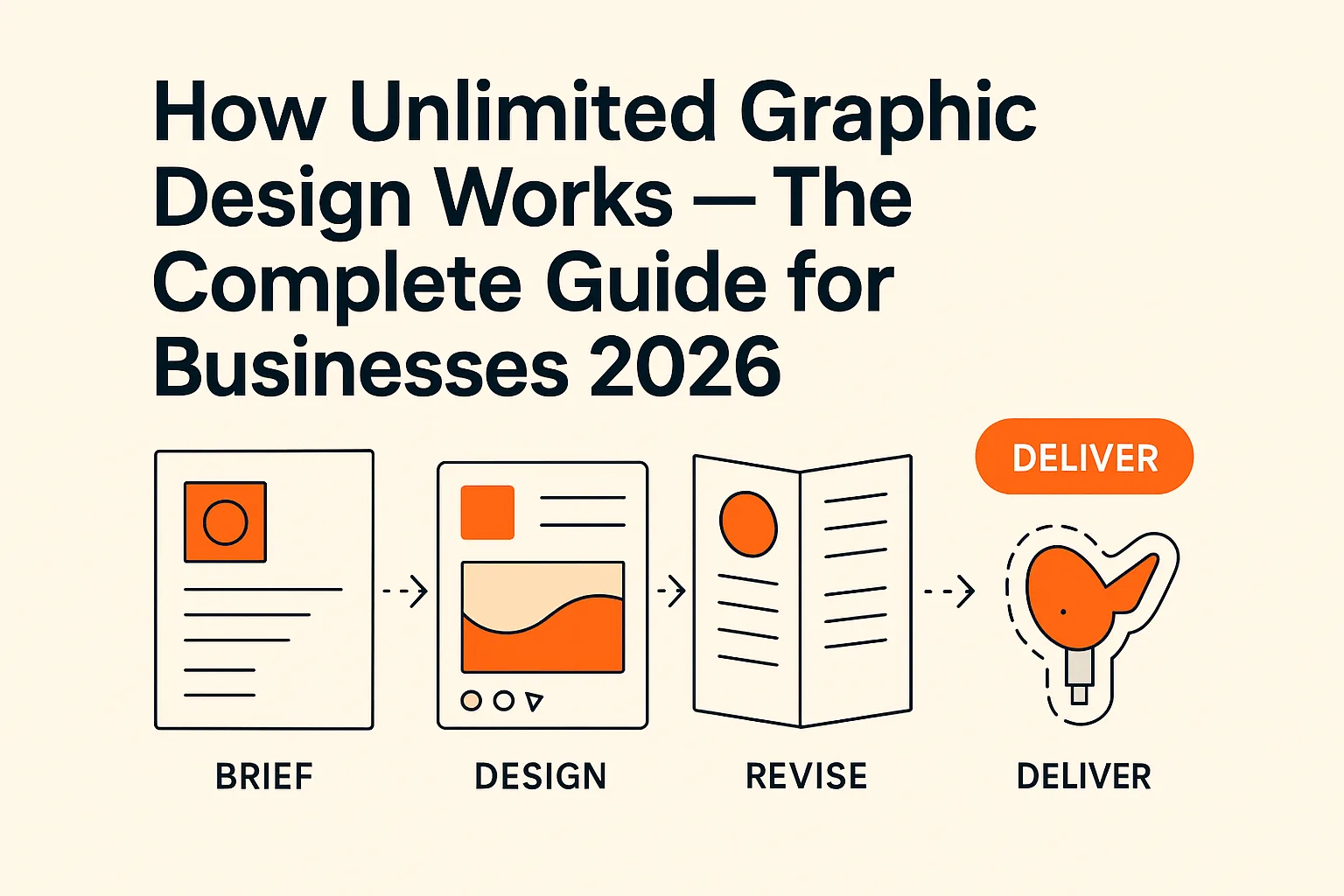
A subscription inverts this. Tasks are worked sequentially through a queue rather than in real time, but that queue is handled by a multi-discipline team — so a logo, a packaging dieline, a set of social graphics, and a vehicle-wrap layout each route to the right specialist. There is no PTO gap and no single point of failure. For how that queue actually operates day to day, see how unlimited graphic design works.
The Break-Even Framework
Strip it down to three questions:
-
What is your real monthly volume? Count the design tasks your business actually ships in a typical month — not the idealized number. Most small and mid-sized businesses land at 4–15 tasks a month across formats. A subscription absorbs that comfortably; a single hire is often underused at the low end and overwhelmed at the high end.
-
How many disciplines do you need? If your needs are narrow and deep — say, a product team that needs one designer embedded in UI work every day — a hire fits. If your needs are broad and spiky — brand, print, social, ads, packaging, the occasional sticker run — a subscription's team coverage wins.
-
Does it need to be in the room? Confidential, strategy-critical, real-time work argues for in-house. Production work with clear briefs argues for a subscription.
The math itself is rarely the deciding factor for the broad middle of the market, because the cost gap is so wide. You could run the Soulmate plan for eight years for less than the loaded first-year cost of one senior hire.
When Hiring a Full-Time Designer Is the Right Call
To be clear, in-house is the correct answer in real situations:
- Design is your product. If you ship software, games, or media where design is the deliverable, you need designers on the team, not in a queue.
- You need daily, real-time creative partnership woven into strategy and product decisions.
- Confidentiality is paramount and even an NDA-covered external partner is more exposure than you will accept.
- Your continuous volume genuinely exceeds a queue — a marketing org pushing dozens of unique assets every week may need both an in-house team and overflow capacity.
Many companies do not pick one. They run a hybrid: one senior in-house lead who owns brand and strategy, plus a subscription to absorb production volume so the senior hire is not spending $90k-a-year time resizing banners. For the deeper case on why production design rarely belongs in-house, see why you should not run graphic design in-house.
How a Subscription Compares to Freelance and Project Agencies
Hiring is not the only alternative, and it helps to see the full spectrum:
- Freelancers typically charge $25–$50/hour, with per-project quotes like $300–$1,500 for a logo. Flexible, but you re-brief every time, quality varies, and continuity is fragile.
- Project agencies bill $100–$250/hour, with a single logo running $1,000–$5,000+ and a tri-fold brochure commonly $1,300–$1,700. Excellent for set-piece work, expensive for steady volume.
- A subscription is the flat-fee middle: one predictable monthly cost, unlimited tasks in the queue, unlimited revisions, and source files retained — built for recurring volume rather than one-off projects.
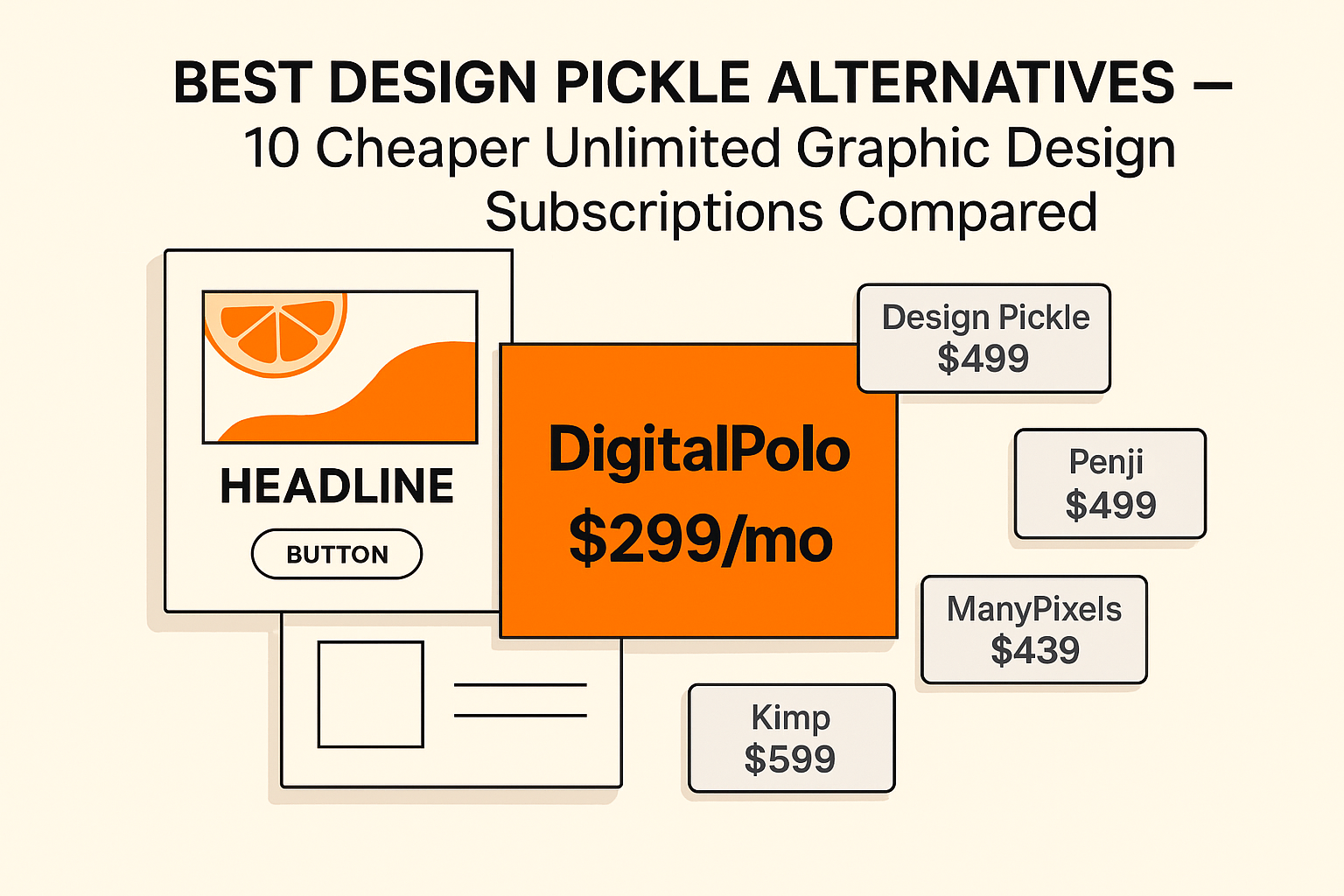
If you are specifically comparing subscription providers, our guide to the best unlimited graphic design for small business and our Design Pickle alternatives breakdown rank the credible options on price and fit.
Who Should Choose Which
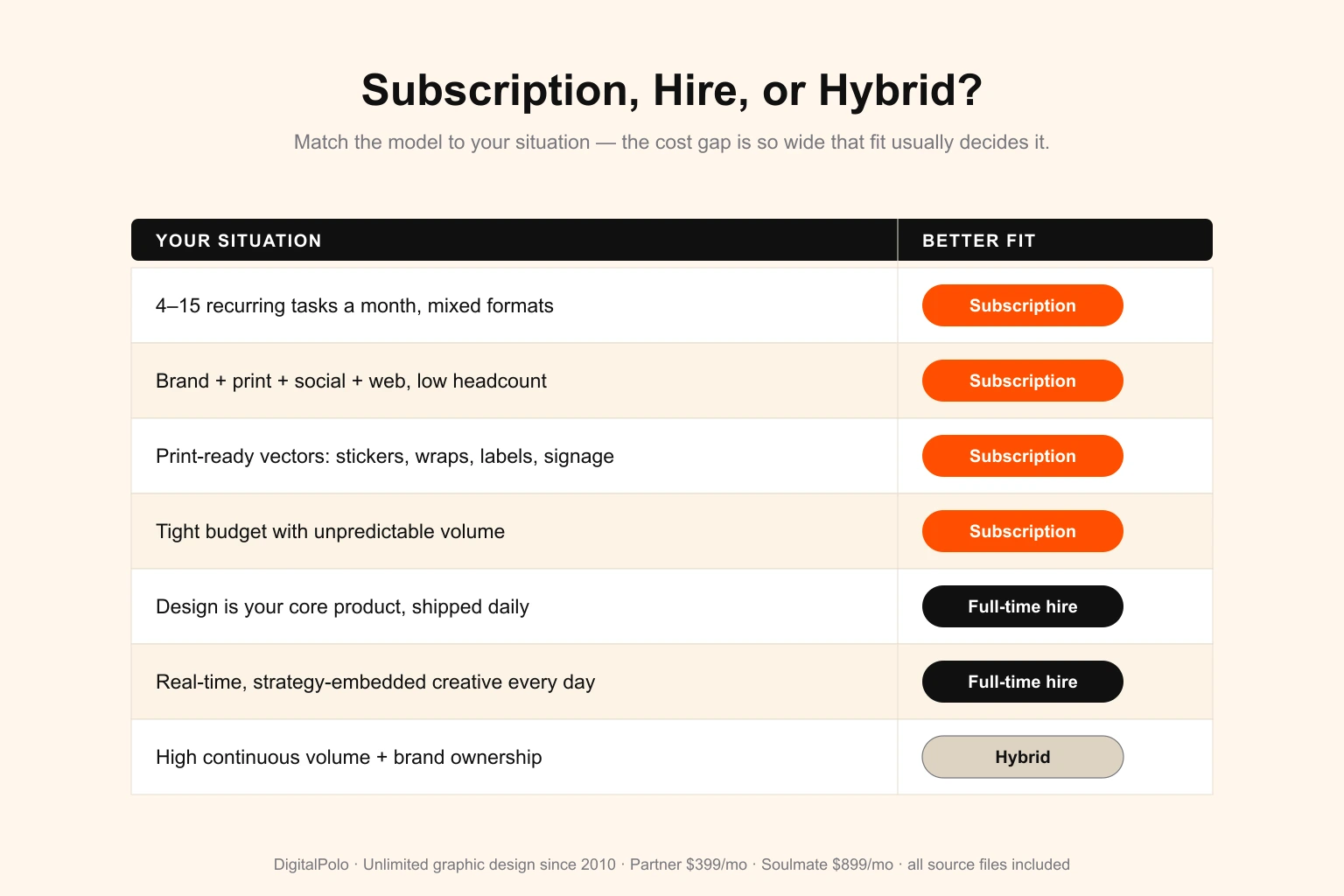
| Your situation | Better fit |
|---|---|
| 4–15 recurring tasks/month across mixed formats | Design subscription |
| Need brand + print + social + web coverage, low headcount | Design subscription |
| Print-ready vector files for stickers, wraps, labels, signage | Design subscription |
| Design is your core product, shipped daily | Full-time hire |
| Real-time, strategy-embedded creative every day | Full-time hire |
| High continuous volume + brand ownership | Hybrid (in-house lead + subscription overflow) |
| Tight budget, unpredictable volume | Design subscription |
If you are not yet choosing between a subscription and a hire — because design currently runs on a template tool and a virtual assistant — start one step earlier with the twelve signs that stack has been outgrown, which includes the capacity arithmetic for deciding whether you have enough genuine design work to justify either option.
DigitalPolo Plans and Pricing
| Plan | Price | Turnaround | What's included | Best for |
|---|---|---|---|---|
| Partner | $399/month | 48 hours | Unlimited tasks, unlimited revisions, all source files | Small businesses, startups, print/sticker shops |
| Soulmate | $899/month | 24 hours (priority) | Dedicated team, 24×7 support, all source files | Agencies, high-volume printers, resellers, hybrid teams |
Both plans include delivery of all source files — vector formats (AI, EPS, PDF) suitable for print production, including sticker printing, vehicle wraps, signage, and promotional product manufacturing.
Frequently Asked Questions
Is a graphic design subscription cheaper than hiring a full-time designer?
Almost always, yes. A single mid-level in-house graphic designer in the US costs roughly $90,000 to $140,000 a year once salary, payroll tax, benefits, software, hardware, workspace, and first-year recruiting are counted. DigitalPolo's Partner plan is $4,788 a year and the Soulmate plan is $10,788 a year — a fraction of one full-time hire, with no employment overhead.
How much does a full-time graphic designer actually cost per year?
The US Bureau of Labor Statistics puts the median graphic designer wage at $61,300 (May 2024). On top of base salary, employers pay roughly 1.25x to 1.4x in payroll taxes and benefits, plus an Adobe Creative Cloud seat at about $1,200 a year, hardware, workspace, and a one-time cost-per-hire averaging $5,475. Fully loaded, that lands around $90,000 to $140,000 in the first year.
Does a design subscription give you the same capacity as a full-time hire?
Not identically. A full-time designer gives you roughly 32 to 40 productive hours a week of one person's skill set, plus real-time collaboration — but zero output during their PTO or after they quit. A subscription gives you a queue handled by a multi-discipline team that covers brand, print, social, web, and packaging, but tasks are worked sequentially. For most small and mid-sized businesses, the subscription covers the realistic monthly volume.
When does hiring a full-time designer make more sense than a subscription?
Hire in-house when design is core to your product, when you need a designer embedded in real-time strategy and brand decisions every day, when confidentiality requires it, or when your continuous volume genuinely exceeds what a queue can deliver. Many companies run a hybrid: one senior in-house lead for strategy plus a subscription to absorb production overflow.
What does DigitalPolo cost compared to a designer's salary?
DigitalPolo's Partner plan is $399/month ($4,788/year) with 48-hour turnaround and all source files. The Soulmate plan is $899/month ($10,788/year) and adds a dedicated team, 24-hour priority delivery, and 24×7 support. Even the Soulmate plan costs less than the benefits package alone on a single mid-level in-house designer.
Can a subscription handle the same range of work as an in-house designer?
Often a wider range. One in-house designer carries one skill set and rarely covers brand identity, print pre-press, social, web, illustration, and packaging equally well. A subscription routes each task to the right specialist on a team. DigitalPolo handles logos, social graphics, ad creatives, brochures, packaging, sticker and vehicle-wrap artwork, labels, and more, with print-ready vector files delivered as standard.
The Bottom Line
For the broad middle of the market — small and mid-sized businesses with 4–15 mixed design tasks a month — a subscription wins on every axis that matters: cost, breadth of skill, and continuity. One full-time mid-level designer costs $90,000 to $140,000 fully loaded in year one and still leaves gaps in coverage and skill set. DigitalPolo's Partner plan covers the same recurring production for $4,788 a year.
Hire in-house when design is your product, when you need real-time creative partnership every day, or when confidentiality demands it — and consider a hybrid if your volume is high enough to justify both. For everyone else, the subscription is the lower-cost, lower-risk path.
Ready to Replace a $90K Hire With a $399/Month Subscription?
DigitalPolo's Partner plan starts at $399/month — unlimited tasks, 48-hour delivery, and all source files in print-ready vector format included. Running since 2010.
- See DigitalPolo plans and pricing →
- Book a free 15-minute intro call →
- See recent design work in the portfolio →
Further reading on choosing the right design model for your business:
- How Unlimited Graphic Design Works: The Complete Guide
- Best Unlimited Graphic Design for Small Business
- Unlimited Graphic Design Pricing: Full Breakdown
- Why You Should Not Run Graphic Design In-House
- Best Design Pickle Alternatives
- Hire a Graphic Designer: the Subscription Alternative
- How Much Does Graphic Design Cost? 2026 Pricing Guide