There is a particular invoice that arrives about eighteen months after a job closes.
It is not from the printer. It is a demand letter, it cites a single image, it names a use nobody remembers approving, and the figure on it is somewhere between two and six thousand dollars — for an asset that would have cost about ninety dollars to license correctly.
By the time it lands, the trail is cold. The designer who placed the image has left. The client believes the design fee covered it. The print shop believes the file arrived cleared. The 8,000 units are in circulation or already sold. And the only question that actually matters — was a licence ever bought, and what did it permit — takes three weeks to answer, because nobody wrote it down.

This is an entirely avoidable category of problem, and it stays common for a reason worth naming at the outset: nearly everything written about stock licensing answers a question that is not the one operators have.
Search the topic and you get two kinds of page. Agency terms pages, which are accurate for that agency and describe only their own products in their own vocabulary. And blog posts summarising those pages, frequently wrong, sometimes wrong in ways that will get you a letter. One of the top-ranking discussions of this exact question tells readers that as long as you print under 500,000 you are fine on merchandise. That is confidently, expensively incorrect, and it is a fair summary of the public understanding.
So this is not a summary of any one agency's terms. It is the operator's version: what the rules actually are across agencies, which of them your business is likely to break, who in the chain has to hold what, and the small set of controls that make the whole thing a solved problem rather than a recurring exposure.
A note on scope. This is practical guidance for people who commission and produce design work, not legal advice, and licence terms change. Every figure below reflects terms as published at the time of writing and should be verified against the licence in force when you download — that is the licence that governs, not the one you read about.
The distinction that explains everything
Here is the thing almost every guide gets wrong, and it is the reason people who believe they are compliant are not.
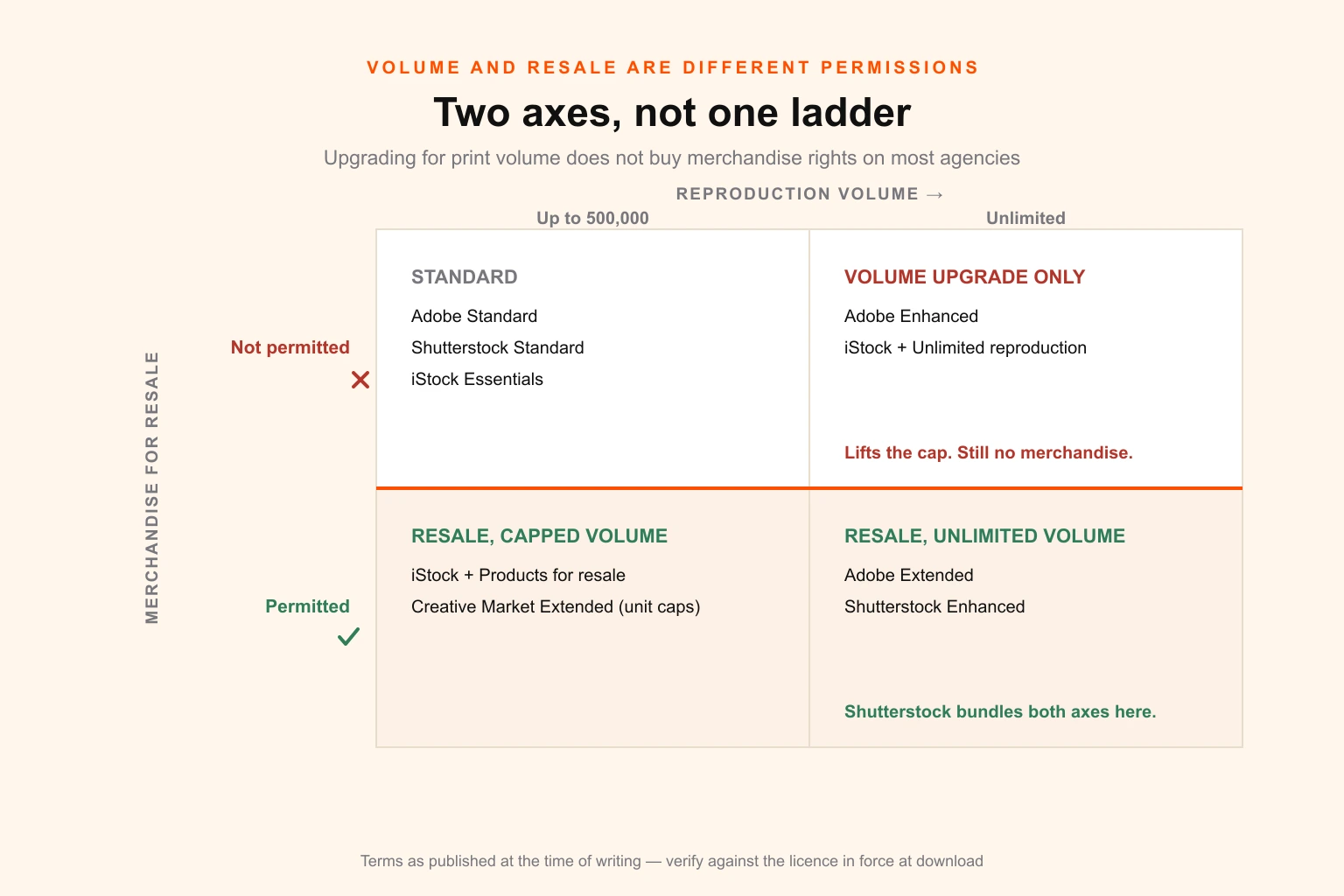
Volume and resale are two separate permissions. They are governed by different clauses, they are sold as different upgrades, and buying one does not get you the other.
Almost everyone merges them into a single vague idea of "I need the bigger licence." Then they buy the bigger licence, and it turns out to be the bigger licence for the wrong axis.
The clearest illustration is Adobe Stock, which sells both as distinct products:
- The Standard licence permits reproduction up to 500,000 copies, and does not permit merchandise for resale.
- The Enhanced licence lifts the 500,000 cap — and still does not permit merchandise for resale.
- The Extended licence is the one that permits creating merchandise or products for resale.
Read that middle line again, because it is where money is lost. A print shop hitting volume limits upgrades to Enhanced, reasonably assuming the more expensive licence covers more. It covers more volume. It covers no merchandise at all.
iStock and Getty structure it the same way with different names — Unlimited reproduction and Products for resale are separate add-ons, purchasable independently of each other. Shutterstock happens to bundle both into a single Enhanced licence covering unlimited print runs and merchandise together, which is genuinely simpler and is also why advice written by Shutterstock users misleads Adobe users so reliably.
Once you see the two axes, the operating question stops being "do I need an extended licence?" and becomes two questions you can actually answer:
- How many times will this asset be reproduced, in aggregate, ever?
- Is the asset a reason someone buys the thing it is printed on?
The first governs volume. The second governs resale. Answer both at brief stage and the licence follows mechanically.
The primary-value test, and how to apply it in ten seconds
The resale question has a name in agency terms: the primary-value test. Adobe's phrasing is the most quotable — the restriction covers products "where the primary value of the product is associated with the asset itself," with the worked example that you cannot make a poster, t-shirt or mug that someone would buy specifically because of the asset printed on it.
Every major agency applies some version of this. It is not a volume question, a profit question, or a "how commercial is it" question. It is a single question about buyer motivation:
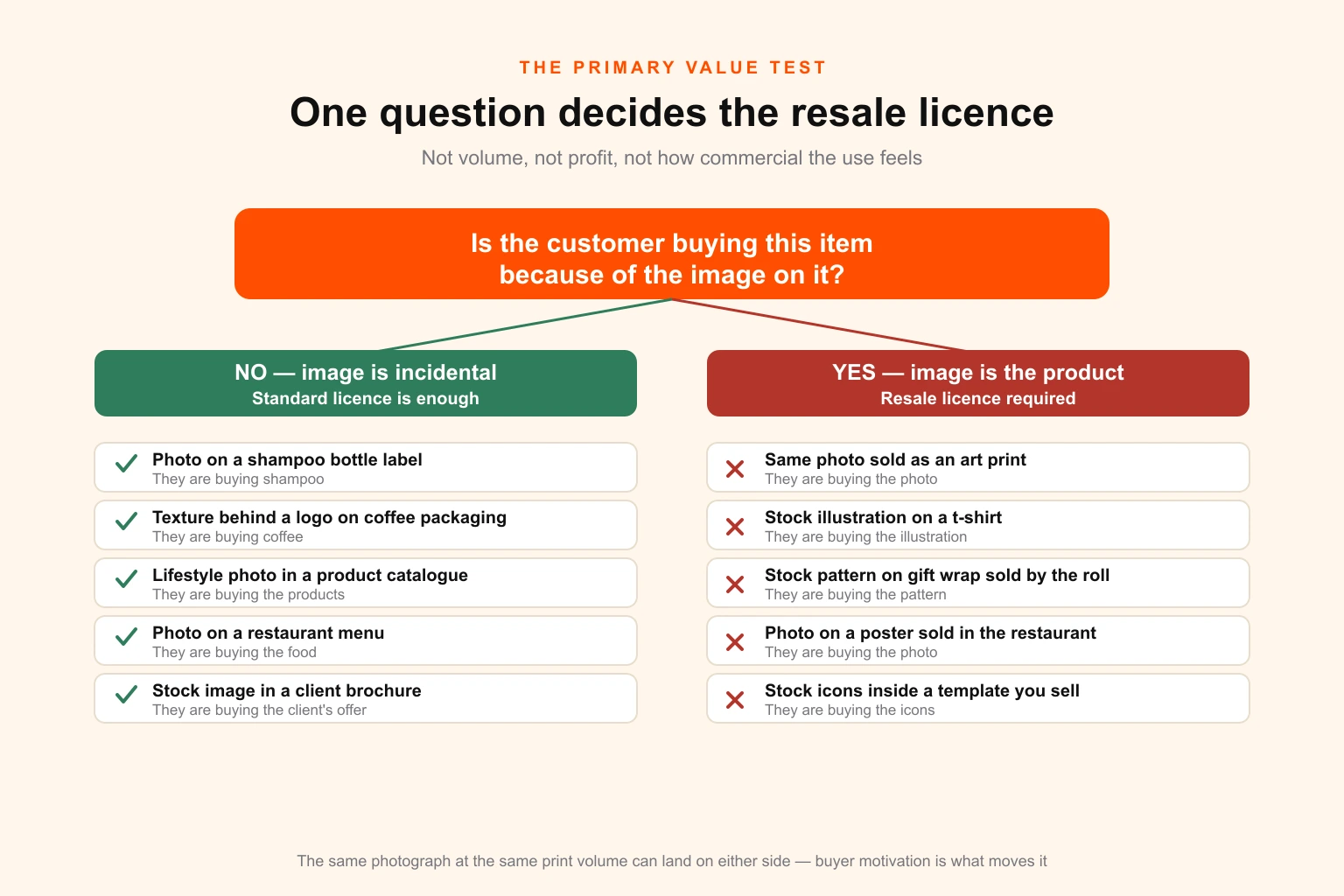
Is the customer buying this item because of the image on it?
If yes, you need the resale permission. If the image is incidental to why the item sells, you generally do not.
That distinction does real work, and it cuts in places people find counterintuitive:
| The use | Primary value | Resale licence needed? |
|---|---|---|
| Stock photo on a shampoo bottle label | The shampoo | No |
| Same photo as an art print you sell | The photo | Yes |
| Stock texture behind a logo on coffee packaging | The coffee | No |
| Stock illustration on a t-shirt in your store | The illustration | Yes |
| Lifestyle photo in a product catalogue | The products | No |
| Stock pattern on gift wrap sold by the roll | The pattern | Yes |
| Photo on a restaurant menu | The food | No |
| Photo on a poster sold in the restaurant | The photo | Yes |
| Stock image in a paid client brochure | The client's offer | No |
| Stock icon set inside a template you sell | The icons | Yes |
| Vector art on a promotional mug given away free | Contested — see below | Usually yes if merchandise |
The two rows worth dwelling on are the shampoo bottle and the art print, because they can be the same photograph at the same print volume and land on opposite sides. Nothing about the asset changed. What changed is why someone hands over money.
The genuinely grey area is promotional merchandise given away rather than sold — branded tote bags, conference mugs, promotional products with a stock graphic on them. There is no sale, so a literal reading of "products for resale" seems to exclude it. Agencies do not consistently agree, some terms address giveaways explicitly and some do not, and the item is functionally merchandise. Treat it as requiring the resale permission unless the specific licence says otherwise in writing. The upgrade costs less than the mugs.
Where each agency actually draws the lines
Terms move, so verify at purchase. But the shape is stable enough to plan against, and seeing them side by side is what makes the pattern obvious.
| Agency | Standard cap | Volume upgrade | Merchandise permitted by | Notes |
|---|---|---|---|---|
| Adobe Stock | 500,000 copies, all media | Enhanced | Extended only | Three tiers. Enhanced does not cover merchandise |
| Shutterstock | 500,000 reproductions in aggregate | Enhanced | Enhanced | Bundles both; unlimited print runs plus merchandise |
| iStock / Getty | ~500,000 print copies | "Unlimited reproduction" add-on | "Products for resale" add-on | Two independent add-ons; $10k standard legal guarantee, $250k available |
| Freepik / Envato | Varies by plan and asset | Varies | Separate licence per item, commonly per-product | Frequently restricts template redistribution |
| Creative Market | Per-licence tiers | Extended tiers | Extended, often unit-capped | Unit caps are real — read the number |
| Unsplash / Pexels | No cap | n/a | Not permitted for the asset as product | No releases, no indemnity — see below |
Two practical readings of that table.
First, the 500,000 figure is close to an industry convention rather than a legal threshold. It is not a safe harbour and it does not mean anything on its own. It is just where most agencies happen to have set the volume dial.
Second, the merchandise column is where the money is, and it is the column people skip.
What actually counts toward a print run cap
The reproduction cap is where compliant intentions quietly fail, because most people count it wrong in the same three ways.
It counts in aggregate, not per job. The cap attaches to your use of the asset, across everything you do with it, for the life of the licence. Five print runs of 120,000 across three campaigns exhaust a 500,000 licence just as completely as one run of 600,000 does.
Reprints count. A packaging design in market for four years, reordered quarterly, accumulates. This is the single most common way a genuinely compliant licence goes out of compliance without anyone doing anything wrong — nobody reprints in bad faith, they just reprint. If your artwork has a long service life, as packaging and signage do, the count is a running total nobody is keeping.
Multi-SKU multiplies. One asset across twelve SKUs at 50,000 units each is 600,000 reproductions, not 50,000. Product ranges cross the line early and quietly, which is why per-SKU asset planning belongs in the same conversation as licensing.
What generally does not count against print caps is web and social display, which most agencies now treat as unlimited views. The exception is paid distribution and out-of-home, where impressions are typically counted like copies.
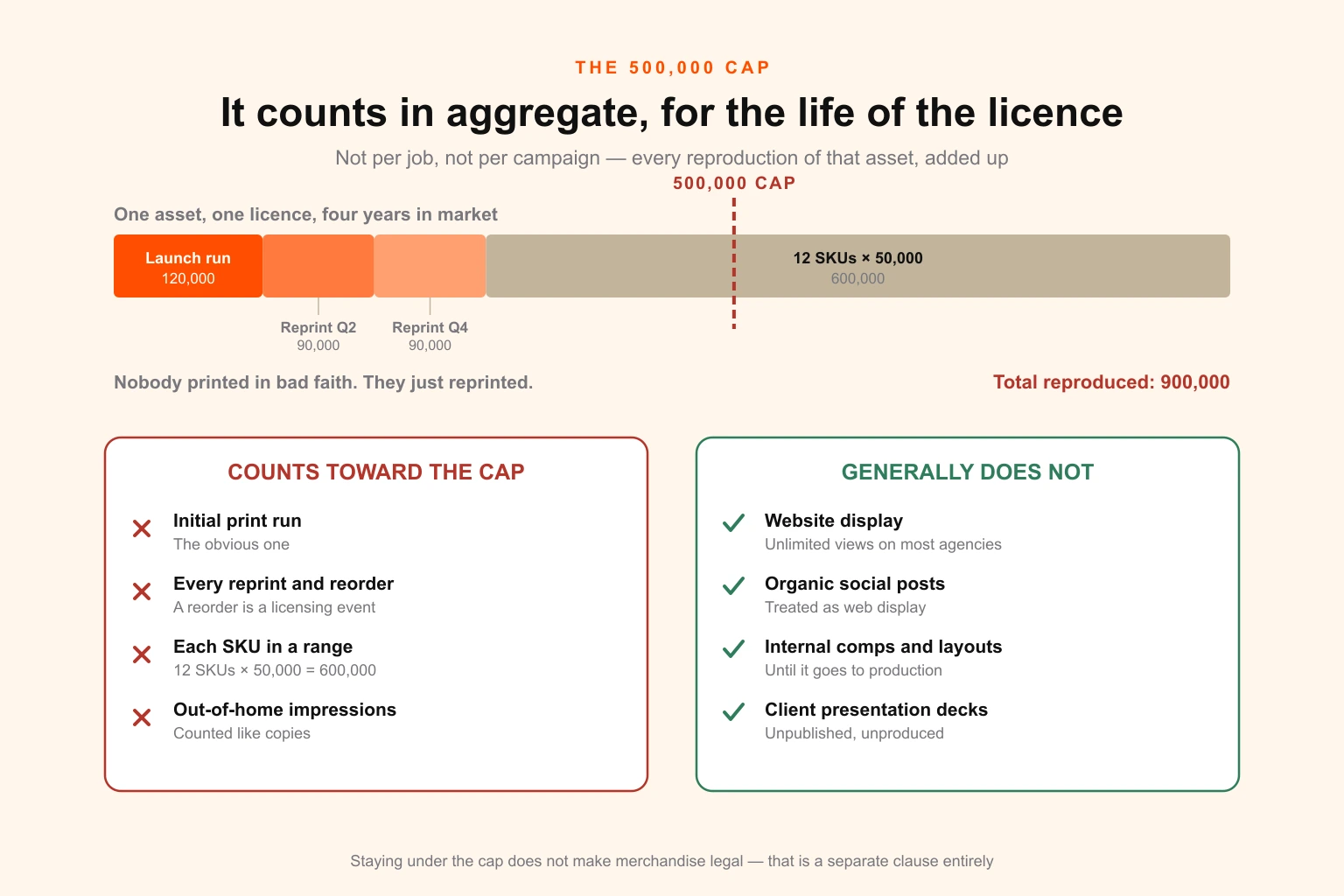
The operational fix is unglamorous and effective: record the licensed cap in the same place you record the artwork version, and check it at reorder rather than at first print. A reorder is a licensing event, not just a production event.
Editorial use only: the bar nothing lifts
Some assets are marked editorial use only, and this is categorical rather than a matter of tier.
Editorial content may only be used in connection with newsworthy or public-interest subjects. It cannot be used commercially — no advertising, promotion or endorsement — and typically cannot be modified beyond minor technical correction or slight cropping. Credit lines are usually mandatory.
There is no upgrade path. You cannot buy your way from editorial to commercial, because the restriction exists precisely because the necessary releases were never obtained or the content contains third-party rights that could not be cleared. It is marked editorial because the underlying rights do not support commercial use.
Editorial images end up on commercial work more often than you would expect, because they are frequently the best available shot of a real place, event or product, and because the marking is easy to miss in a fast search. Filtering editorial content out of search results before a designer starts is a five-second setting that eliminates the whole category. Do it at the account level rather than trusting recall.
The failure that survives a correct licence
You can hold a perfectly valid extended licence and still have an unusable image. This surprises people, and it is the most serious version of the problem because it is the one a purchase record does not solve.
The copyright licence is permission from the rights holder to reproduce the image. It says nothing about the people, property or brands depicted in the image. Those need separate instruments:
- Model release — consent from a recognisable person to commercial use of their likeness. Without it, putting someone's face on a product you sell raises right-of-publicity exposure that is entirely separate from copyright, and in some jurisdictions carries statutory damages.
- Property release — for recognisable private property, interiors, artwork and certain distinctive buildings.
- Trademarks in frame — a logo on a laptop, a recognisable can, a branded shopfront in the background. The stock licence does not clear it, and merchandise is a use where trademark holders are unusually attentive.
Merchandise concentrates all three risks, because merchandise is the use where the image is the point and where it is displayed most prominently, at scale, on a thing being sold.
Agencies flag whether releases are on file, and the filter exists in every serious search interface. The rule that removes the problem: if the end use is merchandise, only released content is eligible, and unreleased images are excluded at search time rather than debated at approval time.
This is also where free platforms fail hardest. Unsplash and Pexels are permissive licences over content that generally arrives without releases, without vetting for third-party rights, and without any indemnity. For a blog header that is an acceptable trade. For a product line it means the entire downside sits on you, uninsured, on content nobody verified.
Who in the chain has to hold the licence
Design work moves through several hands, and licences do not travel with files. This is where most real-world breaches originate — not from anyone deciding to skip a licence, but from four parties each assuming a different one bought it.
Agency licences are granted to a named licensee and are generally not freely transferable. A designer cannot buy a licence and hand the right downstream with the artwork. The workable rule:
The party that reproduces and sells the end product holds the licence, in its own name. Everyone upstream documents that it exists.
| Party | Typically holds the licence? | What they must do |
|---|---|---|
| End client / brand | Yes, for their own products | Hold it in their name; keep the record with the artwork |
| Design studio / agency | Only for its own use, or as agent | Specify in the estimate who licenses; never assume the fee covers it |
| Print shop / manufacturer | Only if selling own-brand product | Require written confirmation the file is cleared before production |
| POD platform / marketplace | Never on your behalf | Applies its own content policy on top of your licence |
For white-label and reseller work the chain runs longer still — end client, reseller, studio, production partner — and the licensee is the party whose name is on the product being sold. This is the same chain-of-custody logic that governs font licensing for resellers, and the two problems are worth solving together, because they arrive through the same door and get missed by the same gap in the process.
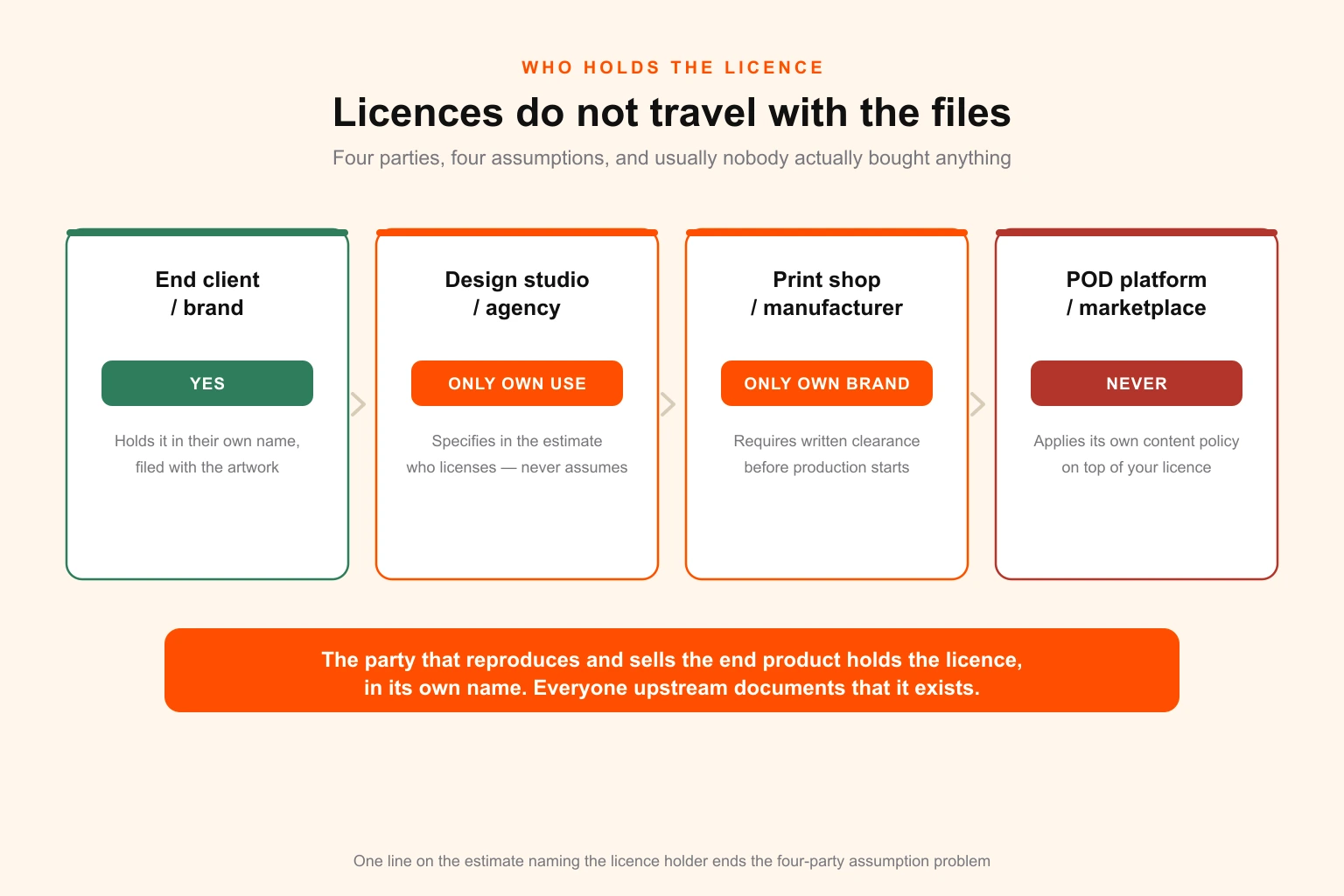
The fix is one line in the estimate. Name the licence holder, state whether asset licensing is included or excluded from the fee, and require written confirmation of clearance before anything goes to production. Studios that add this line stop having the conversation entirely — which is roughly what happened to the studios that started putting font licensing on the estimate.
The print-on-demand layer
Print-on-demand adds a second permission system on top of the licence, and satisfying one does not satisfy the other.
The agency licence governs your right to reproduce the asset on goods for sale. The platform's content policy governs what it will manufacture and list, and platforms enforce independently, on their own timescales, with their own appetite for risk. Marketplaces in particular treat stock-derived designs with suspicion for a structural reason: the same popular asset predictably appears across many sellers' listings, and near-duplicate listings trigger takedowns whether or not every seller licensed correctly.
Two consequences follow, and they are commercial as much as legal.
Holding a valid extended licence protects you from the agency. It does not protect you from a marketplace takedown, an account suspension, or a rights-holder complaint the platform chooses to action without adjudicating.
And the same asset is available to every competitor, which means a stock-based merchandise line is by construction undifferentiated. Commodity designs compete on price, which is a poor place to be selling stickers, apparel or print. Original artwork removes the licensing question and the differentiation question in the same stroke, which is the underappreciated argument for commissioning rather than licensing once merchandise volume is real.
AI-generated assets
Reaching for a generator to sidestep stock licensing swaps one set of questions for another rather than removing them.
Generator terms of service vary on commercial and merchandise use, and are worth reading per tool rather than assuming — some permit it broadly, some condition it on subscription tier, some restrict it.
The live issue is copyright status. In the United States the Copyright Office has taken the position that purely AI-generated material lacking sufficient human authorship is not registrable. For merchandise this matters less for whether you can sell the item and more for whether you can stop anyone else selling the same design. Generators can also produce output resembling trademarked or copyrighted material, and that exposure is yours downstream, not the tool's.
The workable position for merchandise: treat AI output as unprotected unless meaningfully reworked by a human, keep the reworking documented, and understand you may be selling something you cannot enforce against a copyist. The broader picture of where AI actually fits in a design workflow is a longer conversation, but the merchandise-specific answer is narrow: it solves the licence fee and creates an enforceability gap. The full breakdown of selling AI-generated designs legally, including Etsy and KDP disclosure rules, is its own guide.
What it costs, and why the number is not the point
| Item | Typical cost | What it buys |
|---|---|---|
| Standard licence, single asset | ~$10–15 | Up to ~500,000 reproductions, no resale |
| Subscription asset | ~$1–10 effective | Same rights, lower unit cost |
| Enhanced / volume upgrade | ~$60–100 | Lifts the cap. May not add merchandise |
| Extended / resale licence | ~$60–100 | Merchandise and products for resale |
| Extended legal guarantee | Varies; up to $250k cover | Indemnity ceiling, not permission |
| Commissioned original artwork | Project rate | Full control, no cap, no resale question |
| Retroactive settlement demand | ~$1,000–6,000+ per image | Nothing. It is the penalty |
The arithmetic is not subtle. The upgrade is a small multiple of the standard price and a rounding error against a print run, a merchandise batch or a claim. Nobody has ever regretted the ninety dollars.
What actually costs money is the timing. Licensing decided at brief stage is a line item. Licensing discovered after 8,000 units are printed is a choice between a settlement and pulping the stock — and the same job, priced correctly at the start, would have absorbed the fee invisibly. This is exactly the logic that belongs in how a print shop prices design work: the licence is a cost of goods, not an overhead, and it goes on the estimate.
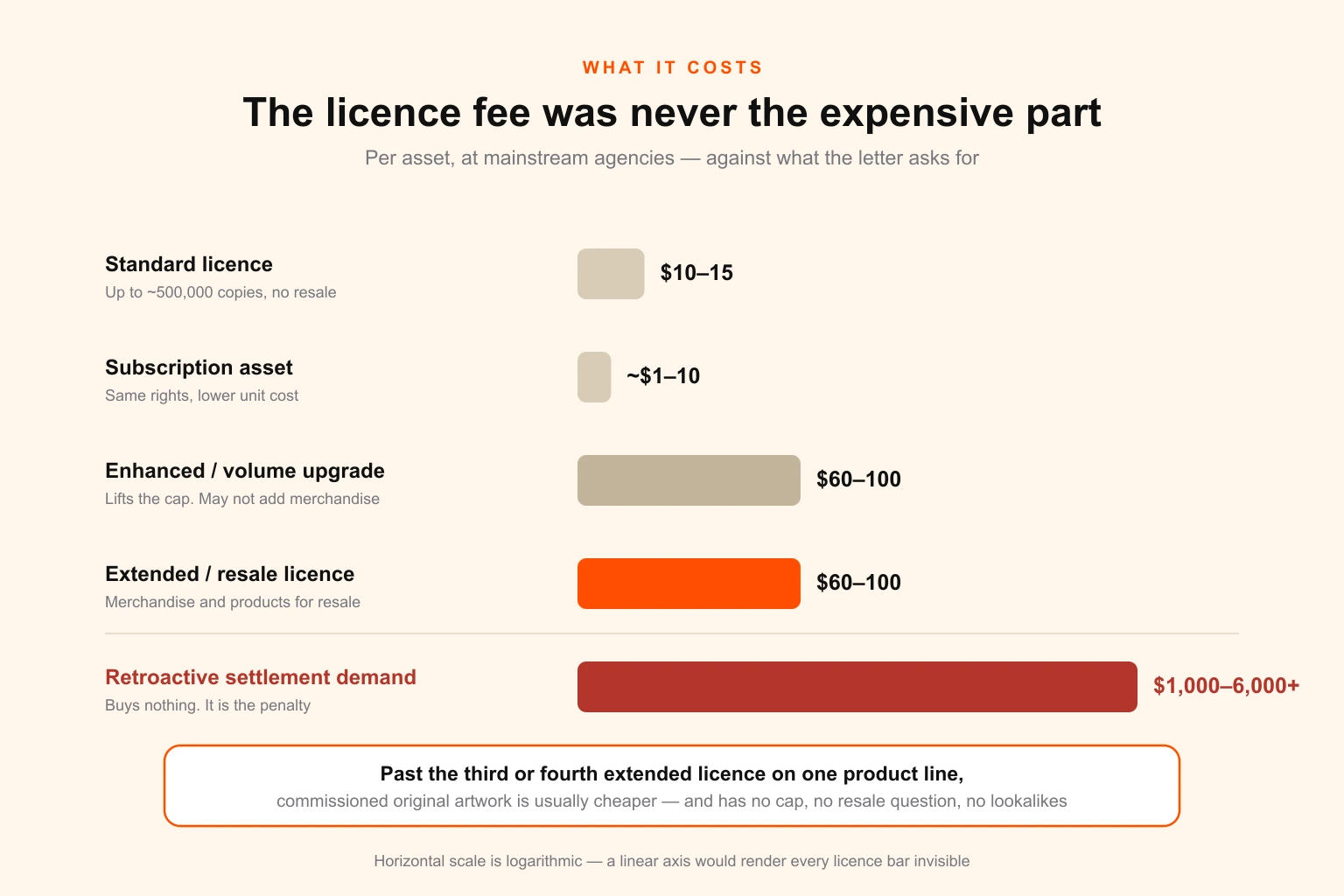
There is a threshold worth naming. Once a design is going on merchandise at any real volume, commissioned original artwork frequently costs less than extended licences across a multi-asset design — and it eliminates the cap, the resale question, the release question and the every-competitor-has-it problem simultaneously. Somewhere around the third or fourth extended licence on a single product line, licensing stops being the cheap option.
When a claim arrives
The typical sequence is a demand letter, not a lawsuit. Agencies and rights-enforcement firms run reverse-image monitoring across the web and marketplaces, the letter cites the asset and the use, and the settlement figure is usually well above what the correct licence would have cost.
What to do, in order:
- Stop the use where you can do so without destroying evidence of what happened.
- Establish whether a licence was ever bought, by whom, and what it permitted. This is where a register earns its existence — minutes rather than weeks.
- Check whether the claimant holds the rights. Opportunistic and overreaching claims exist, and some demands cite uses the licence you hold already covers.
- Get advice before responding. Early admissions are hard to walk back, and settlement figures are frequently negotiable.
- Fix the process, because a claim almost always indicates a systemic gap rather than one bad decision.
Ignoring it tends to escalate. So does responding fast and informally.
The variable that determines how badly this goes is entirely whether you can produce a purchase record quickly. A licence you cannot evidence is functionally a licence you do not have — and studios discover this at exactly the wrong moment, which is the argument for the next section.
Six controls that close this permanently
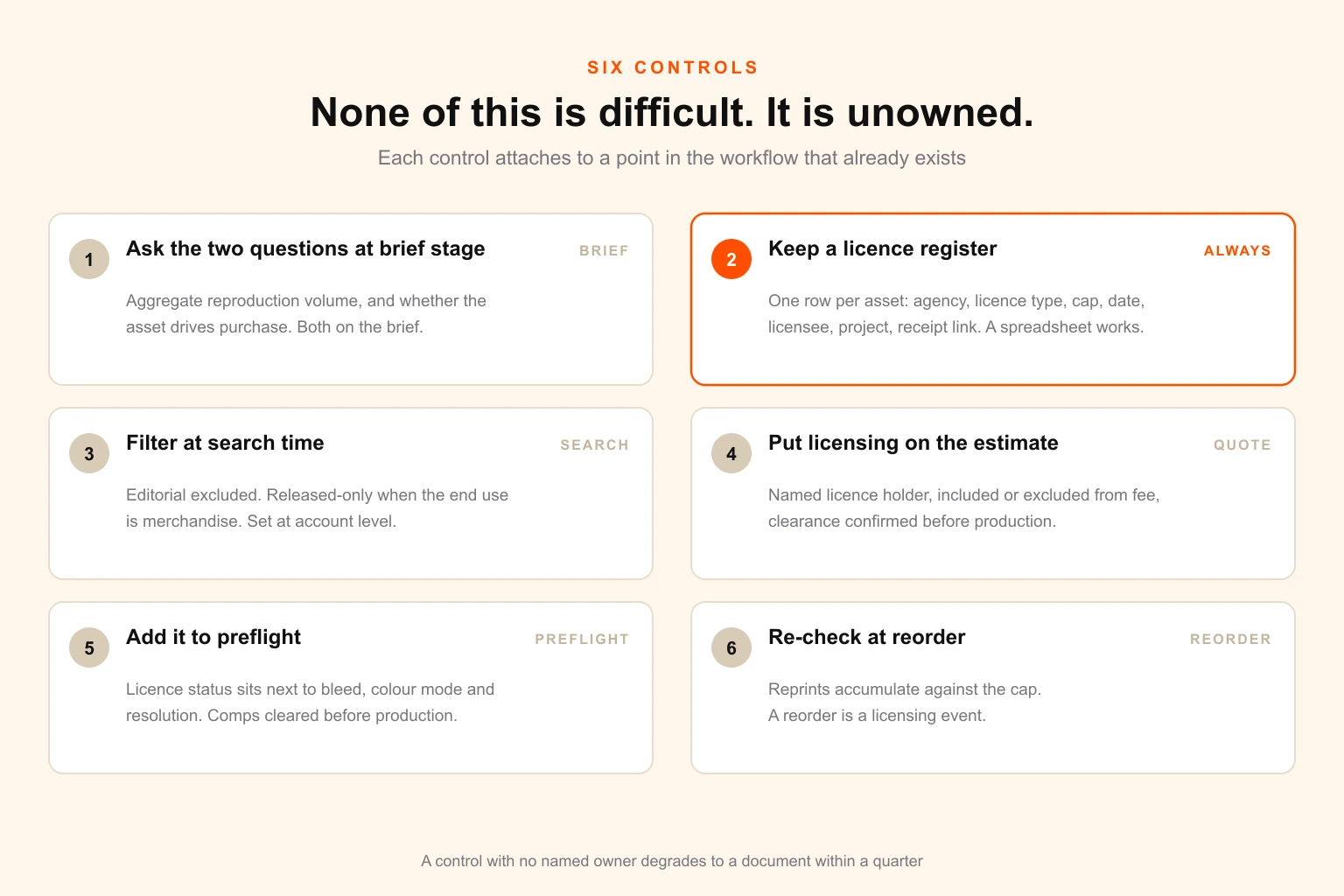
None of this is difficult. It is unowned, which is different, and it stays unowned because it never surfaces until it surfaces expensively.
1. Ask the two questions at brief stage. Aggregate reproduction volume, and whether the asset drives purchase. Both belong on the design brief alongside dimensions and deadline, because both change what gets bought before anyone opens a design tool.
2. Keep a licence register. One row per licensed asset: asset ID, agency, licence type, cap, date, licensee name, project, client, receipt link. A spreadsheet is sufficient. This single artefact converts a three-week panic into a two-minute lookup.
3. Filter at search time, not approval time. Editorial content excluded. Released content only when the end use is merchandise. Set at account level so it is not a thing anyone has to remember.
4. Put licensing on the estimate. Named licence holder, included or excluded from fee, clearance confirmed before production. One line, and it ends the four-party assumption problem.
5. Add it to preflight. Licence status becomes a checklist item next to bleed, colour mode and resolution on the print-ready file checklist. Comps must be cleared before production — the most banal breach in the business is a watermarked comp that went to print because nobody swapped the file.
6. Re-check at reorder. Reprints accumulate against the cap. A reorder is a licensing event. This is the control that catches the slow failure nobody else catches.
The thirty-day version, from nothing
If none of this exists today, the order that gets you to bounded risk fastest:
Week 1 — Find the exposure. List every product, package and piece of merchandise currently in market carrying a stock asset. Do not audit the whole archive; audit what is in circulation and selling, which is where claims come from.
Week 2 — Establish what you hold. Pull purchase records from every agency account. Match them to the list. What remains unmatched is your actual exposure, and it is almost always smaller than feared and never zero.
Week 3 — Fix the live items. Buy the correct upgrade retroactively where it is available — considerably cheaper than a settlement, and available more often than people assume. Replace what cannot be cleared. Prioritise merchandise over collateral, because that is where enforcement concentrates.
Week 4 — Install the controls. Register, search filters, estimate line, preflight item. Then hand ownership to a named person, because a control with no owner degrades to a document within a quarter.
The short version
- Volume and resale are separate permissions. Adobe's Enhanced lifts the print cap and still forbids merchandise; only Extended permits it. iStock and Getty split them the same way. Shutterstock bundles them. Read what the upgrade permits, not what it is called.
- The test for merchandise is buyer motivation, not volume or profit. If the image is why someone buys the item, you need the resale permission.
- 500,000 is a convention, not a safe harbour, it counts in aggregate across reprints and SKUs, and being under it does not make merchandise legal.
- Editorial use only cannot be upgraded. There is no path.
- A licence is not a release. Merchandise needs both, and unreleased content is ineligible regardless of what you paid.
- Licences do not transfer down the chain. The party selling the product holds it, in its own name, and the estimate says so.
- Free platforms are not safe for merchandise — no releases, no indemnity, no vetting.
- A licence you cannot evidence is a licence you do not have. The register is the whole system.
Where this fits if you outsource design
Most of the failures above are process failures rather than knowledge failures. The designer usually knows the rules. What is missing is the point in the workflow where someone asks the two questions and writes the answer down — and that point does not exist by default in any studio, in-house team or print shop.
Where an external design partner helps is that the questions get asked as part of intake rather than as a thing someone remembers. Reproduction volume and resale intent are fields on the brief. Released-only filtering is a default when the output is merchandise. The register is kept because it is part of delivering print-ready files, not because someone volunteered. And once merchandise volume is real, the calculus tips toward commissioned original artwork anyway — which is cheaper than stacking extended licences, and removes the cap, the release problem and the every-competitor-has-the-same-image problem at once.
That shape of work — front-loaded artwork, then steady capacity for the churn, with production discipline attached — is what a design partnership is structured for, and it is why print shops, sticker manufacturers, screen printers and agencies reselling design tend to arrive at the same answer. Our pricing covers the ongoing side.
If the immediate need is narrower — an audit of what is in market and original artwork replacing whatever cannot be cleared — that is a defined project rather than a relationship. Tell us what you are producing and we will scope it against the actual list.
Frequently asked questions
Do I need an extended licence to put a stock image on a product I sell?
Almost always, yes — if the image is a reason someone buys the product. Every major agency draws the line at the same place, usually called the primary-value test: if the value of the item is bound up in the asset printed on it, standard licences do not cover it. A t-shirt, poster, mug, phone case, sticker or art print fails that test, because the buyer is buying the image. A branded product where the image is incidental — a stock texture behind your logo on a coffee bag, a lifestyle photo on a shampoo carton — generally passes, because the buyer is buying shampoo. The safest reading is that the moment the asset becomes the product rather than the packaging, you need the resale-specific upgrade, whatever that agency calls it.
What is the 500,000 limit on a standard stock licence?
It is a reproduction cap, not a resale permission, and it is the single most misunderstood number in stock licensing. Adobe Stock, Shutterstock and iStock all cap standard royalty-free licences at roughly 500,000 copies, impressions or views in the aggregate — across every use of that asset, not per job. Two things about it catch people out. First, it counts in aggregate across all your uses of that asset, including reprints and separate campaigns, so five print runs of 120,000 exhaust it. Second, and more importantly, staying under 500,000 does not make merchandise legal. The cap governs volume; a separate clause governs resale. You can be at 4,000 units and still in breach.
What is the difference between an enhanced licence and an extended licence?
It depends entirely on the agency, and conflating them is a common and expensive mistake. On Adobe Stock they are two different products: Enhanced lifts the 500,000 reproduction cap but still does not permit merchandise for resale, while Extended is the one that permits merchandise. At iStock and Getty the same split exists under different names — Unlimited reproduction and Products for resale are separate add-ons you can buy independently. Shutterstock happens to bundle both into a single Enhanced licence covering unlimited print runs and merchandise together. So an upgrade that solves merchandise on one platform solves only volume on another. Read what the specific upgrade permits rather than trusting the word on the button.
Does an extended licence cover print-on-demand products?
The licence is necessary but often not sufficient, because two separate permission systems apply. The agency licence governs your right to reproduce the asset on goods for sale. The print-on-demand platform's own content policy governs what it will manufacture, and platforms routinely require you to hold rights they will ask you to evidence. Marketplace platforms in particular tend to treat stock-derived designs with suspicion, because the same asset predictably appears in many sellers' listings, and near-identical listings trigger takedowns regardless of whether every seller licensed correctly. Holding a valid extended licence protects you from the agency; it does not protect you from a marketplace takedown or from competing against fifty identical products.
Can I use free stock photos from Unsplash or Pexels on merchandise?
Rarely, and not safely at scale. Both licences are permissive about commercial use in general but specifically restrict selling the asset itself as a product or in a way that competes with the platform, which is what a poster or a print is. Beyond the licence text, three practical problems apply. Free platforms typically do not provide model or property releases, which are what you actually need when a recognisable person or building appears on something you sell. They offer no indemnity or legal guarantee, so any claim lands entirely on you. And contributor uploads are not reliably vetted for third-party rights, so an image can be taken down or turn out never to have been the uploader's to give. Free is a reasonable choice for a blog header and a poor one for a product line.
Who buys the licence — the client, the agency, or the printer?
Whoever is exercising the right, which is usually the party selling the end product, and it needs to be written down rather than assumed. The general rule across agency terms is that a licence is granted to a named licensee and is not freely transferable, so a designer cannot license an asset and simply pass the right along. The workable pattern is that the party who will reproduce and sell the item holds the licence in its own name, and everyone upstream documents that it exists. What causes claims is the silent gap: a designer assumes the client will license it, the client assumes the design fee covered it, the printer assumes the file arrived cleared, and nobody bought anything. Name the licence holder in the contract or the estimate.
Do I need a model release if I have an extended licence?
The licence and the release are different instruments solving different problems, and having one does not give you the other. The licence is permission from the copyright holder to reproduce the image. A model release is the depicted person's consent to commercial use of their likeness, and a property release covers recognisable private property, artwork and some buildings. Agencies mark whether a release is on file, and merchandise is one of the uses where its absence bites hardest — putting a recognisable person on a product you sell raises right-of-publicity exposure that no copyright licence addresses. Filter for released content when the end use is merchandise, and treat unreleased images as unusable for it regardless of what you paid.
What does an extended licence actually cost?
Typically somewhere between about 60 and 100 US dollars per asset at the mainstream agencies for a single-asset extended or enhanced upgrade, against roughly 10 to 15 dollars for a standard licence, though it moves with plans, credit packs and subscription tier. That is the number worth internalising: the upgrade is a small multiple of the standard price and a rounding error against the cost of a print run, a merchandise batch, or a claim. The real cost is never the licence fee. It is discovering after 8,000 units are printed that the file was never cleared, at which point you are choosing between a retroactive settlement and pulping the stock. Budget it into the estimate at brief stage and it stays trivial.
What happens if I use a stock image on merchandise without the right licence?
Usually a letter rather than a lawsuit, at least at first. Agencies and rights-enforcement firms run reverse-image monitoring across the web and marketplaces, and the typical sequence is a demand letter citing the asset, the use and a settlement figure, often several thousand dollars per image and well above what the correct licence would have cost. Ignoring it tends to escalate rather than resolve. The practical response is to stop the use, establish quickly whether a licence was ever purchased and what it permitted, and get advice before responding — including on whether the claimant actually holds the rights, since opportunistic claims exist. What determines how this goes is entirely whether you can produce a purchase record in minutes. A licence you cannot evidence is functionally a licence you do not have.
Can I use AI-generated images on merchandise instead?
It sidesteps the stock licence and introduces a different set of questions. Generator terms of service vary on commercial and merchandise use and are worth reading per tool rather than assumed. Copyright status is the live issue: in the United States the Copyright Office has taken the position that purely AI-generated material without sufficient human authorship is not registrable, which matters less for whether you can sell an item and more for whether you can stop anyone else copying your design. Generators can also produce output resembling trademarked or copyrighted material, which is your problem downstream. For merchandise specifically, treat AI output as unprotected unless meaningfully reworked, and understand that you may be selling a design you cannot enforce.
Does a licence bought for one client transfer to another project?
No, and this is the most common compliance failure inside design studios. Royalty-free licences are granted to a named licensee for defined uses, not purchased outright as an asset you own and redeploy. Reusing an image licensed for Client A on Client B's packaging is a fresh use requiring a fresh licence, even though the file is sitting in your library. The same applies across projects for a single client where the licence was scoped to a specific use. The control that fixes it is a licence register keyed to the asset and the client, checked before reuse — which takes a designer about thirty seconds and removes the entire failure mode.
How long does a stock licence last?
Standard royalty-free licences are generally perpetual for the uses they permit, which is the reassuring half of the answer. The half that catches people out is that perpetual does not mean unlimited or unconditional. The reproduction cap still applies across the life of the licence, so a perpetual licence at 500,000 copies is exhausted when you hit the number, whenever that is. Rights-managed licences are the opposite by design — scoped to a defined term, territory, medium and print run, and genuinely expiring. If artwork stays in circulation for years, as packaging and signage do, the risk is not that the licence lapses but that cumulative reprints quietly cross a cap nobody is counting.
Do I need a licence for stock images used in a mockup or pitch that never gets printed?
Comping is generally permitted and is what watermarked previews are for, but the boundary is narrower than most studios treat it. Agency terms typically allow internal evaluation, layouts and client presentation using unlicensed comps, and require a licence before any public, published or produced use. The problem is that the pitch deck circulates, the mockup lands on a website as a case study, or the comped layout goes to print because nobody swapped the file. Treating comps as a distinct state that must be cleared before production — a preflight check, not a memory — is what keeps this from becoming the most banal way a studio ends up in breach.
Are vectors, icons and templates licensed differently from photos?
Same structure, different failure points, and the template case is genuinely distinct. Vectors and icons follow the familiar standard-versus-extended split, and the resale line applies as it does to photos — a stock illustration on a sticker sheet you sell needs the merchandise permission. What differs is that vectors are editable, which tempts people into believing modification creates a new work; derivative works generally remain governed by the original licence. Templates carry an extra restriction almost universally: you may use a template to produce work, but you may not sell or redistribute the template itself, which catches studios that package client-facing template systems built on stock. Check the specific licence when the deliverable is itself reusable.
The ninety dollars was never the hard part. Knowing which ninety dollars, and being able to prove you spent it, is the whole job.