
A marketing manager asks how long a brochure takes. The freelancer says three days. The agency says two weeks. The subscription service says 48 hours. The brochure is eventually approved nineteen working days after the brief went out, and everyone involved believes someone else was slow.
Nobody lied. They were each quoting a different clock. The freelancer quoted how long the design work takes. The agency quoted its whole process, including its own scheduling. The subscription service quoted one pass of one task. None of them quoted the clock the marketing manager cared about, which runs from the day the brief goes out to the day a file is approved and ready to print. That clock was mostly running while the draft sat in three people's inboxes waiting for comments.
This matters because design turnaround sets launch dates. A product can't ship without packaging. A trade show stand can't be printed without artwork. Ads can't launch without creative, and a sales team can't run a new pitch without the deck. When turnaround is misjudged, it rarely misses by a day. It misses by weeks, and the loss shows up in a slipped launch, a rush print fee, a missed show deadline, or a campaign going live with whatever was ready rather than what was planned.
Most published answers don't help much. The top results for this question are forum threads, where designers compare their own hours, plus a couple of vendor posts that put all digital work at one to six days and all print at five to twelve. Those ranges are too broad to plan with, and they hide the one variable that decides most schedules.
This guide gives you the benchmarks by asset type: designer hours, time to first draft, normal revision rounds and realistic time to an approved final for more than thirty deliverables. It also breaks turnaround into its parts so you can see where the time goes, how much of it you control, what a rush can and can't speed up, and how to plan a deadline backwards so the long-lead assets start first.
If you are planning a launch right now and want to see how a flat-rate design team would handle the volume, the plans page sets out what is included. The benchmarks below apply wherever the design work comes from.
The short answer
For readers who need a number now, here are realistic elapsed times from a complete brief to an approved final. They assume the designer picks up the brief within a working day and you send consolidated feedback within one to two working days.
| Asset category | Designer hours | First draft | Approved final |
|---|---|---|---|
| Resizes, variants, template posts | Under 2 | Same day | 1–2 days |
| Single digital assets: ads, banners, headers | 1–4 | 1–2 days | 2–4 days |
| Single print pieces: flyers, cards, signs | 1–6 | 1–2 days | 3–7 days |
| Multi-panel print: brochures, menus, wraps | 4–16 | 2–4 days | 1–2 weeks |
| Decks, ebooks, email templates, infographics | 6–30 | 2–6 days | 1–3 weeks |
| Packaging on a supplied dieline | 8–20 | 3–5 days | 2–4 weeks |
| Logos and new marks | 12–30 | 5–10 days | 2–5 weeks |
| Brand guidelines, long reports | 25–100 | 2–3 weeks | 3–10 weeks |
Production is not included. Printing, fabrication, platform review and shipping all come after approval, and they are covered further down.
Turnaround is four clocks, not one
Any design turnaround is made of four separate stretches of time. Most confusion about turnaround comes from treating them as one number.
Queue time. How long the brief waits before anyone starts on it. In-house, this depends on what else is on the designer's list. With a freelancer, it depends on their other clients. With an agency, it is the scheduling and resourcing step before kickoff. On a design subscription, it is the number of tasks ahead of yours. Queue time is usually invisible to the person waiting and often the longest single stretch.
Build time. The designer's hours on the first draft, converted to working days. This is what designers mean when they say a logo takes fifteen hours. It is the number everyone quotes, and in most projects it is the smallest of the four.
Feedback loops. Each revision round has two parts. First the draft sits with you while you review it, collect opinions and settle disagreements. Then the designer applies the changes. The designer's part is usually short. Your part is usually not, and it repeats every round.
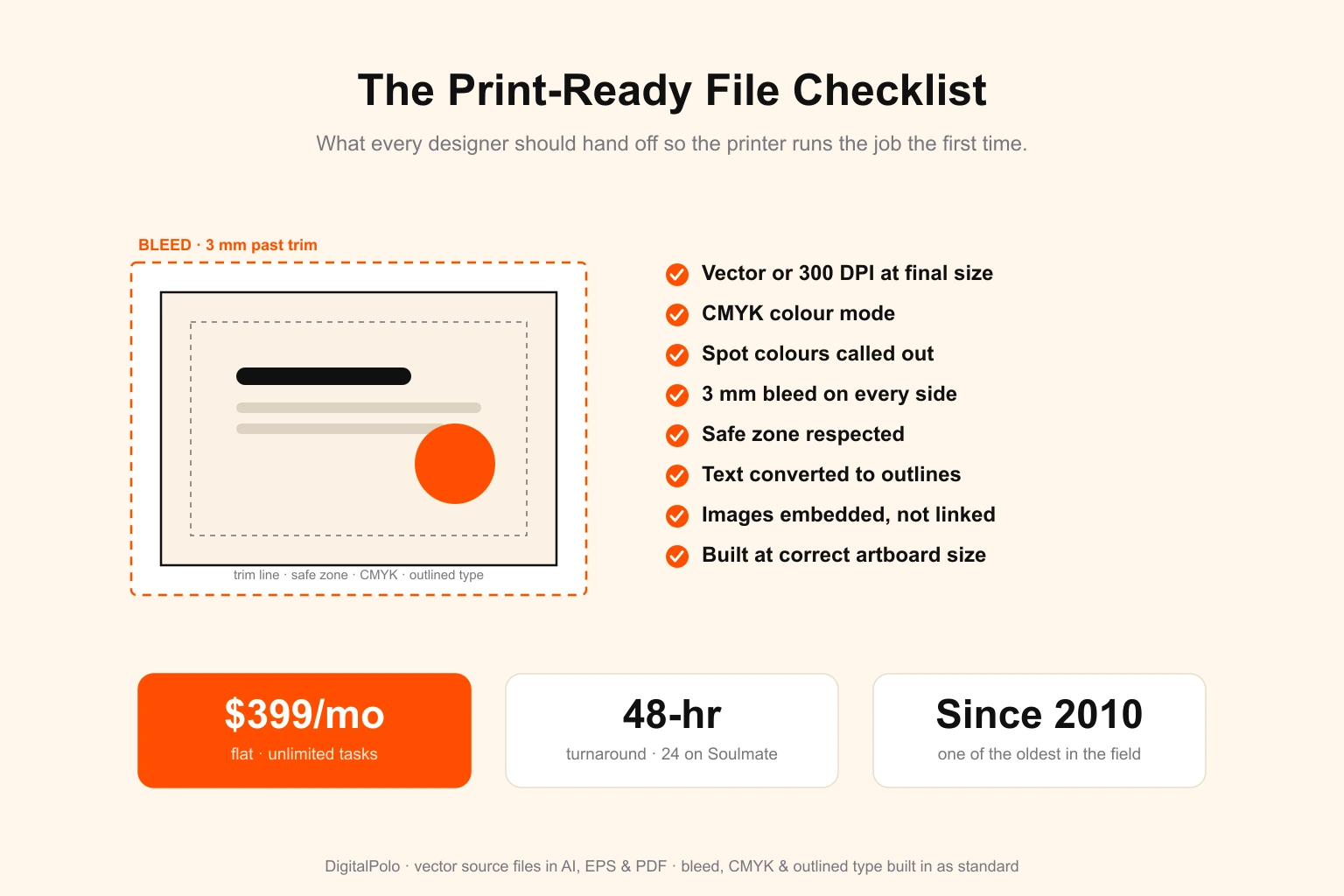
Handoff. Final exports, preflight, packaging files and delivery. Short for a social post. For print it is a real step: bleed, colour mode, fonts, dielines and specs have to be checked, which is why a proper print-ready file checklist exists.
Put together:
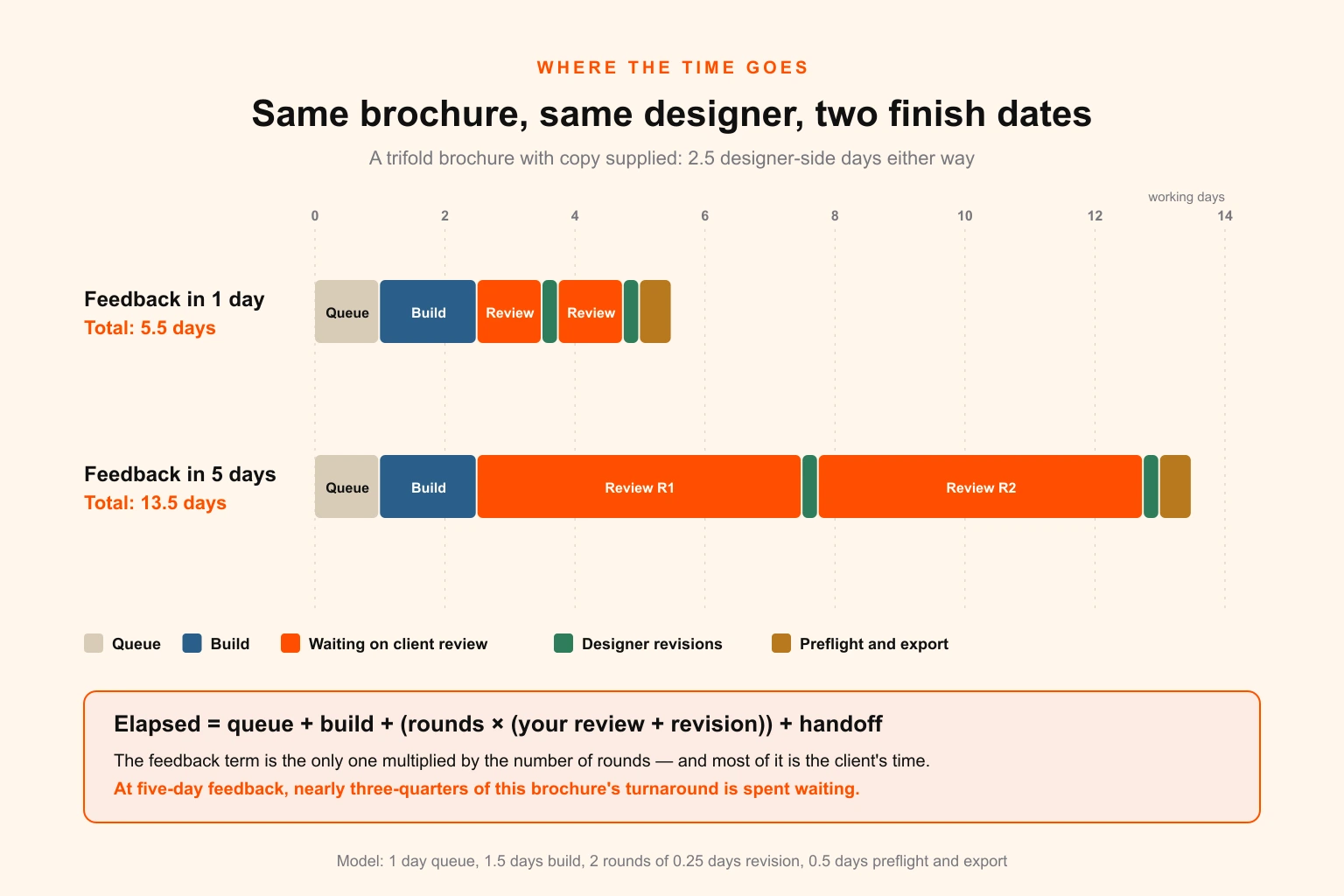
Elapsed turnaround = queue + build + (rounds × (your review time + revision time)) + handoff
This formula changes where you look for delays. Designers can shorten build time. Better tooling can shorten handoff. Queue time depends on how the provider manages capacity. The feedback term is the only one multiplied by the number of rounds, and most of it is your time, not the designer's.
Take a trifold brochure with copy supplied. Assume one day in the queue, a day and a half to build, two rounds of a quarter-day each, and half a day of preflight and export. That is about two and a half days of designer-side time. If you return feedback in one day, the brochure is approved in five and a half working days. If feedback takes five days, because it goes to a committee or someone is travelling, it takes thirteen and a half. The design work is the same. The difference is waiting.
Benchmarks by asset type
The tables below are planning benchmarks, not promises. They reflect how common deliverables move through a working design process when the brief is complete. A complete brief means final copy, supplied images or a clear image direction, exact dimensions and output specs, and brand assets to hand. The approved final column assumes the brief is picked up within a working day and feedback comes back within one to two working days. If your organisation is slower than that, use the feedback latency section to adjust.
Designer hours means hands-on design time for the first draft. First draft is elapsed time from pickup to the first presentable version. Rounds is the typical number of revision rounds for that asset when the brief is sound.
Social, digital and ad creative
| Asset | Designer hours | First draft | Rounds | Approved final |
|---|---|---|---|---|
| Resize an approved design into new sizes | 0.25–1 | Same day | 0–1 | 1 day |
| Blog featured image from a template | 0.5–1 | Same day | 0–1 | 1 day |
| Single social post from a template | 0.5–1.5 | Same day–1 day | 1 | 1–2 days |
| Static ad concept, one message, 3–4 sizes | 2–4 | 1–2 days | 1–2 | 2–4 days |
| Ad variant set, ~10 variants of an approved concept | 3–8 | 1–2 days | 1 | 2–4 days |
| Carousel, 5–10 frames | 3–6 | 1–2 days | 1–2 | 3–5 days |
| Web banner or hero graphic | 1–3 | 1 day | 1 | 2–3 days |
| Infographic, data supplied | 6–14 | 2–4 days | 2 | 1–2 weeks |
| Modular email template, design only | 4–10 | 2–3 days | 2 | 1–2 weeks |
| Landing page design, desktop and mobile | 10–24 | 3–5 days | 2 | 2–3 weeks |
The pattern is simple: derivative work is fast and new work is slow. Once one ad concept is approved, ten variants take hours, because the creative decisions are made and what remains is production. That is why a sensible ad creative volume plan budgets new concepts and variants separately, and why turning one campaign asset into fifteen channel formats is quicker when the master is approved before any format work starts. The same applies to featured images at blog scale: a template system turns around in hours, and bespoke artwork for each post does not.
Email templates and landing pages take longer than their size suggests. They carry more states, breakpoints and edge cases than a static graphic, and they are usually reviewed by more than one team. Development and testing across email clients come after design and are not counted here. See the email design guide for what that stage involves.
Print collateral and signage
| Asset | Designer hours | First draft | Rounds | Approved final |
|---|---|---|---|---|
| Business card, logo supplied | 1–3 | 1 day | 1–2 | 2–4 days |
| Flyer or poster, single side | 2–5 | 1–2 days | 1–2 | 3–5 days |
| Sign panel or banner | 2–6 | 1–2 days | 1–2 | 3–7 days |
| Die-cut sticker | 1–4 | 1 day | 1 | 2–3 days |
| Trade show backwall or pop-up graphic | 3–8 | 1–3 days | 1–2 | 1–2 weeks |
| Trifold brochure | 6–12 | 2–4 days | 2 | 1–2 weeks |
| Menu, one or two pages, copy supplied | 4–10 | 2–3 days | 2 | 1–2 weeks |
| Vehicle wrap layout on a vehicle template | 6–16 | 2–4 days | 2 | 1–2 weeks |
| 8–16 page brochure or catalogue section | 16–40 | 1–2 weeks | 2–3 | 3–5 weeks |
In print, handoff time is real time. A die-cut sticker's artwork is quick to make, but the cut line, bleed and white layer still have to be right. The die-cut sticker file specs cover what that means. Large format has its own resolution and viewing-distance checks, which is why DPI by print size matters before a sign panel is exported. You can check it quickly with the print resolution calculator.
Vehicle wraps and exhibition graphics carry more risk in the specifications than in the design. A wrap depends on an accurate vehicle template, and a stand depends on the exact frame system and fabric allowances. When those details are wrong, the delay is a remake. The vehicle wrap design guide and the sign shop outsourcing guide both cover the inputs that prevent it.
Menus take longer than their page count suggests because the copy is rarely final. Prices change, dishes are swapped and the allergen key is rewritten mid-round. The menu engineering and print spec guide explains how to settle content first.
Brand identity
| Asset | Designer hours | First draft | Rounds | Approved final |
|---|---|---|---|---|
| Stationery suite, logo already approved | 4–8 | 2–3 days | 1 | About 1 week |
| Logo refresh or redraw of an existing mark | 4–10 | 2–3 days | 1–2 | 1–2 weeks |
| New logo, several initial concepts | 12–30 | 5–10 days | 2–3 | 2–5 weeks |
| Brand guidelines, 20–40 pages | 25–60 | 2–3 weeks | 2 | 3–6 weeks |
A new logo is the clearest case of a gap between hours and elapsed time. The hours are modest. The elapsed time is long because it includes research and exploration before concepts can be shown, and because decisions about identity involve more people and more hesitation than anything else a business commissions. A mood board agreed before concepts begin is the best tool for shortening it, because it moves the "that's not what we meant" conversation to before the build rather than after it.
Brand guidelines take as long as they do because they depend on everything else being decided. A guidelines document can't be finished while colour values, type choices or logo lockups are still under discussion. What guidelines should contain sets out those dependencies. If you are rolling out a new identity against a deadline, the 90-day brand rollout plan sequences this work.
Packaging and product
| Asset | Designer hours | First draft | Rounds | Approved final |
|---|---|---|---|---|
| SKU variant of an approved master | 1–3 | 1 day | 1 | 2–3 days |
| Label on an existing dieline | 3–8 | 1–3 days | 2 | 1–2 weeks |
| Marketplace listing image set, ~7 images | 8–16 | 3–4 days | 2 | 1–2 weeks |
| Folding carton, new artwork on a supplied dieline | 8–20 | 3–5 days | 2–3 | 2–4 weeks |
Packaging is slow for reasons that aren't about design. Regulatory copy, barcodes, ingredient panels, legal claims and structural fit all have to be right, and each is usually checked by someone other than the marketing lead. A missing or wrong dieline is the most common cause of delay. The dieline design guide covers what to give your designer before the clock starts, and the label design guide covers the label version.
Once a master is approved, variants are fast. A range of twelve flavours isn't twelve packaging projects. It is one project followed by eleven variants that each take a day or two, provided the master was built as a system with locked zones for the changing elements. For the budget side of that, see what a packaging refresh actually costs.
Presentations and documents
| Asset | Designer hours | First draft | Rounds | Approved final |
|---|---|---|---|---|
| Case study one-pager from a template | 1–3 | 1 day | 1 | 2–3 days |
| Restyle a 30-slide deck into an existing template | 4–10 | 2–3 days | 1–2 | About 1 week |
| Presentation master template | 8–16 | 3–4 days | 2 | 1–2 weeks |
| Pitch or sales deck, 15–20 slides from content | 10–25 | 3–5 days | 2–3 | 1.5–3 weeks |
| Ebook or white paper, ~20 pages | 12–30 | 4–6 days | 2 | 2–3 weeks |
| Annual or long-form report, 40+ pages | 40–100 | 2–3 weeks | 3 | 6–10 weeks |
Decks slip more often than any other asset, and design is rarely the reason. Deck content changes during design. A slide is designed, the narrative is reordered, three slides are merged, and a new data point is added. The designer ends up rebuilding rather than refining, and each rebuild resets part of the build clock. The fix is to lock the storyline before design starts. A team with too many deck variants has this problem repeatedly, which is the case for deciding how many deck versions you actually need before commissioning any of them.
Illustration
| Asset | Designer hours | First draft | Rounds | Approved final |
|---|---|---|---|---|
| Spot illustration | 3–8 | 1–3 days | 1–2 | About 1 week |
| Icon set, ~12 icons | 8–20 | 3–5 days | 2 | 1–2 weeks |
| Complex custom illustration | 12–40 | 1–2 weeks | 2–3 | 2–5 weeks |
Illustration is the least predictable category. The spread in hours reflects real variation in style, detail and the number of sketch approvals needed before rendering. For planning, approve the sketch stage separately and quote rendering time only once the sketch is signed off.
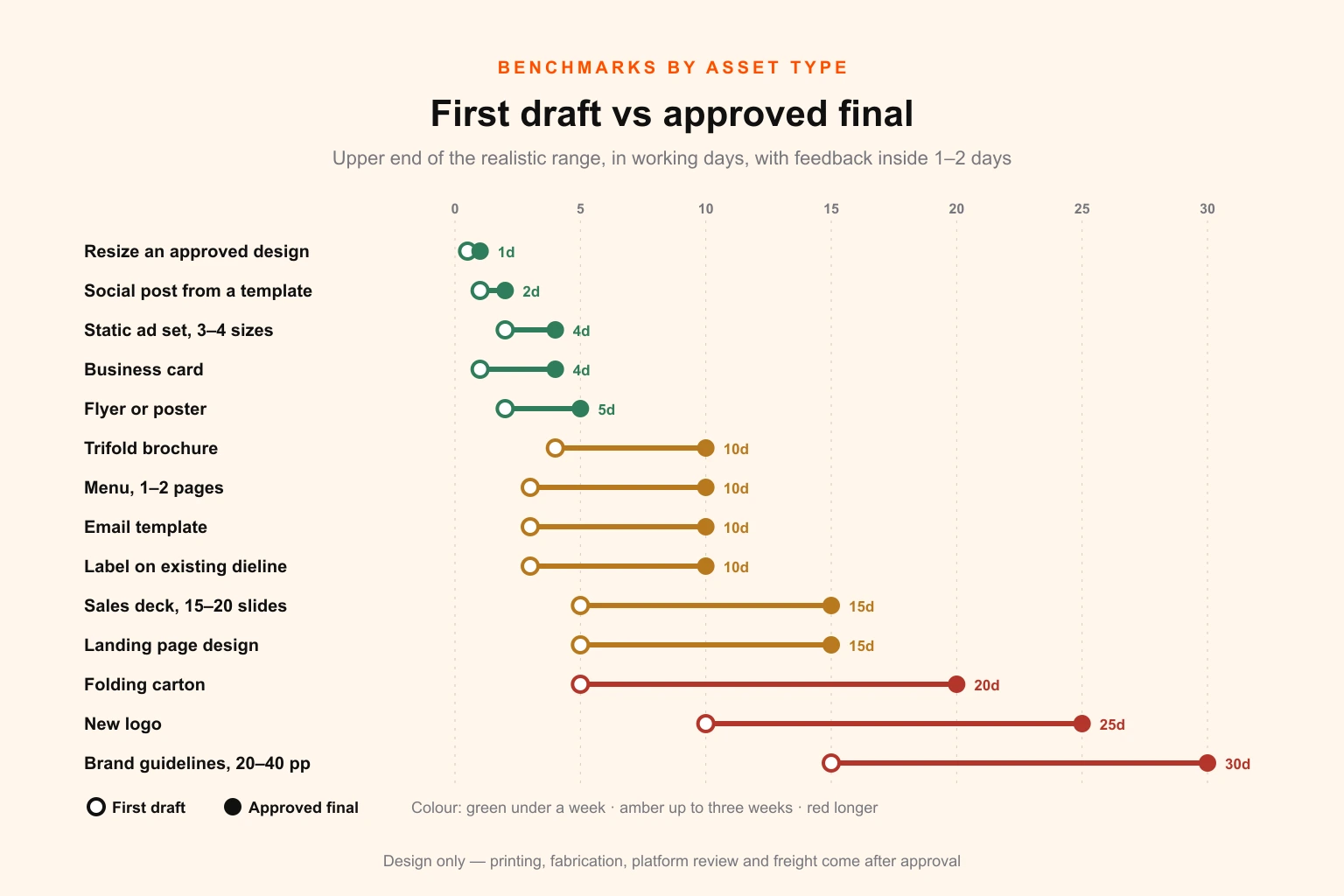
First draft and final are different numbers
A lot of disappointment comes from confusing the two.
Time to first draft is mostly the provider's number. It depends on the queue and on build time, and it is what a well-run design team can actually commit to. When a design subscription advertises a 24 or 48 hour turnaround, it generally means one pass of one task from pickup. That is how unlimited design subscriptions work: you can submit as many requests as you like, and each one moves through the queue a pass at a time.
Time to approved final is shared. It depends on the provider's revision speed and on how fast you review, how many people review, and whether the feedback is clear enough to act on in one pass.
The practical rule: hold your provider to time to first draft, and hold your own team to feedback latency. If you only track time to final, every delay looks like the designer's fault, and the actual bottleneck never gets fixed.
Revision rounds deserve their own warning. The benchmarks assume rounds are used to refine the chosen direction. When rounds are used to find the direction ("can we see something completely different?"), each one restarts build time. A logo with two refinement rounds takes three weeks. A logo with two rounds of new concepts can take two months. Most of that difference is set by the brief. A design brief that settles the direction first is the most effective single tool for keeping elapsed time close to the benchmark.
Feedback latency: the variable you control
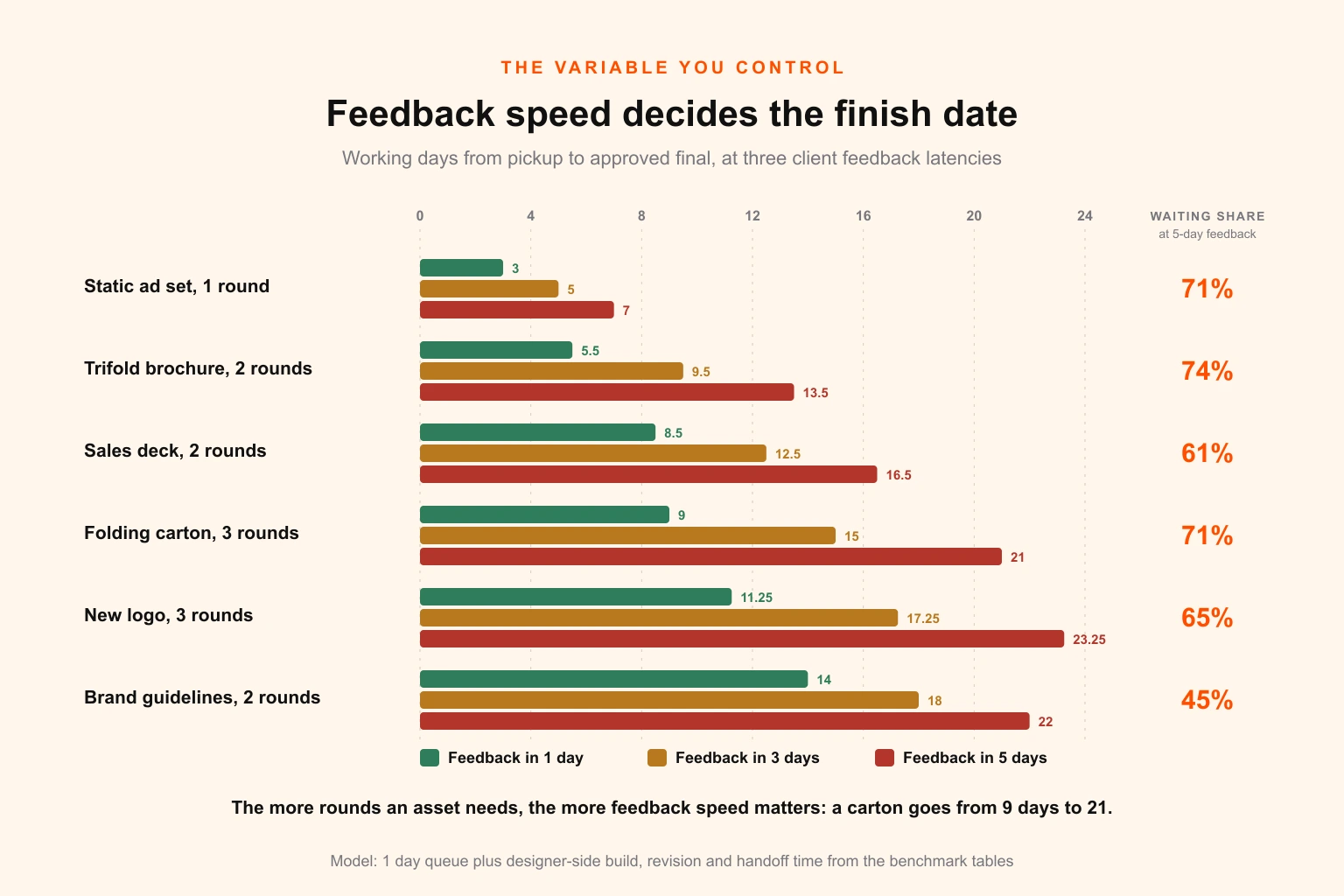
Here is the same formula applied to six common assets at three feedback speeds. Values are working days from pickup to approved final. The model uses one day of queue time and the build, revision and handoff times implied by the benchmarks above.
| Asset | Designer-side days | Feedback in 1 day | Feedback in 3 days | Feedback in 5 days |
|---|---|---|---|---|
| Static ad set, 1 round | 1 | 3 | 5 | 7 |
| Trifold brochure, 2 rounds | 2.5 | 5.5 | 9.5 | 13.5 |
| Sales deck, 2 rounds | 5.5 | 8.5 | 12.5 | 16.5 |
| Folding carton, 3 rounds | 5 | 9 | 15 | 21 |
| New logo, 3 rounds | 7.25 | 11.25 | 17.25 | 23.25 |
| Brand guidelines, 2 rounds | 11 | 14 | 18 | 22 |
Two things stand out.
First, the more rounds an asset needs, the more feedback speed matters. A carton with three rounds more than doubles its elapsed time when feedback slows from one day to five. A brand guidelines document with two long rounds is hurt less, because designer time already dominates it.
Second, for everyday collateral, the designer is working on the asset for a small share of its turnaround. At five-day feedback, a static ad set spends about 71% of its elapsed time waiting on the client, and a brochure about 74%. Speeding up the designer barely changes the finish date. Consolidating feedback does.
In practice, feedback latency is rarely one slow person. It is usually structural:
- Too many reviewers with no consolidator. Five people comment independently, contradict each other, and the designer gets a thread instead of a decision.
- Late stakeholders. Someone senior sees the asset for the first time in round three and resets the direction.
- Feedback that describes a feeling instead of a change. "It doesn't pop" needs another conversation before anyone can act on it.
- Batching reviews into weekly meetings. A weekly marketing meeting means a five-day feedback latency whatever anyone intends.
- Copy and legal review running in series with design review rather than in parallel.
Each of these can be fixed without spending more on design. One named approver, a one-business-day feedback commitment, and comments written as specific changes will usually cut a third or more off elapsed turnaround for multi-round assets.
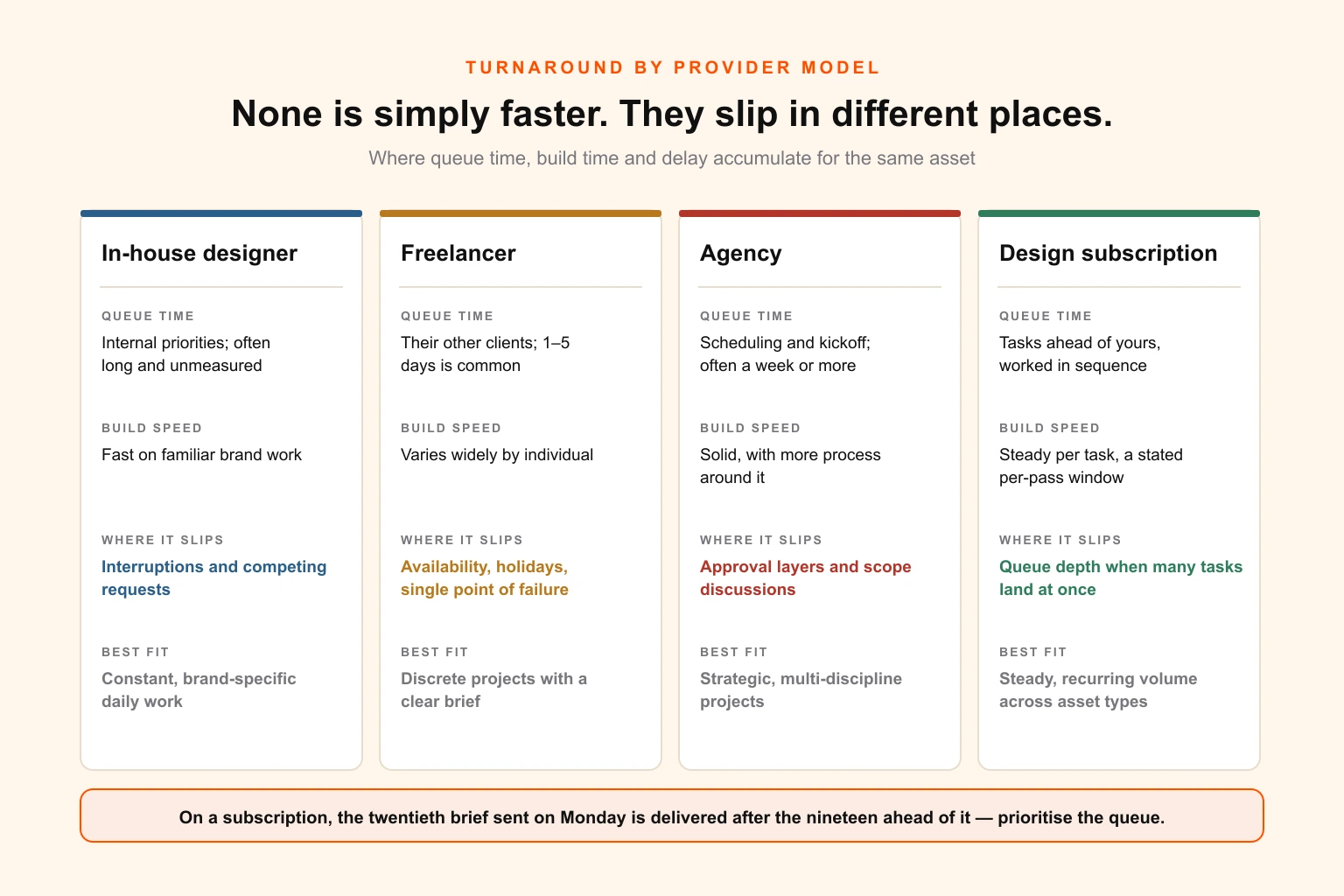
Turnaround by provider model
The same asset moves through the four clocks differently depending on who is designing it. None of these models is simply faster than the others. They put the delay in different places.
| In-house designer | Freelancer | Agency | Design subscription | |
|---|---|---|---|---|
| Queue time | Set by internal priorities; often long and unmeasured | Depends on their other clients; 1–5 days is common | Scheduling and kickoff; often a week or more for new projects | Tasks ahead of yours in your own queue; usually worked in sequence |
| Build speed | Fast on familiar brand work | Varies widely by individual | Solid, with more process around it | Steady per task; stated as a per-pass window |
| Revision model | Informal and frequent | Usually a set number of rounds in the quote | Scoped rounds; extra rounds are change orders | Revisions are further passes through the queue |
| Where it slips | Interruptions and competing requests | Availability, holidays, a single point of failure | Approval layers and scope discussions | Queue depth when many tasks are submitted at once |
| Best fit | Constant, brand-specific daily work | Discrete projects with a clear brief | Strategic, multi-discipline projects | Steady, recurring volume across many asset types |
In-house turnaround looks fastest because there is no quote and no onboarding. Queue time is the hidden cost. An in-house designer is handling requests from sales, product, HR and the founder at once, and the order is often set by whoever asks loudest. If you are comparing costs as well as speed, the full-time designer comparison covers it.
Freelancers can be the fastest option for one well-briefed job and the slowest when you need a steady flow, because they are one person with other clients and holidays. Freelancers versus a design subscription sets out when each makes sense.
Agencies tend to have the longest queue time and the most predictable delivery once a project starts. The process that slows kickoff is the same process that protects quality on complex, strategic work.
Design subscriptions turn around individual tasks quickly and consistently, but throughput is limited by sequencing. Submit twenty briefs on Monday and the twentieth isn't delivered on Wednesday. It is delivered after the nineteen ahead of it. The right way to use one is to prioritise the queue so long-lead assets go first and derivative work is batched behind approved masters.
Why the same asset takes three times longer
Two companies commission the same trifold brochure from the same designer. One is approved in six working days, the other in eighteen. The difference is almost always one of these factors, roughly in order of impact.
1. Copy wasn't final at briefing. This does the most damage. If copy changes after layout, text reflows, images get resized, panel structure breaks, and every round becomes a partial rebuild. Treat "final copy" as a hard entry condition for print and deck work.
2. Assets were missing or low quality. Images to be supplied later, a logo only available as a screenshot, brand colours described as "our blue". Each gap either stalls the job or gets filled with a placeholder that causes a round later.
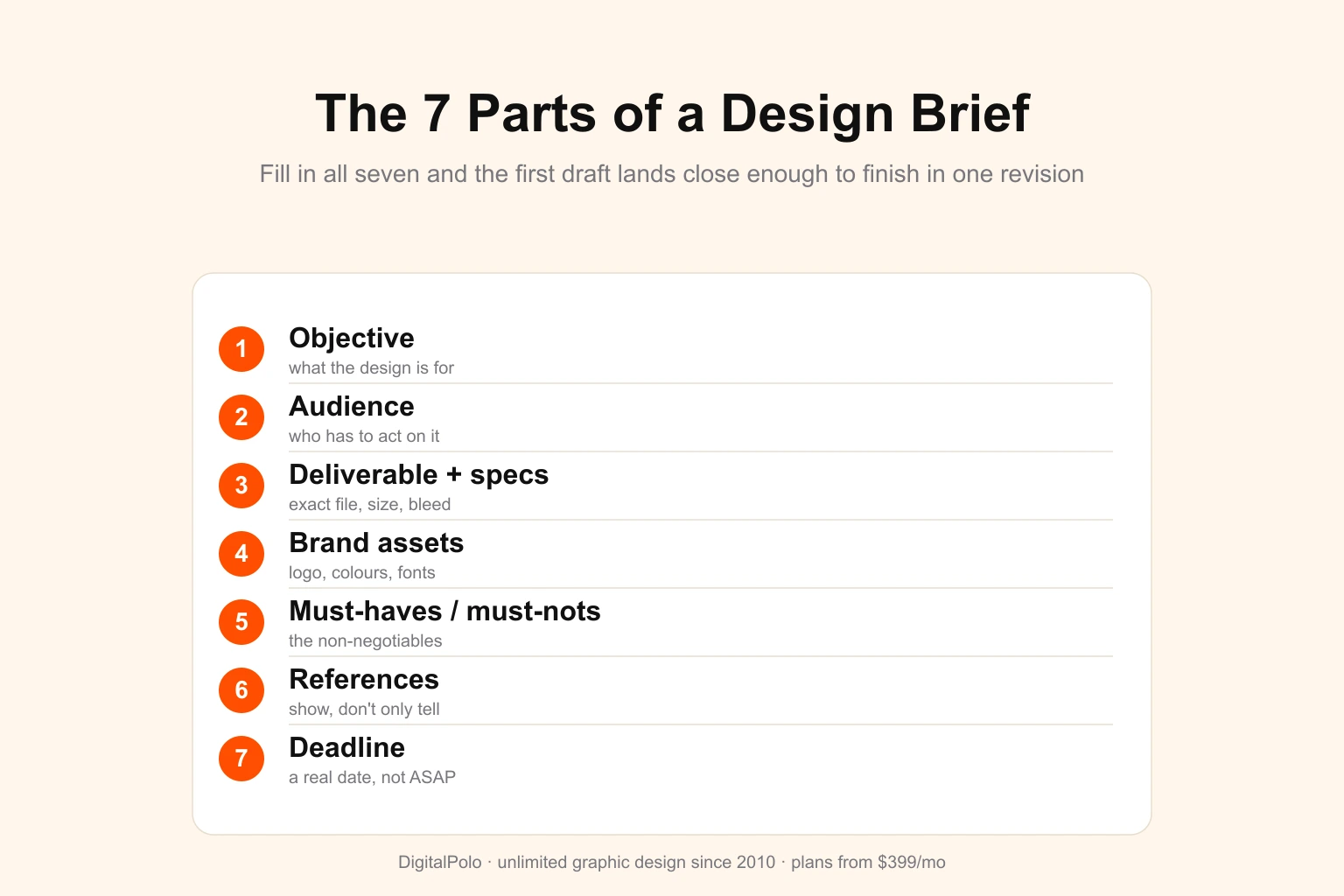
3. The brief described the output, not the decision. "A brochure for the trade show" is an output. "A brochure that gets a facilities manager to book a site survey, handed out at the stand, 99×210mm folded" is a decision. The second one turns around faster because there's less to guess.
4. New concept versus system application. Work that applies an existing brand system goes much faster than work that invents a new look. A company with clear brand guidelines and templates gets system turnaround on most requests. A company without them pays new-concept turnaround every time.
5. Specifications arrived late. Print dimensions, bleed, dieline, stock, finish, platform safe zones. Discovering the printer needs 5mm of bleed rather than 3mm, or that the stand's frame system is different, turns an approved file into a revision.
6. Stakeholder count. Every added reviewer increases feedback latency and the odds of a direction reset. Past three reviewers, it tends to get noticeably worse.
7. Fidelity mismatch. Stakeholders expected to review a rough layout but received a polished draft, or the reverse. Being clear about whether a draft is a sketch, wireframe or finished visual prevents an unnecessary round. For digital work, the difference between wireframes, mockups and prototypes is worth agreeing before the first draft.
What a rush can and can't speed up
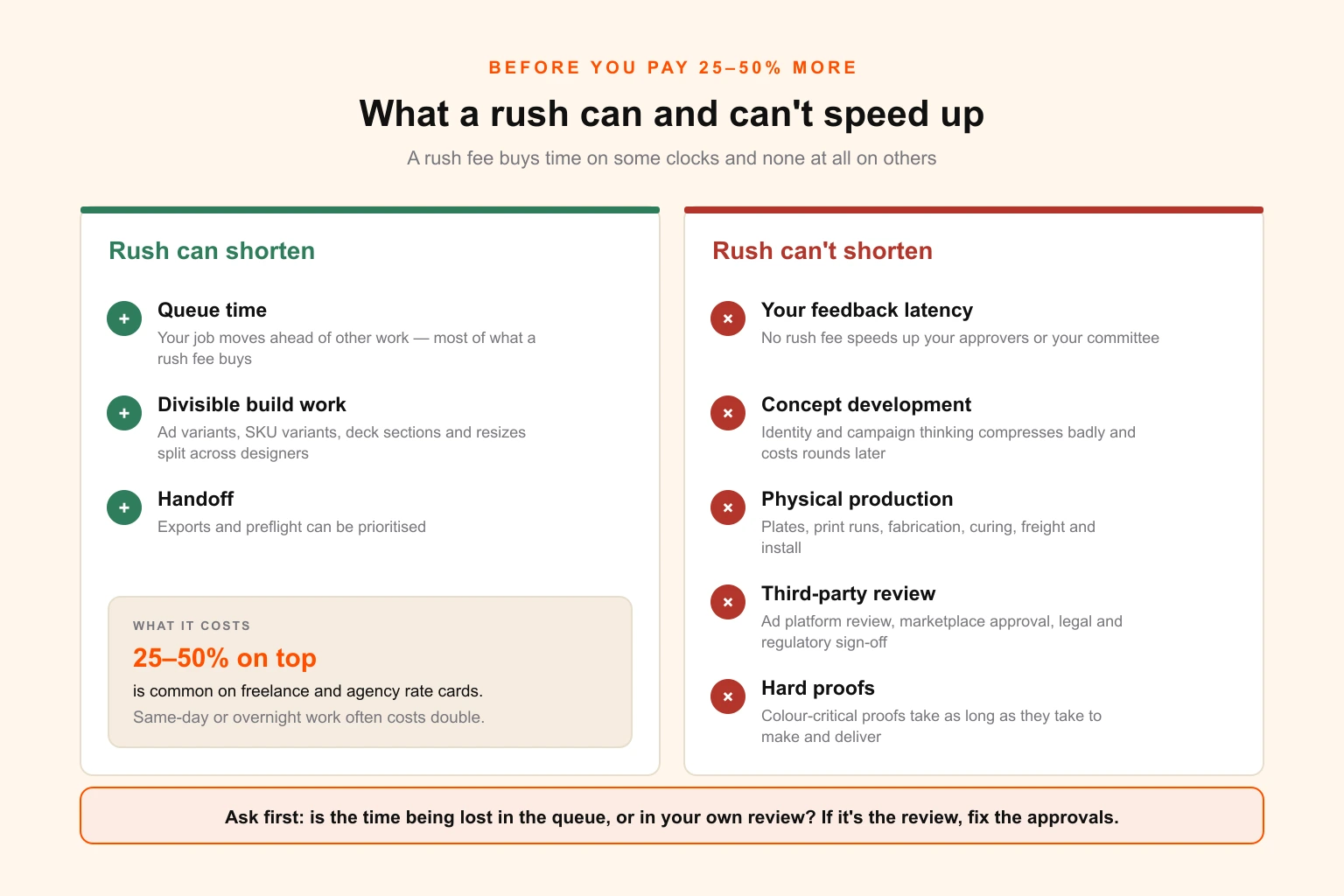
Every provider will do rush work at some price. Rush fees of 25% to 50% are common on freelance and agency rate cards, and same-day or overnight work often costs double. Before paying, check which of the four clocks you are actually buying time on.
Rush can shorten:
- Queue time. Your job moves ahead of other work. This is most of what a rush fee buys, and for short assets it is most of the saving.
- Build time, for divisible work. Ad variants, SKU variants, deck sections and resize sets can be split across several designers. A single logo concept or a tightly integrated brochure can't be split usefully.
- Handoff. Exports and preflight can be prioritised.
Rush can't shorten:
- Your feedback latency. No rush fee speeds up your approvers. If the job was going to wait four days for a committee, it still will.
- Concept development. Thinking time for identity and campaign concepts compresses badly. Rushed concepts tend to cost the time back in extra rounds.
- Physical production. Plates, print runs, fabrication, drying and curing, shipping and installation run on the supplier's schedule.
- Third-party review. Ad platform review, marketplace listing approval, regulatory and legal sign-off.
- Physical proofs. A hard proof for colour-critical print takes as long as it takes to make and deliver.
Before paying for speed, ask whether the time you are losing is in the queue or in your own review. If it is in the review, fix the approval process instead.
Design turnaround is not production lead time
Approval is the halfway point for any physical asset. After it come the production lead times, which are often longer than design and are set by suppliers.
As a rough guide: short-run digital print is a few days. Litho collateral runs one to two weeks. Large format and exhibition graphics run one to three weeks depending on the system. Vehicle wraps depend on installer capacity. Packaging with new plates or cutting dies takes several weeks before the print run starts. On top of that is freight, and for events there are warehouse and venue deadlines. The trade show asset checklist and the event production timeline both show how organiser deadlines land earlier than printer deadlines.
The planning consequence is that design approval dates for physical assets come from the production calendar, not the launch date. A carton that needs five weeks of print and freight before launch needs approved artwork five weeks out, so its brief needs to go out three to four weeks before that.
Plan backwards from the deadline
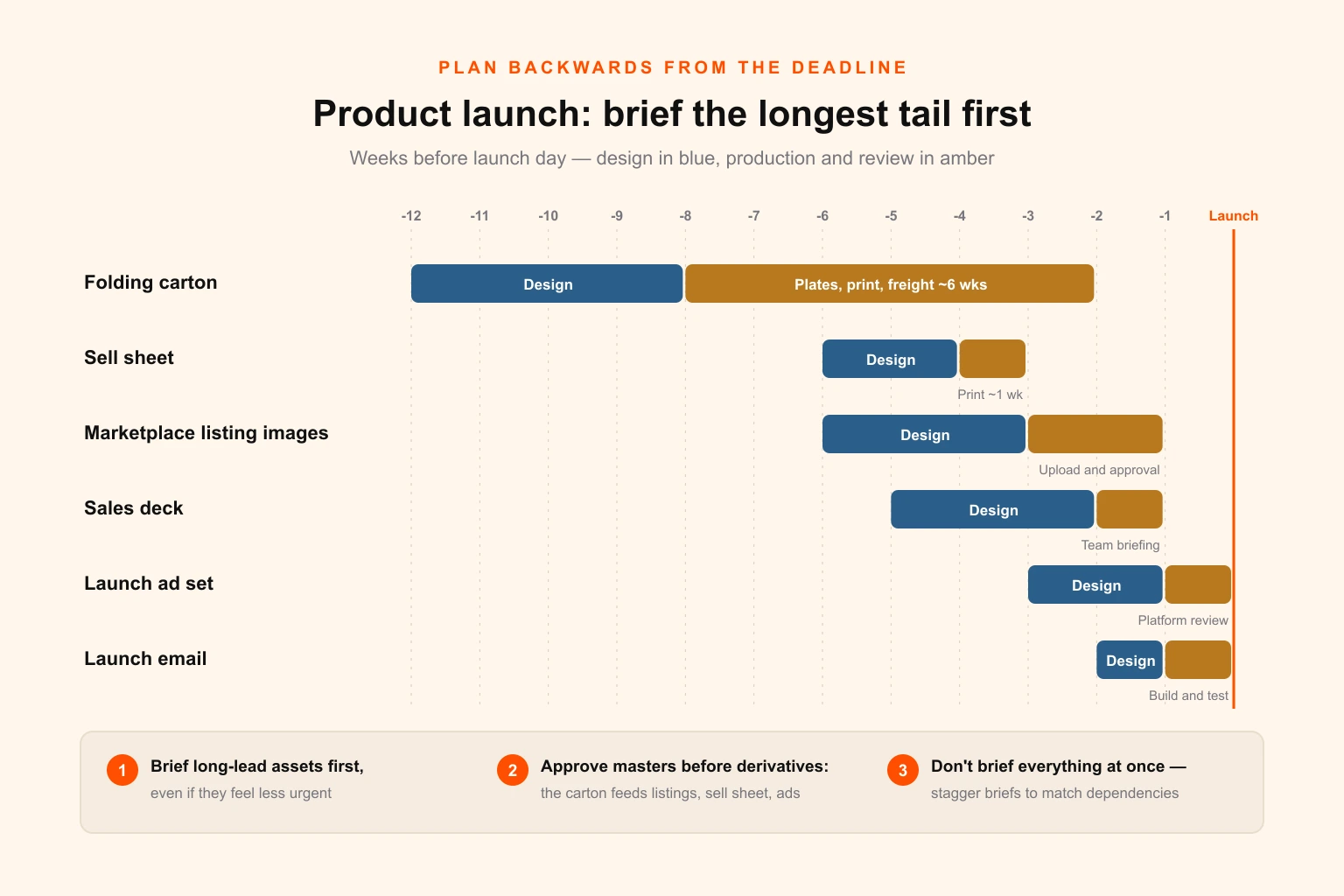
Here is a worked example: a consumer product launching on a fixed date, with retail packaging, marketplace listing images, a printed sell sheet for buyers, a sales deck, a set of launch ads and a launch email. Weeks are counted back from launch day.
| Asset | Brief out | Design approved | Production and review | Ready |
|---|---|---|---|---|
| Folding carton | Week −12 | Week −8 | Plates, print, freight: ~6 weeks | Week −2 |
| Sell sheet | Week −6 | Week −4 | Print: ~1 week, buyer meetings from week −3 | Week −3 |
| Sales deck | Week −5 | Week −2 | Sales team briefing | Week −1 |
| Marketplace listing images | Week −6 | Week −3 | Listing upload and approval buffer | Week −1 |
| Launch ad set | Week −3 | Week −1 | Platform review, variant QA | Launch |
| Launch email | Week −2 | Week −1 | Build, test sends | Launch |
Three rules come out of this.
Brief long-lead assets first, even if they feel less urgent. The carton is briefed twelve weeks out, before anyone has thought about the ads, because its production tail is the longest.
Approve masters before derivatives. Once the carton artwork is approved, it becomes the source for listing images, the sell sheet and the ads. Briefing those before the master is approved risks rework on all of them.
Don't brief everything at once. Twenty briefs sent to any provider on the same day just create a queue. Spread them across the weeks so each one arrives when its dependencies are approved.
If you resell design: setting a turnaround SLA you can keep
Agencies, printers and consultancies that resell design have a harder version of this problem. You pass on your supplier's turnaround, then add your own quality check and your client's review time, and the client blames you for all of it.
A turnaround commitment that holds up usually has five parts.
- Two numbers, not one. Commit to time to first draft. Describe time to final as depending on the client's feedback speed, with an example: "typically one to two weeks with feedback inside two business days".
- A defined start. The clock starts when a complete brief is received, meaning final copy, assets and specs. It does not start when someone sends "can you do a brochure?"
- A pause rule. The clock pauses while a draft is with the client for review.
- A buffer over your supplier. If your white-label partner delivers a pass in 48 hours, don't promise the client 48 hours. Your own QA and account handling sit inside the time the client experiences.
- A rush path with a price. Say what rush speeds up (queue position) and what it doesn't (the client's review or print production).
If you are choosing a partner to sit behind that commitment, the twelve questions for vetting a white-label design partner include how to test turnaround claims before you depend on them. The white-label pricing benchmarks put speed alongside cost in a comparable unit.
Measuring turnaround properly
Most teams track one number, whether things were late, and learn nothing from it. These six metrics show where the time actually goes.
| Metric | How to calculate it | What a healthy number looks like |
|---|---|---|
| Brief-to-first-draft | Days from complete brief to first presentable draft | Within the benchmark for the asset type |
| Rounds per asset | Revision rounds before approval, by asset type | At or below the benchmark rounds |
| Feedback latency | Days a draft sits with the client per round | One to two working days |
| First-pass approval rate | Share of assets approved in one round or fewer | Rising over time as briefs improve |
| Waiting share | Client review days divided by total elapsed days | Falling; above 60% signals an approval problem |
| On-time rate | Share of assets approved by the planned date | Tracked per asset category, not overall |
Recording these doesn't require new software. A column for each date in whatever tracker you already use is enough. The waiting share is the one to watch. Once a team sees that most elapsed time is spent waiting on its own approvers, the approval process usually gets fixed quickly.
Tools that help. A task tracker with timestamped status changes, such as Asana, Trello, Monday.com or Jira, gives you queue, build and review dates without extra admin. Proofing tools like Filestage, Frame.io or Markup.io collect comments on the file itself, which cuts vague feedback and the time spent consolidating email threads. Figma comments do the same for digital work. Time trackers like Toggl or Harvest record build hours if you want to compare them with elapsed time. A shared drive with a fixed folder structure for briefs, assets and finals removes the "can you resend the logo" delay entirely.
Eight mistakes that stretch turnaround
- Quoting designer hours as a delivery date. Fifteen hours of work isn't two days of calendar time once queue and review are added.
- Briefing before copy is final. Every copy change after layout is a partial rebuild.
- Letting everyone comment and nobody decide. Unconsolidated feedback adds rounds and lengthens every round.
- Using revision rounds to look for a direction. Asking for new concepts at the revision stage restarts build time.
- Briefing derivatives before the master is approved. Changes to the master then flow into every variant.
- Sending every brief on the same day. It creates a queue instead of a plan, and long-lead assets end up behind quick ones.
- Paying for rush when the delay is internal. A rush fee buys queue position, not faster approvers.
- Planning from the launch date instead of the production calendar. Physical assets need approved artwork weeks before launch, not days.
Where Digital Polo fits
Most turnaround problems are volume and sequencing problems. A business needing a steady flow of ads, social posts, sell sheets, packaging variants, decks and print collateral usually doesn't lack a talented designer. It lacks the capacity to keep a queue moving without every request waiting behind the last.
That is the problem a flat-rate design team is built for. On the Partner plan, most tasks are delivered within 48 hours per pass. On the Soulmate plan, priority delivery is within 24 hours. You can keep adding requests to the queue, and derivative work such as resizes and variants often comes back the same day. The benchmarks above still apply: a logo still needs its rounds, and a carton still needs its preflight. What changes is that queue time is predictable and you aren't paying a quote for every item.
In practice, that covers brand identity and logo design when the system needs building, packaging design and print-ready artwork when production deadlines matter, social media and ad creative when volume is high, presentation design for decks and sales collateral, and infographic design for data-heavy content. Graphic design pricing compares the model with hiring and agency rates. If you resell design to your own clients, the same capacity is available white-label.
The short version
Design turnaround is four clocks: queue time, build time, feedback loops and handoff. Designer hours are usually the smallest part. For everyday collateral, most of the elapsed time is spent waiting for client feedback.
Use the benchmarks to plan: about a day for derivative work, two to four days for single digital assets, one to two weeks for multi-panel print, one and a half to three weeks for decks, two to four weeks for packaging, two to five weeks for a new logo and three to six weeks for brand guidelines. Adjust for your own feedback speed, because a carton that takes nine working days at one-day feedback takes twenty-one at five-day feedback.
Hold your provider to time to first draft. Hold your own team to feedback latency. Lock copy before layout, approve masters before variants, brief long-lead assets first, and plan physical assets from the production calendar rather than the launch date.
If you need that capacity without hiring, see what the plans include or talk to us about your workload.