If you have ever paid a freelancer $200 to remake one social-media graphic, or paid an agency $4,000 to produce a single brochure that took three weeks, the words "unlimited graphic design" sound like a category error. They are not. The model has been quietly running for over a decade, the math works at the volume most marketing-led businesses actually operate at, and the buying decision is now simple enough to make on a single page — if you understand how the service actually works.
This is the complete guide. Not a sales page — a working explanation of how unlimited graphic design subscriptions are structured, what the workflow looks like in practice, what's included and what isn't, what they cost across the category in 2026, and how to evaluate one without buying a subscription you can't use.
DigitalPolo has been delivering unlimited graphic design since 2010 — one of the oldest services in the category — with plans from $399/month, 48-hour turnaround, unlimited revisions, and production-ready source files (AI, EPS, PDF) included as standard. The model has changed shape several times in fifteen years; what follows is what it looks like now, in 2026, based on how the category actually operates today rather than how its first wave of marketing pages once described it.
What Unlimited Graphic Design Actually Is
Unlimited graphic design is a subscription-priced design service. You pay a flat monthly fee, you submit as many design briefs as you want, and a designer or design team works through your queue inside a published turnaround time per task. There is no hourly billing, no per-project quote, no scope-of-work renegotiation. The price is the price; the queue is the queue.
Three structural facts define the model:
- Fixed monthly cost. The fee doesn't move based on how much you submit, how many revisions you ask for, or which file formats you need.
- Queue-based delivery. Tasks are worked one at a time per designer assigned. You can submit ten briefs at once, but they are delivered in sequence, not in parallel.
- Turnaround SLA, not deadline. Each task ships within the service's published window (typically 24 or 48 hours) from when the designer picks it up — not from when you submitted it. If you submit five briefs simultaneously, the fifth one ships five turnaround cycles later.
That last point is the one most first-time subscribers misunderstand. "Unlimited" describes the number of requests you can submit, not the number of designs the service can deliver in parallel. Throughput is bounded by turnaround × number of active task slots.
For deeper grounding on the broader category economics, our breakdown of why most businesses should not run graphic design in-house covers the cost comparison from the opposite angle.
The Workflow: What a Day on an Unlimited Subscription Looks Like
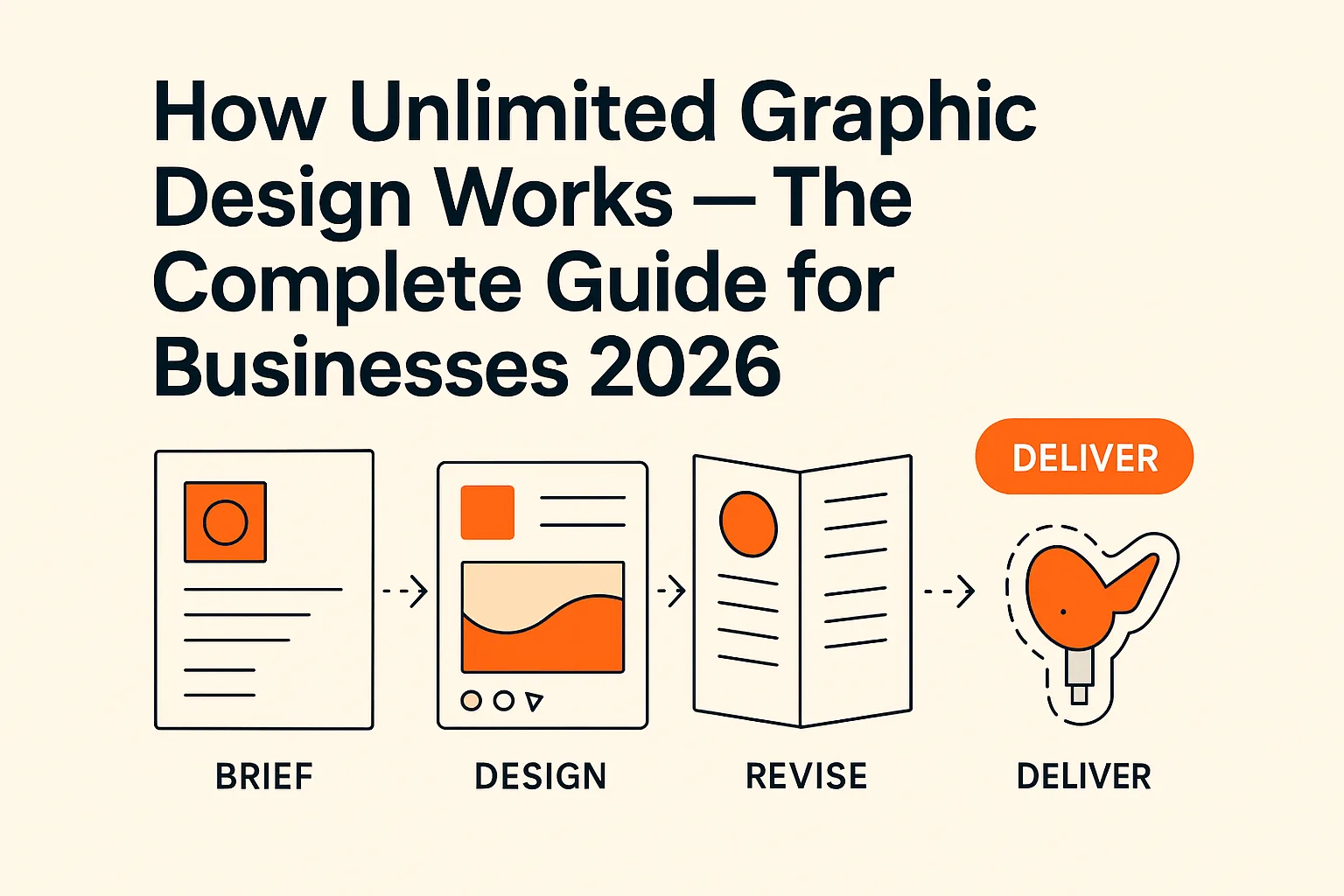
The mechanical workflow across the category is more uniform than the marketing pages suggest. Six steps, repeating.
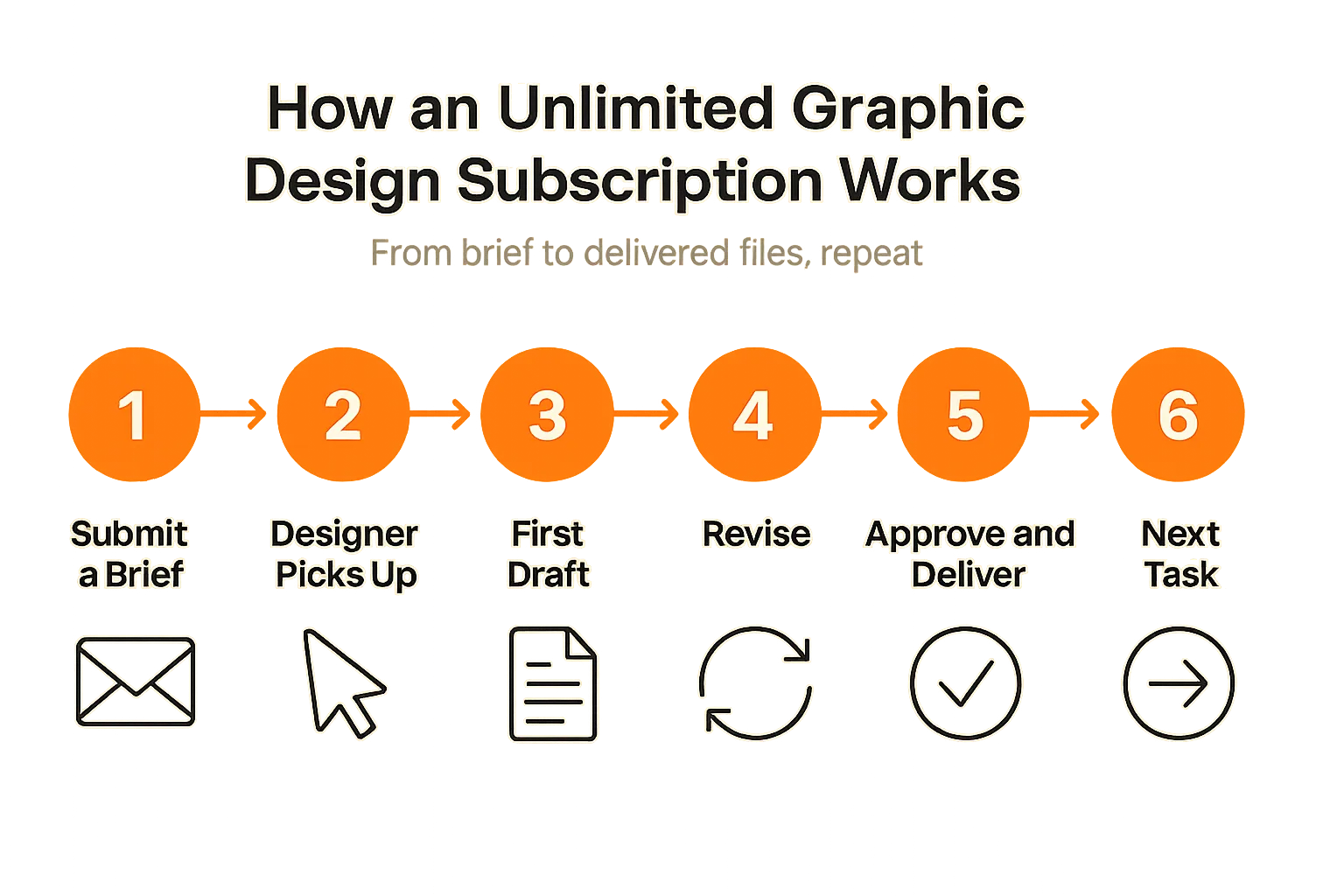
Step 1 — Submit a Brief
You write a short brief: what you need, what size, what format, brand colours, reference images, deadline (if any). Method varies by provider — some use a custom portal, some use a Trello board, DigitalPolo uses email so there's no platform learning curve. The brief content matters far more than the submission method; brief quality is the single biggest determinant of revision count.
Step 2 — Designer Picks Up the Task
Inside the SLA window, a designer picks the task off the queue and starts work. Most providers operate one active task per client at a time on solo-designer plans (Partner-tier pricing across the category), and 2–3 active tasks on dedicated-team plans (Soulmate-tier and above).
Step 3 — First Draft Delivered
Within the SLA — 24 or 48 hours depending on plan — the first draft lands in your inbox or portal. You see exactly what the designer interpreted from your brief. If your brief was specific, the first draft is usually 80%+ of the way to final. If the brief was vague, the first draft is a starting point for the revision cycle.
Step 4 — Revise
You request revisions. Move the logo, change the headline, swap the colour, replace the photo, redraw the illustration. Unlimited revisions means you can iterate until the design is right; it doesn't mean revisions are instant. Each revision round runs through the queue at the same SLA as the original task (typically a shorter window for revision rounds — many services treat revisions as priority).
Step 5 — Approve and Deliver Final Files
Once approved, the designer packages and delivers final files in every format you need — production-ready PDFs, vector source files (AI, EPS), web-ready PNGs and JPGs, and any specialty formats like print-with-bleed PDFs for sticker printers or vehicle wrap installers. Good services deliver everything; weaker ones force you to ask for the source files separately.
Step 6 — Pick Up the Next Task in the Queue
The designer moves to your next brief. The whole loop repeats.
The bottleneck in this workflow is almost never the designer. It is the speed at which you brief and approve. Subscribers who brief in batches and approve quickly extract three to five times the throughput of subscribers who brief sporadically and let drafts sit unapproved for days.
What's Included — and What Isn't
This is the single area where buyers get burned most often. "Unlimited" varies by provider; here is what the category typically covers and what it typically excludes in 2026.
Standard Inclusions
- Logo design (single concept, multi-concept on better plans)
- Social media graphics — Instagram, LinkedIn, Facebook, X, Pinterest, TikTok
- Ad creatives — static digital, Meta and Google ad sizes, banner ads
- Brochures, flyers, posters, postcards, business cards, letterheads
- Email templates and email graphics
- Presentation decks (Keynote, PowerPoint, Google Slides)
- Infographics, charts, simple data visualisation
- Print collateral — menus, packaging label artwork, signage layouts
- Sticker and label artwork with cut paths
- Vehicle wrap layout artwork
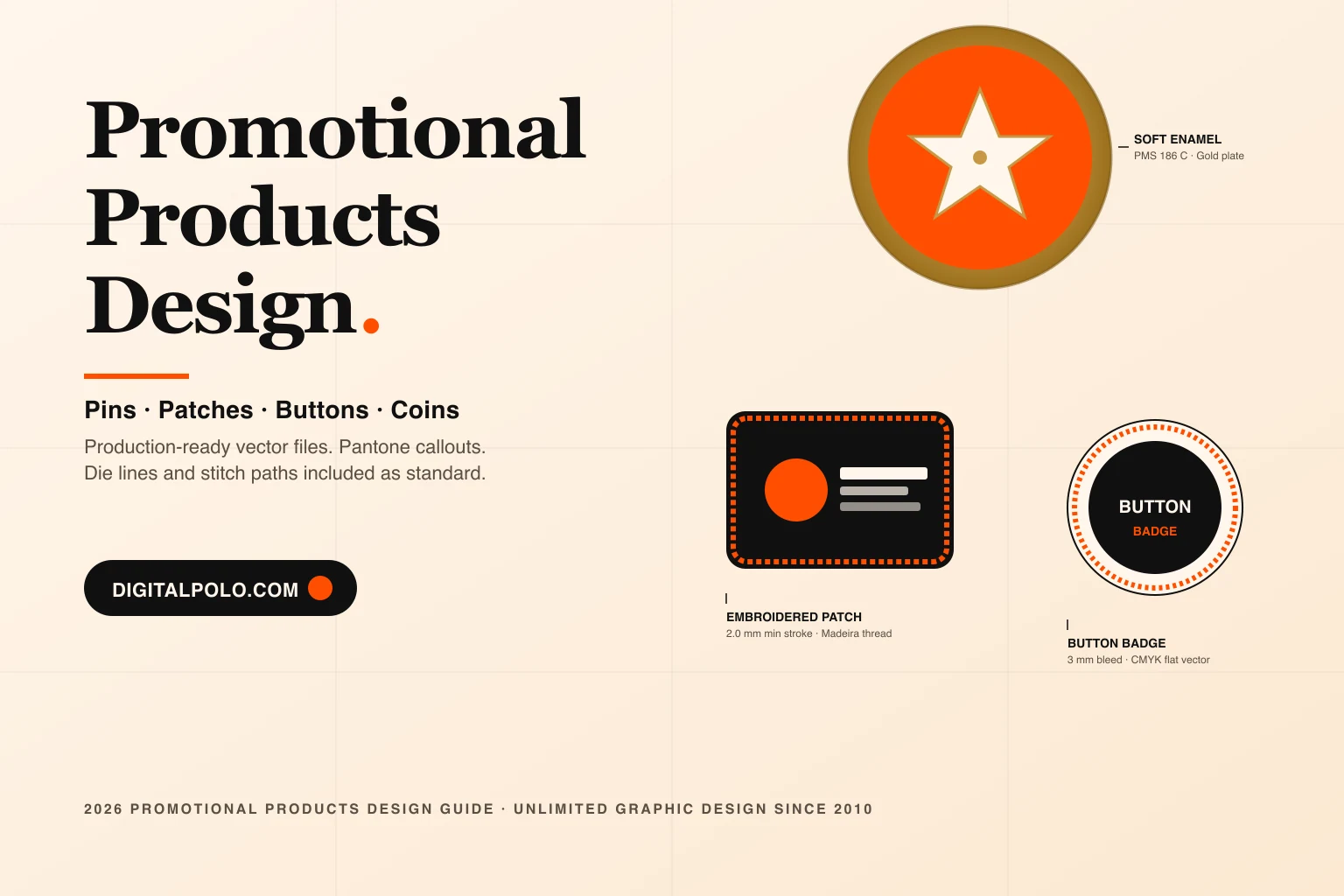
- Promotional product artwork — pins, patches, button badges, challenge coins
- Brand style sheets and one-page brand guidelines
- Photo retouching and basic image editing
- Vector source files (AI, EPS, PDF) — standard on DigitalPolo, upgrade-only on some providers
- Unlimited revisions
- Reseller / white-label rights (varies — DigitalPolo includes, some providers restrict to upper tiers)
Standard Exclusions
- Video editing, motion graphics, animation (separate subscription tier with most providers)
- 3D modelling and 3D rendering
- Custom long-form illustration (small custom illustration usually included; multi-day illustration is usually scoped separately)
- UX research and product design (different discipline)
- Developer-built websites — design mockups yes, code no
- Copywriting (some providers add basic copy as a bonus; serious copy needs a copywriter)
- Print production and printing itself (you take the file to your printer)
- Translation and localisation
If video, 3D, or animation is your primary need, look at multi-discipline subscriptions like Kimp (graphic + video) or specialist motion services. If your monthly need is overwhelmingly static graphic design with occasional motion, run two specialist subscriptions — it's usually cheaper than one all-in-one plan that under-serves both disciplines.
Pricing Across the Category in 2026
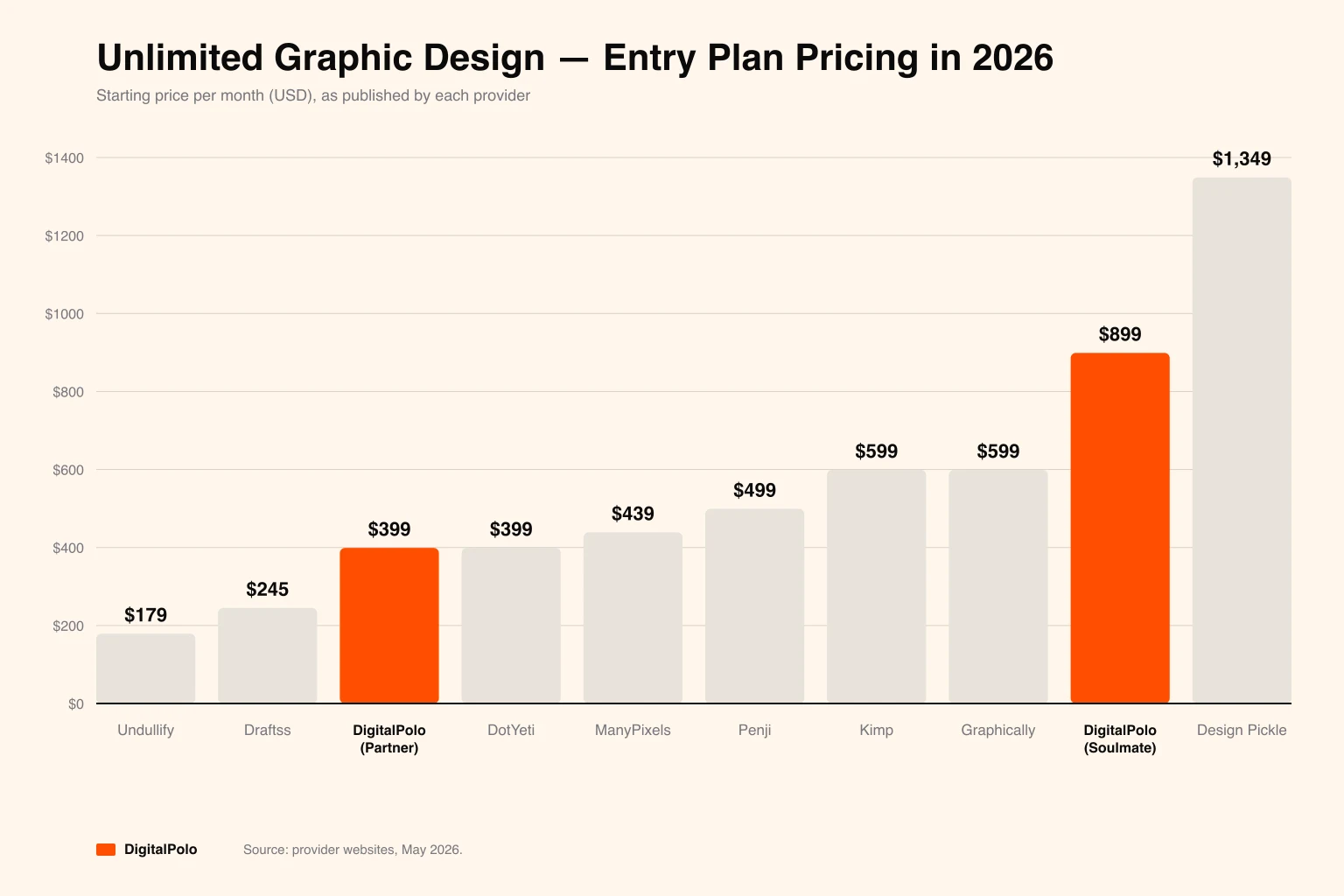
Pricing is the most useful filter when narrowing the category. Here is the published entry-tier pricing across the major providers, current as of 2026:
| Service | Entry Plan | Turnaround | Founded |
|---|---|---|---|
| Undullify | $179/month | 1–2 days | 2014 |
| Draftss | $245/month | 1–2 days | 2016 |
| DigitalPolo (Partner) | $399/month | 48 hours | 2010 |
| DotYeti | $399/month | 1–2 days | 2018 |
| ManyPixels | $439/month | 1–2 days | 2017 |
| Penji | $499/month | 24–48 hours | 2017 |
| UnicornGO | $499/month | 24 hours | 2020 |
| No Limit Creatives | $499/month | 1–2 days | 2018 |
| Kimp | $599/month | 1–2 days | 2018 |
| Flocksy | $595/month | 1–2 days | 2018 |
| Graphically | $599/month | 1–2 days | 2018 |
| DigitalPolo (Soulmate) | $899/month | 24 hours | 2010 |
| Design Pickle | $1,349/month | 1–2 days | 2015 |
| Superside | $6,000+/month | Custom | 2015 |
Two patterns matter:
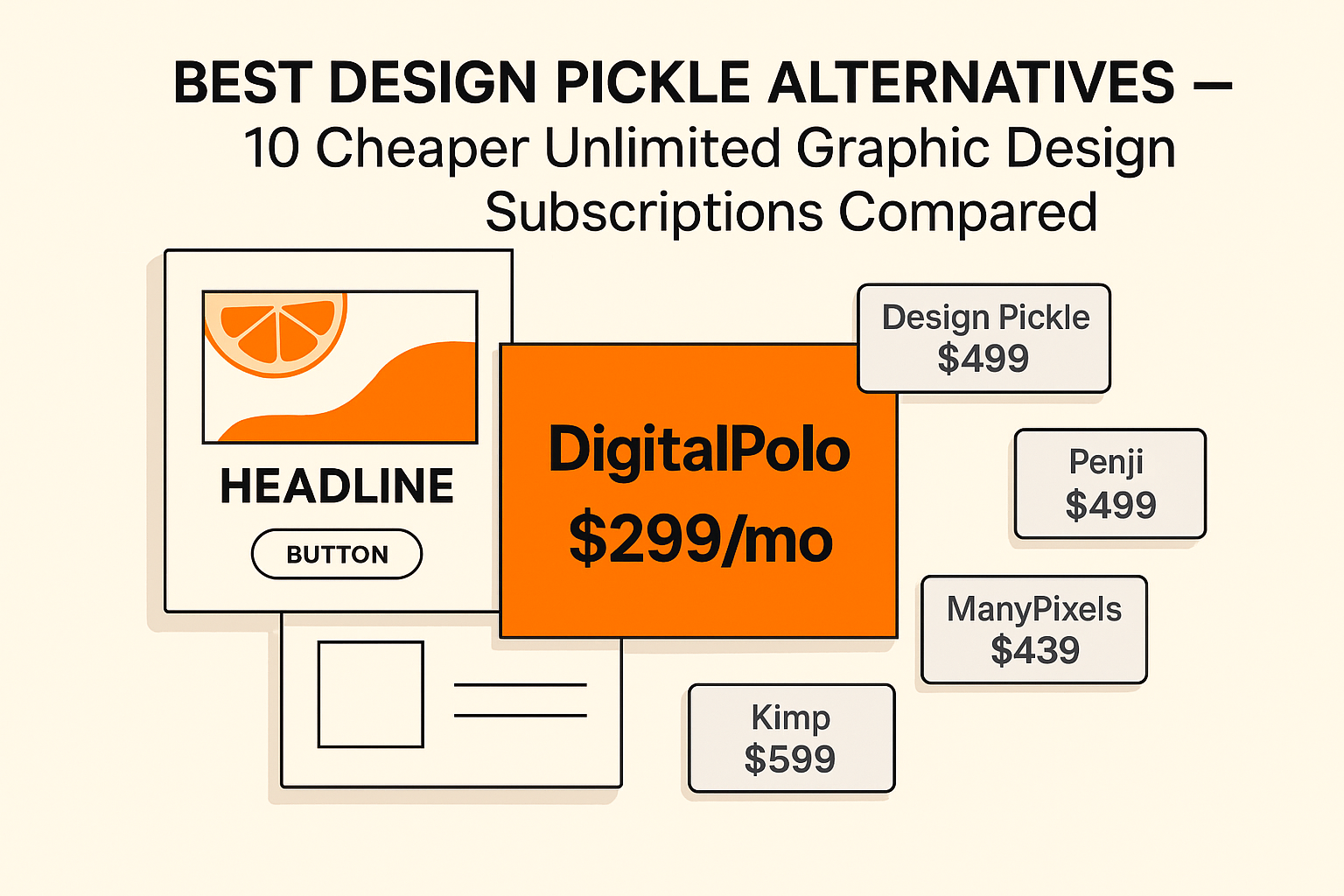
1. Pricing has compressed. A decade ago Design Pickle defined the category at $370/month. It now starts at $1,349/month. Most newer entrants have settled in the $400–$600 entry range; DigitalPolo (the oldest provider) sits at $399 — significantly under the median.
2. Solo-designer vs. dedicated-team is the real plan-tier divide. Entry plans across the category are nearly always one designer working your queue. Dedicated-team plans — DigitalPolo's Soulmate, Kimp's higher tiers, Design Pickle's higher tiers — assign multiple designers and shorter turnarounds. The decision between tiers is almost entirely a function of monthly task volume.
For a structured comparison covering features beyond pricing, see our breakdown of the eight best unlimited graphic design services for small business and the full Design Pickle alternatives analysis.
The Math: When Unlimited Beats the Alternatives
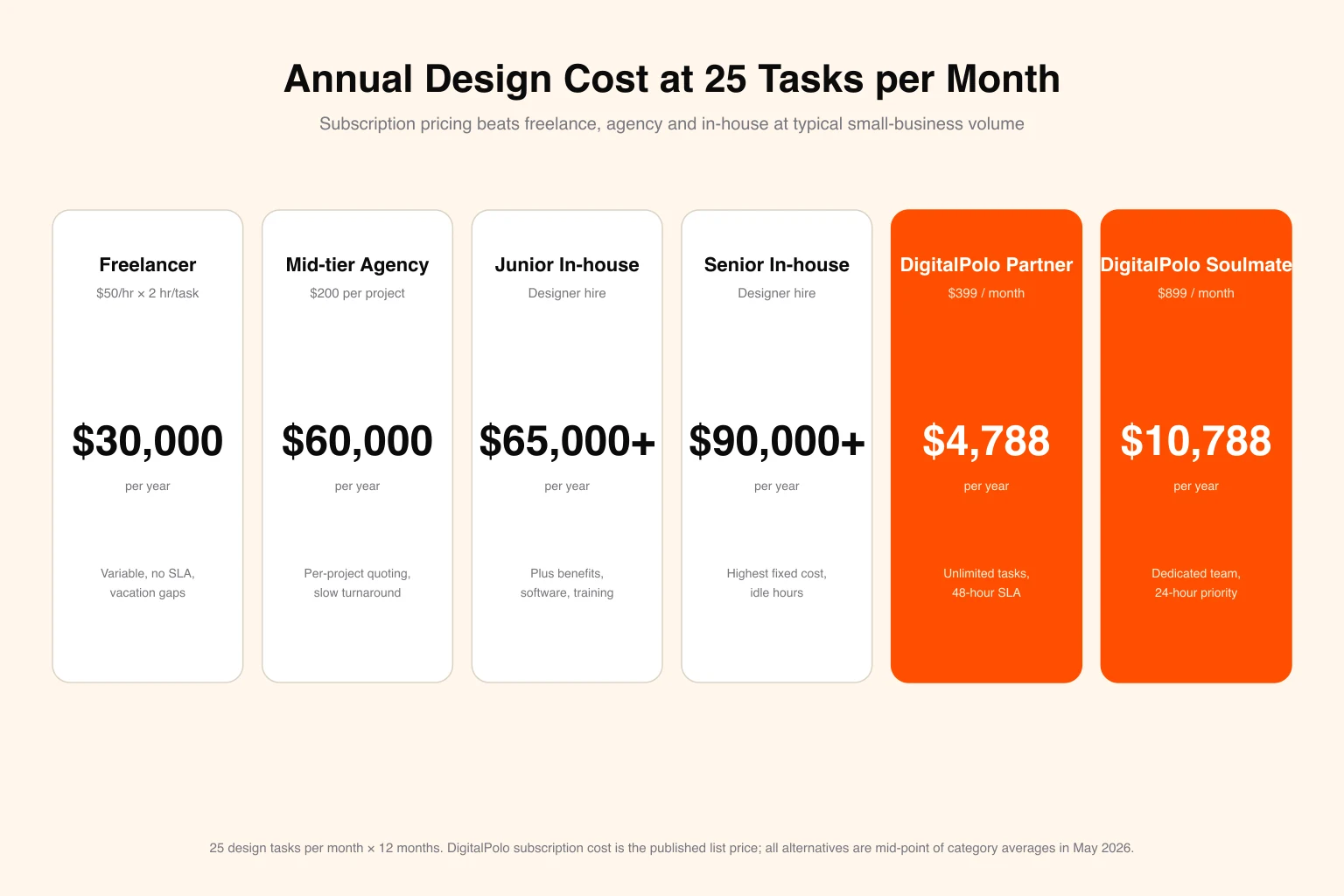
There are four practical ways to access graphic design as a small or mid-sized business. Here is what each costs at a realistic monthly volume of 25 tasks — the rough breakeven point for most subscribers.
| Approach | Monthly Cost at 25 Tasks | Annual Cost | Notes |
|---|---|---|---|
| Freelancer at $50/hour, 2 hours per task | $2,500 | $30,000 | Variable per project, unpredictable availability, no SLA, vacation gaps |
| Mid-tier agency, $200 per project | $5,000 | $60,000 | Premium quality, slow turnaround, brutal at volume |
| In-house junior designer | $5,400 (salary alone) | $65,000+ all-in | Add benefits, software, equipment, training. Output capped by hours worked. |
| Senior in-house designer | $7,500 (salary alone) | $90,000+ all-in | Best quality control, highest fixed cost, idle hours unrecoverable |
| DigitalPolo Partner | $399 | $4,788 | Unlimited tasks, 48-hour SLA, vector files included |
| DigitalPolo Soulmate | $899 | $10,788 | Dedicated team, 24-hour priority, multi-client capacity |
At 25 tasks a month, the subscription is 6× to 15× cheaper than the alternatives. The gap widens at higher volumes — most agency print shops and promotional product businesses run 40+ design tasks a month and find the math even more decisive.
The catch is that the subscription only works if you can brief work clearly enough to keep the queue moving. Businesses that pile six unbriefed concepts on the queue and then sit on revisions for a week get a fraction of the throughput, blame the subscription, and churn. Businesses that brief tightly and approve quickly extract the full advertised value.
Where Unlimited Graphic Design Actually Works — Real Use Cases
The category has narrowed into a handful of buyer segments where the model fits cleanly. Inside each, the workflow looks slightly different.
E-Commerce Brands
Product images, lifestyle composites, social campaigns, ad creatives across Meta and Google, email graphics, packaging design, label artwork. Typically 30–50 design tasks a month at steady state — well above the subscription breakeven. Source files matter (AI for label printers, PDF with bleed for packaging vendors).
Marketing Agencies and Resellers
White-label design throughput across multiple client accounts. The agency briefs, the subscription delivers, the agency invoices the end client. Reseller rights have to be explicit in the subscription's terms — DigitalPolo allows it on both plans; some competitors restrict it to upper tiers. See our white-label graphic design service explainer for the operational pattern.
Sticker Businesses and Print Shops
Recurring custom sticker designs, sheet layouts, packaging labels, banner artwork, customer-supplied artwork cleanup. Vector files with cut paths are mandatory. Volume is steady. See our deep guide on graphic design for sticker businesses.
Vehicle Wrap and Sign Shops
Wrap layouts, chassis-template artwork, signage at print scale, fleet vehicle systems. Print-ready vector delivery with hinge zones and bleed is non-negotiable. See the full vehicle wrap design service guide.
Promotional Product Manufacturers
Custom enamel pins, embroidered patches, button badges, challenge coins. Highest file-spec demands of any vertical — die lines, Pantone callouts, elevation maps. See our practical playbook for graphic design for promotional products businesses.
Content-Led Startups and Bootstrapped SaaS
Blog images, social cards, infographics, ad creatives, pitch decks, landing-page graphics. Volume is sometimes lumpy (sprint cycles push spikes), but the flat fee absorbs the spike at no extra cost — the opposite of freelance billing, which punishes you for any week of high demand.
Real Estate Agents and Local-Service Businesses
Listing graphics, social posts, flyers, postcards, open-house signage. Lower-volume use case but the recurring nature still beats per-project freelance billing past about 8–10 tasks a month.
How to Evaluate an Unlimited Graphic Design Service Before Buying
Five things to check before subscribing. Skip any of these and you risk paying for a service you can't use.
1. Verify Source File Delivery
Most providers say they deliver source files. Some deliver them only on the upper plans, some deliver only flattened PDFs without editable AI/EPS, and some lock the source files behind an off-boarding clause if you cancel. Confirm in writing that AI, EPS, and editable PDF formats ship with every task on whichever tier you subscribe to. This is non-negotiable for any business that prints, manufactures, or hands files to a third party.
2. Verify the One-Active-Task Rule
Ask explicitly how many tasks are worked in parallel on the plan you are considering. Solo-designer plans (Partner-tier pricing) almost always operate one task at a time. Dedicated-team plans (Soulmate-tier and above) work 2–3 in parallel. If you need 50 designs a month, a one-active-task plan won't deliver it inside the SLA — math, not marketing.
3. Verify Reseller and White-Label Rights
If you plan to use designs in client work, agency deliverables, or white-label products, this has to be permitted by the subscription's terms. Some providers restrict reseller use to upper tiers; some prohibit it entirely. DigitalPolo permits reseller use on both plans, no upgrade required.
4. Verify the Cancel Policy
Month-to-month with no minimum term is now industry standard at the entry tier. Some providers still require annual commitments for the best rates. Test the cancel flow before subscribing — services with friction-heavy cancel processes are a warning sign.
5. Try the Service Before Committing the Full Brand to It
A 7-day money-back guarantee or short trial period is standard across the better providers. Use the trial. Submit three realistic briefs. Measure: (a) turnaround vs. SLA, (b) first-draft quality, (c) revision speed, (d) source file delivery. The trial period is the right time to discover that the SLA is theoretical, not when you have moved your whole brand pipeline to the subscription.
DigitalPolo Plans and Pricing
| Plan | Price | Turnaround | Delivery | Best For |
|---|---|---|---|---|
| Partner | $399/month | 48 hours | Unlimited tasks, all source files (AI, EPS, PDF), unlimited revisions | Solo businesses, e-commerce brands, startups, sticker/print shops, 10–25 designs/month |
| Soulmate | $899/month | 24 hours (priority) | Dedicated team, 24×7 support, all source files, reseller rights | Agencies, multi-client print shops, wrap shops, promotional product businesses, 25+ designs/month |
Both plans include delivery of all source files — vector formats (AI, EPS, PDF) suitable for digital use, print production, sticker printing, vehicle wraps, signage, packaging, and promotional product manufacturing. Reseller and white-label use is permitted on both plans.
See Digital Polo's full pricing →
The Mistakes That Sink First-Time Subscribers
The category has a real churn pattern that experienced subscribers know to avoid. Five mistakes account for almost all the failed subscriptions.
1. Briefing too vaguely. "Design a social post for our launch" produces what the designer thinks you want, which is rarely what you actually want. "Design an Instagram square (1080×1080) announcing our March 5 launch — headline 'New Spring Collection', three product thumbnails from our Shopify catalogue (URLs attached), our brand palette (already on file), call-to-action button at bottom right linking to /spring" gets the right first draft. The same designer; a different outcome.
2. Submitting one task at a time and waiting between deliveries. The queue is built for batched briefing. Submit five briefs on Monday morning, get five drafts by mid-week, revise them all in one session, approve them all by Friday. Submitting one, waiting, submitting one, waiting — that workflow extracts a quarter of the available throughput.
3. Treating revisions as instant. A revision round runs through the queue at the same priority as a new task. Plan two revision cycles into any non-trivial timeline. Build the buffer.
4. Mismatching plan tier to volume. Subscribing to the Partner plan with a 50-task-a-month workload doesn't fail the subscription — it fails the relationship. The designer can deliver 50 tasks a month, but not inside the 48-hour SLA when they arrive in a clump. Upgrade to a dedicated-team plan if volume regularly exceeds 25 tasks.
5. Cancelling after one bad week. Every subscription has a learning curve. The first two weeks are when both sides calibrate — your brief style, the designer's interpretation, your house brand conventions. Subscribers who push through the first month almost always renew; subscribers who cancel in week two never see what the subscription actually delivers.
For a practical framework on getting more out of a designer relationship, see our guide on developing a friendly collaboration with your graphic designer.
Frequently Asked Questions
What is unlimited graphic design?
Unlimited graphic design is a flat-fee subscription model where a business pays a fixed monthly price and submits as many design requests as it wants. A designer or team works through the queue, typically delivering 24 to 48 hours per request, with unlimited revisions until each design is approved. The service replaces hourly freelance billing, per-project agency fees, and full-time in-house designer hires for businesses with steady, recurring design volume.
How does an unlimited graphic design subscription actually work?
You subscribe to a monthly plan, submit design briefs by email or through a portal, and the designer delivers each request inside the service's stated turnaround time — usually 24 to 48 hours per task. You review, request revisions if needed, and approve when ready. Tasks run sequentially (one active at a time on most plans), so output scales with how quickly you brief and approve, not by hour-rate quotas.
How much does unlimited graphic design cost?
Entry pricing across the category in 2026 ranges from about $179/month (Undullify) to $1,349/month (Design Pickle's entry plan). DigitalPolo sits at the lower end with Partner at $399/month and Soulmate at $899/month. Most plans in this category fall between $399 and $999/month for solo-designer service, with dedicated-team plans priced from $899 upward.
Is unlimited graphic design really unlimited?
Yes for design requests, but bounded by turnaround time and the one-active-task rule that most providers operate. You can submit unlimited briefs to the queue, but the designer works one at a time and delivers each within the service's SLA. Realistic monthly throughput on a solo-designer plan is 25 to 40 finished designs depending on complexity; dedicated-team plans handle 50+ comfortably.
What's included in an unlimited graphic design subscription?
Standard inclusions are logos, social media graphics, ad creatives, brochures, flyers, business cards, presentation decks, email templates, infographics, and print collateral. Better services also include vector source files (AI, EPS, PDF), unlimited revisions, brand-style storage, and reseller / white-label rights. Most subscriptions exclude video editing, 3D modelling, custom illustration beyond a few hours, animation, and developer-built websites.
How is unlimited graphic design different from hiring a freelancer?
A freelancer charges by the hour or per project, has unpredictable availability, takes vacations without coverage, and renegotiates pricing as the relationship matures. An unlimited subscription has fixed monthly cost, queue-based delivery with an SLA, no scope renegotiation, and continuous availability. At 10+ design tasks per month, the subscription is almost always cheaper than retaining a freelancer for the same volume.
Who should use unlimited graphic design?
Businesses with 10 or more recurring design tasks per month — e-commerce brands, marketing agencies, content-led startups, SaaS companies, sticker and print shops, vehicle wrap installers, sign shops, promotional product manufacturers, and agencies reselling design to their clients. The model breaks even quickly above 10 tasks/month and saves significant money above 25 tasks/month versus any alternative.
Who should NOT use unlimited graphic design?
Businesses needing fewer than 5 designs per month (pay-per-project freelance is cheaper), brands needing premium one-off creative direction for a flagship campaign (hire a senior agency), businesses needing primarily video, 3D, or animation work (the model doesn't fit), and any team that cannot brief work clearly enough to use queue-based delivery effectively.
How long does unlimited graphic design take per task?
Most providers deliver each task within 24 to 48 hours of brief submission. DigitalPolo's Partner plan delivers within 48 hours; the Soulmate plan delivers within 24 hours. Simple tasks (text-based graphics, single-variant logos, social posts) often arrive same-day. Complex tasks (multi-variant brand systems, packaging dielines, vehicle wrap layouts) usually use the full window.
Verdict: How to Decide in Under Five Minutes
If you have 10 or more recurring design tasks a month, an unlimited graphic design subscription is the cheapest, fastest, and most predictable option in 2026. The math beats freelance billing past about 10 tasks, beats agency per-project pricing past 5 tasks, and beats hiring a junior in-house designer at almost any volume. The only failure mode is briefing badly, and that failure is on the brief, not the service.
Choose a Partner-tier plan ($399/month across the category) if your volume runs 10–25 tasks a month and your work is mostly standard production design — social posts, ad creatives, brochures, business cards, print collateral. Choose a Soulmate-tier plan ($899/month) if your volume runs 25+ tasks a month, you need a dedicated team that learns your brand and your house conventions, or you run an agency/reseller workflow with multiple end-client accounts.
DigitalPolo has been running this exact service since 2010, with the lowest entry pricing of any established provider, vector source-file delivery as standard on both plans, reseller rights included, and an email-based workflow that needs no platform learning. For most marketing-led and print-trade businesses, that combination is the practical answer.
For a structured comparison of the major providers, see our eight best unlimited graphic design services for small business and the full Design Pickle alternatives analysis.
Ready to See How Unlimited Graphic Design Works in Practice?
DigitalPolo's Partner plan is $399/month — unlimited design tasks, 48-hour turnaround, unlimited revisions, and every source file delivered as standard (AI, EPS, PDF). White-label and reseller use included. Month-to-month, cancel anytime, 7-day money-back guarantee.
- See Digital Polo plans and pricing →
- Book a free 15-minute call →
- See the unlimited graphic design service in detail →
Further reading on unlimited graphic design and where it fits:
- Best Unlimited Graphic Design for Small Business in 2026
- Best Design Pickle Alternatives in 2026
- Graphic Design for Sticker Businesses in 2026
- Vehicle Wrap Design Service in 2026
- Graphic Design for Promotional Products Businesses in 2026
- White-Label Graphic Design Service for Resellers
- Why You Should Never Do Graphic Design In-House
- Ways to Develop a Friendly Collaboration with Your Graphic Designers