The money lands on a Tuesday. By Friday someone has asked whether the new logo will be ready for the announcement.
That question is the beginning of a specific, expensive and almost entirely predictable failure — not because the logo is hard, but because the logo is not the work. A funding round does not create a branding project. It creates a distribution problem. The number of surfaces carrying your company's identity is about to multiply, the rate at which you produce for those surfaces is about to become the binding constraint on three other plans, and the deadline is not yours to set. The board wants a launch. The hiring plan starts in week two. Sales has a quarter to hit. The press window is fourteen days wide and then it closes.
Meanwhile the thing almost every newly funded company does is approve a budget for an identity, brief an agency, and discover in week nine that the identity was fifteen per cent of the job.

The existing advice on this is not wrong so much as it is unhelpful. Search for how to roll out a brand and you get a set of genuinely sensible principles — prepare your touchpoints, have the style guide ready, launch internally before you launch externally — repeated across a dozen agency blogs with no counts, no sequence and no arithmetic. None of it tells you how many files you are about to need, how long they take, who makes them, what they cost, or what has to be true on day 20 for the announcement on day 60 to work.
This is that plan. It assumes a seed or Series A company between ten and sixty people. It assumes you are not doing a full strategic repositioning — if you are, read the rebranding guide first, because that is a different project with a different clock. And it assumes the constraint you are actually managing is production capacity, because after a raise, it always is.
Why a funding round is the worst possible time to rebrand, and why you have to anyway
Every argument against rebranding right after a raise is correct. You are about to change the product. Positioning may shift once you have a real go-to-market motion. Your capacity is thin, your team is about to double, and burning a quarter of executive attention on colour palettes while the board watches is a poor use of a honeymoon period.
And you have to do it anyway, because four things change at close and all four have brand at their bottleneck.
Hiring volume changes. A raise is a hiring event before it is anything else. You are about to run ten to forty job postings, and every one of them is a brand impression to a candidate comparing you against companies with a decade of employer-brand equity. Candidates research. A careers page assembled in an afternoon costs you offers you will never know you lost. The employer brand asset kit is the piece of the rollout most likely to be skipped and most likely to be missed.
Buyer scrutiny changes. Funding moves you into deals with procurement teams, security reviews and a different class of comparison. The prospect who would have overlooked a rough deck when you were a scrappy unknown is now benchmarking you against your funded competitors, and the deck is one of the few artefacts they see before the demo. For software companies this bites hardest on the product marketing surface, where feature launches and release collateral suddenly need to ship at a cadence one person cannot sustain.
The surface count changes. More people means more people making things. Every sales hire builds a deck. Every marketer builds a landing page. Every recruiter posts a graphic. Within a quarter of a raise, the number of people authoring brand-bearing assets typically triples, and if no system exists, all of them invent one.
The window changes. A funding announcement is the largest volume of inbound attention most companies will get in their first five years. Every one of those visitors lands on whatever brand exists that day. You do not get to re-run it.
So the question is not whether. It is how to compress what is genuinely a six-month programme into the ninety days you actually have, without producing a half-migrated brand that looks worse than the one you replaced.
Start by counting, not designing
Here is the discipline that separates rollouts that land from rollouts that overrun: the first deliverable is not a design. It is a register.
An asset register is a literal list of every surface that carries your identity, with four columns — the surface, the file or files it needs, the person who owns it, and the date it has to change. It is unglamorous, it takes eight to fifteen hours to build properly, and it is the single highest-leverage thing anyone will do in the first fortnight, because every subsequent estimate depends on it and because the count is always shocking.
Most teams, asked to guess, say sixty. The real number for a seed to Series A company is 180 to 340 discrete files.
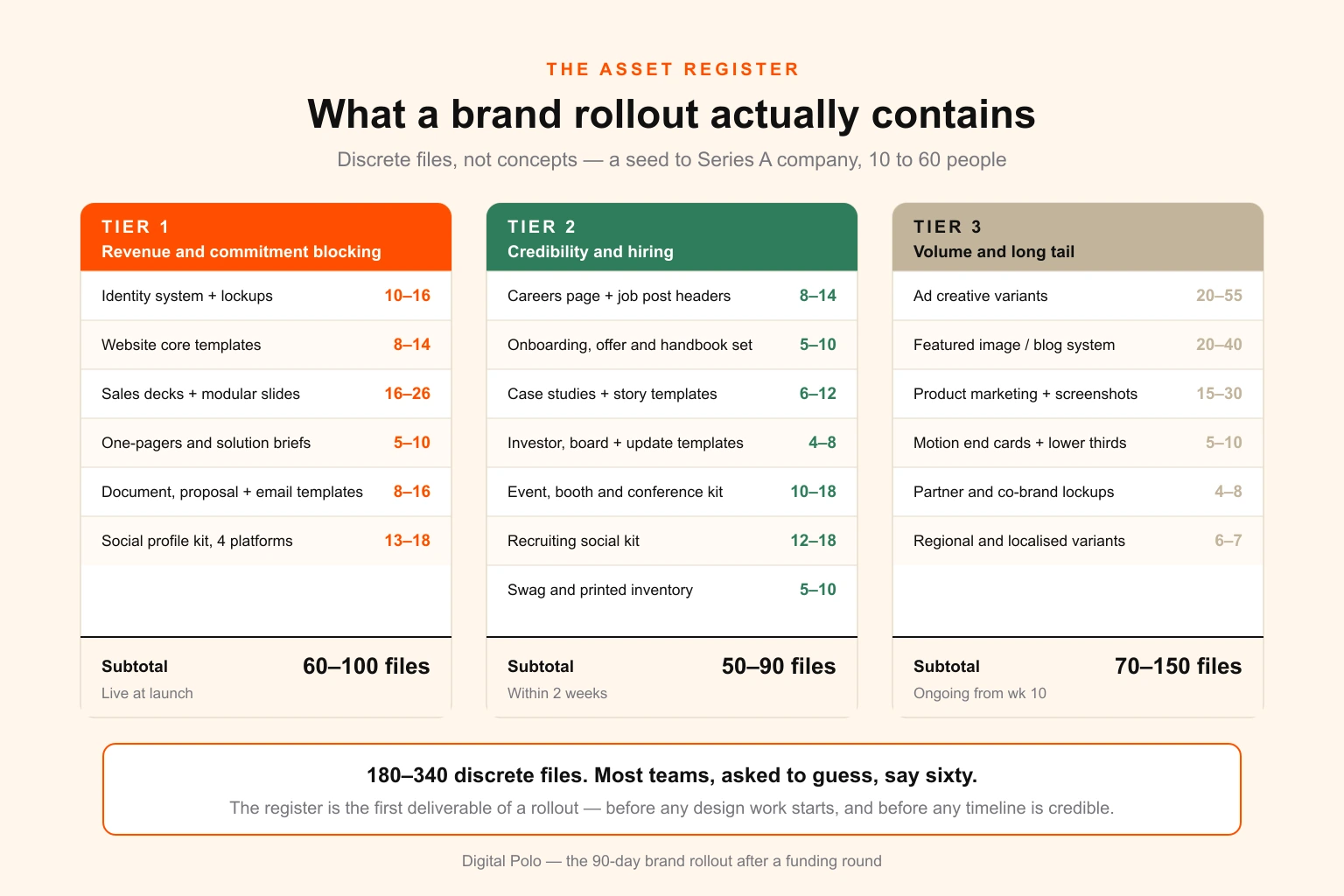
Three things about that table are worth dwelling on.
The counts are files, not concepts. "Sales deck" is not one asset. It is a master template, a short-form variant, a partner-facing version, and the eight to fifteen modular slides that get recombined per deal. Counting concepts is how a 250-file project gets estimated as a 40-file project.
Tier 1 is defined by what it blocks, not by importance. A Tier 1 asset is one where the absence of it stops revenue or stops a commitment: a prospect cannot buy, a candidate cannot apply, a contract cannot be sent. Everything else, however visible, is Tier 2 or 3.
The long tail is where the budget goes. Tier 3 looks optional right up until you notice it is the largest tier and it is the one that runs indefinitely — ad variants, blog images, product screenshots, partner lockups. This is precisely the volume that should be built from a template system rather than one asset at a time, and the decision about that has to be made in week two, not week ten.
While you are counting, run a proper brand audit across the same surfaces. The audit tells you what is inconsistent today; the register tells you what has to change tomorrow. They are different documents and you need both.
The four things to confirm before anyone opens a design file
Each of these is cheap now and ruinous in week eight.
- You own your source files. Every logo, every illustration, every template from every previous designer or agency, in editable form. Not PDFs. Not PNGs someone exported. If a previous agency holds them, ask now — the request gets slower and more expensive the moment they hear you raised.
- Your fonts are licensed for what you are about to do. A desktop licence does not cover a website, an app, or an embedded font in a distributed PDF, and licences are commonly tiered by pageviews or seat count — both of which are about to jump. This is the most frequently missed item on the list; the mechanics are covered in the guide to font licensing and what transfers.
- Your stock and illustration licences scale. Standard licences cap print runs and impressions. A funded ad budget breaches those caps quietly.
- The name and the mark are clear. A USPTO search and a domain and handle sweep, before anyone falls in love with anything. If you are changing the name as well as the look, this is a hard gate, not a checkbox.
The three-tier triage
With a register in hand, sort it. Not by department, not by who shouted loudest — by whether the absence of the asset stops something.
Tier 1 — Revenue and commitment blocking. Nothing can be sold, signed, or applied for without it. Website core pages, sales deck, one-pagers, contract and proposal templates, email signatures, the identity system itself. Built in weeks 3–6, live at launch, no exceptions.
Tier 2 — Credibility and hiring. Nothing stops without it, but everything is measurably worse. Careers page and job headers, onboarding and offer documents, case studies, investor and board templates, event collateral. Built weeks 6–10, live within a fortnight of launch.
Tier 3 — Volume and long tail. Ongoing production rather than a project. Ad creative sets, featured images, product marketing assets, motion, partner co-brands, regional variants. Templated in weeks 6–8, produced continuously from week 10 onward and forever after.
The triage matters because it determines what you do when — and you will — fall behind. A team without a tier system responds to slippage by de-scoping whatever is least defended, which is usually the hiring collateral, which is the thing the raise was substantially for. A team with a tier system knows that Tier 3 slips and Tier 1 does not.
The 90-day sequence
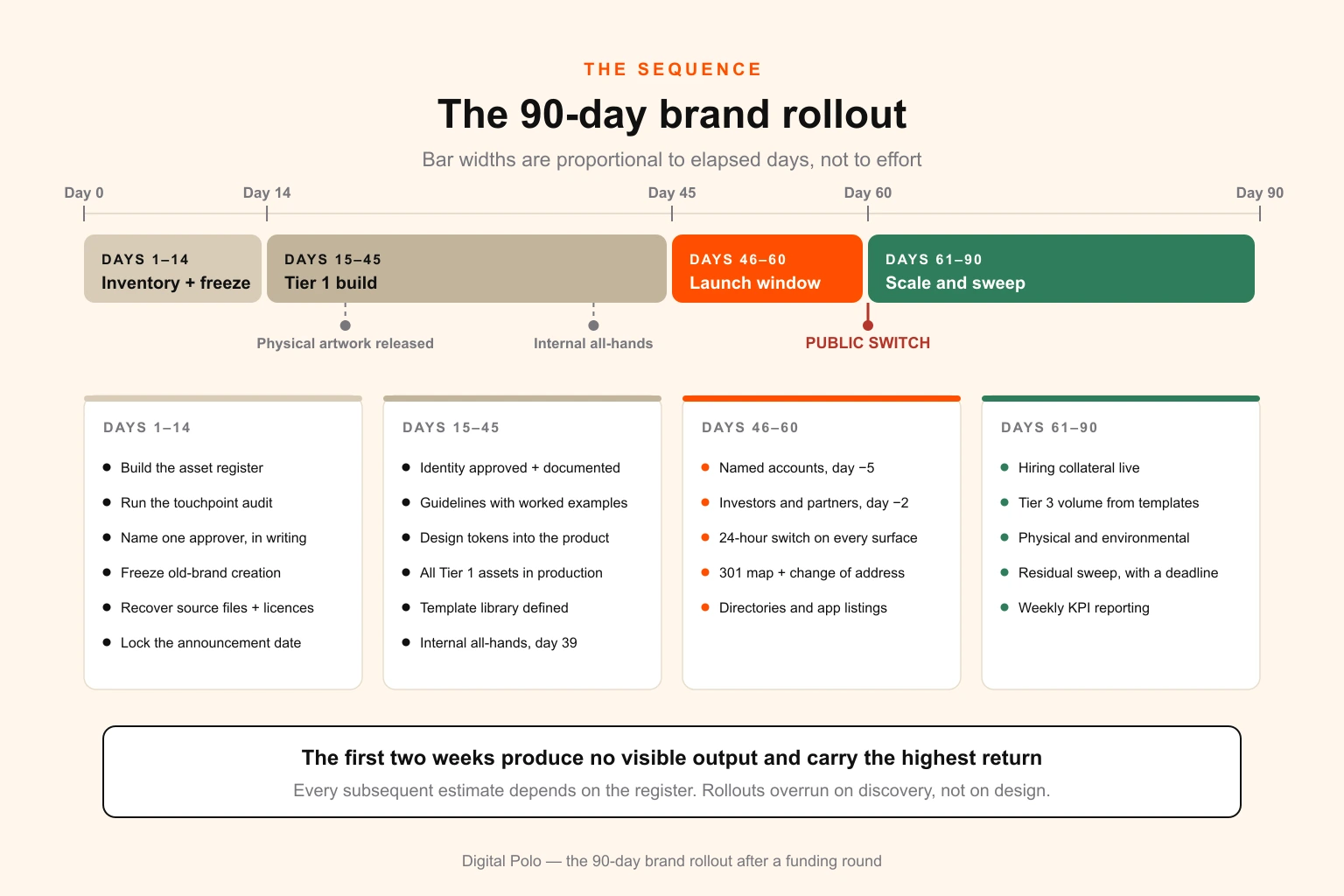
Days 1–14 — Inventory and freeze
The two weeks with no visible output and the highest return.
Build the register. Run the audit. Confirm the four ownership items above. Then do the two things nobody remembers to do.
Name one approver. One person, named in writing, whose sign-off is final. Not a committee, not "the founders", not a Slack channel. The most common cause of rollout overrun is not slow production — it is a design that goes round four stakeholders who have never spoken to each other and comes back with contradictory notes. If you take one operational instruction from this article, take that one. Every downstream estimate in this plan assumes it.
Freeze the old system. From day one, no new assets get built in the old brand. Every deck, every one-pager, every social template created after close is a file you will pay to migrate later. Two weeks of unfrozen drift in a busy company adds ten to twenty files to the register. Announce the freeze in the same all-hands where you explain the project.
Also in this window: lock the announcement date and work backwards from it, brief the identity work, and — critically — release any artwork with a physical lead time as early as humanly possible. Signage does not care about your funding round, and a supplier who receives a file that fails preflight will silently add a week — so anything going to a printer or fabricator goes through the print-ready file checklist before it leaves the building.
Days 15–45 — Tier 1 build and internal launch
The identity gets finalised and, more importantly, documented. A logo file is not a brand identity, and a brand identity is not a brand system. What you need is the minimum viable governance layer: logo usage and clear space, the colour system with accessible pairings, the type scale, and three to five worked examples of real assets. The distinctions between the artefacts here — and how much of each you actually need at this stage — are laid out in design system vs style guide vs brand guidelines; the practical contents of the document itself are covered in the brand guidelines guide. If you have engineering capacity, encoding colour and type as design tokens at this stage is the difference between a product that follows the brand automatically and one that drifts every sprint.
Then Tier 1 production runs in parallel: the website templates, the sales and pitch decks, the one-pagers, the social profile kit, the document templates. Every one of these should be briefed properly — a rollout is the worst possible context for the ambiguous brief, because everything is being made once and simultaneously. Use a structured design brief for each Tier 1 group.
At roughly day 39 — three weeks before external launch — run the internal launch. All-hands, the reasoning behind the change, and the asset library already accessible. Not a preview. Access. An employee who finds out about the rebrand from a customer is an employee who will keep using the old deck, and an internal launch that arrives with nothing downloadable is theatre.
Days 46–60 — The launch window
Everything a person can encounter in one session flips inside 24 hours: site, app, social profiles, email signatures, live decks, ad creative, review-site profiles, app store listings.
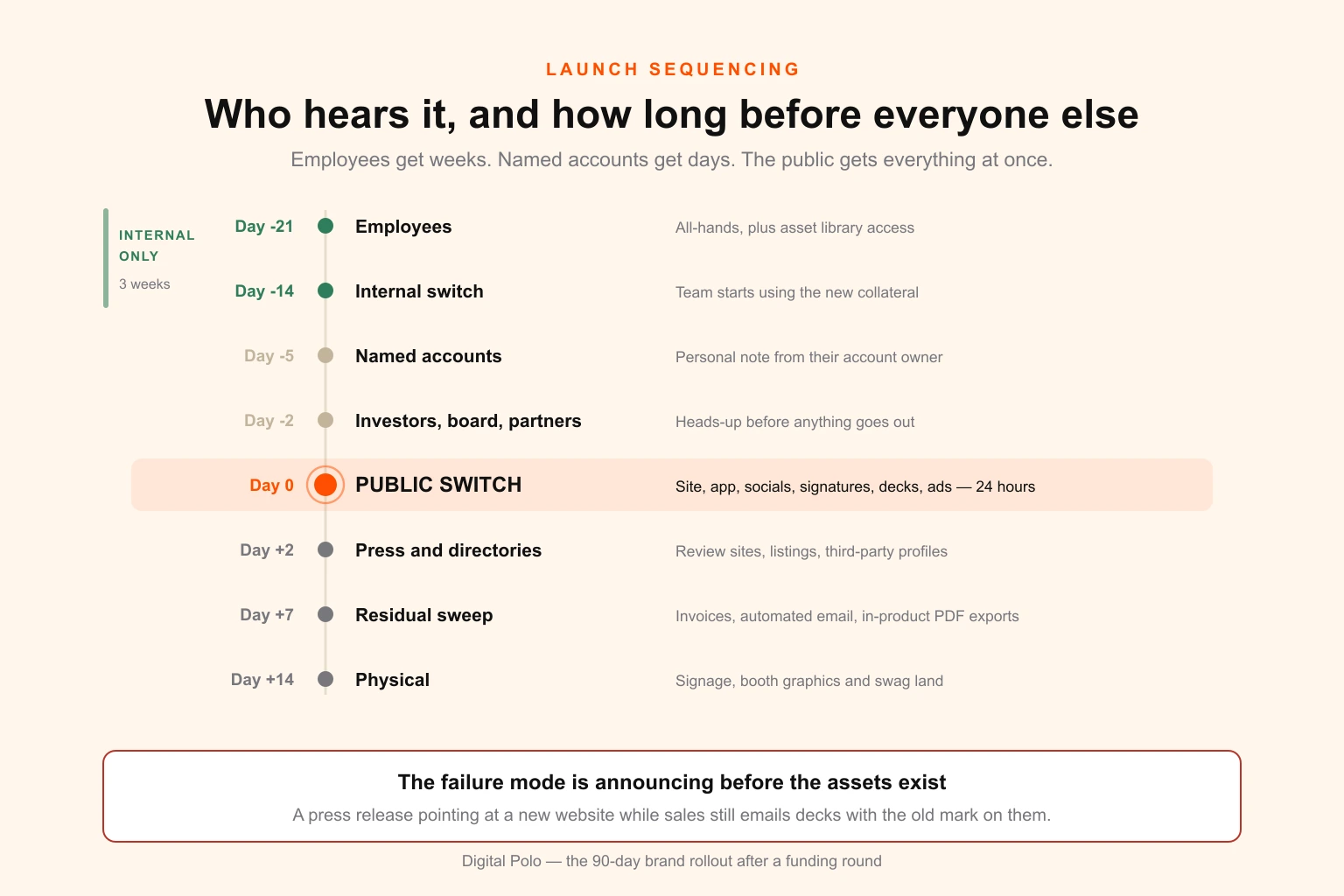
The order is the whole trick. Employees get weeks. Named accounts get a personal message from their actual account owner, not a marketing email — three to seven days out. Investors, board and material partners get a heads-up at day minus two so nobody important learns it from a press release. Then day zero is the public switch, ideally paired with the funding announcement itself so one news cycle carries both.
If a domain change is part of this, the migration is an engineering deliverable with a named owner: a complete one-to-one 301 map, the old domain retained indefinitely, canonicals and internal links pointed at the new domain rather than chained through redirects, a Search Console change of address, a fresh sitemap, and outreach to your top referring domains. Expect a dip. Plan for two to six months of recovery, and accept that brand-term traffic to the old name does not come back — it gets rebuilt under the new one.
Days 61–90 — Scale and sweep
Hiring collateral goes live in step with the hiring plan rather than after it. Ad creative moves to volume production. Physical and environmental assets — office and building signage, booth graphics, printed inventory, swag — land as their lead times allow.
And then the residual sweep, which is the part everyone underestimates: the invoice footer, the automated email templates, the Zoom backgrounds, the PDF export in the product, the partner directory listing, the conference bio submitted four months ago, the 2019 case study still on page three of the site. Give the sweep an owner and a deadline, or it runs for a year.
The hiring collision
The default post-funding move is to hire a designer. It is a good move. It is also, on its own, a plan that cannot arrive in time, and the arithmetic is worth doing in public because so few teams do it before committing.
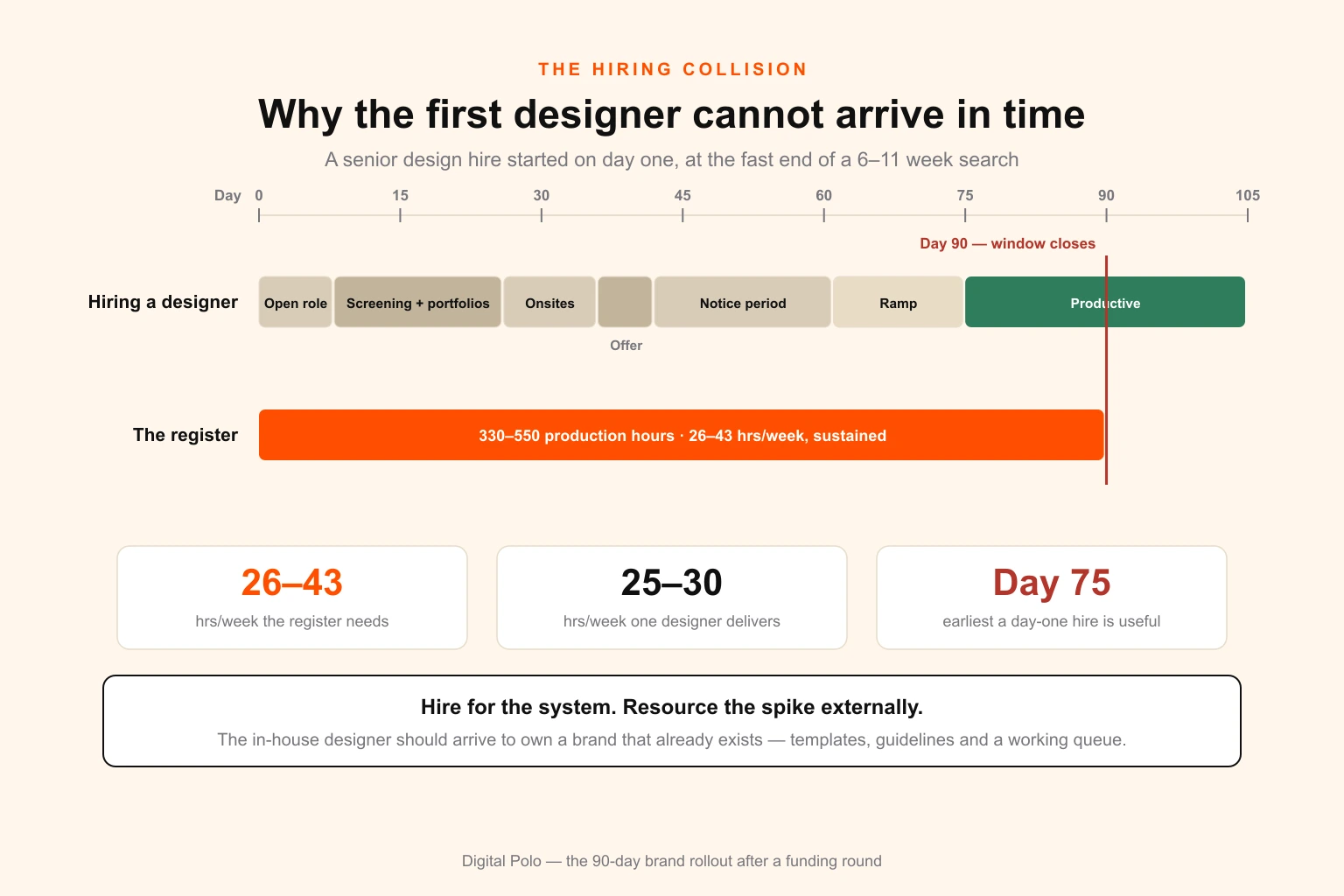
A senior designer search realistically runs six to eleven weeks from posting to first day: one to two weeks to write the role and get the pipeline moving, two to four weeks of screening and portfolio review, one to two weeks of onsites and exercises, one week of offer and negotiation, and two to four weeks of notice, which is standard for anyone worth hiring. Add two to three weeks of ramp before their output can be trusted without heavy review.
Start on day one and your first designer is genuinely productive somewhere around day 75 of a 90-day window.
Now the other side of the equation. The register says 180 to 340 files. At a blended 1.5 to 2.5 production hours per file — that blend accounts for template setup being expensive and template instances being cheap — a 220-file register is 330 to 550 production hours. Across the roughly 12.8 weeks of a 90-day window, that is 26 to 43 hours a week of pure production, sustained.
One designer at realistic utilisation delivers 25 to 30 production hours a week. The rest of their forty goes to briefs, reviews, revisions, meetings and the endless small requests that arrive from a company that has just discovered it has a designer. So even a designer who started on day one — which is impossible — would only just cover the bottom of the range while doing nothing else.
The conclusion is not "don't hire". It is hire for the system, resource the spike externally. The in-house designer should arrive to own a brand that already exists, with a template library, documented guidelines and a working queue. That is a far better first ninety days for them, and a far better use of the hire — and it changes the role you write, because you are recruiting a brand owner rather than a production resource. The full comparison, including where the crossover actually sits, is in unlimited graphic design vs hiring a full-time designer, and the practical options at each volume are laid out in the guide to hiring a graphic designer.
For the spike itself there are three viable structures, and the right one depends on volume rather than preference:
| Model | Best when | Typical cost shape | Risk |
|---|---|---|---|
| Brand agency (project) | Identity + Tier 1 only, high strategic stakes | USD 25k–90k fixed for creative | Priced per deliverable; Tier 3 volume gets expensive fast |
| Freelance bench (2–4 people) | 100–200 files, you have someone to art-direct | USD 55–95/hour | Coordination load lands on you; availability is not guaranteed |
| Fixed-fee design subscription | 200+ files, sustained volume past day 90 | Flat monthly, unlimited queue | Needs a real brief discipline to work |
Most funded companies end up with a hybrid: an agency or a senior freelancer for the identity and the guidelines, then a fixed-fee production partner for the register itself and the ongoing Tier 3 volume. That split works because the two jobs genuinely are different — one is a small number of high-judgement decisions, the other is a large number of consistent executions. Trying to buy both from one supplier is how companies end up paying agency rates for social resizes. If you are weighing that decision, is unlimited graphic design worth it runs the cost-benefit properly, and the startup-specific breakdown covers the same question at post-seed scale.
What it costs
Build the budget from the register, not from a quote. Here is the structure that survives a board conversation.
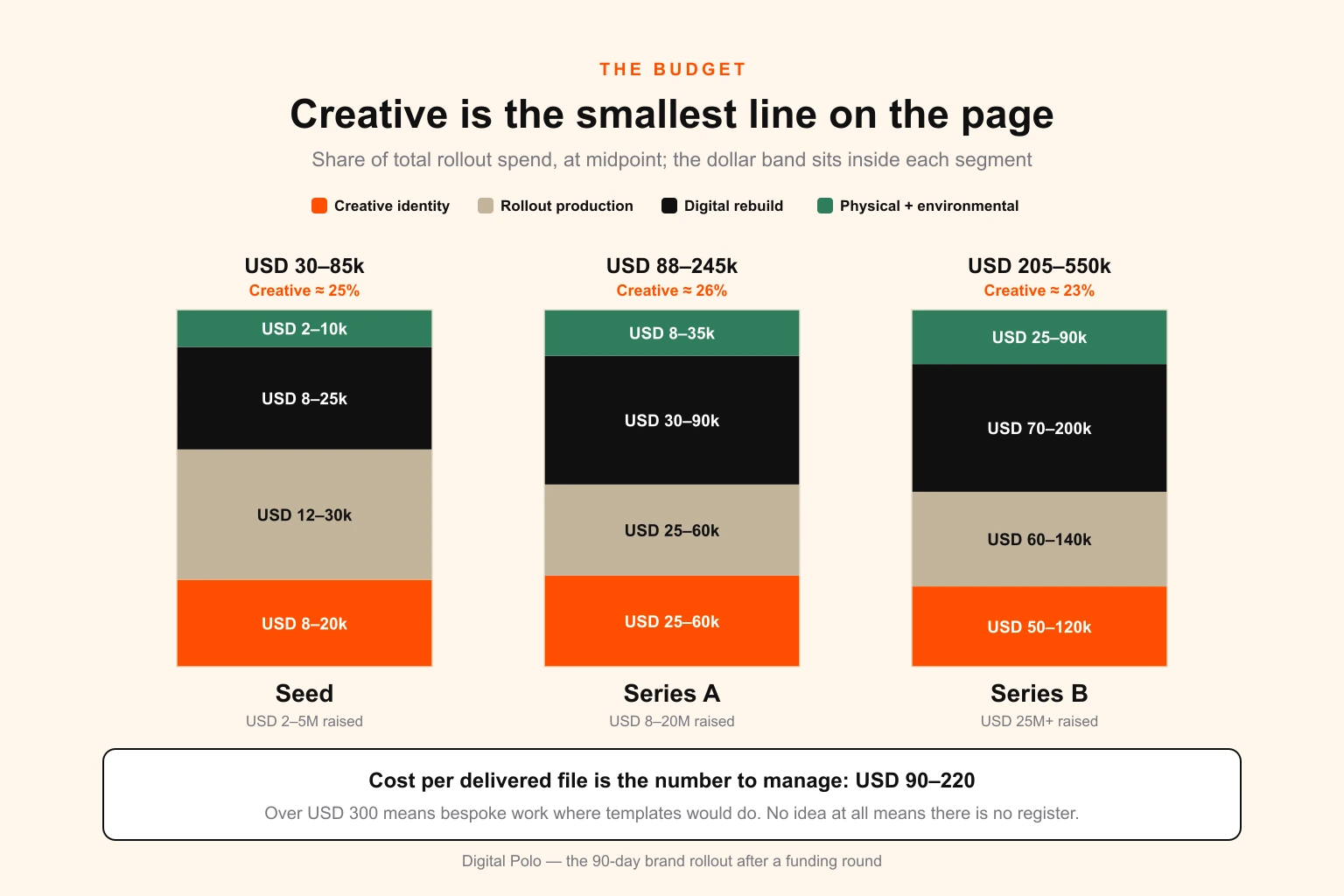
The proportion is the point: creative is 15 to 30 per cent of the total. The identity — logo, palette, type, guidelines — is the line item everyone budgets and the smallest one on the page. Putting that identity onto 250 surfaces, rebuilding a website, and replacing everything physical is where the rest goes.
Three notes on reading those bands.
Website rebuild is the most variable line by a wide margin. A template refresh on an existing stack is USD 8,000 to 20,000. A full custom marketing site with new information architecture, new copy and a CMS migration is USD 40,000 to 120,000+, takes ten to sixteen weeks, and is the single most common reason a 90-day rollout becomes a 150-day rollout — largely because the wireframe, mockup and prototype stages each carry their own review cycle, and a company mid-raise has no spare review capacity. Decide in week one which of those you are doing, and if it is the second one, decouple it — launch the brand on a refreshed existing site and ship the rebuild in Q2. Two brands running concurrently is fatal; a good site now and a better site later is not.
Physical scales with footprint, not headcount. A remote company with no office and no events might spend USD 2,000. A company with two offices, a booth programme and a field sales team carrying printed collateral spends USD 30,000 to 60,000 and needs eight weeks of lead time to do it.
Cost per delivered file is the number to actually manage. Across the whole programme it should land somewhere between USD 90 and 220. If yours is over USD 300, you are buying bespoke work where templates would do. If you have no idea what it is, you do not have a register.
For a more granular view of what individual asset types cost at market, the graphic design pricing guide breaks it down by deliverable, and the plan comparison covers the fixed-fee end of the range.
The eight ways this breaks
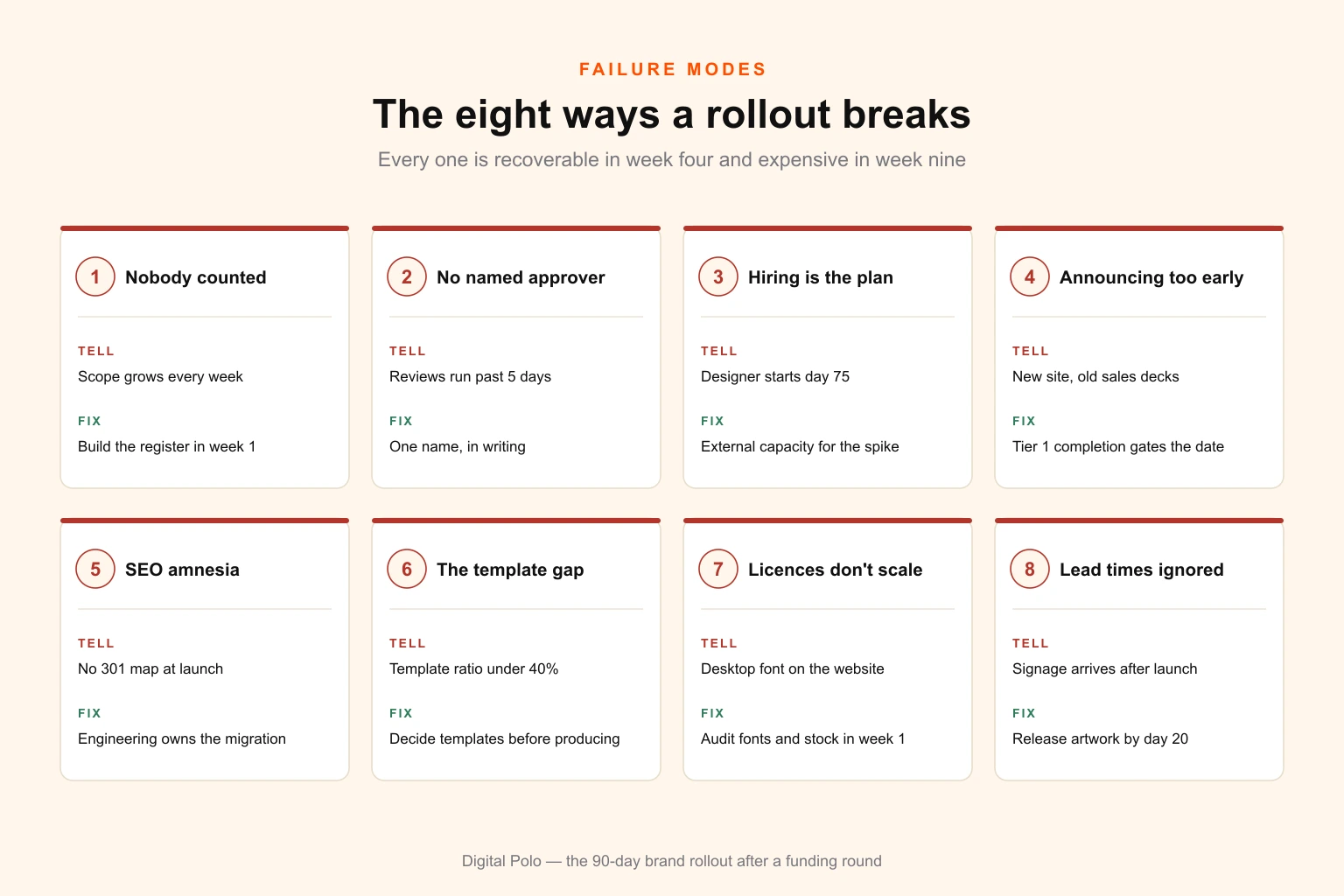
Every one of these is recoverable if caught by week four and expensive if caught by week nine. Three deserve expanding.
Announcing before the assets exist is the most publicly damaging. It happens because the announcement date is set by the funding news and the asset date is set by production reality, and nobody reconciles them. The reconciliation is simple: the announcement date is a hard input to the plan, and everything Tier 1 works backwards from it. If Tier 1 cannot be complete by then, the announcement covers the funding and the brand launches separately three weeks later. That is a completely acceptable outcome. A press release pointing at a new website while your sales team emails decks with the old mark is not.
The template gap is the most expensive over twelve months. A company that produces 40 one-off social assets instead of building 6 templates pays roughly four times as much and gets less consistency. Every Tier 3 category should be a template decision before it is a production decision, and the ratio to watch is the share of delivered assets that came from a template — below 60 per cent and you are paying for the same layout repeatedly.
No named approver is the most common and the least visible, because it never announces itself as a problem. It shows up as revision rounds that do not converge, as a deck that has been "nearly done" for three weeks, and as a designer who has stopped making decisions because every decision gets overturned. If a Tier 1 asset has been in review for more than five working days, you have this problem and the fix is a name, not a meeting.
The six numbers to report weekly
A rollout without a scoreboard becomes a series of opinions about whether things feel on track.
| KPI | How to measure | Healthy at day 45 | Healthy at day 90 |
|---|---|---|---|
| Register completion | Migrated surfaces ÷ catalogued surfaces | 35–45% (all Tier 1 in flight) | 85–95% |
| Request → delivery | Median working days, brief to approved file | ≤ 4 days | ≤ 3 days |
| Template ratio | Assets from template ÷ total delivered | ≥ 40% | ≥ 60% |
| Organic sessions | vs pre-launch baseline | n/a | 85–100% recovered |
| Deals on current collateral | Active deals using new-brand assets | ≥ 60% | 100% |
| Cost per delivered file | Total production spend ÷ files delivered | USD 90–220 | trending down |
Register completion is the one to lead with in board updates, because it is the only metric that converts a vague programme into a percentage. It also has a useful political property: it makes the size of the job legible to people who assumed the job was a logo.
The checklist
Print this, or paste it into whatever your team actually uses.
Before close (or week 1)
- Touchpoint audit across every channel
- Asset register built — surface, files, owner, date
- Source files recovered from all previous designers and agencies
- Font licences verified against web, app and distribution use
- Stock and illustration licences checked against new volumes
- Trademark, domain and social handle availability confirmed
- Announcement date locked
Days 1–14
- Single approver named in writing
- Freeze on all new old-brand asset creation, announced internally
- Register triaged into Tiers 1, 2, 3
- Production capacity secured for 330–550 hours
- Website decision made: refresh now vs rebuild later
- Physical lead-time items identified and artwork deadlines set
Days 15–45
- Identity approved
- Brand guidelines documented with worked examples
- Design tokens implemented in product, if applicable
- All Tier 1 assets in production with briefs
- Template library defined for every Tier 3 category
- Internal all-hands at day ~39 with library access
- Physical artwork released to suppliers
Days 46–60
- Named-account outreach from account owners (day −5)
- Investor, board and partner heads-up (day −2)
- 24-hour switch: site, app, socials, signatures, decks, ads
- 301 map live, Search Console change of address filed
- Review sites, directories and app store listings updated
Days 61–90
- Careers page and hiring collateral live
- Tier 3 volume production running from templates
- Physical and environmental installed
- Residual sweep assigned with a deadline
- Weekly KPI reporting established
- Ongoing production model decided for month 4 onward
What to do on Monday
If you closed recently and none of this exists yet, do these four things this week, in this order.
Build the register. Eight to fifteen hours, one person, every surface. It will be worse than you think and that is the entire value of doing it.
Name the approver. One person. Put it in writing so it survives the first disagreement.
Freeze the old brand. Every day of drift is files you will pay for twice.
Then decide your production model against the number the register gave you — not against a feeling about how much design you need. If it says 200 files and you are three months from a designer starting, you have a capacity problem that hiring will not solve inside the window, and the sooner that is a decision rather than a surprise, the cheaper the whole quarter gets.
Digital Polo runs post-funding rollouts as a fixed monthly cost rather than per-deliverable, which is the structure that fits a register — unpredictable in shape, predictable in volume, and heaviest exactly when a per-asset quote hurts most. If you want a second set of eyes on your register before you commit a budget to it, send it over and we will tell you what the hours actually look like.
Frequently asked questions
How long should a brand rollout take after a funding round? Ninety days is the right target for seed and Series A, and it is achievable — but only if the first two weeks go on counting rather than designing. Two weeks of inventory and freeze, four weeks of Tier 1 production, a two-week launch window where everything flips together, and a final month for hiring collateral, ad volume and the physical long tail. Rollouts rarely miss on creative. They miss because the register did not exist, so the real scope surfaced in week nine.
How many design assets does a brand rollout actually involve? 180 to 340 discrete files for a typical seed to Series A company. Tier 1 alone — lockups, the type and colour system, six to ten site templates, two decks, one-pagers, document and email templates, social profile kit — is 60 to 100. Tier 2 adds 50 to 90 for careers, case studies, investor templates and events. Tier 3 adds 70 to 150 in ad variants, featured images, product marketing and partner lockups. Nobody guesses within a factor of three, which is why the register comes first.
What does the rollout cost compared with the identity itself? The identity is 15 to 30 per cent of the total. That inversion is the most common budgeting error after a raise: a company approves USD 40,000 for an identity, treats it as the brand line, then finds that putting it onto 250 surfaces costs more than creating it did. Build from the register — 220 files at 1.5 to 2.5 hours each and USD 65 to 95 an hour is 330 to 550 hours and USD 21,000 to 52,000 of production, before website, signage and print.
Should we hire an in-house designer to run the rollout? Hire for what comes after it. A senior search runs six to eleven weeks to first day, plus two to three weeks of ramp, so a day-one start makes someone productive around day 75 of a 90-day window — against a register needing 330 to 550 hours, when one person delivers 25 to 30 production hours a week. Resource the spike externally and let the hire arrive to own a system that already exists.
What order should we announce a rebrand in? Employees first with real lead time, then commercial relationships, then the public. Internal all-hands at day −21 with the library already accessible; named accounts at day −5 from their own account owner; investors, board and partners at day −2; public switch at day 0 with site, app, socials, signatures and decks all changing inside 24 hours. The failure mode is announcing before the assets exist.
What happens to our SEO if we change domain? Plan for a dip and two to six months of recovery, owned by engineering rather than marketing. Non-negotiables: a one-to-one 301 map, the old domain retained indefinitely, canonicals and internal links pointed at the new domain instead of chained through redirects, a Search Console change of address, a fresh sitemap, and outreach to your top referring domains. Brand-term traffic to the old name does not return; it gets rebuilt under the new one.
Do we need brand guidelines, or is a logo file enough? Guidelines, and the reason is headcount rather than taste. Five people can hold a brand in shared judgement; thirty cannot, and you are about to add reps, a recruiter and a marketer who will each build something in their first fortnight. The post-raise minimum is logo usage and clear space, an accessible colour system, the type scale, light photography direction, and three to five worked examples of real assets.
Phased rollout or all at once? Switch the visible surfaces at once, phase the invisible ones. Anything encounterable in a single session — site, app, socials, signatures, collateral, ads — changes inside 24 hours, because two concurrent brands read as a company mid-collapse. Printed inventory, signage, vehicle graphics, swag and booth hardware phase out as stock depletes, with the phase-out dates written into the register so the tail has a deadline.
How much lead time do physical assets need? Four to eight weeks from approved artwork, and the clock starts at approval. Building and interior signage four to eight weeks with permitting; trade show hardware and large-format three to six; custom swag and apparel three to six; vehicle graphics two to four. If the announcement is day 60 and you want signage up for it, artwork releases around day 20 — which means the identity locks in the first three weeks.
What KPIs should we track? Six, weekly. Register completion as a percentage of catalogued surfaces, so the project has a denominator. Median request-to-delivery in days. Template ratio, which should clear 60 per cent. Organic sessions against a pre-launch baseline at 30, 60 and 90 days. Share of active deals running on current collateral. And cost per delivered file, which is the only figure that tells you whether the production model works.
When should brand work start relative to closing? The audit and register before close; the design work after. Inventory, touchpoint audit, trademark and domain search and source-file recovery are useful regardless of outcome and cost only attention. Doing them during diligence turns day one into a production start rather than a discovery start, which buys back two to three weeks. Wait on anything with an invoice, and on anything depending on positioning the round itself might change.
Can we run this without a dedicated project manager? Without the title, yes; without the function, no. Someone owns the register, chases unclaimed surfaces, holds the single-approver line against a founder who wants to weigh in on everything, and enforces the freeze. That is ten to fifteen hours a week for twelve weeks. A marketing ops or chief-of-staff type owning it as their primary quarterly deliverable works. An external producer with the register template already built works. The founder owning it in the margins of fundraising follow-through does not.