
Somebody in an agency Slack asks what everyone is paying for white-label design, and within an hour there are nine answers and no information.
One person pays $90 an hour. Another pays $699 a month. A third pays $250 for a landing page and $1,200 for an identity. Someone quotes a range of $500 to $10,000 a month, which is not a range so much as an admission. Someone else says they charge forty to fifty per cent above their normal rate, which answers a different question entirely. And a printer who has been buying design for eleven years says $18 an asset, and is telling the truth, and is not comparable to anyone else in the thread.
None of these people are wrong. They are quoting in incompatible units, for incomparable work, with wildly different amounts of their own labour hidden behind the number. The thread ends the way it always ends, with everyone slightly more confident and no better informed.
This is the version of that conversation that produces a usable number. Not a rate survey — rate surveys age badly and were never comparable in the first place. A conversion method, a set of benchmark ranges organised by something that actually predicts cost, an honest accounting of what a quoted price leaves out, and a protocol for producing your own numbers in about thirty days.
If you are buying design to resell it under your own name — as an agency, a print shop, a sign shop, a manufacturer, a freelancer with more work than hands — the number you need is not the one on anyone's pricing page.
Why every published white-label price is unusable
Go looking for white-label design pricing and you will find three kinds of answer, all presented as though they were the same kind.
The per-asset quote. A number attached to a thing: $250 for a landing page, $80 for a social set, $1,500 for an identity. It feels like the most concrete of the three and it is the most treacherous, because the thing is undefined. A landing page is between three and forty hours of work depending on whether a design system exists, how much copy is final, and whether "landing page" means a layout or a layout plus fourteen responsive states plus a developer handoff.
The hourly rate. Onshore agency-to-agency partners commonly publish figures around $90 an hour. Nearshore and mid-market studios sit lower. Offshore production studios lower again. The rate is the most honest of the three units and the least useful in isolation, because an hourly rate contains no information about how many hours the work takes, and hours-to-completion varies between suppliers far more than rates do. A supplier at $90 an hour who delivers a clean one-pager in two hours has cost you $180. A supplier at $35 an hour who takes seven hours and needs a second round has cost you $245 plus a week.
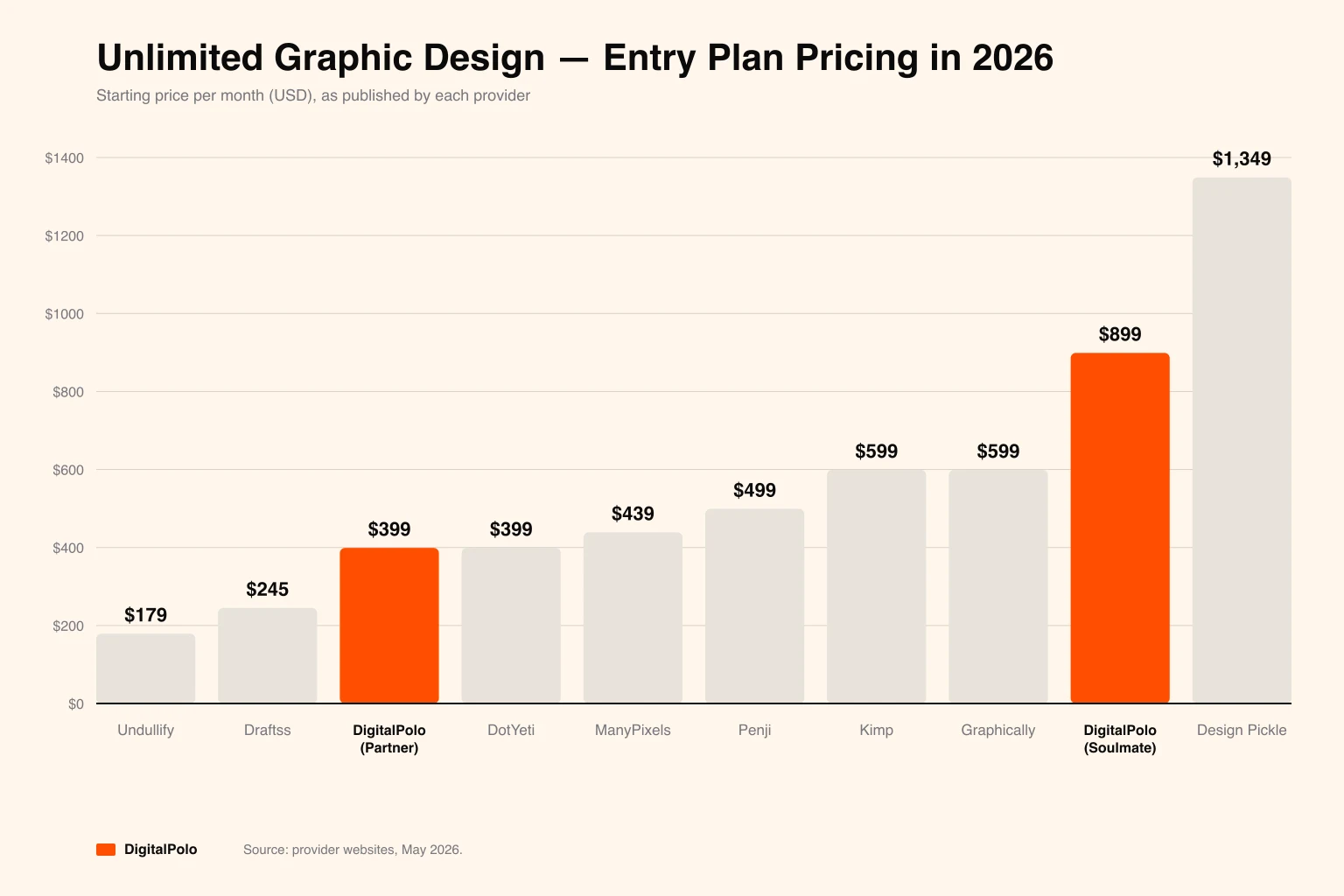
The monthly subscription. ManyPixels publishes plans from around $699 a month, Design Pickle sits considerably higher at roughly $1,918, Kimp lands near $700, and Digital Polo's plans are $399 and $899. These are real, comparable-looking numbers, and they are the most misleading of the lot, because the price is fixed and the thing you receive is not. A monthly plan is not a price for design. It is a price for a queue position, and the amount of design that comes out of a queue position varies by a factor of three or four depending on how you use it.
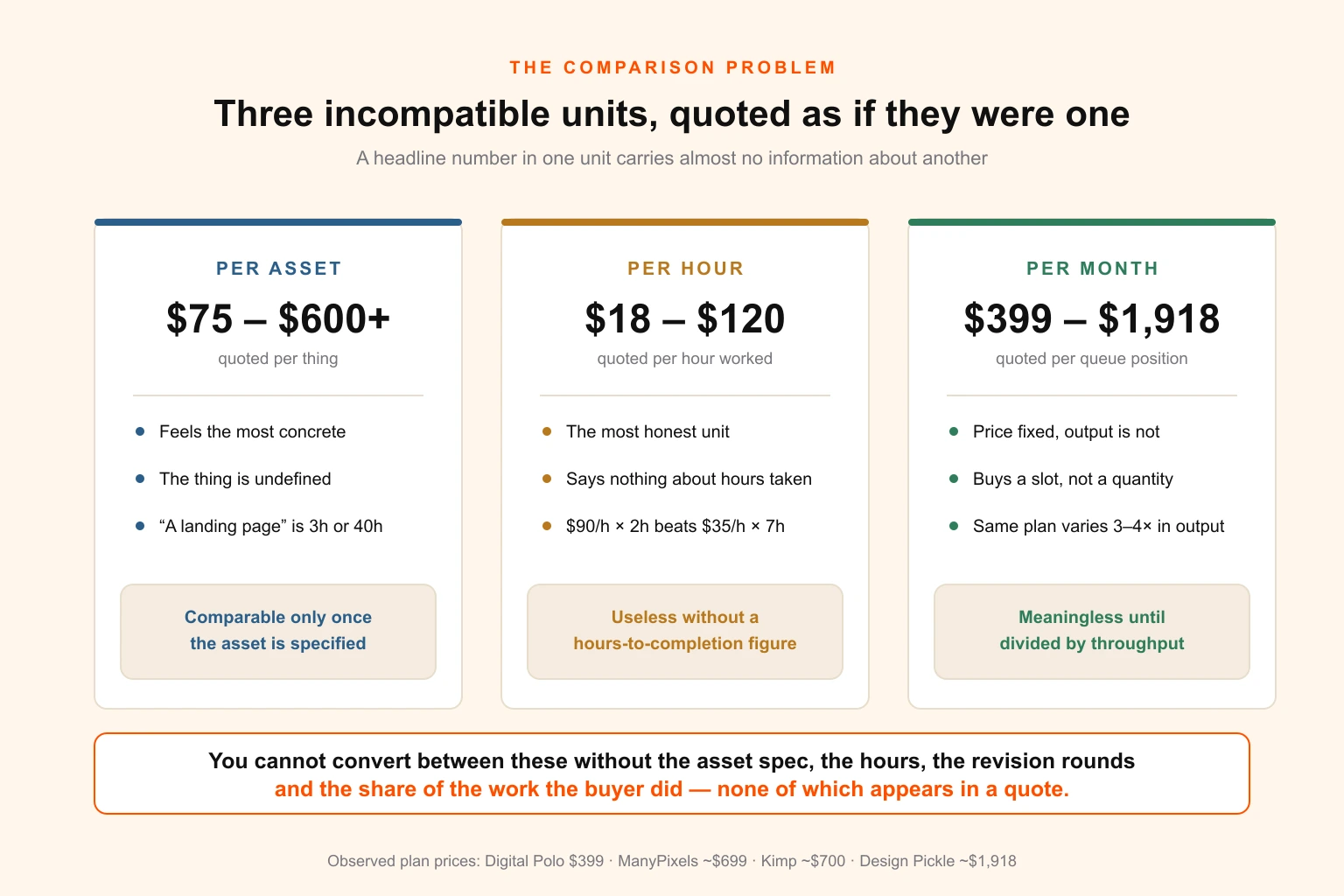
The reason the Slack thread fails is not that people are secretive about rates. It is that the three units cannot be converted into one another without information nobody includes in the answer: what the asset actually was, how many hours it took, how many revision rounds it needed, and how much of the work was done by the buyer.
So the first job is not finding benchmarks. It is building a unit that benchmarks can live in.
The unit that makes prices comparable
Every serious procurement function in every other category solved this problem the same way: stop pricing the input and start pricing the delivered outcome, with your own costs included.
For design bought wholesale, the working unit is landed cost per accepted deliverable.
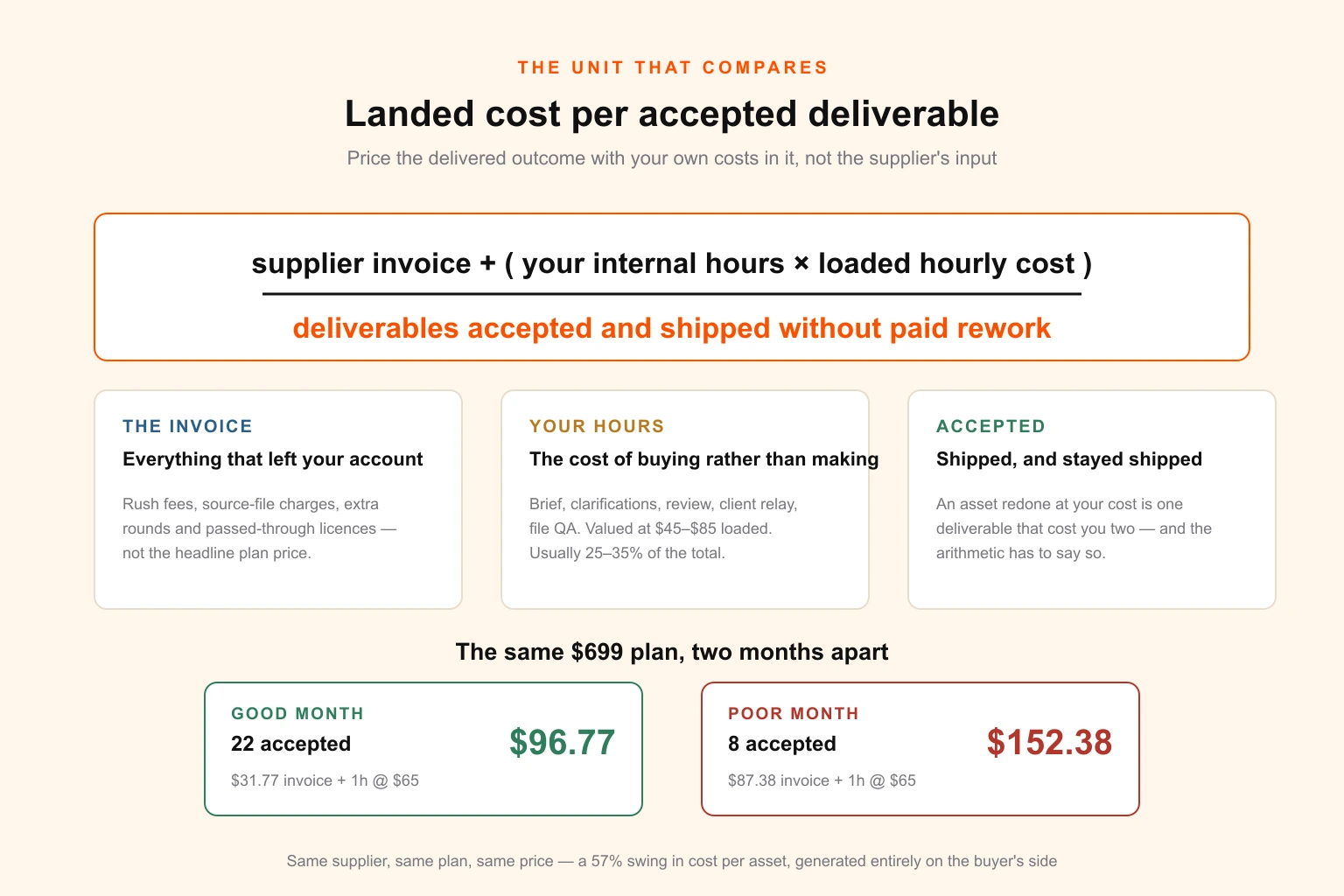
Three parts, each of which has to be defined precisely or the number quietly becomes fiction.
The invoice is everything you actually paid the supplier in the period, including rush fees, source-file charges, extra revision rounds and any licences they bought and passed through. Not the headline plan price. The amount that left your account.
Your internal hours are the ones you spend because you are buying rather than making: writing the brief, answering clarifying questions, reviewing the work, running it past your client, relaying feedback, checking files against your own delivery standard. Value them at your loaded hourly cost — salary plus employment overhead plus your own overhead recovery, which for most small agencies lands somewhere between $45 and $85 an hour for the person doing this work. This is the term everyone omits and it is frequently a quarter to a third of the total.
Accepted deliverables are the ones that went to a client and stayed there. Not the ones that were delivered. If an asset came back, was redone, and you paid for the redo — in money or in your own hours — it is one accepted deliverable that cost you two, and the arithmetic has to say so or you will systematically overrate cheap suppliers with high rework rates.
The formula is unremarkable. What it does to a decision is not.
Take a $699 monthly subscription. In a month where your brief quality is good, your review turnaround is same-day and you feed the queue properly, you might take 22 accepted deliverables out of it. That is $31.77 an asset on the invoice. Add one hour of your own time per asset at $65 and the landed cost is $96.77.
Take the same $699 plan in a month where briefs go out half-formed, you sit on reviews for two days, and four assets need a second round. Eight accepted deliverables. That is $87.38 on the invoice and roughly $152 landed.
Same supplier. Same plan. Same price. A 57 per cent difference in cost per asset, and every bit of the difference was generated on your side of the relationship.
That is the finding underneath every benchmark in this article, so it is worth stating flatly before any numbers appear: for subscription and retainer models, throughput is a bigger cost driver than rate, and throughput is mostly determined by the buyer. People shop rates because rates are visible. The money is in the other variable.
Benchmark ranges by complexity class
A price benchmark is only useful if the things being compared are genuinely comparable, and "a design" is not a comparable thing. The taxonomy that predicts cost best is not asset type — brochures and social posts sit in wildly different places depending on context — but how much of the thinking already exists.
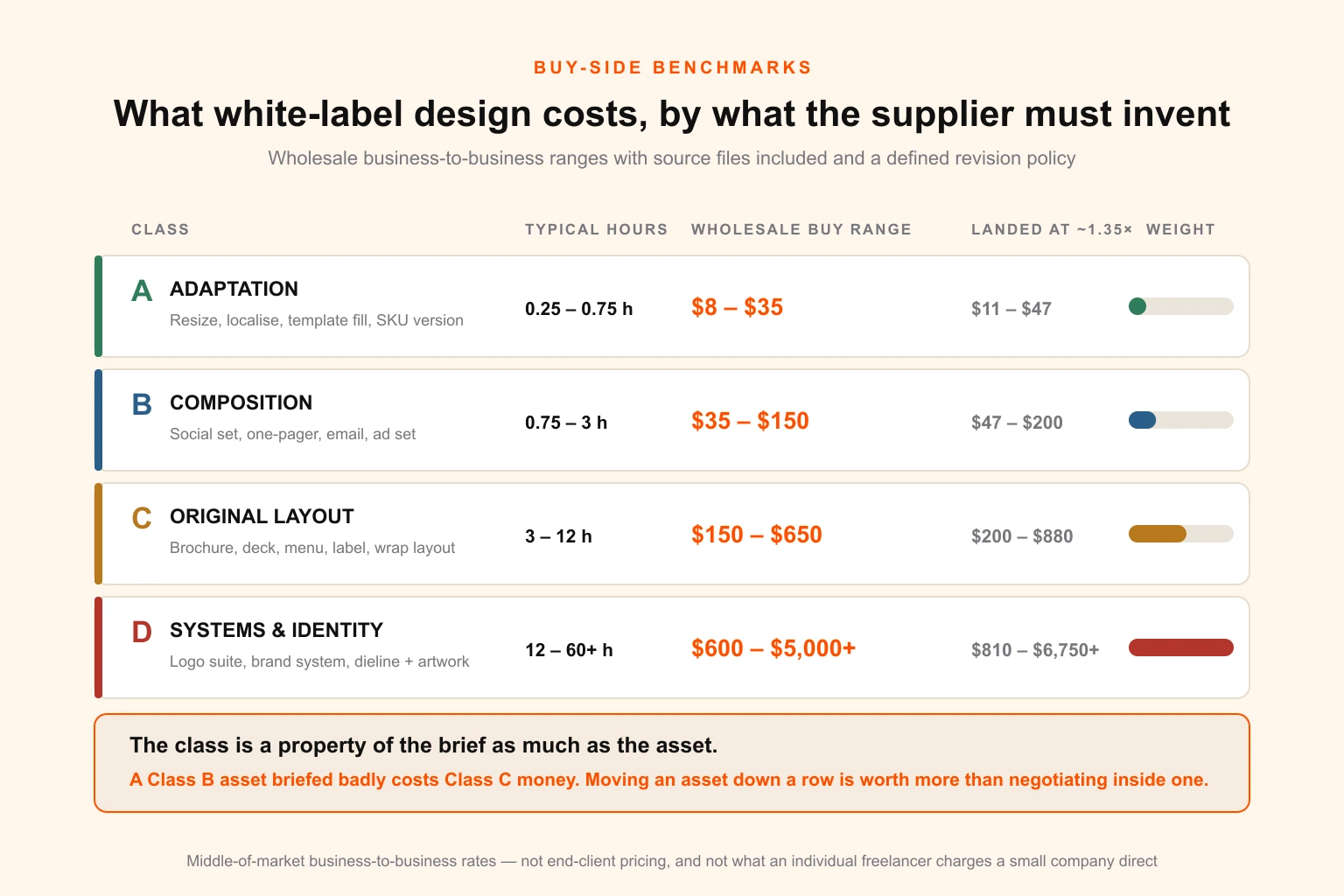
Four classes, defined by what the supplier has to invent.
Class A — Adaptation. The design decisions are already made and the job is to execute them somewhere new. Resizing a campaign into eleven placements, localising an ad set, filling a template with new copy, versioning a label for a second SKU. Typically 15 to 45 minutes of skilled work. This is the class where volume buying pays, and it is a very large share of most resellers' actual demand — the arithmetic of it is laid out in one campaign asset across fifteen channel formats.
Class B — Composition within a system. Brand rules exist, assets exist, and something new has to be built from them. A social set, a one-pager, an email template, an ad concept executed across a set, an event banner. Usually 45 minutes to three hours.
Class C — Original layout. No system to lean on, or the piece is complex enough that the system does not carry it. A brochure, a pitch deck, a menu, a packaging label, a vehicle wrap layout, an annual report spread. Three to twelve hours, and the top of that range is a soft ceiling rather than a hard one. Class C is also where hidden recurring demand tends to hide: a deck is usually counted once and then maintained forever, which is the arithmetic run in how many sales deck versions a team actually needs.
Class D — Systems and identity. The output is a set of rules other work will be built on. A logo suite with lockups and usage documentation, a brand system, a dieline plus artwork, an illustration system, a full design system. Twelve to sixty hours and up, with the highest price variance in the market.
| Class | What it is | Typical skilled hours | Wholesale buy range, per asset | Landed, at ~1.35× |
|---|---|---|---|---|
| A — Adaptation | Resize, localise, template fill, SKU version | 0.25 – 0.75 | $8 – $35 | $11 – $47 |
| B — Composition | Social set, one-pager, email, ad set | 0.75 – 3 | $35 – $150 | $47 – $200 |
| C — Original layout | Brochure, deck, menu, label, wrap layout | 3 – 12 | $150 – $650 | $200 – $880 |
| D — Systems & identity | Logo suite, brand system, dieline + artwork | 12 – 60+ | $600 – $5,000+ | $810 – $6,750+ |
Read these as the middle of the market rather than as limits. They describe what a competent supplier with source files included and a defined revision policy charges another business — not what that business charges its end client, and not what an individual freelancer charges a small company directly.
Three things worth noticing about the table.
The ranges overlap deliberately. A Class B asset briefed badly costs Class C money. A Class C asset with a mature design system behind it costs Class B money. The class is a property of the work as it arrives at the supplier, not of the asset type on the invoice — which means brief quality moves assets between rows, and moving a row is worth more than negotiating within one.
Class A is where subscription economics bite hardest. At $8 to $35 per asset bought individually, and effectively $15 to $40 bought inside a busy monthly plan, the two models look similar. The difference is that per-asset buying has a transaction cost — a quote, an approval, an invoice line — that frequently exceeds the price of the asset itself. Any organisation buying more than about fifteen Class A assets a month is spending more on procuring them than on producing them.
Class D deserves a different buying process entirely. It is the one class where the cheapest credible supplier is often the wrong answer, because the output constrains every downstream cost for years. A weak identity makes every future Class A and B asset slower. The cost structure of a packaging redesign shows this pattern clearly: the design fee is a small fraction of what the decision costs once tooling, print and rollout follow it.
The four engagement models, priced against each other
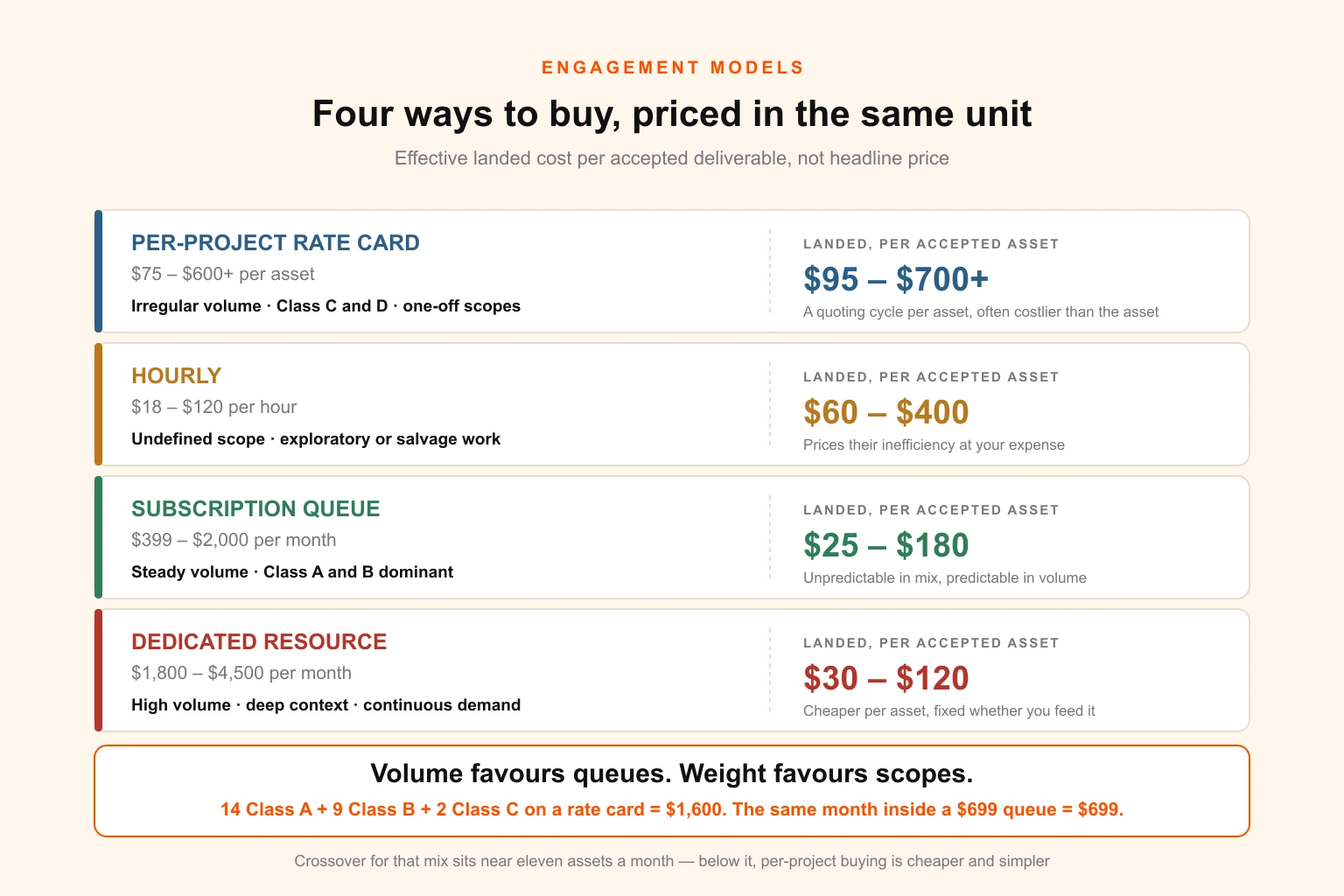
Complexity classes tell you what an asset should cost. Engagement models tell you what your supply arrangement costs, which is a different question, and the one most resellers actually have to decide.
| Model | Headline price | Effective landed, per accepted asset | Fits |
|---|---|---|---|
| Per-project rate card | $75 – $600+ per asset | $95 – $700+ | Irregular volume, Class C and D, one-off scopes |
| Hourly | $18 – $120 / hr | $60 – $400 | Undefined scope, exploratory or investigative work |
| Subscription queue | $399 – $2,000 / mo | $25 – $180 | Steady volume, Class A and B dominant |
| Dedicated resource | $1,800 – $4,500 / mo | $30 – $120 | High volume, deep context, continuous demand |
Per-project rate cards are the easiest to reason about and the most expensive way to buy routine work. Every asset carries a quoting cycle, and the quoting cycle costs both parties real time that ends up in the price. They are the right instrument for anything you want a firm commitment on: a defined scope, a defined date, a defined deliverable. They are a bad instrument for a stream of small requests.
Hourly is the honest arrangement when nobody can define the scope, which is a legitimate situation more often than the industry admits. Its weakness is that it prices the supplier's inefficiency at your expense and gives them no reason to get faster. Use it for discovery, investigation and salvage work — a broken file, an unrecoverable legacy asset — and move to a fixed unit as soon as the work becomes describable.
Subscription queues are the model most white-label buying has converged on, for a structural reason: reseller demand is unpredictable in composition and fairly predictable in volume. The category comparison for agencies and resellers covers which suppliers actually permit resale, which is not all of them. You cannot forecast which client will need what. You can forecast that roughly thirty things will need doing. That shape is bad for per-asset pricing and good for a queue — which is the argument set out in more detail in how the unlimited model actually works and interrogated honestly in whether it is worth it.
Dedicated resources — a named designer, full or part-time, embedded in your process — cost more per month and frequently less per asset, because context stops being re-explained. The catch is utilisation: a dedicated person is a fixed cost whether or not you feed them, and most resellers overestimate their own steady-state volume by a comfortable margin. The utilisation arithmetic is the same one that governs the in-house decision, worked through in unlimited design versus hiring a full-time designer.
The crossover point, calculated rather than argued
The subscription-versus-project question has an arithmetic answer, and it takes about four minutes.
Take your realistic monthly volume by class. Say a small agency runs 14 Class A assets, 9 Class B and 2 Class C in a typical month.
Priced on a mid-market rate card at $20, $80 and $300: $280 + $720 + $600 = $1,600 a month, plus a quoting cycle on each of 25 line items.
Priced on a $699 subscription: the whole set fits comfortably inside a two-slot queue at a two-day cycle, so $699, plus a bit more of your own briefing discipline.
The crossover for that mix sits at about eleven assets a month. Below it, per-project buying is cheaper and simpler. Above it, the subscription wins and keeps winning, because the marginal asset is free.
What flips the answer is complexity mix, not volume. Shift that same month to 2 Class A, 3 Class B and 6 Class C — an agency doing fewer, heavier pieces — and the rate card comes to $2,080 while the subscription queue may not have the capacity to absorb six original layouts inside a month at all. Volume favours queues. Weight favours scopes.
Throughput: the variable nobody prices
If you buy on a subscription or a retainer, your cost per asset is the plan price divided by throughput, and throughput is a number you can predict.
Monthly accepted deliverables
  =  (working days ÷ average cycle days)
     ×  concurrent request slots
     ×  (1 − rework share)
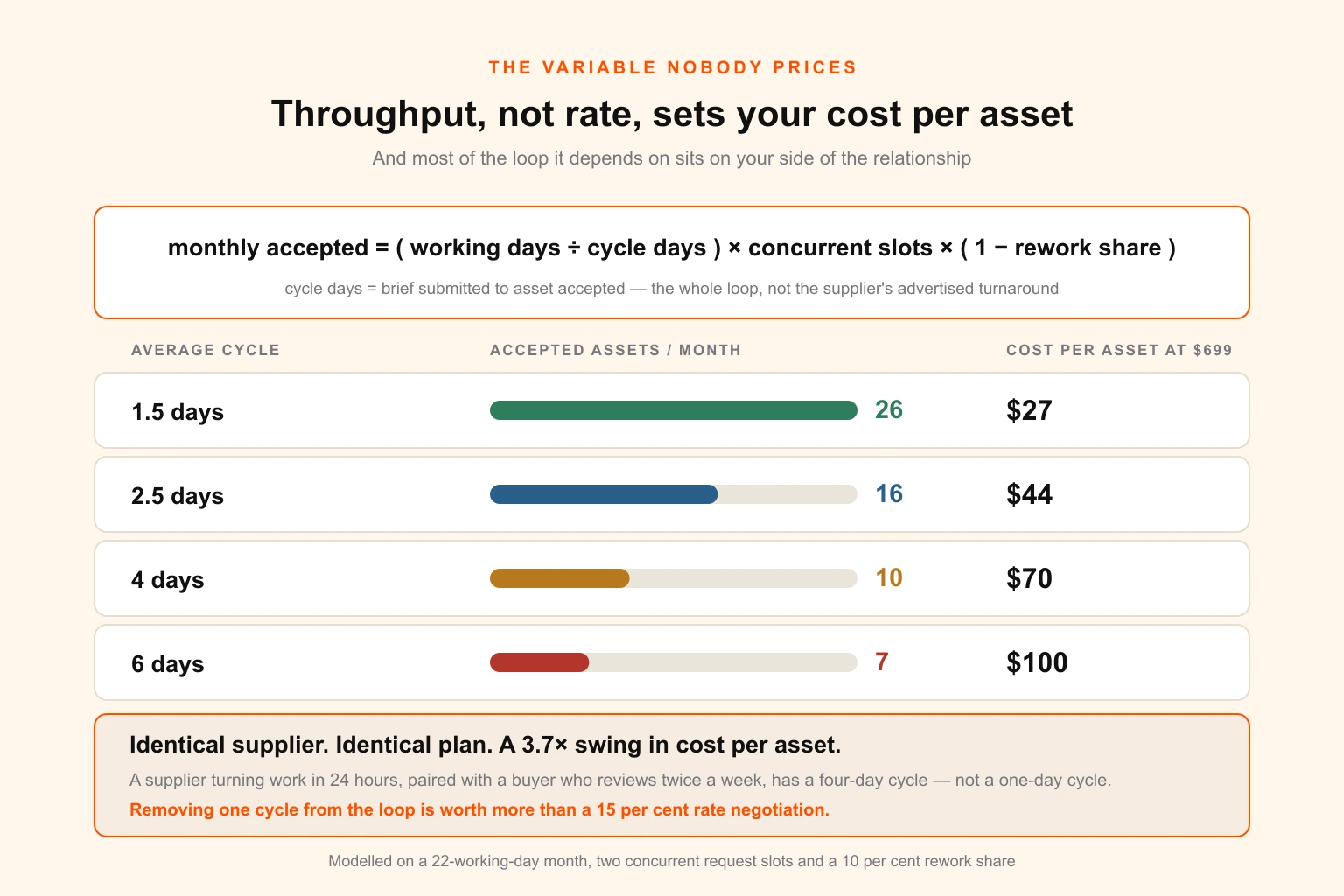
Cycle days is the whole loop: brief submitted to asset accepted. Not the supplier's advertised turnaround. This is where the interesting failure lives. A supplier turning work around in 24 hours, paired with a buyer who reviews on Tuesdays and Fridays, produces a cycle of three to four days, not one. The supplier's turnaround is a component of your cycle time and frequently not the largest one.
Run the numbers on a 22-working-day month with two concurrent slots and a 10 per cent rework share:
| Average cycle | Accepted assets / month | Cost per asset at $699 |
|---|---|---|
| 1.5 days | 26 | $27 |
| 2.5 days | 16 | $44 |
| 4 days | 10 | $70 |
| 6 days | 7 | $100 |
The supplier is identical across all four rows. The plan is identical. The only thing that changed is how quickly work moves through the loop — and that alone produces a 3.7-fold swing in cost per asset. Most of that loop is yours.
This is why brief quality is a pricing lever rather than a nicety. A brief that produces a usable first draft removes an entire cycle from the loop, and removing one cycle from a four-day loop is worth more than a fifteen per cent rate negotiation. If you buy design regularly and have never standardised your brief, that is the highest-return hour available to you — how to write a design brief covers the structure, and the discipline matters more for resellers than for anyone else, because you are briefing on behalf of a client who is not in the room.
Two second-order effects worth building into the model.
Batching beats trickling. Assets submitted in coherent batches share context and review passes. Twelve requests submitted as three batches of four will clear faster than twelve submitted individually across three weeks, because the reviewer holds one mental model instead of twelve.
Review latency compounds against you at exactly the wrong time. The months when you are busiest are the months your reviews slip, which raises your cost per asset precisely when volume should be lowering it. Resellers who track this find their cost per asset is highest in their best revenue months, which is counter-intuitive right up until you see the formula.
What the invoice leaves out
The quoted rate is not the cost. It is the visible part of the cost, and the ratio between the two is stable enough to be useful.
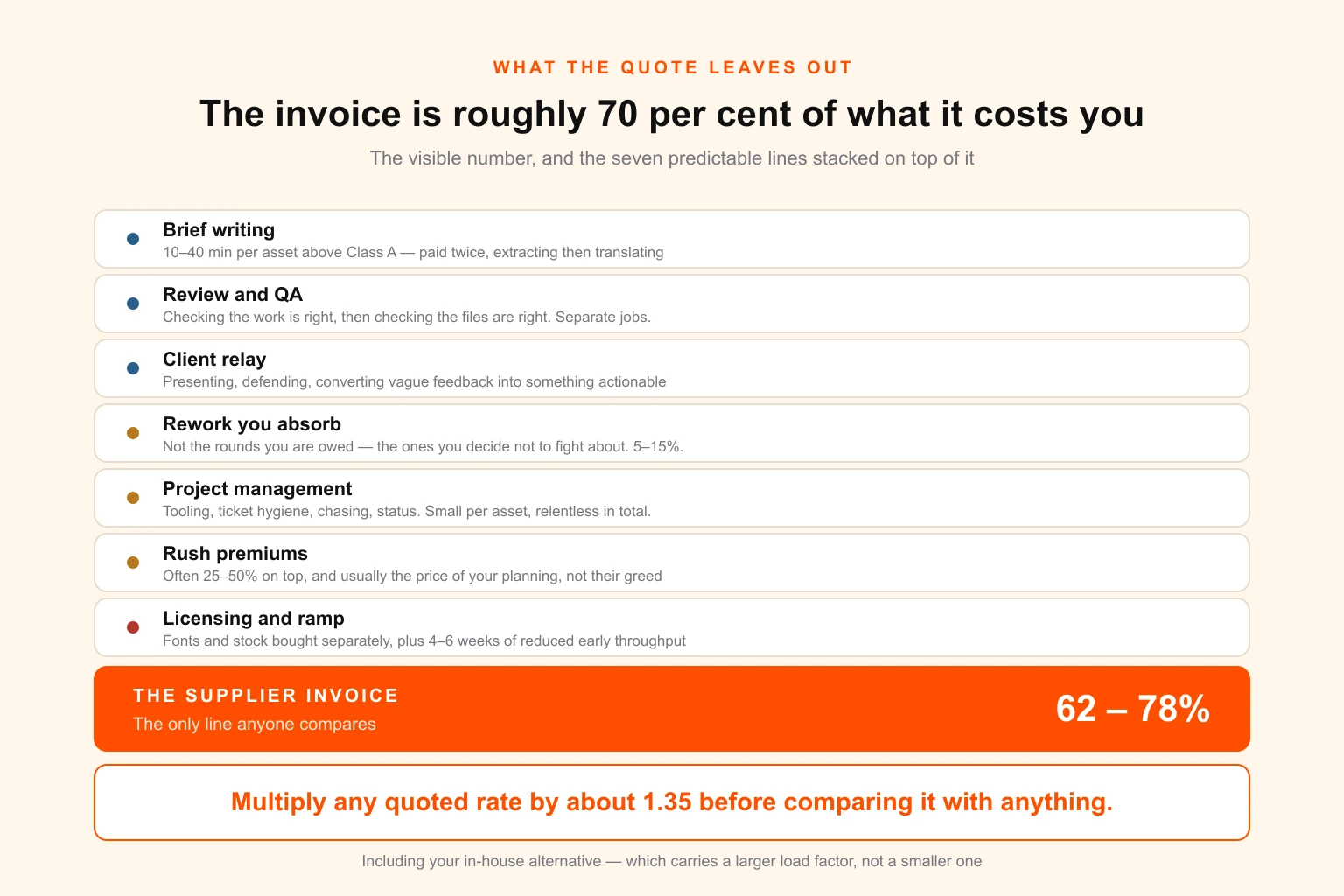
Brief writing. Ten to forty minutes per asset for anything above Class A, and the reseller pays it twice — once extracting the requirement from the client, once translating it into something a supplier can execute.
Review and QA. Checking the work is right, then checking the files are right, which is a separate job. Print resellers know this best: an approved design with the wrong bleed, a spot colour left as process, or fonts unoutlined is not a delivered asset, it is a delivered problem. A standing print-ready file checklist converts this from judgement into a five-minute pass.
Client relay. Presenting, defending, collecting feedback, converting that feedback into something specific enough to act on. Often the single largest internal line.
Rework you absorb. Not the revision rounds you are entitled to — the ones you decide not to fight about because the relationship matters more than the forty minutes. Every reseller absorbs some. Few measure it, and it is usually somewhere between five and fifteen per cent of delivered volume.
Project management overhead. Tooling, ticket hygiene, chasing, status. Small per asset, relentless in aggregate.
Rush premiums. Often 25 to 50 per cent on top, and they are a symptom rather than a cost: rush fees are usually the price of your own planning, not the supplier's greed. Media-buying and campaign work is the worst offender here, because creative demand arrives in bursts — the shape of it is covered in running a design retainer against media-buying clients.
Licensing bought separately. Fonts and stock are the two that catch resellers hardest, because the licence that covers a design agency's own work frequently does not cover redistribution to a client, and the licence that covers a client's own use frequently does not cover a print run or merchandise. Both are worth understanding before an invoice arrives rather than after: font licensing for resellers and stock licensing across print runs and merchandise cover where the boundaries actually sit.
Ramp. The first four to six weeks with any new supplier run at reduced throughput while context accumulates. Real, temporary, and routinely forgotten when comparing an incumbent against a challenger — the challenger is being judged during its worst month.
Add these up across resellers who track them honestly and the invoice comes to roughly 62 to 78 per cent of true landed cost. The working rule:
Multiply any quoted rate by about 1.35 before comparing it with anything.
Including your in-house alternative — which carries its own load factor, generally larger, because an internal designer also consumes management, tooling, recruitment and idle capacity.
What moves you within the range
Seven variables account for most of the spread between two quotes for nominally the same work. None are visible in a headline rate, and all of them are negotiable before the rate is.
- Brief maturity. The difference between a briefed asset and a described one is often a full complexity class. This is the only variable entirely under your control and it has the largest effect.
- Complexity class. Established above. Getting the class right before comparing prices is most of the work.
- Source files. Included or charged. Where charged, price it into every asset in the comparison — see below for why.
- Revision policy. Two rounds is standard for Class B and C; one for Class A. The definition matters more than the number.
- Rights and licensing scope. Full commercial transfer with the right to sublicense to your client is a different product from a limited-use grant, and it should be priced as one.
- Turnaround class. Standard, expedited, same-day. Buying the fastest tier by default is one of the more common quiet overspends.
- Volume commitment. Committed monthly volume typically buys 10 to 25 per cent, and buys priority far more reliably than it buys discount — which is usually the more valuable of the two.
The source-file question, which is not really a pricing question
Of the seven, source files deserve separating out, because treating them as a line item to negotiate is the most expensive small mistake in reseller procurement.
Layered, editable, native-format source files are what make you the owner of the client relationship rather than a broker permanently dependent on one supplier. Without them, every future change to an asset has to go back through the party that made it. That is a fine arrangement while the relationship is good and an acute problem at precisely the two moments it matters: when a client is leaving, and when a supplier is being replaced.
Both of those are moments of minimum leverage. The time to buy source files is at the start, in the rate, before anyone needs them. A supplier who will not include them, or who charges meaningfully for them, is telling you what their retention strategy is. The twelve questions for vetting a white-label partner treat this as a near-disqualifying answer, and that is the right weight for it.
The same logic extends to what happens when a relationship ends in either direction, which is worth having a written process for rather than discovering: the design offboarding checklist covers what has to come back and in what state.
Reading a quote properly
A quote answers one question. Nine others determine what it means. Before comparing two numbers, get both suppliers to answer all ten in writing.
| Question | Why it changes the price |
|---|---|
| What complexity class is this, in your reading? | Reveals whether you and they have scoped the same job |
| What is included in one unit? | The single largest source of quote-to-quote variance |
| Are layered source files included? | Ownership, lock-in and every future edit |
| What counts as a revision? | Direction change versus correction is the whole argument |
| How many rounds, and what happens after? | Where an underpriced quote recovers its margin |
| What is the standard turnaround, and what is a rush? | Whether you are buying speed you do not need |
| What rights transfer, and can I sublicense to a client? | Whether you can legally resell what you buy |
| Who buys fonts and stock, and under what licence? | The two most common downstream liabilities |
| Is my name or yours on the delivery? | The definition of white label, which varies |
| What is your first-pass acceptance rate? | The one operational question that predicts real cost |
That last question is the one almost nobody asks and the one whose answer correlates best with landed cost. A supplier who knows their first-pass acceptance rate is running a measured operation. A supplier who has never thought about it will be cheap on the invoice and expensive in your calendar.
The floor, and what is underneath it
There is a level below which a price stops describing a discount and starts describing a product.
Roughly speaking, below about $6 to $8 for a simple adaptation, or under about $12 an hour, you are very unlikely to be buying design. You are buying one of four things, sometimes several at once.
Template retrieval. A stock layout with your content substituted. Occasionally fine, especially in Class A. Not fine when sold to a client as bespoke, and a real problem when the same template turns up on a competitor's collateral.
Flattened output. A JPEG or a flat PDF instead of an editable file. Usually discovered at the first change request, when the economics of the original saving reverse in a single afternoon.
No rights indemnity. Nobody has verified that the fonts are licensed for your use, the stock covers commercial redistribution, or the illustration is original. The exposure sits with you, because you are the one whose name is on the delivery.
An unattributed generative pass. Increasingly common, hard to detect on a small asset, and reliably visible on anything that needs to scale, extend or print — the seams appear at the moment of extension, which is the moment the client is depending on it.
None of this means offshore or low-cost production is a mistake. A great deal of excellent Class A and B work is produced at genuinely low rates by studios running tight, specialised operations, and the arbitrage is real. The distinction is not price, it is what the price is attached to. A $15 adaptation with source files, cleared licensing and a named reviewer is a good buy. A $4 adaptation with none of those is a liability with a discount attached.
The reverse also holds. Paying $600 for a Class B social set does not buy you insurance. Above the range, you are usually paying for an agency's own overhead recovery, which is a real cost — to them.
A 30-day protocol for producing your own numbers
Benchmarks borrowed from an article — including this one — settle arguments. They do not settle decisions. The numbers that settle decisions are the ones produced by your own work, briefed by your own people, judged against your own delivery standard.
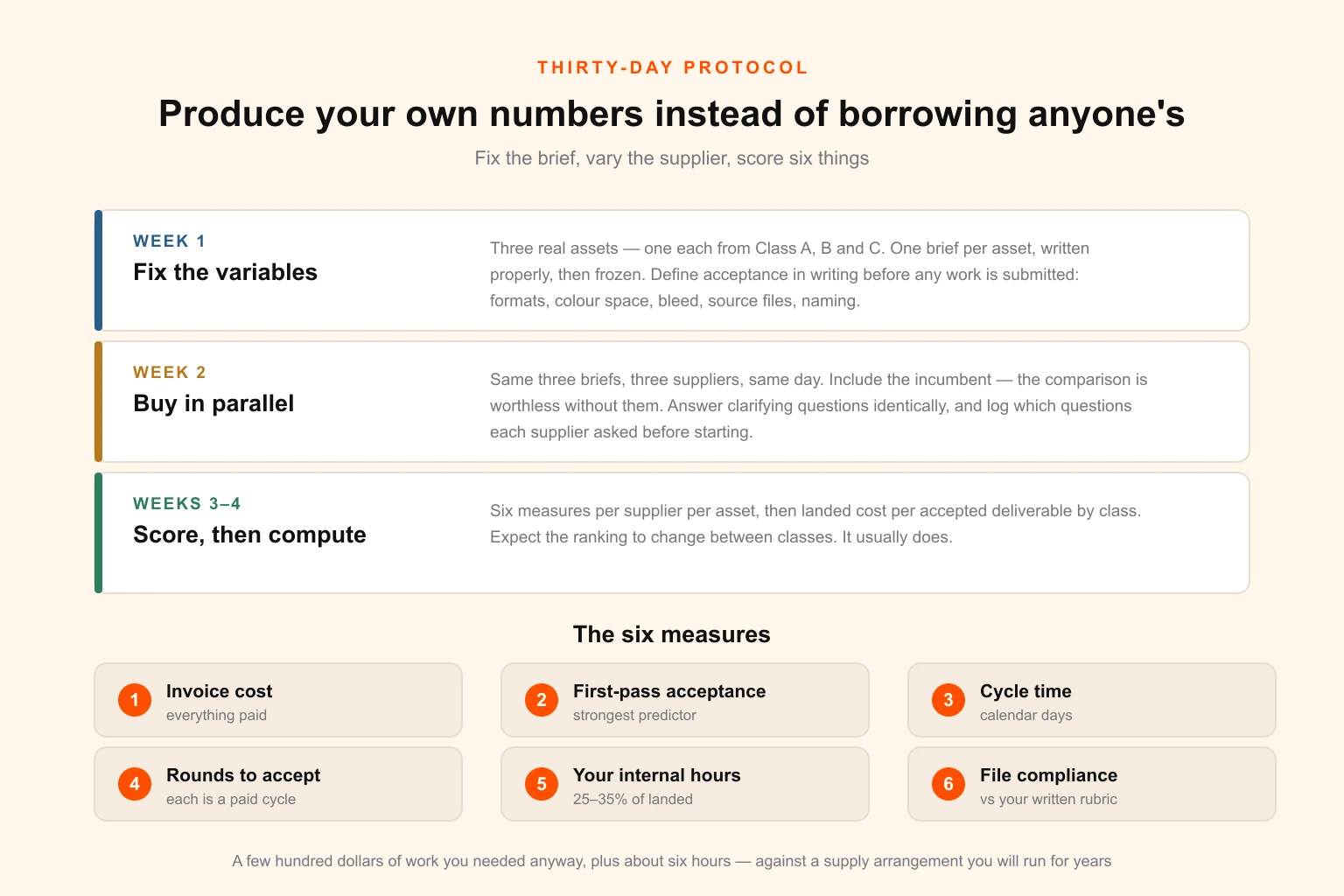
Week 1 — Fix the variables.
Choose three assets you genuinely need, one each from Class A, B and C. Real work for real clients, not test briefs — suppliers behave differently on tests, and so do you. Write one brief per asset, properly, and freeze it. The same brief goes to every supplier, unedited. If you improve a brief mid-experiment you have destroyed the comparison.
Define acceptance before anything is submitted. Write down what "done" means for each of the three: file formats, colour space, bleed, source files, naming. That definition is your scoring rubric and it must exist before you see any work.
Week 2 — Buy in parallel.
Three suppliers, same three briefs, same day. Include your incumbent — the comparison is worthless without them, and incumbents frequently win, which is itself useful information. Answer clarifying questions identically for all three, and log the questions: the questions a supplier asks before starting are one of the better proxies for whether they will get it right.
Weeks 3 and 4 — Score, then compute.
Six measures per supplier per asset:
| Measure | How to capture it | Why it matters |
|---|---|---|
| Invoice cost | Everything paid, including extras | The visible number |
| First-pass acceptance | Usable without a revision round? Y/N | The strongest predictor of real cost |
| Cycle time | Calendar days, brief to acceptance | Drives throughput, drives cost per asset |
| Rounds to acceptance | Count | Each round is a cycle you pay for twice |
| Your internal hours | Logged honestly, including review | Typically 25–35 per cent of landed cost |
| File compliance | Score against your written rubric | Where cheap suppliers fail invisibly |
Then compute landed cost per accepted deliverable for each supplier, per class. Expect the ranking to change between classes — it usually does, and the most common result is that no single supplier wins everything. A studio that dominates Class A adaptation work is frequently not the one you want for Class D identity work, and forcing all your volume through one supplier because the paperwork is simpler is a decision worth making deliberately rather than by default.
The whole exercise costs a few hundred dollars in work you needed anyway, plus perhaps six hours of your time. Against a supply arrangement you will run for years, that is close to free.
What to measure once you are live
The benchmark is a snapshot. Supplier performance drifts, your mix changes, and the number that was true in March is decoration by November. Five measures, reviewed quarterly, keep it honest.
Landed cost per accepted deliverable, by class. The headline. Track the trend rather than the level — the level depends on your mix.
First-pass acceptance rate. Rising is good and usually means your briefs are improving. Falling sharply on a stable brief usually means something changed at the supplier: a team change, a capacity problem, or a quiet substitution of who is doing the work.
Cycle time, median and 90th percentile. The median tells you about normal work. The 90th percentile tells you what happens under pressure, which is what your clients will actually remember.
Rework share. Deliverables needing paid or absorbed redo, as a proportion. Above about 15 per cent, stop negotiating rate and go fix briefs.
Gross margin per client, not per asset. The account-level number is the one that catches slow bleeds. An account can carry a perfectly healthy per-asset margin and still lose money through volume of small unbilled requests, which is the most common way reseller margin actually disappears.
From what you pay to what you charge
Everything above is buy-side. The sell-side question — what to charge your client — deserves its own treatment, and the short version is that the common advice is directionally reasonable and structurally wrong.
The widely repeated multiples are a 1.5 times markup on supplier cost, or pricing white-label work forty to fifty per cent above a standard project rate. As starting points they are fine. As a system they anchor your pricing to your supplier's cost structure, which is the wrong reference point: your client is not buying your supplier's hours, they are buying the outcome and the fact that they never have to think about it.
Use your landed cost as a floor test, not a formula. If you also sell direct, the end-client side of the same market is mapped in the graphic design pricing guide, which is the number your client is comparing you against whether or not they say so. Know it precisely, know the minimum margin an account has to clear to be worth servicing, and price the outcome to the market you sell into. Then watch the two places margin actually leaks — unbilled rework and scope drift — because both are far more destructive than a slightly low original quote, and both are invisible on any single invoice.
The full sell-side playbook, including how to position white-label work without misrepresenting it, is covered in how to resell graphic design services. Print operators pricing design against a print order have a specific and different problem — the waive threshold, the customer-supplied-file tiers, the art charge versus setup charge confusion — worked through in what a print shop should charge for design. And the model-level question of what you are actually selling when you sell design as a recurring service is set out in design as a service, explained.
Where Digital Polo sits in these numbers
For the sake of transparency about the source of this analysis: Digital Polo is a white-label supply arrangement, so we are one of the data points rather than a neutral observer of them.
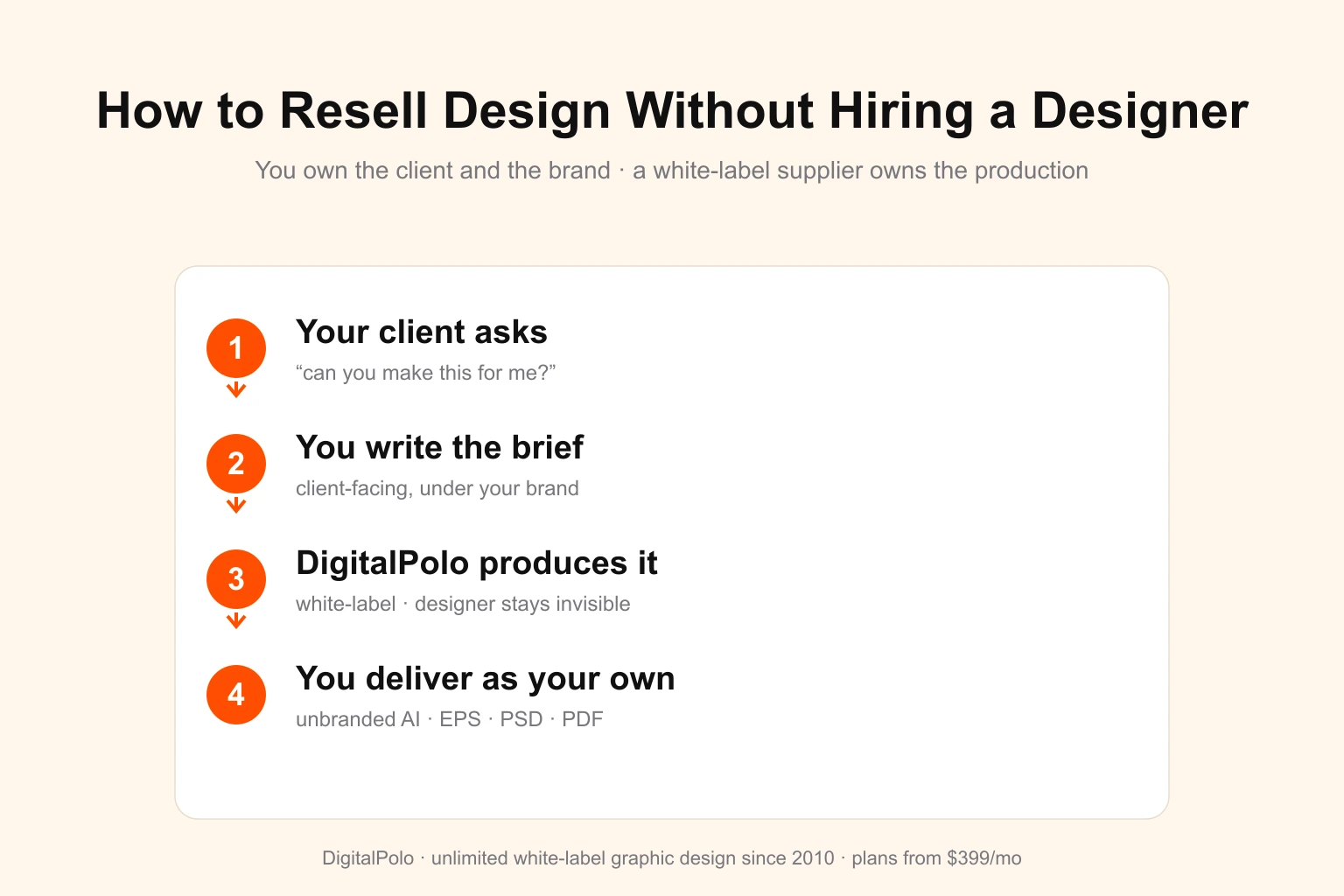
The plans are $399 and $899 a month, which places them at the accessible end of the subscription band described above. Source files are included rather than charged, an NDA is available on request, and the work ships without our name on it — the three things that determine whether a supply arrangement is genuinely white-label or merely discounted. How the model works in practice covers scope, turnaround and what a queue does and does not absorb, and the full pricing comparison across the category puts those figures next to every major alternative including the ones that beat us on specific dimensions.
The honest framing of fit, using this article's own model: a subscription queue is the right instrument when your volume is steady and your mix leans towards Class A and B — which describes most agencies, most print and sign shops, and most manufacturers buying artwork. It is the wrong instrument for an occasional Class D identity project, which wants a scoped engagement instead.
Different verticals hit these classes in different proportions, which is why the buying decision looks different depending on where you sit: marketing agencies tend to run heavy on Class A and B campaign volume, print shops and sign shops on Class A artwork prep with periodic Class C layout work, sticker manufacturers and screen-print shops on high-volume Class A with tight file specs, and freelance designers on overflow capacity across the whole range.
The short version
Nine points, if the rest of this was longer than the decision warrants.
- Three units, not one. Per asset, per hour and per month are not comparable, and most published pricing arguments are two people using different ones.
- Convert everything to landed cost per accepted deliverable. Invoice plus your own hours, divided by what actually shipped.
- Class the work before pricing it. Adaptation, composition, original layout and systems work have different economics, and the class is a property of the brief as much as the asset.
- Multiply any quote by about 1.35. The invoice is roughly 62 to 78 per cent of true cost.
- Throughput beats rate on any recurring arrangement. And most of throughput is your review latency, not their turnaround.
- Brief quality is a pricing lever. A better brief can move an asset down a complexity class, which is worth more than any negotiation.
- Source files are not a line item. They are the difference between owning a relationship and renting one.
- Know where the floor is. Below it you are buying templates, flat files, unverified licensing, or an unattributed generative pass.
- Run the 30-day protocol. Borrowed benchmarks settle arguments; your own numbers settle decisions.
If you want the arithmetic for your own mix, the inputs are your monthly volume by class, your loaded internal hourly cost, and your honest average cycle time. Those three numbers will tell you which model you should be buying on, and they will usually tell you something uncomfortable about where your current cost per asset is actually going.
Digital Polo's plans are $399 and $899 a month, source files included, and the white-label arrangement is built for exactly the buyers this article is written for. If you would rather test than read, the 30-day protocol above works perfectly well with us as one of the three suppliers — and we would rather be chosen on a scored comparison than on a pricing page.