Ask an event organiser what is going to go wrong and they will tell you about the venue, the catering minimum, or the keynote speaker whose flight connects through somewhere unreliable.
Ask them three days after the event what actually went wrong and the answer is usually smaller and more irritating than that. The wayfinding signs were unreadable from more than about four metres, so two hundred people asked where the breakout rooms were. Forty badges had the wrong job titles. The sponsor whose contract closed in week two of the final month is on the holding slides but not on the stage set, because the stage set was fabricated six weeks earlier and there was never a version of the timeline that made that possible.
None of these are failures of design taste. All of them are failures of scheduling, and they happen because the artwork half of an event has deadlines that most event timelines never write down.

The half of the timeline nobody schedules
Search for an event planning timeline and you will find a great deal of genuinely competent material. It will schedule venue selection at twelve months, catering at four, registration at three, AV at two, and rehearsal at one. It will be organised by month, it will have a downloadable template, and it will be broadly right about all of it.
Then, somewhere around the three-month mark, it will contain a single line that says finalise branding and marketing materials, and that line will be the only thing it says about the entire visual production of the event.
That line is doing an enormous amount of work. Underneath it sit somewhere between forty and a hundred and twenty discrete artwork items, produced by at least four different manufacturing processes, with lead times ranging from three days to eight weeks, sourced from between three and eight suppliers, most of them dependent on content that other people owe you.
And unlike almost everything else on an event timeline, these deadlines are not negotiable by agreement. You can call the caterer and change the numbers. You cannot call the fabric printer and ask them to sublimate faster, because the process takes as long as it takes. Design deadlines at an event are set by physics and logistics, not by preference, which makes them the most schedulable part of the whole project and the part that is scheduled least.
This is the countdown for that half — built backwards from doors-open, organised by what each thing is actually made of.
A note on scope and on numbers. This covers the organiser's side: the event's own environment, collateral and screen content. If you are an exhibitor taking a booth inside someone else's show, your deadlines are set by that show's official contractor and are usually earlier — that is a different schedule and it will land before this one, and it is set out in the trade show asset checklist for exhibitors. And every lead time below is a typical working range, not a promise. Substrate availability, seasonal demand and your supplier's own queue move all of them. Confirm each against the supplier who will actually produce the job, at the time you book it.
Everything schedules backwards from a date that cannot move
Most projects have a deadline that can flex under pressure. Events have the opposite property, and it changes how the whole schedule has to be built.
The date is fixed the moment the venue is contracted. Doors open at a stated hour whether or not the signage arrived. That single fact means an event production timeline can only be built one way: start at doors-open, subtract the install window, subtract delivery, subtract production, subtract proofing, and whatever date you land on is when that asset's artwork must be finished.
Run that subtraction for one asset and it looks trivial. Run it for every asset and something useful appears: the deadlines fan out enormously. Screen content is due three days before. Custom scenic is due two months before. These are not two points on a gradient of urgency — they are separate production realities that happen to share an event.
The mistake almost every timeline makes is collapsing that fan into one date. Set it early and you force decisions on assets that could easily have waited, which means the programme goes to print before the schedule is final and you reprint it. Set it late and the fabric, the merchandise and the scenic build become impossible, which means you either pay rush premiums or you do without.
The correct structure is one deadline per asset class, each derived from its own production chain.
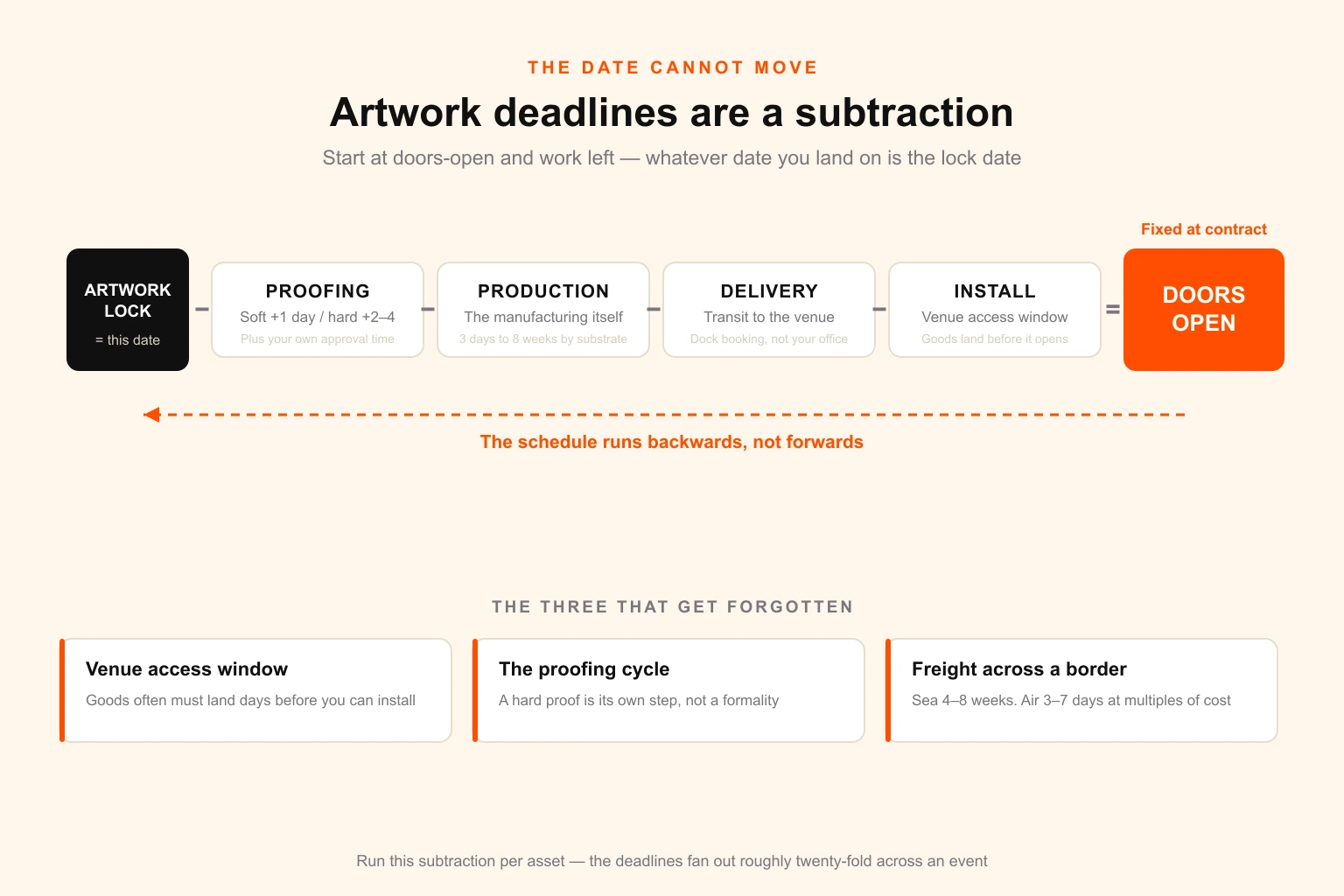
Three components of that subtraction get forgotten with remarkable consistency.
The venue access window. You do not install when you like. Most venues give a build period that starts hours or days before doors, and goods frequently have to arrive before that, into a loading dock with its own booking system. An asset that is delivered on time to your office and not to the venue's storage schedule is late.
The proofing cycle. A soft proof adds a day. A hard proof — a physical sample posted to you — adds two to four, plus whatever you take to approve it. For anything where colour accuracy matters, and for anything being fabricated rather than printed flat, you want the hard proof, and it belongs in the schedule as its own step.
Freight, if anything crosses a border. Sea freight is four to eight weeks and air is three to seven days at multiples of the cost. This is what makes overseas merchandise and lanyards the earliest deadlines on the entire event, well before anything that feels more important.
Lead times by asset class
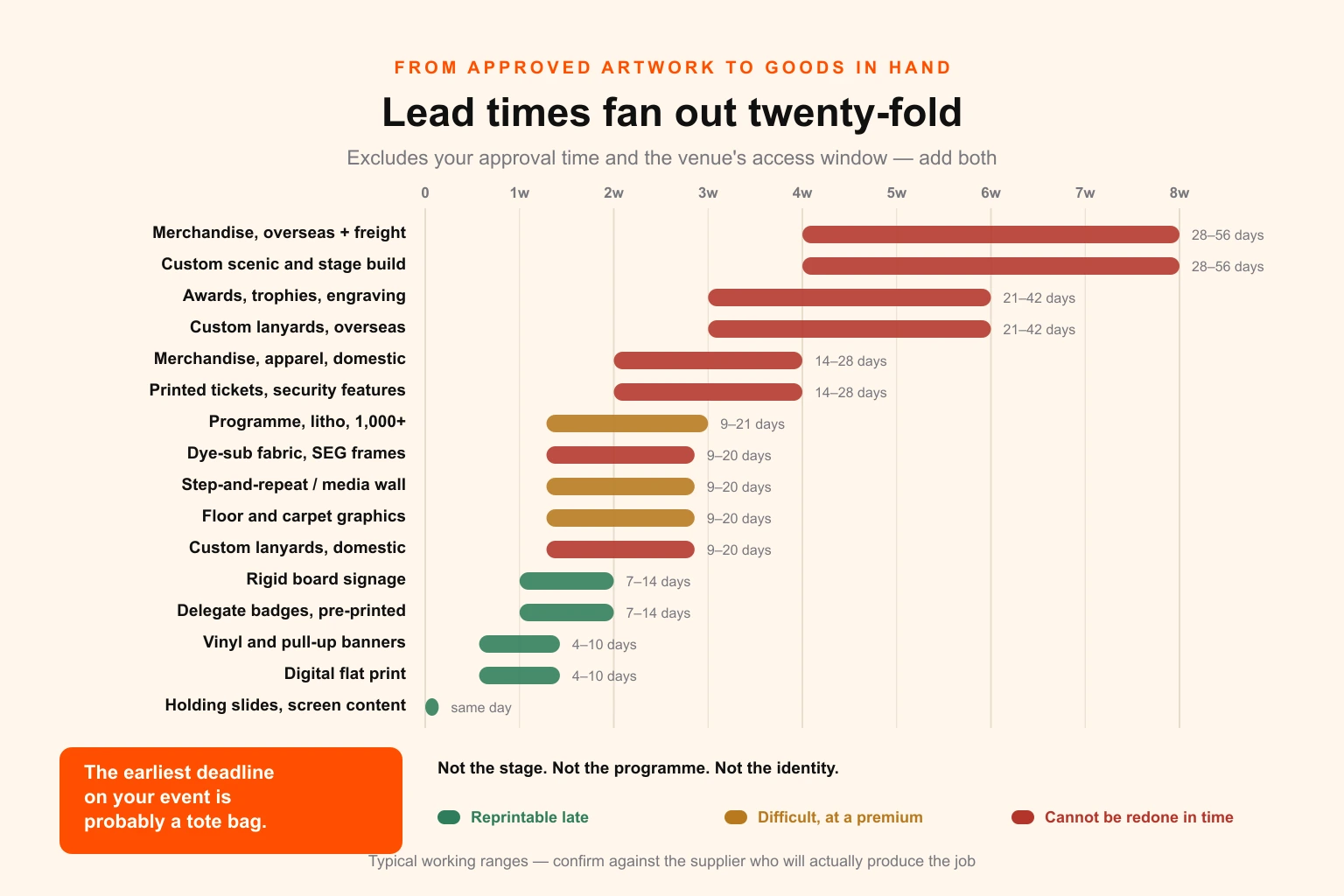
This is the table that the general event timelines are missing. Everything below is from approved, print-ready artwork to goods in hand, excluding your own approval time and excluding venue access.
| Asset | Typical production | Artwork lock (before doors) | Late reprint? |
|---|---|---|---|
| Holding slides, screen content, lower thirds | Same day | 3–5 days (tech check) | Yes — trivially |
| Digital flat print: flyers, inserts, table tents | 3–7 working days | 2 weeks | Yes — 2–5 days |
| Programme, litho, 1,000+ copies | 7–15 working days | 3–4 weeks | Rarely |
| Delegate badges, pre-printed | 5–10 working days | 2–3 weeks | On site only |
| Delegate badges, printed on site | Same day | Template: 1 week | n/a |
| Vinyl banners, pull-up banners | 3–7 working days | 2 weeks | Yes — 2–5 days |
| Rigid board signage: Foamex, Dibond, PVC | 5–10 working days | 2–3 weeks | Yes — at a premium |
| Directional and wayfinding boards | 5–10 working days | 2–3 weeks | Yes — at a premium |
| Floor and carpet graphics | 7–14 working days | 3 weeks | Difficult |
| Dye-sublimated fabric, SEG frames | 7–14 working days | 4–5 weeks | No |
| Step-and-repeat / media wall | 7–14 working days | 4 weeks | Difficult |
| Custom scenic and stage build | 4–8 weeks | 6–8 weeks | No |
| Custom lanyards, domestic | 7–14 working days | 3–4 weeks | No |
| Custom lanyards, overseas | 3–6 weeks + freight | 6–8 weeks | No |
| Merchandise and apparel, domestic | 10–20 working days | 4–6 weeks | No |
| Merchandise and apparel, overseas | 4–8 weeks + freight | 8–10 weeks | No |
| Awards, trophies, engraving | 3–6 weeks | 6 weeks | No |
| Printed tickets with security features | 10–20 working days | 4 weeks | No |
Three readings of that table are worth making explicit, because they are what turn it from a reference into a plan.
The earliest deadline on your event is probably a tote bag. Not the stage, not the programme, not the identity itself — the merchandise, because it is manufactured overseas and shipped by sea. Organisers reliably schedule merchandise late because it feels peripheral, and then either pay for air freight or hand out something they did not choose. If there is swag, it is the first artwork deadline in the project, and it needs the visual identity to exist before anything else does.
The right-hand column is a design instruction, not a warning. It tells you which substrates can absorb a late change and which cannot, and that information is far more useful at design stage than at production stage. More on this below, because it is the single highest-leverage idea in this article.
The spread is roughly twenty-fold. Three days to eight weeks. Any timeline with one artwork deadline is wrong for almost every asset on it.
The three lock dates, and why they are not the same date
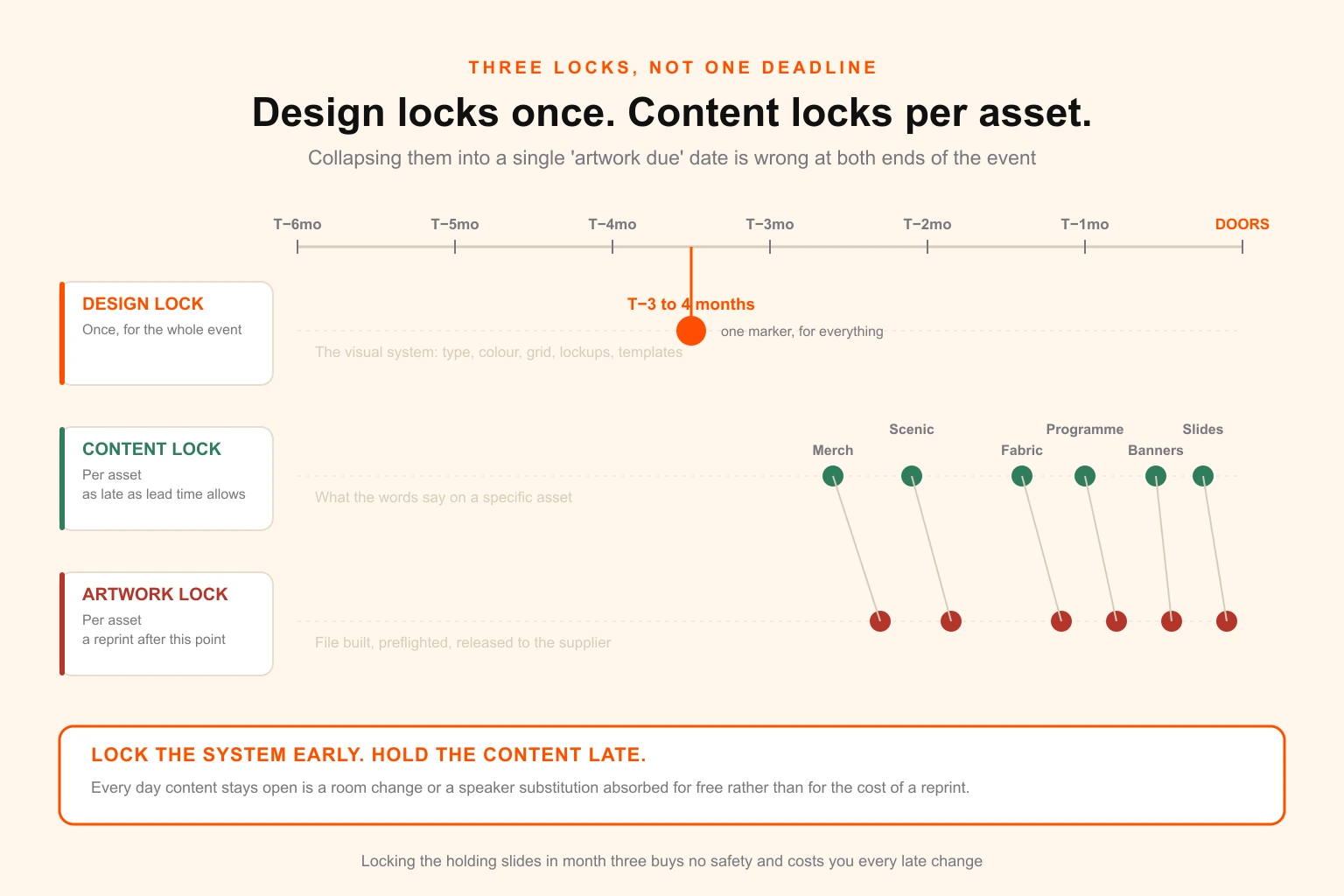
Here is the distinction that resolves most of the confusion about event artwork deadlines. There are three different things that get locked, they lock at different times, and treating them as one event is why organisers experience the process as chaotic.
Design lock fixes the visual system. Typography, colour, the grid, logo lockups, the treatment of photography, the look of every template. It happens once, for the entire event.
Content lock fixes what the words say on a specific asset. Session titles, room names, speaker names and biographies, the sponsor list and its tiers, the floor plan. It happens separately for every asset.
Artwork lock is the moment a specific file is built, preflighted and released to a supplier. After this point, a change costs a reprint. It also happens separately for every asset.
The practical consequences follow directly.
Design lock should land three to four months before doors for a mid-size event, and earlier if there is merchandise or scenic build in scope, because those need approved artwork six to eight weeks out and you cannot make artwork from a system that does not exist yet.
There is a second reason to lock the design early that organisers consistently underestimate: marketing needs the identity long before production does. Ticket sales, the website, the speaker announcement graphics and the paid campaign all draw on the same system, and they start months out. An identity that is still moving in month three has already caused rework across everything published to date. If the event has a defined visual system and a set of rules for applying it, that rework mostly disappears — the campaign and the signage are the same system rendered at different sizes.
Content lock, by contrast, should be as late as each asset's lead time permits, and no later. This is the opposite instinct from most project management, and it is correct here. Every day you hold content open is a day a room change or a speaker substitution can be absorbed for free rather than for the cost of a reprint. The lanyards lock at six weeks because they must. The programme locks at three. The holding slides lock at four days. Locking the slides in month three buys nothing and costs you flexibility.
Artwork lock is a production step, not a decision point, and it needs the same discipline as any other print job — correct bleed, correct colour space, embedded or outlined fonts, adequate resolution at final size. Running each file through a print-ready preflight check before release is what stops a supplier's queries from consuming the days you allowed for production, and it is the reason files built to production specification reach a supplier once rather than three times.
The sponsor problem
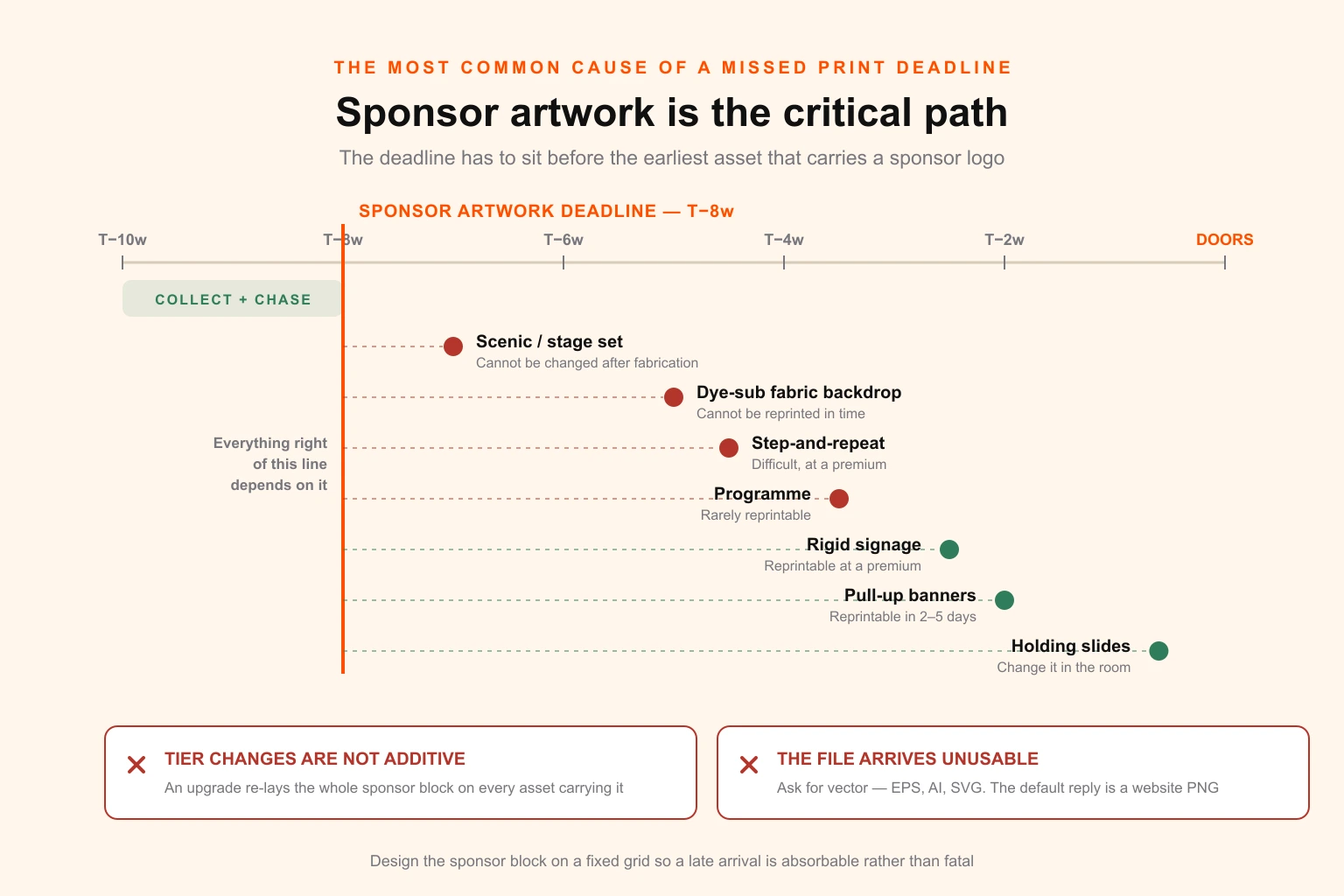
If an event's print deadline is missed, the cause is a sponsor roughly as often as it is everything else combined. This is worth treating as a structural feature of events rather than as a series of unfortunate individual cases, because it recurs at every event, at every scale, in the same shape.
Four things go wrong, and they compound.
Sponsors sell late. The commercial team's incentive is to keep selling until as close to the event as possible, which is correct commercially and catastrophic for production. A tier sold in the final month has to appear on assets that were fabricated two months earlier.
Tier changes are not additive. A sponsor upgrading from silver to gold does not simply move up a list. It changes the size, position and prominence of every logo on every asset carrying the sponsor block, which means re-laying out the whole block on all of them. One late upgrade can invalidate a dozen finished files.
The files that arrive are unusable. You ask a sponsor for a logo. That request travels to a marketing coordinator, who takes what is in a shared drive — commonly a PNG lifted from a website at screen resolution. At badge size it is passable. On a four-metre banner it is a smear. This happens so consistently that the request itself has to change: ask for vector files — EPS, AI or SVG — in full-colour and single-colour versions, with any clearspace rule, and say why. Understanding the difference between vector and raster artwork is what makes this request non-negotiable rather than pedantic.
Sponsors have brand rules of their own. Minimum sizes, clearspace, approved colourways, and sometimes an approval step on the layout you have produced. Discovering an approval requirement four days before a print deadline is a genuinely bad afternoon.
The fix is partly administrative and partly design, and the design half matters more.
Administratively: set the sponsor artwork deadline before the earliest asset that carries sponsor logos, which usually means six to eight weeks out, not three. Collect through a form that states format requirements rather than an email thread. Put the deadline and its consequence in the sponsorship agreement — artwork received after this date appears on digital assets only is a clause that works, because it is enforceable without anyone having to be difficult about it.
By design: build the sponsor block so a late arrival is absorbable. A fixed grid with defined slots per tier, sized so an additional logo fits without re-laying anything out. A version of every sponsor-bearing asset that is digital rather than printed. And, above all, sponsor recognition kept off the substrates that cannot be reprinted — which brings us to the idea that does the most work in this whole article.
Put volatile content on reversible substrates
This is the principle worth taking away even if nothing else here survives contact with your event.
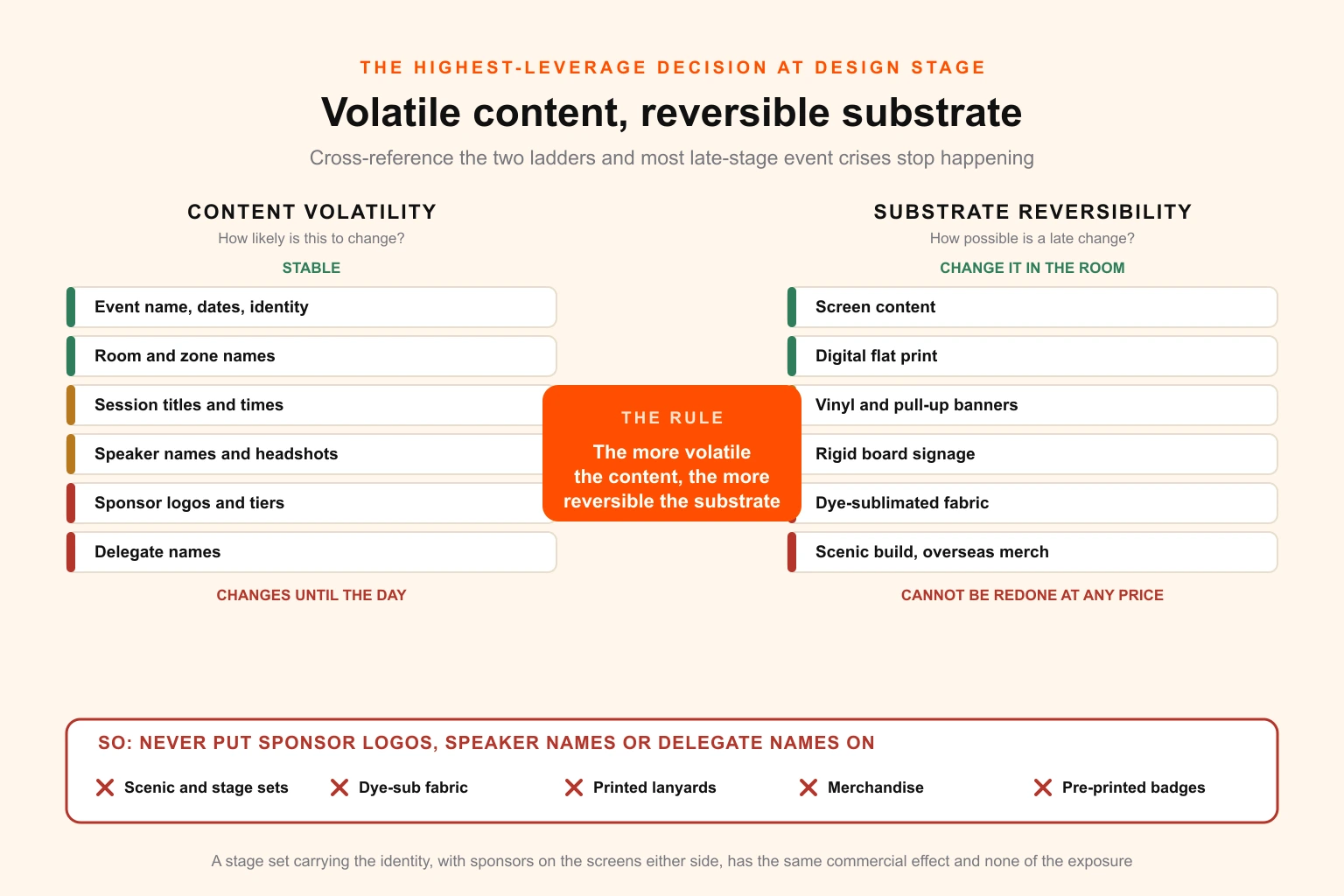
Every asset at an event sits somewhere on a ladder of irreversibility — how expensive and how possible it is to change after production. Screen content sits at the top: change it in the room, at no cost, minutes before. Digitally printed flat sheets sit near the top: a few days and a few hundred. Rigid board sits in the middle. Dye-sublimated fabric sits near the bottom. Custom fabricated scenic and overseas merchandise sit at the very bottom: not changeable at all, at any price, once the window closes.
Separately, every piece of content at an event sits somewhere on a ladder of volatility — how likely it is to change. The event name and dates are stable. The visual identity is stable. Room names are fairly stable. Session titles are less so. Speaker names change up to the day. Sponsor tiers change until the commercial team stops selling. Individual delegate names are not knowable until registration closes, and change after it.
Cross-reference those two ladders at design stage and most late-stage event crises simply stop happening.
The rule is one line: the more volatile the content, the more reversible the substrate must be.
| Content | Volatility | Belongs on | Not on |
|---|---|---|---|
| Event name, dates, identity | Stable | Anything, including scenic | — |
| Room and zone names | Fairly stable | Rigid board, fabric | — |
| Session titles and times | Volatile | Screens, digital print | Fabric, scenic |
| Speaker names and headshots | Volatile | Screens, digital print | Fabric, scenic, merch |
| Sponsor logos and tiers | Very volatile | Screens, pull-ups, digital print | Scenic, fabric, lanyards, merch |
| Delegate names | Only known late | On-site printed badges | Anything pre-printed |
Read down the "not on" column and you have a set of design decisions that most events make by accident and regret.
The stage set carrying sponsor logos is the classic and most expensive example. It looks generous at the design stage — the sponsors are prominent, the commercial team is pleased. Then a sponsor signs in the final month, and the set was fabricated six weeks ago. Now you are choosing between an awkward conversation, an inelegant addition, or a rebuild that costs more than the sponsorship was worth. A stage set that carries the event identity, with sponsors on the screen either side of it, has the same commercial effect and none of the exposure. The screen is updated in ninety seconds on the morning of the event.
The same logic applies down the whole list. Printed lanyards carrying a sponsor name are a bet that the sponsorship will not change in the eight weeks between artwork and doors. Pre-printed name badges are a bet that registration is final, which it never is — badges printed on demand at the desk solve the misspelling, the late registration and the substitution in one decision, and they are worth the equipment hire on their own.
Wayfinding is worth calling out separately, because it fails in a different way. Directional signage is not a branding surface, it is a functional one, and the most common failure is that the type is simply too small to read from where people are standing when they need it. The relationship between letter height and viewing distance is fixed and calculable rather than a matter of taste — running the numbers with a letter height and viewing distance calculator before the boards are printed takes two minutes and is the difference between signage that works and signage that generates two hundred questions at the registration desk. The underlying rule of thumb and its limits are worth understanding, because venues break the assumptions behind it regularly — sightlines are obstructed, corridors are crowded, and lighting is often worse than the plan suggested.
The countdown
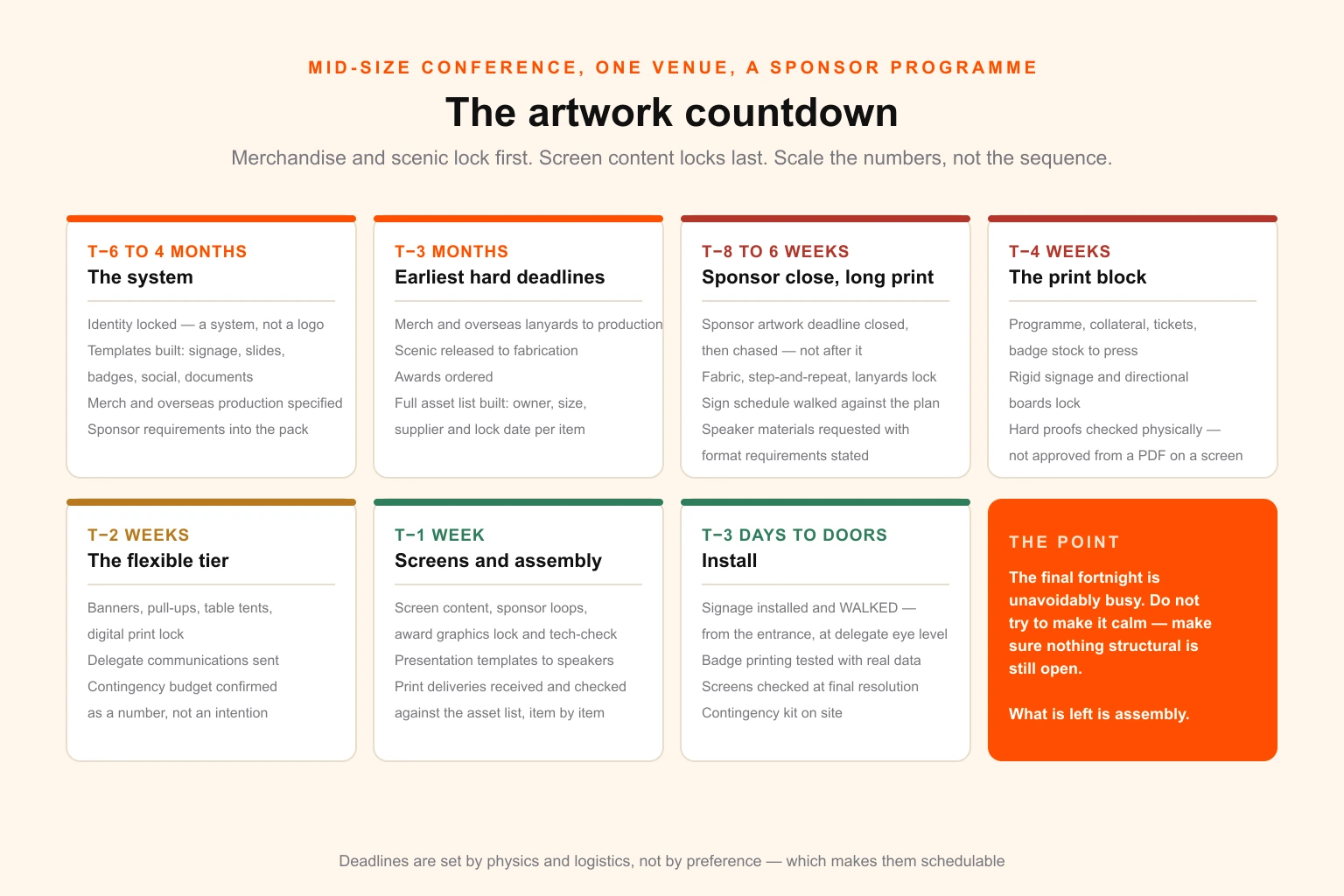
With the principles in place, the schedule for a mid-size conference — several hundred to a couple of thousand delegates, one venue, a sponsor programme — looks like this. Scale the numbers up for a multi-day festival or a large trade event; the sequence does not change.
T-minus 6 to 4 months — the system
The visual identity is developed and locked. Not a logo: a system — typography, palette with print and screen references, grid, photographic treatment, and the rules that make an unfamiliar designer produce something consistent with it. That is an identity build rather than a logo project, and the distinction matters here more than in most contexts, because an event applies its identity across more substrates in less time than almost anything else. If the event is an edition of a recurring series, this is a refresh against an existing system rather than a build.
Templates are built at the same time, and this is where the leverage is. A signage template, a slide template, a badge template, a social template, a document template. Get this right and the ninety artwork items later in the project are assembly work. Get it wrong and they are ninety design jobs arriving in the last six weeks.
Merchandise and any overseas production are specified and quoted now, because their artwork deadline is the earliest in the project.
Sponsor artwork requirements are written into the sponsorship pack before it goes out, not requested afterwards.
T-minus 3 months — the earliest hard deadlines
Merchandise and overseas lanyard artwork lock and go to production. Custom scenic and stage design is approved and released to fabrication. Awards and trophies are ordered.
The marketing campaign is running hard on the templates: speaker announcements, ticket-sale pushes, the website. This is a high-volume, repetitive design load — the same information rendered across a dozen formats — and it is the phase where one campaign concept adapted across every channel format either works as a system or consumes an unreasonable amount of design time.
The full asset list is built here: every sign, every printed item, every screen, every digital format, with its owner, its dimensions, its supplier, its lock date. This document is the spine of the whole production and it should exist before anyone starts designing individual pieces.
T-minus 8 to 6 weeks — sponsor close and long print
The sponsor artwork deadline lands, ahead of every sponsor-bearing asset. Chase from the deadline, not after it.
Fabric graphics, step-and-repeat and media walls lock. Domestic lanyards lock. Large signage quantities are confirmed with the venue's plan in hand — this is when the sign schedule gets walked against a floor plan and half a dozen locations nobody had considered appear.
Speaker materials are requested here, with the format requirements stated. Headshots at print resolution, biographies to a word count, presentation files in the format the AV supplier runs. Requested as a form with a deadline, this takes a fortnight. Requested as an email thread, it takes until the day before.
T-minus 4 weeks — the print block
Programme, printed collateral, tickets and pre-printed badge stock lock and go to press. Rigid signage, directional boards and floor graphics lock. This is the heaviest artwork week in the project and it is entirely predictable, which means it can be resourced.
Hard proofs are checked here, physically, against the brand reference — not approved from a PDF on a screen. If the event's colour appears on fabric, board, paper and a screen simultaneously, this is the week the mismatches are visible and still fixable. The mechanics of why the same colour renders differently across processes are worth understanding before the proofs arrive, and a specified Pantone with agreed print and screen equivalents gives every supplier the same target instead of their own interpretation.
T-minus 2 weeks — the flexible tier
Banners, pull-ups, table tents, flyers and anything digitally printed lock. Content is now final enough for these and they are still reprintable if something moves.
Delegate-facing communications go out — joining instructions, the app content, the final agenda. Email templates that hold together across clients matter more here than they seem to; a broken layout in a joining instruction generates support volume on the morning of the event.
The contingency budget is confirmed as a real number rather than an intention. Something will change.
T-minus 1 week — screens and assembly
Holding slides, sponsor loops, session graphics, lower thirds and award graphics lock, and go to the AV supplier for a technical check on the actual system in the actual room. Presentation templates go to speakers with enough time for a rehearsal — decks built on a proper template is what stops the stage looking like fourteen different events.
Print deliveries are received and checked against the asset list, item by item. Errors found here are recoverable. Errors found on site are not.
The contingency kit is packed.
T-minus 3 days to doors — install
Venue access opens. Signage is installed and then walked — not checked against a plan, walked, from the entrance, at delegate eye level, following the route a delegate would follow. Every event has at least one sign that is technically correct and functionally invisible, and this walk is the only thing that finds it.
Badges are printed, or the on-site printing is tested with real data. Screens are checked in the room, at the resolution and aspect ratio they will actually run.
What most of the volume actually is
An organiser looking at a hundred-item asset list reasonably concludes that they have a hundred design jobs. They almost never do.
Sort a typical mid-size conference's asset list by what each item actually requires and the distribution is consistently lopsided. A small number of genuinely bespoke pieces — the identity itself, the stage design, the programme cover, perhaps a hero campaign visual. Then a large majority that are the same few templates populated with different content: forty directional signs that are one sign design with different words, thirty slides that are one slide template, twelve social formats that are one campaign adapted, a hundred and forty badges that are one badge with variable data.
This matters because the two categories need completely different resourcing. Bespoke work needs design judgement, early, once. Template population needs throughput, late, in volume — and it is the part that overwhelms events, because it all arrives in the final six weeks.
The organiser who treats the whole hundred as design work either over-commissions early or panics late. The one who separates them front-loads the design decisions into months six through four, and then needs capacity rather than creativity for the run-in. That is a scheduling insight before it is a procurement one, and a written brief that distinguishes the two is usually what makes it concrete.
Two related things worth flagging while the merchandise and collateral are being specified. Any stock photography or illustration going onto items you sell or give away carries licensing rules that differ from editorial use, and merchandise is precisely the category where a standard licence usually does not cover you. And if the event uses a typeface the design team licensed rather than the client, check that the licence covers the printer and any third-party supplier who will process the file — font licensing across a production chain is a routine and entirely avoidable source of problems.
What it costs
Costs vary with scale, ambition and how much already exists, but the shape is stable enough to budget against.
| Work | Typical design hours |
|---|---|
| Event identity and system | 25–60 |
| Template set: signage, slides, badges, social, documents | 30–60 |
| Signage suite population | 15–40 |
| Print collateral: programme, inserts, tickets | 20–50 |
| Campaign and social adaptation | 20–60 |
| Screen and stage graphics | 10–30 |
| Sponsor integration across assets | 8–25 |
A mid-size conference built from scratch lands somewhere between eighty and two hundred and fifty design hours in total. Those hours convert to money very differently depending on how the work is resourced, and what design costs by engagement model covers the spread between agency, freelance and retained arrangements.
Two observations about that table are more useful than the numbers themselves.
First, the system and template rows are close to half the total, and they are the rows that do not recur. A second edition of the same event should cost dramatically less than the first. If it does not, the first edition was not built as a system, and the correct response is to fix that at the second edition rather than to keep paying the difference annually.
Second, the costs that damage event budgets are not on this table at all. They are the reprints, the rush premiums and the air freight — and every one of those is a scheduling failure rather than a design cost. An organiser who holds a modest contingency and a schedule that separates volatile content from irreversible substrates spends materially less than one who runs a tighter design budget and absorbs three rush jobs.
The contingency kit
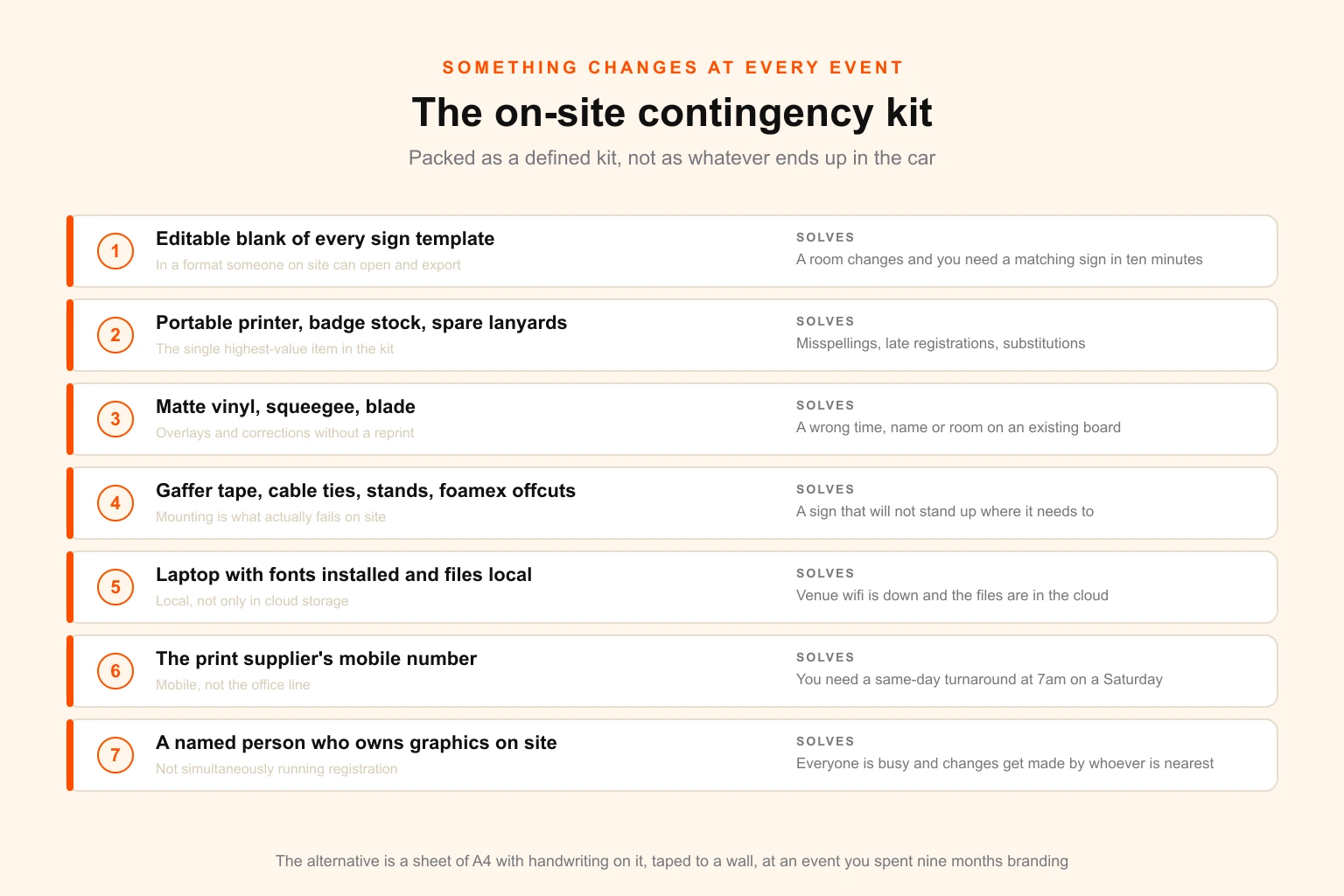
Something changes. It changes at every event, and the events that handle it well are the ones that decided in advance what they would do.
Pack the following, and pack it as a defined kit rather than as whatever ends up in the car:
- An editable blank of every sign template, in a format someone on site can actually open and export
- A portable printer, blank badge stock and spare lanyards — the single highest-value item in the kit
- A roll of matte vinyl, a squeegee and a blade for overlays and corrections on existing boards
- Gaffer tape, cable ties, sign stands and blank foamex offcuts
- A laptop with the fonts installed and the working files local, not only in cloud storage that depends on venue wifi
- The print supplier's mobile number, not their office line, and confirmation of what they can turn around same-day
- A named person whose job on site is graphics, and who is not simultaneously running registration
The kit exists because the alternative is a sheet of A4 with handwriting on it, taped to a wall, at an event you spent nine months branding. Every organiser has seen this. Most have caused it.
Mistakes worth naming
One artwork deadline for the whole event. The single most common structural error, and the source of most of the others. Deadlines fan out twenty-fold across asset classes.
Merchandise scheduled last. It feels peripheral and it has the earliest deadline in the project, because it is manufactured overseas and shipped by sea.
Sponsor logos on fabricated surfaces. The most expensive individually correctable mistake on this list. Sponsors are the most volatile content at an event and scenic is the least reversible substrate.
Pre-printed delegate badges. Registration is never final. On-demand printing at the desk solves misspellings, late registrations and substitutions in one decision.
Wayfinding designed at desk scale. Type that reads beautifully at A4 on a monitor is illegible at eight metres in a crowded corridor. The calculation is quick and the failure is expensive in delegate experience.
Approving colour from a screen. Fabric, rigid board and paper will not match unless someone is managing to a physical reference, and they will be standing next to each other in the same room.
No named owner for graphics on site. Everyone is busy on the day. Without a named person, changes get made by whoever is nearest, in whatever font is on their laptop.
Sponsor logos requested without a format specified. You will receive a website PNG. It will be unusable at signage size and you will find out late.
No contingency budget. Not a risk register entry — a number. Something changes at every event, and pretending otherwise means the change gets funded by an argument instead.
The countdown checklist
- T-6 to 4 months — Identity and system locked. Templates built: signage, slides, badges, social, documents. Merchandise and overseas production specified. Sponsor artwork requirements written into the sponsorship pack.
- T-3 months — Merchandise and overseas lanyards to production. Scenic released to fabrication. Awards ordered. Full asset list built with owner, dimensions, supplier and lock date per item. Campaign running on templates.
- T-8 to 6 weeks — Sponsor artwork deadline closed and chased. Fabric, step-and-repeat and domestic lanyards locked. Sign schedule walked against the venue floor plan. Speaker materials requested with format requirements.
- T-4 weeks — Programme, collateral, tickets, badge stock to press. Rigid signage and directional boards locked. Hard proofs checked physically against the brand reference.
- T-2 weeks — Banners, pull-ups, table tents and digital print locked. Delegate communications sent. Contingency budget confirmed as a number.
- T-1 week — Screen content, sponsor loops and award graphics locked and tech-checked in the room. Presentation templates with speakers. Print deliveries received and checked against the asset list. Contingency kit packed.
- T-3 days to doors — Signage installed and walked at delegate eye level from the entrance. Badge printing tested with real data. Screens checked at final resolution and aspect ratio.
Where this usually lands
The organisers who find this part of an event genuinely difficult are not disorganised. They are running a project where the majority of the artwork volume arrives in the final six weeks, arrives as high-volume template population rather than design, and arrives at exactly the moment their attention is required by the venue, the speakers and the delegates.
That is a capacity problem with a scheduling problem sitting on top of it, and both halves are solvable in advance. Lock the design system early enough that the campaign and the production draw on the same thing. Derive a content lock per asset from real lead times instead of setting one date. Close sponsor artwork before the earliest asset that carries it. Keep volatile content off irreversible substrates. Template the eighty per cent that repeats. Hold a real contingency number.
The resourcing shape that fits this is unusual and worth naming: a concentrated design effort early to build the system, then sustained throughput through the run-in, then almost nothing until the next edition. It is a poor fit for a hire and an awkward one for a project fee, which is why it is the shape a design partnership is built around — defined monthly capacity that expands into the run-in and costs nothing in the quiet months. Event and experiential agencies producing multiple events a year tend to run it as white-label capacity behind their own brand for the same reason, and organisers producing one flagship event a year tend to want the system built once and populated annually.
Either way, the useful move is the same and it is available today: write the asset list, put a lead time against every line, and subtract backwards from the door. Most of what goes wrong at events is already visible in that document.
If you want a second pair of eyes on it — the asset list checked against real production lead times before anything is committed — tell us what the event involves and we will scope it against the actual list.