A brand gets a quote for a packaging redesign. Eleven thousand dollars for a range of twelve, from a good studio, with a proper strategy phase. The number is high but defensible, the work is genuinely needed, and it is approved.
Four months later the finance director totals what the exercise actually cost and gets something north of sixty thousand. Nothing went wrong. Nobody overcharged. The design invoice came in at exactly eleven thousand dollars. It was simply the smallest of three bills, and the only one anybody had asked about.
The second bill was tooling: new photopolymer plates for twelve SKUs at six colours each, prepress for every one of them, and a press proof for every one of them, none of which the design studio charges for because none of it is design. The third bill was changeover: eleven weeks of pre-printed film sitting at the converter for the old artwork, which became scrap the day the new artwork was approved for all twelve SKUs simultaneously.
This is the ordinary shape of a packaging project, and it is almost entirely absent from the material you find when you search for what one costs. Every guide on the first page of results answers the same question — what does a designer or agency charge — with the same answer, a range somewhere between a few thousand and fifty thousand dollars. All of those ranges are broadly accurate. All of them describe one layer of a three-layer cost.
This article is the other two layers, plus the two decisions that determine whether you pay them at all: whether what you are doing is a refresh or a rebrand, and whether you schedule it around your print runs or against a calendar.
A note on every number below. They are planning ranges for the United States, offered so you can build a budget before you have quotes, and they move substantially with substrate, format, print process, run length, region and supplier. Confirm each one with your actual converter and your actual printer. The arithmetic is the point; the inputs are yours.
Refresh and rebrand are separated by one thing, and it is not ambition
Most people treat refresh and rebrand as points on a scale of how much changes. A refresh is a little, a rebrand is a lot, and somewhere in the middle is a redesign. This is the intuitive framing and it is operationally useless, because it gives you no rule and therefore no way to decide anything.
The useful line is different, and it is binary.
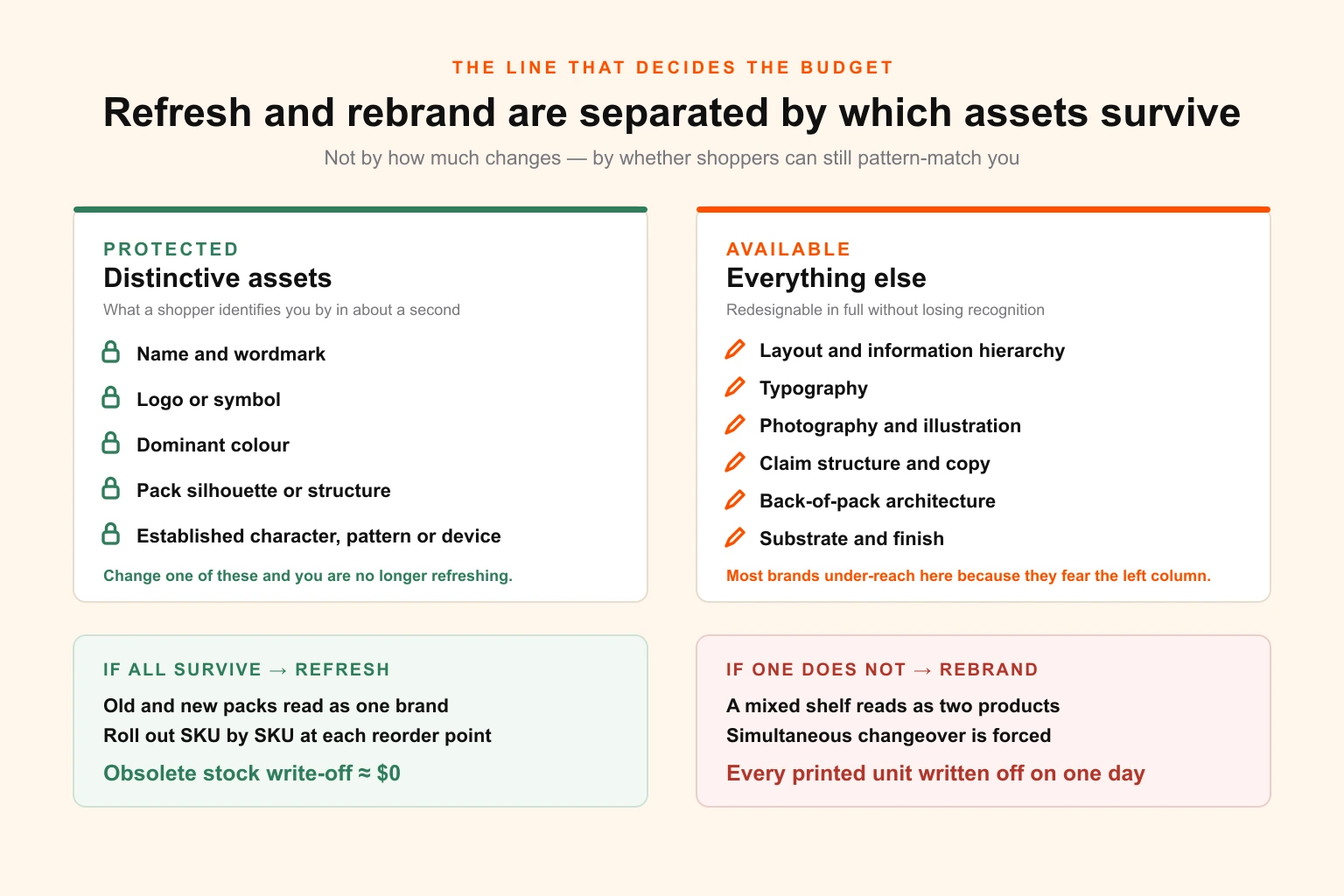
A refresh keeps every distinctive asset. A rebrand puts at least one on the table.
A distinctive asset is anything a shopper uses to identify you without reading — the name, the logo, the dominant colour, the pack silhouette, and any character, pattern, device or typographic signature that has been in market long enough to mean you specifically. These are the things that do the work in the second or so of attention a pack gets on a shelf, and they are a small set. Everything else on a pack — layout, hierarchy, type choices, photography or illustration, claim structure, back-of-pack architecture, substrate, finish, even the structural format within limits — is not a distinctive asset and is available to change.
That reframe has three consequences worth stating plainly.
You can change far more than you think. A refresh that leaves the name, the logo and the dominant colour alone can rebuild the entire information hierarchy, replace all imagery, change the typeface, change the finish and change the substrate, and still be recognised instantly by an existing customer. Most brands under-reach on refreshes because they confuse change with risk.
You can also change one small thing and destroy recognition. Tropicana's 2009 redesign in the United States is the case everybody cites, and it is worth being precise about what actually happened. The pack replaced the orange-with-a-straw and the established typographic treatment with a generic glass of juice. Sales reportedly dropped around twenty percent within roughly two months, the company reverted, and the episode is widely reported to have cost tens of millions of dollars. The design was not bad. It removed the two things shoppers were matching on.
And the distinction decides your rollout. This is the part that has a dollar figure attached, and it is the reason this article is organised around the refresh-or-rebrand question rather than treating it as a semantic preamble. If your distinctive assets survive, old and new packs sitting side by side on a shelf still read as one brand, which means you can change SKUs one at a time as their printed stock runs out. If your distinctive assets do not survive, a mixed shelf reads as two unrelated products, you are forced into a simultaneous changeover, and every unit of printed packaging already made becomes scrap on the same day.
Phasing versus simultaneous changeover is frequently the largest single number in the whole project. It is decided by a strategic choice made months earlier, usually without anyone realising the choice had a price.
If what you are contemplating does cross the line into a rebrand, the cost model in this article understates your position substantially, and the rebranding guide and the rebrand rollout inventory are the documents you want instead — the second in particular, because packaging is only one of six surfaces carrying your identity and it is rarely the most expensive one to change.
The five reasons that justify a refresh, and the four that do not
Before any arithmetic, the qualifying question: is packaging actually the problem?
It is worth being sceptical here, because packaging is unusually vulnerable to being blamed. It is the most visible thing a brand owns, everybody in the business has an opinion about it, and it is the one asset a new marketing director can point to and change. Declining sales have many causes and packaging is only one of them.
The diagnostic is a single question. Are shoppers who are standing in front of your pack failing to buy it, or are fewer shoppers getting in front of it at all? If it is the second — distribution loss, delisting, price position, a competitor's promotional spend, category contraction — a refresh will not fix it and a brand audit is a much cheaper first move.
If it is genuinely the first, these are the five reasons that hold up.
The pack is failing a nameable job. It is not found at distance. It does not communicate the claim that drives purchase. It does not justify its price against what sits beside it. It does not survive as a thumbnail, which now matters more than shelf presence for a growing share of categories. A refresh briefed against a specific failure has something to be measured against.
The product or the range has changed underneath it. A range that grew from three SKUs to eighteen usually has no architecture at all, just eighteen decisions made at different times. This is the single most common legitimate trigger, and the fix is a system rather than a set of packs.
A channel has changed. Entering retail from direct-to-consumer, or the reverse, changes the requirements substantially — shelf-ready secondary packaging, different legibility distances, different regulatory prominence, different photography needs. So does entering a market with different labelling rules.
A claim or regulation has changed. If mandatory information is changing anyway, the artwork is opening and the tooling is being remade regardless. This is the cheapest possible moment to refresh, because the incremental cost of the redesign is close to design fee alone.
The category has moved and you have not. If every competitor has converged on a look and you are the only pack that still signals a previous decade, the pack has become a liability rather than a differentiator. Be careful with this one: it is also the reason most often given for refreshes that fail, because "looks dated" to a marketing team and "looks dated" to a shopper are frequently different things.
The four that do not hold up: a new marketing leader wanting a visible first act; internal boredom, which is real, understandable and not a business case, since your team sees the pack a thousand times more often than any customer does; a competitor redesigning, which is information about them and not about you; and an agency pitch that arrived at a moment when there was budget. None of these are disqualifying on their own, but none of them should be the argument.
The three layers
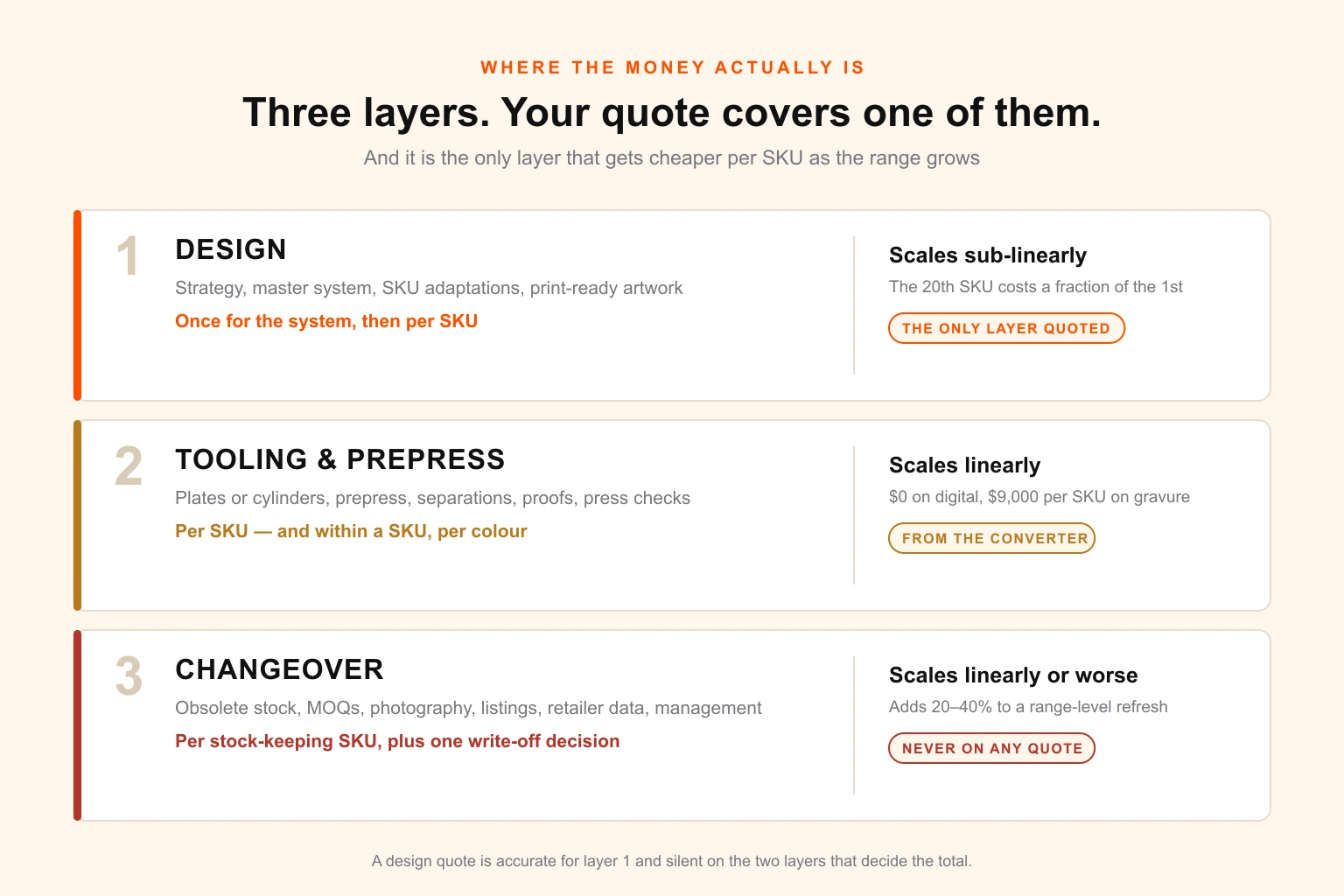
Here is the structure the rest of this article uses. Every cost of a packaging change falls into one of three layers, and they behave completely differently as your range grows.
Layer 1 — Design. Creating the artwork. Strategy, concepts, the master design, adaptation across SKUs, and print-ready file preparation. Charged once for the system and then per SKU for adaptations. This is the layer every quote covers.
Layer 2 — Tooling and prepress. Turning artwork into something a press can print. Plates or cylinders, prepress and repro, colour separation and matching, proofs and press checks. Charged per SKU, and within a SKU frequently per colour. This is the layer that is invisible until the converter's invoice arrives.
Layer 3 — Changeover. Everything that happens because the old pack existed. Obsolete printed stock, minimum order quantities on the new run, product photography, marketplace listings, retailer data, sales collateral, and the internal project management of getting forty artworks approved. Charged in ways that do not look like packaging costs at all, which is why they are routinely omitted.
Layer 1 scales sub-linearly with SKU count — the twentieth SKU adaptation costs a fraction of the first. Layers 2 and 3 scale linearly or worse. That is the entire reason a refresh that is trivially affordable on one SKU can be a six-figure decision on forty, and why the cost guides quoting design fees are least useful precisely for the brands with the most at stake.
Layer 1: design, and what the published ranges hide
The published ranges are roughly right and I will not argue with them. A single pack from a competent freelancer sits somewhere around $500 to $2,000. A studio engagement with a strategy phase for a small range sits somewhere between $8,000 and $35,000. Large agency work on a regulated or complex category runs well past that.
What the ranges hide is that these numbers describe three genuinely different products, and buying the wrong one is more expensive than buying the expensive one.
Execution. You have a defined look and you need artwork produced to it. Roughly $300 to $1,200 per SKU. Appropriate when the system already exists and you are adapting, extending or correcting.
A design system. You need the master decisions made once — the shelf block, the hierarchy, the colour architecture that distinguishes variants, the rules for where a new flavour or format slots in — and then applied. Roughly $4,000 to $15,000 for the system, then $150 to $600 per SKU to apply it. This is what most growing ranges actually need and rarely what they buy.
Strategy plus design. The positioning itself is in question, research is involved, and the pack is one output of a larger piece of work. $20,000 upward.
The failure mode is buying per-pack execution repeatedly for a range that needed a system once. Twelve packs at $900 each is $10,800 and produces twelve unrelated packs; a $9,000 system plus twelve $350 adaptations is $13,200 and produces a range that also tells you what the thirteenth pack looks like. The second is more expensive on the first project and much cheaper across the third, fourth and fifth.
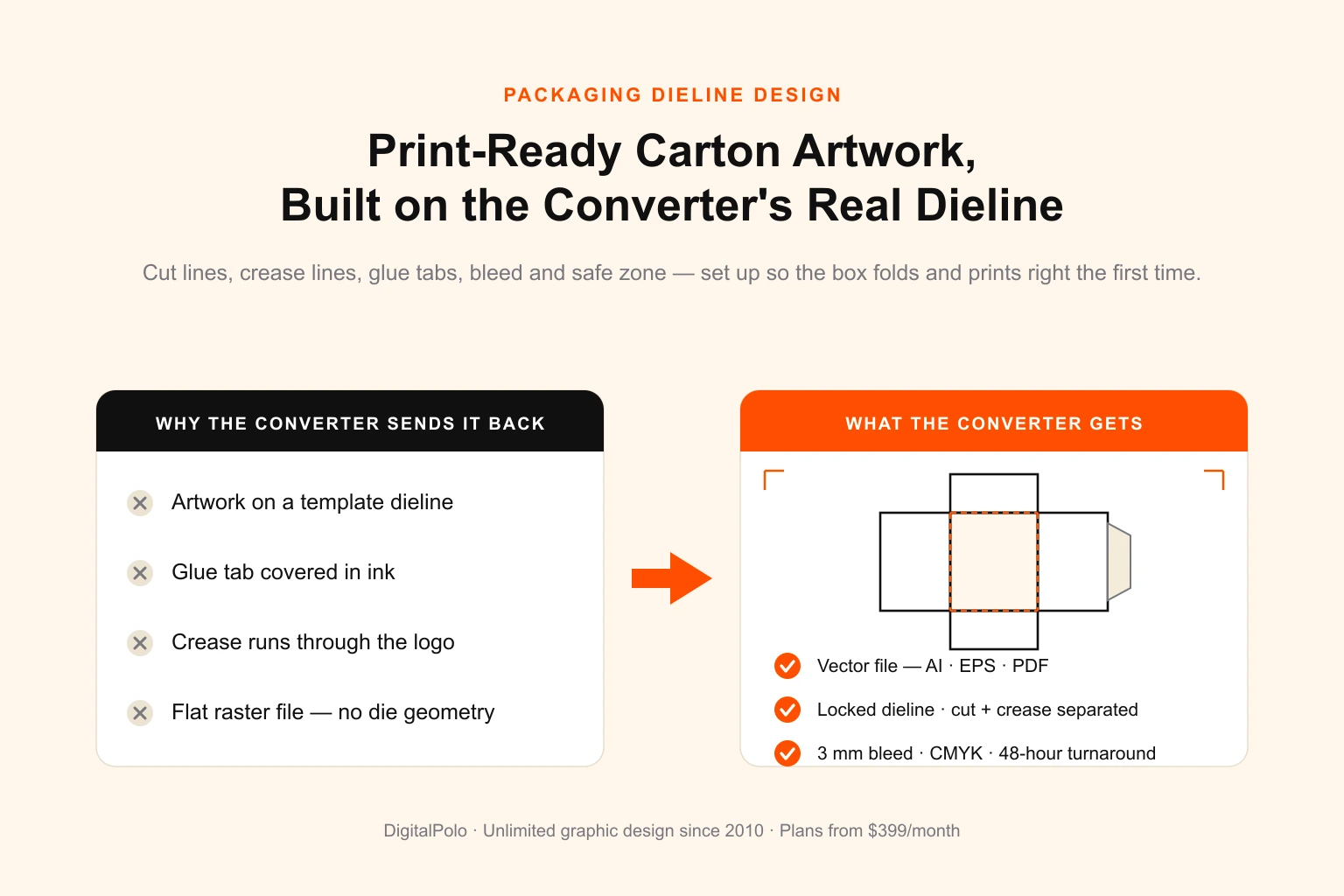
The related trap is buying design without buying print-ready file preparation, discovering at the converter that the files need rebuilding, and paying for that separately at repro rates. Whatever you commission, make sure the deliverable is production artwork on the correct dieline in the correct colour space with the correct separations — the packaging dieline guide covers exactly what that file has to contain, and the print-ready file checklist is the shorter version to hand a designer. For anything with a label rather than a printed carton, label design specifications is the equivalent.
Layer 2: tooling, and why the print process decides your budget
This is where the real variance lives, and it has almost nothing to do with design.
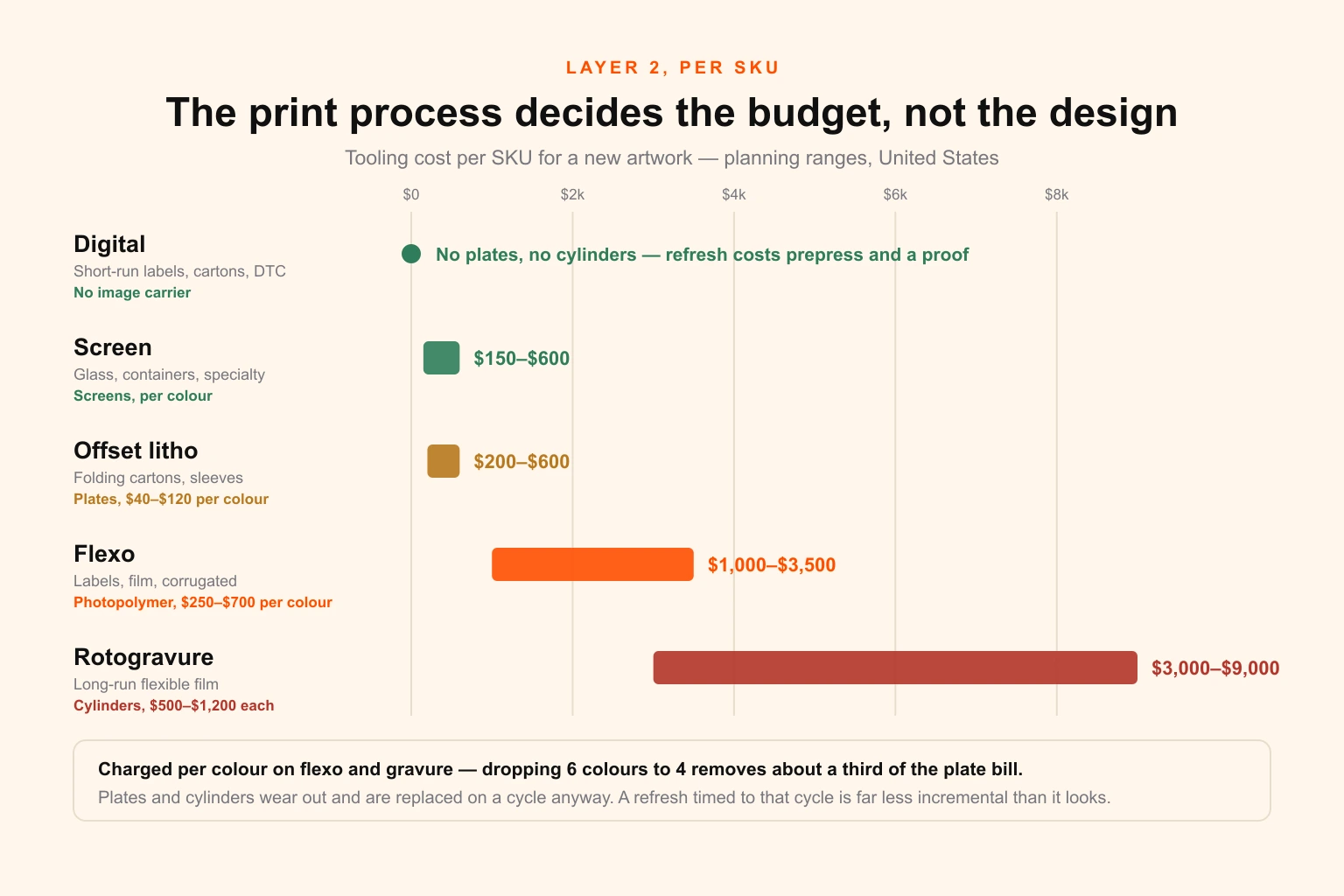
Every printing process except digital needs a physical image carrier — a plate or a cylinder — made for each colour of each design. Changing the artwork means making new ones. The cost of those carriers varies by an order of magnitude across processes, which means two brands with identical range sizes and identical design briefs can face tooling bills that differ by a factor of twenty.
Planning ranges, per SKU:
| Process | Typical use | Image carrier | Tooling per SKU | Prepress | Proofing |
|---|---|---|---|---|---|
| Digital (electrophotographic / inkjet) | Short-run labels, cartons, DTC | None | $0 | $75–$250 | $50–$150 |
| Offset litho | Folding cartons, sleeves, leaflets | Plates, ~$40–$120 per colour | $200–$600 | $150–$400 | $100–$400 |
| Flexo | Labels, flexible film, corrugated | Photopolymer plates, ~$250–$700 per colour | $1,000–$3,500 | $200–$500 | $300–$900 |
| Rotogravure | Long-run flexible film | Engraved cylinders, ~$500–$1,200 each | $3,000–$9,000 | $300–$700 | $500–$1,500 |
| Screen | Glass, containers, specialty | Screens per colour | $150–$600 | $100–$300 | $100–$400 |
Four things follow from that table, and they are the practical core of this article.
Digital-printed brands can refresh almost freely. No image carrier means no tooling, which collapses Layer 2 to prepress and a proof. If your labels come off a digital press in lots of a few thousand, a refresh costs design plus a few hundred dollars, and the decision genuinely does not need a business case. This is a structural advantage that direct-to-consumer brands hold over supermarket brands and rarely exploit.
Gravure effectively locks you in. Engraved cylinders at four figures each, per colour, per SKU, mean a six-SKU gravure range carries thirty to fifty thousand dollars of tooling before design is counted. Gravure is chosen for very long runs where the per-unit economics are excellent, and the trade is exactly this: the packaging is cheap to make and expensive to change. Know which of your SKUs are on gravure before you scope anything, because they will not be evenly distributed — they will be your highest-volume lines, which is to say the ones that matter most.
Colour count is a budget lever, not just an aesthetic one. On flexo and gravure, tooling is charged per colour. Dropping from six colours to four on a twelve-SKU flexo range removes roughly a third of the plate cost, which on the numbers above is several thousand dollars. This is a real design constraint worth putting in the brief rather than discovering afterwards, and it interacts with how spot colours and process builds are specified — worth reading alongside CMYK versus RGB and, if you are matching an existing brand colour across processes, the Pantone to CMYK converter.
Some of the tooling is not incremental. Plates and cylinders wear out and are replaced on a cycle regardless of whether you redesign. If your flexo plates are due for replacement anyway, a refresh timed to land on that replacement removes a large share of Layer 2 from the incremental cost of the project. Almost nobody asks their converter when the current plates are due to be remade. It is a two-minute question with a five-figure answer.
One cost that is often assumed and often absent: the cutting die. If the structure is unchanged — same carton, same fold, same glue tab — the existing die is reused and costs nothing. A new die is $400 to $1,200 and is only triggered by a structural change. Keeping the structure and changing everything printed on it is the cheapest meaningful refresh available on a carton, and it is frequently sufficient.
Layer 3: changeover, and the number nobody forecasts
Layer 3 is everything that exists because the old pack existed. It divides into one large avoidable cost and a long list of small unavoidable ones.
The large avoidable one: obsolete printed stock
Printed packaging is inventory. It sits as finished units in your warehouse, as printed-but-unfilled material at your co-packer, and as printed roll stock or die-cut blanks at your converter waiting for the next production run. All of it carries your current artwork.
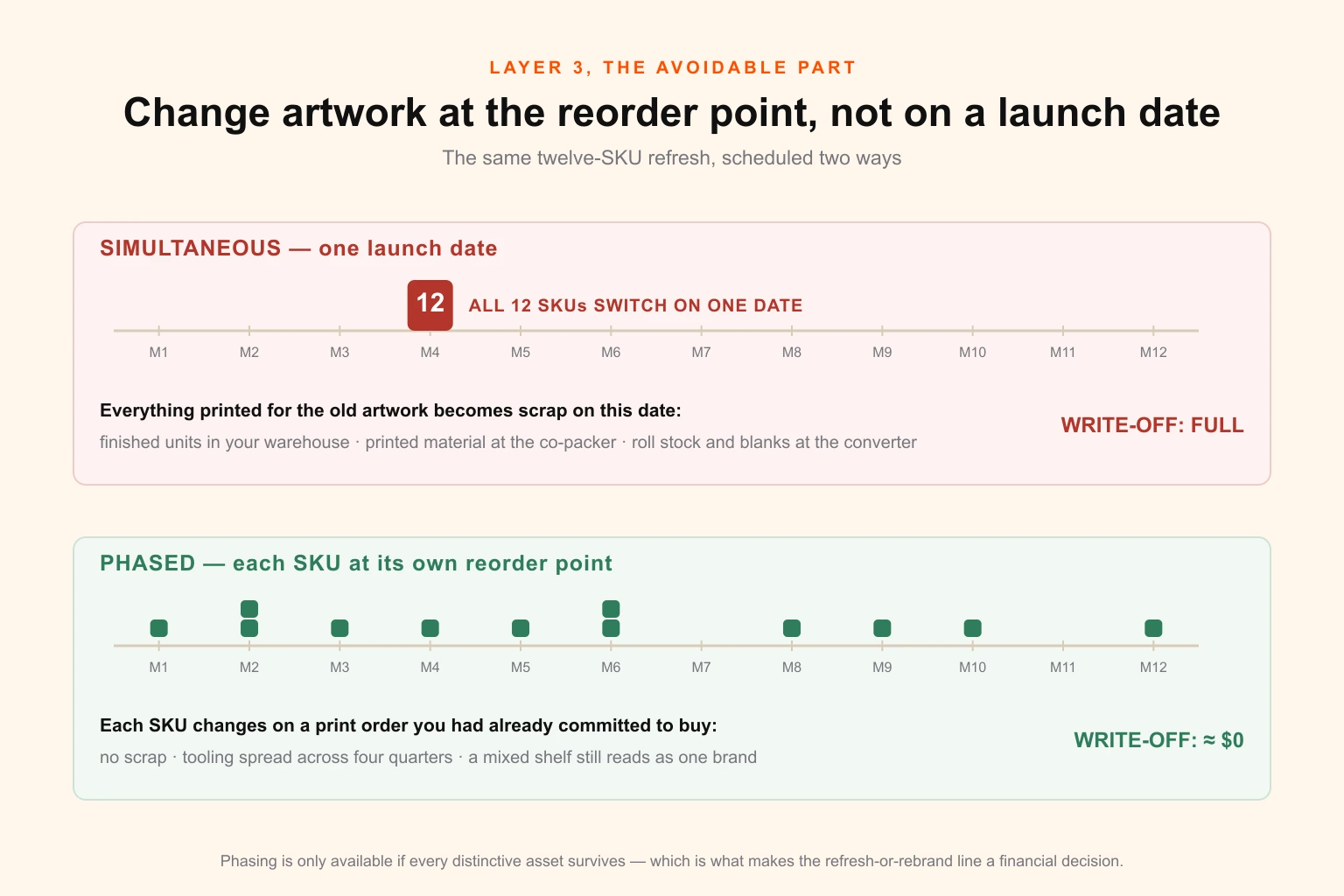
The day you approve new artwork for a SKU, everything in that chain for that SKU becomes obsolete unless you run it out first. For a brand holding ten weeks of packaging cover across a range, that is ten weeks of packaging spend written off in a single decision.
There is exactly one thing to do about it, and it is the most valuable sentence in this article:
Change the artwork at each SKU's natural reorder point, not on a launch date.
Every SKU has a moment when its printed stock is nearly exhausted and a new print order is being placed anyway. Land the new artwork on that moment and the write-off is zero, because you are buying printing you had already committed to buy. The tooling is still incremental, but the single largest avoidable cost disappears entirely.
Across a range, those moments are staggered — which is the whole reason a refresh has to be phaseable, which is the whole reason the distinctive assets have to survive. The three ideas connect, and they connect at the level of money rather than theory.
The objection is that the shelf looks inconsistent for a few months. If your distinctive assets are intact, this is close to invisible: shoppers see one brand with some variation, which is what they see in most categories anyway. If your distinctive assets are not intact, phasing is genuinely unavailable and you should count the write-off as part of the cost of choosing a rebrand.
The small unavoidable ones
These are individually minor and collectively add twenty to forty percent to a range-level project.
Minimum order quantities. A new print run has a floor. Flexible film MOQs are commonly in the thousands to tens of thousands of units or a minimum linear-metre charge; folding cartons typically in the low thousands. On a slow-moving SKU, the MOQ may force you to buy two years of packaging to change the artwork on it — which is a good argument for leaving the tail of your range on its existing design until it turns over naturally.
Photography. Every SKU whose pack changes needs a new silo shot for ecommerce, marketplace listings, retailer portals, sales sheets and trade presentations. Roughly $150 to $600 per SKU for straightforward pack shots, and $1,500 to $6,000 for a lifestyle set if the range uses one.
Marketplace and ecommerce listings. Main image, gallery, and enhanced content per listing. On Amazon that is the main image plus A+ content per ASIN; on your own store it is the product page and any grid thumbnails. Budget $75 to $400 per listing in design and admin, and remember the pack is also on your homepage, your ads and your email templates — ecommerce brands in particular tend to find the pack shot embedded in dozens of places.
Retailer and distributor data. Trading partners hold pack images and product data in shared pools and portals. Updating them is administrative rather than creative, small per SKU, and easy to forget across forty. Note that a pure artwork refresh does not change your GTIN — a barcode identifies the trade item, not its appearance — but a change in pack size, count or case configuration does, and that is a larger project than a refresh.
Collateral carrying pack shots. Sales sheets, catalogues, trade presentations, shelf-ready display, point of sale, exhibition graphics. These carry old pack imagery for years unless somebody makes a list, and the list is longer than anyone expects. This is the same problem as a rebrand asset inventory, scoped down to one asset type.
Artwork management. Somebody has to route forty artworks through internal approval, regulatory checking, converter prepress, colour approval and sign-off, tracking versions across multiple printers. On a small range this is a person's afternoon. On a large one it is a genuine project management load, and underestimating it is the most common cause of a refresh sliding two quarters and colliding with a print run that then has to be reordered on the old artwork anyway.
The SKU multiplier
The reason cost guides are unhelpful is that they answer for one pack, and almost nobody has one pack.
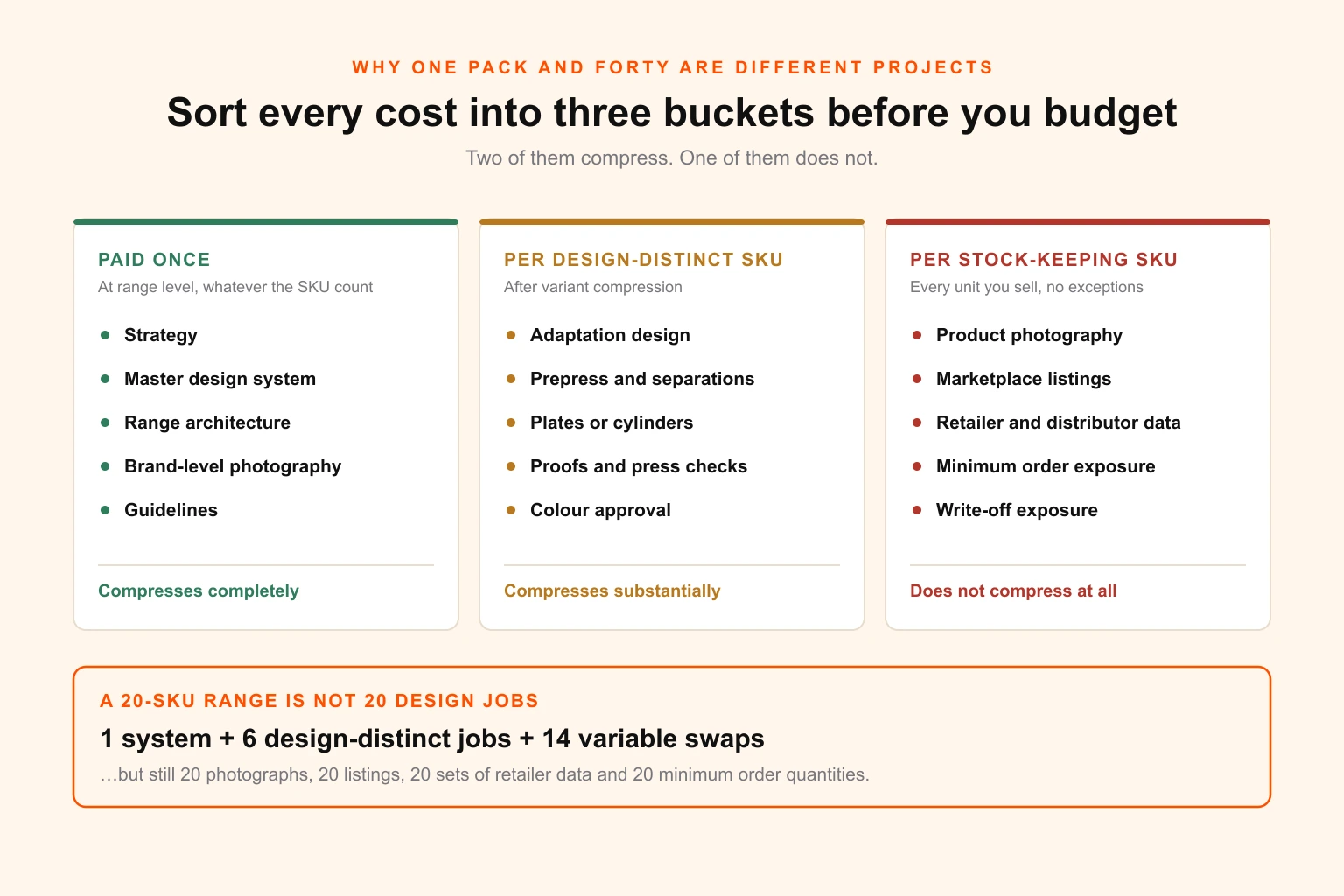
A useful way to think about it: within a range, some costs are paid once, some are paid per design-distinct SKU, and some are paid per stock-keeping SKU. Getting your range sorted into those three buckets is most of the budgeting work, and it usually shrinks the number substantially.
Paid once: strategy, the master design system, the range architecture, brand-level photography, guidelines.
Paid per design-distinct SKU: adaptation design, prepress, plates or cylinders, proofs. But "design-distinct" is a smaller number than your SKU count, because variants that differ only in flavour name and a colour panel are one design with a variable, not twenty designs. A twenty-SKU range is frequently five or six genuinely distinct design jobs plus fourteen variable swaps — the per-SKU asset inventory works through how to do that compression properly, and it is the single highest-leverage exercise available before you commission anything.
Paid per stock-keeping SKU regardless: photography, listings, retailer data, MOQ exposure, write-off exposure. These do not compress. A variant that is only a colour panel change still needs its own photograph and its own listing.
The practical consequence is that the cheapest refresh of a large range starts by sorting the range by volume and treating the head and the tail completely differently. The top handful of SKUs carry most of the volume and most of the tooling cost, and deserve the design attention. The tail carries almost no volume, frequently sits on painful MOQs, and can often be left alone entirely until it turns over — or, in the honest case, delisted, since a refresh is a good moment to notice that eleven SKUs are producing two percent of revenue.
Three worked examples
Illustrative, with the arithmetic shown so you can substitute your own inputs. All three assume a refresh, not a rebrand — distinctive assets intact, phasing available.
A single-SKU DTC brand, digitally printed labels
30,000 units a year, $22 retail, $14 gross margin per unit. Labels printed digitally in lots of 5,000.
| Line | Cost |
|---|---|
| Design, single pack, systemised for future variants | $2,500 |
| Prepress | $150 |
| Digital proof | $100 |
| Tooling | $0 |
| Product photography | $400 |
| Listing and site updates | $300 |
| Stock write-off, timed to reorder | $0 |
| Total | $3,450 |
Break-even: $3,450 ÷ $14 = 247 units, or 0.8% of annual volume.
The decision does not need a business case. It needs a calendar entry at the next label reorder. This is the position most direct-to-consumer brands are in and most do not realise it.
A 12-SKU regional food brand, flexo-printed film
400,000 units a year across twelve SKUs, $1.10 gross margin per unit. Six-colour flexo on film, ten weeks of packaging cover held across the chain.
| Line | Phased | Simultaneous |
|---|---|---|
| Design system | $9,000 | $9,000 |
| 11 SKU adaptations at $400 | $4,400 | $4,400 |
| Plates, 12 SKUs at $1,800 | $21,600 | $21,600 |
| Prepress, 12 at $250 | $3,000 | $3,000 |
| Proofs and press checks, 12 at $600 | $7,200 | $7,200 |
| Photography and listings | $3,600 | $3,600 |
| Artwork management | $2,500 | $2,500 |
| Obsolete printed stock | $0 | $12,000 |
| Total | $51,300 | $63,300 |
Break-even, phased: $51,300 ÷ $1.10 = 46,600 units, or 11.7% of annual volume.
That is a serious hurdle, and it is the honest finding of this exercise. A cosmetic update will not clear an eleven percent lift. Three responses are legitimate, and one is not.
Legitimate: narrow it to the four SKUs carrying most of the volume, which cuts tooling by roughly two-thirds and drops break-even under five percent. Or wait for the plate replacement cycle, which removes a large share of the $21,600. Or attach the refresh to a change that has its own justification — a claim, a format, a regulatory update — so the tooling is being paid regardless and only design is incremental.
Not legitimate: doing it anyway on the argument that brand investment does not need to pay back. It might well be right that it does not need to pay back inside a year. But you should know that you are making that argument, rather than discovering it afterwards.
A 40-SKU retail range, mixed litho cartons and gravure film
34 SKUs in litho-printed cartons, 6 high-volume SKUs in gravure-printed film. The six gravure lines carry roughly 60% of volume.
| Line | Cost |
|---|---|
| Strategy and master design system | $18,000 |
| Adaptations, compressed to 9 design-distinct jobs plus 31 variable swaps | $14,000 |
| Litho tooling and prepress, 34 at $350 | $11,900 |
| Gravure cylinders, 6 at $6,000 | $36,000 |
| Proofs, 40 averaged at $300 | $12,000 |
| Photography and listings, 40 at $250 | $10,000 |
| Artwork management | $8,000 |
| Obsolete stock, phased | ~$0 |
| Total, phased | $109,900 |
The instructive line is the gravure one. Six SKUs out of forty carry a third of the entire budget. Refreshing the 34 litho SKUs costs roughly $74,000; the six that carry the most volume cost $36,000 in cylinders alone.
Which produces a genuinely counterintuitive option worth putting on the table: refresh the 34 cheap SKUs first, and hold the six expensive ones until their cylinders are due for re-engraving. It looks backwards — leaving your biggest lines on old artwork — and it is frequently the correct sequencing, because those six lines are also the ones with the most established recognition and the least to gain from a change.
The payback threshold
The whole decision reduces to one calculation, and it is worth running before you talk to anybody.
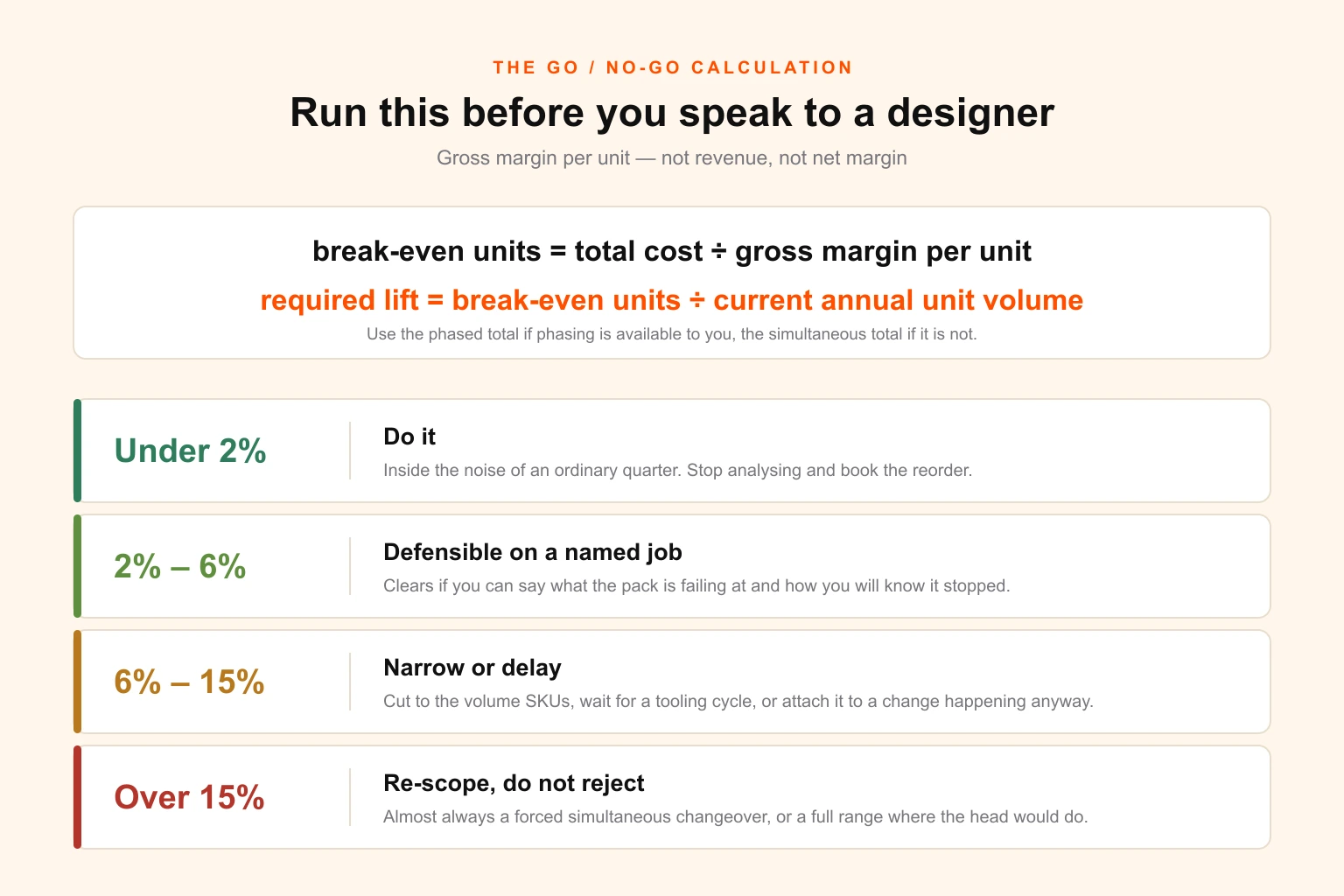
Units needed to break even = total cost ÷ gross margin per unit
Required lift = units needed ÷ current annual unit volume
Use gross margin per unit, not revenue and not net margin. Use the phased total if phasing is available to you and the simultaneous total if it is not, because that difference is a real consequence of the refresh-or-rebrand decision.
Then read the answer honestly:
Under 2%. Do it. The threshold is inside the noise of an ordinary quarter. Stop analysing and book the reorder.
2% to 6%. Defensible on a named job. If you can say what the pack is failing at and how you will know it stopped failing, this clears. If you cannot, it does not.
6% to 15%. Narrow or delay. Cut to the volume SKUs, wait for a tooling replacement cycle, or attach it to a change that is happening regardless. A full-range refresh at this threshold is a bet rather than an investment.
Over 15%. Something is wrong with the scope. Almost always this means either simultaneous changeover on a project that could be phased, or a full-range refresh where a head-of-range refresh would do. Re-scope before rejecting.
Two honest caveats on the upside of the calculation. First, a design change does not reliably produce a durable sales lift on its own, whatever the case studies suggest; what a refresh reliably improves is findability, comprehension of a specific claim, and fit with a channel, and those convert into volume only when one of them was actually the constraint. Second, some of the return does not appear as volume at all — it appears as a price you can hold, a retailer conversation that goes better, or a listing you win. Those are real and they are hard to put in the denominator. Put them in the discussion, not in the arithmetic.
The distinctive asset audit
If the arithmetic clears, this is the one piece of work to do before writing a brief.
Test recognition, not preference. Preference testing — which of these do you like — tells you almost nothing useful, because liking a pack in isolation on a screen has very little to do with finding it on a shelf in a second. Show existing customers the pack with the name and logo removed, or blurred until only colour, shape and gross layout survive, and ask them to name the brand. What they still identify is a distinctive asset. What they do not is available.
Four practical notes.
Do it before concepts exist. Once a route is on the table the conversation becomes taste, seniority and sunk effort. The audit is cheap in week one and impossible in week six.
Check whether the asset is still distinctive. An asset only counts if it is both strongly associated with you and not shared with the category. A colour that was yours in 2016 may now belong to four competitors, in which case protecting it is protecting nothing, and it may be the thing most worth changing.
Audit in the channel that carries your volume. A pack that works at two metres in an aisle and a pack that works at 200 pixels in a grid are different problems. An ecommerce thumbnail preserves colour and silhouette and destroys hierarchy, secondary type and finish entirely. If most of your growth is online, weight the audit accordingly — the ecommerce branding guide goes further into how that shifts the design requirement.
Write the result into the brief as a constraint. "The dominant green, the vessel silhouette and the wordmark do not change; everything else is open" is one of the most useful sentences you can put in a design brief, and it converts an anxious project into a bounded one. The design brief guide covers the rest of what should be in the document, and if you have brand guidelines they should be updated to record the distinction — most guidelines list every element as equally sacred, which is precisely what makes them unusable during a refresh.
Related and worth deciding early: whether your existing photography and illustration licences cover the new usage. A refresh that reuses commissioned or stock imagery on a longer print run, a new market or a new format can quietly exceed the licence it was bought under — stock asset licensing across print runs covers where those limits usually sit.
Sequencing that keeps the cost down
The order of operations does more for the budget than any negotiation on rates.
Ask the converter when tooling is due for replacement. Before anything else. Plates and cylinders have a life. If a replacement cycle is within twelve months, the entire project should be scheduled around it.
Get the reorder calendar for every SKU. Your buyer or ops lead has this. It is the schedule the rollout should follow, not a marketing launch date.
Compress the range into design-distinct jobs. Nine designs plus thirty-one variable swaps, not forty designs. This is the largest single reduction in Layer 1 and a meaningful one in Layer 2.
Fix the structure unless there is a reason not to. Same dieline means no new cutting die, no new pack testing, no changes to filling line settings, no new case dimensions and no logistics changes. Structural change is a legitimate decision and a large one; do not make it accidentally.
Set the colour count in the brief. On flexo and gravure this is a direct budget lever. Design to it rather than discovering it at quotation.
Sequence head before tail, unless tooling says otherwise. Volume SKUs get the design attention. Tail SKUs wait for natural turnover or get delisted.
Build production files once, properly. Correct dieline, correct separations, correct colour space, correct bleed, fonts outlined, at final size. Files rebuilt at repro rates are a pure, avoidable cost, and they are also the most common cause of a missed reorder date. This is what print-ready production design exists to prevent, and the difference between a file that is nearly right and one that runs is described in the vector versus raster and dieline explanations.
Update the downstream assets in the same sprint. Photography, listings, retailer data, sales sheets, site. If they are not done alongside, they get done in eighteen months.
Mistakes worth naming
Approving all artwork at once because it feels tidier. This is the write-off, in one decision. Approve per SKU, against its reorder date.
Getting one quote, from a design studio, and calling it the budget. It covers Layer 1. Ask your converter for the tooling and prepress figure for every SKU before you approve anything.
Not knowing which SKUs are on which press. The tooling cost varies by twenty times across processes. Nobody can scope a range refresh without this list and it takes one email to get.
Changing structure without meaning to. A slightly different carton depth means a new die, new pack testing, potentially new case dimensions and a conversation with logistics. Structural change is fine when intended.
Redesigning the tail. Eleven SKUs producing two percent of revenue, each carrying its own plates, its own MOQ, its own photograph and its own listing. The tail is where range refreshes go over budget.
Protecting everything. The mirror image of the Tropicana error, and much more common. A team so frightened of losing recognition that it changes nothing meaningful, spends the entire budget, and ships a pack indistinguishable from the old one. The distinctive asset audit exists to tell you what to protect so that you can confidently change the rest.
Forgetting the pack lives outside the shelf. Website, ads, email, sales sheets, exhibition stands, catalogues. Make the list at the start.
Treating it as a project rather than a system. A range that grows will need SKU thirteen, and then a seasonal variant, and then a format extension. If the refresh does not leave behind rules for making those, you are buying the same project again in two years.
The decision, condensed
Before you commission anything
- Confirm packaging is the constraint, not distribution, price or category
- Name the specific job the pack is failing
- Run the distinctive asset audit — recognition, not preference
- Confirm this is a refresh, not a rebrand, and that phasing is therefore available
- List every SKU with its print process, colour count and converter
- Ask each converter when tooling is next due for replacement
- Get the reorder calendar and stock cover for every SKU
- Compress the range into design-distinct jobs
- Sort SKUs by volume and decide head, tail and delist
Building the budget
- Layer 1: system plus per-SKU adaptation, not per-pack execution
- Layer 2: tooling per SKU per colour, prepress, proofs, from the converter
- Layer 3: MOQ exposure, photography, listings, retailer data, collateral, management
- Write-off exposure under simultaneous rollout, for comparison
- Run the payback threshold and read the band honestly
In the brief
- The protected distinctive assets, stated as a constraint
- The colour count ceiling
- Structure fixed or explicitly in scope
- The named job the design has to do
- Production file requirements — dieline, separations, colour space, bleed
- The rules the system must leave behind for future SKUs
Rolling out
- Approve artwork per SKU against reorder dates, not on a launch date
- Head SKUs first unless tooling cycles say otherwise
- Photography, listings and collateral in the same sprint
- Retailer and distributor data updated per SKU
- Old artwork archived with its production files, not deleted
Where this usually lands
Most packaging refreshes are commissioned as a design project and priced as a design project, and then cost two to five times the design quote for reasons that were entirely knowable at the outset. The overrun is not caused by scope creep. It is caused by asking one supplier, who quotes accurately for the layer they are responsible for, and treating that as the budget.
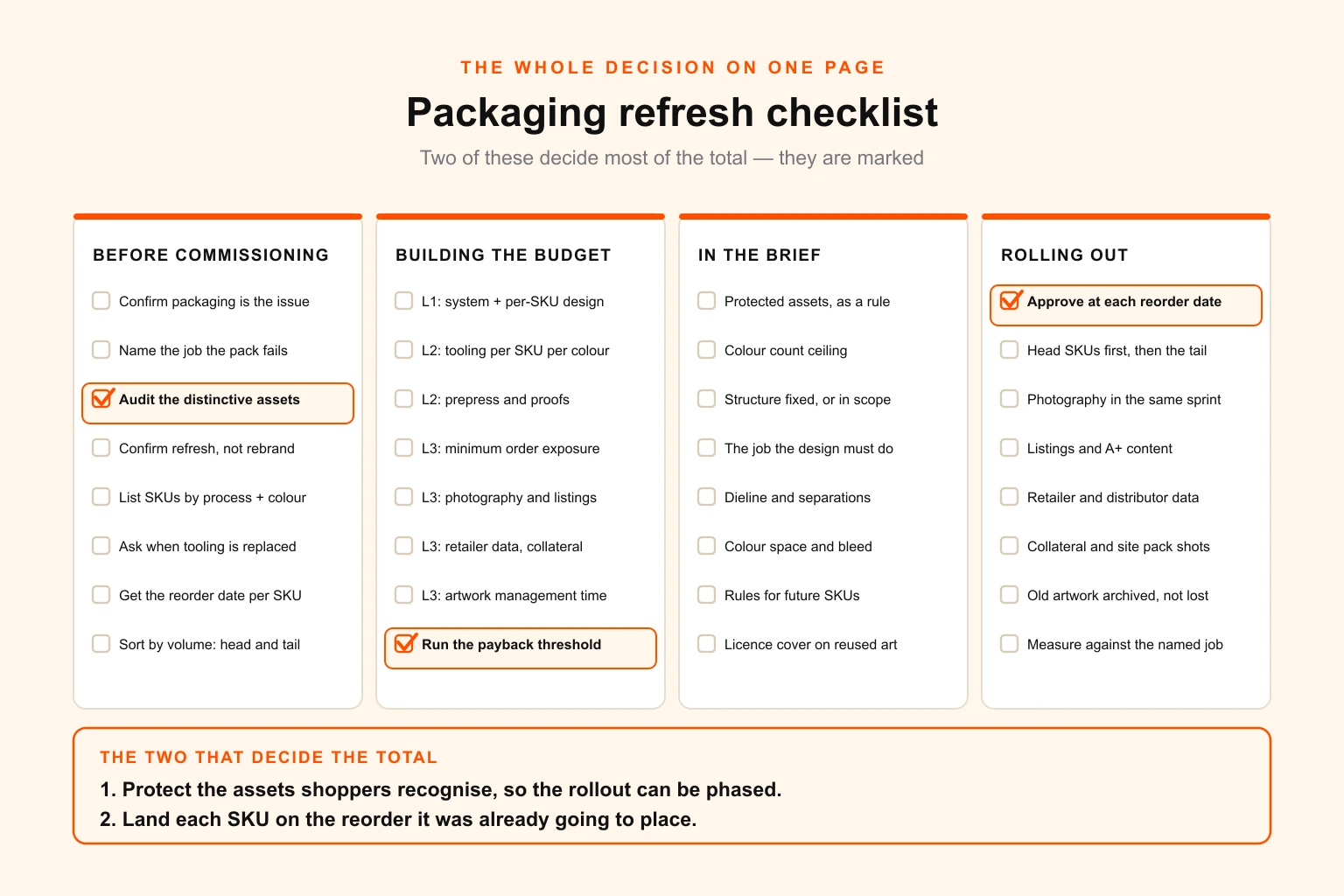
Two decisions do almost all the work. The first is protecting the two or three assets shoppers actually recognise you by, which makes the refresh phaseable. The second is landing each SKU's new artwork on the reorder it was going to place anyway, which makes the write-off disappear. Get those right and a project that looked like a hundred thousand dollars of risk becomes an ordinary line in a print budget, spread over four quarters.
The design work underneath is more volume than invention — a system decided once, then applied across every SKU, every variant, every language, every ecommerce listing and every sales sheet, all of it built as production artwork on the right dieline in the right colour space so the converter runs it first time. That is a throughput problem more than a creative one, and it is why product brands tend to move it onto a standing arrangement rather than commissioning each wave as a separate project.
That is what Digital Polo does: a fixed monthly cost, unlimited requests, one queue for the master design, the SKU adaptations, the packaging and label artwork, the pack photography retouching, the marketplace listings and the sales collateral that all have to change together. Print-ready files are built to production specification, and the full service list covers where each of the three layers is handled — with pricing published rather than quoted per project, which for a phased rollout across four quarters is usually the point.
If you are still deciding whether the change is a refresh or something larger, start with the rebranding guide. If you already know it is a rebrand, the rollout inventory is the document that tells you what else is about to change. And if you simply want to see what a well-resolved range looks like before committing, the packaging design inspiration collection is a reasonable place to start looking.