
The design budget did not break when you launched. It broke somewhere around SKU 60, and nobody could say why.
The pattern is consistent enough to be predictable. A product business launches with a tight range — eight products, one channel, one packaging format — and design costs feel proportionate. Two years later there are two hundred SKUs, four sales channels, a retailer who wants their own image spec, a marketplace that keeps rejecting files, and a design spend that has grown faster than the catalogue. Somebody eventually asks the reasonable question: why does adding a product cost so much more than it used to?
The answer is that you have been counting the wrong unit. A SKU is an inventory concept. It was never a design concept. When a finance team budgets design per SKU, they are pricing a bundle as though it were an item — and the bundle has been quietly growing every time you added a channel, a retailer, a language or a regulatory market.
This is the arithmetic nobody runs before they need it: what a product actually costs in graphics, how the multiplier compounds, how to collapse two hundred SKUs into the far smaller number of design jobs they really represent, and where — specifically — the money leaks in between.
The unit of work is not the product
Ask a founder how many products they sell and you get a number instantly. Ask how many finished graphic files that catalogue represents and you get silence, then a guess, then — if they actually go and count — a figure three to eight times higher than the guess.
The gap is structural. Products are things you can hold. Assets are things that exist per product per surface, per channel, per market and per format. Every one of those dimensions is a multiplier, and multipliers do not feel like they are compounding while they compound.
Here is the shape of it. One shampoo. One bottle, one label. Now: front panel, back panel with ingredients, the variant name in three sizes because the 100ml, 400ml and 1L bottles have different label dimensions and different amounts of room. A dieline per size. A barcode placement per size. Eight listing images for your own store, a different main image for the marketplace because they forbid the lifestyle background you like, a square crop and a vertical crop for paid social, a flat-on-white for the retailer's portal, a line sheet entry for wholesale, a shelf talker for the two hundred stores that stock it, and a spec sheet for the distributor.
That is one product. Before you have made a second scent.
None of those files is optional, none is expensive on its own, and no single one of them is where the budget went. The budget went into the multiplication, which is exactly the kind of cost that never appears in a single invoice large enough to trigger a review.
Why the miscount is so consistent
Three reasons, and they compound.
Design is requested in units of urgency, not units of product. Nobody commissions "the asset bundle for SKU 114". They commission "the Amazon images for the new mango one, by Thursday", then two weeks later "the shelf talker", then a month later "can we get a square version". The bundle is bought in fragments over months, so it is never seen as a bundle and never priced as one.
Channels are added without re-baselining. A new marketplace, a new retailer, a new market feels like a distribution decision. It is also a design decision that retroactively applies to every product you already sell. Adding one channel to a 200-SKU catalogue is not one project — it is 200 derivative sets, and it is usually approved by someone who has never seen the asset inventory.
Variants are assumed to be free. They are cheap, if the artwork was built for variation. If it was not, a colourway is a rebuild. Most catalogues contain both kinds of family, and nobody has labelled which is which.
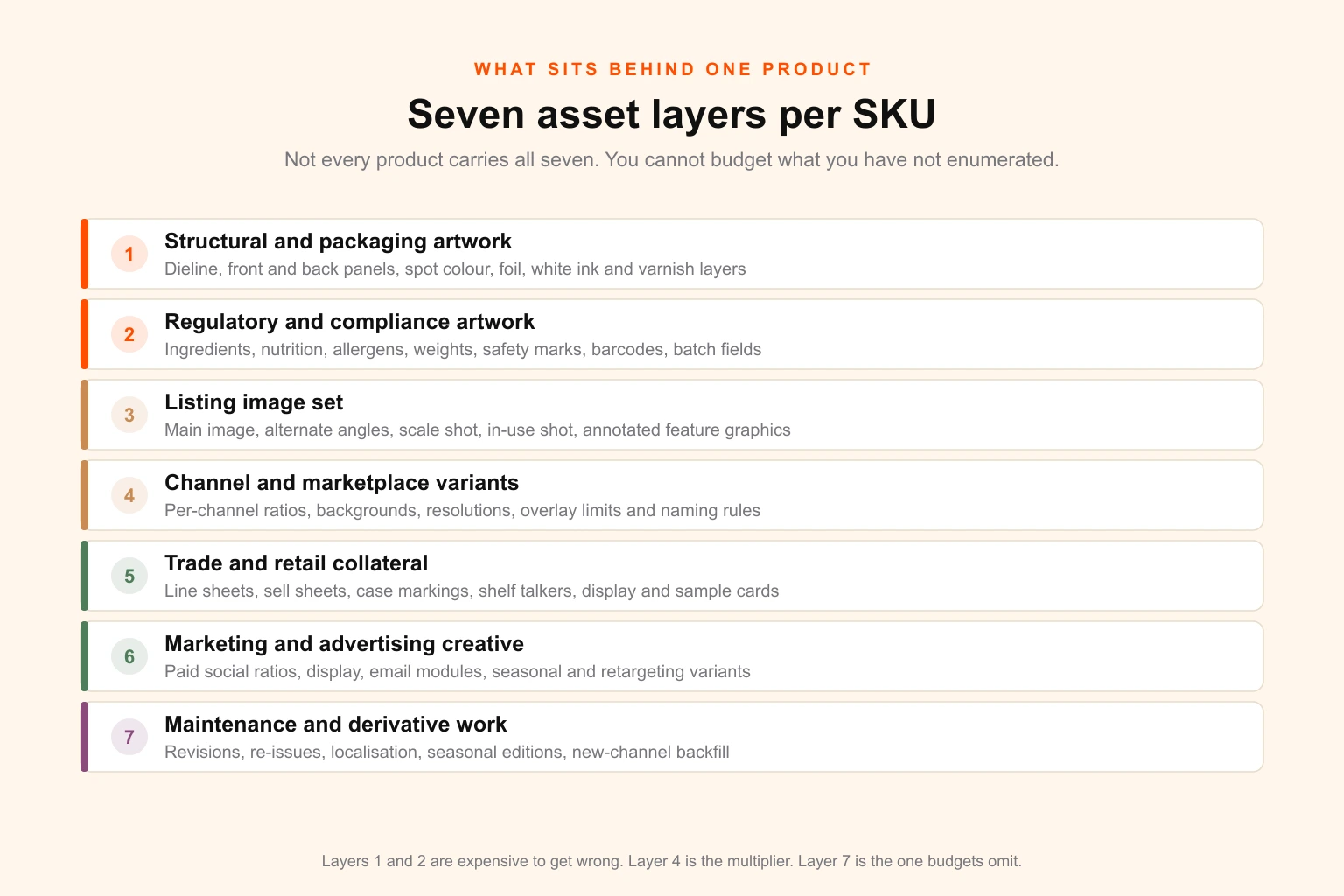
The seven asset layers behind a single SKU
Every physical product sold through more than one channel carries some subset of seven layers. Not every product carries all seven. But you cannot budget what you have not enumerated, and the enumeration is the same regardless of category.
Layer 1 — Structural and packaging artwork
The physical carrier. A dieline supplied or verified against the converter's template, the front panel, any secondary panels, and the print-method-specific technical layers — spot colours, foil, white ink, spot UV, emboss and varnish are each their own layer in the file, not effects applied at the end.
This layer is unforgiving because it is expensive to get wrong. A listing image with the wrong crop is a five-minute fix. A carton printed from artwork built to the wrong dieline is a scrapped print run. It is also the layer most often started before the specification exists, which is the single most reliable predictor of rework in product design work.
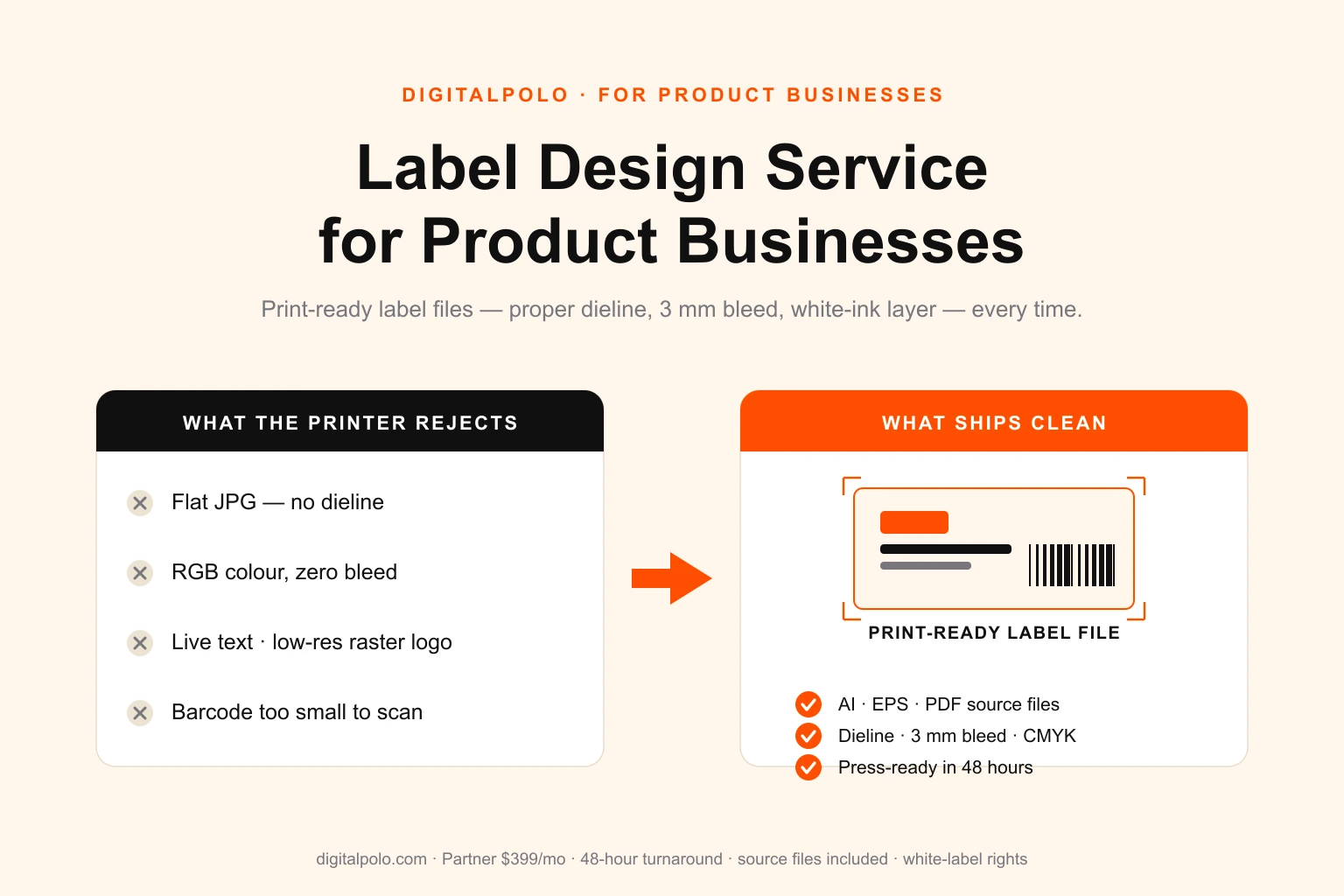
For anything printed, the print-ready file checklist is the gate this layer has to pass, and the CMYK versus RGB distinction is not academic here — it determines whether the shade on the shelf matches the shade on the site.
Layer 2 — Regulatory and compliance artwork
Ingredient declarations, nutrition panels, allergen statements, weights and measures, recycling marks, safety symbols, batch and date fields, country-of-origin, importer details, and any market-specific mark. Barcodes belong here too, and so does the size and legibility minimum that governs where the rest of the panel can go.
Two properties make this layer disproportionately expensive relative to its visual footprint. It changes independently of everything else — a formulation tweak or a regulation update re-issues artwork for reasons unrelated to design. And it is the layer most likely to arrive late, after layout is complete, which converts a compositional decision into a rebuild.
Regulated categories — food, supplements, cosmetics, chemicals, children's products, medical devices — should assume this layer alone doubles the artwork cost per family compared with an unregulated equivalent, and should assume a re-issue cycle rather than a one-off.
Layer 3 — The listing image set
The set that sells the product where nobody can touch it. In practice: a compliant main image on the required background, two to four alternate angles, a scale reference, an in-use or lifestyle shot, one or two annotated feature images that carry the claims as graphics rather than as body copy, and — increasingly — a short video or animated sequence.
The floor is lower than most people think and the ceiling is higher. Marketplace guidance clusters around six or seven images as the recommended set, general commerce advice lands at three to five for simple, self-explanatory goods and seven to ten for considered purchases. The variable is not category prestige but how much explaining the product needs. A candle needs fewer images than a folding workbench, and no amount of brand ambition changes that.
Note the split inside this layer: photography and graphic design are different disciplines with different suppliers, and the annotated feature images sit squarely in the second. That boundary is where a lot of catalogues quietly lose consistency, because the photographer's output and the designer's overlay were never specified together.
Layer 4 — Channel and marketplace variants
The layer that turns a linear cost into a multiplied one.
Your own storefront, each marketplace, each retailer's vendor portal, comparison shopping feeds, wholesale platforms and social commerce surfaces all impose their own aspect ratios, background rules, minimum resolutions, text-overlay limits and file-naming conventions. They overlap enough that people assume the assets transfer, and differ enough that they do not.
The correct mental model is the one set out in one campaign asset, fifteen channel formats: a single origination, then a defined family of derivatives, each produced from the master rather than adapted from a sibling. Adapting from a sibling is how a catalogue ends up with four slightly different versions of a product image and nobody able to say which is current.
Layer 5 — Trade and retail collateral
Everything that sells the product to the people who sell the product. Line sheets, wholesale catalogue pages, spec and sell sheets, case and carton markings, shelf talkers, shelf strips, dump bin and display artwork, sample cards, and the trade show materials that carry the range rather than the item.
This layer is invisible to direct-to-consumer businesses right up to the week they sign their first retailer or book a trade show stand, at which point it becomes urgent for the entire catalogue simultaneously. It is also the layer most likely to be produced under time pressure by whoever is available, which is why trade collateral is so often the least on-brand material a company owns.
Layer 6 — Marketing and advertising creative
Paid social in every required ratio, display banners, email modules, seasonal and promotional treatments, retargeting variants, and the volume of iterations that performance marketing consumes.
The distinguishing property of this layer is that it does not scale with the catalogue at all — it scales with media spend. A brand running significant paid media on ten hero products will produce more creative for those ten than for the other 190 combined. Budgeting it per SKU is the wrong model entirely; budget it against spend, using the approach in how many ad creatives you actually need per month, and keep it in a separate line from catalogue production.
Layer 7 — Maintenance and derivative work
Revisions, refreshes, seasonal editions, re-issues triggered by regulatory or formulation change, new-channel backfill, localisation, and the periodic tidying that follows any brand guidelines update.
This is the layer that budgets omit and reality insists on. In a stable catalogue with an established range, maintenance typically re-touches a fifth to two-fifths of the items in any given year without a single new product being added. Treat it as a recurring line, not a contingency.
Asset load by product type
Enumerating layers is not the same as costing them. The load varies enormously by what you sell, and the variation is driven by two factors only: how many channels the product passes through, and how much regulated content it must carry.
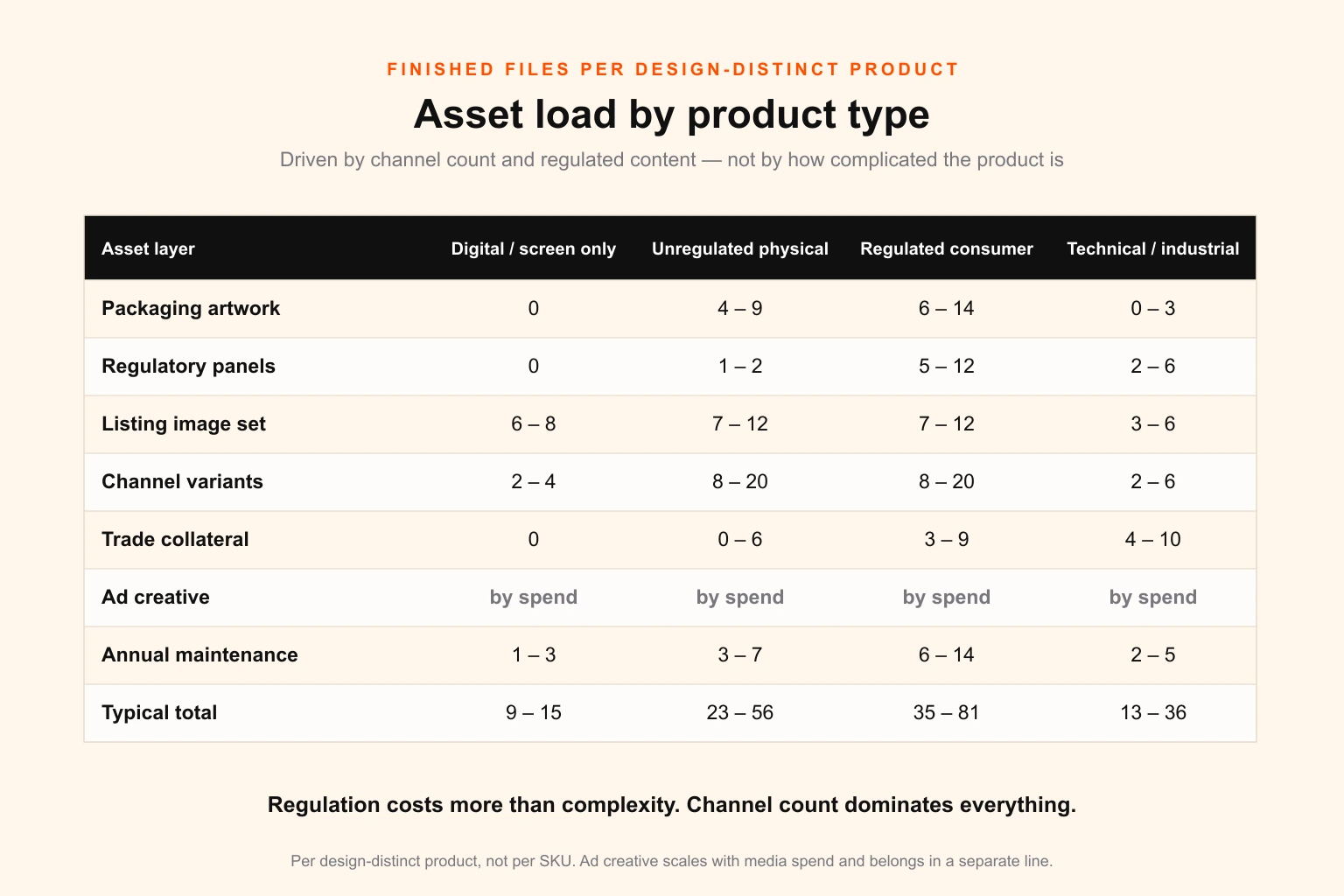
Read those figures as the load per design-distinct product, not per SKU — the distinction is the subject of the next section and it is the one that decides whether your catalogue is affordable.
A few observations that matter more than the exact numbers.
Regulation costs more than complexity. A technically complicated industrial component with no consumer packaging is often cheaper to originate than a simple supplement, because the supplement carries a compliance panel, a claims review, market-specific variants and a re-issue cycle.
Channel count dominates everything. A single-channel direct-to-consumer product is a fundamentally different cost object from the same product sold direct, on two marketplaces, through three retail portals and into wholesale. Same product, same packaging, four to six times the finished-file count.
The trade layer is binary. It is zero or it is substantial. There is no gradual version, and it arrives with the first wholesale account.
Compressing 200 SKUs into the jobs they really are
This is the section that changes the budget.
A SKU exists so that a warehouse can pick the right box. Every size, colour, flavour, count, bundle and pack format earns its own. A design-distinct unit is different: it is a piece of artwork that must be originated rather than derived from something that already exists.
The two numbers are not close.
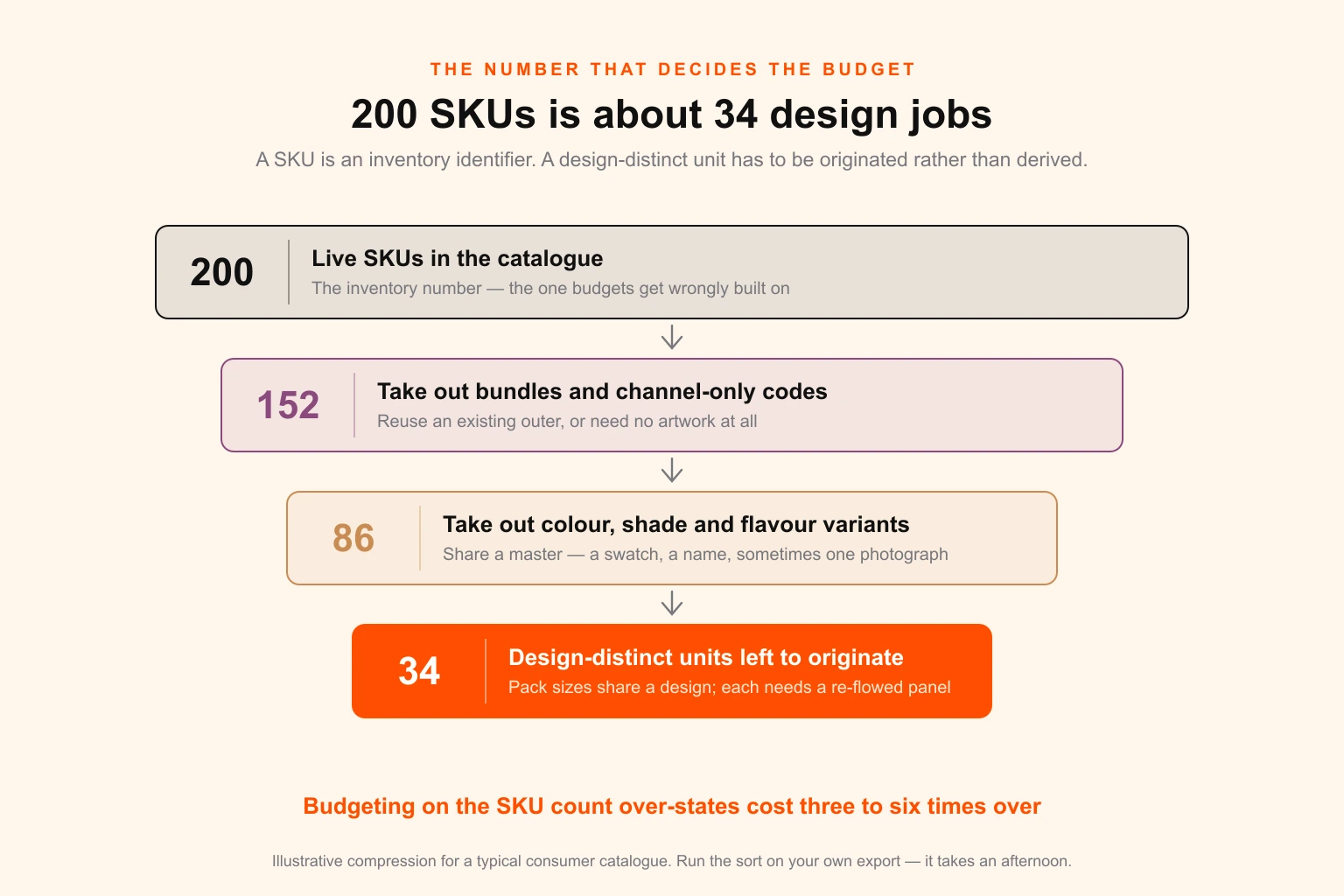
Work through a real catalogue and the compression is dramatic. Bundles and multipacks usually need one new outer and nothing else. Pack-size variants share a design and need a re-flowed panel per dieline. Colour and flavour variants share everything except a swatch, a name and often a single photograph. Channel-only SKUs — the same physical product with a different identifier because a retailer demanded one — need nothing at all.
What remains is the origination work. For most 200-SKU catalogues it lands somewhere between 25 and 60 items.
The four-way classification
Sort every SKU into one of four buckets. The sort takes a couple of hours for a mid-sized catalogue and it is the highest-leverage couple of hours in this entire process.
Originate. No existing artwork can produce this. New family, new format, new structure. Carries the full asset bundle for its product type.
Derive. Shares a master with an existing item and differs in defined, pre-planned ways — a colour, a name, a flavour, a size. Costs a small fraction of origination if the master was built for it.
Reformat. Identical artwork, different output specification. A channel crop, a resolution change, a different aspect ratio. Should be near-mechanical, and should never involve a designer making a judgement call.
Nothing. Bundles that reuse an existing outer, retailer-specific SKU codes, internal identifiers. Genuinely zero design cost, and there are always more of these than anyone expects.
The one that repays attention is derive. A colourway is only cheap if the original artwork isolated colour to defined swatches, held the variant name in a single editable field and kept the photography reusable. If the original was delivered as a flattened one-off, every "cheap" variant is a rebuild wearing a variant's price tag — and this is the most common way a catalogue budget goes wrong quietly rather than loudly.
Which produces the most useful single rule in this article: pay more for the first item in a family, on the explicit condition that you are buying the mechanism, not the panel. The second through fifteenth items are where that decision pays for itself.
The three cost bases, and when each one wins
Catalogue design is bought in one of three ways. They are not interchangeable, and the volume at which each stops making sense is calculable.
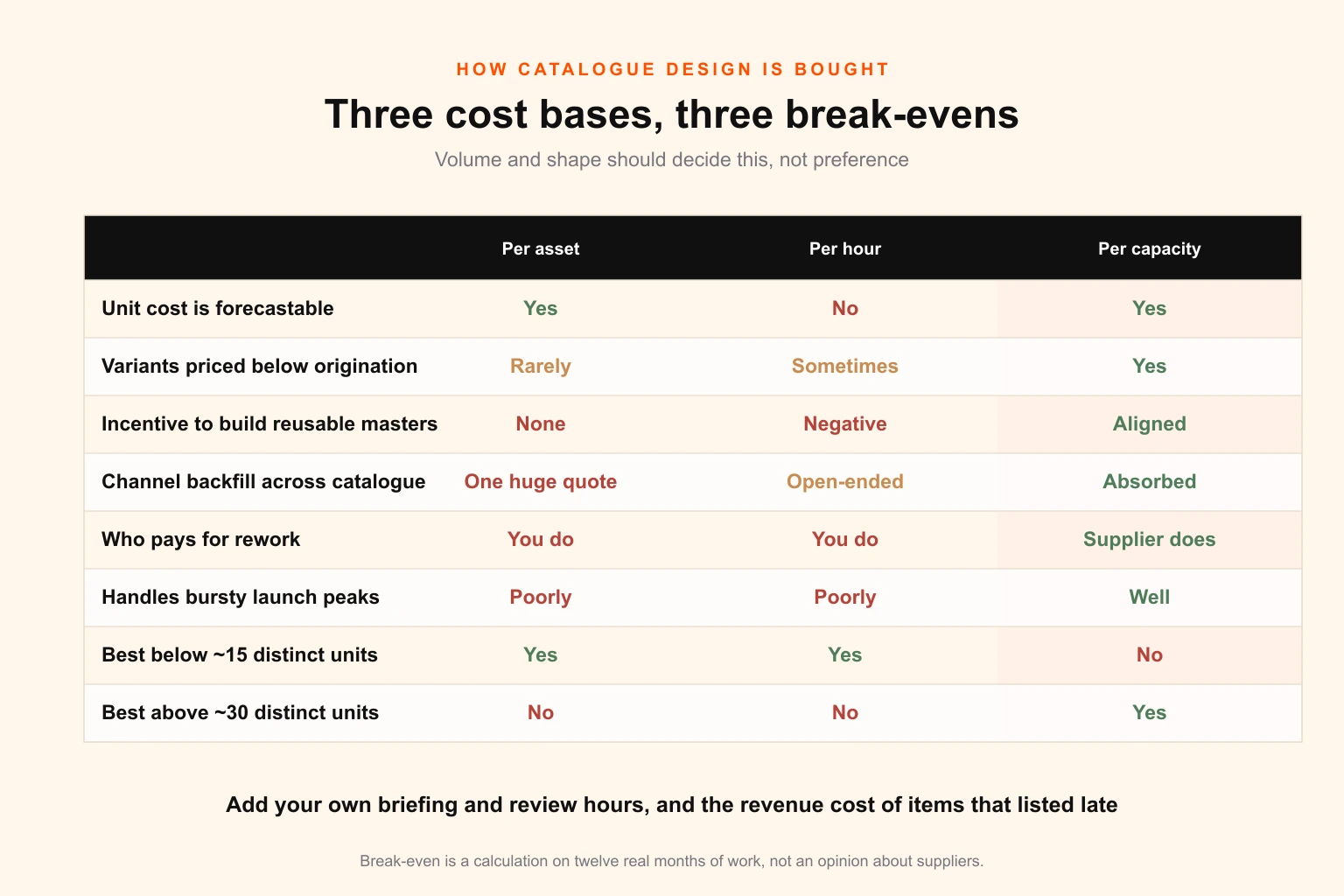
Per asset is honest and simple and works beautifully at low volume with well-defined deliverables. It develops two failure modes as catalogues grow. Derivative work gets billed at close to origination rates, because the supplier has no incentive to build reusable masters and often no brief telling them to. And channel backfill — the 200 derivative sets that a new marketplace triggers — arrives as a single enormous quote that gets deferred, which is how catalogues end up half-populated on their newest channel.
Per hour handles ambiguity well and suits genuinely exploratory work such as an initial identity or a structural packaging problem. It is poorly suited to volume production, because it prices the supplier's inefficiency at your expense and gives you no forecastable unit cost. It is also the basis under which rework is most invisible: a specification failure upstream simply shows up as more hours.
Per capacity — a retainer, a subscription, an in-house hire — buys throughput rather than deliverables. It is the only basis under which building a template system is in everyone's interest, because reusability directly increases what the same capacity produces. It wins when volume is steady enough to keep the capacity occupied, and loses when work is genuinely sporadic. The pricing breakdown for unlimited design and the full comparison against freelancers set out the arithmetic; the graphic design pricing guide covers how the three bases compare across the wider market.
Working the break-even honestly
The break-even is not a matter of opinion, but it does require you to count things you have probably never counted.
Take a real twelve-month window rather than a projection. Count design-distinct units originated. Count derivatives produced. Count reformats. Count maintenance re-issues. Then add the two costs that never appear on an invoice: your own team's hours spent briefing, reviewing, chasing and correcting, and the revenue cost of items that listed late.
That last one is usually the largest number on the page and it is almost never in the model. A seasonal product that lists three weeks late has lost a meaningful share of its window, and no saving on artwork recovers it.
Three worked catalogues
The abstraction only becomes useful when you put real shapes to it. Three 200-SKU catalogues, three completely different cost profiles — which is precisely why a per-SKU rate is a meaningless thing to quote.
A 200-SKU cosmetics range
Perhaps 14 product families across skincare and colour. Heavy variant load — shades, sizes, sets — so compression is aggressive and most SKUs derive. But the regulatory layer is substantial, ingredient lists are long and change, claims need review, and the brand sells direct, on two marketplaces, through a department store portal and into wholesale.
Origination is modest; derivatives and channel variants dominate; maintenance is high because formulations and regulations move. This catalogue lives or dies on whether the master artwork was built for variation. If it was, the range is cheap to extend indefinitely. If it was not, every new shade costs like a new product and the brand will conclude, wrongly, that shade extensions are unaffordable.
A 200-SKU apparel range
Compression is the most aggressive of the three — size and colour variants can collapse 200 SKUs into a dozen or fewer design-distinct units. But the listing layer is the heaviest of any category, because apparel sells on fit and drape and needs on-model photography per colourway, plus flat-lays, detail crops and size guidance.
Packaging is minimal. Regulatory content is a care label and a fibre composition. The cost centre is imagery volume, and the lever is a rigidly consistent shoot specification so that every colourway can be produced identically without re-deciding anything — the same discipline that makes featured images at scale tractable in a different context.
A 200-SKU industrial hardware catalogue
The inverse profile. Little consumer packaging, no lifestyle photography, no marketplace glamour. But 200 SKUs here are frequently 200 genuinely distinct items with individual technical drawings, dimension diagrams, tolerance tables and spec sheets — compression barely happens.
The dominant asset is the technical spec sheet and the diagram, the dominant channel is a distributor portal and a printed or PDF catalogue, and the dominant cost driver is that each item needs its own accurate technical illustration. This is the catalogue where per-SKU costing is closest to correct, and where a template system pays back fastest because the layout is repeatable even when the content is not.
Where the money actually leaks
Across enough catalogues the waste concentrates in the same places. None of them is a design failure. All of them are documentation and process failures that present as design costs.
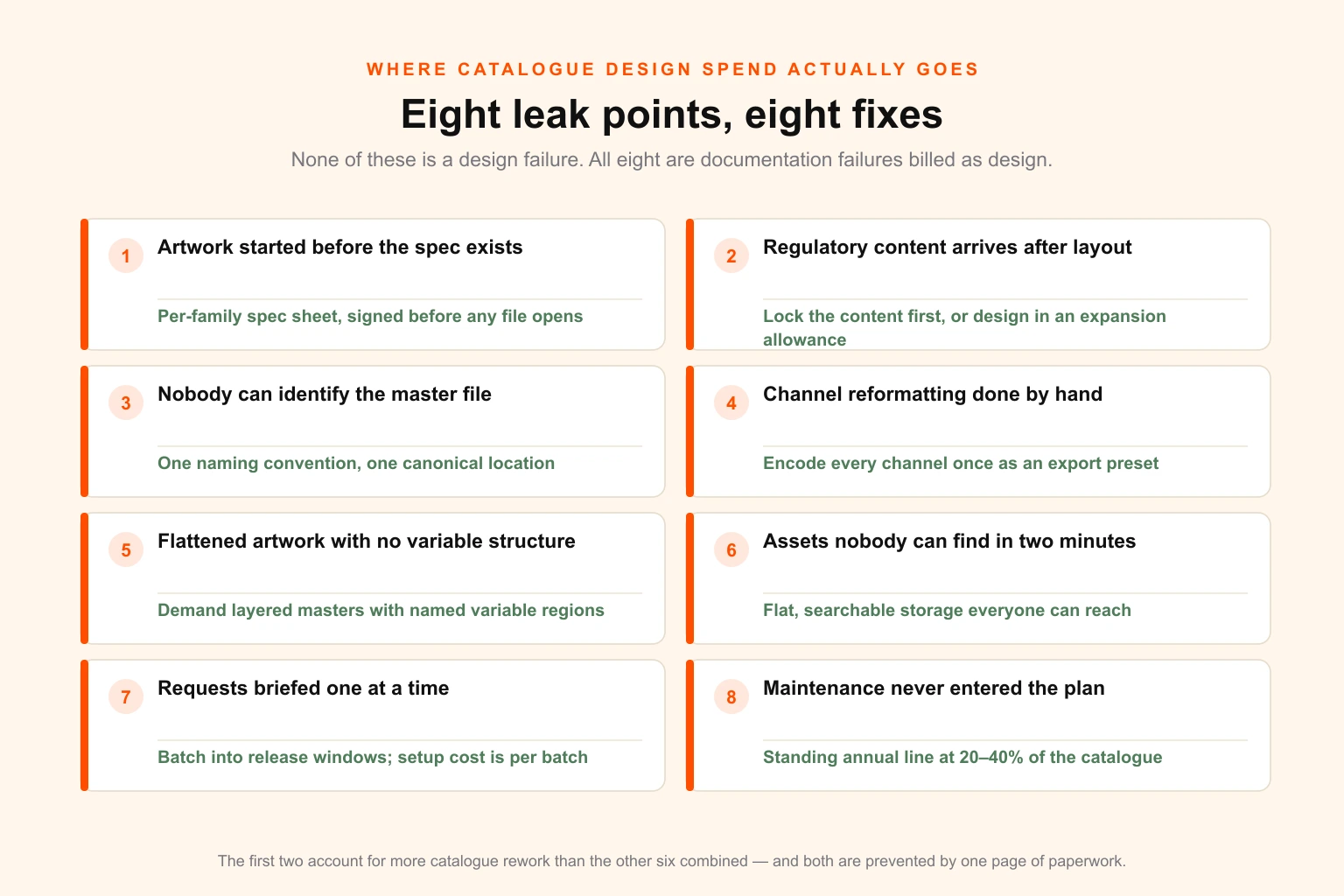
Artwork started before the specification exists. Design begins on a promised dieline, a provisional substrate or an unconfirmed print method. When the real specification arrives, the work is not adjusted — it is redone. This single cause accounts for more catalogue rework than the other seven combined, and it is entirely preventable with a per-family spec sheet.
Regulatory content arriving after layout. An ingredient list that grows by four lines after the panel is composed is a rebuild, not an edit. Lock content before layout, or design the panel with a declared expansion allowance.
Masters that nobody can identify. Three files named final, final-v2 and final-USE-THIS. Work proceeds against the wrong base and is discovered at proof stage. A naming convention and one canonical location fixes this permanently and costs nothing.
Channel reformatting done by hand. A designer manually re-cropping the same product image into six aspect ratios, repeatedly, forever. This is a preset problem masquerading as a labour problem.
Flattened artwork with no variable structure. Discussed above, and worth restating because it is expensive and invisible until the second variant. Ask for layered, editable masters explicitly in the brief; suppliers deliver what the brief specifies.
Assets that cannot be found in two minutes. Beyond roughly two minutes of searching, most people give up and commission a replacement. You then pay twice and own two versions. Findability is a design-cost lever, which is not intuitive but is consistently true.
Unbatched requests. Twelve products briefed individually across six weeks cost substantially more than the same twelve briefed together, because setup, context-switching and review cycles are per-batch costs, not per-item ones. Batching is free and most organisations do not do it.
Maintenance that nobody budgeted. Re-issues happen. If they are not in the plan they arrive as emergencies, and emergency work is the most expensive work there is.
The systems that collapse the number
Every leak above has a structural fix, and the fixes reinforce each other. Implemented together they typically halve the cost of a growing catalogue — not by paying less per file, but by needing far fewer originated files.
A master-and-derivative model
One originated master per family. Every variant, size and channel output derives from it. Nothing is ever adapted from a sibling, because sibling-adaptation is how drift enters a catalogue and drift is unrecoverable once it has propagated across 200 items.
The master has to be built for this from the start: colour isolated to named swatches, variable text in dedicated fields, photography kept separate from overlay graphics, and everything vector where vector is possible so that scale is never a constraint.
A per-family specification sheet
One page per product family, completed before any artwork begins. Substrate. Print method. Converter and their dieline reference. Colour space and any spot or Pantone assignments — the Pantone to CMYK tool is useful here, with the standing caveat that a converted value is an approximation and a critical brand colour needs a real proof. Named owner for regulatory content and the date it will be final. Every channel the product will appear on and that channel's image specification. Required output formats.
It is dull, it takes twenty minutes, and it removes the two largest sources of rework in the entire process.
Channel export presets
Every channel's requirements encoded once as a preset, then applied mechanically. Aspect ratio, resolution, background, colour profile, file naming, maximum file size. A new channel becomes a new preset applied across the catalogue rather than 200 fresh judgement calls. Where output goes to print, resolution should be resolved against the actual reproduction size rather than a habit — the print resolution calculator does that arithmetic, and large-format work has its own rules.
A naming convention and one canonical location
family_variant_asset-type_channel_version. Any convention beats no convention; the specific scheme matters far less than universal adherence. One location, flat enough to search, with a rule that nothing ships from anywhere else.
A release calendar with batching
Group product launches into release windows. Brief the batch together, review it together, ship it together. The overhead per batch is roughly fixed, so batch size is close to free efficiency — and a predictable calendar is what makes a capacity-based supply arrangement work at all.
Written rules for what may vary
A short document naming the handful of decisions people actually get wrong: which colours, which logo placements, minimum sizes, clear space, which type styles, what may never be altered. This is narrower than a full brand book and complements it — the difference between a design system, a style guide and brand guidelines matters here, because catalogue work needs the operational document rather than the philosophical one.
Building your own per-SKU inventory
Six steps. A person who knows the catalogue can complete this in a day for 200 SKUs, and the output is a real budget rather than a guess.
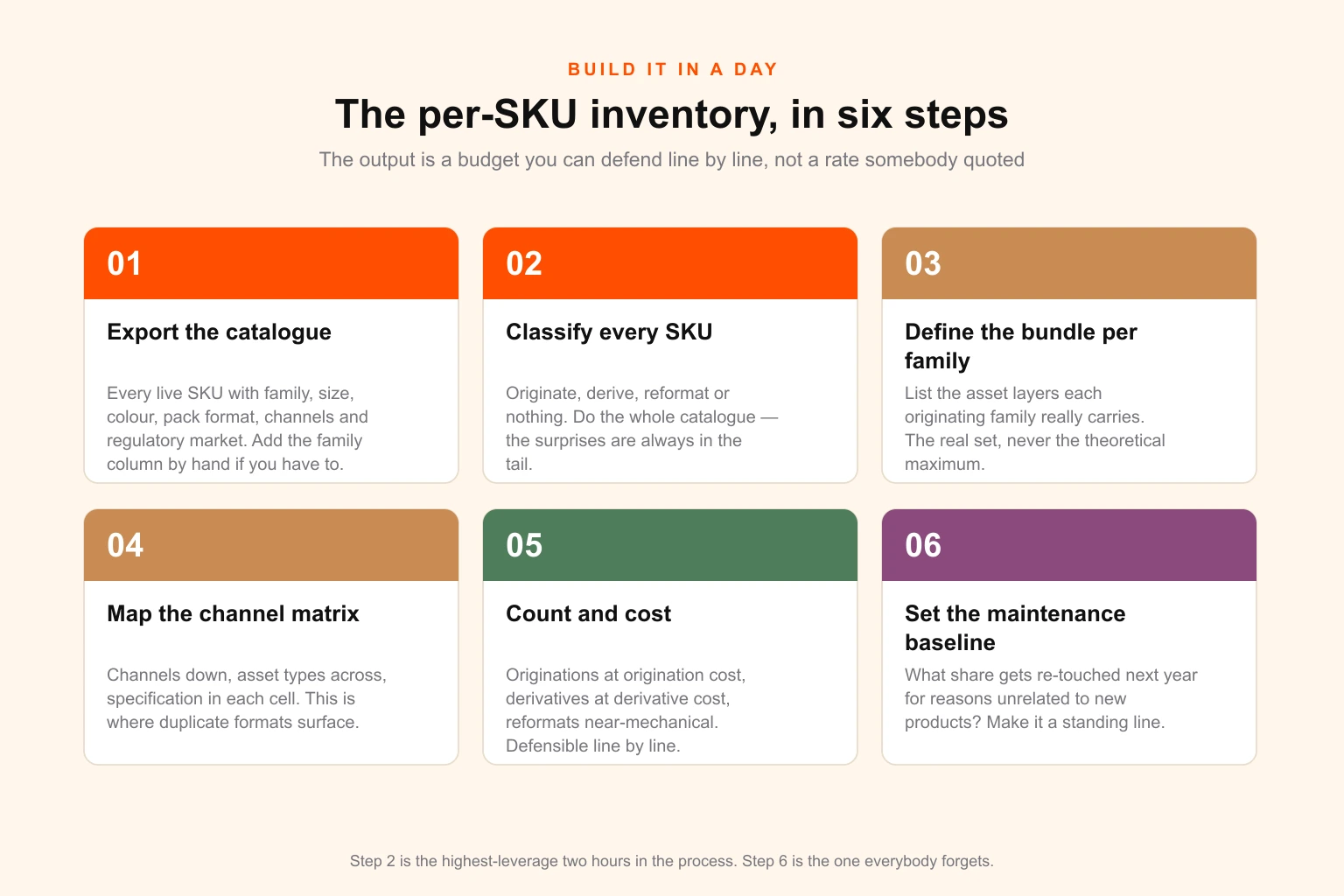
1. Export the catalogue. Every live SKU from the system of record, with product family, size, colour or flavour, pack format, channels sold on, and regulatory market. If your system cannot produce family, add the column manually — it is the axis everything else depends on.
2. Classify every SKU. Originate, derive, reformat or nothing. Do the whole catalogue; the surprises are in the tail. The count of originate items is the number you will budget origination against, and it will be far smaller than the SKU count.
3. Define the bundle per family. For each originating family, list the asset layers it actually carries. Not the theoretical maximum — the real one. A wholesale-only industrial part has no lifestyle photography and no social crops, and pretending otherwise inflates the budget into implausibility.
4. Map the channel matrix. Channels down one axis, asset types across the other. Fill in the specification for each intersection. This is where you discover the three formats nobody knew were required, and the four that duplicate each other and can be consolidated.
5. Count and cost. Multiply out. Originations at origination cost, derivatives at derivative cost, reformats at near-mechanical cost. You now have a build number that is defensible line by line rather than a per-SKU rate that is defensible nowhere.
6. Set the maintenance baseline. What proportion of the catalogue will be re-touched in the next twelve months for reasons unrelated to new products — regulatory change, seasonal editions, channel additions, refreshes? Put a number on it and add it as a standing line. If you have never measured it, look at what changed last year.
Where this exercise ends up looking familiar, that is not a coincidence: the same discipline drives the rebrand rollout inventory and the multi-property hotel asset inventory. Counting before committing is the whole method.
Sourcing the work once you know the number
The inventory produces a volume and a shape. Those two things, not a preference, should determine how you buy. One caveat if the work in question is changing artwork on SKUs that already exist rather than launching new ones: the design volume is only part of the bill, because tooling and obsolete stock are charged per SKU on top of it — the packaging refresh cost model covers that arithmetic.
Low volume, high variety, sporadic. Per-project purchase from specialists. A packaging designer for the structural work, a product photographer for the imagery. Accept that coordination is your job and that consistency will require your attention.
Steady volume, narrow discipline, predictable. An in-house hire starts to make sense — provided the work genuinely fits one skill set. Catalogue work usually does not, which is the recurring problem with this option; the in-house versus outsourced comparison works through the utilisation arithmetic properly.
Steady volume, wide discipline, bursty. This is where most product catalogues actually sit, and it is the hardest shape to staff. You need packaging literacy, retouching, marketplace format knowledge, print production and ad creative, arriving unevenly around launches and seasons. A capacity arrangement — how unlimited design works covers the mechanics, and whether it is worth it covers the cases where it is not — absorbs the peaks without carrying five salaries through the troughs.
Reselling design to your own clients. If you are an agency, printer or distributor producing catalogue work on behalf of product brands, the economics differ again and the relevant model is white-label production, where how to price outsourced design determines whether the margin survives.
Whichever route you take, the brief is what determines whether you get reusable masters or expensive one-offs. The design brief guide covers the general form; for catalogue work, the non-negotiable additions are layered editable masters, named variable regions, source files on delivery, and an explicit statement of every channel the asset must serve. Ownership of those files matters more than it seems — stock and font licensing both constrain what you may do with artwork across a print run and a merchandise line, and font licensing in particular catches product businesses out at exactly the point when the catalogue scales.
What to measure
Five numbers, quarterly. They take an hour to compile once the inventory exists.
Cost per design-distinct unit. Total origination spend divided by items originated. Should fall as the template system matures. If it is flat across two years, you are buying one-offs.
Assets per SKU. Finished files divided by live SKUs. Rising fast means channel sprawl is outpacing the catalogue, which is worth a deliberate decision rather than a drift.
Rework rate. Files revised for reasons other than a genuine change of mind, as a share of files delivered. Above roughly one in ten, the cause is upstream in specification, not downstream in execution.
Time from product-ready to listing-live. The only metric here with a direct revenue consequence. Track it per launch and look at the distribution rather than the average — the tail is where the losses are.
Template coverage. The share of requests fulfilled from an existing master rather than originated. The leading indicator for everything else, and the number to optimise if you only track one.
For wider context on what design spend looks like across the industry, the 2026 graphic design statistics roundup is a reasonable external benchmark — though your own four quarters of data will always beat somebody else's median.
The mistakes worth naming
Budgeting per SKU. The whole subject of this article. It over-states cost by a large multiple and makes reasonable catalogues look unaffordable.
Buying the cheapest first item in a family. You are buying a mechanism, not a panel. The saving on item one is repaid with interest on items two through fifteen.
Adding a channel without re-baselining. Every new channel applies retroactively to the entire catalogue. Cost it as 200 derivative sets, not as one integration.
Treating photography and graphics as one line. They are different suppliers with different skills, and the interface between them — where the overlay meets the shot — is where consistency is lost when nobody specified it.
Leaving maintenance out of the plan. It is not a contingency. It is a fifth to two-fifths of the catalogue every year, and it arrives whether or not you budgeted it.
No source files. A catalogue you cannot edit is a catalogue you will rebuild. Make deliverable source files a condition of the engagement, not a favour requested afterwards.
Start with the count
Nobody needs a strategy meeting to begin this. They need a spreadsheet and an afternoon.
Export the catalogue. Add a column for family. Sort every SKU into originate, derive, reformat or nothing. Count the originations. Multiply against the channels you actually sell on. That number — not the SKU count, not a per-item rate somebody quoted — is the real shape of your catalogue design cost, and it is almost always more affordable and more fixable than the fear it replaced.
Then fix the two things that cause most of the waste: write the per-family specification sheet before artwork begins, and insist on layered masters built for variation. Those two habits do more for a catalogue budget than any change of supplier.
If the count comes back larger than your current capacity can absorb — which for a 200-SKU catalogue across four channels it usually does — the useful next question is not who is cheapest per file, but which arrangement turns origination into derivation fastest. Digital Polo runs exactly this shape of work: packaging and label artwork, print-ready production, listing and social image sets, trade collateral and technical diagrams, produced as a system rather than a stack of invoices, on a flat monthly plan. The pricing page has the numbers, and a conversation about your catalogue will get you a real figure faster than another quarter of estimating.
Bring the count. It makes the conversation short.