A hotel can tell you how many mattresses it owns.
It can tell you the count to the unit, the age of each one, when it was last rotated and when it is due for replacement. Same for televisions, chairs, ice machines and air handlers. There is an asset register, someone owns it, and it is audited.
Now ask the same hotel how many branded printed items are in circulation on the property. Not roughly — exactly. Every menu across every outlet, every piece of in-room collateral, every sign, every card, sleeve, tag, hanger, folder and form carrying the property's name.
Almost nobody can answer. Not the general manager, not the director of marketing, not the owner, and usually not the franchisor either. The information does not exist in one place because no single role is accountable for it.
That is a tolerable state of affairs right up until the moment it is not, and the moment is always the same: something forces a reprint of everything at once. A flag change. A property improvement plan at franchise renewal. A brand refresh handed down with a compliance deadline. And then the property discovers its own inventory the hard way — one forgotten item at a time, over the following twelve months, each one arriving as a small urgent job at the worst possible unit price.

This is the list that should have existed beforehand. Every zone, what sits in it, who controls it, what it costs, how long it takes and how often it turns over.
Why this list does not exist anywhere
It is worth understanding the structural reason, because it explains why the problem survives competent management.
Start with the accounting. Printed collateral is almost always classified under OS&E — operating supplies and equipment — alongside linen, glassware and amenities. It is not FF&E, the capital register of furniture, fixtures and equipment. That classification is defensible: menus and key card sleeves genuinely are replenishable supplies.
But it has a consequence. OS&E is a procurement line, and procurement's job is unit cost and availability, not visual consistency. So the item gets reordered, forever, by whoever notices the box is empty, from whichever vendor supplied it last, using whatever artwork that vendor still has on file. Nobody in that loop is responsible for whether it still matches the brand.
Then layer on the ownership structure, which in hospitality is unusually fragmented. A single property can simultaneously involve:
- An owner who holds the real estate and signs off capital spend
- A management company running day-to-day operations
- A franchisor or brand licensor setting standards the property must meet
- Third-party operators running one or more F&B outlets, the spa, or retail under their own identities
- A rotating cast of local print and signage vendors, each holding a partial archive of artwork
Five parties, none of whom owns the whole list. The general manager owns the property. The brand owns the logo. Procurement owns the reorder. The restaurant operator owns the menu. Nobody owns the inventory.
This is not a hospitality-specific failure so much as an extreme case of a general one — the same structural gap shows up whenever brand guidelines define what things should look like without anyone defining what things exist.
The inventory, zone by zone
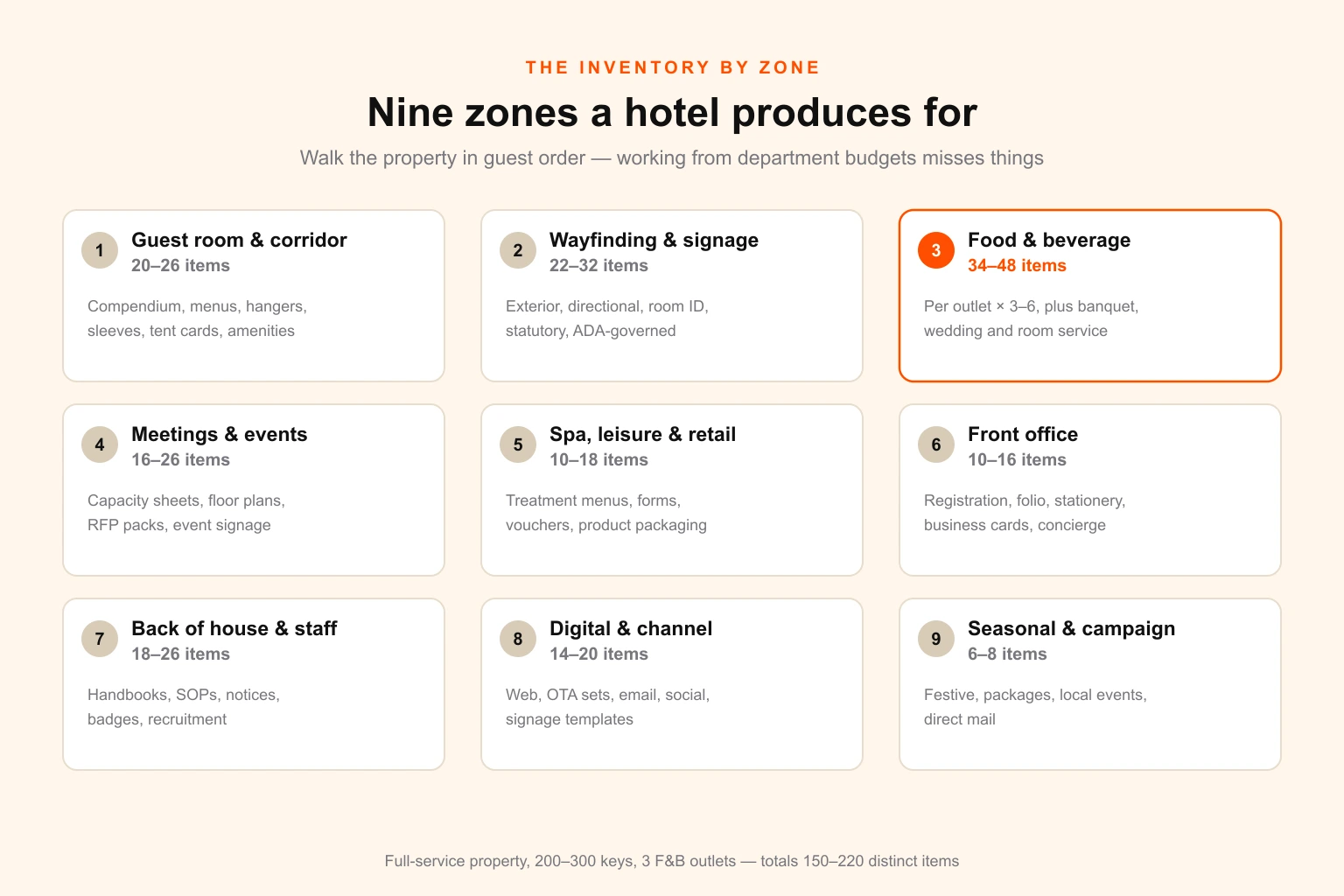
The most reliable way to build the list is to walk the property physically, in the order a guest experiences it, and write down every item carrying the brand. Working from department budgets misses things; walking finds them.
Zone 1 — Guest room and corridor
The zone people think of first, and typically only 15 to 20 per cent of the total.
- Compendium or guest directory (folder, book or card set)
- Room service and in-room dining menu
- Pillow menu, where offered
- Door hanger — do not disturb and service request, usually double-sided
- Key card and key card sleeve
- Notepad and pen
- Tent cards: sustainability and linen reuse, connectivity, dining promotion, spa promotion
- Laundry and dry cleaning list plus laundry bag
- Minibar list and price card
- Coffee and tea service card
- Television channel guide
- Welcome letter or VIP amenity card
- Comment or feedback card
- Fire evacuation notice, statutory, usually door-mounted
- Safe instruction card
- Shoeshine and valet bags
- Amenity packaging — soap, bath products, slippers, sewing kit
- Room number and tactile identification signage
- Turndown card, where turndown service operates
That is roughly 20 to 25 distinct items in a single room type — and a property with four room categories plus suites often runs variants of several of them.
Zone 2 — Wayfinding, statutory and exterior signage
The most expensive zone per item, the longest lead times, and the one most likely to derail a schedule.
- Exterior building identification, monument and pylon signage
- Porte-cochère and entrance identification
- Directional wayfinding — vehicular and pedestrian
- Parking, valet and loading identification
- Lobby directory and floor directories
- Lift lobby and floor-level identification
- Room identification with tactile characters and Braille
- Restroom identification, accessibility-compliant
- Meeting room and function space identification, plus changeable event boards
- F&B outlet exterior and threshold signage
- Pool, gym, spa and amenity identification with statutory notices
- Statutory and safety signage — occupancy, evacuation, capacity, licence display
- Back-of-house and service area identification
- Digital signage templates for lobby and function space screens
The compliance layer here is real and it constrains design before design starts. Under the 2010 ADA Standards, permanent room identification requires tactile characters with Grade 2 Braille, characters between 5/8 inch and 2 inches high in a sans serif face, non-glare finish, high contrast, mounted 48 to 60 inches above the finished floor to the baseline of the tactile characters, on the latch side of the door. That is not a stylistic guideline — it determines the manufacturing method, which determines the artwork format, which determines what the designer can do.
The other signage constraint is legibility at distance, which is a specification rather than a judgement call. The working rule is roughly one inch of cap height per ten feet of viewing distance, and it is worth checking wayfinding against it before fabrication rather than after — our sign letter height calculator does the arithmetic, and the full explanation of letter height and viewing distance covers where the rule breaks down.
Zone 3 — Food and beverage
Usually the largest zone by item count in any property with more than one outlet, and by far the fastest-churning.
Per outlet, and a full-service hotel commonly has three to six:
- A la carte menu, often in multiple covers or panels
- Breakfast menu, plus buffet identification cards
- Lunch, dinner and seasonal menus where separated
- Beverage, wine and cocktail lists
- Dessert and digestif menu
- Kids' menu and activity sheet
- Table tent promotions
- Coasters, napkin bands, cup sleeves, takeaway packaging
- Reserved and table number cards
- Allergen and dietary information inserts
- Outlet exterior menu display, weatherproofed
- Specials boards or digital menu templates
- Bill folder and check presenter
Then property-level F&B items on top: banquet and catering menus, the wedding and private dining pack, the seasonal festive menu set, room service, pool and beach service, and the minibar list.
Menus deserve their own note. They are the highest-frequency reprint in the building, they are the item most likely to be produced under time pressure, and they carry a compliance layer that is easy to design yourself into a corner on. Under FDA menu labeling rules, calorie information is required for restaurants and similar retail food establishments that are part of a chain of 20 or more locations trading under the same name with substantially the same menu — a single hotel restaurant usually sits outside this, a branded chain outlet inside a hotel often sits inside it. In the UK and EU, allergen information requirements apply regardless of scale. Either way, the layout has to reserve that space from the first version, because adding an allergen column to a finished menu is not an edit, it is a redesign. The fundamentals of menu layout still apply, and if any outlet operates as its own concept with local marketing, the growth patterns that work for food and beverage outlets are worth reading alongside.
Zone 4 — Meetings, events and catering
The zone with the highest revenue per asset and, almost always, the oldest-looking material in the building.
- Capacity charts and function space specification sheets
- Floor plans and room diagrams, per space and combined
- Meeting and events brochure or digital pack
- Day delegate and residential rate cards
- Banquet and catering menu suite
- Wedding pack — brochure, menus, planning documents
- Audio-visual capability sheet
- Digital and printed event signage templates, plus directional boards
- Table plans, place cards, menus for events
- RFP response templates and proposal covers
- Site inspection and familiarisation trip pack
- Post-event thank you and rebooking material
The reason this zone matters disproportionately is who sees it. A corporate booker or wedding planner comparing three properties is making a five- or six-figure decision from a PDF pack and a site visit. Dated capacity sheets and a proposal built in a word processor read as a signal about the property, fairly or not. This is a sales enablement problem dressed as a print job — closer to presentation and proposal design than to collateral — and it is where a modest design investment has the clearest revenue line. It also rewards a written brief, because the pack has to work unattended.
Zone 5 — Spa, wellness, leisure and retail
- Treatment menu and price list
- Consultation and health questionnaire forms
- Retail product labelling and packaging
- Gift voucher and gift card plus carrier
- Locker, robe and towel tags
- Pool and beach service material — menus, towel cards, safety notices
- Class and activity schedules
- Membership documentation and cards
- Kids' club material and consent forms
Retail packaging in particular tends to be treated as a procurement item rather than a brand item, which is how a property ends up with beautifully designed spa collateral and generic packaging on the products it sells. If the property retails its own line, the packaging and label side is a separate discipline from collateral and needs the dieline handled properly before anything gets quoted.
Zone 6 — Front office and guest services
- Registration cards and folio covers
- Business cards for management and sales staff
- Letterhead, second sheets, compliment slips and envelopes
- Invoice, receipt and folio templates
- Luggage tags and valet tickets
- Concierge material — local maps, recommendation cards, transport guides
- Loyalty programme collateral, where brand-supplied
- Group welcome packs and rooming list documents
- Lost property and incident forms
Zone 7 — Back of house, staff and HR
Invisible to guests, consistently the largest single count of documents, and almost never designed.
- Staff handbook and onboarding pack
- Training material and standard operating procedure documents
- Uniform specification and name badges
- Departmental notice and briefing templates
- Safety, hygiene and compliance notices
- Shift, rota and staff communication boards
- Recruitment material and careers collateral
- Staff canteen and welfare notices
The service standards a hotel sells depend entirely on staff who read and retain this material, and it is usually the worst-produced content in the building. The argument for treating it properly is the same one that applies to internal communications design generally, and the recruitment subset is a straightforward employer brand asset question in a sector with structurally high turnover.
Zone 8 — Digital, channel and social
- Website imagery, page templates and booking-flow assets
- OTA listing imagery, sized per channel, each with its own specification
- Pre-arrival, confirmation and post-stay email templates
- Social media templates per platform and format
- Paid advertising creative across formats and sizes
- Digital signage and in-lift screen templates
- Presentation and pitch deck templates
- App and connectivity assets, where operated
Channel image specifications are their own quiet tax. Each distribution partner wants different dimensions, crops and counts, and a photoshoot delivered as a folder of hero images rather than a properly cropped channel set generates weeks of downstream work. The economics of producing one asset in many shapes are covered in turning one campaign asset into fifteen channel formats, and email templates have their own rendering constraints that are worse in hospitality than most sectors because confirmation emails have to survive every client a guest might use.
Zone 9 — Seasonal and campaign
The layer that sits on top of everything else and is genuinely additive rather than a replacement.
- Festive and holiday campaign across menus, signage, in-room and digital
- Seasonal packages and promotional material
- Local event tie-ins
- Anniversary, opening and milestone material
- Direct mail to past guests and corporate accounts
Seasonal work is where properties most often discover their template system does not exist, because the festive campaign has to touch thirty items in six weeks.
What the count actually looks like
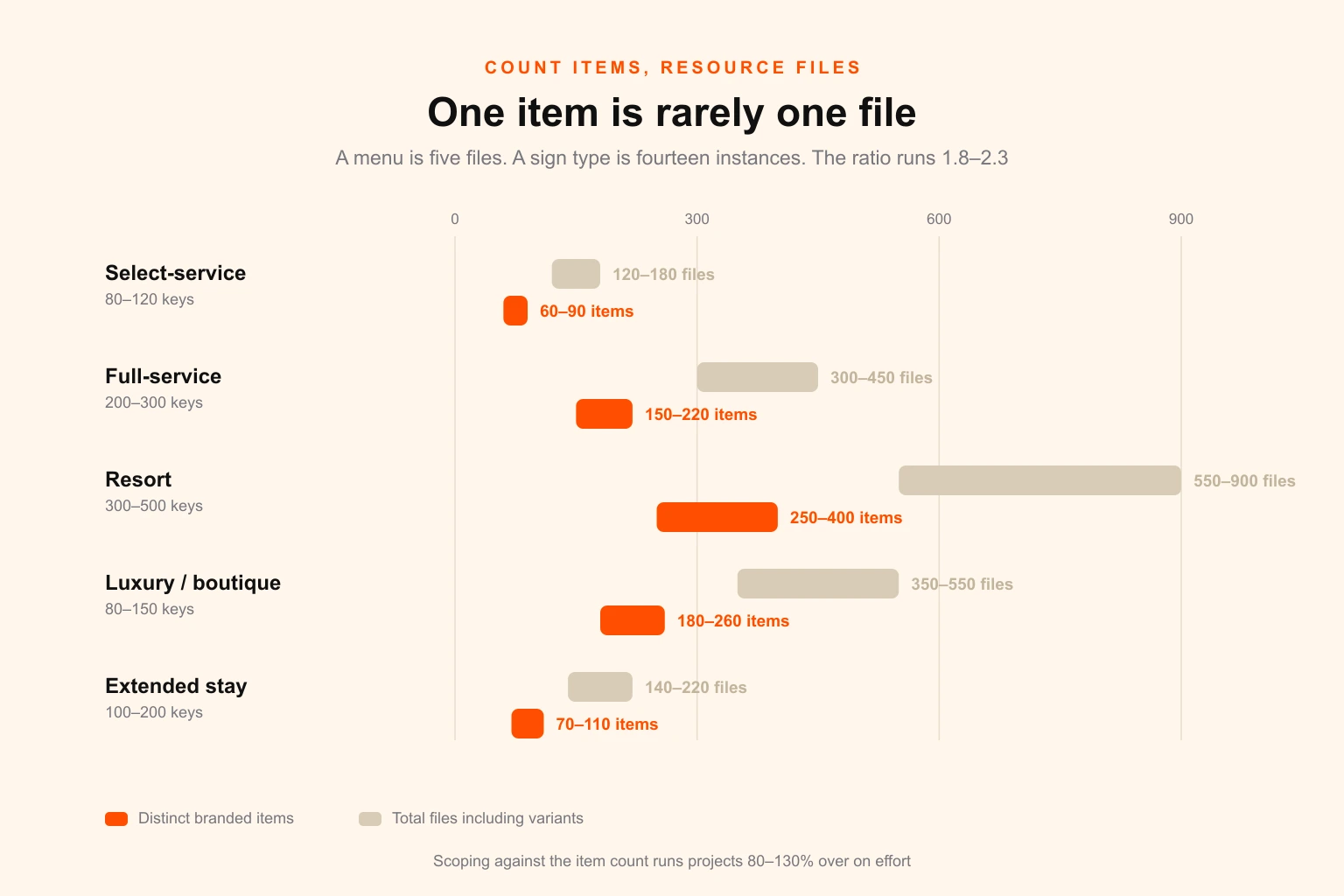
Counts scale with outlets and meeting space, not with keys. A 400-key select-service airport hotel with one bar and a breakfast room runs a smaller inventory than a 140-key boutique with three restaurants and a spa.
| Property type | Typical keys | Distinct branded items | Files including variants |
|---|---|---|---|
| Select-service, limited F&B | 80–120 | 60–90 | 120–180 |
| Full-service, 2–3 outlets | 200–300 | 150–220 | 300–450 |
| Resort, multi-outlet + spa + banqueting | 300–500 | 250–400 | 550–900 |
| Luxury / boutique, high detail per key | 80–150 | 180–260 | 350–550 |
| Extended stay / apart-hotel | 100–200 | 70–110 | 140–220 |
The right-hand column is the one that matters operationally and it is the one nobody estimates. A single menu is not one file — it is a print-ready PDF, a weatherproof display version, a web version, a PDF for the booking engine, and often a large-format version for a specials board. A door hanger is one item and two artwork faces. A wayfinding sign type is one design and fourteen instances with different text.
The ratio between items and files runs about 1.8 to 2.3 in practice. Budgeting against the item count and resourcing against the file count is the single most common planning error in a hotel rebrand.
Specifications worth fixing once
Most of the recurring pain in hotel collateral comes from specifications that were never written down, so every reorder re-litigates them. These are the ones worth settling permanently.
| Item | Typical format | Substrate and finish | Notes |
|---|---|---|---|
| Key card sleeve | 90 × 55 mm card, sleeve to suit | 300 gsm, matt lamination | High-volume consumable; order in bulk |
| Door hanger | 90–100 × 220–250 mm | 350 gsm, scuff-resistant | Double-sided, die-cut collar |
| Compendium | A5 or A4 folder or bound | Board with wipeable finish | Loose-leaf saves reprint cost |
| A la carte menu | A4 or slim 210 × 297 mm | 300–350 gsm, or insert in cover | Insert model for price churn |
| Outdoor menu display | A3 or A2 | Weatherproof, UV-stable | Fades fastest; plan replacement |
| Tent card | 100 × 150 mm folded | 350 gsm, scored | Check stability when folded |
| Wayfinding sign | Per sign type schedule | Aluminium, acrylic or vinyl | Cap height per viewing distance |
| Room identification | Per brand standard | Tactile + Grade 2 Braille | ADA-governed; non-negotiable |
| Event capacity sheet | A4 | 170 gsm or digital PDF | Keep digital as the master |
| Gift voucher | 210 × 99 mm | 350 gsm, numbered | Security and sequencing matter |
| Business card | 85 × 55 mm | 400 gsm | Highest per-person churn item |
Two decisions on that table save more money than everything else on it. Use insert-based menu covers wherever price or seasonality changes, so a price update reprints a sheet rather than a bound piece. And specify a single substrate set across the property rather than per-item, so runs can be batched with one vendor at better rates.
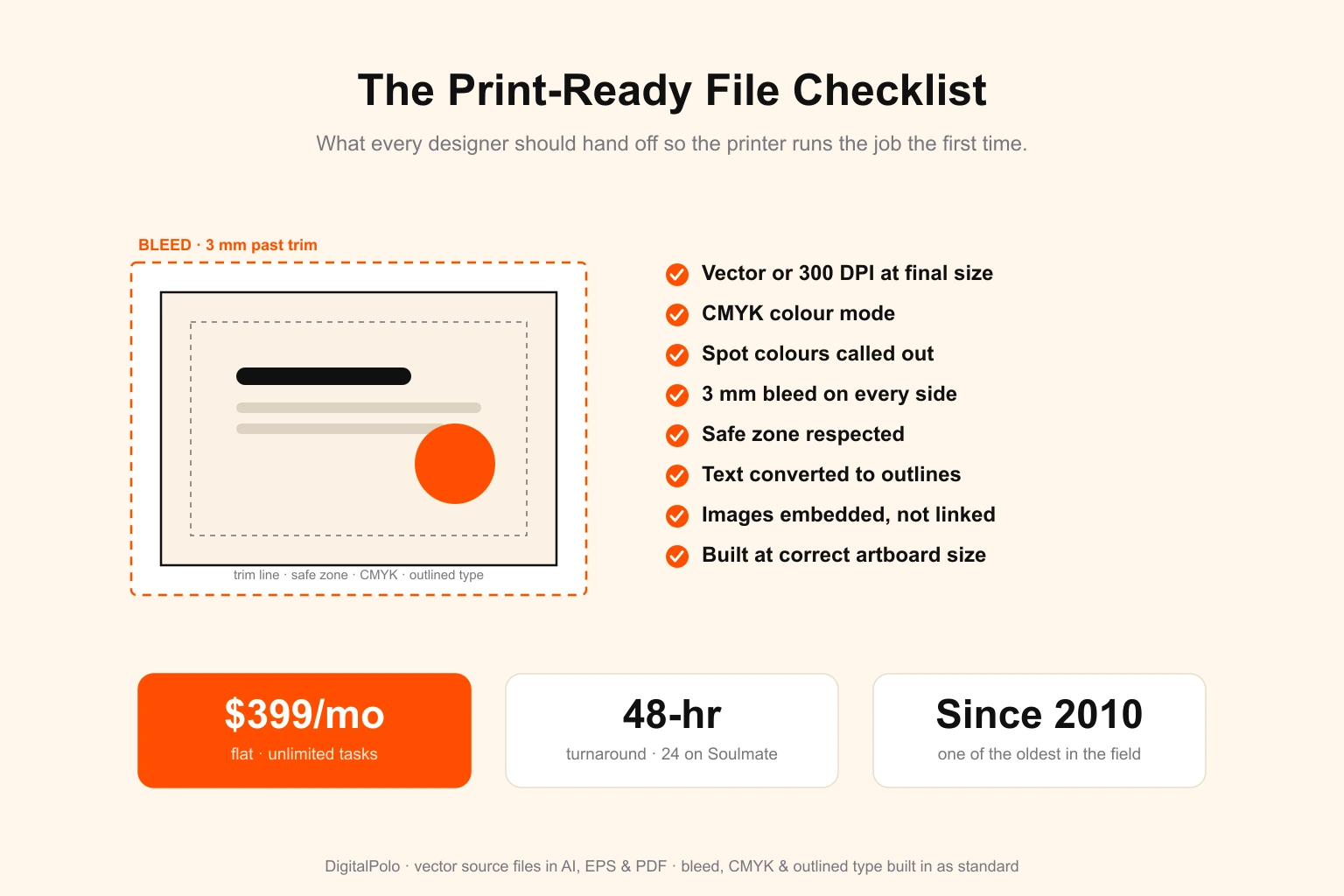
The other thing worth fixing once is the handoff. Hotels typically run four to eight print and signage vendors simultaneously, each with different preflight requirements, and files that go out inconsistently come back wrong. A single print-ready file checklist applied to every vendor eliminates most reprints — this is the core of what print-ready production means as a discipline — and pinning brand colours properly across coated, uncoated and vinyl — the Pantone to CMYK conversion tool is the starting point — is what stops the same brand colour arriving as three different colours on three substrates. That drift is the most common finding in a brand audit of a multi-outlet property.
Reprint cycles and lead times
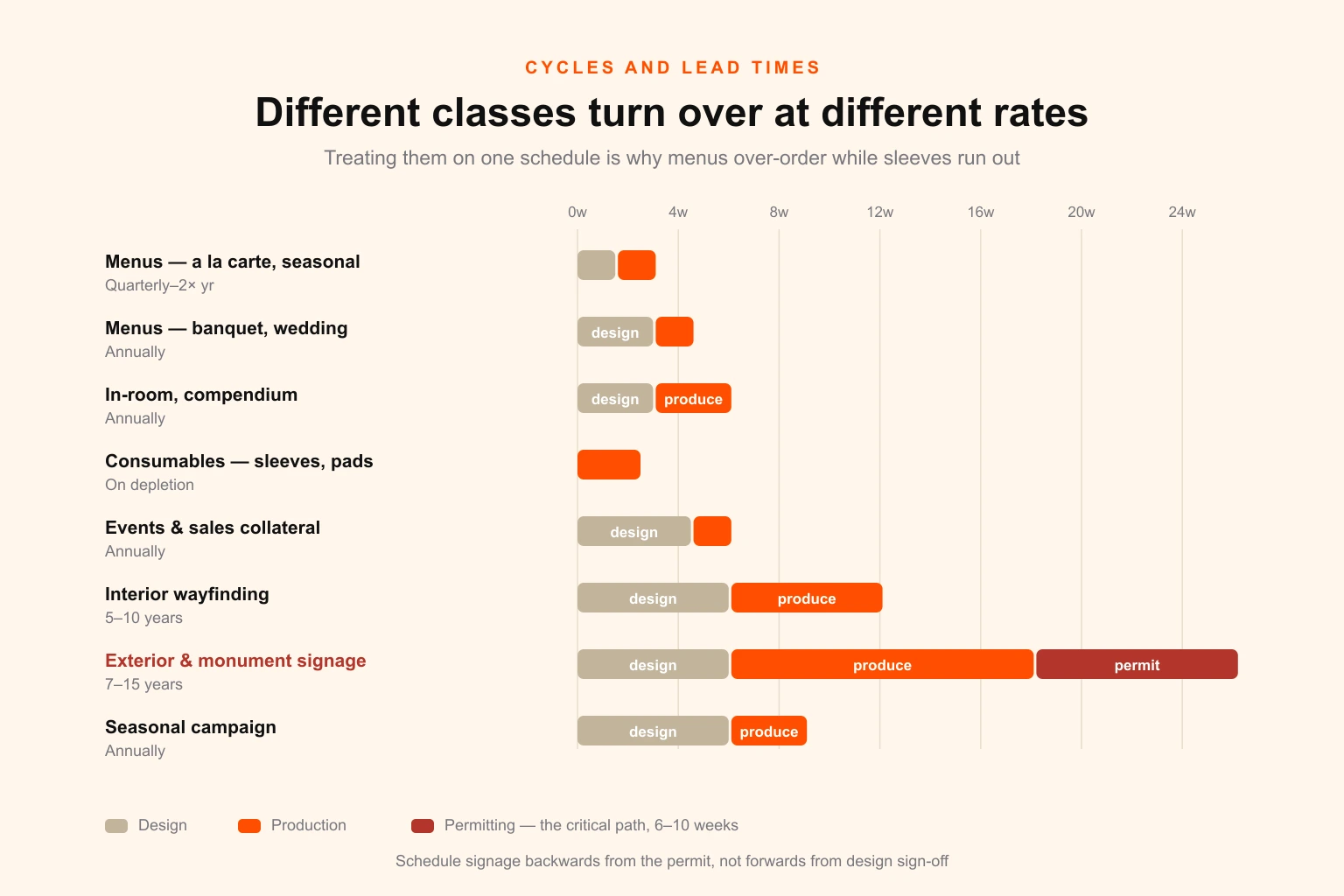
Different item classes turn over at completely different rates, and treating them on one schedule is why properties are simultaneously over-ordering menus and running out of key card sleeves.
| Item class | Reprint frequency | Design lead time | Production lead time |
|---|---|---|---|
| Menus — a la carte, seasonal | Quarterly to twice yearly | 3–10 days | 5–10 days |
| Menus — banquet, wedding pack | Annually | 2–4 weeks | 1–2 weeks |
| In-room collateral, compendium | Annually, reviewed twice | 2–4 weeks | 2–4 weeks |
| Consumables — sleeves, hangers, pads | On depletion, 2–4× yearly | None once locked | 2–3 weeks |
| Events and sales collateral | Annually | 3–6 weeks | 1–2 weeks |
| Interior wayfinding | 5–10 years | 4–8 weeks | 4–8 weeks |
| Exterior and monument signage | 7–15 years | 4–8 weeks | 8–16 weeks + permits |
| Digital and channel templates | Continuous | 2–4 weeks initial | Immediate |
| Seasonal campaign | Annually | 4–8 weeks | 2–4 weeks |
Signage is the row that breaks schedules. Municipal sign permitting commonly runs six to ten weeks on its own and is frequently the critical path for an opening or a conversion — longer in heritage or conservation contexts, where the design itself may need to change to secure approval. Signage should be scheduled backwards from the permit, not forwards from design sign-off.
The operational fix is a single reprint calendar per property, holding every item, its cycle, its last order date and its vendor. Batching turns a year of individually urgent small orders into four or five consolidated ones, which is worth 20 to 35 per cent on print spend before anyone negotiates a rate.
The brand-controlled and property-controlled split
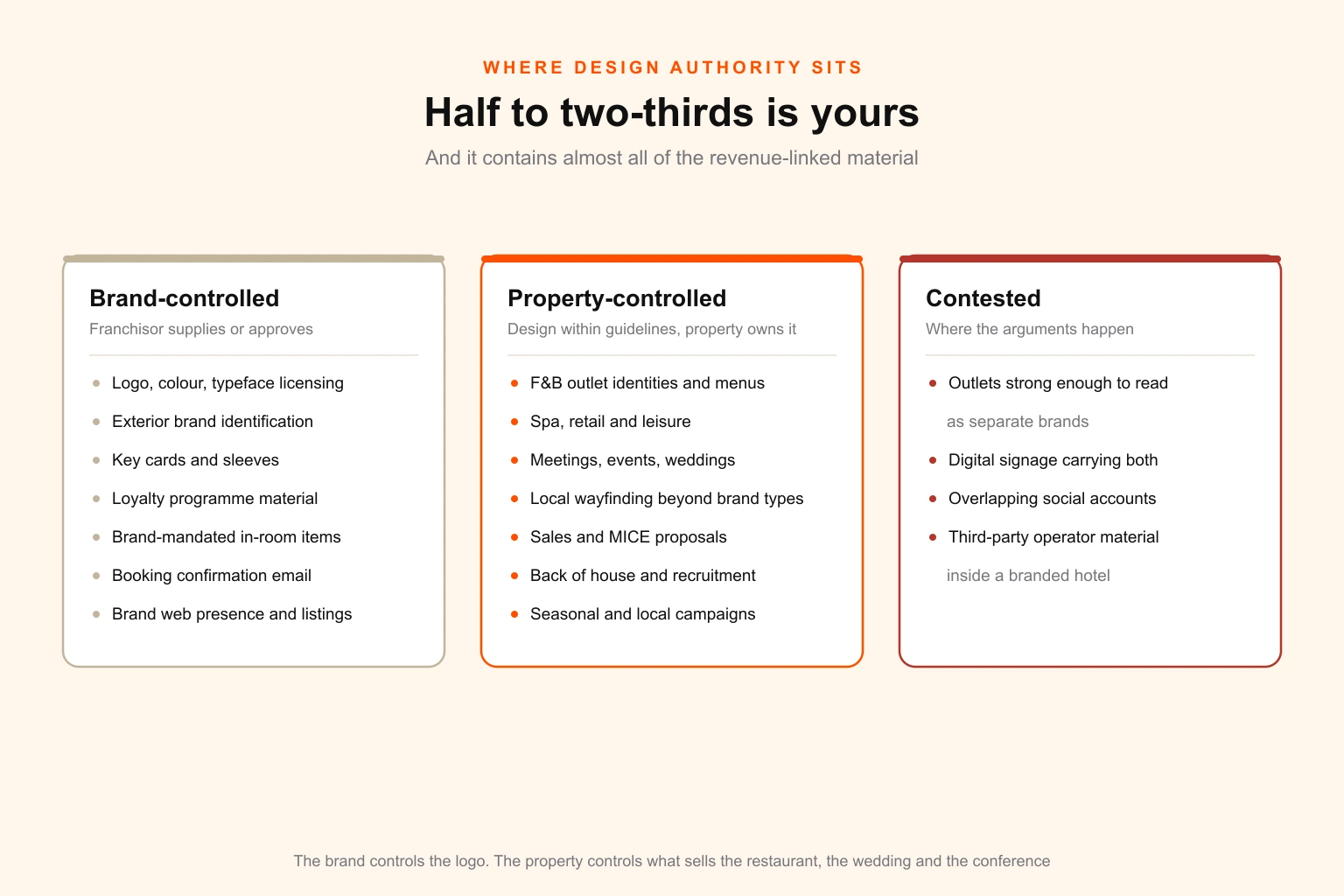
For any flagged property, every item on the inventory falls on one side of a line drawn in the franchise agreement and detailed in the brand standards manual. Knowing which side an item sits on before design starts saves an enormous amount of rework.
Typically brand-controlled — the franchisor supplies templates or artwork, approves usage, and the property has little or no latitude:
- Logo, wordmark, colour system and typeface licensing
- Exterior identification and brand signage specification
- Key cards and key card sleeves carrying brand identity
- Loyalty programme material
- Brand-standard in-room items where the brand mandates them
- Booking confirmation and brand-sent guest email
- Brand website presence and listing content
Typically property-controlled — the property designs within brand guidelines but owns the outcome:
- F&B outlet identities, menus and outlet collateral
- Spa, retail and leisure material
- Meetings, events and wedding collateral
- Local wayfinding beyond brand-mandated types
- Sales and MICE proposal material
- Back-of-house, staff and recruitment material
- Local marketing, seasonal campaigns and direct mail
Outlet identities are the interesting case in that second list. A hotel restaurant with its own name, its own local following and its own social presence is functionally a separate brand identity operating inside a branded building, and it needs to be designed as one rather than as a menu with a logo on it.
Contested in practice — the items that generate the arguments:
- Restaurant identities that are strong enough to read as separate brands
- Digital signage carrying both brand and outlet content
- Social channels where property and brand accounts overlap
- Anything a third-party operator produces under its own identity inside a branded hotel
Independent and soft-branded properties control everything, which is why independents typically have larger design requirements per key than flagged properties of the same size — there is no template pack arriving from a franchisor.
The practical takeaway: a flagged property has real design authority over roughly half to two-thirds of its own inventory, and that portion contains almost all of the revenue-linked material. The brand controls the logo. The property controls what sells the restaurant, the wedding and the conference.
What forces everything at once
Routine churn is manageable. The events that convert a manageable inventory into a crisis are these, in rough order of severity.
Brand conversion or flag change. Everything guest-facing changes, on the franchisor's timetable, with a deadline that is usually contractual. This is the largest single collateral event a property will ever experience.
Property improvement plan. Triggered at franchise renewal or change of ownership. PIPs are usually discussed in terms of soft goods and capital works, but they routinely mandate signage and public-area material, and the collateral implications are frequently costed late.
Brand refresh from the franchisor. The brand updates its identity and pushes the change down with a compliance window. The property did not choose the timing and pays for the subset it owns.
F&B concept change. The most frequent trigger by a wide margin, because restaurants are re-concepted far more often than hotels are rebranded. One outlet changing concept can replace 40 to 70 items on its own.
Regulatory change. Allergen rules, accessibility requirements, fire and safety notices, licensing display. Non-negotiable, usually deadlined, and easy to miss until it is urgent.
Ownership or management company change. Rarely mandates a visual change directly, but almost always triggers an audit that surfaces every inconsistency accumulated over the prior decade.
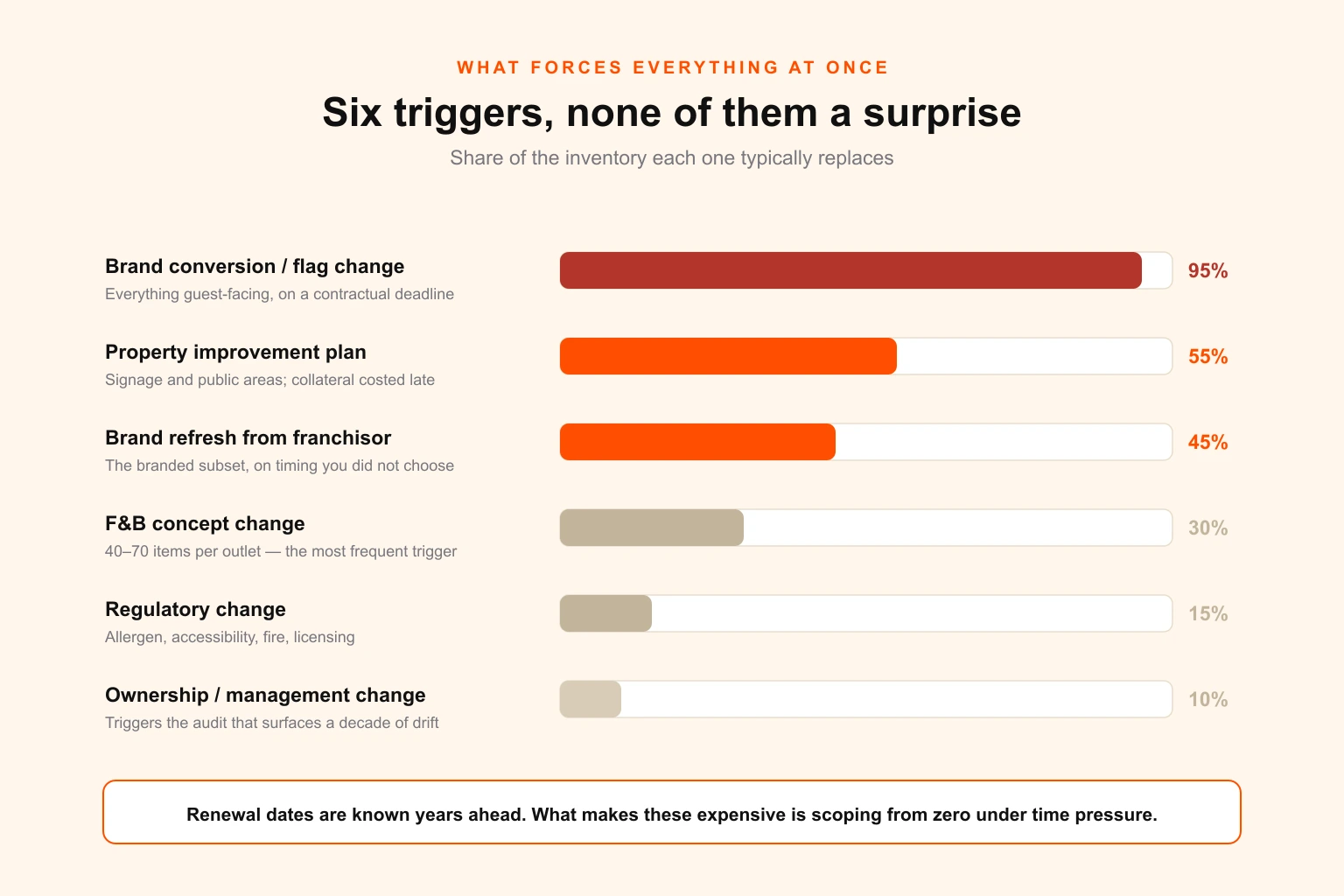
The pattern worth internalising: none of these are surprises. Franchise renewal dates are known years ahead. PIP timing is knowable. Concept changes are planned internally long before they are announced. What makes them expensive is not that they happen — it is that the inventory does not exist when they do, so the scoping starts from zero under time pressure. The rebrand rollout sequencing is well understood as a discipline; hotels just tend to enter it without a list. The same 90-day rollout structure used after a funding round applies almost unchanged to a flag conversion.
What it costs
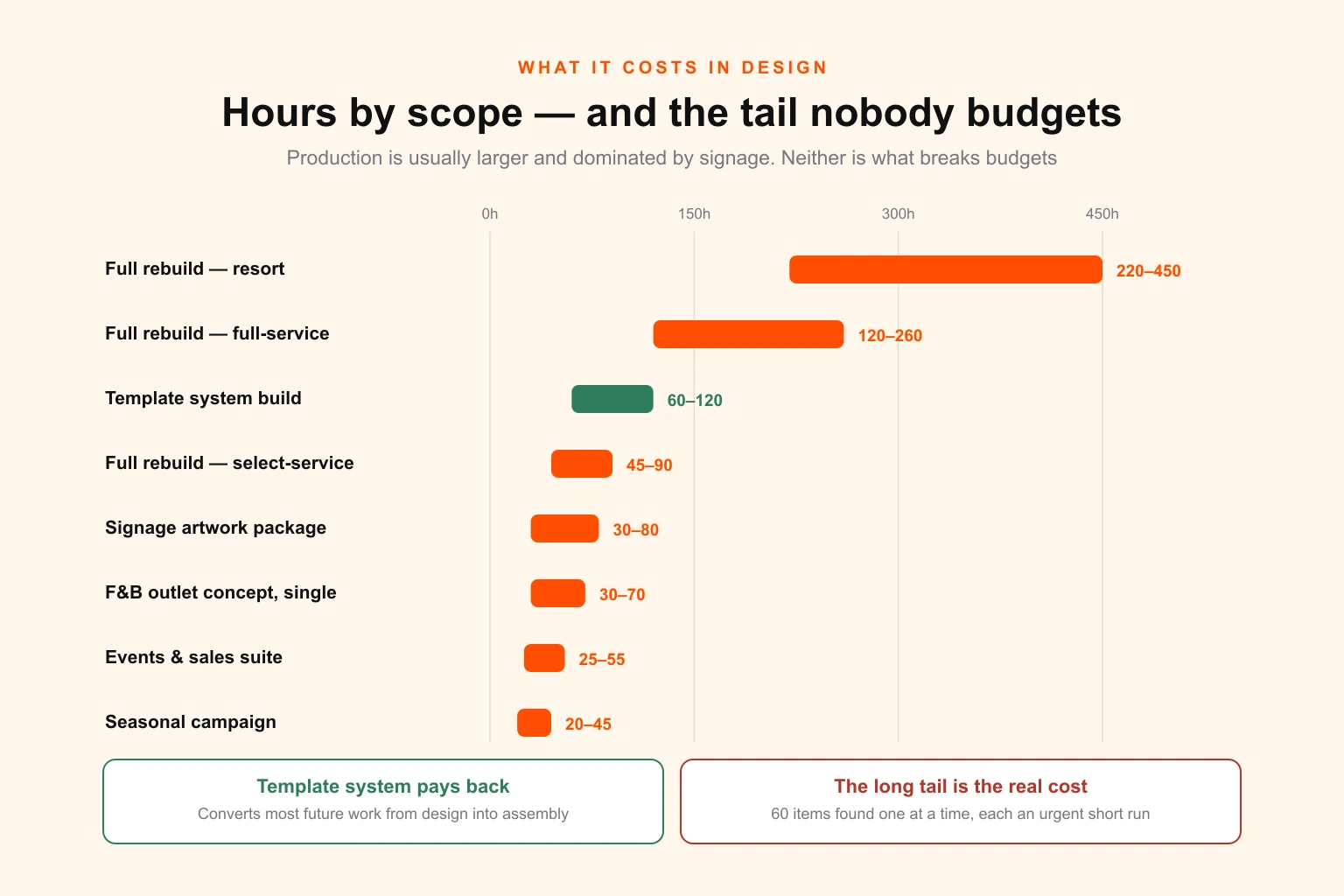
Separate design from production, because they scale differently and are budgeted by different people.
| Scope | Design hours | Notes |
|---|---|---|
| Full guest-facing rebuild, select-service | 45–90 | Smaller inventory, more brand-supplied |
| Full guest-facing rebuild, full-service | 120–260 | Menu set across outlets dominates |
| Full guest-facing rebuild, resort | 220–450 | Multi-outlet, spa, retail, banqueting |
| F&B outlet concept, single outlet | 30–70 | Identity plus full menu suite |
| Events and sales collateral suite | 25–55 | Highest revenue leverage per hour |
| Template system build, per property | 60–120 | Front-loaded; removes most future cost |
| Seasonal campaign across zones | 20–45 | Recurs annually |
| Signage artwork package | 30–80 | Excludes survey and fabrication |
Those hour ranges convert to money differently depending on how the work is resourced — what design actually costs by engagement model covers the spread between agency, freelance and retained rates. Production is usually the larger number and is dominated by signage, which can exceed the print budget for everything else combined at a full-service property. But the cost that actually damages budgets is neither line: it is the long tail. The items nobody inventoried, found one at a time over the following year, each needing its own origination and a short run at the worst unit price. A property that scopes 150 items and discovers 60 more over twelve months does not pay 40 per cent more — it pays substantially more than that, because the discovered items arrive as urgent single jobs rather than batched runs.
Which is the whole argument for building the inventory before the trigger rather than during it.
The other structural cost is the template question. A property that rebuilds collateral without a template system pays close to full design cost again at the next trigger. A property that invests 60 to 120 hours in a proper template system — locked layouts, a defined component set, one production specification per substrate — converts most future work from design into assembly. At group scale the difference compounds hard: fifteen properties solving the same problem separately is fifteen times the cost of solving it once and localising, and the economics of a template system versus bespoke production is the same arithmetic in every sector that has run it.
Mistakes worth naming
Counting items instead of files. The single most common scoping error. One menu is five files. One sign type is fourteen instances. Budget against the file count or the project runs 80 to 130 per cent over on effort.
Treating signage as a design deliverable. Signage is a permitting, fabrication and compliance workflow with a design component. Scheduling it like print is how opening dates slip.
Letting vendors hold the master files. Properties routinely discover during a rebrand that the only current artwork for six items lives on a print vendor's server, sometimes a vendor no longer used. Master files belong to the property, in one place, with the working source and not just the output PDF. The related trap is typeface licensing, which for a hotel needs to cover print, web, digital signage and use by third-party print vendors — and frequently covers only the first.
Designing menus without reserving compliance space. Allergen and nutritional information added after the layout is finished turns a price update into a redesign. Reserve it in version one.
Ignoring back of house. The largest document count in the building, produced worst, read by the people delivering the service standard the property is selling.
Assuming the brand pack covers it. A franchisor's template pack covers brand-controlled items. It does not cover the restaurant, the spa, the wedding pack or the sales collateral — which is most of what actually drives revenue. Properties frequently discover this after assuming otherwise.
Rebranding without an inventory. Everything above, at once, on a contractual deadline.
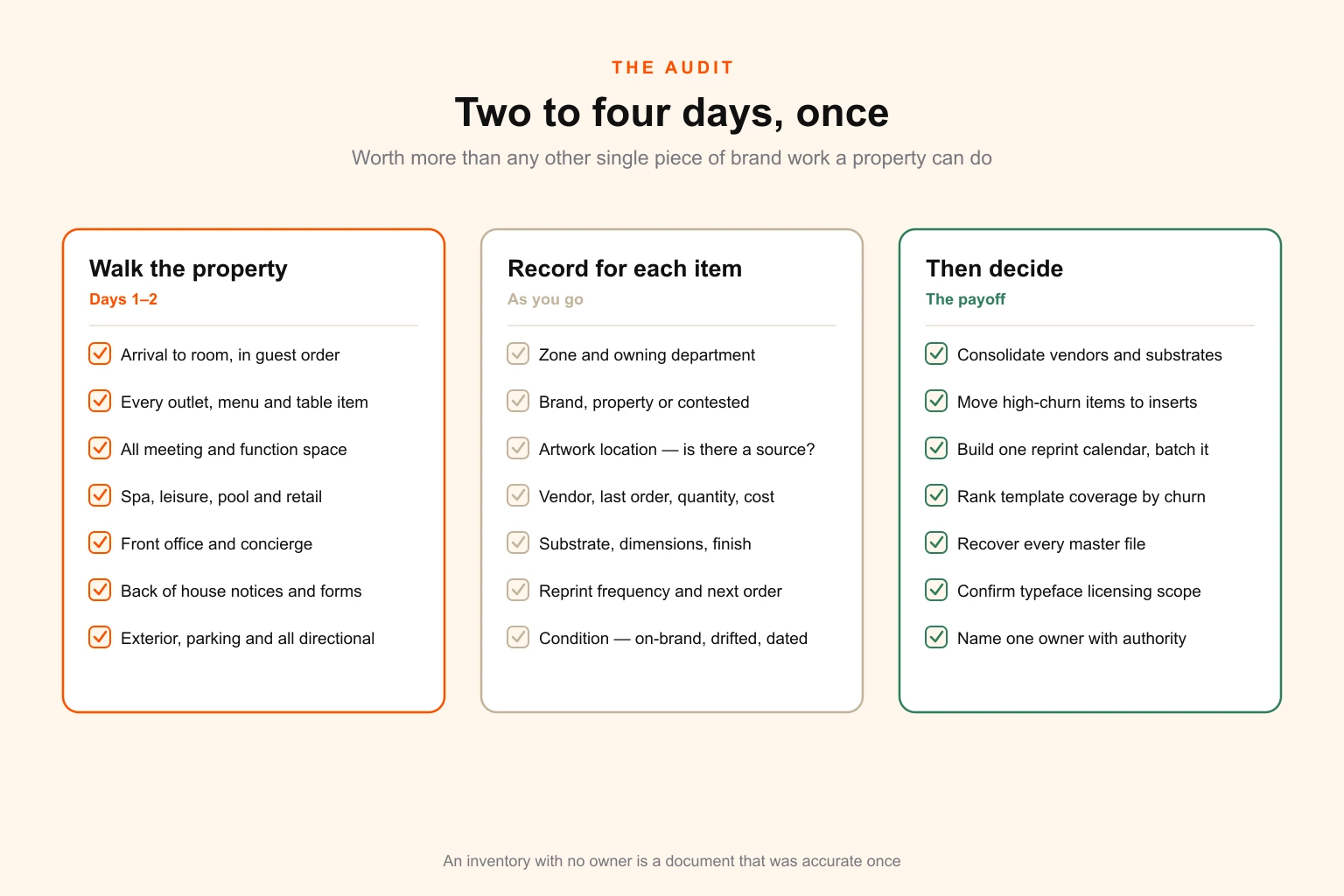
The audit checklist
If a property has never done this, it takes two to four days and is worth more than any other single piece of brand work.
Walk the property — days 1–2
- Guest arrival to room, recording every branded item in order
- Every F&B outlet, every menu and every table item, including outdoor displays
- All meeting and function space, including signage and capacity material
- Spa, leisure, pool and retail, including packaging and forms
- Front office, concierge and guest services
- Back of house — notices, forms, training and staff areas
- Exterior — approach, parking, monument, entrance, all directional signage
Record for each item
- Item name, zone and owning department
- Brand-controlled, property-controlled or contested
- Current artwork location and format, and whether the working source exists
- Vendor, last order date, quantity and unit cost
- Substrate, dimensions and finish
- Reprint frequency and next expected order
- Condition — on-brand, drifted, or visibly dated
Then decide
- Consolidate the vendor list and standardise substrates across items
- Move high-churn items to an insert or modular format
- Build one reprint calendar and batch orders against it
- Identify what a template system should cover, ranked by churn rate
- Recover every master file into a single owned location
- Confirm typeface licensing covers print, digital, signage and vendor use
- Name one owner of the inventory, with the authority to approve artwork
That last item is the one that determines whether any of the rest survives. An inventory with no owner is a document that was accurate once.
Where this usually lands
The sequence repeats with enough consistency to predict.
A property opens or converts with a complete, coherent set of material. For the first year or two it holds. Then a menu changes and gets reprinted by whoever was free. An outlet re-concepts. A sign gets replaced by a local vendor working from a JPEG. Marketing produces a seasonal campaign in a template tool. A new sales manager rebuilds the capacity sheets in a word processor because the originals could not be found.
None of that is negligence. Each individual decision was reasonable under the constraints of the day. But four years on, the property is running three versions of its own logo, brand colour arrives differently on three substrates, half the master files exist only on vendor servers, and nobody can produce a list of what exists.
Then the franchise renewal lands, or the flag changes, or a PIP arrives — and the scoping starts from nothing, under a deadline, with the discovery happening in parallel with the production.
The fix is not more diligence from operators who are already fully occupied running a hotel. It is two artefacts and one decision: an inventory that exists, a template system that converts most future work into assembly, and one named owner with authority over artwork. Build those and the triggers stop being crises — a flag change becomes a scheduled project against a known list, and seasonal churn stops consuming design time at all.
That shape of work — a front-loaded build, then steady capacity for the churn, without a headcount — is what a design partnership is structured for, and hospitality is close to a textbook case: predictable recurring volume, sharp seasonal peaks, multi-substrate print output, and a large templatable majority. Our pricing covers the ongoing side, and if the immediate need is narrower — the inventory audited and the template set built once against it — that is a defined project rather than a relationship. Tell us what the property runs on and we will scope it against the actual list.
A hotel knows how many mattresses it owns. It should know this too.