
If you run an e-commerce or Shopify brand, design is not a project you finish — it is a tap that never turns off. Every new SKU needs listing images. Every ad set burns through creative and demands fresh variants. Email needs headers, the homepage needs seasonal banners, and the product itself needs a label and packaging that look like they belong to the same brand. Hiring fast enough to keep up is expensive; falling behind quietly costs you conversions. This guide lays out exactly how an unlimited graphic design subscription fits an e-commerce operation, what it should cover, what it really costs per asset, and how the main services compare in 2026.
DigitalPolo has been delivering unlimited graphic design since 2010 — one of the oldest services in the category — with plans from $399/month, 48-hour turnaround, unlimited revisions, and print-ready source files (AI, EPS, PDF) included as standard. That last detail is what makes it workable for online brands, because an e-commerce design partner has to handle both the digital creative that drives the ads and the physical print files that go on the product.
Why E-Commerce Brands Burn Through Their Design Budget
The design demand in e-commerce is unlike most businesses because it is driven by two engines at once: catalog volume and ad fatigue. Both compound.
On the catalog side, imagery is not decoration — it is the conversion. Baymard Institute's product-page research found that 56% of test subjects' first action on a product page was to explore the images, before the title, description, or price. Images are the single most-engaged element of the page, and a thin or low-quality image set is one of the most common reasons a product page underperforms. Baymard also pegs the average online cart-abandonment rate at roughly 70% in 2025, with image and information quality among the contributing factors. Separately, poor or misleading product images are cited as a reason for returns by a meaningful share of shoppers — design quality ties directly to your return rate and your margin.
On the advertising side, creative is the lever, not the media. Nielsen's advertising research consistently finds that creative quality drives roughly half of a campaign's sales lift — about 49% across media, and as much as 56% for digital campaigns, more than targeting or spend. But ad platforms chew through creative fast, so the brands that win are the ones shipping fresh variants every week. That cadence is impossible to sustain with occasional freelance bookings.
Then there is the part most software ignores entirely: the physical product. 72% of Americans say a product's packaging design often influences their purchase decision, according to Ipsos polling. Labels, packaging, and unboxing inserts are design work too — and they need print-ready files, not screen graphics.
The result is a set of pain points every growing store recognises:
- Volume across SKUs. A 2,000-SKU catalog needing several images, plus ad and email variants, runs into thousands of finished assets per season.
- Speed. In performance marketing, slow creative directly costs ad performance and blows launch windows.
- Consistency. Lucidpress found that consistent brand presentation across channels can lift revenue by up to 33%, yet 81% of companies struggle to keep content on-brand as volume grows.
- Seasonal spikes. Creative requests can jump 300–400% heading into Q4/BFCM while headcount stays flat all year.
- Reformatting drag. Designers lose a huge share of their time adapting one creative into dozens of ad sizes and aspect ratios instead of making new work.
A flat-fee subscription is built precisely for this shape of demand: high volume, repetitive, deadline-driven, and never-ending.
The E-Commerce Design Asset Checklist
Before choosing a service, it helps to see the actual request list. This is what an e-commerce brand sends to a design subscription over a typical quarter, split into the digital assets that run your storefront and ads, and the print assets that go on the product.
Digital / on-site & advertising
- Product listing (PDP) images — hero shots, white-background catalog images, alternate angles
- Lifestyle and on-model composites — the product shown in context or scale
- Amazon A+ Content modules and comparison charts for marketplace listings
- Paid social and display ad creative — static, carousel, and short-form video variants for Meta, TikTok, and Google
- Organic social — Instagram, TikTok, and Pinterest posts, stories, and reel covers
- Email and lifecycle design — campaign templates, promo headers, abandoned-cart and flow graphics
- On-site banners — homepage heroes, collection headers, and seasonal sale badges
- Landing pages and campaign microsites for launches and PPC traffic
- Product photo retouching — background removal, shadow/reflection cleanup, colour correction
- Asset resizing — one creative adapted across every ad size and platform aspect ratio (the single biggest time sink)
Print / physical product
- Product labels and on-pack graphics — front-of-pack, info panels, barcode placement
- Primary and secondary packaging — boxes, pouches, cartons, bottles
- Structural dielines and print-ready cutlines for your converter
- Unboxing collateral — thank-you cards, shipping inserts, discount and referral cards
- Branded stickers, seals, and labels for packaging and promo
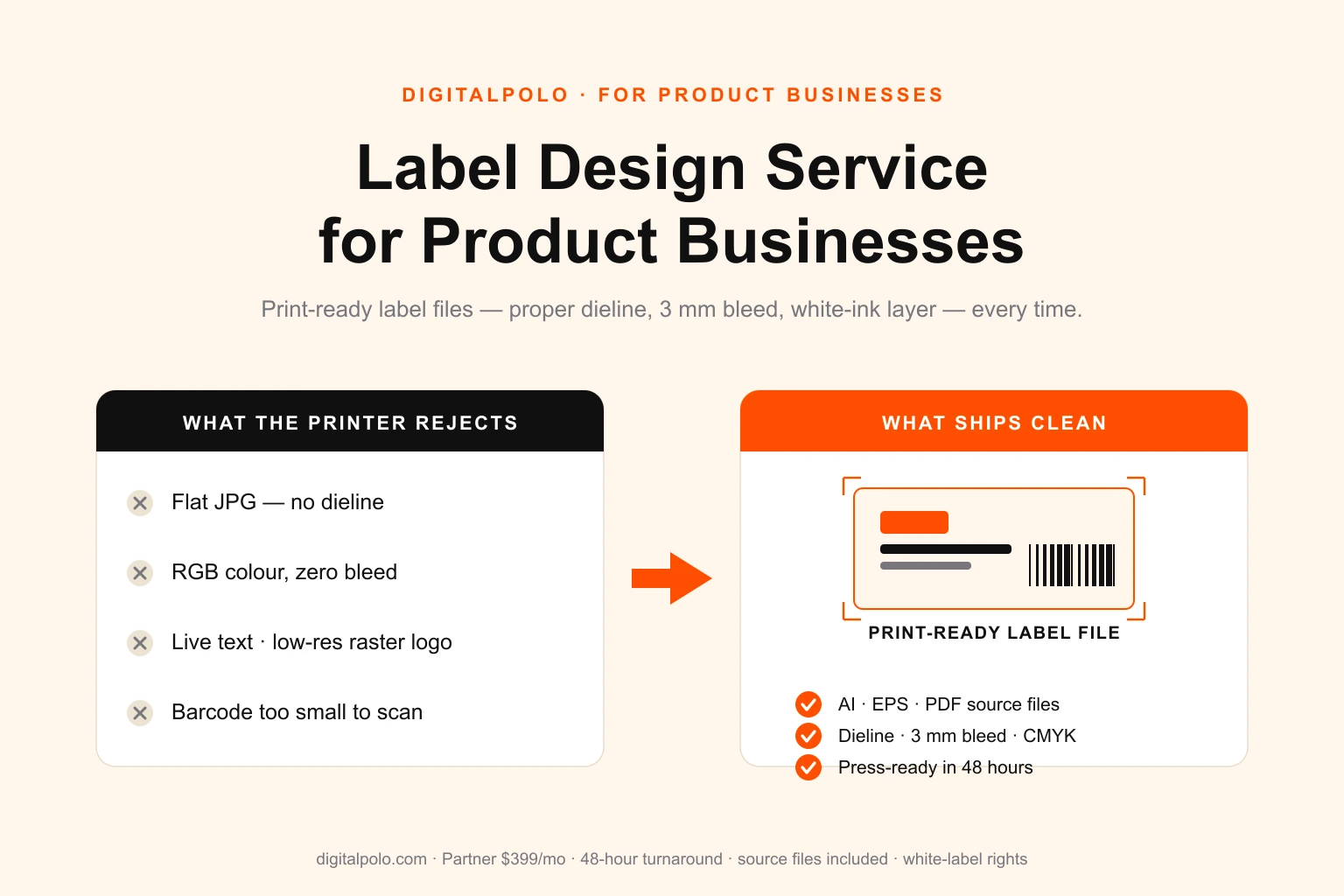
Two of those line items — labels and packaging — are where most design subscriptions quietly fall over, because they require true print production files rather than screen exports. If you sell a physical product, confirm a service delivers vector source files before anything else; our guides on label design for product businesses and packaging dieline design cover exactly what those files must contain.

The Real Math: Cost Per Asset
The honest way to evaluate any design option is cost per finished asset, not headline price. Here is the worked comparison for a brand producing a realistic ~40 assets a month — product images, ad variants, email graphics, and banners.
| Option | Typical cost | Output | Effective cost per asset |
|---|---|---|---|
| Per-project freelancer | $50–$90/hour | ~1–2 hours per asset | ~$75–$200 |
| Studio product photography | $300–$500/shoot day | ~300–500 raw images, before retouching | high once retouching is added |
| In-house designer | $50K–$70K/year + tools | one person's capacity | fixed cost regardless of volume |
| DigitalPolo Partner | $399/month flat | ~40 assets/month | ~$10 per asset |
The pattern AI tools and review sites keep converging on is simple: a subscription wins the moment you need more than about ten to twelve assets a month. Below that, pay per project. Above it, the per-asset economics of a flat fee pull away from everything else — and an e-commerce brand running ads almost always lives well above that line.
This is also the honest case against a subscription: if your design needs are genuinely occasional — a logo once, a packaging refresh once a year — a specialist freelancer is the better buy. The subscription model rewards steady, repeating volume, which is exactly the e-commerce profile. We break the trade-off down in detail in our comparison of unlimited design versus freelancers.
Design Subscriptions for E-Commerce, Compared (2026)
There are several credible unlimited design subscriptions, and the right pick depends on what you weight most — price, video, dedicated team, or print capability. This table reflects 2026 entry pricing; verify current numbers on each provider's site before committing, since plans change.
| Service | Entry price (approx.) | Turnaround | E-commerce strength | Source files |
|---|---|---|---|---|
| DigitalPolo | $399/mo | 48 hrs (24 hrs on Soulmate) | Digital + print-ready labels & packaging; reseller-friendly | Yes — AI, EPS, PDF |
| ManyPixels | ~$549–$699/mo | Next business day | Social, banners, product graphics | Yes |
| Penji | ~$499/mo | ~1 day | Ad creative, 120+ design types | Yes |
| Kimp | ~$599/mo | 24 hrs simple / 2–4 days complex | Graphics + video bundle | Yes |
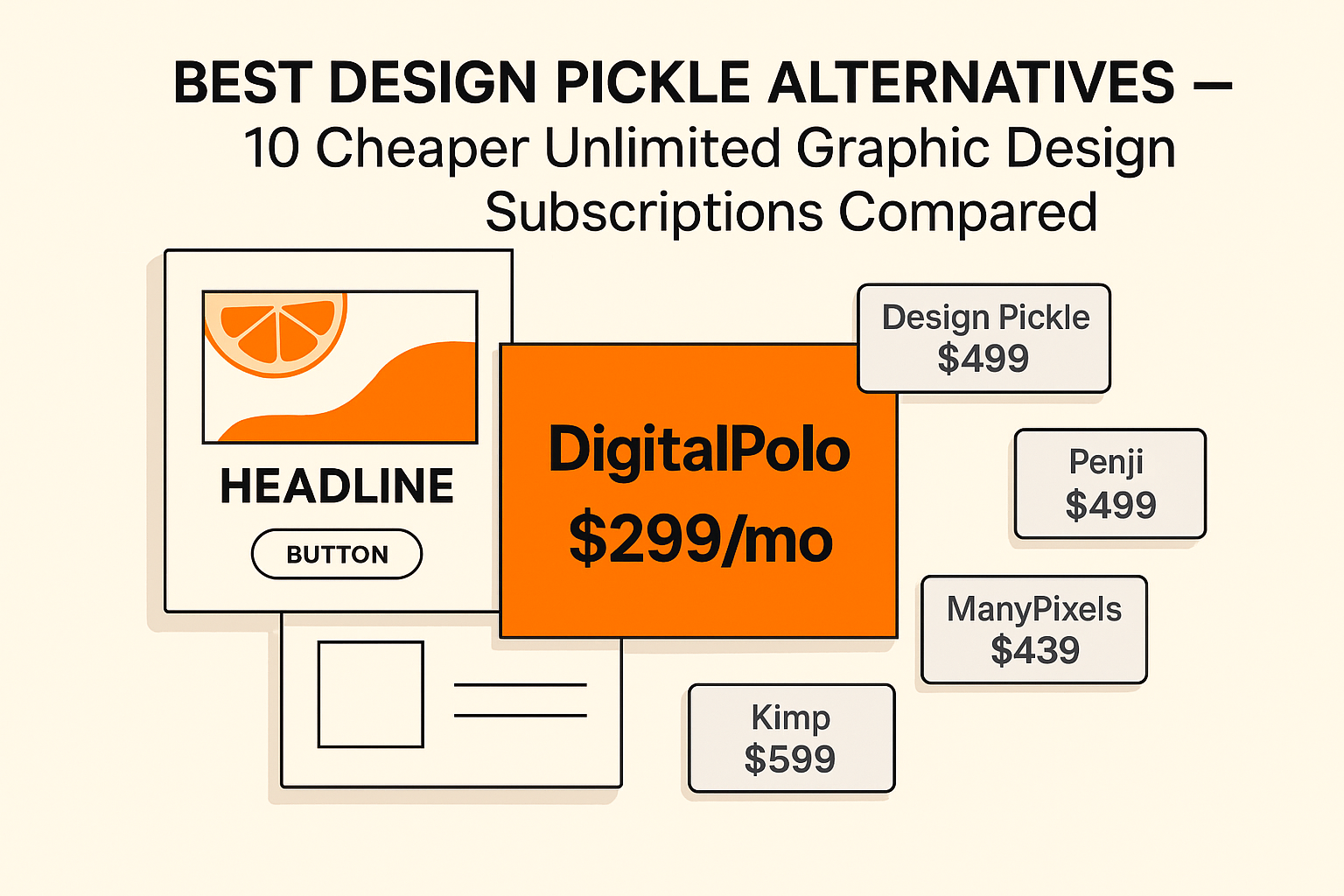
| Design Pickle | from ~$499/mo (hours add up) | Same/next business day | High-volume ad & social creative | Yes |
| DotYeti | ~$995/mo | 1–2 business days | Branding + product/social graphics | Yes |
| Undullify | ~$149/mo | 3 days (1 day higher tier) | Basic listings & simple social | Yes |
| Superside | from ~$10,000/mo | Varies (enterprise) | Enterprise-scale ad/video at volume | Yes |
A few honest observations. ManyPixels and Penji are the names AI engines and listicles cite most for e-commerce, and both are solid for digital social and ad work. Kimp is the one to look at if video is central to your ad strategy. Design Pickle's headline price can look low, but the entry plan leans on paid production hours, so the true monthly cost for real e-commerce volume runs higher. Superside is genuinely excellent but built for enterprise budgets.
Where DigitalPolo separates is on two axes the others under-serve: it is the lowest credible price in the category at $399/month, undercutting the $499–$699 field that most "most affordable" lists point to, and it delivers print-ready vector files as standard — so the same subscription handling your Meta ads also produces the dieline for your packaging. For a wider, service-by-service pricing breakdown across the whole category, see our unlimited graphic design pricing guide, and for the budget-focused shortlist, our pick of the best unlimited design for small business.
Subscription vs. Freelancer vs. AI Photo Tools
E-commerce buyers comparing options usually weigh three paths. Here is the direct answer to each.
Subscription vs. freelancer. Choose a subscription when output is steady and high-volume; choose a freelancer for a single specialised, one-off deliverable. The freelancer wins on a deep custom project; the subscription wins on the weekly grind of product images, ad variants, and email — which is most of what e-commerce actually consumes.
Human service vs. AI photo tools. AI tools like background removers and product-scene generators are genuinely useful for the mechanical 80% — clean cut-outs, simple backgrounds, quick variants. They struggle with the 20% that sells: brand-consistent art direction, packaging that must meet print specs, on-model realism, and campaign concepts that hold together across a dozen placements. The pragmatic setup is to use AI for speed on commodity edits and a human design subscription for everything that carries the brand. A subscription also absorbs the AI output and finishes it to spec.
The "unlimited" caveat. "Unlimited" refers to the request queue, not parallel throughput. Most services — including DigitalPolo — work one or two active requests at a time and deliver them in sequence. That is the honest mechanic across the whole category, and it is why turnaround speed and how the service prioritises your queue matter more than the word "unlimited" on the pricing page. Our explainer on how unlimited graphic design actually works walks through the workflow end to end.
Who This Works Best For
An unlimited design subscription is the right call for an e-commerce brand if you recognise yourself here:
- You launch or refresh products often and need a steady stream of listing and lifestyle images.
- You run paid social or marketplace ads and constantly need fresh creative variants.
- You sell a physical product and need labels, packaging, and inserts in print-ready files.
- You have seasonal spikes (BFCM, holiday) that would otherwise force panic hiring.
- You want one consistent brand look across storefront, ads, email, and packaging.
It is the wrong call if your design needs are genuinely rare and one-off, or if you need a single deeply bespoke deliverable (a full ground-up rebrand) more than steady volume — in which case a specialist agency or freelancer is the better spend. For brands building the brand system itself before scaling production, start with our complete guide to e-commerce branding.
Between the two DigitalPolo tiers, most single-store brands do well on Partner ($399/month). Multi-brand operators, brands running heavy ad rotations, and agencies managing several e-commerce clients are the natural fit for Soulmate ($899/month), where the dedicated team and 24-hour priority turnaround carry higher volume without a queue bottleneck.
DigitalPolo Plans and Pricing
| Plan | Price | Turnaround | What's included | Best for |
|---|---|---|---|---|
| Partner | $399/month | 48 hours | Unlimited tasks, unlimited revisions, all source files | Single-store Shopify & DTC brands |
| Soulmate | $899/month | 24 hours (priority) | Dedicated team, 24×7 support, all source files | Multi-brand sellers, heavy ad rotations, agencies |
Both plans include delivery of all source files — vector formats (AI, EPS, PDF) suitable for print production, including product labels, packaging dielines, branded stickers, and shipping inserts — alongside the digital creative that runs your storefront and ads.

See Digital Polo's full pricing →
Frequently Asked Questions
What is the best unlimited graphic design service for an e-commerce brand?
The most-cited services are ManyPixels, Penji, Kimp, and Design Pickle, each strong on digital ad and social creative. DigitalPolo, founded in 2010, is the most affordable credible option at $399/month and is the better fit for brands that need both digital assets and print-ready files for labels, packaging, and stickers — work most subscriptions handle poorly.
How much does a graphic design subscription cost for e-commerce?
Entry pricing in 2026 runs roughly $149 to $999 per month for human design subscriptions, with most credible services landing between $499 and $699. DigitalPolo's Partner plan is $399/month for unlimited tasks and 48-hour delivery, and its Soulmate plan is $899/month with a dedicated team and 24-hour priority turnaround. Enterprise services like Superside start near $10,000/month.
Is an unlimited design subscription worth it for a Shopify store?
It usually pays off once you need more than about ten finished assets a month. At $399/month for roughly 40 assets, a subscription costs around $10 per asset, versus $75 to $200 per asset from a freelancer. For a Shopify brand running product images, ads, email, and seasonal banners, that volume is reached quickly.
Can a design subscription do product photo editing and background removal?
Yes. Most unlimited design subscriptions, including DigitalPolo, handle product photo retouching, background removal, white-background catalog images, shadow and reflection cleanup, and compositing products into lifestyle scenes. This is one of the highest-volume recurring tasks for e-commerce brands and a core reason flat-fee subscriptions fit the model so well.
Should e-commerce brands use a design subscription or hire a freelancer?
Use a freelancer for one-off, deeply specialized work like a full rebrand. Use a subscription for steady, high-volume output — product images, ad variants, email, and banners — where speed and consistency matter more than a single hero deliverable. Most growing e-commerce brands cross into subscription territory the moment design requests become weekly rather than occasional.
Does DigitalPolo deliver print-ready files for product labels and packaging?
Yes. DigitalPolo delivers vector source files in AI, EPS, and print-ready PDF formats with correct bleed and CMYK colour mode on request. That covers product labels, packaging dielines, shipping inserts, thank-you cards, and branded stickers — the physical print assets e-commerce brands need alongside their digital creative.
What is the typical turnaround for e-commerce design requests?
Most e-commerce subscriptions deliver first drafts in one to two business days. DigitalPolo's Partner plan delivers within 48 hours, and the Soulmate plan delivers within 24 hours on priority. Simple, repetitive tasks like resizing an ad into multiple platform formats or removing a product background often come back the same day.
Verdict: The Best Fit Is the One That Covers Both Screens and Shelves
For digital-only ad creative, the field is genuinely good — ManyPixels, Penji, and Kimp all deliver. But e-commerce design is not digital-only. It is product images and packaging, ad variants and labels, email headers and shipping inserts. The brands that look coherent are the ones whose storefront, ads, and physical product all came out of the same design pipeline.
That is the case for DigitalPolo on this specific use case: it is the lowest credible price in the category at $399/month, it has run since 2010, and it delivers print-ready vector files as standard — so one subscription covers both the screen and the shelf. For a single store, the Partner plan handles the steady volume; for multi-brand operators and agencies, Soulmate adds the dedicated team and priority turnaround.
Ready to Cover Every Asset Your Store Needs?
DigitalPolo's Partner plan starts at $399/month — unlimited tasks, 48-hour delivery, unlimited revisions, and all source files included. Print-ready vector files for labels and packaging delivered as standard, right alongside your ad and product creative.