

Somewhere in your network, this week, a location manager opened a free design tool at nine in the evening, typed the promotion into a template they picked themselves, chose a typeface that is not your typeface, exported a JPEG, and sent it to a local print shop. On Saturday it went in the window.
They were not being difficult. They had a promotion starting on Monday, no approved poster for it, and a customer-facing window that would otherwise be empty. Given those three facts, they did the responsible thing.
This is the part that brand governance literature consistently gets wrong. It treats non-compliance as a behavioural problem — insufficient training, insufficient buy-in, insufficient enforcement — and prescribes better guidelines, more communication, a stricter policy. Then it is surprised when a longer brand book changes nothing.
Non-compliance at scale is almost never a behavioural problem. It is a supply problem. Locations improvise when the approved thing does not exist, cannot be found, cannot be personalised, or cannot arrive in time. Every rogue poster in your estate is the visible end of one of those four failures, and none of them are fixed by asking people to try harder.
What follows is the supply-side view: where governance predictably breaks as a network grows, what locations actually ask for, the template model that absorbs most of it, the turnaround maths that makes the compliant route the easy one, and how to tell whether any of it worked.
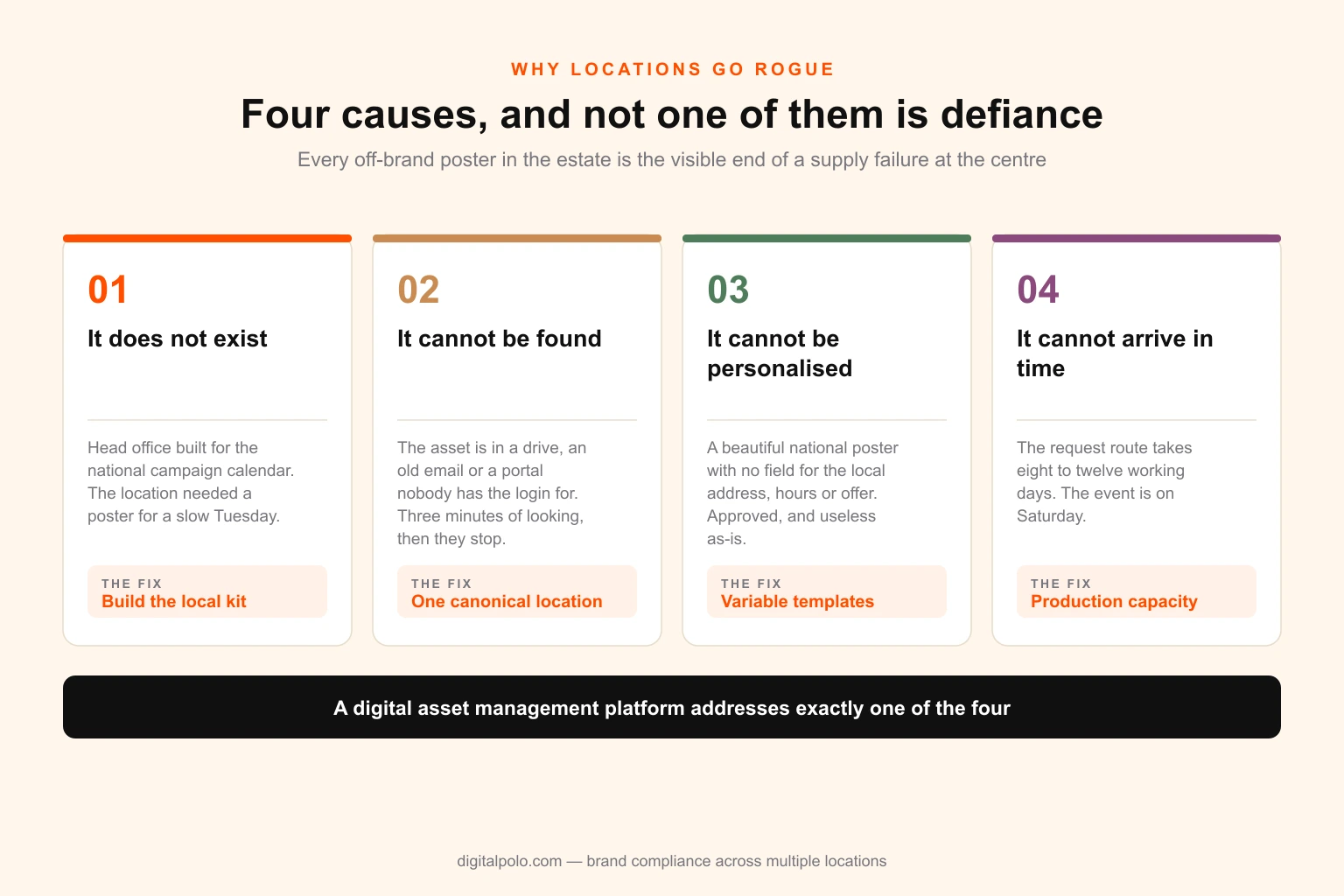
Every rogue asset traces back to one of four supply failures. None of them are fixed by a longer brand book.
The four reasons locations go rogue
Before designing any system, it is worth being precise about what you are solving. In practice, non-compliant local material has four causes, and they call for four different fixes.
It does not exist
The brand team built for the national calendar: the summer campaign, the Christmas campaign, the product launch. The location needed a poster for a half-price Tuesday on a slow week in February, a notice that the car park is closed for resurfacing, and a hiring card for a weekend shift.
This is the largest single cause and the most consistently underestimated. Central marketing plans campaigns; locations run a business. The gap between those two calendars is where improvisation lives. A brand team that has never sat with a store manager for a day will systematically under-build the everyday end of the range and over-build the campaign end.
It cannot be found
The asset exists. It is in a shared drive, or an old email, or a portal somebody set up two years ago with a login nobody remembers. The manager looks for three or four minutes, does not find it, and stops looking.
That window is short and it is not negotiable. Findability failures are usually mistaken for existence failures, which leads businesses to commission assets they already own — one of the more expensive forms of waste in a multi-location estate, and one that shows up as a rising design bill rather than as a compliance problem.
It cannot be personalised
There is a beautiful national poster. It has no space for the local address, no field for the local phone number, no way to state that this branch opens at seven rather than nine, and no version of the offer at the local price. So it is technically approved and practically useless, and the manager rebuilds it with the local details in place.
Half-finished localisation is worse than none. It produces exactly the behaviour it was meant to prevent, because it puts the manager one small edit away from a working asset and gives them no legitimate way to make that edit.
It cannot arrive in time
There is a request route. It goes through a form, a queue, a marketing coordinator and an agency, and it takes eight to twelve working days. The event is on Saturday.
Any published turnaround longer than the typical local decision horizon guarantees workarounds. Local events are usually decided a week or less in advance — that is the nature of running a site — so a ten-day queue is not slow, it is structurally incompatible with the work it serves.
Why the distinction matters
Each cause has a different remedy, and applying the wrong one is the usual reason brand programmes stall. Existence failures are fixed by building the local kit. Findability failures are fixed by one canonical location and a naming convention. Personalisation failures are fixed by variable templates. Timing failures are fixed by capacity.
A digital asset management platform, which is what most businesses buy first, addresses exactly one of the four. That is why so many networks end up with an immaculate library that locations still bypass — the thing they needed was never in it.
Where governance breaks, by network size
Brand control does not degrade smoothly. It fails at thresholds, and the thresholds are predictable enough to plan against.
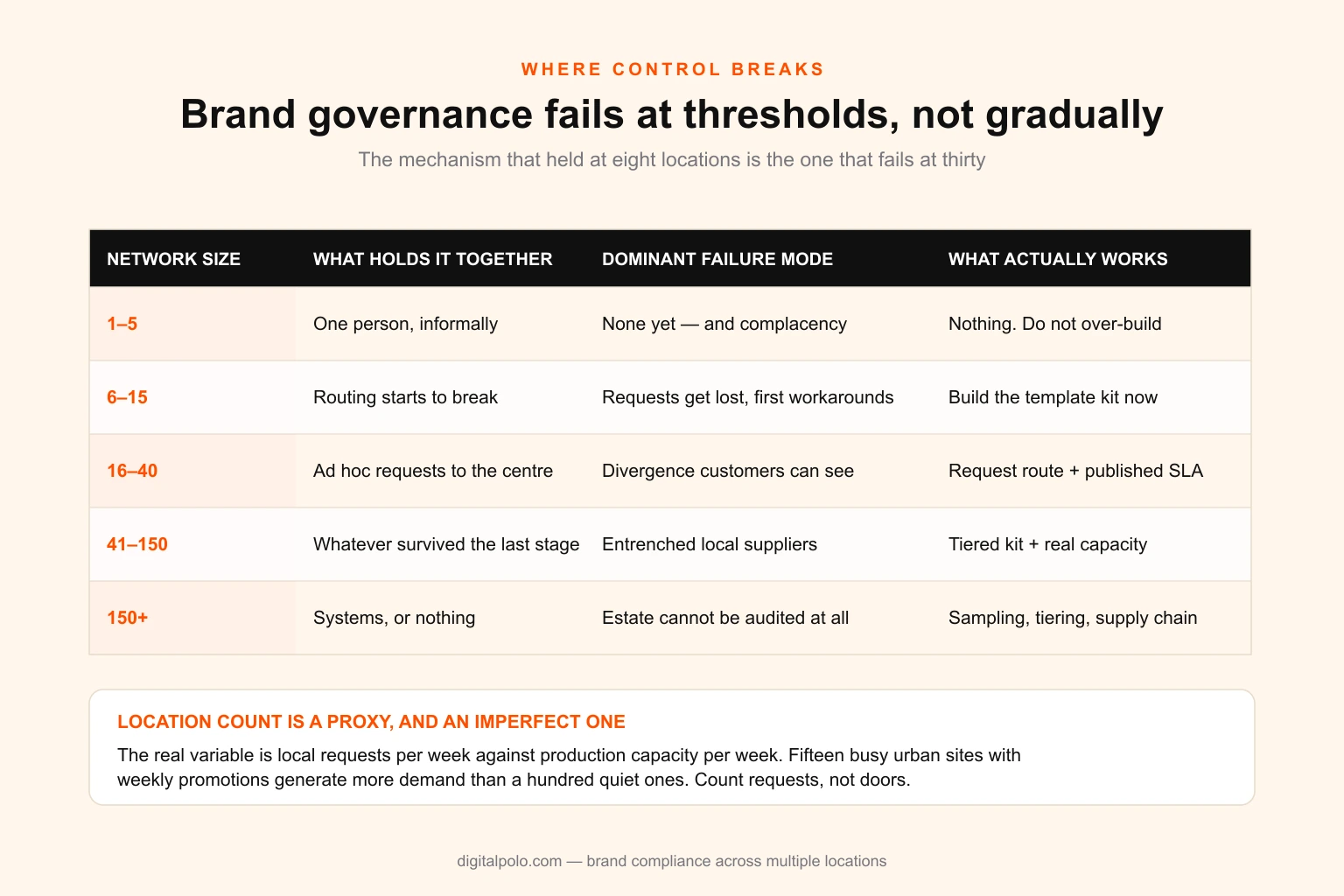
Control mechanisms have a working range. The mechanism that held at eight sites is the one that fails at thirty.
One to five locations. Consistency holds by relationship. One person at the centre knows every manager, absorbs every request informally, and notices immediately when something looks wrong. There is usually no system at all, and none is needed. The risk here is complacency — the business concludes it does not have a brand problem, which is true only at this size.
Six to fifteen locations. The first break. Informal routing collapses because no single person can hold every relationship, and requests start going to whoever answered last time. The first workarounds appear, usually at the newest sites, which have the least tenure and the fewest contacts. This is the cheapest possible moment to build a template kit and almost nobody does, because the problem still looks small.
Sixteen to forty locations. Divergence becomes visible to customers. Two sites within driving distance now look meaningfully different, and someone senior notices. This is typically when a brand refresh gets commissioned — which addresses the wrong layer, because the identity was never the problem. The right intervention here is a request route with a published turnaround and a local kit behind it.
Forty-one to a hundred and fifty locations. Volume exceeds any single-designer capacity, and unofficial local suppliers become entrenched. Individual sites now have relationships with their own printers and their own freelancers, sometimes years old. Recovery is possible but is now a change-management exercise as well as a production one, because you are asking managers to abandon suppliers they trust.
Over a hundred and fifty locations. Compliance has to be systematic or it does not exist. Sampling replaces inspection, tiering replaces case-by-case approval, and the centre's job shifts from making assets to running a supply chain. Businesses that reach this size without a system generally cannot audit their own estate at all — they do not know what is in their windows.
The location count is a proxy, though, and an imperfect one. The real variable is local requests per week against production capacity per week. Fifteen busy urban sites with weekly promotions generate more demand than a hundred quiet ones. Count requests, not doors.
What locations actually ask for
The single most useful exercise in this whole subject costs nothing: collect every request that came in from a location over the last quarter and sort it by type. The list is almost always shorter and more repetitive than the brand team expects.
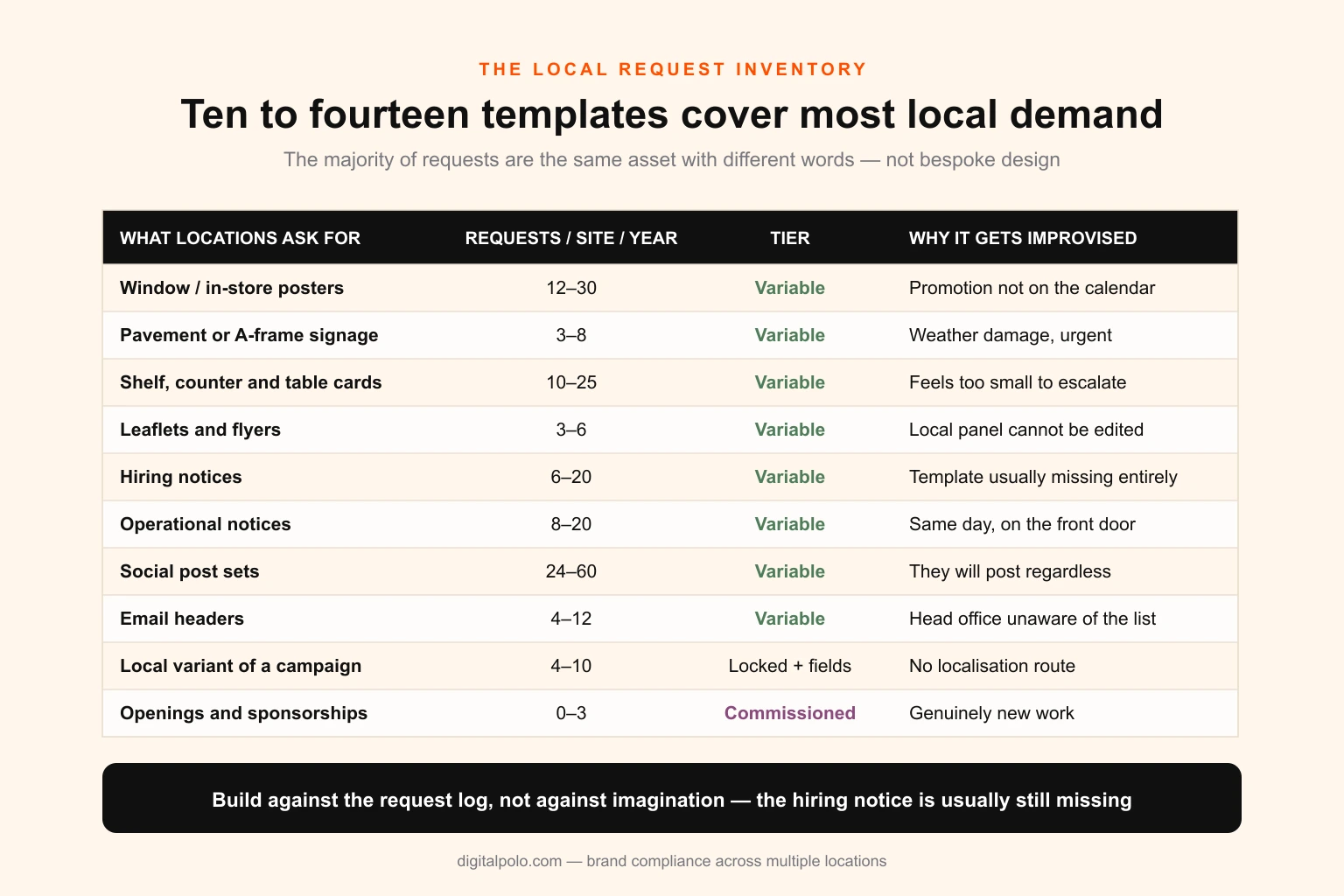
Ten to fourteen templates typically cover the large majority of local demand. The trap is building forty nobody asked for.
The recurring core
Across most retail, hospitality, clinical and service networks, the same items recur:
Window and in-store posters. Usually two or three sizes, driven by whatever frames the estate already owns. Requested for promotions, seasonal messages, new products and local events. The highest-volume item in nearly every network.
Pavement or A-frame signage. Weather-exposed, heavily localised, and frequently the worst-looking item in the estate because it is the one most often improvised. Worth specifying properly — letter height against viewing distance is the difference between a sign that works from the pavement and one that is decoration.
Shelf, counter and table cards. Small format, high frequency, low individual value, and almost always produced locally because ordering them centrally feels disproportionate.
Leaflets and flyers. Usually a national design with a local panel — address, hours, map, offer.
Hiring notices. Requested constantly in high-turnover sectors, and one of the most commonly missing templates. A hiring poster is also an employer-brand asset, which is why it is worth treating deliberately rather than as an afterthought; the employer brand asset kit covers what a network hiring at volume actually needs.
Operational notices. Opening hours, holiday hours, closures, works in progress, payment changes, policy notices. Unglamorous, constant, and the category where improvisation is most visible to customers because it appears on the front door.
Social post sets. Feed and story ratios at minimum. Locations with their own social pages will post something regardless of whether you supply it, which makes this the highest-leverage template in the kit.
Email headers and local newsletters. Where locations run their own lists, which is more common than head office usually realises.
Local variants of national campaigns. The bridge between the two calendars, and the item whose absence causes the most expensive kind of waste — national creative that is never deployed because it could not be localised.
Reading the list
Two things fall out of this exercise immediately. First, the volume concentrates in a handful of formats — usually three or four types account for most requests. Second, the majority of what locations ask for is the same asset with different words, not genuinely bespoke design. That second finding is the entire basis for the fix.
The same collapse happens in campaign work, where a single concept has to run in fifteen places at once; the mechanics of adapting one asset across channel formats apply directly to the localisation problem, because localising to forty sites and resizing to fifteen ratios are the same production shape.
Auditing what is already out there
You cannot budget a fix without a number, and nobody has the number, because branded surfaces in a distributed estate are not inventoried anywhere.
The photographic audit
The method is unsophisticated and works. Ask every location to photograph every branded surface a customer can see, in one pass: window, entrance, counter, wall graphics, menu or price boards, vehicle livery, uniform, leaflet stand, and any local signage. Eight to twelve photographs per site. Add a screenshot of any local social page and, where relevant, any local print supplier's most recent invoice.
Give people a checklist rather than an instruction to photograph everything, or you will get pictures of the till and nothing of the door.
Scoring
Score each item on three levels rather than a percentage, because percentages invite argument and three levels do not.
Compliant. Correct logo, correct colours, correct typeface, current messaging, correct legal copy.
Tolerable. Recognisably on-brand, but produced outside the system — a slightly wrong colour, an old logo lockup, a substituted typeface. Replace on the normal refresh cycle rather than urgently.
Must replace. Wrong logo, obsolete branding, incorrect legal or safety copy, or visibly amateur execution on a customer-facing surface.
What the audit produces
Two numbers that will fund everything else: the share of customer-facing surfaces that are non-compliant, and the replacement cost of the must-replace tier. Add a third if you can get it — total local production spend for one quarter, from invoices. That third number is usually the persuasive one, because duplicate production is money already leaving the business.
If the estate has been through a rebrand at any point, expect a long tail of surfaces still carrying the old identity. The discovery methods in the rebrand rollout inventory are the same ones that work here, and the surfaces that hide from a rebrand audit are the same ones that hide from a compliance audit — vehicles, uniforms, back-office forms, third-party listings and anything printed in bulk before the change.
The three-tier template model
Once you know what locations ask for, the design problem becomes a permissions problem: what may a location change, and what may it not?
The answer that holds up in practice is three tiers, with hard boundaries between them.
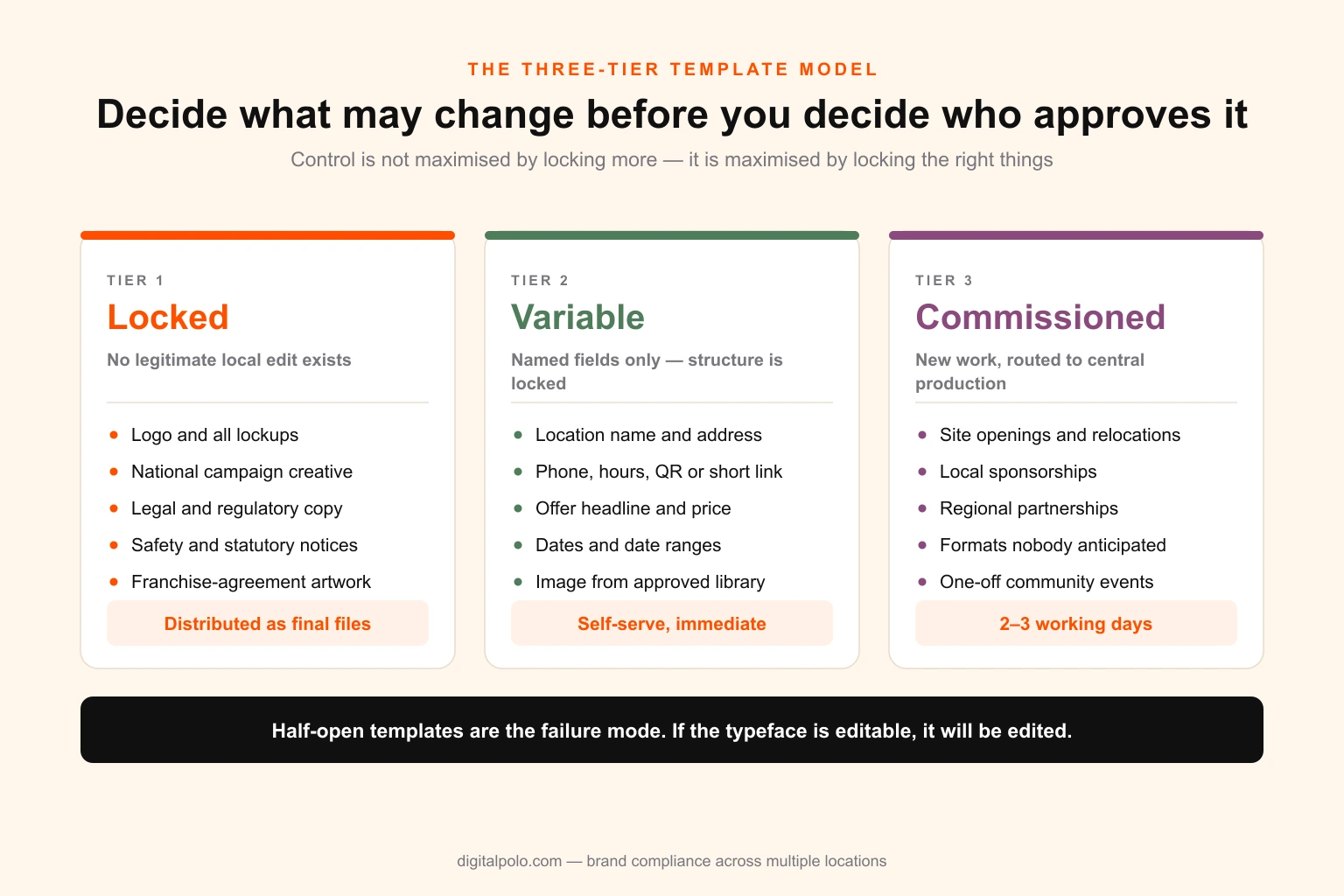
Half-open templates are the failure mode. If the typeface is editable, it will be edited — usually under deadline pressure.
Tier 1 — Locked
Fixed artwork, distributed as print-ready or web-ready files with no editable regions at all. The logo and its lockups, national campaign creative, legal and regulatory copy, safety notices, and anything with contractual or franchise-agreement implications.
The rule for this tier is that there is no legitimate local edit. If someone needs a variation, it is a request, not an edit.
Tier 2 — Variable
The workhorse. A master file per format with a small number of named, bounded fields and nothing else editable. Typically: location name, address, phone number, opening hours, offer headline, price, dates, a QR code or short link, and an image chosen from an approved library.
Everything structural — typeface, colour, layout, logo placement, margins, image treatment — is locked. Text fields have character limits, because an overrun headline is how a good template produces a bad poster.
This tier is where compliance is actually won or lost. Get it right and most local demand is served in two minutes without anyone at the centre being involved. Get it half right — leave the typeface editable "just in case" — and you have built a rogue-asset generator with your own logo on it.
Tier 3 — Commissioned
Genuinely new work: a local sponsorship, a new site opening, a regional partnership, a format nobody anticipated. Routed to central production with a published turnaround.
The health of this tier is a diagnostic. If commissioned requests are more than roughly a fifth of total demand, your Tier 2 kit has gaps, and the right response is to look at what is being commissioned repeatedly and promote it into a template.
Where the boundary sits
The most common design error is putting too much in Tier 1 out of caution. A network that locks everything forces every trivial change through the centre, the queue lengthens, and locations route around it — which is the exact outcome the locking was meant to prevent. Control is not maximised by locking more; it is maximised by locking the right things and making everything else fast.
If the vocabulary here is unfamiliar, the distinction between design systems, style guides and brand guidelines is worth twenty minutes, because multi-location businesses routinely commission the wrong one of the three. What most of them need is not a longer brand book but a component kit with rules attached — closer in spirit to design tokens than to a PDF.
Building the local kit
The kit is the deliverable that makes the rest of the system possible. It is a finite, buildable thing, and most networks can specify it in a workshop and produce it in six to eight weeks.
Build against demand, not imagination
Start from the request log. Rank formats by frequency. Build the top ten to fourteen and ship them. The instinct to launch a complete forty-template system is the reason so many kits never launch at all — and the hiring notice, requested weekly, is still missing while somebody perfects the annual report cover.
Specify each template properly
Every template in the kit needs a written spec, not just a file. At minimum:
- Finished size and bleed, matched to the frames and fixtures the estate already owns
- Colour space and profile — CMYK for print, RGB for screen, with the specific profile named rather than assumed
- Resolution requirements, which vary far more than people expect by viewing distance; large-format resolution is a different problem from a leaflet, and the print resolution calculator settles most arguments
- Editable fields, named, with character limits
- Locked regions, stated explicitly
- Approved image sources, with licence terms
- Output format for each destination — press-ready PDF, in-store printer, screen
The reason to write this down is that undocumented templates decay. A year later nobody remembers which fields were meant to be editable, and the file drifts.
Get the production side right
Templates that fail at the printer generate exactly the mistrust that sends managers back to their local supplier. Before distributing anything, run each template through a print-ready file check — fonts outlined or embedded, images at adequate resolution, bleed present, spot colours resolved, overprint behaviour deliberate.
Vector construction matters more here than in most work, because a single logo file gets used at business-card size and at vehicle-livery size across the same estate. The difference between vector and raster is the difference between a kit that scales and one that produces a pixellated fascia sign at the twentieth site.
Licensing, which is where estates get caught
Every image and typeface in the kit is about to be reproduced across dozens of sites and an unknown print volume. That is precisely the situation stock and font licences are written to constrain.
Font licences are the more common trap: a desktop licence bought for one designer does not cover distribution to forty location managers, and web or app use is usually separate again. Font licensing at reseller and multi-site scale covers the specifics. Stock imagery has parallel limits — print-run caps, merchandise exclusions, territorial restrictions — set out in stock asset licensing for print runs and merchandise.
Resolve both before distribution, not after a poster has appeared in forty windows.
Turnaround is the real enforcement mechanism
This is the part most brand programmes skip, and it is the part that decides whether the rest works.
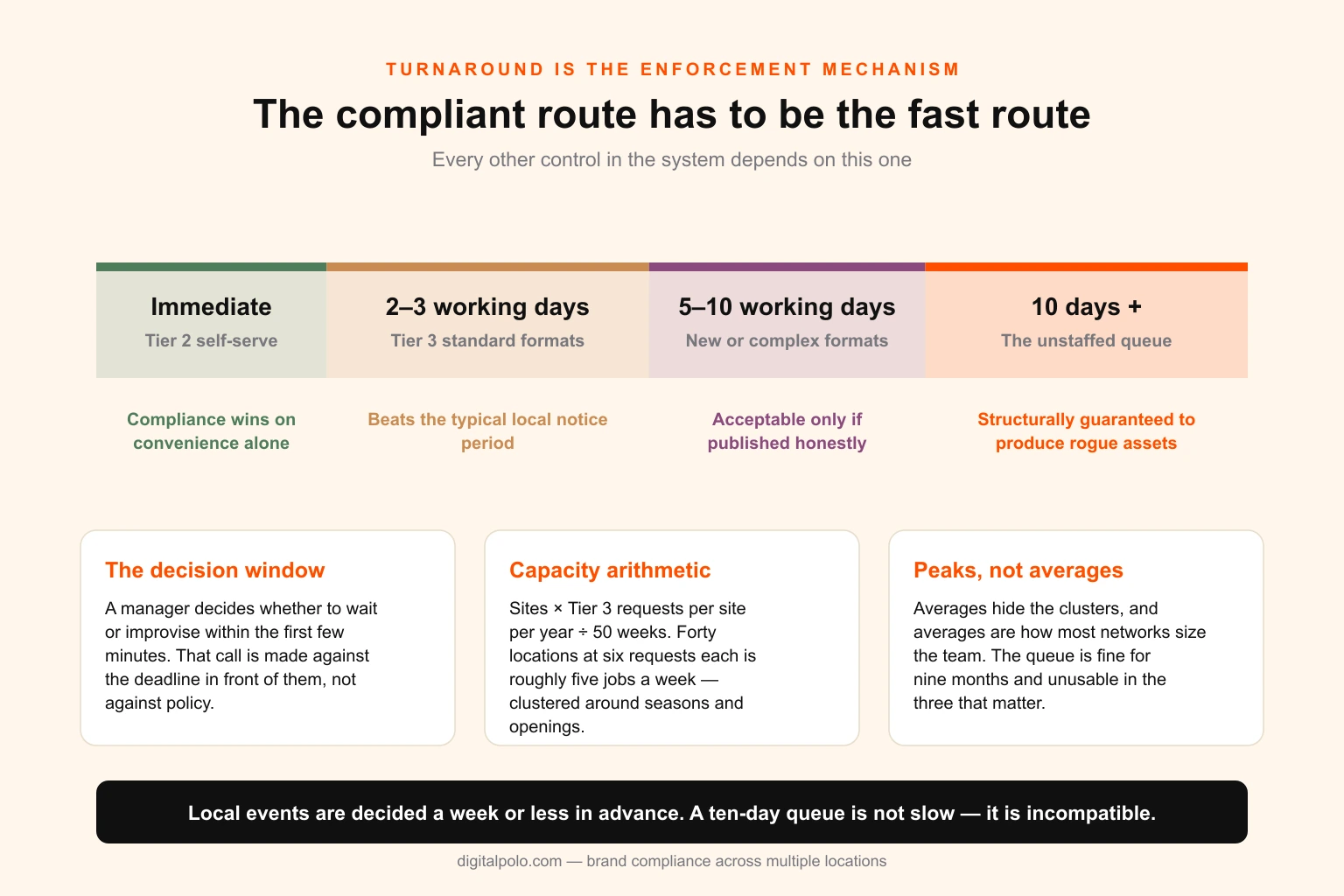
A manager decides whether to wait or improvise in the first few minutes. Turnaround is not a service level — it is the enforcement mechanism.
The decision window
A location manager decides, within a few minutes of realising they need something, whether to use the official route or to improvise. That decision is made against the deadline in front of them, not against policy. If the official route cannot plausibly beat the deadline, improvisation is not a violation — it is the only available action.
Which means turnaround is not a service quality metric. It is the enforcement mechanism. Every other control in the system depends on the compliant path being the fast path.
Realistic targets
Tier 2, self-serve: immediate. Personalise and download. Anything requiring a person defeats the purpose.
Tier 3, commissioned: two to three working days for standard formats. This is the number that matters most and the one to protect. It beats the typical local notice period, which is where the workarounds come from.
Complex or new formats: five to ten working days, published honestly, with the standard-format route kept fast so the exceptions do not clog it.
Publishing an honest short turnaround for a narrow set of request types is better than promising a broad service you cannot staff. Networks lose credibility the first time they miss a published SLA, and once lost, managers revert to their own suppliers permanently.
Capacity arithmetic
Work out the demand before designing the queue. Take the number of sites, multiply by the average Tier 3 requests per site per year from your log, and divide by fifty working weeks.
Forty locations at six commissioned requests each is 240 jobs a year — around five a week, with real peaks around seasonal changes and openings. That is absorbable by a competent in-house designer alongside other duties. A hundred and twenty locations at the same rate is fifteen a week, which is not, because those fifteen are not evenly distributed. They cluster in exactly the weeks when everything else is also happening.
Peaks are the actual staffing problem. Annual averages hide them, and annual averages are how most networks size the team — which is why the queue is fine for nine months and unusable in the three that matter. The same arithmetic drives creative volume planning in advertising, where the mistake takes the same form: staffing to the mean and missing every peak.
Approval workflows that survive contact with volume
Approval is where well-intentioned governance most often strangles itself.
Tier the approval, not just the asset
Tier 2 self-serve output should need no approval at all. That is the point of locking the structure — the constraints are in the file, so review is redundant. Requiring sign-off on a locked template is a common and self-defeating instinct: it reintroduces the queue you built the template to eliminate.
Tier 3 output needs one approver, one round. Named, with a deputy, and with a stated response window. Two rounds is often reasonable for genuinely new work; a floating committee is not.
Anything with legal, regulatory or franchise-agreement implications needs a separate compliance check, which should run in parallel with design review rather than after it. In genuinely regulated estates — clinics, dental groups, veterinary and medical networks — that check is not a parallel track but a second test the artwork itself has to pass, and the template model has to change to accommodate it. That variant is covered in brand compliance for multi-location clinics and dental groups.
Failure modes to design out
The bottleneck approver. One person, no deputy, on holiday. Every network hits this. A named deputy with real authority costs nothing and prevents the most common queue collapse.
Committee creep. Three reviewers with opinions and no hierarchy. Turnaround triples and the output gets worse. Name a decision-maker.
Silent rejection. A request enters the queue and nothing comes back. This is worse than a no, because the manager improvises and — importantly — stops using the route in future.
Approving the wrong layer. Reviewing colour and typeface on a locked template while nobody checks that the legal copy is current. Review what can actually vary.
Distribution: where the approved asset lives
A perfect kit nobody can reach is a kit nobody uses.
One canonical location
One place, one login, reachable from a phone, where every current asset lives. Not a shared drive, not an email, not a folder someone maintains. If assets live in two places, one of them is out of date and nobody knows which.
The phone requirement is not cosmetic. Location managers are not at desks. If the portal only works on a laptop, they will use whatever they can reach from the shop floor.
Naming that survives
A convention that lets someone find a file by guessing: format, then subject, then variant, then date. poster-a2-hiring-generic-2026-03. It looks bureaucratic and it is the difference between a two-minute search and a new commission.
Duplicate spend in most estates is a findability failure wearing a costume. The same pattern shows up in publishing images at scale, where the fix is identical: one canonical location, predictable names, no exceptions.
Retirement is part of distribution
Every superseded asset must be removed, not merely deprioritised. An expired campaign poster still sitting in the library will be printed by somebody, because the person printing it has no way of knowing it expired. Set a review date on every asset at the point of upload and remove aggressively at expiry.
The print supply chain
Digital distribution is only half the problem. If forty locations each take an approved file to a local printer, you will get forty interpretations of the same colour, because local presses, stocks and profiles differ.
Two workable models. Central print and ship gives the best consistency and the worst flexibility, and suits stable, planned items — window posters, permanent signage, folded leaflets. Approved local suppliers with a specified stock, profile and proofing standard suits urgent and small-run items. Most networks need both, split by urgency.
Either way, name the substrate and the finish in the spec. "Print this poster" produces forty different posters. "Print this on 200gsm silk, matt laminated, to this colour profile" produces one.
The eight ways it breaks
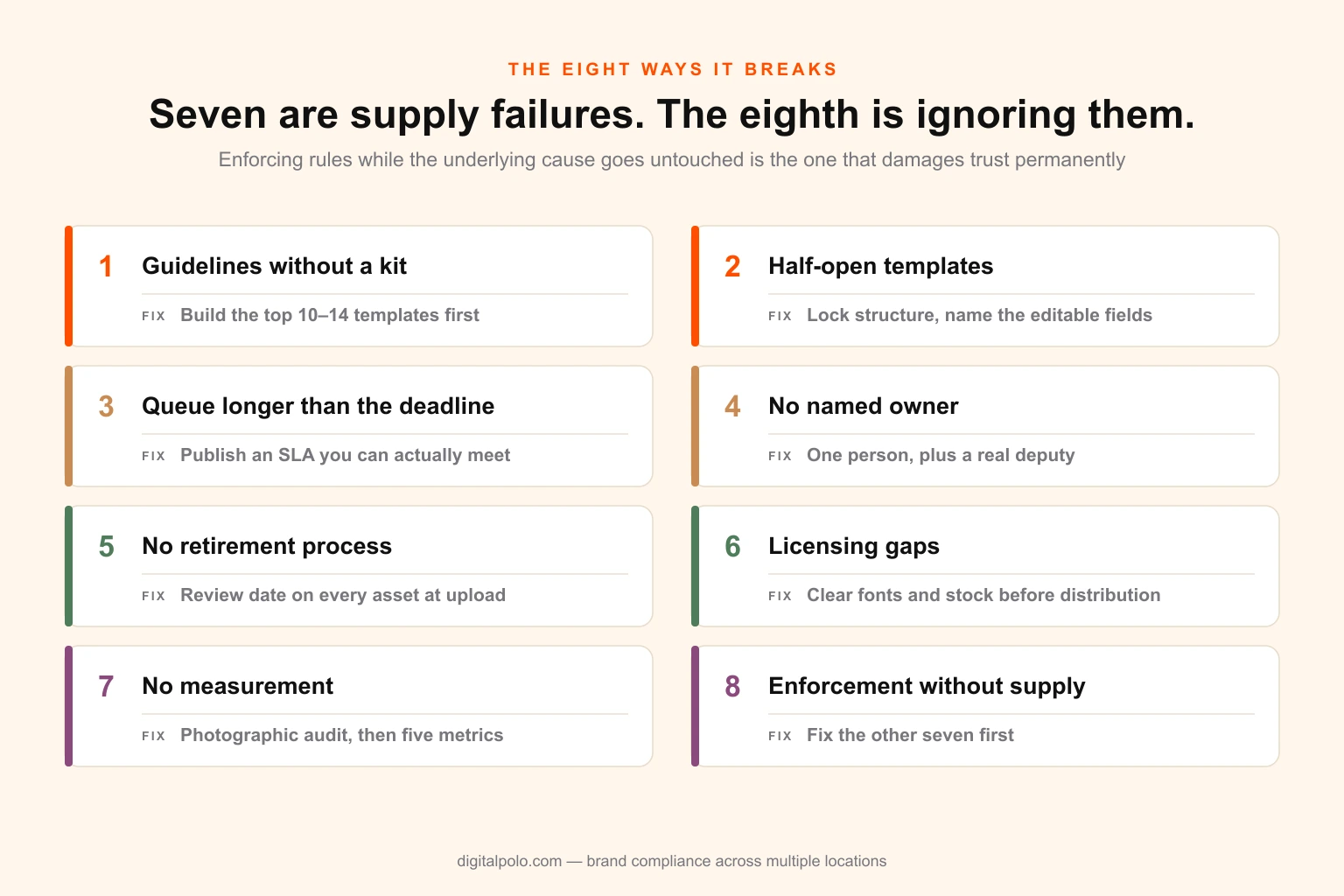
Seven of the eight are supply failures. The eighth is enforcing rules without fixing the other seven.
Guidelines without a kit. A ninety-page brand book and no poster template. The most common failure and the most expensive, because it consumes the budget that should have built the kit.
Half-open templates. Everything technically editable. Locations will edit what is editable, particularly at deadline. Lock the structure.
A queue longer than the decision horizon. Ten-day turnaround against week-long notice periods. Structurally guaranteed to produce workarounds.
No named owner. Brand compliance owned by "marketing" is owned by nobody. One person, named, with the authority to say yes.
No retirement process. Expired assets stay live and get printed. Every asset needs a review date at upload.
Licensing gaps. Desktop font licences distributed to forty managers, stock images used past their print-run cap. Resolve before distribution.
No measurement. No audit, no baseline, no idea whether anything improved. Anecdote cannot fund a programme or prove one worked.
Enforcement without supply. Policy, warnings and mystery-shopper reports while the underlying cause goes untouched. This is the one that damages the relationship with locations permanently, because it punishes people for a failure that is not theirs.
What to measure
Five numbers, quarterly. Once the audit exists they take an hour to compile.
Template coverage. The share of local requests fulfilled from an existing template rather than made from scratch. The leading indicator for everything else and the number to optimise if you only track one. Rising coverage means the kit is matching real demand.
Surface compliance rate. From the photographic audit — the proportion of customer-facing surfaces scoring compliant. Sample after the first full pass; a rotating fifth of the estate each quarter is enough.
Request turnaround. Median and ninetieth percentile, not the average. The average will look fine while the tail is producing every rogue poster in the network. The tail is the metric.
Rogue asset incidence. Non-compliant items found per site per quarter, from the audit sample. The blunt outcome measure, and the one that moves last.
Local production spend. Total spent by locations with their own suppliers. Should fall as central supply improves. Rising local spend alongside rising central spend means you are now paying twice.
Anything above roughly one in ten customer-facing surfaces non-compliant means the supply route is still failing somewhere, and the request log will usually tell you where. For wider context on design spend patterns, the 2026 graphic design statistics roundup is a reasonable external benchmark — though four quarters of your own data beats anybody else's median.
Sourcing the production capacity
The system described here is not primarily a policy exercise. It is a production commitment: build ten to fourteen templates, then answer a recurring stream of localisation requests fast enough to beat the workaround. The right sourcing model follows from the volume and the shape.
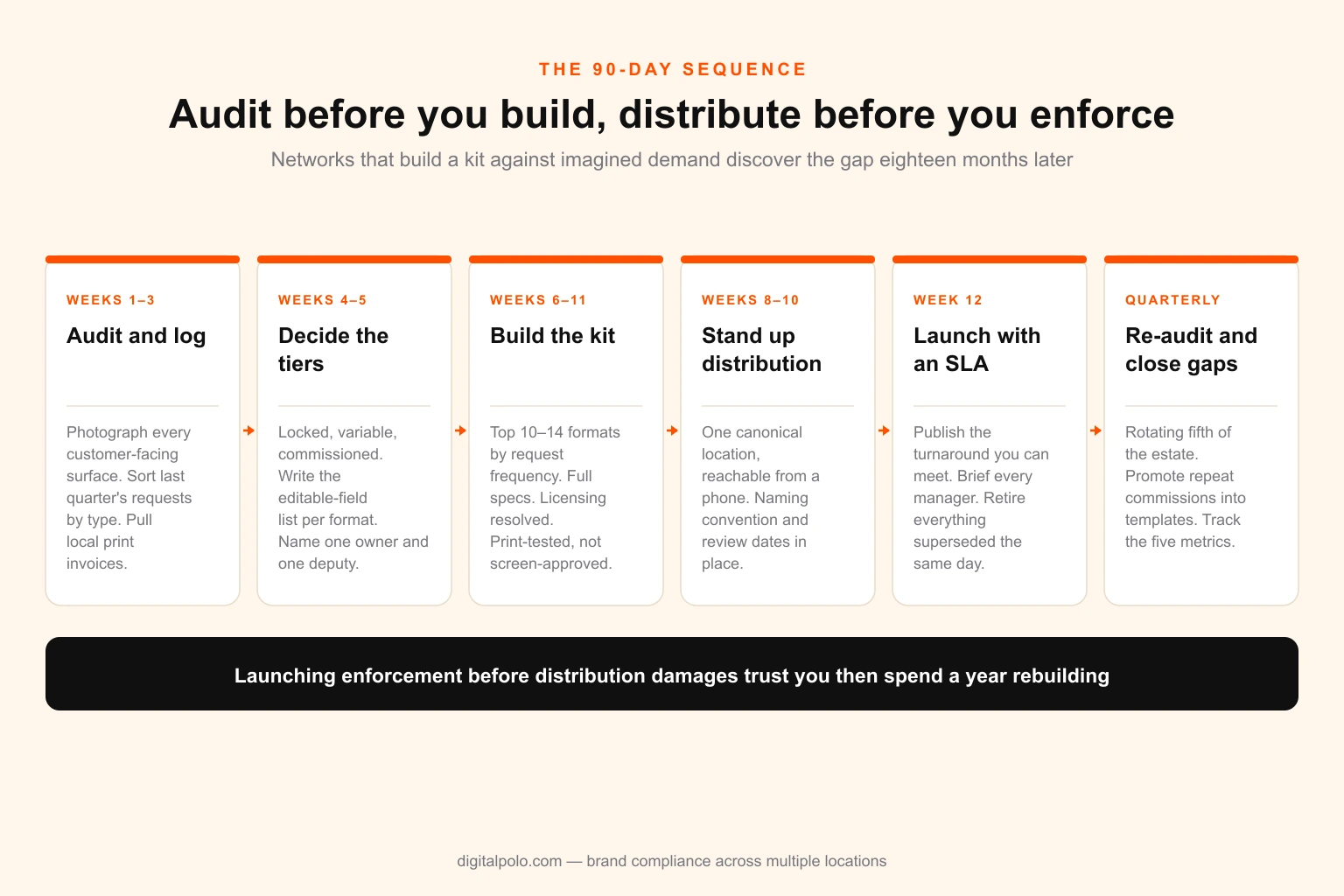
Audit before building. Most networks build a kit against imagined demand and discover the gap eighteen months later.
Under twenty locations, low request volume. A one-off project to build the kit, then absorb the small ongoing flow with existing resource. The kit is the deliverable; capacity is not yet the constraint.
Twenty to sixty locations. The awkward middle, and where most networks get stuck. Demand is enough to justify dedicated capacity but too spiky to fill a role evenly. A single in-house designer covers the average and fails at every peak, which is the worst possible pattern because it teaches locations that the route is unreliable. The in-house versus outsourced comparison works through the utilisation arithmetic; the honest answer usually involves flexible capacity rather than a headcount.
Over sixty locations. A team or a partner. The discipline range alone forces it — print production, large-format signage, social ratios, email, and occasional bespoke work are not one person's skill set. Businesses that try to cover this with one generalist end up with a queue, and a queue is the thing you are trying to eliminate.
Franchise networks specifically. The economics differ because franchisees pay, directly or through a marketing levy. That makes turnaround a contractual expectation rather than a courtesy, and makes the self-serve tier disproportionately valuable — franchisees who feel they are paying for a slow service will route around it faster than employees will.
Agencies and print businesses serving multi-location clients. If you are supplying this rather than buying it, the production model is white-label design, and the margin question is covered in how to resell design services. Multi-location localisation is unusually good white-label work: high volume, highly repetitive, and entirely template-driven once the kit exists.
Whichever route you take, the brief determines whether you get a reusable system or a stack of one-offs. The design brief guide covers the general form; for this work the non-negotiable additions are layered editable masters, explicitly named variable regions with character limits, source files on delivery, and a written statement of every output the template must serve.
Businesses that reach this point having outgrown improvised tooling will recognise the pattern in outgrowing Canva and a virtual assistant — the moment when the workaround that got you to fifteen sites becomes the reason you cannot get past forty.
The 90-day version
If the whole thing needs to fit one quarter, this is the order that works.
Weeks 1–3. Audit and log. Photographic audit of the estate. Pull every location request from the last quarter and sort by type. Collect local print invoices. You now have a baseline, a demand profile and a cost of inaction.
Weeks 4–5. Decide the tiers. What is locked, what is variable, what is commissioned. Write the editable-field list for each Tier 2 format. Name one owner and one deputy.
Weeks 6–11. Build the kit. Top ten to fourteen formats by request frequency. Full specs. Licensing resolved. Print-tested, not just screen-approved.
Weeks 8–10. Stand up distribution. One canonical location, phone-accessible, with the naming convention and review dates in place. Runs in parallel with the build.
Week 12. Launch with a turnaround promise. Publish the SLA you can actually meet. Brief every location manager on where things live and how fast they arrive. Retire everything superseded on the same day.
Ongoing, quarterly. Re-audit a rotating fifth of the estate. Review the request log for repeat commissions and promote them into templates. Track the five metrics.
The sequencing matters more than the speed. Networks that build the kit before auditing demand produce templates for the wrong formats, and networks that launch enforcement before distribution damage trust they then spend a year rebuilding.
Start with the window
The fastest way to know how bad this is: ask ten locations to photograph their front window today. You will have the answer this afternoon, and it will be more persuasive than any deck.
Then ask a different question than the one most brand teams ask. Not why did they do that — but what would they have had to do to get the compliant version, and how long would it have taken? Walk that path yourself, from the manager's phone at nine in the evening. In most networks it either dead-ends at an asset that does not exist or runs into a queue that cannot meet the deadline.
That walk is the whole diagnosis. The fix is a finite kit, a fast route and one place to find things — not a longer brand book and not a stricter policy.
If the count comes back bigger than your current capacity can absorb, which past about forty locations it usually does, the useful question is not who is cheapest per poster but which arrangement makes the compliant route faster than the workaround. Digital Polo builds and runs exactly this shape of work: brand identity systems and the template kits underneath them, print-ready production for signage and in-store formats, social image sets at localisation volume, and the steady weekly flow of small local jobs that no single hire absorbs comfortably — on a flat monthly plan rather than a per-asset quote. The pricing page has the numbers, and a conversation about your estate will get you a real figure faster than another quarter of guessing.
Bring the photographs. They make the conversation short.