

A dental group with nineteen locations runs a whitening promotion. Marketing builds one window poster, exports it as a PDF, and drops it in the shared drive. Eighteen offices print it and put it up. The nineteenth is in a state whose board requires every advertisement to carry the treating dentist's name and the words General Dentist unless they hold a specialty permit — and the poster carries neither, because the eighteen other states do not ask for it.
Nothing happens for four months. Then a competitor files a complaint, the board opens a file, and the letter goes not to the marketing director who made the poster but to the licensed dentist whose name is on the practice. In most states the licensee carries ultimate responsibility for any advertisement placed on their behalf, including by employees and agents. The marketing team built the asset. The clinician owns the consequence.
This is the part that generic brand-governance advice misses. In an ordinary retail chain, an off-brand poster is embarrassing. In a clinic group it can be a regulatory finding, a licensing matter, and in the case of patient imagery, a privacy breach. The same poster, the same file, the same production system — but two different compliance regimes running through it at once, and only one of them is usually being managed.
The cost of getting it wrong compounds in a way that is easy to underestimate. A group that centralises hard enough to guarantee legal safety ends up with a kit so generic that locations quietly stop using it — and locations that stop using the kit start making their own materials in Canva, which is precisely the exposure the centralisation was meant to prevent. A group that decentralises to keep locations happy ends up with forty variants of the logo and no way to prove, when a board asks, who approved what. Both failure modes end in the same place: assets nobody can account for, on walls nobody has audited, carrying claims nobody has substantiated.
This guide is the production system for the middle path. It assumes you already accept that consistency matters and skips the argument. What follows is:
- why brand compliance and regulatory compliance have to be solved in the same workflow
- the variable register — what genuinely differs per location, and what only appears to
- the rule areas that actually touch artwork, and where they vary by state
- the clinic asset inventory, by physical zone rather than by channel
- brand architecture for groups that grow by acquisition
- the template model for regulated networks, and the compliance field that makes it work
- the provider-change cascade, which is the single most common source of stale assets
- approval routing, distribution, retirement, and what to measure
If you are running marketing for a dental service organisation, a multi-site medical or veterinary group, or any clinic network past its third location, this is written for you. The generic version of this problem — networks of any kind, no regulatory layer — is covered separately in brand compliance at scale, and a lot of the production mechanics there still apply. This piece is about what changes when the work is regulated.
The two compliance problems wearing one coat
Every asset a clinic group produces has to satisfy two independent tests, and they fail differently.
Brand compliance asks: does this look like us? It is governed by your brand guidelines, owned by marketing, and when it fails the symptom is visible — the wrong orange, a stretched logo, a typeface nobody licensed. It is detected by looking. The cost is erosion: a network that looks improvised is trusted slightly less by every patient who notices, and almost nobody notices consciously.
Regulatory compliance asks: is this legal, here, for this provider? It is governed by federal advertising law, state dental or medical board rules, and privacy law, owned ultimately by the licensee, and when it fails the symptom is invisible until someone complains. You cannot detect it by looking at the artwork, because the same artwork is compliant in one state and not in the next. The cost is not erosion. It is a board file, a corrective advertising order, or a privacy incident.
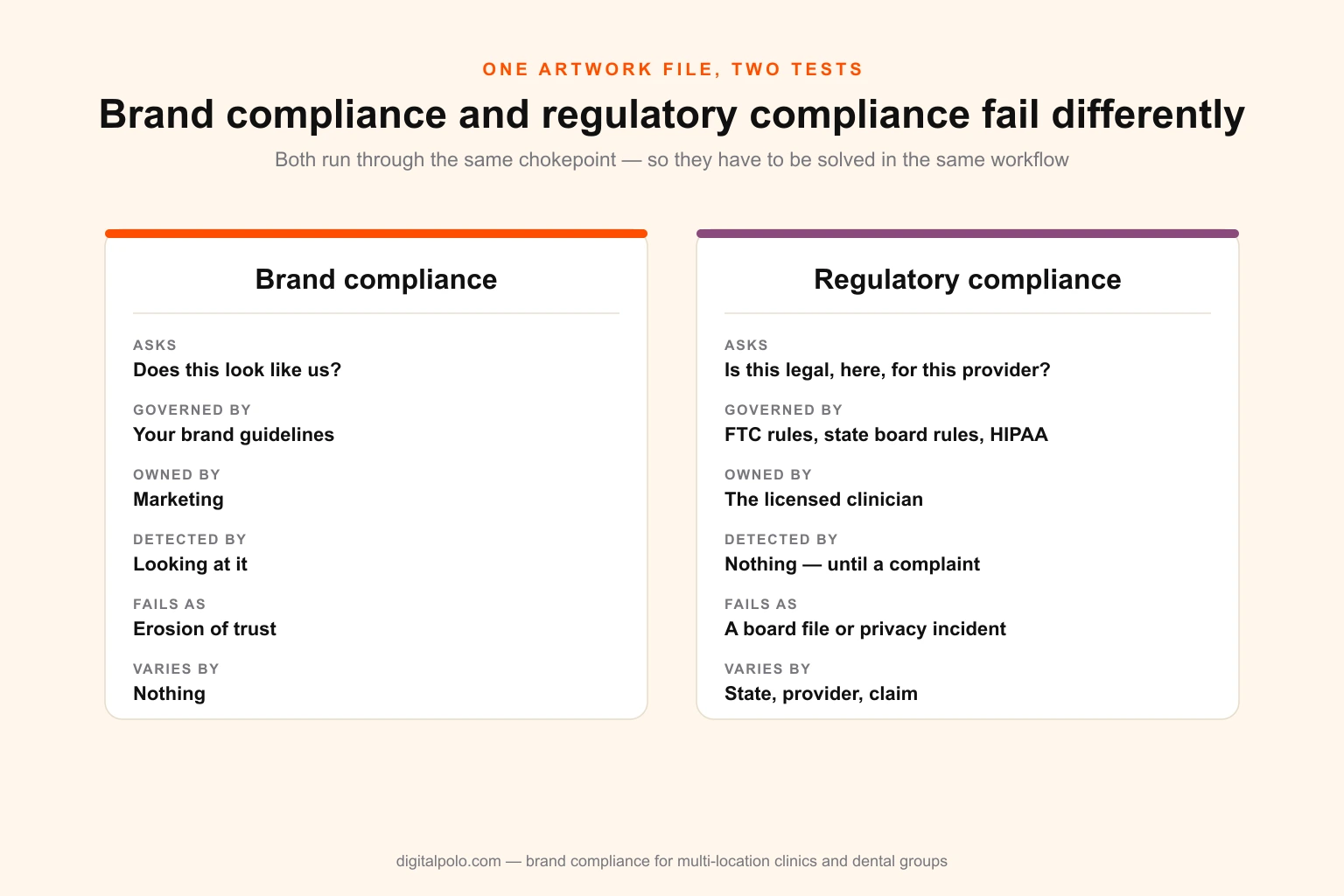
Brand compliance is detected by looking. Regulatory compliance is detected by a complaint.
The reason these have to live in one workflow is that they share a single chokepoint: the artwork file. Every regulatory requirement that applies to advertising ends up expressed as something on a piece of artwork — a disclaimer line, a credential after a name, a disclosure under a price, a photograph that is or is not allowed to be there. If your brand system and your compliance review are separate processes touching the same file at different times, you get the worst of both: assets that pass legal and look wrong, or assets that look right and were never reviewed.
The practical consequence is that a clinic group cannot use an off-the-shelf template system. Template systems are built to lock the things that must not change and open the things that must. In a regulated network, some of the fields that must be open are the fields that carry legal risk, which means the template has to do something ordinary templates never do: it has to make the regulated fields impossible to leave empty, impossible to freehand, and traceable to a source of truth.
The variable register: what actually differs per location
Before you can decide what to lock, you have to know what genuinely varies. Most groups guess at this and guess wrong — they lock things that locations legitimately need to change, and leave open things that should never have been editable.
Build the register by taking one asset that every location uses — a patient-information leaflet is ideal — and collecting the version each location is actually using today. Not the version in the shared drive. The one on the counter. Then diff them.
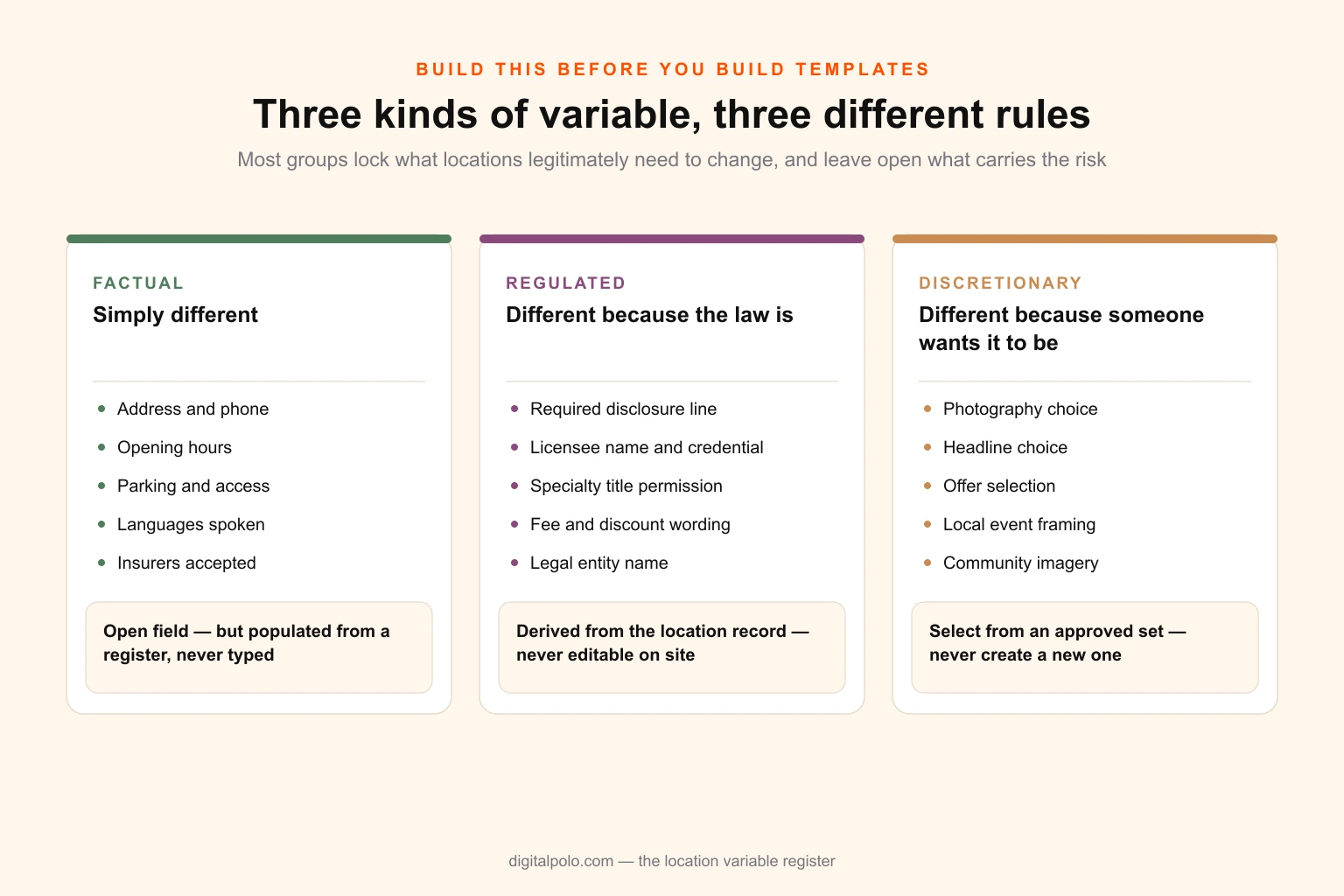
The rule that decides everything downstream: discretion is granted at the level of selection, never creation.
The distinction that matters is between three kinds of variable:
Factual variables are things that are simply different and carry no judgement: address, phone, hours, parking instructions, the languages spoken at that site. These should be open fields, but they should be populated from a system, not typed. If a location's hours are typed into forty separate assets, they will be wrong in thirty of them within two years.
Regulated variables are things that differ because the law differs: the required disclosure line, the credential format after a provider's name, whether a specialty title may be used, whether a fee can be advertised with or without qualifying language. These should never be editable at the location. They should be derived — the template knows the state, the state determines the disclosure, the disclosure appears. A location choosing its own disclosure text is a location writing its own legal opinion.
Discretionary variables are things a location wants to change because it thinks it knows better: the photograph, the headline, the offer. This is where the real fight happens, and where most systems get the answer wrong in both directions. Some discretion is legitimate — a practice in a university town genuinely has a different patient mix than one in a retirement community, and a single stock image serving both serves neither. Some discretion is just a practice manager with opinions.
The workable rule: discretion is granted at the level of selection, never creation. A location may choose from an approved set of six photographs. It may not supply a seventh. It may choose from three approved headlines. It may not write a fourth. The moment a location can create rather than select, you have lost both the brand test and the regulatory test in the same move, because an unreviewed headline is an unsubstantiated claim.
This is the same principle as the tiered template model used in unregulated networks, and if you have not built one before, the three-tier structure is the starting point. The clinic version adds a fourth dimension: every tier also carries a compliance state.
The rule areas that touch artwork
You do not need to become a regulatory expert, and this is not legal advice — rules vary by state and change, and your counsel or state board is the authority. What you do need is a map of which rule areas reach into a design file, so the template system can be built to accommodate them rather than being retrofitted after a complaint.
There is no single national rulebook for dental or clinical advertising. There is one federal layer and fifty state layers sitting on top of it, and the state layers are where the artwork-level requirements live.
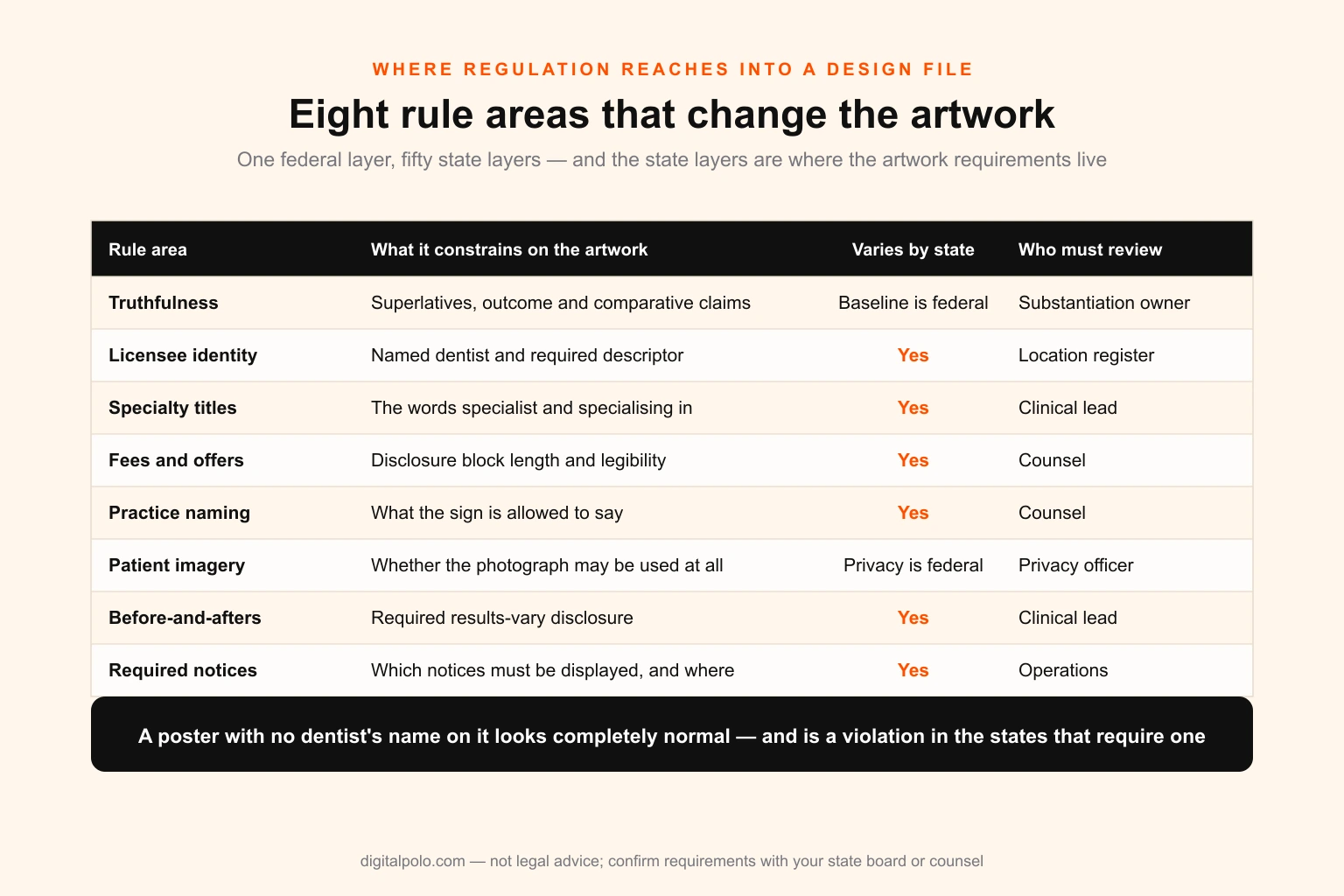
Not legal advice — rules vary by state and change. Confirm each row against your own state board or counsel.
Truthfulness and substantiation
The federal baseline, enforced by the FTC, is that advertising claims must be truthful, not deceptive, and substantiated before they run. In practice this reaches artwork in three places: superlatives ("the best dentist in the county"), outcome claims ("pain-free"), and comparative claims. A superlative that cannot be evidenced is not a copywriting flourish, it is an unsubstantiated claim, and the fact that it appears on a poster rather than in a press release changes nothing.
For a design system this means the approved headline set is not a convenience — it is the substantiation record. Every approved headline should have, somewhere, a note of what substantiates it. When a location asks for a new headline, the question is not "does it fit the layout" but "what evidence supports it".
Licensee identification and credentials
Several states require advertisements to identify the responsible licensee by name, and some require a descriptor alongside it. New Jersey's professional advertising rule, for example, requires advertisements to carry the licensee's name together with the phrase General Dentist, unless the licensee holds a specialty permit. Other states have their own formulations, and some have none.
This is the single most common artwork-level trap for a multi-state group, because it is invisible. A poster with no dentist's name on it looks completely normal. It is only non-compliant in the states that require one, and a designer in another country building a template for a client in nineteen states has no way to know which those are unless the system tells them.
Specialty titles
Describing a practice or a provider as a specialist, or using a specialty title, is restricted. Specialty recognition and the permitted announcement language are controlled at state level, and several states have had this area litigated and rewritten in recent years. The design-side consequence is narrow but sharp: the words specialist, specialising in, and any specialty name are not copy, they are regulated terms tied to a specific provider's credential status.
A group that lists services on a location page or a window decal will eventually have a location that offers, say, orthodontic treatment delivered by a general dentist. How that is described is a legal question with a visual answer, and it is not one the location should be answering alone.
Fees, discounts and offers
Advertising a fee, a discount, or a free offer is permitted in most places but usually conditioned: the terms have to be clear, the qualifying conditions disclosed, the period stated, and in some states the regular fee shown alongside the discounted one. Free-offer advertising in particular has its own rules in several states, often requiring specific disclosure of what is and is not included.
This is the requirement that most often breaks a layout. Disclosure text has a minimum legibility that the design has to accommodate, and a promotional poster designed with a single elegant line of small print at the bottom will not hold three sentences of conditions. Design the offer template around the worst-case disclosure length, not the shortest one, or every promotion will arrive as an emergency redesign.
Practice naming
Several states regulate what a dental or medical practice may call itself, particularly where the name does not include the owner's name, implies a specialty, or suggests a group structure that does not exist. For a DSO that operates practices under a common consumer brand while the underlying entities are separately owned professional corporations, this is not a detail — it determines what the sign on the building is allowed to say, and whether the ownership entity has to appear somewhere on the artwork.
Get this decided before the brand architecture, not after. A group that designs an exterior sign system and then discovers the legal entity name must appear on it has to redesign the sign system.
Patient images, before-and-afters, and testimonials
This is where the two compliance regimes collide hardest, and it deserves its own section.
Patient imagery: the rule most design systems get wrong
A photograph of a patient is not a photograph. It is protected health information, and putting it on a poster is a use of that information for marketing.
Under HIPAA, full-face photographic images and any comparable images are among the identifiers that make information individually identifiable. Using protected health information for marketing purposes generally requires a valid written authorisation from the individual — a specific document with required elements, including a description of what is being used, who may use it, the purpose, an expiration date or event, and the individual's right to revoke. A general consent-to-treatment form is not that document. A verbal yes at the chair is definitely not that document.
Three practical consequences for the design and production system:
Every patient image needs a linked authorisation, and the link has to survive. The photograph and the signed authorisation must be findable together, years later, by someone who was not there. In practice this means the authorisation reference lives in the asset's metadata or filename convention, and an image without one is unusable by default rather than usable until challenged. The discipline is the same one you should already be applying to stock and font licensing across print runs — proof of the right to use, attached to the asset, retrievable on demand.
Revocation has to be actionable. An individual can revoke authorisation. If that photograph is on a window decal in six locations, in a printed leaflet, on the website, and in a scheduled social post, revocation means a recall — and you can only run a recall if you know everywhere the asset went. This is the strongest argument there is for a single canonical asset register with distribution tracked. Without it, revocation is unenforceable in practice and you will not discover that until you need it.
Before-and-after images carry a second layer. Beyond the privacy authorisation, many states treat before-and-after photographs as claims about achievable outcomes, and require disclosure that results vary or that the images depict actual patients of the practice. Retouching a before-and-after, or using a stock before-and-after, moves it from a claim into a deceptive claim.
The safest default for a multi-state group is a standing policy that is stricter than the strictest state you operate in, applied uniformly. Trying to run eleven different patient-imagery policies across eleven states is how a group ends up with none.
Where a location genuinely needs human warmth in its materials and does not have authorised patient imagery, the answer is commissioned photography of the team and the space, with staff releases on file, plus properly licensed stock where the image is clearly environmental rather than clinical. This costs money once. Reusing an unauthorised patient photograph costs money in a way that is much harder to budget for.
The clinic asset inventory, by zone
Most asset inventories are organised by channel — print, digital, social. For a clinic group that is the wrong axis, because the constraints are physical. A leaflet in the waiting room, a sign in the operatory, and a card the patient takes home have different legibility requirements, different replacement cycles, and different regulatory exposure, and grouping them as "print" hides all of that.
Organise by zone instead. This is what a full inventory looks like for a typical dental or clinical location, and it is almost always longer than the group's existing kit.
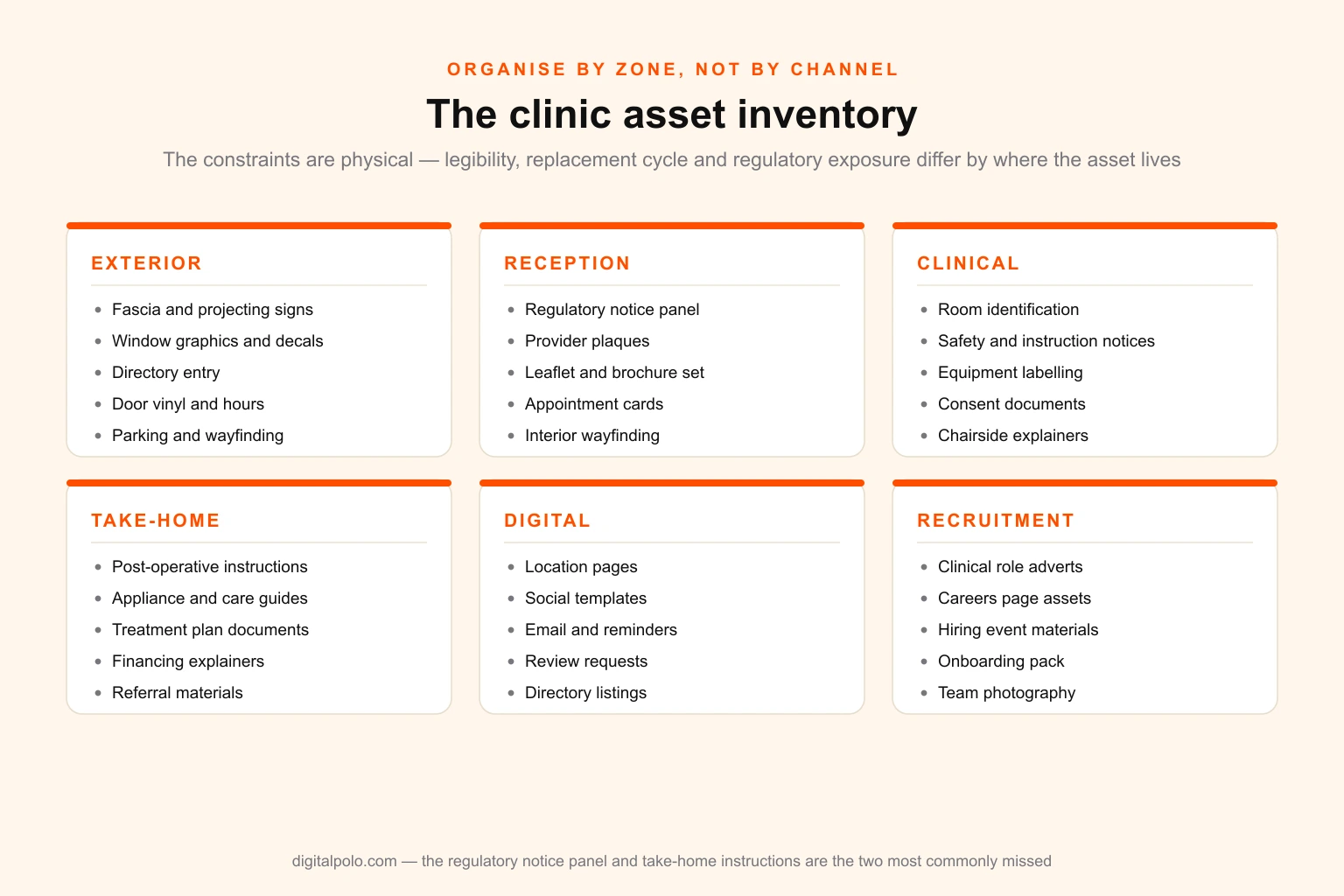
Organised by zone rather than by channel, because the constraints are physical.
A few notes on the items groups most often miss:
The regulatory panel. Many jurisdictions require certain notices to be displayed — licence certificates, a notice of privacy practices, patient rights, complaint routing, and in some places a specific notice about fees or financing. These are usually printed by whoever remembers, in whatever typeface was on the computer, and they hang in the most-looked-at part of the reception. They are the cheapest possible win: designing the required-notice set once, properly, as print-ready artwork in the brand system, makes the single most visible wall in the practice look intentional.
Provider plaques and name plates. These change whenever a provider does, which is more often than any other asset in the building, and they are almost never in the template system. See the provider cascade below.
Take-home clinical instructions. Post-operative care, appliance care, medication instructions. These are clinical documents that patients read at home under stress, and they are frequently the worst-designed thing the practice produces. They also carry clinical liability, which means the content is owned by the clinical lead and the layout is owned by marketing — a split that has to be explicitly managed or the document gets updated clinically and re-typed by whoever has Word open.
Recruitment materials. Clinical hiring is the constraint on growth for most groups, and the recruitment kit is usually an afterthought built by an office manager. If provider recruitment is a strategic priority, the employer brand asset kit is a marketing deliverable, not an HR one.
The financing and payment set. Insurance acceptance, payment plan explainers, financing partner materials. These carry both regulated fee-advertising language and third-party brand requirements from the financing provider, which often conflict with yours. Resolve the conflict once, centrally, and hand locations the resolved version.
Brand architecture when you grow by acquisition
Clinic groups rarely grow by opening greenfield sites. They grow by buying practices that already have a name, a sign, a patient base that is loyal to that name, and a selling dentist who may be staying on for three years.
That makes brand architecture the first strategic decision, and it has a direct and expensive production consequence.
There are three workable models:
Masterbrand. Every location converts to the group brand. Cleanest to produce — one kit, one set of templates, one photography library. Highest conversion cost and highest patient-attrition risk in the first year, particularly in markets where the acquired practice's name is the local institution and the selling dentist's surname is on it.
Endorsed. The location keeps its name, with a consistent group endorsement — a lockup, a strapline, a shared visual system. Middle cost. This is where most DSOs land, and it is the hardest to produce well, because every asset needs a lockup variant for every acquired name. Get the lockup construction rules right at the outset and the marginal cost per acquisition is small. Get them wrong and every acquisition is a mini rebrand.
House of brands. Locations keep independent identities, with the group invisible to patients. Lowest disruption, highest production cost, no compounding brand equity. Defensible as a transitional state, rarely as a destination.
The production question that decides this is rarely asked early enough: what is the per-acquisition asset cost under each model? A group acquiring eight practices a year under an endorsed model is producing eight lockups, eight signage packages, eight stationery sets, eight leaflet variants and eight website sections annually, forever. That is a standing production line, and it should be resourced as one rather than treated as eight surprises.
If you are converting acquired practices into a single brand, the sequencing, the asset-by-asset order of operations, and the patient-communication layer are covered in detail in merging two brands after an acquisition — it is written for corporate mergers, but the mechanics of retiring one identity without losing the goodwill attached to it are the same. The full list of what actually has to be remade is in the rebrand asset inventory.
One thing specific to clinical acquisitions: the transition window is usually defined by a legal agreement, not by marketing. If the purchase agreement says the selling dentist's name comes off the signage at eighteen months, the signage project is scheduled by that date and no other. Build the production calendar off the deal calendar.
The template model for a regulated network
The tiered template model works, but a clinic group needs a modification. In an ordinary network, a template field is either locked or open. Here, a field has both a permission state and a compliance state.
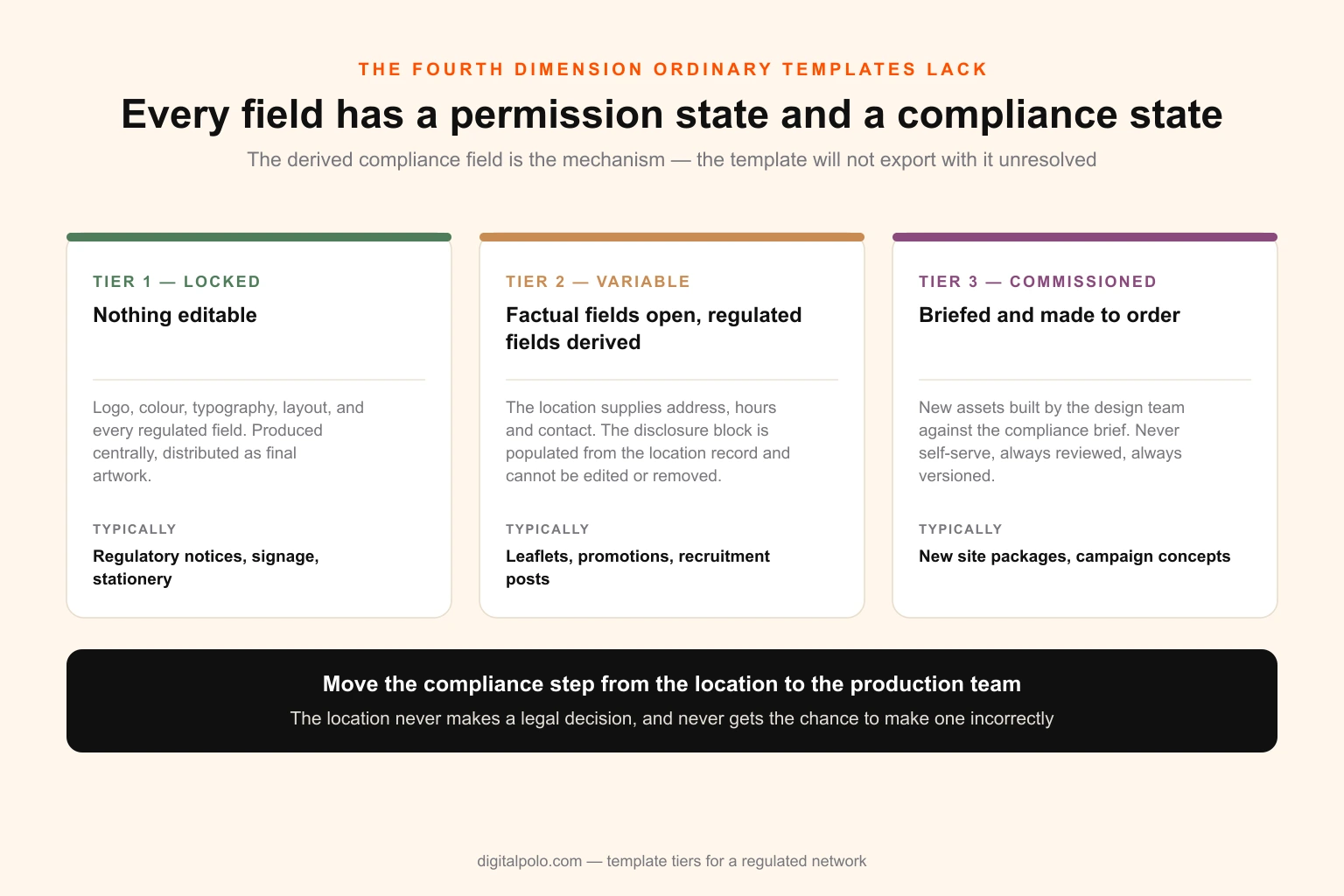
Tier 2 is where the derived compliance field does its work: factual fields open, regulated fields supplied at production.
The mechanism that makes this work is the derived compliance field. It is not an open field with guidance next to it, and it is not a locked field. It is a field whose content is determined by the location's record.
Concretely: the template knows which location it is being produced for. The location record holds the state, the responsible licensee, their credential, the entity name, and the current disclosure requirements for that state. The disclosure block on the artwork is populated from that record. A location cannot edit it, cannot delete it, and cannot produce the asset without it, because the template will not export with the field unresolved.
This sounds like enterprise software, and at scale it is — brand management platforms do this. But you do not need a platform to get most of the benefit at twenty locations. You need:
- a single location register, maintained by one named person, holding the regulated facts per site
- a per-state disclosure sheet, reviewed by counsel, updated on a fixed cycle
- templates built with the disclosure block as a separate, non-editable layer supplied at production time
- a production step where the correct disclosure is applied, done by the design team rather than the location
That last point is the important one. Moving the compliance step from the location to the production team is what makes the whole system hold, because it converts a distributed judgement into a centralised, repeatable one. The location requests a poster for a promotion. The design team produces it with the correct disclosure for that location's state already applied. The location never makes a legal decision and never has the opportunity to make one incorrectly.
For this to be acceptable to locations, the production team has to be fast. Which brings us to the constraint that decides whether any of this works.
Turnaround is the enforcement mechanism
Locations do not go off-brand out of rebellion. They go off-brand because the approved asset did not exist on the day they needed it.
A practice manager who needs a sign for a temporary closure on Thursday, requests it Monday, and receives it the following Tuesday will make their own sign on Thursday. Not because they disagree with the brand system — because a taped-up sheet of A4 is better than no notice on the door when patients arrive to a locked practice. Every one of those improvisations is a small, rational decision, and forty locations making small rational decisions is what an off-brand network actually is.
So the governing number is not how good your guidelines are. It is your turnaround relative to the local decision window.
| Request type | Local decision window | Required turnaround |
|---|---|---|
| Urgent operational notice (closure, hours change, equipment down) | Same day | Under 4 hours, or a self-serve locked template |
| Local event, community sponsorship, school visit | 3–7 days | 48 hours |
| Recruitment post for an open clinical role | 2–5 days | 48 hours |
| Promotion or campaign localisation | 1–3 weeks | 3–5 days |
| New provider announcement set | 1–2 weeks | 3–5 days |
| Signage or fit-out package for a new or acquired site | 4–12 weeks | 2–4 weeks |
The first row is the one that breaks systems. Nobody can produce a bespoke asset in four hours reliably, which means urgent operational notices must be self-serve — a small set of locked templates with one or two open fields, available to every location without a request. Closure notices, hours changes, "this room is out of use", "please use the other entrance". These carry near-zero regulatory risk and near-total improvisation risk. Solve them with self-serve and you eliminate the majority of visible off-brand material in the network at almost no cost.
Realistic turnaround benchmarks by asset type, and how to set expectations that survive contact with a real request queue, are covered in the design turnaround benchmarks breakdown.
The provider-change cascade
Here is the failure that costs clinic groups more than any other, and it is almost never designed for.
A dentist leaves. Or joins. Or gets a new credential. Or moves between two locations in the group.
That single event invalidates a surprising number of assets, and because no single person owns the list, most of them are never updated. Patients are still seeing a provider's name on the window six months after they left. The website still lists them. The recruitment ad still cites a team size that no longer holds. In the states that require the responsible licensee to be identified on advertising, a poster naming a departed dentist is not merely stale — it is inaccurate advertising carrying a name that has no relationship to the practice.
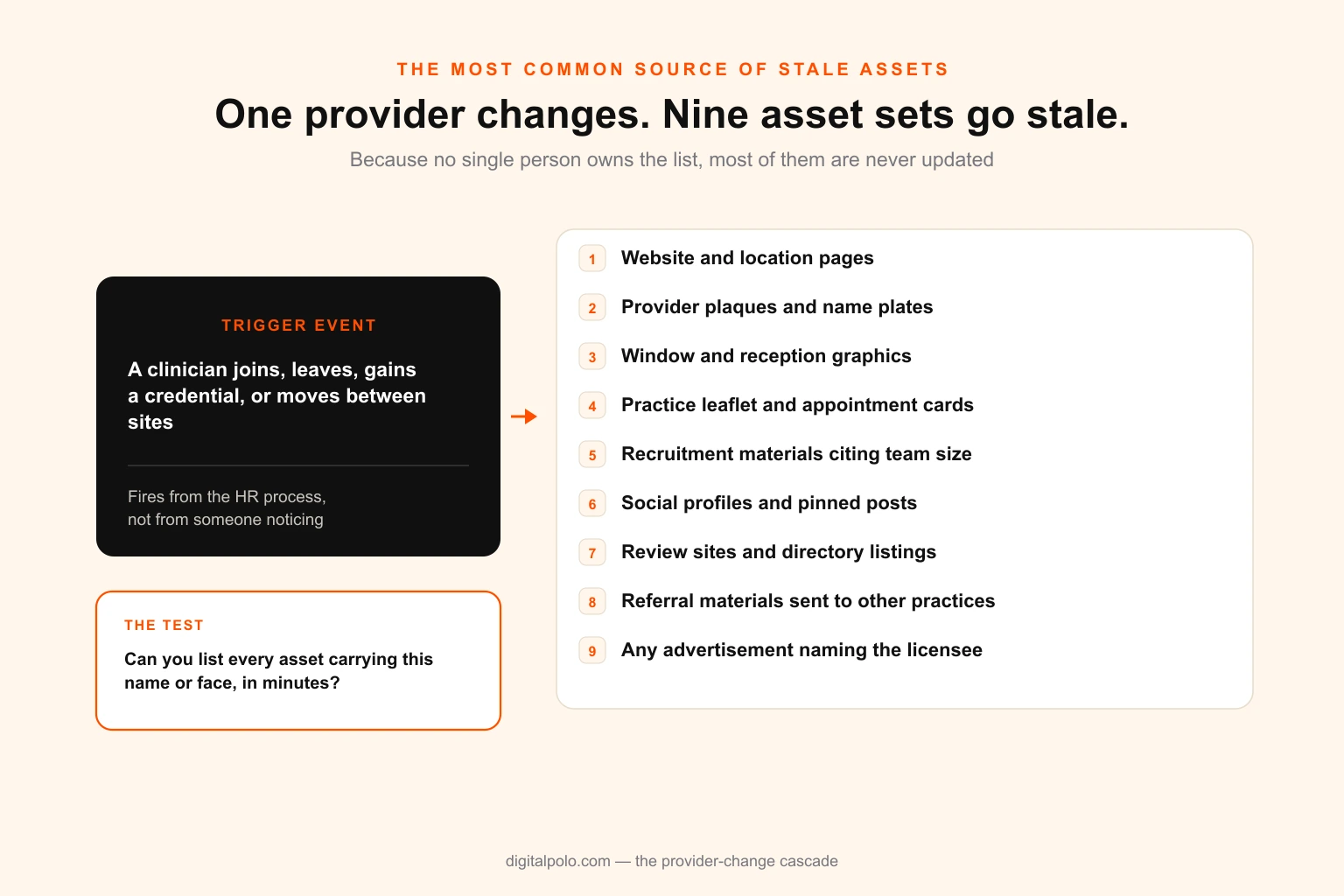
The test of whether the roster is a system: can you list every asset carrying this name or face, in minutes?
The fix is unglamorous: treat the provider roster as structured data with owners and a trigger, not as a set of facts embedded in dozens of files.
- One roster, one owner. A single register of providers per location, with name, credential exactly as it may legally be presented, licence state, start date, end date, photograph, and biography. Owned by one named person, usually in operations rather than marketing.
- A trigger, not a reminder. Provider onboarding and offboarding checklists include a marketing-assets step. It fires automatically from the HR process, not from someone noticing. The same discipline that makes an onboarding document system work applies here, and the offboarding half matters more.
- A known blast radius. For any provider, you should be able to answer "which assets carry this person's name or face" in minutes. That requires the asset register to record which provider each asset references. It is five extra minutes at production time and it is the difference between a two-hour recall and a two-week audit.
- A default sunset. Provider-specific assets carry a review date. Bios and headshots go stale even when the provider stays.
The offboarding case is the urgent one, because the window between a provider leaving and their name coming off patient-facing material is a window of active inaccuracy. Treat it the same way you would treat a departing agency's access to your accounts — as a checklist that runs on the day, not a task that gets to the bottom of a list. The general pattern is in the offboarding checklist.
Approval routing by risk, not by seniority
The instinct in a regulated business is to route everything through legal. This fails in a predictable way: the review queue becomes the bottleneck, locations learn that the official route takes three weeks, and they stop using it.
Route by the risk the asset actually carries.
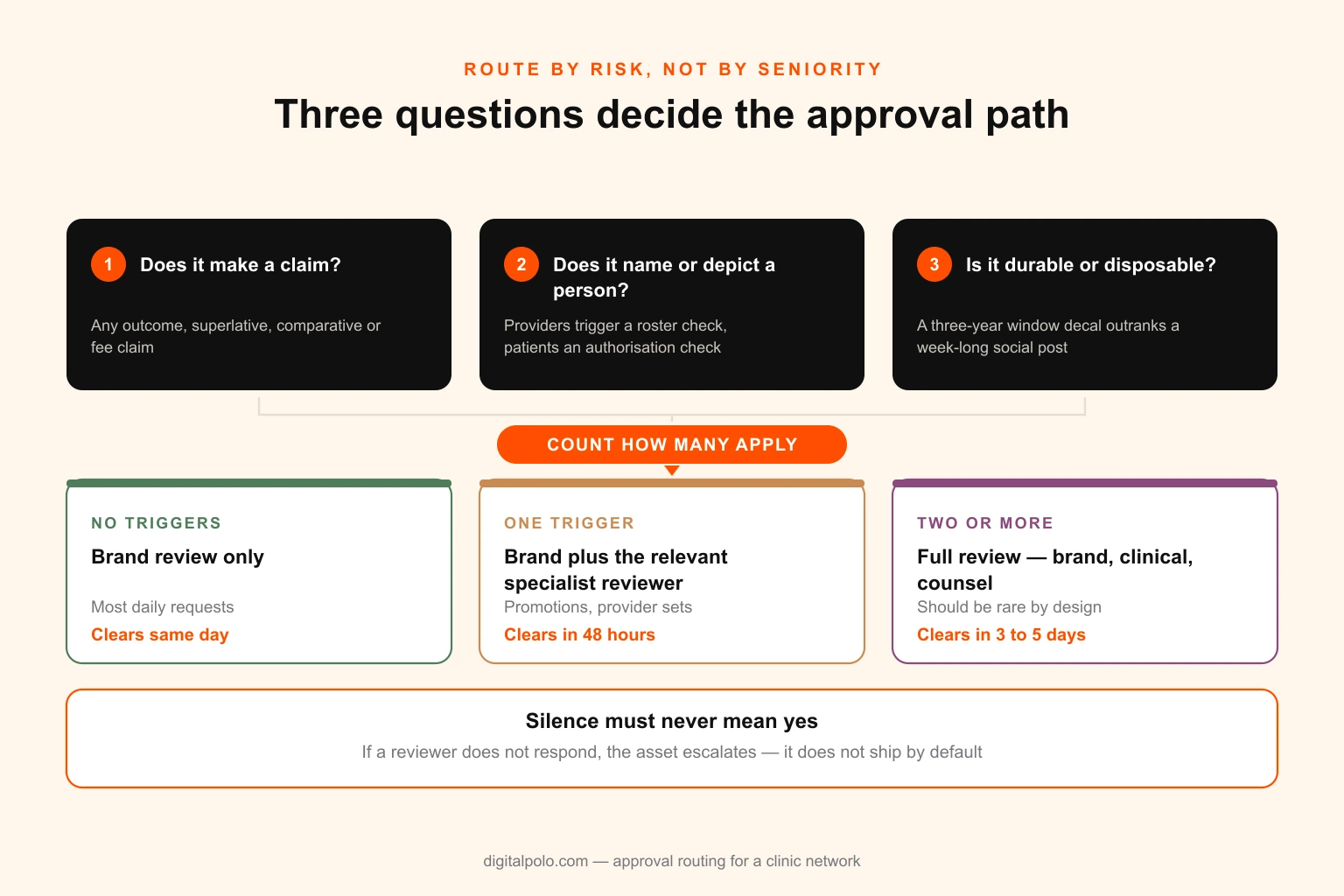
Route by the risk the asset carries, not by the seniority of whoever asked for it.
The three questions that determine routing are:
- Does it make a claim? Any outcome, superlative, comparative or fee claim triggers substantiation review. A closure notice does not.
- Does it name or depict a person? Providers trigger a roster check. Patients trigger an authorisation check. Neither is optional.
- Is it durable or disposable? A window decal that will be up for three years deserves more scrutiny than a social post that runs for a week — not because the rules differ, but because the cost of a recall does.
Assets that trigger none of the three — the large majority of daily requests — should route through brand review only, and should clear same-day. Assets that trigger one route to the relevant specialist reviewer. Assets that trigger two or more route to full review, and those should be rare enough that full review can be fast.
Two failure modes to design out explicitly:
Silent approval by timeout. If a reviewer does not respond, the asset must not ship by default. It must escalate. A network where silence means yes is a network with no approval process, discovered retrospectively.
Approval attached to the wrong thing. Approve the artwork file, at a specific version, with a record of who approved it and when. Not the concept, not the email thread. When a board asks who approved a poster, the answer needs to be a record, not a recollection. This is also what makes the licensee's ultimate responsibility survivable — the licensee can point to a documented review rather than to a shared drive.
Distribution, and the recall you will eventually need to run
An approved asset that locations cannot find has not been distributed. Most groups think they have solved distribution because the files are in a folder. A folder is storage.
Four requirements:
One canonical location. Not a folder plus an email plus a Slack pin plus a printer's FTP. One place, and every reference points to it. The most common cause of an outdated asset in production is a location using a file from an email sent eleven months ago.
Naming that encodes what matters. At minimum: asset type, brand or location scope, state applicability if the asset carries a state-specific disclosure, version, and date. A file named poster-final-v3-NEW.pdf is a future incident. The convention should let someone answer "is this current, and is it valid for this location" from the filename alone.
Retirement as a first-class action. Superseded assets are moved out of reach, not left alongside the current one. The single most reliable way to get a wrong asset printed is to leave the wrong asset findable.
The print supply chain. Locations order from local printers who hold files. When you retire an asset, the printer still has it, and the next reorder will produce the old version. Any retirement that touches a printed asset has to include notifying whoever holds the plates or the artwork. For groups producing at volume across many sites, this is the argument for consolidating print procurement, or at minimum for maintaining a list of every printer holding your artwork. The mechanics of keeping print files correct across suppliers are in the print-ready file checklist, and large-format items have their own resolution rules covered in large-format print resolution.
The recall capability is the test of all four. Ask yourself: if a provider revoked their consent this afternoon, or a patient revoked a photograph authorisation, could you identify every location and every medium carrying that image, and get it down, within a week? If the answer is no, the distribution system is incomplete regardless of how tidy the folder looks.
Signage and the exterior
Exterior signage is the most expensive asset a location owns, the hardest to change, and the one most likely to be regulated in three directions at once — by the state board on what the practice may call itself, by the landlord or centre on dimensions and materials, and by the municipality on planning and illumination.
Two production rules save the most money:
Specify legibility from viewing distance, not from the drawing. Sign artwork is approved on a screen at a size nobody will ever see it. Letter height is a function of viewing distance, and the practice name being legible from the car park is the entire point of the sign. Run the numbers before approving artwork — the sign letter height calculator does it directly, and the reasoning is explained in letter height by viewing distance.
Design the sign system for the worst case in the estate. One location will have a narrow fascia, one will be inside a medical centre with a shared directory, one will be a converted house with a planning restriction on illumination. If the sign system only works on a standard retail fascia, every exception becomes a bespoke design project. Design a family — fascia, projecting, window, directory entry, door vinyl, parking — with rules for reduction, and the exceptions become specification decisions instead.
For acquired sites in an endorsed model, add one more: a defined interim state. Between acquisition and full conversion there is a period where the sign says the old name and the group wants a visible association. Design that interim treatment once, properly, rather than letting each site improvise a vinyl banner.
What to measure
Brand compliance programmes die when nobody can show they worked. Four measures, all of which are gettable without a platform.
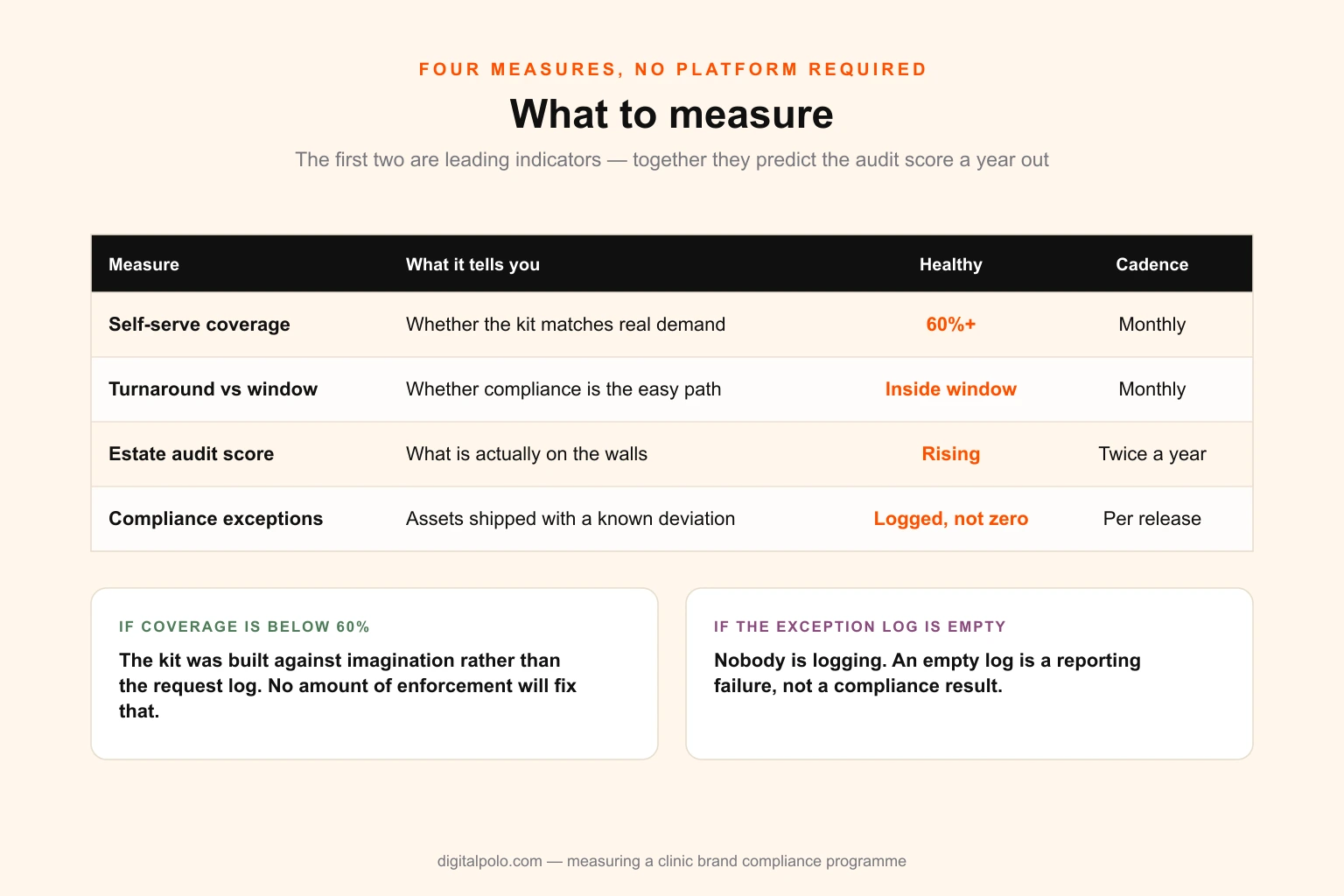
Two leading indicators, one outcome measure, one regulatory measure. None of them needs a platform.
The first two are the leading indicators and the ones worth optimising. Self-serve coverage — the proportion of location requests that could have been satisfied by an existing approved asset — tells you whether the kit matches real demand. If it is below 60%, the kit was built against imagination rather than the request log, and no amount of enforcement will fix that. Median turnaround against the local decision window tells you whether compliance is the path of least resistance. These two together predict the audit score twelve months out better than anything else.
The estate audit score is the outcome measure: photograph every patient-facing surface at every location twice a year and score against the standard. It is tedious, it is the only honest measure, and delegating the photography to the locations themselves works fine — they are not incentivised to hide anything if the audit is framed as a supply request rather than an inspection.
The compliance exception log is the regulatory measure: every asset that shipped with a known deviation, why, and whether it was remediated. A log with zero entries means nobody is logging, not that nothing deviated.
Sourcing the production capacity
The arithmetic that decides whether this is an in-house or partnered function is straightforward, and it turns on request volume rather than location count.
A network generating 40 to 60 design requests a month across localisation, provider changes, recruitment and promotions needs roughly one full-time designer's capacity — but not one designer, because the work spans print production, layout, signage specification, social formats and the occasional illustration, and it arrives in bursts tied to the acquisition and promotional calendars rather than evenly. A single in-house hire covers the average and fails the peak, which is exactly when the failure is most visible.
The models available, and the honest trade-offs:
- In-house designer. Best when request volume is steady and above roughly 60 a month, and when the clinical and regulatory context genuinely takes months to learn. Fails at peaks and leaves you exposed on the day they resign.
- Local freelancers. Flexible, but every new freelancer relearns your compliance rules, and compliance knowledge that lives in one freelancer's head is not a system. Workable as overflow, poor as a backbone.
- A subscription design partner or white-label studio. Fixed monthly cost, absorbs peaks, and — the part that matters here — the compliance rules live in a documented brief that the partner works to, which forces you to write them down. The comparison against hiring is worked through in unlimited design versus a full-time designer, and pricing benchmarks for the partnered model are in the pricing breakdown.
Whichever you choose, the deliverable that makes it work is the same: a written production brief that encodes the location register, the per-state disclosure sheet, the template rules and the approval routing. If you cannot hand that document to a new designer and have them produce a compliant poster for location 14 without asking a question, the system is in someone's head rather than in the system. Writing it is covered generally in how to write a design brief; the clinic version simply has more mandatory fields.
Digital Polo works with multi-location and franchised networks on exactly this kind of standing production: templated localisation, provider-change sets, signage packages and print-ready output against a documented compliance brief. If that is the shape of the problem, see how the plans work or look at the white-label option if you are an agency delivering this for a clinical client.
The 90-day version
If you are starting from nothing, the order matters more than the pace. Auditing before building prevents a kit nobody wants. Distributing before enforcing prevents a policy nobody can comply with.
Days 1–20 — Audit and register. Photograph every patient-facing surface at three representative locations. Pull the last twelve months of location requests from email. Build the location register: state, licensee, credential, entity name, hours, languages. Commission a per-state disclosure sheet from counsel.
Days 21–45 — Decide and specify. Fix the brand architecture decision. Classify every asset in the inventory by tier and compliance state. Write the specification for each template, including the worst-case disclosure length. Define approval routing by risk.
Days 46–70 — Build. Produce the self-serve operational set first — it is small, it is low-risk, and it removes the most visible off-brand material fastest. Then the top ten assets by request frequency. Then the regulatory notice panel, which is high-visibility and cheap.
Days 71–90 — Distribute, then enforce. Move everything to the canonical location. Retire superseded files and notify printers. Run a session with location managers that frames the system as a supply improvement, because it is. Only after locations have had the kit for a month does enforcement become reasonable.
Start with the operational notices. They are the least interesting assets in the network, they carry almost no regulatory risk, and they are responsible for more visible off-brand material than every campaign you will ever run. Fix the taped-up A4 on the door and you have bought the credibility to fix everything else.