

The supplier's invoice says $90. You quote the client $180, double it, and tell yourself you are running a 50 per cent margin on outsourced design. Then you spend twenty minutes pulling the requirement out of the client, fifteen minutes rewriting it into a brief the designer can execute, a quarter of an hour checking the files, half an hour on the feedback call and the round of changes that followed it, and ten minutes chasing and filing. Value that seventy minutes at what an hour of your team actually costs and the job lost money before the stock image was licensed.
This is the most common pricing mistake in white-label design, and it is invisible on any single invoice. The supplier cost is the number you can see, so it becomes the number you price from. But on small and mid-sized assets the supplier is usually not the largest cost on the job. You are. Price as a markup on the supplier and your margin is set by the one cost you do not control while ignoring the one you do.
The cost of getting this wrong compounds quietly. Work that loses $40 a time looks fine at five jobs a month and becomes a structural loss at fifty — at exactly the point where you have added an account manager to cope with the volume. Agencies in that position tend to conclude that design reselling "doesn't work", when the model was fine and the price was wrong.
This guide is the sell-side companion to our white-label design pricing benchmarks, which covers what you pay a supplier. Here we cover what you charge, and how to keep the difference. You will get:
- the markup-versus-margin conversion that explains where the first fifteen points go
- how to build a fully loaded unit cost that includes your own time
- a worked rate card by complexity class, with every number shown
- how to price a retainer on a flat-fee design queue, including the floor you cannot go below
- the seven places margin leaks after the price is set, and the clause or habit that plugs each
- the discount arithmetic, the quote line items, the KPIs, and a 30-day reset plan
There is also a free design pricing and margin calculator that runs every formula below on your own numbers.
Reselling design and want the supply side solved first? Digital Polo runs white-label design for agencies on a flat monthly fee, with source files, NDA and reseller rights included — which turns your supply cost into a fixed number you can price against. See plans and pricing.
The short answer
If you only take one formula from this page, take this one:
Price = fully loaded cost ÷ (1 − target margin − payment fees)
Not supplier cost × (1 + markup). The two differ in what goes on top of the fraction and in what the percentage is measured against, and both differences cost you money.
| Step | What you do | Typical value for a design reseller |
|---|---|---|
| 1. Supplier cost | The landed price per accepted deliverable | Varies by class — see the rate card |
| 2. Internal time | Briefing, QA, client relay, PM, at your loaded hourly cost | 10 minutes to 8 hours per deliverable |
| 3. Rework allowance | Changes you absorb rather than bill | 5–10% of steps 1 + 2 |
| 4. Pass-throughs | Stock, fonts, proofs, mock-up licences | $0–$150 per deliverable |
| 5. Target margin | Delivery margin you need to fund the business | 50–55%, floor 40% |
| 6. Payment fees | Card, transfer and FX costs, as a share of price | ~3% |
Run that and two things usually happen. Small jobs get more expensive than you were charging, and large jobs get slightly cheaper. Across most rate cards the supplier ends up at 20 to 30 per cent of the selling price, an effective markup on supply of roughly three to five times. That ratio is the sanity check for everything else on this page.
It also matches how experienced agency advisers frame partner budgets. Karl Sakas, who consults to agency owners, suggests capping white-label development at around a quarter of the end client's budget. The same 25 per cent appears for a different discipline, from a different direction.
Markup vs margin: the confusion that eats the first fifteen points
Markup is profit as a percentage of cost. Margin is profit as a percentage of price. The profit is the same; the two percentages are not.
Buy a deliverable at $100 and sell it at $150. Profit is $50. As a markup that is 50 per cent ($50 ÷ $100). As a margin it is 33 per cent ($50 ÷ $150). An owner who says "we mark up 50 per cent" and then plans the business on a 50 per cent margin has overstated their profit by seventeen points before a single other cost is counted.
The two conversions worth memorising:
- Margin = markup ÷ (1 + markup)
- Markup = margin ÷ (1 − margin)
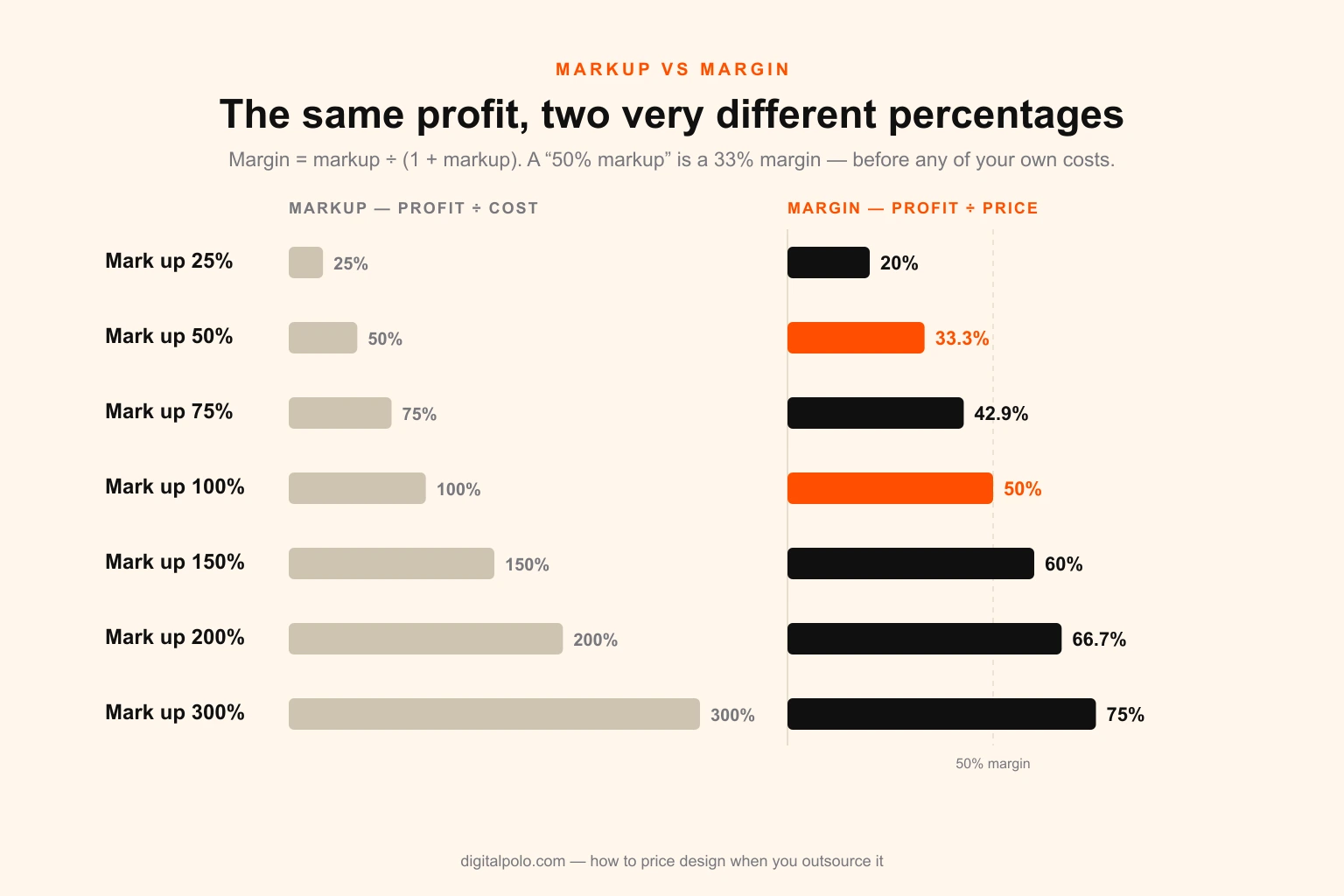
Markup always reads higher than margin on the same job, and the gap widens as prices rise. Plan the business in margin and use markup only for checking.
| If you mark up by… | …your margin is | To hit this margin… | …you must mark up by |
|---|---|---|---|
| 25% | 20.0% | 30% | 42.9% |
| 50% | 33.3% | 40% | 66.7% |
| 75% | 42.9% | 50% | 100% |
| 100% | 50.0% | 60% | 150% |
| 150% | 60.0% | 70% | 233% |
| 200% | 66.7% | 75% | 300% |
The practical rule: set targets in margin, and only use markup to check your work. Margin is what your accounts, your bank and any buyer of your business will look at. It is also the only one of the two that cannot exceed 100 per cent, which makes it much harder to fool yourself with.
There is a second, less obvious reason to stop pricing in markup. A markup is always a markup on something. In outsourced design, that something is nearly always the supplier's invoice. So the moment you price in markup, you have also chosen the supplier's cost as your reference point. That is the wrong reference point, for the reason the next section shows.
What "cost" actually means: the fully loaded unit cost
The supplier invoice is the visible part of the cost. The fully loaded cost is everything the job consumes before the client pays you. For outsourced design it has five parts.
1. Supplier cost per accepted deliverable
Not the headline rate. The landed cost of a deliverable that actually shipped to the client without you paying for a redo. If you buy on a subscription, divide the monthly fee by accepted deliverables in the month. If you buy per project, use the project price plus any extras the supplier billed. The method is set out in full in the benchmarks guide, and the quality of supplier you choose moves this number more than any negotiation will — which is why vetting a white-label partner properly is a pricing decision, not just a procurement one.
2. Your internal time, at a loaded hourly cost
This is the line most resellers leave out, and on small assets it is the biggest one. Four activities consume it:
- Briefing. Extracting the requirement from the client, then translating it into a brief a designer can execute. A well-built brief template cuts this more than any other single change.
- Review and QA. Checking the work is right, then checking the files are right — bleed, colour mode, outlined type, export settings. A standing print-ready file checklist turns the second part into a five-minute pass.
- Client relay. Presenting, collecting feedback, consolidating it, and converting "can it pop more" into something actionable.
- Project management. Tickets, status updates, chasing, filing.
Value those minutes at a loaded hourly cost, not a salary divided by 2,080. Here is a worked example for an account manager:
| Line | Annual figure |
|---|---|
| Salary | $65,000 |
| Payroll taxes, benefits, on-costs (~25%) | $16,250 |
| Allocated overhead — software, equipment, space | $12,000 |
| Fully loaded annual cost | $93,250 |
| Available hours after leave and holidays | ~1,700 |
| × realistic share spent on client delivery (70%) | ~1,190 productive hours |
| Loaded cost per productive hour | ≈ $78 |
Your number will differ. Work it out once, write it down, and use it everywhere. If the owner does the account work, use what it would cost to hire someone to do it. Unpaid founder time is still a cost; you have just chosen to pay it in equity rather than cash.
3. A rework allowance
Every reseller absorbs some changes rather than arguing over forty minutes, because the relationship is worth more. Few measure how much. Across resellers who do, it typically runs between 5 and 15 per cent of delivered volume. Budget 10 per cent of supplier plus internal cost on composition and layout work, and less on templated adaptation.
4. Pass-through costs
Stock photography, font licences, mock-up licences, printed proofs, couriers. These are small per job and add up across a year. The licensing ones are dangerous because a licence that covers your own use often does not cover redistribution to a client or a merchandise print run. Font licensing for resellers and stock licensing across print runs and merchandise cover where those boundaries sit.
5. Payment fees and cash float
Card processing, bank transfer fees and currency conversion typically take 1 to 3.5 per cent of what the client pays. They scale with price, not cost, so they belong in the denominator of the pricing formula, not on the cost stack. There is also a carrying cost when you pay a supplier monthly in advance and the client pays you on net 45. That one is better handled through payment terms than through price, and we come back to it below.
The worked example: one social media set
A set of six on-brand social posts for an existing client. This is Class B work in the benchmark taxonomy: composition within an established system.
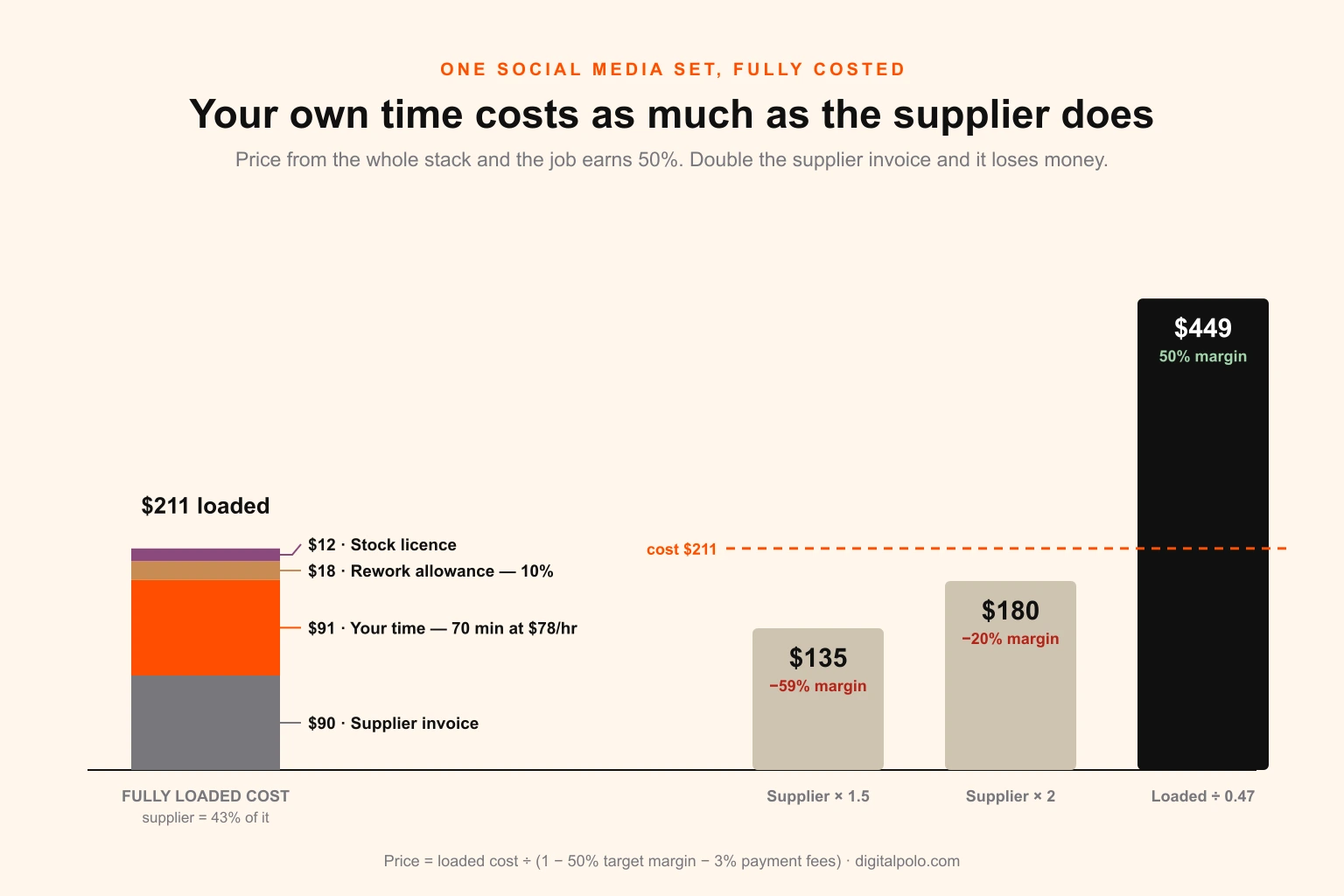
On a mid-sized asset, the reseller's own time costs as much as the supplier does. Price from the full stack, not from the bottom bar.
| Cost line | Calculation | Amount |
|---|---|---|
| Supplier, per accepted set | Per-project quote | $90 |
| Internal time | 70 min (brief 20, QA 15, relay 25, PM 10) × $78/hr | $91 |
| Rework allowance | 10% × ($90 + $91) | $18 |
| Pass-through | One stock image licence | $12 |
| Fully loaded cost | $211 |
Now compare three ways of pricing it:
| Pricing method | Price | Profit after loaded cost and 3% fees | Real delivery margin |
|---|---|---|---|
| Supplier × 1.5 ("50% markup") | $135 | −$80 | −59% |
| Supplier × 2 ("we double it") | $180 | −$36 | −20% |
| $211 ÷ (1 − 0.50 − 0.03) | $449 | $225 | 50% |
The formula lands on the 50 per cent target exactly, after the processor has taken its 3 per cent. That is why fees go in the denominator rather than on the cost stack: they scale with the price you are trying to set.
Doubling the supplier's price loses money on this job. That is not because the supplier is expensive. It is because on this kind of work the supplier is less than half the cost. Look again at the internal time line: it is the same size as the supplier invoice. The cheaper the asset, the larger the share of its cost that is you.
Set the target margin before you set the price
Delivery margin — what is left after supplier, internal delivery time and pass-throughs — is not profit. It has to pay for sales, finance, admin, tools that are not tied to a job, the owner's salary and only then profit. Agencies that run delivery margin in the thirties usually find their net profit is close to zero. They are working hard to break even.
Set a target by class of work, and a floor below which a job gets repriced or declined:
| Class of work | Target delivery margin | Why |
|---|---|---|
| A — Adaptation (resizes, versions, template fills) | 55% | Low risk, high volume, and the client sees little difference between suppliers, so the margin has to come from your efficiency |
| B — Composition (social sets, one-pagers, emails, ad sets) | 50% | The bulk of most resellers' volume; margin is decided by brief quality and relay time |
| C — Original layout (brochures, decks, menus, labels) | 50% | Higher supplier cost and higher error risk; protect the margin with a tighter scope rather than a higher percentage |
| D — Systems and identity (logo suites, brand systems, dielines) | 55% or value-priced | The output constrains every downstream job for years, and clients pay for that judgement, not the hours |
| Floor, any class | 40% | Below this, reprice, rescope or decline |
Two refinements. First, set a minimum dollar contribution per job as well as a percentage. A 55 per cent margin on a $40 resize is $22, which does not cover the cost of raising the invoice. Batch small requests or set a minimum order. Second, review the targets once a year against your actual overheads. If overheads have grown, the targets have to as well.
The five sell-side pricing models, and what each does to margin
There are five ways to price outsourced design to a client. They are not equally good, and the right one depends on how predictable the client's demand is.
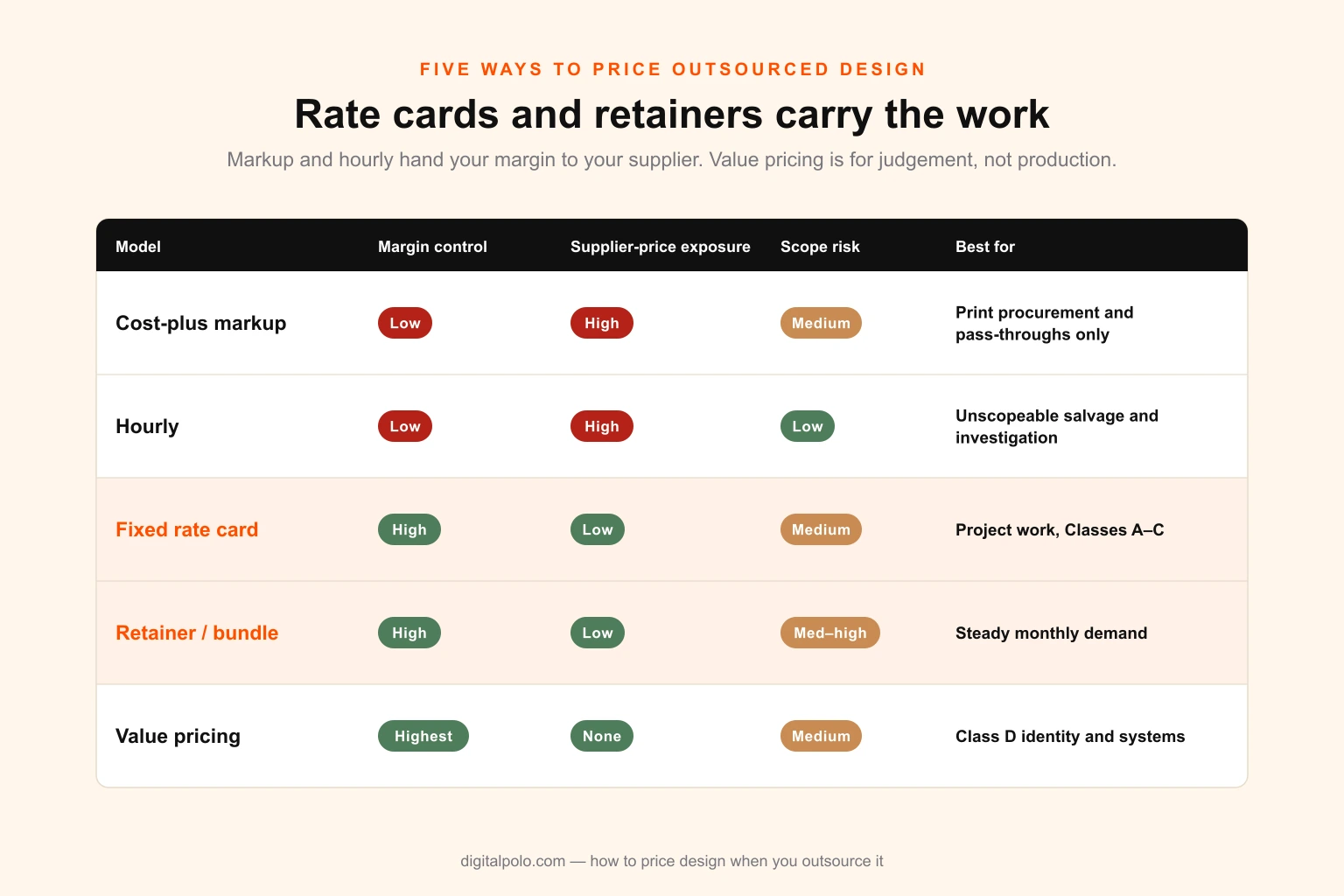
Rate cards and retainers carry most outsourced design; value pricing is for the identity and systems work where judgement is what the client pays for.
1. Cost-plus markup
Supplier cost plus a percentage. The default, and the weakest. It anchors your price to your supplier's cost structure instead of the client's alternatives. It hands your supplier's price changes straight to your client, in both directions — when you find a better, cheaper supplier, your revenue falls. And as the worked example showed, a markup that looks generous often does not cover internal time. Use it only for genuine pass-throughs such as print procurement, where clients typically accept a handling fee of 10 to 20 per cent.
2. Hourly
Avoid it for outsourced work. Hourly billing passes your supplier's speed straight through to the client, so every efficiency gain — a faster partner, a better template, a mature brand system — reduces your revenue. It also invites the client to compare your rate with a freelancer's on a marketplace, which is a comparison you will lose. Keep hourly for work that genuinely cannot be scoped, such as rescuing a broken legacy file, and move to a fixed price as soon as the work becomes describable.
3. Fixed rate card by deliverable
A published or semi-published price per type of deliverable, built from loaded cost and target margin. This is the right default for project work. It is easy for clients to approve and easy for you to defend. It is also insulated from supplier changes: if your supply cost falls, your margin rises. The next section builds one.
4. Retainer or bundle
A fixed monthly fee for a defined scope — a number of deliverables, a mix of classes, a service level. This suits clients with steady demand, and it pairs naturally with a subscription supply model, because then both sides of the spread are fixed. The risk is utilisation: if the client sends half the expected volume you keep the fee but the relationship sours, and if they send double you eat the internal time. Define the scope in deliverables, not hours, with an overage rate. The design retainer playbook for media-buying clients covers scope documents for this model in detail.
5. Value pricing
Price set by what the outcome is worth to the client, not by what it costs you. This is right for Class D work — a brand identity, a packaging system, a launch campaign architecture — where the client is buying judgement and the downstream consequences are large. A packaging refresh shows why: the design fee is a small fraction of what the decision costs once tooling, print and rollout follow it. Value pricing needs a confident sales conversation and a clear statement of the outcome. Do not use it for production work, where clients know the market rate.
| Model | Margin control | Exposure to supplier price | Scope risk | Best for |
|---|---|---|---|---|
| Cost-plus markup | Low | High | Medium | Print procurement and pass-throughs only |
| Hourly | Low | High | Low | Unscopeable salvage and investigation |
| Fixed rate card | High | Low | Medium | Project work, Classes A–C |
| Retainer / bundle | High | Low | Medium–high | Steady monthly demand |
| Value pricing | Highest | None | Medium | Class D identity and systems |
Build the rate card: worked numbers by complexity class
Here is a full sell-side rate card, built bottom-up with the method above. Supplier costs are mid-market wholesale figures from the benchmark ranges. The internal rate is the $78 loaded hour, and payment fees are 3 per cent. Replace every number with your own; the structure is what matters.
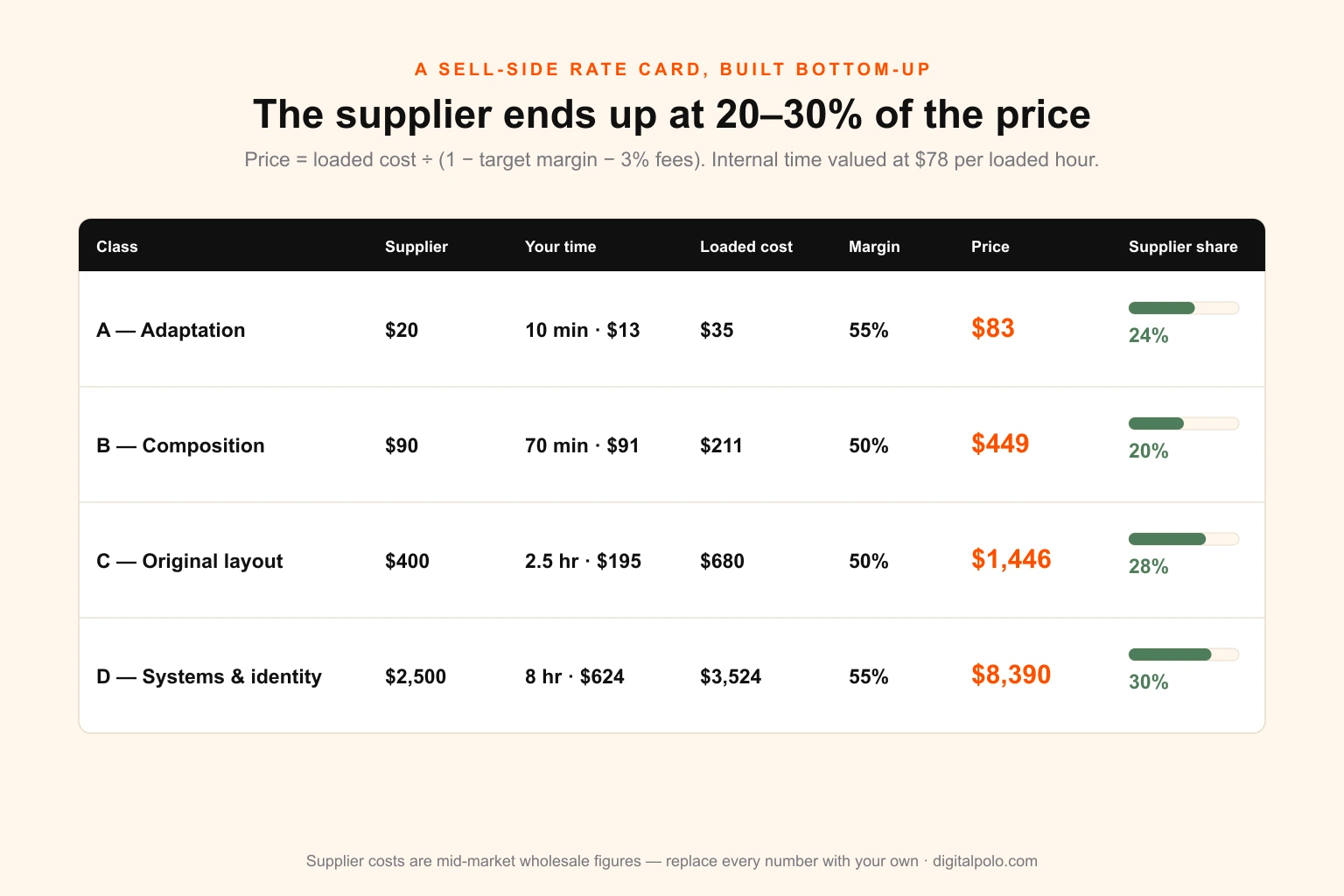
The supplier's share of the price lands between a fifth and a third in every class. That ratio is the quickest check on any quote.
| Class | Supplier | Internal time | Rework | Pass-through | Loaded cost | Target margin | Price | Supplier share of price |
|---|---|---|---|---|---|---|---|---|
| A — Adaptation (per asset, batched) | $20 | 10 min = $13 | 5% = $2 | — | $35 | 55% | $83 | 24% |
| B — Composition (e.g. social set) | $90 | 70 min = $91 | 10% = $18 | $12 | $211 | 50% | $449 | 20% |
| C — Original layout (e.g. trifold brochure) | $400 | 2.5 hr = $195 | 10% = $60 | $25 | $680 | 50% | $1,446 | 28% |
| D — Systems (e.g. logo suite + guidelines) | $2,500 | 8 hr = $624 | 8% = $250 | $150 | $3,524 | 55% | $8,390 | 30% |
Price = loaded cost ÷ (1 − target margin − 0.03).
Check the result against the market you sell into. Your client is comparing you with the alternatives they know about, whether or not they say so. The end-client side of the market is mapped in our graphic design pricing guide: a brochure from a freelancer or small studio typically runs $1,000 to $5,000, and an agency brand identity $5,000 to $50,000 and up. Every price in the table sits inside those ranges, which is what you want. If your bottom-up price lands above the market, the fix is cost — fewer internal minutes, better briefs, a supplier who needs less QA — not a lower margin. If it lands well below, you have room to price up to the market. Being the cheapest option makes the client suspicious and leaves you with no buffer.
Round to price points, not to the cent. Publish $85, $450, $1,450, $8,400 — or tidy ranges. Precise-looking prices invite line-by-line negotiation.
Batch Class A. Ten resizes priced as one request share one briefing and one QA pass, which is how the internal time per asset drops to ten minutes. Sold one at a time, the same resize carries thirty minutes of your time and needs to be priced near $150 to hold margin. Clients usually prefer the batch once they see both numbers. The scale of that adaptation demand is easy to underestimate. One campaign asset across fifteen channel formats shows how fast one concept turns into dozens of deliverables, and how many ad creatives you need per month shows how fast that recurs.
Pricing a retainer on a flat-fee design queue
When your supply is a flat monthly subscription, the economics change shape. Supplier cost no longer scales with volume, so the sell-side question becomes how to share one fixed cost across several clients. Your own time still scales with every client you add, and it never gets cheaper.
The floor price for each client retainer is:
Per-client floor = (queue cost ÷ clients sharing it + internal hours per client × loaded rate) ÷ (1 − target margin − fees)
Worked on a Digital Polo Soulmate queue at $899 a month, with six hours of account time per client per month at $78 an hour, a 50 per cent target margin and 3 per cent fees:
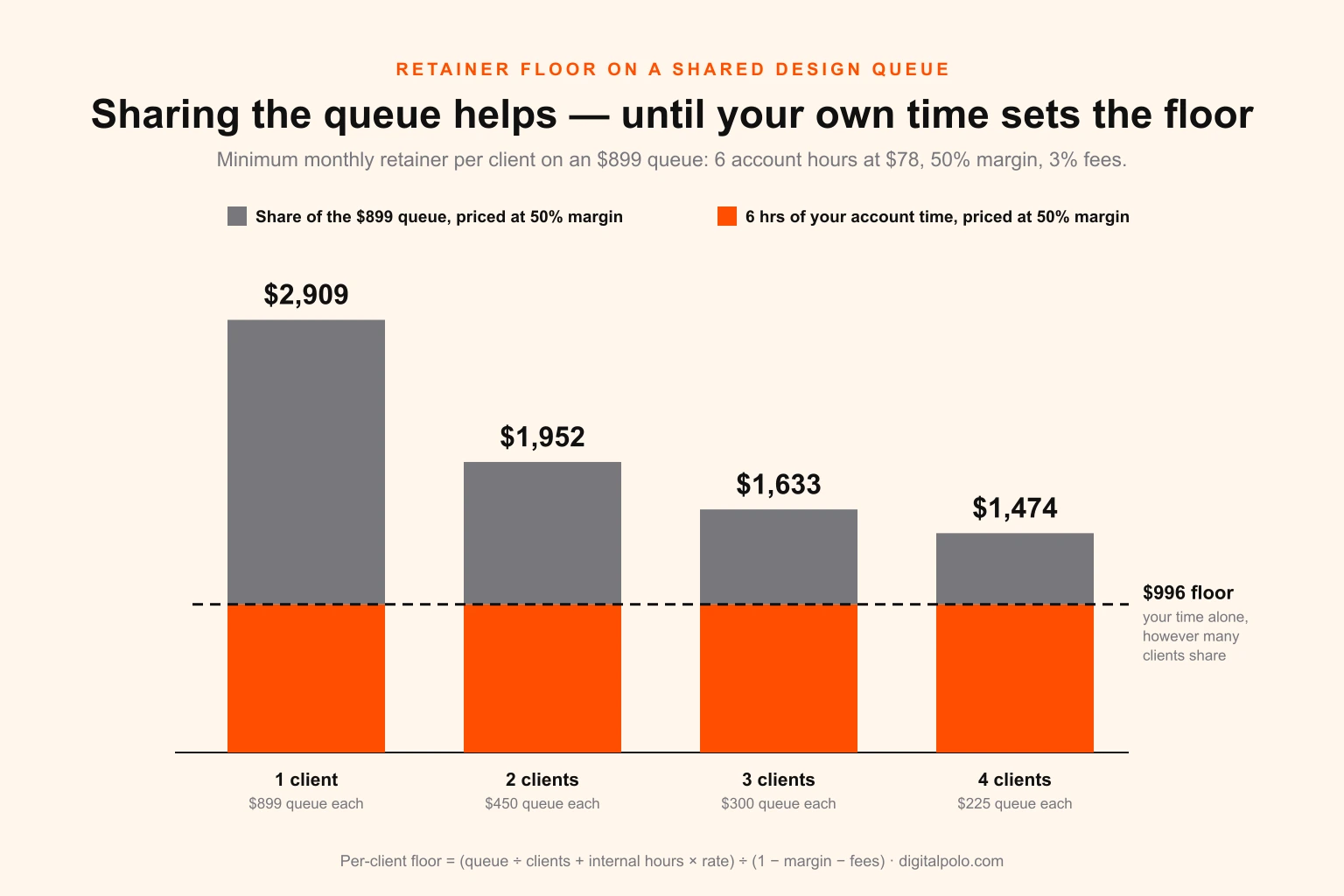
Sharing the queue drives the floor down quickly from one client to three. After that your own account time dominates, and the floor never falls below about $1,000.
| Clients sharing the queue | Queue cost per client | Internal cost per client | Per-client floor price |
|---|---|---|---|
| 1 | $899 | $468 | $2,909 / mo |
| 2 | $450 | $468 | $1,952 / mo |
| 3 | $300 | $468 | $1,633 / mo |
| 4 | $225 | $468 | $1,474 / mo |
| ∞ (theoretical) | $0 | $468 | $996 / mo |
Three things follow.
A single-client queue is expensive to resell. Selling one client a $1,500 retainer on a dedicated $899 queue looks like a 40 per cent spread on supply. Count your six hours and fees, and it is a delivery margin of about 6 per cent. Either price the first client higher, start them on a lower tier — a $399 Partner queue with four hours of account time puts the single-client floor near $1,510 — or plan from day one to add a second client to the queue.
The internal-time floor is the real constraint. However many clients share the queue, you cannot price a six-hour-a-month account below about $1,000 at these assumptions. If the market will not bear that, reduce the hours — templates, a brief form, consolidated feedback rules — rather than the margin.
Do not overfill the queue. Sharing improves margin until throughput slows, and then it destroys it: clients wait, escalate, and the relay time per client climbs. In practice that ceiling sits at two to four small retainer clients per queue. The reseller playbook covers how to recognise it.
This also explains why the margin figures in most reseller guides — including the supply-only spread table in our own playbook — look higher than what agencies report in practice. A spread over supply cost is not a delivery margin until your time has been taken out.
Mid-article checkpoint. If you already resell design and your supply cost is a moving target, the retainer arithmetic above is impossible to run. A flat-fee white-label queue fixes the supply side at $399 or $899 a month, with unlimited revisions and source files on both tiers, so the only variables left are your own. Compare the plans.
The seven places margin disappears after the price is set
A correct price is necessary and not sufficient. Most outsourced-design margin is not lost in the quote; it leaks out afterwards, in small amounts that never show up as a line on any invoice. Here are the seven leaks, roughly in order of how much they cost, and what plugs each.
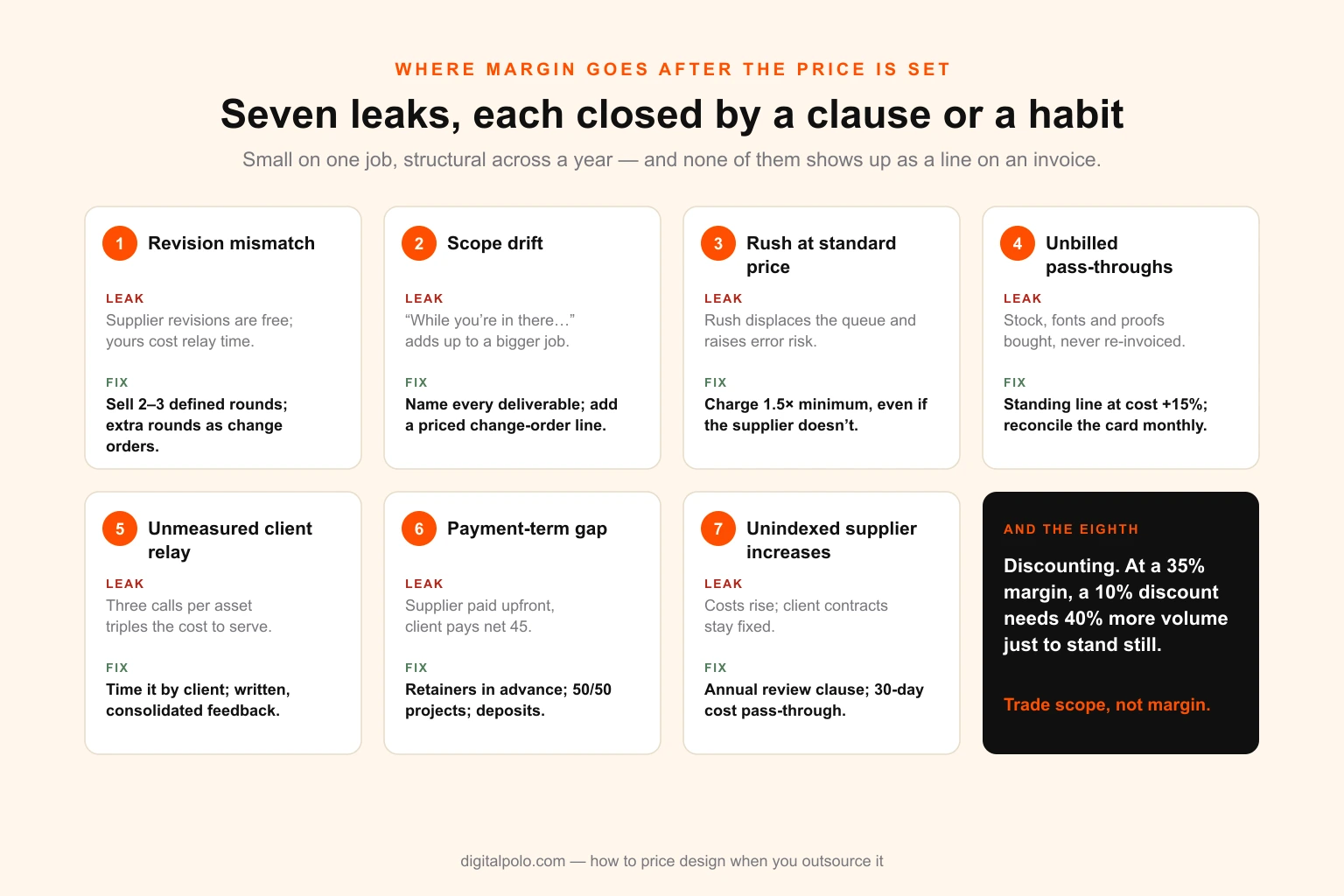
Each leak is small on one job and structural across a year. Every one of them is closed by a clause in the quote or a habit in the workflow, not by a higher price.
1. A revision-policy mismatch
Your supplier offers unlimited revisions, so you offer unlimited revisions. The supplier's rounds are free; yours are not, because every round passes through your review and your client call. Fix: sell a defined number of rounds — two is standard for composition work, three for original layout — and define a round as one consolidated set of feedback from one decision-maker. Price extra rounds as a change order at roughly twice your loaded internal hourly rate. Keep the supplier's unlimited policy as your buffer, not as the client's entitlement.
2. Scope drift
"While you're in there, could you also…" One more format, one more language, one more page. Each is small; together they turn a $1,450 brochure into a $2,200 job billed at $1,450. Fix: list deliverables in the quote by name, format and quantity, and add a change-order line with a price. The line rarely gets used. What matters is that it exists, so "can you also" becomes a conversation about price instead of a favour.
3. Rush work at standard price
Rush jobs displace other clients in the queue, compress your review time and raise the chance of a mistake reaching print. Fix: charge at least 1.5 times standard for anything inside your normal service level, even if the supplier does not charge you a rush premium. Your cost is still higher. If one client rushes constantly, sell them a priority retainer instead of discounting the rush rate. Design turnaround benchmarks set out what a realistic standard service level is by asset type, which is the baseline your rush rate is measured against.
4. Unbilled pass-throughs
Stock images, font licences, printed proofs, courier fees, mock-up licences — bought on the company card and never re-invoiced. Fix: a standing pass-through line in every quote ("third-party licences and materials at cost plus 15 per cent"), and a monthly reconciliation of the card statement against client invoices.
5. Unmeasured client relay
The biggest cost in the stack, and the one nobody times. A client who needs three calls per deliverable costs three times as much to serve as one who sends written feedback, at the same price. Fix: time it, by client, for one month. Then either price relay-heavy clients higher, or change the process: written consolidated feedback, a single approver, a review call only at concept stage.
6. The payment-term gap
You pay a subscription supplier monthly in advance. The client pays you net 30 or net 45, and often late. On $10,000 a month of client billing you can be carrying one to two months of supply cost on your own balance sheet. Fix: retainers billed monthly in advance; projects at 50 per cent on approval and 50 per cent on delivery; deposits for Class D work; a late-payment clause you actually enforce.
7. Supplier price increases you cannot pass on
Suppliers raise prices, currencies move, and your client contracts are fixed. Fix: an annual price review clause in every retainer, plus a clause allowing you to pass through documented third-party cost increases with 30 days' notice. Clients rarely object to a clause they agreed to at the start. They object to a surprise.
The leak that looks like a sales tactic: discounting
A discount comes straight out of margin, and the volume you need to make it back is far larger than intuition suggests:
Volume increase needed to break even = discount ÷ (margin − discount)
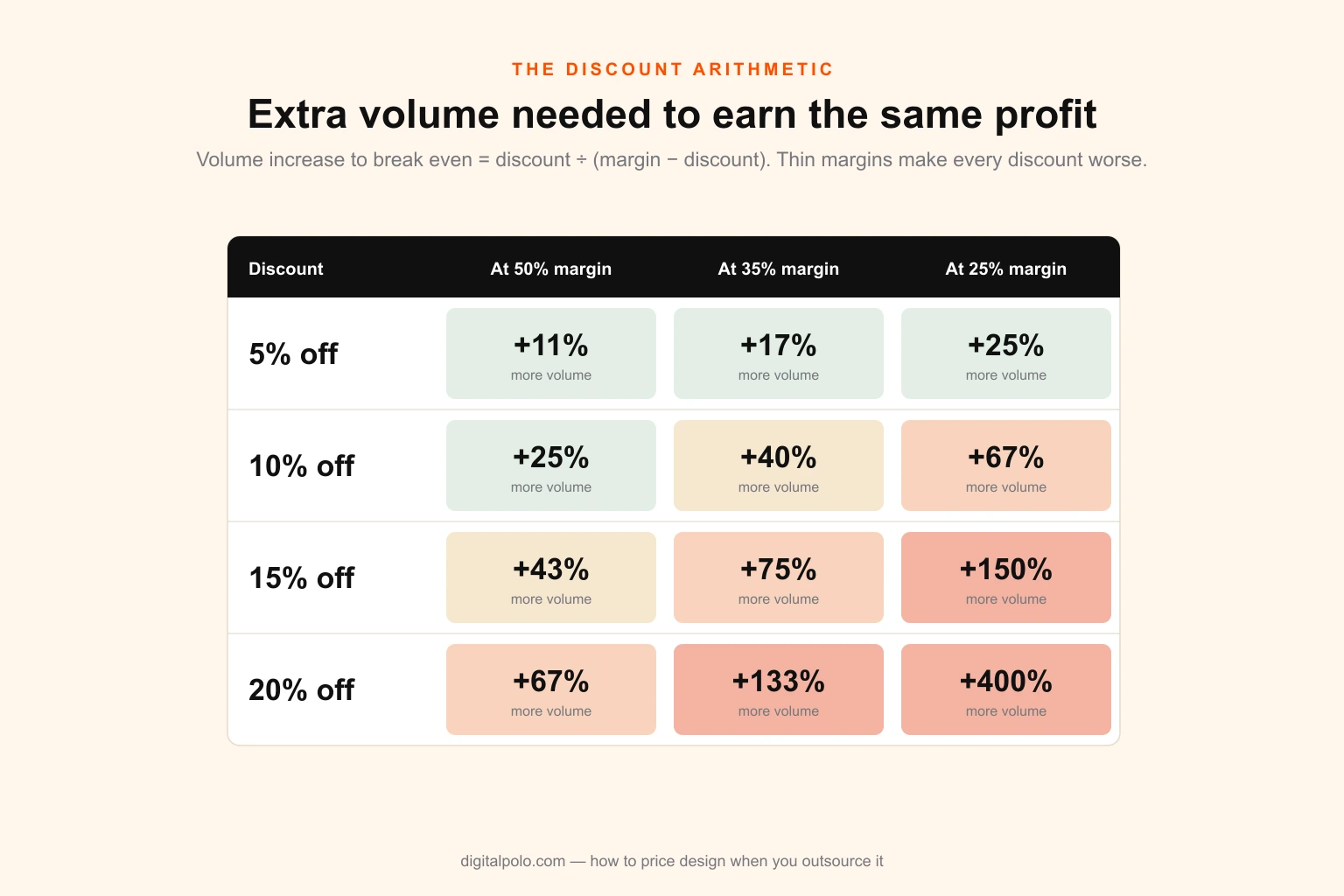
The thinner your margin already is, the more destructive each discount becomes. At 25 per cent margin, a 20 per cent discount needs five times the volume.
| Discount | At 50% margin | At 35% margin | At 25% margin |
|---|---|---|---|
| 5% | +11% volume | +17% volume | +25% volume |
| 10% | +25% volume | +40% volume | +67% volume |
| 15% | +43% volume | +75% volume | +150% volume |
| 20% | +67% volume | +133% volume | +400% volume |
If a client pushes on price, trade scope instead of margin: fewer rounds, a longer turnaround, a smaller deliverable set, or a longer commitment. Each of these lowers your cost alongside the price, so the margin survives.
Pricing white-label work honestly
Outsourcing design under your own brand is legal, common and long established. Agencies, printers and studios have done it for as long as they have existed. The pricing rule that keeps it clean is simple: the price must stand on its own. You are selling an outcome: the right asset, delivered on time, consistent with the brand, without the client having to manage anyone. Price that, and the question of who drew the pixels does not affect what it is worth.
What that means in practice:
- Never itemise the supplier's cost on a client invoice or quote. It invites the client to price your work as a markup, which is the mistake this whole guide is about avoiding.
- Never claim named people did work they did not do. "Our design team" is fine. "Sarah designed this personally" is not, if Sarah did not.
- Make sure the rights chain is complete. You can only assign to the client what your supplier assigned to you. If your quote promises full ownership and source files, your supplier contract has to deliver both — see what a client actually owns after a logo project, and, if any part of the workflow uses generative tools, the rules on selling AI-generated designs.
- Cover confidentiality. An NDA with the supplier protects your client relationship as much as the client's data.
- Hand over files cleanly when engagements end. The offboarding checklist lists every file and licence a client should receive.
Writing the quote: line items that protect margin
A quote is the cheapest margin-protection tool you have. Every line below exists to close one of the leaks above.
- Deliverables by name, format and quantity. "Trifold brochure, A4 folded to DL, print-ready PDF/X-1a with 3 mm bleed, plus web PDF." Not "brochure design".
- Included revision rounds, with the definition of a round.
- Change-order rate for additional rounds and additional deliverables.
- Service level and the rush multiplier for anything faster.
- Pass-throughs at cost plus a handling percentage.
- What the client must supply — copy, images, brand assets, approvals — and by when. Delays caused by missing inputs move the deadline, not your margin.
- Rights and files: what is assigned, when (normally on full payment), and which source files are included.
- Payment terms: deposit, milestones, due dates, late-payment charge.
- Price review: annual review and third-party cost pass-through for retainers.
- Validity: quote valid for 30 days.
None of this needs to be adversarial. Clients who buy design regularly expect it, and a clear quote reads as professionalism, not caution.
Tools that make this measurable
You cannot price from loaded cost without measuring internal time. The tooling does not need to be elaborate:
- Time tracking — Harvest, Toggl Track or Clockify, with one project per client and a tag per activity (brief, QA, relay, PM). One month of honest data replaces every assumption in this guide.
- Agency profitability — Productive.io or Function Point if you want job-level margin reporting out of the box; a spreadsheet works up to a few dozen jobs a month.
- Project management — ClickUp, Asana or Monday, with a request form that captures the brief in a fixed structure so briefing time falls.
- Proposals and quotes — PandaDoc, Proposify or Better Proposals, with the ten line items above saved as a template.
- Invoicing and payments — QuickBooks or Xero, Stripe for cards, and Wise for multi-currency supplier payments to keep FX cost visible.
- The calculator — our free design pricing and margin calculator runs the per-job and per-retainer formulas from this guide.
The KPIs that prove it is working
Review these monthly, by client as well as in aggregate. One badly priced account can hide inside a healthy average for a year.
| KPI | How to calculate | Target | Investigate if |
|---|---|---|---|
| Realised delivery margin | (Invoiced − supplier − internal time − pass-throughs) ÷ invoiced | ≥ 50% | < 40% |
| Supply cost ratio | Supplier cost ÷ invoiced | 20–30% | > 40% |
| Internal minutes per deliverable | Tracked delivery time ÷ deliverables, by class | Falling over time | Rising two months running |
| Absorbed rework rate | Unbilled change rounds ÷ deliverables | < 10% | > 15% |
| Write-off rate | (Quoted value − invoiced value) ÷ quoted value | < 5% | > 10% |
| Effective internal rate | Delivery profit ÷ internal hours | ≥ 2× loaded hourly cost | < 1.5× |
| Days sales outstanding | Receivables ÷ daily billing | < 45 days | > 60 days |
The supply cost ratio is the fastest early warning. If it creeps above 35 or 40 per cent on a client, either the client's work has moved up a class without the price following, or you are pricing that account as a markup again.
A 30-day pricing reset
Week 1 — Measure. Track internal time on every outsourced job for five working days, by activity and client. Pull the last three months of supplier invoices and the client invoices they relate to.
Week 2 — Cost. Calculate your loaded hourly rate. Compute the fully loaded cost of your ten most common deliverables using the five-part stack. Calculate the real delivery margin on your top five clients. Expect at least one surprise.
Week 3 — Rebuild. Set target margins by class. Build the rate card bottom-up, check it against the market, and round to price points. Rebuild the quote template with the ten line items. Work out the retainer floor for every shared queue.
Week 4 — Apply. Use the new rate card on every new quote. For existing clients below the 40 per cent floor, choose for each one: reprice at renewal, rescope, change the process to cut relay time, or exit gracefully. Add the price-review clause to every renewal.
Then monthly: the KPI table, by client.
Where Digital Polo fits
The method above works with any supplier. It works best when the supply side is a fixed, predictable number, because then the only variables left are the ones you control: your price, your process and your time.
That is the shape of our model. Digital Polo is a white-label design partner for agencies and resellers, run as a flat-fee design subscription: $399 a month on Partner, or $899 on Soulmate with parallel tasks and a dedicated team. Every plan includes unlimited revisions, all source files, reseller rights and NDA on request. In practice:
- Your supply cost is fixed, so the retainer arithmetic above actually holds month to month.
- Revisions on the supply side are free, which gives you the buffer to sell a defined round policy without absorbing the cost of extra rounds.
- Print-ready output is standard — bleed, CMYK, outlined type — which is what cuts the QA line in your cost stack. Our print-ready design service and brand identity work cover the Class C and D end.
- Source files transfer to you, so the rights chain to your client is complete.
If you are a freelancer reselling overflow rather than an agency, the same economics apply at smaller scale — see white-label design for freelance designers. If you are a print shop, the problem has a different shape, with waive thresholds and customer-supplied files: what a print shop should charge for design covers it.
See the plans and run your own numbers →
Frequently asked questions
How much should an agency mark up outsourced design work?
Stop thinking in markup on the supplier's invoice. On small jobs the supplier is not your biggest cost; your own briefing, review and client time is. Work out the fully loaded cost and divide by one minus your target margin. For most design resellers the supplier ends up at roughly 20 to 30 per cent of what the client pays, an effective markup on supply of three to five times. A flat 1.5 or 2 times markup on supply loses money on most small assets once your time is counted.
What is the difference between markup and margin?
Markup is profit as a percentage of cost; margin is profit as a percentage of the selling price. Buy at $100 and sell at $150: that is a 50 per cent markup but a 33 per cent margin. Margin = markup ÷ (1 + markup), and markup = margin ÷ (1 − margin).
What gross margin should a design reseller target?
Around 50 per cent delivery margin for composition and layout work, and 55 per cent for adaptation and systems work, with a floor of about 40 per cent. Delivery margin has to fund sales, admin and the owner's salary before it becomes profit.
Should I charge clients hourly for outsourced design?
Almost never. Hourly billing passes your supplier's efficiency through to the client as a lower bill, so every improvement cuts your revenue. Price by deliverable, bundle or retainer, and keep hourly for genuinely unscopeable work.
How do I price a design retainer when I use a white-label subscription?
Divide the subscription by the number of clients sharing it, add each client's internal account time at your loaded rate, and divide by one minus your target margin. On an $899 queue with six hours of account time per client, the floor runs from about $2,900 a month with one client to about $1,470 with four, and never below roughly $1,000.
Do I have to tell clients I outsource their design?
There is generally no obligation to name suppliers, but you must not misrepresent the work. Do not claim named staff did work they did not do, make sure your supplier assigns you every right you promise the client, use an NDA, and never itemise supplier cost on the client's invoice.
How do I stop revisions eating my margin on outsourced work?
Sell a defined number of rounds, define a round as one consolidated set of feedback from one decision-maker, and price extra rounds as a change order at about twice your loaded internal rate. Keep any unlimited-revision policy from your supplier as your buffer, not the client's entitlement.
How much should I charge for rush design work?
At least 1.5 times the standard price for anything inside your normal service level, even if your supplier does not charge a rush premium. For clients who rush constantly, sell a priority retainer instead.
How much volume do I need to make up for a discount?
Divide the discount by the margin minus the discount. At 50 per cent margin, a 10 per cent discount needs 25 per cent more volume; at 25 per cent margin it needs 67 per cent more.
What KPIs show whether outsourced design pricing is working?
Realised delivery margin per job, supply cost ratio, internal minutes per deliverable, absorbed rework rate and write-off rate — reviewed monthly by client, not only in aggregate.