A print-on-demand seller builds a range of forty illustrated t-shirts in a weekend with Midjourney. Three of them take off. Within a month, near-identical copies of those three appear from a dozen other shops, some of them cheaper. The seller files takedown notices. The marketplace asks for evidence of copyright ownership. There isn't any to give, because in the United States a purely AI-generated image has no copyright for anyone to own.
Nothing the seller did was illegal. Selling the shirts was fine. What they could not do was stop anyone else selling them.
A different case, same root cause. A small agency uses an image generator to speed up a logo project, delivers the mark, and signs the client's standard contract: the designer warrants the work is original and assigns all copyright to the client. Two years later the client is acquired, and the buyer's lawyers ask for the copyright assignment in the primary brand asset. The agency's honest answer is that the core artwork may not carry any copyright at all — and that the warranty they signed said otherwise.
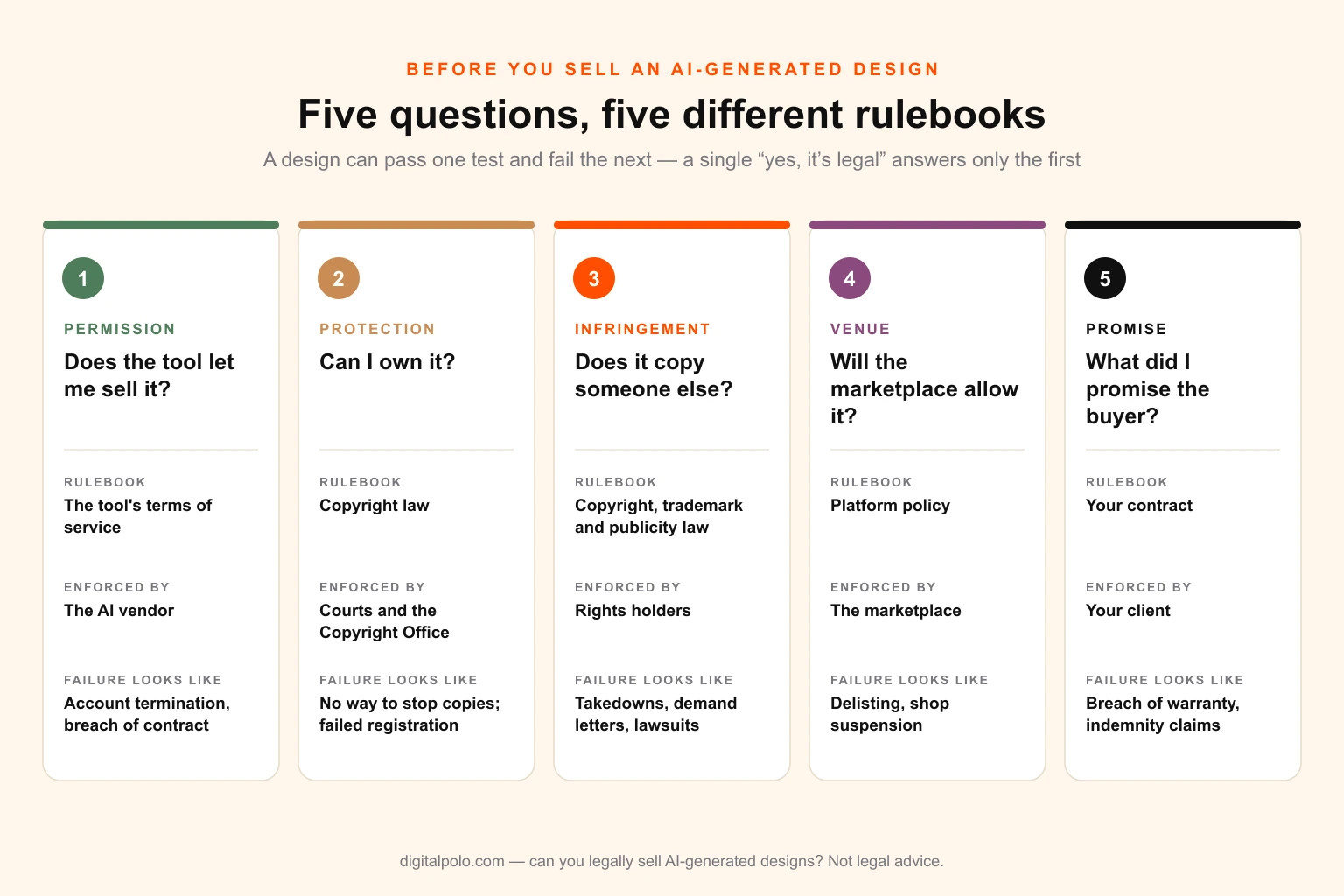
Every page that ranks for can you sell AI-generated art gives some version of the same answer: yes, it's legal, read the tool's terms of service. That answer is correct and nearly useless, because it addresses only one of the five separate questions that decide whether selling an AI-generated design is actually safe. The others — whether you own anything, whether the output copies someone else, whether the marketplace will keep your listing up, and what you have promised the person paying you — are where the money is actually lost.
This guide takes each one in turn:
- the five rulebooks that apply to every AI design sale, and why they don't overlap
- what the major tools actually grant you, and what "you own the output" really means
- where copyright law stands after the Supreme Court declined to hear Thaler in March 2026
- which prompts create genuine infringement exposure, and which don't
- the marketplace rules on Etsy, Amazon KDP, Merch on Demand and the stock sites
- the contract clauses that break when a deliverable contains AI output, and how to rewrite them
- the EU AI Act disclosure rules that have applied since August 2026
- which asset types can safely be AI-generated and which should not be
- the provenance log that turns all of this into evidence
A necessary note first: this is operational guidance from a design studio, written against United States law with notes on the UK and EU. It is not legal advice. Terms of service change frequently, several court cases are still live, and anything consequential — a registration, a licensing deal, a dispute — deserves a lawyer who has read your actual paperwork.
The short answer, and why it is incomplete
Yes, you can generally sell AI-generated designs. No statute in the US, the UK or the EU forbids selling an image because software generated it. The major commercial tools permit commercial use on their paid plans. Most marketplaces accept AI work with disclosure.
But "can I sell it" collapses five different questions into one, and each is governed by a different rulebook with a different enforcer:
| Question | Rulebook | Who enforces it | What failure looks like |
|---|---|---|---|
| Does the tool let me sell it? | The tool's terms of service | The AI vendor | Account termination, breach of contract |
| Can I own it? | Copyright law | Courts, the Copyright Office | No way to stop copies, failed registration |
| Does it copy someone else? | Copyright, trademark, publicity law | Rights holders | Takedowns, demand letters, lawsuits |
| Will the marketplace allow it? | Platform policy | The marketplace | Delisting, shop suspension |
| What did I promise the buyer? | Your contract | Your client | Breach of warranty, indemnity claims |
A design can pass one test and fail the next. A Firefly image on an enterprise plan clears the first question comfortably and still fails the second. A human-reworked illustration may clear the second and fail the fourth if the seller forgot the disclosure box. The questions are independent, which is exactly why a single yes is not an answer.
Question 1: Does the tool let you sell it?
This is the question every existing guide answers, so it gets the shortest treatment here — with one correction that most of them miss.
What the major tools grant
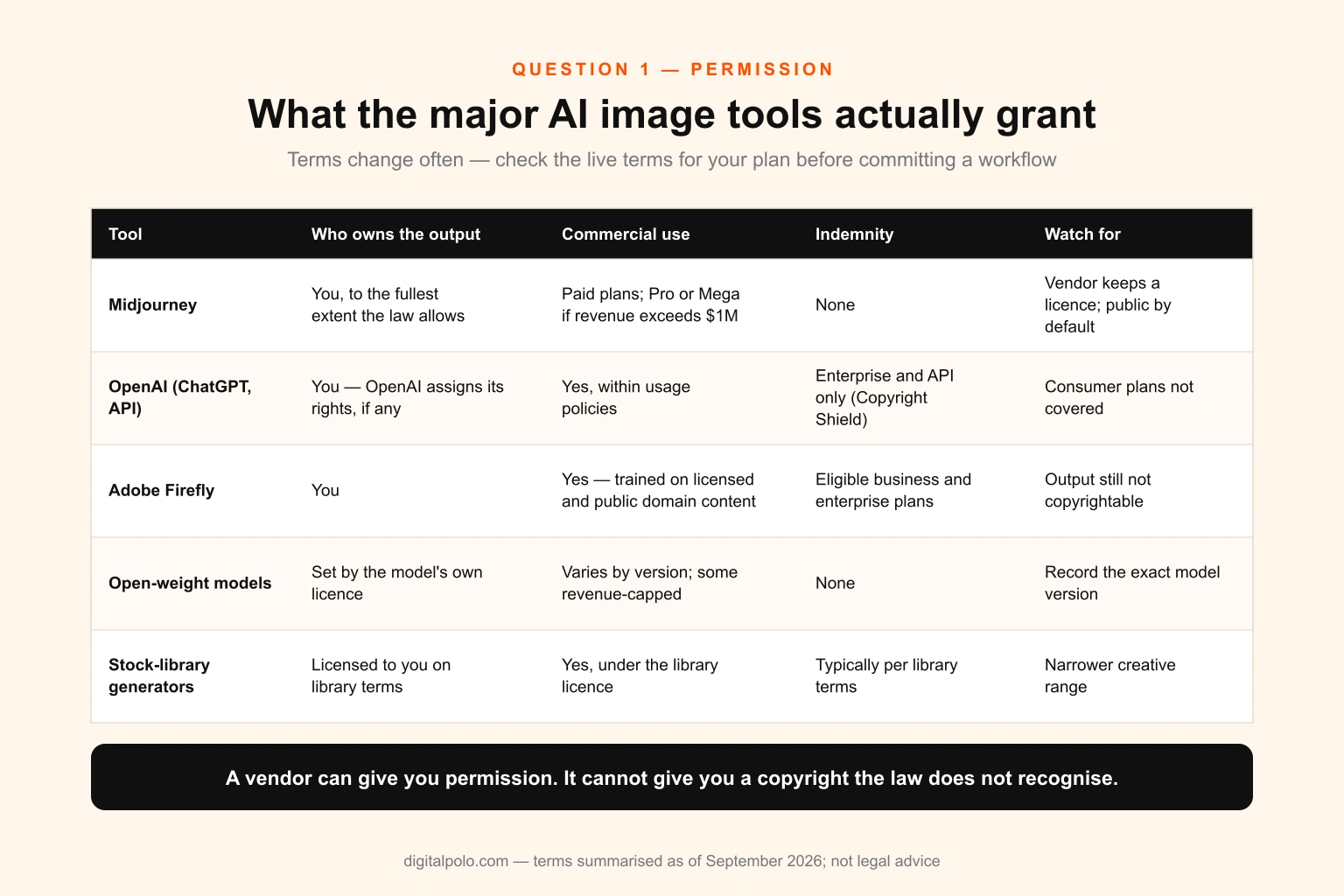
Midjourney. Its terms say you own the assets you create to the fullest extent possible under applicable law. Two conditions matter commercially. If you, or the company you work for, earn more than $1 million a year in gross revenue, you must be on a Pro or Mega plan to own your assets. And Midjourney keeps a broad, perpetual licence to use, reproduce and sublicense what you generate and the prompts you use. Images are public in the gallery by default; private generation (stealth mode) is limited to the higher tiers. Ownership you acquire persists if you later downgrade or cancel.
OpenAI (ChatGPT and the API). The terms state that, as between you and OpenAI, you own the output, and OpenAI assigns to you whatever right, title and interest it has in it. Commercial use is permitted subject to its usage policies. OpenAI's Copyright Shield — its promise to defend customers against copyright claims over output — applies to ChatGPT Enterprise and the developer platform, not to free or individual consumer plans, and it carries exclusions, including where a user knew or should have known output was infringing.
Adobe Firefly. Adobe positions Firefly as commercially safe because its models are trained on licensed Adobe Stock content, openly licensed material and public domain works, rather than scraped web images. Intellectual property indemnification for Firefly output is offered on eligible business and enterprise agreements. For studio work delivered to brand clients, this is the most defensible mainstream generator on the training-data question.
Open-weight models (Stable Diffusion, Flux and others). There is no single answer, because the licence is attached to the specific model version, not the brand. Some licences permit commercial use freely; some permit it only below a revenue threshold (Stability AI's community licence, for example, is free for commercial use under $1 million in annual revenue); some restrict commercial use of the model while treating outputs differently. Check the licence on the model card for the exact version you ran, and record which one it was.
Stock-library generators (Getty Images, iStock, Shutterstock). These are trained on the library's own licensed content and typically sold with the library's usual indemnification attached, which makes them attractive for commercial marketing work where legal cover matters more than creative range.
The phrase that misleads almost everyone
Read the ownership clauses again and notice the qualifier. To the fullest extent possible under applicable law. Whatever right, title and interest it has, if any.
A vendor can only give you the rights it holds. If the law recognises no copyright in purely AI-generated output — which is the position in the United States — then the vendor has nothing to assign, and the clause transfers nothing. "You own the output" is a promise that the vendor won't claim the output against you. It is not a promise that there is anything there to own.
That is the whole gap between question 1 and question 2. The tool's terms give you permission. They cannot give you protection.
What to check before you commit a workflow to a tool
- Does your plan tier permit commercial use, given your revenue or your employer's?
- Does the vendor retain a licence to your outputs and prompts — and does that conflict with a client's confidentiality requirements?
- Are generations public by default?
- Is indemnity available, on which plan, with what cap and exclusions?
- Do the usage policies prohibit any category you plan to sell (real people, political content, trademarks)?
- Which exact model version produced the asset? Record it, because terms change and the version you used is the one that governed.
Question 2: Can you own it?
This is where most of the value in a design lives, and where AI output behaves least like human-made work.
Where US law stands
The rule is settled at the top and unsettled in the middle.
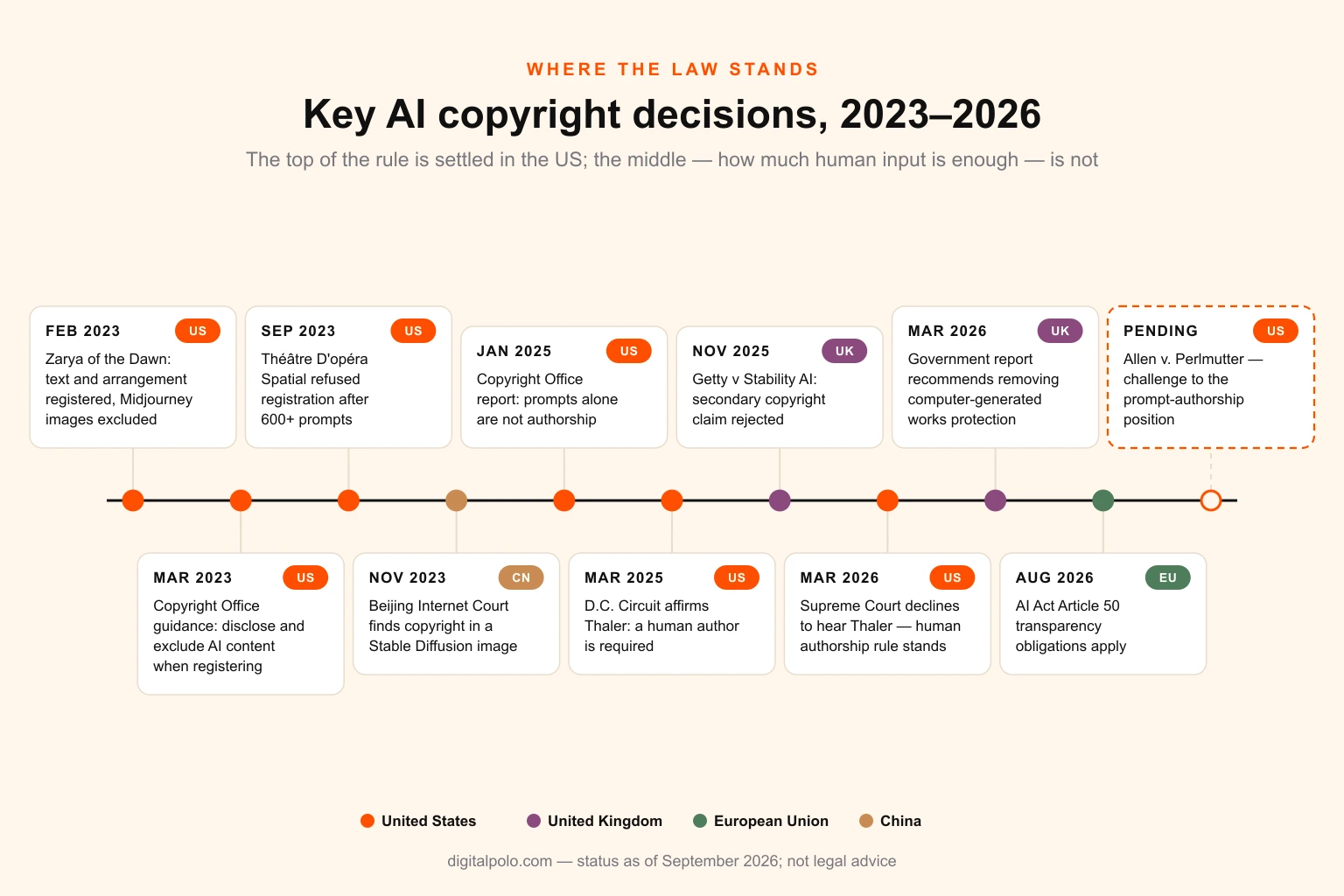
Settled: a work with no human author has no copyright. Stephen Thaler applied to register an image he said was created autonomously by his AI system, listing the machine as author. The Copyright Office refused, the district court upheld the refusal, the D.C. Circuit affirmed in March 2025, and on 2 March 2026 the Supreme Court declined to hear the case. Human authorship is a requirement of the Copyright Act.
Settled: prompts alone do not make you the author. The Copyright Office's January 2025 report on copyrightability concluded that, given how current systems work, prompts function as instructions rather than as control over the expressive result, however detailed or iterated. The Office's 2023 decision on Théâtre D'opéra Spatial — Jason Allen's Midjourney image, refined over more than 600 prompts — refused registration for the generated material on that basis. Allen's challenge is still pending in federal court in Colorado, so this is the one point where a ruling could still move the line.
Protectable: the human contributions around the output. Three kinds, each with a precedent:
- Selection and arrangement. In Zarya of the Dawn (2023), the Office registered a comic book's text and the author's selection and arrangement of images, while excluding the Midjourney-generated images themselves. In January 2025 it registered A Single Piece of American Cheese, an image built by selecting and arranging dozens of separately generated regions through inpainting — protection attaching to the arrangement.
- Expressive inputs. If you draw an original sketch and use a tool to render it, your sketch's expression remains yours and is perceptible in the output.
- Human modification. Substantial changes you make by hand — redrawing, repainting, restructuring — are protected to the extent of those changes.
The contribution ladder
The practical way to think about it is a ladder of human involvement, where each rung buys a little more protection, and where the generated material underneath stays unprotected throughout.
| Rung | What the human did | What is protectable |
|---|---|---|
| 1. Raw output | Prompted, accepted the result | Nothing |
| 2. Curated output | Iterated prompts, chose the best | Nothing, in the Office's current view |
| 3. Arranged output | Composited several generated elements into an original layout | The selection and arrangement |
| 4. Modified output | Redrew, repainted or substantially reworked by hand | The human modifications, plus arrangement |
| 5. Human-led work | Drew the design; used AI for reference, texture or ideation | The design as a whole, minus any generated elements retained |
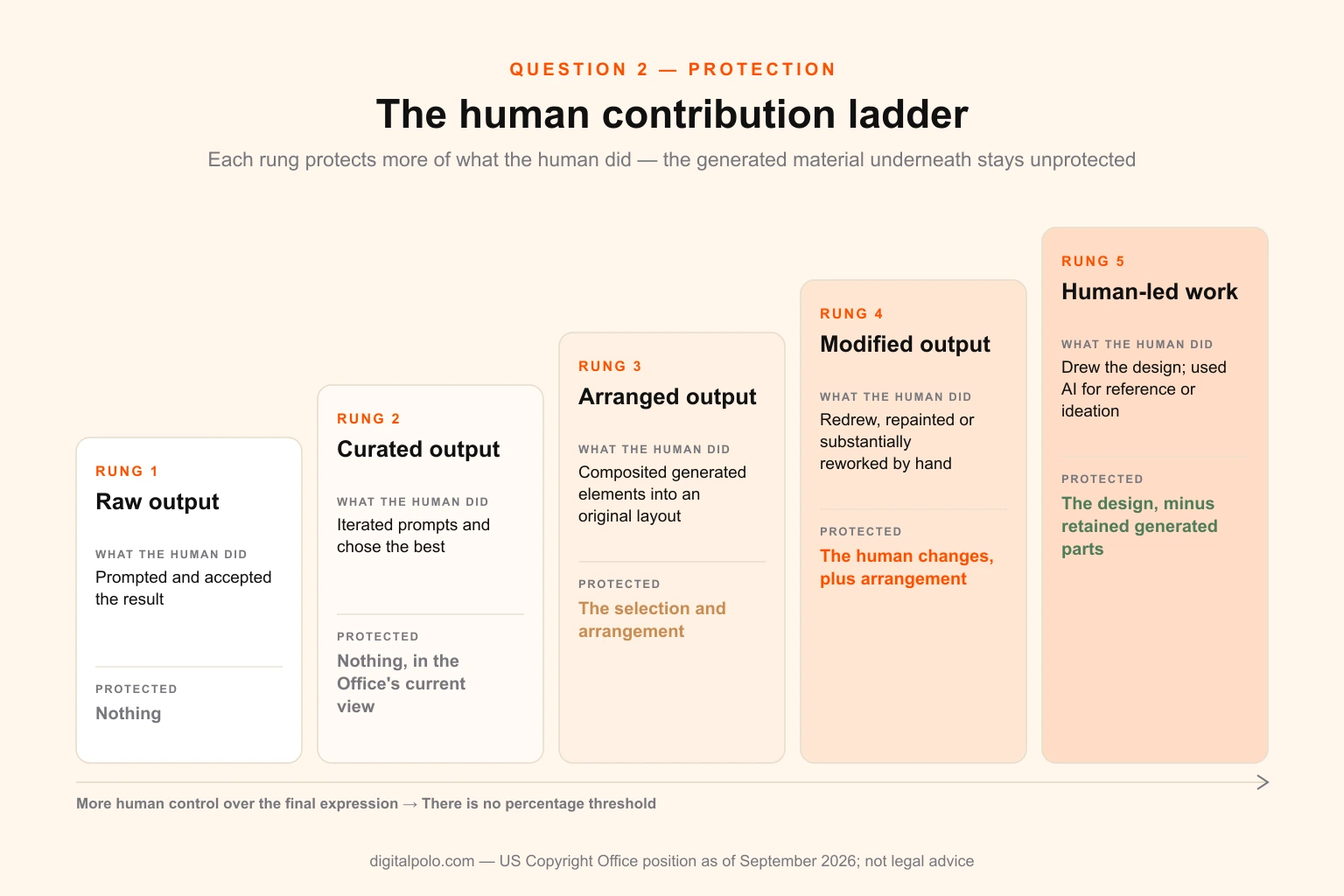
Note what the ladder is not. It is not a percentage. There is no rule that a set percentage of human editing makes a work protected, and advice that quotes one is inventing it. The Office asks what the human actually controlled in the final expression, case by case.
Outside the United States
- United Kingdom. Section 9(3) of the Copyright, Designs and Patents Act has, since 1988, given computer-generated works a 50-year copyright owned by the person who made the arrangements for their creation — on paper, a more generous regime. In March 2026 the government's report on copyright and AI concluded that this protection should be removed while protection for AI-assisted human work is kept. No legislation has followed yet, so the provision is still law, but it is not a foundation to build a business on.
- European Union. Copyright attaches to a work that is the author's own intellectual creation, a standard courts have consistently tied to human creative choices. Purely generated output is generally regarded as unprotected.
- China. The Beijing Internet Court in 2023 found copyright in a Stable Diffusion image, citing the plaintiff's prompts and parameter choices as intellectual input — the clearest example of a major jurisdiction reaching the opposite conclusion from the US Copyright Office.
For a business selling internationally, the conservative position is to assume the US rule applies, because it is the strictest major market and the one where your enforcement is most likely to be tested.
What "no copyright" means commercially
Lacking copyright does not stop you selling. It stops you excluding.
You cannot file a valid copyright takedown against a copy of the purely generated parts. You cannot register the work without disclosing and disclaiming the generated material — Copyright Office guidance since 2023 requires applicants to identify AI-generated content that is more than de minimis and exclude it from the claim, and failure to disclose can invalidate the registration. You cannot license exclusivity you do not have. And you cannot sell a business on the strength of a design portfolio that anyone may copy.
For some products that barely matters. For others it is the entire value. That distinction gets its own section below.
Question 3: Does it infringe someone else's rights?
This is the question with actual legal exposure, and it is independent of the first two. You can have permission from the tool and protection for your own contributions and still be selling something that belongs to someone else.
The key principle: liability for the output you sell sits with you. The high-profile cases against AI companies — Getty Images against Stability AI, Disney and Universal against Midjourney, and the artists' class actions — largely concern how models were trained and what the companies themselves are responsible for. How those cases resolve will shape the industry. It will not shield a seller who lists a t-shirt showing a recognisable protected character, whatever tool drew it.
Getty's UK case is a useful illustration of how narrow the training-side cases can turn out. In November 2025 the High Court rejected Getty's secondary copyright claim, finding that the model did not itself contain copies of the images, and found trademark infringement only in an extremely limited form tied to watermark-like artefacts in early model versions. The studios' case against Midjourney, which focuses heavily on outputs depicting characters like Darth Vader and the Minions, was still in pretrial stages at the time of writing.
Where output infringement actually comes from
Protected characters and franchises. Models reproduce famous characters readily because they appear so often in training data. Output that depicts a recognisable protected character infringes regardless of how it was made, and it is also the category rights holders monitor most aggressively on merchandise platforms.
Substantial similarity to a specific work. Output can land close to a particular photograph, illustration or artwork, especially for prompts describing a famous image or a narrow niche with few training examples. The test is the same as for human-made work: whether an ordinary observer would recognise the protected expression as taken.
Trademarks. Generated designs can include brand names, logos, product shapes or garbled near-copies of them. On merchandise, even a distorted version of a famous mark creates confusion and dilution risk, and marketplaces remove these listings fast.
Real people. Using a real person's face, name or recognisable likeness to sell a product engages right-of-publicity laws, which vary by state and are expanding — Tennessee's ELVIS Act, in force since 2024, extended protection explicitly to voice and likeness replicated by AI. Celebrities on merchandise are the clearest risk; realistic images of identifiable private individuals are the more overlooked one.
Artist style. Style as such is not protected by copyright. But naming a living artist in a prompt pulls output toward that artist's specific compositions and signature elements, which raises the substantial-similarity risk above, breaks several marketplace policies outright, and is the fastest route to a public complaint that gets a shop delisted before any legal question is even asked.
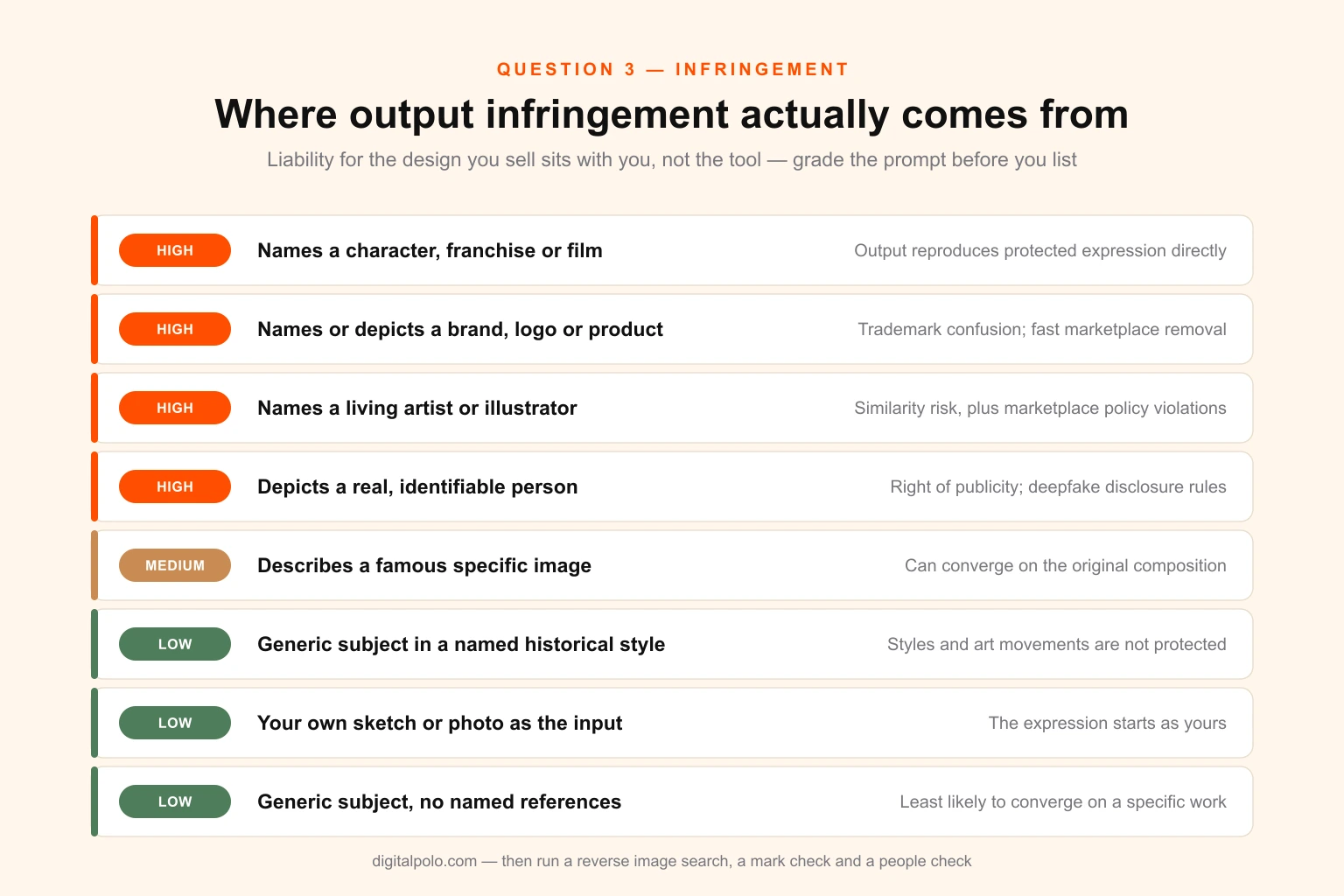
Prompt risk, graded
| Prompt pattern | Risk | Why |
|---|---|---|
| Names a character, franchise or film | High | Output reproduces protected expression directly |
| Names or depicts a brand, logo or product | High | Trademark confusion; fast marketplace removal |
| Names a living artist or illustrator | High | Similarity risk plus policy violations |
| Depicts a real, identifiable person | High | Right of publicity; deepfake disclosure rules |
| Describes a famous specific image | Medium | Can converge on the original composition |
| Generic subject in a named historical style | Low | Styles and movements are not protected |
| Your own sketch or photo as the input | Low | The expression starts as yours |
| Generic subject, no named references | Low | Least likely to converge on a specific work |
The clearance habit that covers most of it
Before an AI-generated design goes on sale, run it through the same three checks a careful studio would run on human-made commercial artwork:
- Reverse image search the final design (Google Lens, TinEye) to catch convergence on an existing image.
- Read every mark in it. Zoom in on anything letter-like, logo-like or product-like. Generators produce half-legible brand artefacts that are easy to miss at thumbnail size.
- Check for identifiable people. If a face could be a real person, either confirm it is not or remove it.
For merchandise, add a fourth: search the marketplace itself for the design's key terms, because you are also checking whether a rights holder is already actively enforcing in that niche.
The same discipline applies to the components you don't generate. Fonts and stock elements composited into an AI design carry their own licences, which are covered in detail in the guides to font licensing for resellers and stock licensing for print runs and merchandise.
Question 4: Will the marketplace let you sell it?
Marketplace rules are not law, but they are enforced faster than law and with less due process. A delisting takes hours; a suspended shop can take months to recover. For most sellers this is the rulebook most likely to actually bite.
Where the major venues stand
Etsy. AI-assisted items are permitted under Etsy's creativity standards, provided they are based on the seller's own original design and creative direction. Sellers must disclose the use of AI, which in practice means choosing the Designed by attribution rather than Made by and stating AI use in the listing description. Etsy has been actively enforcing disclosure through 2026, and passing generated output off as handmade is the pattern that gets listings removed.
Amazon KDP. Kindle Direct Publishing requires publishers to disclose AI-generated content — text, images or translations — during title setup. Its distinction is useful: content an AI tool created counts as AI-generated even if you edited it substantially afterwards and must be disclosed; content you created and merely refined with AI tools counts as AI-assisted and does not. A cover image produced by a generator is AI-generated.
Merch on Demand (Amazon). The content policy does not currently include a dedicated AI disclosure field, but every intellectual property and content rule applies in full, and the seller is responsible for everything in the artwork, title and listing. Trademark and character complaints are handled the same way whether a design was drawn or generated.
Adobe Stock. Accepts generative AI submissions, which must be labelled with the Created using generative AI tools checkbox or they are rejected. Contributors must hold the rights to any inputs, may not reference artists, real people or third-party brands in prompts, titles or keywords, and must follow the property and people requirements for depicted content.
Shutterstock. Does not accept AI-generated content from contributors. It offers its own generator trained on its licensed library instead.
Getty Images and iStock. Getty has maintained a restrictive position on AI-generated contributor submissions and sells its own commercially licensed generator instead. Check the current contributor terms before submitting anything AI-derived.
| Venue | Accepts AI-generated work? | Disclosure required? | Watch for |
|---|---|---|---|
| Etsy | Yes, with your original creative direction | Yes — Designed by, plus description | Passing output off as handmade |
| Amazon KDP | Yes | Yes, at title setup | Generated covers count as AI-generated |
| Merch on Demand | Yes | No dedicated field | Character and trademark complaints |
| Adobe Stock | Yes | Yes — generative AI checkbox | No artist, brand or real-person references |
| Shutterstock | No (contributor uploads) | — | Use its own generator instead |
| Getty / iStock | Restricted | — | Check current contributor terms |
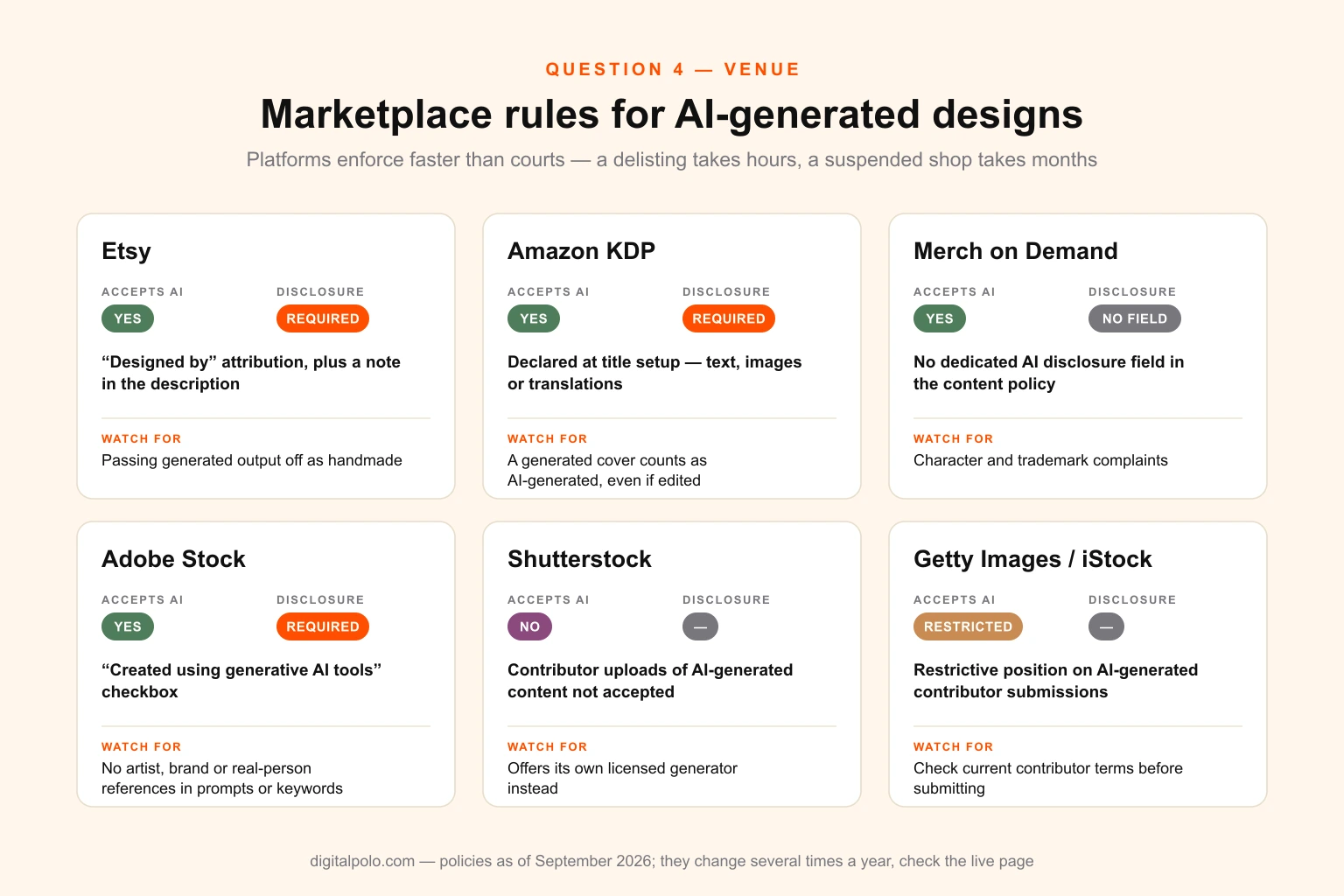
Policies in this area change several times a year, so treat any table — this one included — as a starting point and check the live policy page before listing a new product line. Amazon's rules on images in retail listings are a separate system again, covered in the guide to Amazon listing image requirements.
The copycat problem is a marketplace problem too
Return to the t-shirt seller from the introduction. Their real loss was not legal exposure. It was that the marketplace's takedown process depends on the complainant owning a right — and for purely generated designs, they didn't. Every marketplace IP complaint form asks, in some form, what right do you hold? If the honest answer is "none," the process is not available to you, while it remains fully available to anyone whose character or trademark your design resembles. The asymmetry runs against the AI seller in both directions.
Question 5: What are you promising the buyer?
This is the question almost nobody writing about AI art addresses, and for agencies, freelancers, white-label studios and anyone selling design to a business rather than to a consumer, it is the most important one.
Standard design contracts — the ones clients send, the ones on template sites, the ones most studios still use — were written for human-made work. They routinely contain promises that AI-generated output cannot keep.
The clauses that break
The originality warranty. "The designer warrants that the deliverables are original and do not infringe any third-party rights." For human work this is a reasonable promise the designer controls. For generated output, the designer cannot see the training data and cannot guarantee that output does not resemble something in it. A warranty is a promise of fact; if it is wrong, you are liable whether or not you were careless.
The copyright assignment. "The designer assigns all copyright in the deliverables to the client." You cannot assign what does not exist. An assignment of rights in purely generated material transfers nothing, and a client who later discovers that — typically during an acquisition, a trademark dispute or an attempt to stop a copycat — has a grievance you created. The ownership mechanics of assignments generally, including why work for hire clauses fail for commissioned logos, are covered in what a client actually owns after a logo project.
The exclusivity promise. "The client has exclusive rights to the deliverables." Unprotected material cannot be exclusive. And the vendor licence on some tools means the generator company itself retains rights to reuse the output.
The confidentiality clause. If a tool's generations are public by default, or the vendor retains a licence to your prompts and outputs, putting a client's unreleased product into a prompt may already breach the NDA.
The indemnity. "The designer indemnifies the client against claims arising from the deliverables." Combined with an originality warranty over AI output, this turns an uncontrollable risk into an uncapped personal liability.
How to rewrite them
| Clause | Standard wording problem | Rewrite for AI-assisted work |
|---|---|---|
| Disclosure | Silent on tools | Name the generative tools used and which deliverables contain generated material |
| Originality warranty | Absolute promise of originality | Warrant human-authored elements; for generated elements, warrant reasonable clearance checks were performed |
| Copyright assignment | Assigns "all copyright" | Assign all rights the designer holds, acknowledging generated material may carry none |
| Exclusivity | Promises exclusive rights | Exclusivity applies to protectable elements; generated elements are non-exclusive |
| Asset scope | Applies to everything | List asset types where generated material is not permitted (e.g. primary logo) |
| Confidentiality | Ignores tool data terms | Client material only enters tools with no retention or on approved enterprise plans |
| Indemnity | Uncapped, covers all claims | Cap it, exclude generated elements the client approved, pass through any vendor indemnity |
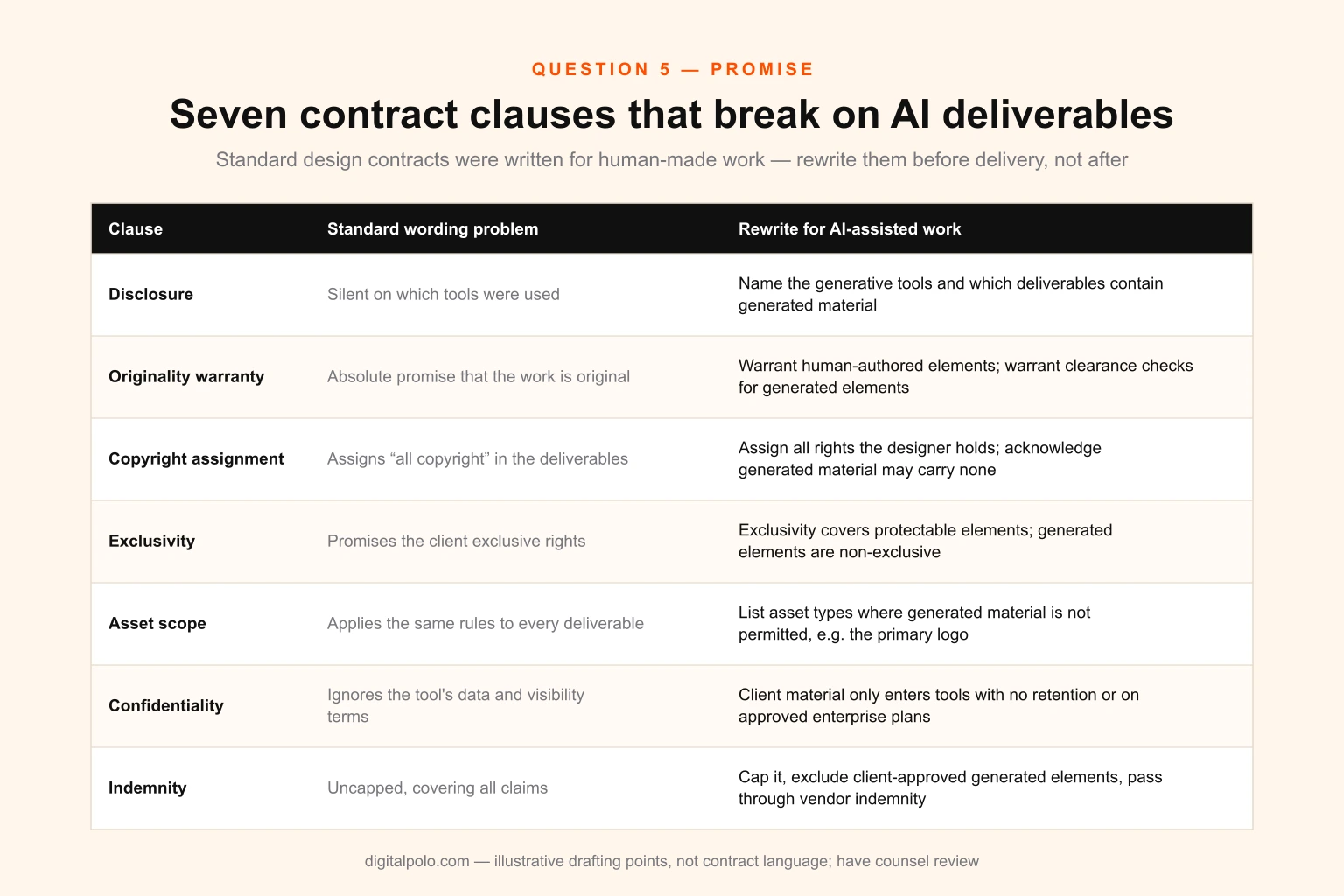
The single most useful clause is the asset scope list, because it moves the conversation from legal abstraction to a practical agreement: we will use generative tools for moodboards, social variations and background textures; we will not use them for your logo, your packaging hero illustration or your mascot. Most clients agree to that immediately, because it matches what they care about.
The white-label chain
If you resell design work under your own brand, or buy it from a white-label studio, every warranty in the chain has to match. An agency that warrants originality to its client, having received AI-assisted work from a production partner that disclosed nothing, is holding a liability it cannot see. Ask partners directly which tools they use, on which asset types, and what their own contract warrants — it belongs on the same checklist used to vet any white-label design partner.
Digital Polo's own position, since clients ask: our designers use generative tools for ideation, reference, background extension and production variations, and brand-critical deliverables — logos, identity systems, packaging artwork and illustration a client needs to own — are human-drawn. If you need a partner whose deliverables you can actually assign, that is how our plans are set up, and the white-label programme carries the same rule through to your clients.
The disclosure layer: EU AI Act and beyond
A sixth consideration now sits across all five questions for anyone selling into Europe.
The transparency obligations in Article 50 of the EU AI Act have applied since 2 August 2026. The Digital Omnibus amendments that postponed the Act's high-risk system deadlines to 2027 and 2028 left Article 50 in place. In outline:
- Providers of generative AI systems must mark synthetic output in a machine-readable, detectable way. Systems already on the market before August 2026 have until 2 December 2026 to comply with the marking requirement.
- Deployers — which can include a business publishing AI-generated content — must disclose when image, audio or video content is a deepfake: realistic content resembling real people, places or events that would falsely appear authentic.
- For content that is evidently artistic, creative, satirical or fictional, the deepfake disclosure is lighter: it must be made in a way that does not spoil the display or enjoyment of the work.
- Infringements can attract fines of up to €15 million or 3% of worldwide annual turnover, whichever is higher.
What this means for a design business in practice is narrower than the headlines suggest. A stylised illustration on a t-shirt is not a deepfake. A photorealistic generated image of an identifiable real person or event in advertising almost certainly is, and needs disclosure. And the provider-side marking requirement means generated files increasingly carry embedded provenance metadata — so stripping it to hide AI origin is both detectable and, in EU contexts, a bad look for a business that is otherwise compliant.
In the US, disclosure obligations are still arriving piecemeal — the Copyright Office's registration requirement, marketplace policies, FTC rules against deceptive claims (describing AI output as "hand-illustrated" is a deceptive claim), and state laws aimed at large AI providers and political content. The workable default is simple: never describe generated work as hand-made, and disclose AI use wherever a buyer would reasonably care.
Legal to sell versus worth selling: exclusivity by asset type
Pulling the five questions together produces the decision that actually matters commercially. The copyright gap is irrelevant for some assets and fatal for others, and the difference is how much of the asset's value depends on nobody else having it.
| Asset type | How much value depends on exclusivity | AI-generated material appropriate? |
|---|---|---|
| Primary logo and brand mark | Very high | No — human-drawn, trademark-cleared |
| Mascot or brand character | Very high | No — you need to stop copies |
| Packaging hero illustration | High | Only as reference; final art human-made |
| Merchandise and POD graphics | High | Risky — sells fine, cannot be defended |
| Book covers and art prints | Medium–high | With disclosure and substantial rework |
| Ad creative and social variations | Low | Yes — short-lived, volume-driven |
| Blog, email and presentation imagery | Low | Yes, with clearance checks |
| Moodboards, concepts, backgrounds | None | Yes — ideal use |
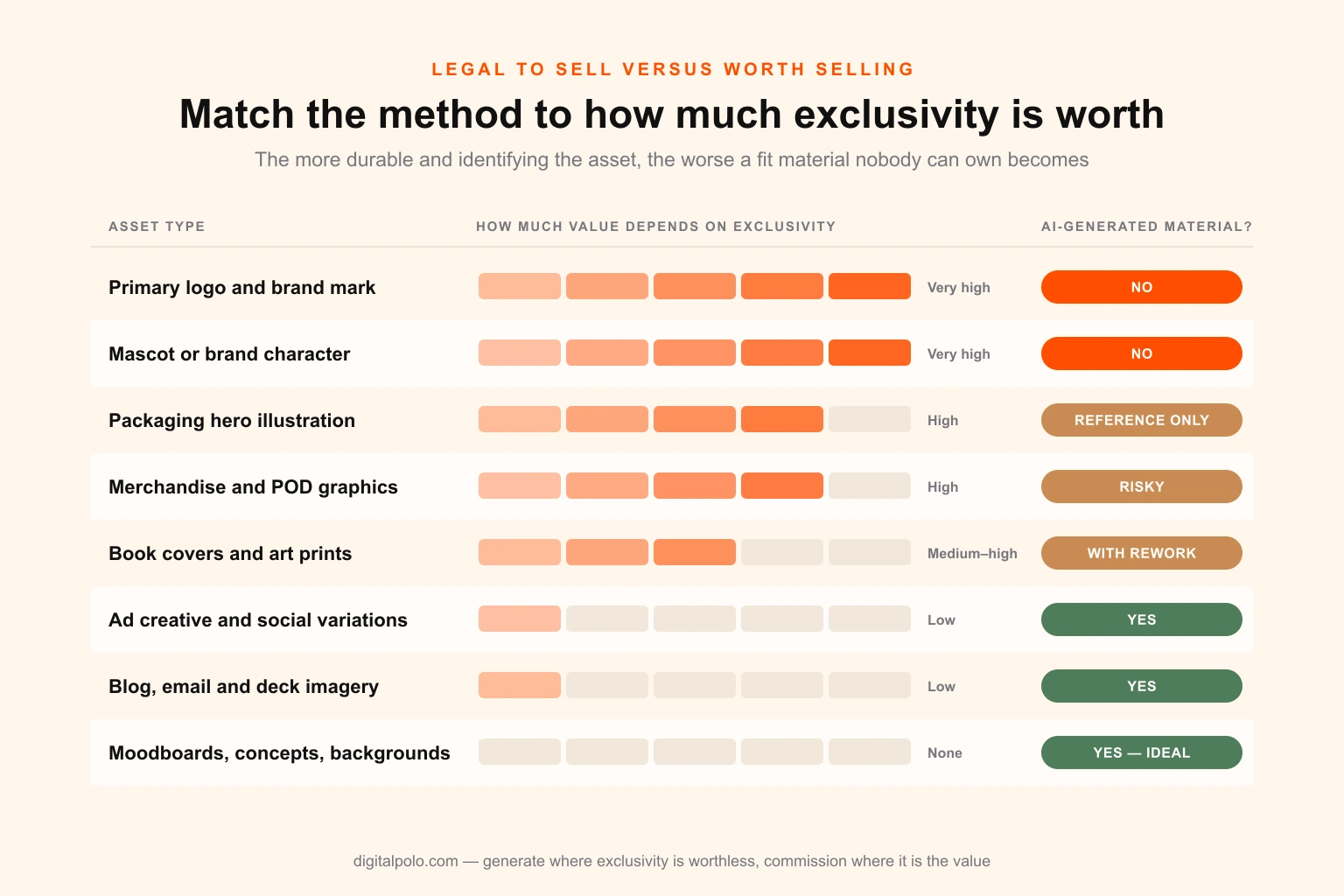
The pattern is that the more durable and more identifying an asset is, the worse a fit raw AI output becomes. A brand mark is meant to last decades and to be the one thing competitors cannot use; it is the worst place for material nobody can own. That is why a logo or brand identity is worth commissioning as human work even when everything around it is AI-assisted. An ad variation that runs for three weeks before creative fatigue retires it needs no exclusivity at all, which makes it exactly where generation earns its keep — especially at the volumes covered in how many ad creatives you actually need per month.
Merchandise sits in the uncomfortable middle. It is where AI selling is most common and where the copyright gap hurts most, because a successful print-on-demand design is precisely the thing competitors copy. Businesses building a real merchandise line — sticker makers, screen-print shops, apparel brands — tend to reach the same conclusion: generate for exploration, then commission the winners as original artwork you can actually enforce.
The provenance log: evidence you will need later
Every question above is eventually answered with evidence — to a marketplace, a client, a registration examiner, a buyer's due-diligence team or a court. Evidence you did not record at the time cannot be reconstructed afterwards. A provenance log is a short record kept per commercial asset:
- Tool and version. The exact product and model version, and the plan tier at the time.
- Terms snapshot. The date you last checked the terms, and a saved copy for anything high-value.
- Inputs. Prompts, reference images and any of your own sketches or photos used as input — plus confirmation you had rights to each input.
- Outputs selected. Which generations were used and which were discarded.
- Human work. Layered source files showing the modifications, with a short note of what was changed by hand. Keep the working file, not just the export.
- Third-party elements. Fonts, stock and textures composited in, each with its licence.
- Clearance checks. Date and result of the reverse image search, mark check and people check.
- Disclosures made. Which marketplace fields, client notices or registration statements were completed.
- Contract terms. Which warranty and assignment wording the asset was delivered under.
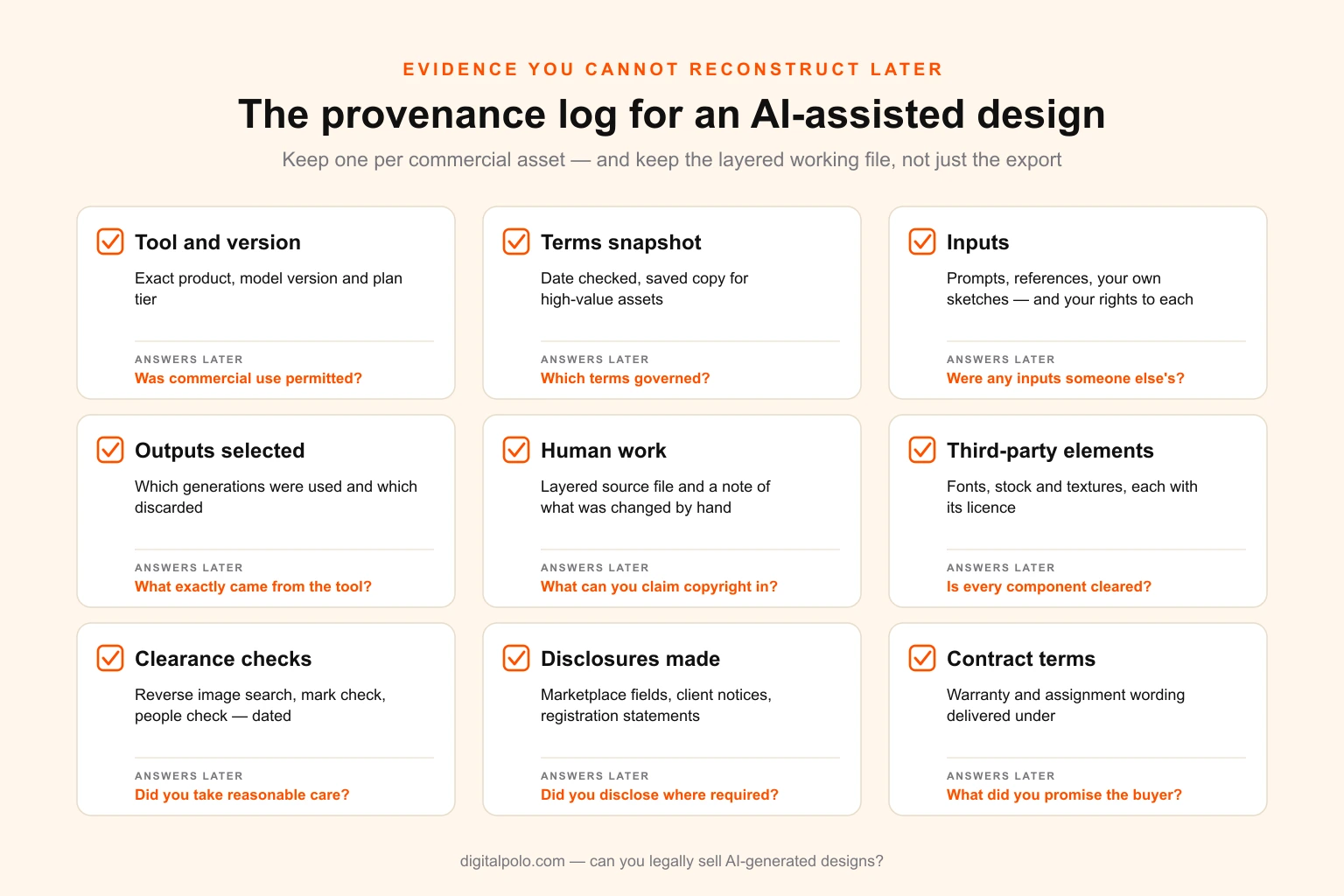
The human-work record is the one that pays off most often. If you ever need to claim copyright in a reworked design, the layered file history is the proof of what you contributed — and it is the same evidence that satisfies a marketplace asking whether a listing reflects your own creative direction. It fits naturally into a proper project handover; the full manifest of what should be retained is in the design offboarding checklist.
The pre-sale workflow
Run in order before listing a product or delivering to a client:
- Classify the asset against the exclusivity table. If it is a brand mark, mascot or other asset whose value depends on exclusivity, stop and route it to human-made artwork.
- Confirm tool permission for your plan tier, revenue and use case, and record the tool and version.
- Check the prompt history against the risk grades. Regenerate anything built from a character, brand, living artist or real-person prompt.
- Run clearance checks — reverse image search, mark inspection, people check, marketplace search.
- Add human authorship where ownership matters — rework, redraw, arrange — and keep the layered file.
- Complete the venue's disclosure in the exact field the marketplace or stock site requires.
- Align the contract — disclosure, limited assignment, carved-out warranties, asset scope — before delivery, not after.
- Close the provenance log and file it with the asset.
For most low-risk assets steps 1 to 4 take under ten minutes. The expensive failures almost all come from skipping step 1 — putting generated material into the one asset that needed to be ownable.
Common mistakes
- Treating "you own the output" as a copyright grant. It is a vendor's non-claim, capped by what the law recognises.
- Assuming paid means indemnified. Indemnity typically sits on business and enterprise agreements, with caps and exclusions.
- Quoting a percentage threshold for human editing. None exists.
- Using an AI-generated logo as the permanent brand mark and discovering the gap during a trademark dispute or acquisition.
- Signing a standard design contract unchanged while delivering generated material under it.
- Prompting with living artists' names for commercial work.
- Skipping the disclosure field on Etsy, KDP or Adobe Stock because the design was "mostly edited."
- Relying on a takedown process that requires a right you don't hold.
- Putting client-confidential material into a tool whose generations are public or retained.
- Keeping only the exported file, which destroys the evidence of your human contribution.
What to measure
For a business producing AI-assisted design at volume, four numbers show whether this is under control:
- Disclosure coverage — the share of live AI-assisted listings or deliverables with the required disclosure completed. Target 100%; anything lower is a queue of future removals.
- Provenance completeness — the share of commercial assets with a complete log. Audit a sample monthly.
- Takedown and complaint rate — complaints received per hundred live AI-assisted listings, tracked by prompt type. A rising rate in one category tells you which prompts to retire.
- Brand-critical asset authorship — the share of logos, mascots and packaging hero art that is human-drawn with a valid assignment. This should be 100% and stay there.
Where a design partner fits
Most of what goes wrong here is a sourcing decision disguised as a legal question. Generative tools are genuinely good at volume, variation and exploration, and genuinely poor at producing assets a business can own. The businesses handling this well have simply split the work: generate where exclusivity doesn't matter, commission where it does, and keep the paperwork on both.
That split is what a design subscription is set up to absorb. The high-volume, low-exclusivity layer — social media design, ad variations, presentation and email imagery — moves fast with AI-assisted production. The ownable layer — logos, identity systems, packaging artwork and print-ready merchandise art — is drawn by people, delivered with source files and assigned properly. For agencies, the white-label route means your clients receive the same split under your brand, with warranties you can honestly sign. Pricing benchmarks for the white-label model are published if you are comparing options.
If you have AI-generated assets already in market and are not sure which of them you can defend, that is a defined audit rather than an ongoing engagement. Tell us what you are selling and we will sort it into keep, rework and redraw.
For the wider view of where AI genuinely helps in design practice — beyond the legal questions — see graphic design and AI: the current reality and the AI in design statistics roundup.
The short version
- Selling AI-generated designs is generally legal. The risks are in five separate rulebooks, not in the act of selling.
- Tool terms give permission, not protection. "You own the output" transfers only what the law recognises.
- In the US, purely AI-generated material has no copyright. Thaler is final as of March 2026; prompts alone are not authorship. Selection, arrangement and human modification are protectable.
- No copyright means you can sell but cannot exclude. Copycats are the business risk, not lawsuits.
- Infringement liability for output is yours. Characters, brands, living artists and real people are the high-risk prompts.
- Marketplaces enforce faster than courts. Etsy, KDP and Adobe Stock require disclosure; Shutterstock and Getty restrict contributor AI uploads.
- Standard design contracts break on AI deliverables. Rewrite the warranty, assignment, exclusivity and indemnity.
- EU disclosure rules apply from August 2026. Photorealistic depictions of real people or events need labelling.
- Match the method to the asset. Generate where exclusivity is worthless; commission where it is the value.
- Log provenance. The evidence you don't record now is the evidence you won't have later.
Frequently asked questions
Is it legal to sell AI-generated art?
In most cases, yes. No law in the United States, the UK or the EU prohibits selling an image because a generative AI tool made it. Whether a specific sale is lawful depends on four other things: whether the tool's terms permit commercial use on your plan, whether the output reproduces someone else's copyrighted work, trademark or likeness, whether the marketplace you sell through permits it and requires disclosure, and whether you have promised the buyer something — originality, exclusivity, a copyright assignment — that AI output cannot deliver. Legality is rarely the problem. The unmanaged risks sit in those four places.
Can you copyright AI-generated art?
Not the purely AI-generated parts, in the United States. Copyright requires a human author. The D.C. Circuit confirmed this in Thaler v. Perlmutter in March 2025 and the Supreme Court declined to hear the appeal on 2 March 2026. The Copyright Office's January 2025 report on copyrightability concluded that prompts alone do not make you the author of the output. What can be protected is your own contribution: an original drawing you fed into the tool, your creative selection and arrangement of AI elements, and substantial modifications you made by hand. The protection covers those contributions, not the raw generated material beneath them.
Who owns AI-generated art?
Two different questions hide inside this one. Contractually, most major tools say you own the output: OpenAI's terms assign to you whatever rights it has in the output, and Midjourney's terms say you own the assets you create to the extent the law allows, with companies above $1 million in annual revenue required to be on a Pro or Mega plan. Legally, in the US, purely AI-generated material has no copyright for anyone to own. So you can hold every contractual right the vendor has and still own no copyright, which means you can sell the design but may not be able to stop anyone copying it.
Can you sell AI art on Etsy?
Yes, within Etsy's creativity standards. Etsy permits items made using AI tools, but they must be based on the seller's own original design and creative direction, and the seller must disclose the use of AI. In practice that means selecting the Designed by attribution rather than Made by, and saying in the listing description that generative AI was used. Etsy has been actively enforcing disclosure. Undisclosed AI listings, and listings that pass generated output off as handmade, are the ones that get removed, and repeated removals put the shop at risk.
Can I sell images I made with ChatGPT or Midjourney?
Generally yes, on a plan that permits it. OpenAI's terms assign the output to you and allow commercial use, subject to its usage policies. Midjourney grants ownership to paid subscribers, requires a Pro or Mega plan if you or your employer earn more than $1 million a year, and keeps a broad licence to reuse what you generate. Neither tool's permission protects you if the output resembles a copyrighted character, a trademark or a real person. The tool gives you permission; it does not give you clearance.
Is Adobe Firefly safe for commercial use?
It is the lowest-risk mainstream option for commercial work, with qualifications. Adobe trains Firefly on licensed Adobe Stock content, openly licensed material and public domain works rather than scraped web images, and it offers intellectual property indemnification for Firefly output on eligible business and enterprise agreements. That reduces training-data and output risk; it does not change the copyright position. A Firefly image still has no copyright in its purely generated parts, so it is safe to use and still not exclusive to you.
Can I use an AI-generated logo for my business?
You can use it and you can build trademark rights in it, because trademark protection comes from using a mark in commerce, not from who drew it. What you probably cannot do is claim copyright in the unedited artwork, which removes one of the remedies you would normally use against someone copying the design onto unrelated goods. AI logo tools also tend to produce generic shapes that sit close to existing marks, which makes a trademark clearance search more important, not less. For a primary brand mark, a human-drawn or substantially human-reworked design is the defensible choice.
Do I have to disclose that a design was made with AI?
It depends on where you sell and who you sell to. Etsy, Amazon KDP and Adobe Stock all require disclosure in their own ways. The US Copyright Office requires you to disclose and exclude AI-generated material when registering a work. In the EU, the AI Act's transparency obligations under Article 50 have applied since 2 August 2026, requiring AI providers to mark synthetic output and requiring disclosure of deepfake content. And if you are delivering work to a client under a contract that warrants originality, you should disclose AI use to them regardless of any law, because the warranty is what exposes you.
Can I get sued for selling AI-generated art?
Yes, if the output infringes someone else's rights. The legal exposure is not that the image was made by AI — it is that it reproduces a protected character, copies a recognisable existing work, includes a trademark, or depicts a real person commercially without permission. Liability for the output you sell sits with you, not the tool. The high-profile lawsuits against AI companies mostly concern how models were trained, but a seller who lists a recognisable Disney character generated by a model is exposed directly, regardless of how those cases resolve.
Is it legal to prompt an AI in the style of a living artist?
Style itself is not protected by copyright, so an image that merely shares a general aesthetic with an artist's work is not infringing on that basis alone. The practical risk is different. Naming a living artist in a prompt pushes output toward their specific compositions and signature elements, which raises the chance of substantial similarity to an actual work. It also breaks marketplace policies — Adobe Stock, for instance, prohibits artist names in prompts and metadata for generative submissions — and it is the fastest way to attract a public complaint. Treat artist-name prompts as a commercial no.
Can I sell AI-generated designs to clients as a freelancer or agency?
Yes, but most standard design contracts are written for human-made work and will misdescribe what you are delivering. Clauses warranting that the work is original, that you have assigned all copyright, and that the client has exclusive rights may be unfulfillable for AI-generated elements. The fix is contractual: disclose which tools you use and where, limit the assignment to whatever rights exist, carve AI material out of exclusivity and originality warranties, and agree with the client which asset types may use generated material at all. If you white-label work for an agency, the same disclosure has to flow up the chain.
How much human editing makes AI art copyrightable?
There is no percentage threshold, and anyone quoting one is guessing. The Copyright Office evaluates what the human actually controlled. Choosing among outputs and writing iterative prompts has not been enough. Compositing AI elements into an original arrangement has supported registration of that arrangement, as with the Invoke image registered in January 2025. Redrawing, repainting or substantially transforming the generated material by hand supports protection for those changes. The more of the final expression you can show you determined — and document — the stronger your position, but the generated material underneath stays unprotected.