
Three years after you paid for it, one of these happens.
A sign fabricator asks for vector artwork and the only file you can find is a 1200-pixel PNG with a white box behind it. Or an acquirer's counsel asks, during diligence, for the document assigning the copyright in the company's primary brand asset, and there isn't one. Or you decide to modernise the mark, and the designer who made it — who you have not spoken to since 2023 — replies that they would rather you didn't. Or a franchisee wants to put it on a van and you realise you have never actually established whether you are allowed to sublicense it. Or you get an email from a type foundry.
None of these is a dramatic legal crisis. All of them are the same small, boring, entirely avoidable failure: the project ended when the logo was approved, rather than when the assets and the rights were transferred. Those are different events, and almost nobody schedules the second one.
The reason this keeps happening is that "ownership" gets treated as a single yes-or-no fact. You paid, so you own it. That sentence is wrong in an interesting way — not because you own nothing, but because there is no single thing called the logo to own. There are six separate assets bundled inside a logo project, each governed by different law, each transferred by a different mechanism, and each capable of failing independently while the other five are fine.
You can own the trademark rights and not the copyright. You can own the copyright and not have the source files. You can have the source files and not be licensed for the typeface they're built on. All three at once is common.
Why every article about this answers one-sixth of the question
Search for who owns a logo and you get law firms. They answer one question — copyright vests in the creator by default — accurately, and then stop, because that is the part that is law and the rest is contract and craft. Search for what files you should get from a logo designer and you get design blogs. They answer a different question — EPS, SVG, PNG, and why you need a vector — accurately, and then stop, because that is the part that is craft and the rest is law.
The two halves are never joined, and the join is where every real problem lives. A file list with no rights attached gives you assets you may not be free to modify. A rights assignment with no file list gives you a legal entitlement to something you cannot open. The one search result that reliably reflects what people are actually confused about is a Reddit thread, which is a fairly clear signal that the question being asked in public is not the question being answered.
So this is the join. What follows is the complete inventory of what changes hands — and what conspicuously does not — when a logo project ends. It is written for the client side, though designers will find the contract sections useful in the other direction.
One necessary note before the substance: this is general information about how these rights normally work, oriented to United States law with notes where other jurisdictions differ. It is not legal advice, and anything consequential — a registration, an acquisition, a dispute — deserves an actual attorney who has read your actual paperwork.
The six assets inside one logo project
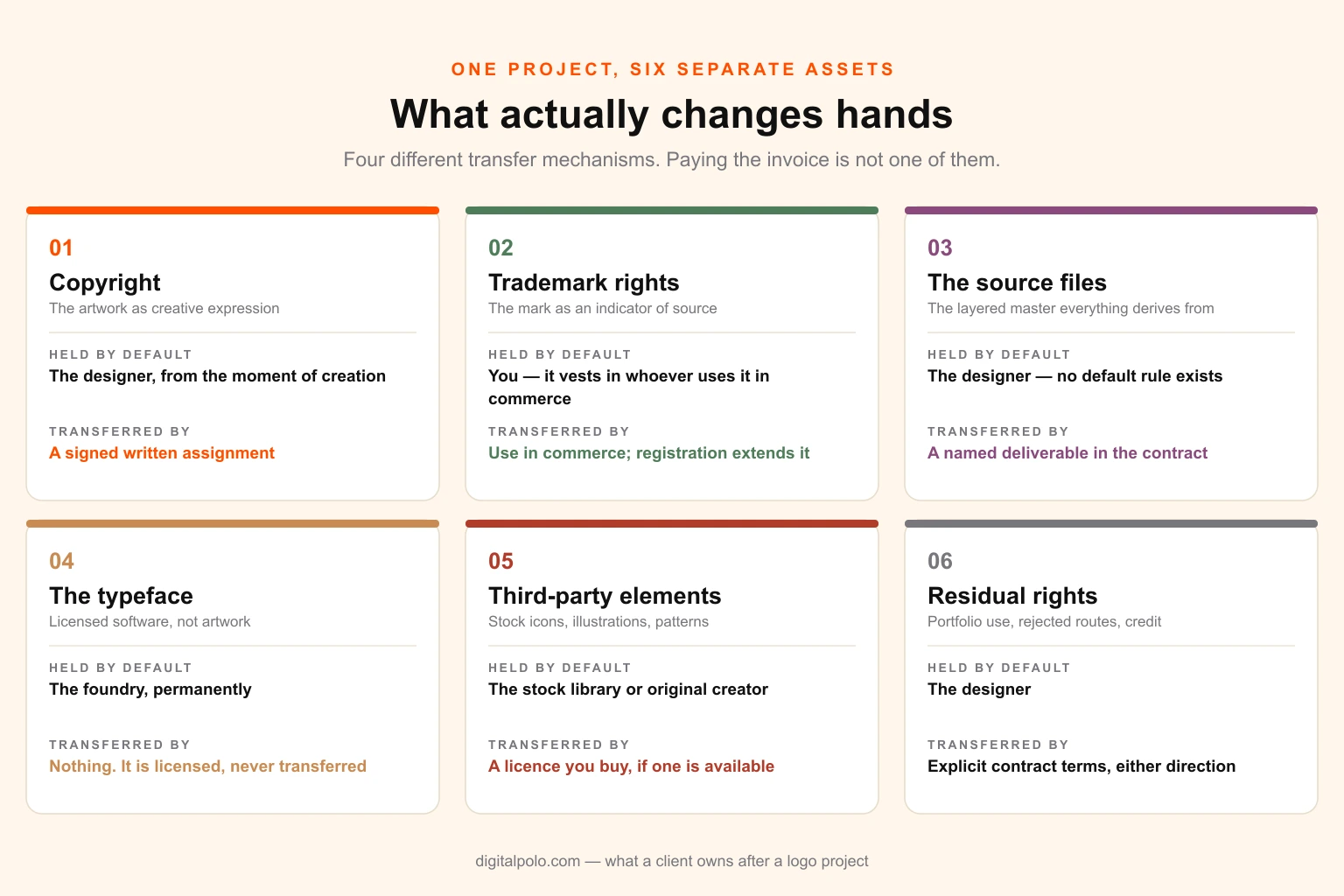
Here is the whole picture in one table. Everything after this section is an expansion of one row.
| Asset | Who holds it by default | What actually transfers it | What happens if you skip it |
|---|---|---|---|
| Copyright in the artwork | The designer, from the moment of creation | A signed written assignment | You have a licence to use, not a right to control, adapt or relicense |
| Trademark rights in the mark | You — it vests in whoever uses the mark in commerce | Use in commerce; registration strengthens and extends it | You hold unregistered rights only, limited to where you actually trade |
| The source files | The designer — no default rule exists | A named deliverable in the contract | You own rights to a file you cannot open or edit |
| The typeface | The foundry, permanently | Nothing. It is licensed, never transferred | Live text you are not licensed for, or a logo licence you did not buy |
| Embedded third-party elements | The stock library or original creator | A licence you buy, if one is even available | An assignment that is void over part of your own mark |
| The designer's residual rights | The designer | Explicit contract terms, in either direction | Ambiguity about portfolio use, credit and reuse of rejected concepts |
Read that table twice. The second column is the surprising one: two of the six default to you or to nobody, and four default to someone else. The third column is the useful one, because it says that these are transferred by four completely different mechanisms — a signature, commercial use, a delivery clause, and a purchase — and no single act accomplishes more than one of them.
Paying the invoice is not on the list at all.
Asset one: the copyright, and what payment does not do
Copyright in a graphic work vests, at the instant of creation, in the human who created it. That is the baseline in the United States and in most of the world, and it does not care who commissioned or paid for the work. The Copyright Office states it plainly: the author and initial owner of a visual work is the person who makes it.
There is one clean exception and one messy one.
The clean exception is employment. Work created by an employee within the scope of their employment is a work made for hire, and the employer is the author and owner from the start, with nothing to sign. If your in-house designer drew the logo on a Tuesday as part of their job, the company owns it. That is the whole analysis.
The messy exception is the one written into nearly every freelance design contract, and it usually does not work.
Why the work-for-hire clause in your contract probably fails
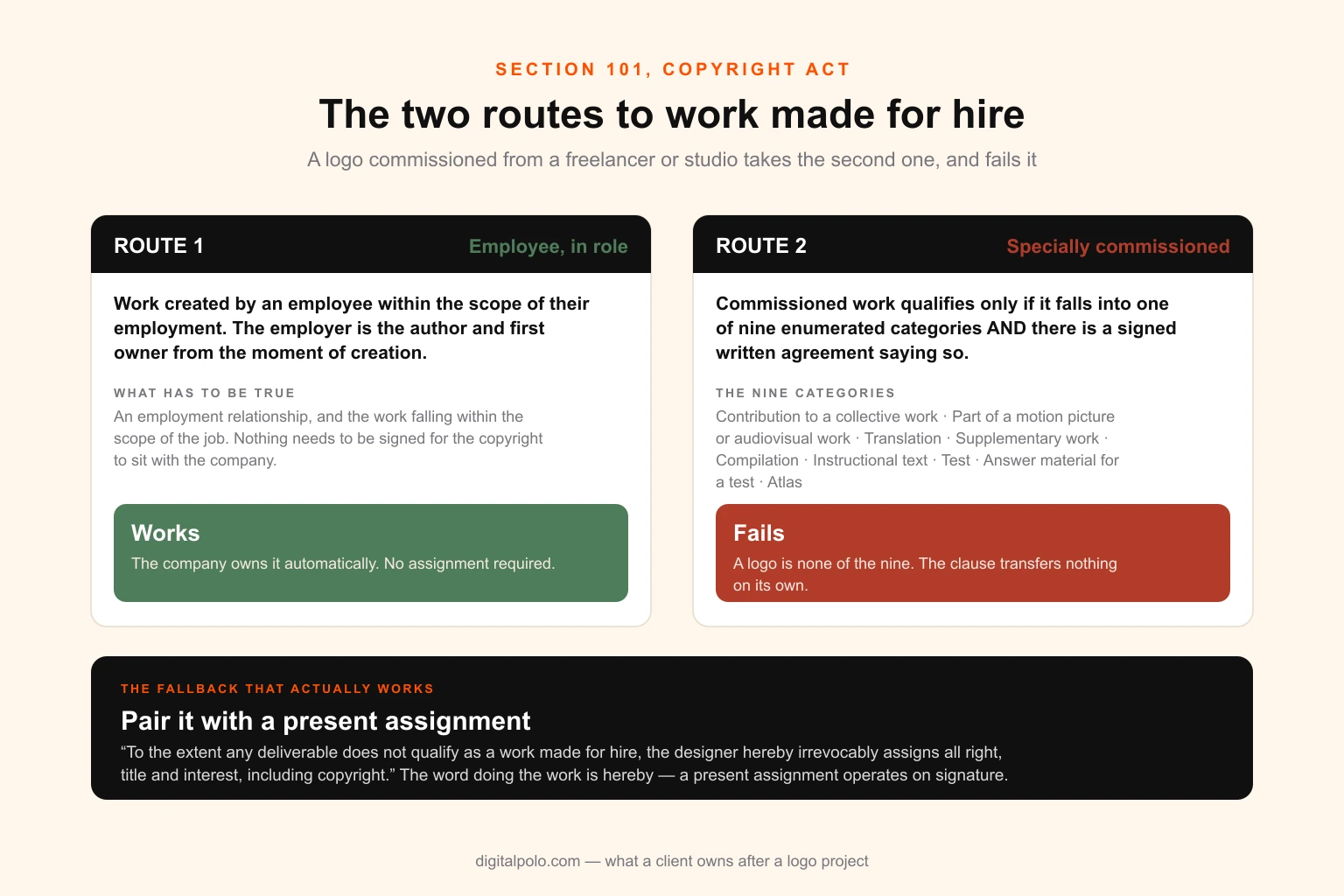
Work made for hire has exactly two routes under Section 101 of the Copyright Act. The first is the employment route above. The second covers specially ordered or commissioned work — but only if the work falls into one of nine enumerated categories, and there is a signed written agreement saying it is a work for hire.
The nine categories are: a contribution to a collective work, a part of a motion picture or other audiovisual work, a translation, a supplementary work, a compilation, instructional text, a test, answer material for a test, and an atlas.
A logo is none of those things.
So when a design contract with a freelancer or an outside studio says "all work produced hereunder shall be deemed a work made for hire," that clause is, for the logo itself, frequently doing nothing. It fails the category test, and a clause that fails the category test does not fall back to anything on its own. Two parties can genuinely believe they have transferred ownership, have it written down, both have signed it, and the copyright can still be sitting with the designer.
This is not an obscure trap. It is the single most common defect in commissioned design paperwork, and the fix is one sentence.
A competent design contract pairs the work-for-hire language with a present assignment. Something to the effect of: to the extent any deliverable does not qualify as a work made for hire, the designer hereby irrevocably assigns to the client all right, title and interest in it, including all copyright. The word doing the work is hereby — a present assignment operates on signature, where a promise to assign later is only a promise you may one day have to enforce.
If you are having a contract drafted, that is the belt-and-braces construction to ask for. If you are reviewing one you already signed, search it for the word "assign". If the only ownership language is work-for-hire, you likely have a gap.
The writing requirement, and the licence you got instead
There is a second formality that catches people. Section 204(a) of the Copyright Act says a transfer of copyright ownership is invalid unless it is in writing and signed by the owner of the rights conveyed. Not an email exchange agreeing in principle. Not an invoice marked paid. Not a verbal agreement, however clear and however honourably both sides have behaved since.
So what do you have, if you paid a designer, received a logo, put it on your building, and never signed anything?
You have an implied licence. Courts routinely find one in exactly this situation, because the alternative — that a client who commissioned and paid for a logo may not use it — is commercially absurd. The implied licence covers the purpose the work was commissioned for. You can trade under the mark. You can put it on your site and your packaging. Nobody sensible is going to tell you otherwise.
What an implied licence does not reliably give you is the control half:
- Exclusivity. Nothing stops the designer reusing elements, or licensing something very similar to someone else.
- The right to adapt. Modifying the mark means making a derivative work, which is one of the copyright owner's exclusive rights. A refresh you commission from a different studio in four years may need the original designer's permission.
- The right to sublicense. Franchisees, licensees, co-packers and merchandise partners all need rights flowing through you.
- Clean transferability. An implied licence of uncertain scope is exactly the sort of thing that surfaces in diligence and slows a transaction.
You can trade on an implied licence indefinitely and most businesses do. You cannot cleanly sell, franchise or overhaul a brand on one.
Asset two: trademark, which you probably do own
Here is the part the law-firm posts underplay, and it is genuinely reassuring.
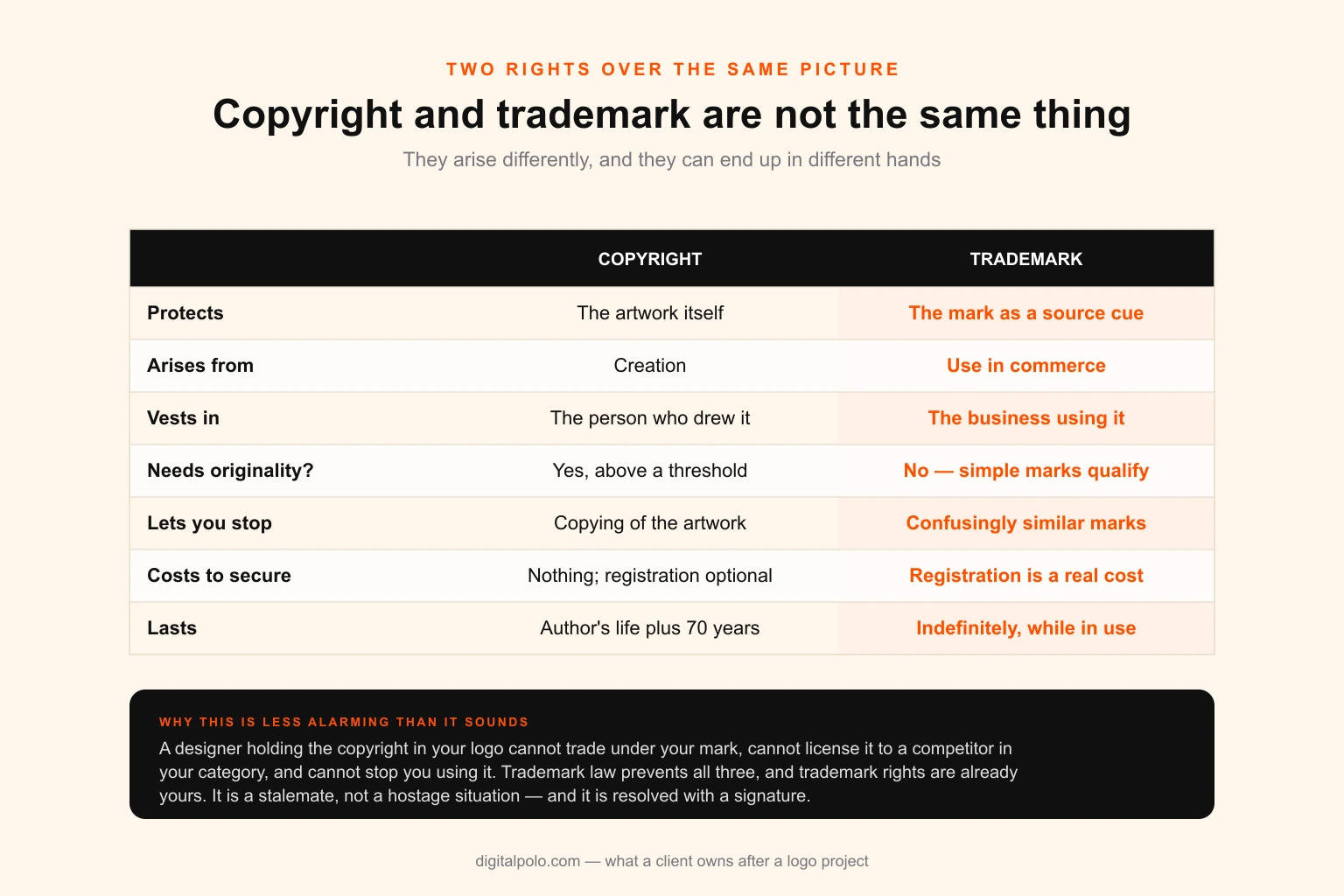
Copyright and trademark are different rights over the same picture, and they behave in almost opposite ways.
| Copyright | Trademark | |
|---|---|---|
| Protects | The artwork as creative expression | The mark as an indicator of commercial source |
| Arises from | Creation | Use in commerce |
| Vests in | The person who drew it | The business using it on goods or services |
| Requires originality? | Yes, above a threshold | No — a simple mark is fully protectable |
| Lets you stop | Copying of the artwork | Confusingly similar marks in related categories |
| Costs to secure | Nothing; registration optional | Nothing at common law; registration is a real cost |
| Lasts | Life of the author plus 70 years | Indefinitely, while you keep using it |
In the United States, trademark rights arise from actually using a mark in commerce to identify your goods or services. They vest in the business making that use. That is you, and it does not matter at all who drew the mark. From the day you started trading under it, you have been accruing common-law trademark rights in the geographic area where you trade, and a federal registration converts those into something far stronger and nationwide.
This is why the copyright question, while worth fixing, is rarely the emergency people fear when they first read that the designer owns the artwork. A designer who owns the copyright in your logo cannot start a competing business under your mark, cannot license it to a rival in your category, and cannot stop you trading under it. Trademark law prevents all of that, and trademark law is on your side of the table.
The awkwardness is real but narrower than it sounds: the designer holds the artwork rights, you hold the source-identifying rights, and neither of you can do very much unilaterally. It's a stalemate rather than a hostage situation. And it is a stalemate you resolve with a signature, not litigation.
Two practical notes. First, if you have not registered the mark, that is usually a bigger commercial exposure than the unassigned copyright, and cheaper to fix — federal filing fees start at a few hundred dollars per class of goods or services, plus attorney time for a clearance search you genuinely want done properly. Second, register the mark you actually use. If you have quietly modernised the logo since the registration, the specimen and the drawing can drift apart.
The copyrightability floor: your wordmark may have nothing to own
Before you spend money chasing a copyright assignment, establish whether there is a copyright to chase.
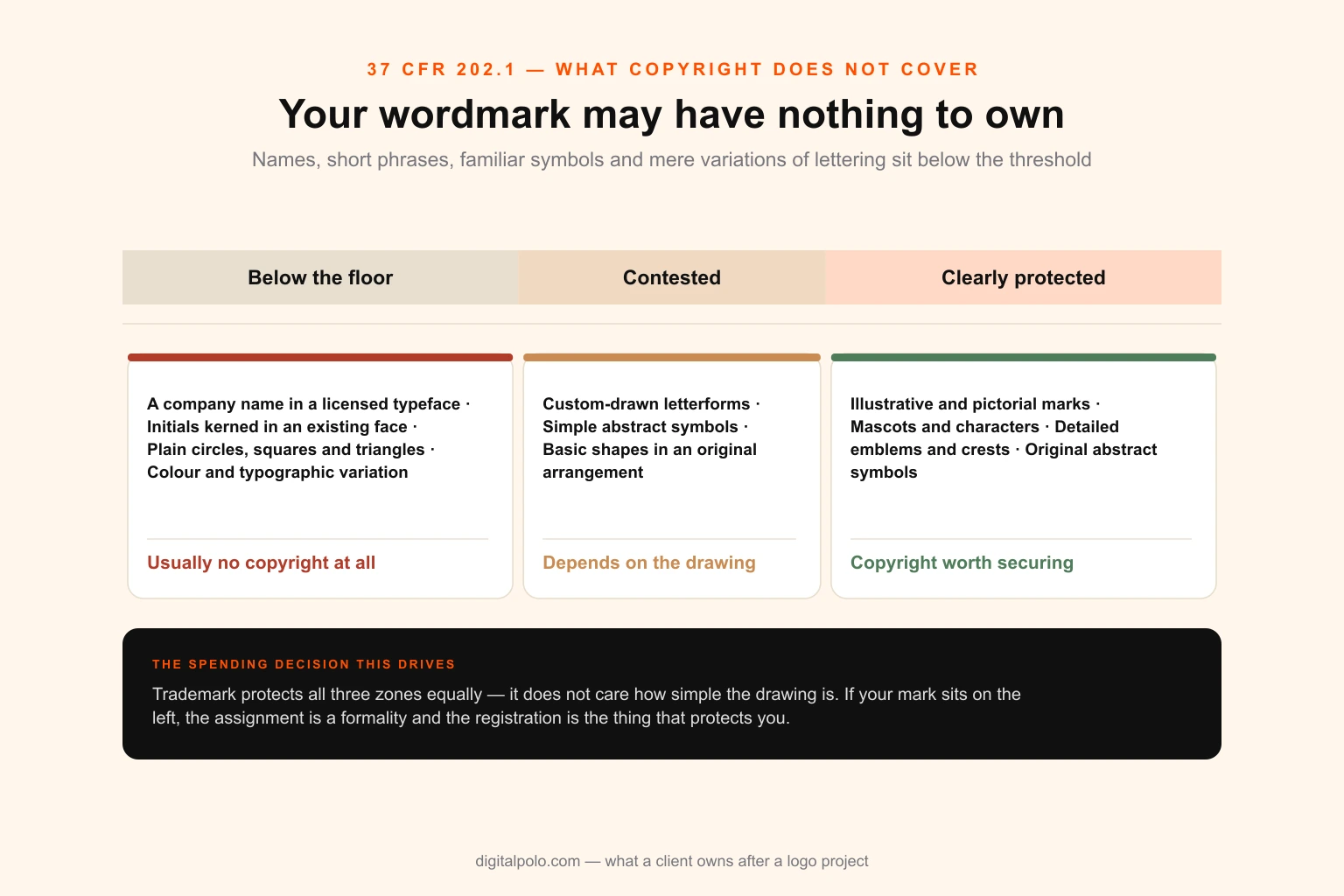
US copyright regulations expressly exclude several things from protection, and three of the exclusions land directly on logos: names, titles and short phrases; familiar symbols and designs; and mere variations of typographic ornamentation, lettering or colouring. Typeface designs as such are also not protected by US copyright.
Put those together and a substantial share of real logos sit below the floor:
- A company name set in a licensed typeface, with the spacing tightened and the colour changed, is very likely unprotectable. This is a large proportion of all wordmarks.
- A basic geometric shape — a plain circle, a simple triangle, an unadorned square — carries no copyright by itself.
- Initials set in an existing face, without genuine original drawing, are in the same territory as a wordmark. Custom-drawn monogram and lettermark construction can cross the line; kerning an existing font does not.
Above the floor, comfortably: illustrative marks, mascot logos, detailed pictorial marks, and genuinely original abstract symbols with real creative choices in them. The middle ground — a simple abstract mark, custom-modified letterforms — is exactly that, a middle ground, and it is where reasonable people disagree.
The consequence is a spending decision, not a philosophical one. If your mark is a name in a typeface, the copyright assignment is close to a formality and the trademark registration is the thing that actually protects you. If your mark is a drawn symbol somebody could copy and put on a T-shirt, the copyright matters and you want it in your name. Working out which of those you have is a five-minute exercise, and it should precede any spending. Understanding what kind of logo mark you actually have makes that call obvious.
Asset three: the source files, which no legal right gets you
This one surprises people who have got everything else right.
A copyright assignment does not oblige anyone to give you a file. Assignment transfers rights in the work. It is silent on which artefacts change hands. You can own the copyright in a logo outright and still have nothing but a flattened PNG, and be entirely without recourse, because delivery is a matter of contract and your contract did not mention it.
There is no default legal rule entitling a client to working files. There is no industry-wide convention either — practices vary enormously and defensibly. Many designers regard the layered working file as studio apparatus rather than a deliverable: it contains their construction method, their unused explorations, their reusable components. Others hand it over as a matter of course. Both are legitimate positions, and both are priced differently.
So it is a negotiation, and it is a cheap one before the project and an impossible one afterwards.
The line to put in the contract names the artefact rather than gesturing at it: deliverables include the layered master vector source file in [named format], with all type converted to outlines, delivered on final payment. Two details matter. Naming the format stops you receiving a flattened PDF and being told it is vector. Tying delivery to final payment is the term a designer will actually agree to, because it protects them too.
If you are commissioning design now, this belongs in the brief itself, alongside the usage requirements. Our guide to writing a design brief that works the first time covers where deliverables sit in the document; the short version is that the file manifest is part of the scope, not an afterthought at handover.
Asset four: the typeface, which never transfers
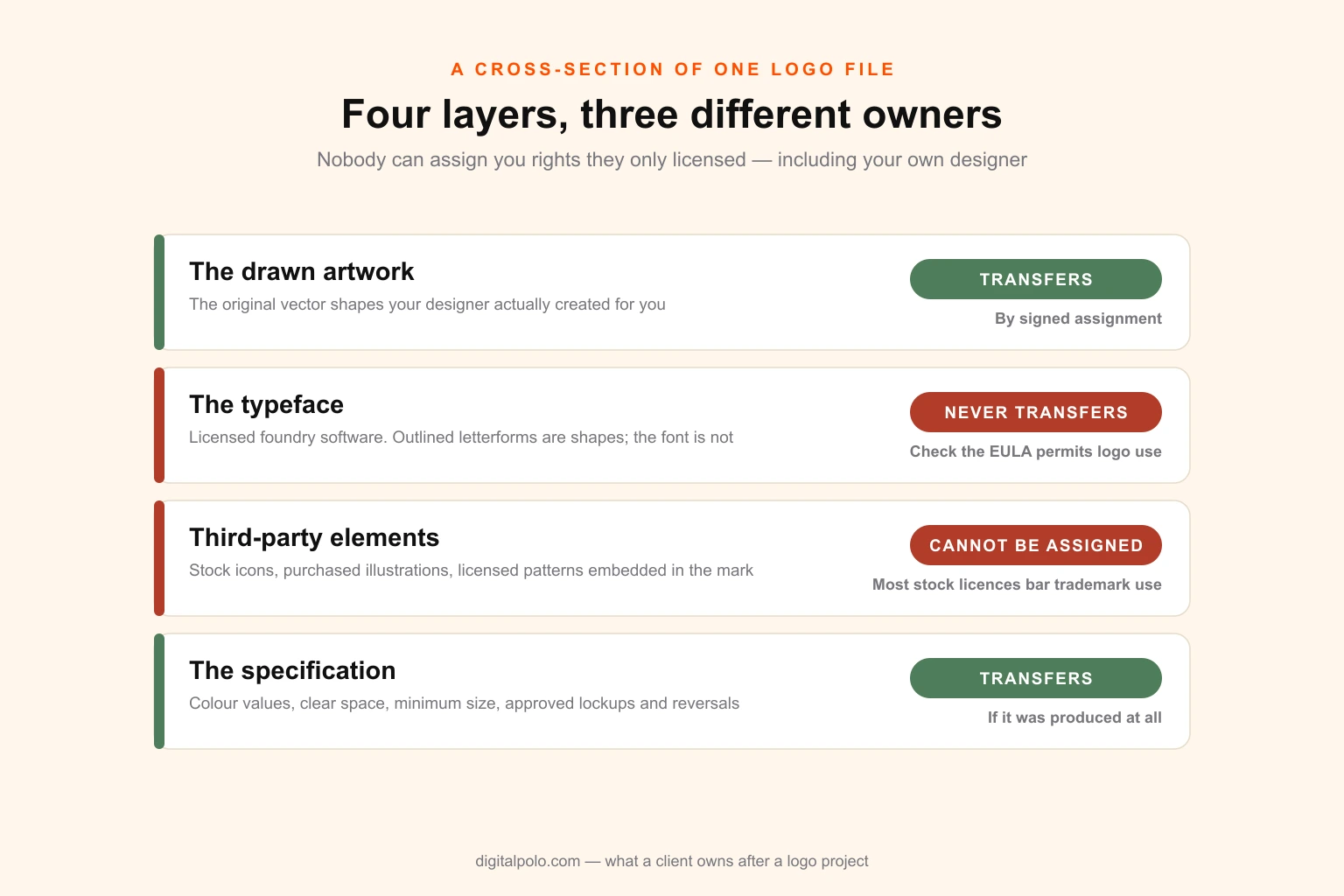
A font is software, licensed under an end user licence agreement, to a named licensee, for a defined scope. Your designer's font licence is theirs. It does not travel with the artwork, it cannot be assigned to you as part of a logo assignment, and no amount of paying for the design changes that.
What you own is the artwork — and this is precisely why professional handovers convert all type to outlines. Once letterforms are outlines they are vector shapes rather than text. The shapes are part of the drawing you commissioned. Any machine can open, print and reproduce the file with no font installed and no licence required.
Two failure modes follow.
Live text in a delivered logo file. If the file still contains editable type, every machine that opens it correctly needs that font licensed. Your printer doesn't have it. Your sign shop doesn't have it. Your web developer doesn't have it. What happens instead is silent font substitution, and your logo quietly renders in something else on a run of 5,000 brochures. Beyond the licensing question this is a straightforward production defect, and it is on the standard print-ready file checklist for exactly that reason.
Licences that restrict logo use. This is the one that generates the surprise email. Some foundries specifically restrict use of their typefaces within a logo or a registered trademark, and require a separate extended or logo licence, priced anywhere from a couple of hundred dollars to several thousand depending on the foundry and the size of the business. It is not universal and it is not hidden — it is in the EULA — but almost nobody reads the EULA of a font their designer chose.
Three questions, asked once, close this out permanently: which typeface is the mark built on, under whose licence was it used, and does that licence permit trademark use. Get the answers in writing at handover. If a logo licence is required, buying it during the project costs a fraction of resolving it after the mark is registered and printed on inventory. The mechanics of how type licences work across parties are covered in more depth in our guide to font licensing when design passes between businesses.
Asset five: third-party elements inside your own mark
Nobody can assign you rights they do not have. If a stock illustration, a purchased icon, a licensed pattern or a third-party texture is embedded in your logo, the assignment you signed is void over that portion of your own mark.
This matters more than it sounds, because standard stock licences are close to the worst possible shape for logo use. Royalty-free licences commonly prohibit using the asset as part of a trademark, service mark or logo, and commonly prohibit uses where the licensed asset constitutes the primary value of the end product. A logo is the textbook case of both restrictions at once.
An icon bought for three dollars and dropped into a mark can therefore sit inside a brand for years as a live defect — one that surfaces at the least convenient moment, which is usually trademark examination, an acquisition, or a cease-and-desist from the library.
Ask the direct question at handover: is any part of this mark derived from a stock, licensed or third-party asset? Most designers will answer honestly and most answers are no. If the answer is yes, you have two clean options — commission a redraw of that element as original work, or buy the extended licence if the library offers one that permits trademark use. Both are cheap now. Neither is cheap after the mark is registered and printed. The same reasoning applies across the rest of your brand assets, which is why stock licensing for print runs and merchandise is worth understanding as a general discipline rather than a logo-specific one.
The AI question, which is now a real question
An AI-generated logo raises an ownership problem that did not exist five years ago, and the answer is genuinely different from the one for human-made work.
United States copyright requires human authorship. The Copyright Office's 2025 report on copyrightability concluded that prompting alone does not give a person authorship of the resulting output, however elaborate the prompt, and the courts have upheld the human authorship requirement. What can be protected is a human's own contribution — meaningful selection, arrangement and modification of AI-generated material supports copyright in that contribution, not in the raw output underneath it.
Three practical consequences.
A purely AI-generated mark may have no copyright for anyone to own or assign. Not the designer's, not yours, not the tool vendor's. A contract that assigns you the copyright in AI-generated output is assigning something that may not exist.
This does not stop you using it. Trademark rights still arise from use in commerce, exactly as before. You can trade under an AI-generated mark, build rights in it, and register it.
What you lose is the copyright remedy. If a competitor copies the artwork itself — not a confusingly similar mark in your category, but the drawing, on unrelated goods — copyright is the tool you would normally reach for, and it may not be there.
There is also a disclosure obligation worth knowing about: Copyright Office guidance requires applicants to disclose AI-generated content when registering a work. And separately from the law, most AI logo generators assemble output from component libraries, which folds the stock-element problem above back into the picture.
None of this makes AI tools unusable in brand work — it makes them a poor choice for the one asset in your business that most needs to be defensible. The wider question of whether you can legally sell AI-generated designs — tool terms, infringement, marketplace rules and the contract clauses that break — is covered separately. Our wider read on where AI genuinely fits in design practice sets out the same distinction across other asset types.
Asset six: what the designer keeps
A well-drafted agreement transfers what you need and leaves the designer what they reasonably keep. Three things usually stay on their side, and you should generally let them.
Portfolio and self-promotion rights. Nearly universal, usually reserved explicitly, and the right answer almost always. It is a display right, not a use right. The genuine exception is a mark that hasn't launched — a portfolio post can leak a rebrand weeks early. The workable term is an embargo rather than a prohibition: nothing published before a named date, unrestricted afterwards.
Rejected concepts and unused routes. The concepts you did not choose were never assigned to you and normally remain the designer's, free to be developed for someone else. Occasionally a client wants those killed off too, particularly when a shortlisted route was uncomfortably close to a competitor's territory. That is a buyout of unused work and it is priced separately, because you are asking the designer to write off inventory.
Moral rights, where they exist. In the US these barely touch commercial logos — the federal moral rights statute covers a narrow set of fine-art categories and expressly excludes advertising, promotional and merchandising material. In the UK, the EU and especially France, moral rights of attribution and integrity are broader, sometimes cannot be assigned at all and can only be waived, and can in principle be engaged by significant distortion of a work. It rarely becomes a live issue in commercial branding. It is worth a line in the contract if you are commissioning across borders, and worth remembering that a cross-border assignment drafted for one jurisdiction may not do everything you assumed in another.
Where you bought the logo changes everything
The default analysis above assumes a commissioned freelancer. Most logos do not arrive that way, and the source materially changes what you hold.
| Source | Copyright position | Source files | The specific thing to check |
|---|---|---|---|
| Employee, in role | Yours automatically as work made for hire | Wherever they saved it | Whether it was actually within the scope of employment, and whether it left with them |
| Freelancer | Theirs until assigned in writing | Only if named as a deliverable | Whether the contract says "assign", not just "work for hire" |
| Design agency or studio | Usually assigned, often on final payment | Usually available on request, sometimes priced | Whether their subcontractors assigned up the chain to them first |
| Design contest platform | Winning entry transferred under the platform's own agreement | Varies by package tier | That the transfer covers the winner only — the entries you liked and didn't pick stay with their designers |
| Logo generator or template marketplace | Typically a licence, not ownership; exclusivity sometimes sold as an upgrade | Rarely a true layered master | Whether the mark is exclusive to you at all, and what stock components it contains |
| AI logo tool | May be uncopyrightable outright | Usually raster exports only | Human authorship, plus the component libraries the tool draws on |
| Offshore marketplace gig | Assignment often claimed in the listing, rarely executed properly | Frequently a traced or re-drawn file | Whether anything was signed by a named individual, and whether the mark is original |
Two rows deserve emphasis because they are the ones people get wrong most often.
The agency row: agencies routinely subcontract. If the studio's own freelancer never assigned the copyright to the studio, the studio cannot assign it to you, and you have a broken chain nobody has noticed. The question to ask is whether all contributors have assigned upstream. It is a standard question when vetting a design partner, and a professional partner will answer it without hesitation.
The template marketplace row: a non-exclusive licence means someone else can be trading under a near-identical mark tomorrow, in your category, entirely lawfully. That is a trademark problem rather than a copyright one, and it is the reason cheap template marks tend to become expensive at the exact moment a business starts being worth something.
The handover manifest a real logo project produces
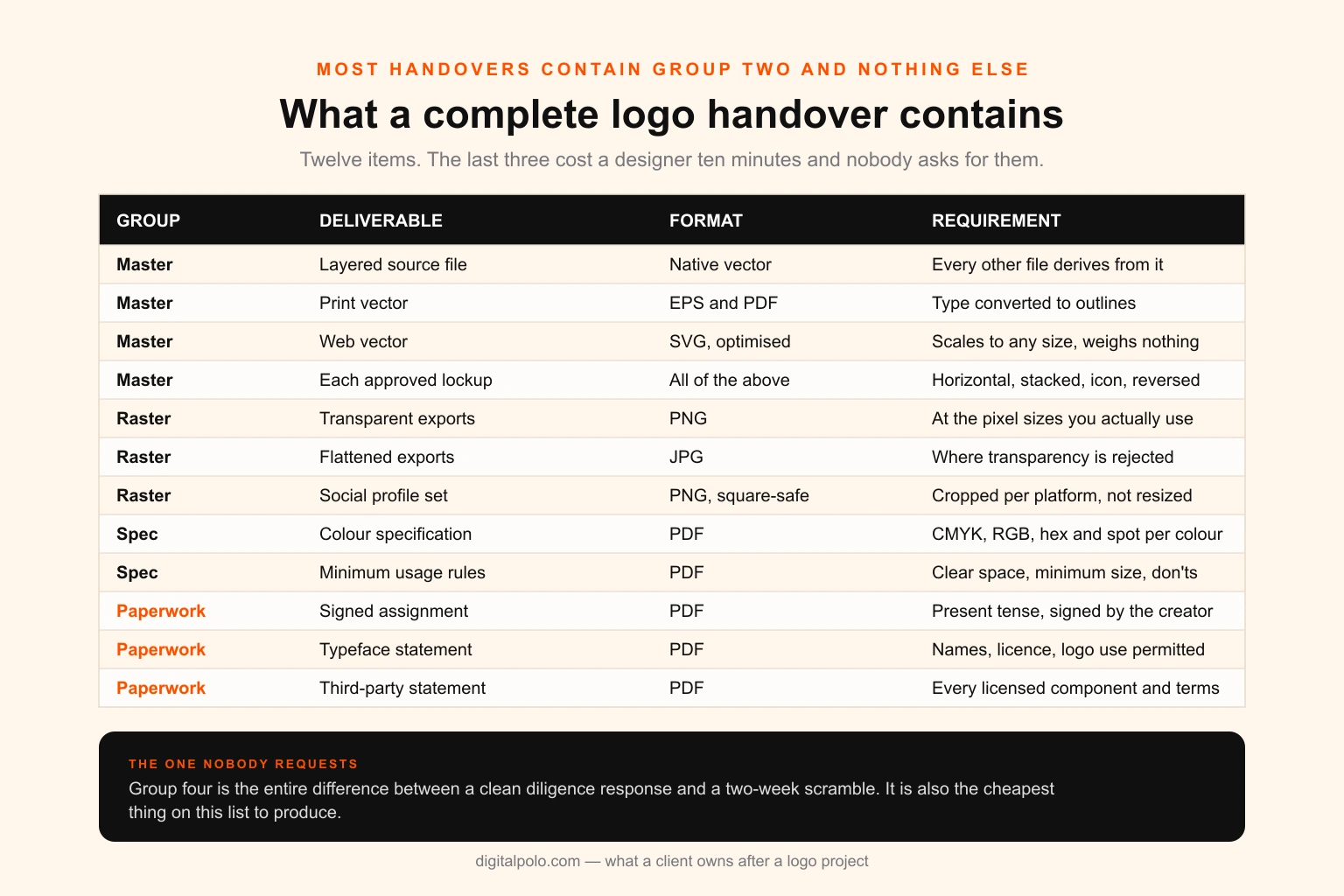
This is what should land in your folder. Most handovers contain the second group and nothing else.
Group 1 — Master and production files
| File | Format | Why it exists |
|---|---|---|
| Layered master source | Native vector (AI, or equivalent) | The file every other file is generated from |
| Print vector | EPS and PDF, type outlined | What printers, fabricators and merch suppliers ask for |
| Web vector | SVG, optimised | Scales infinitely, weighs almost nothing, sharp on any display |
| Each approved lockup | All of the above, per variant | Horizontal, stacked, icon-only, one-colour, reversed |
If you take one thing from this list: the difference between vector and raster is the difference between a logo you can use at any size forever and a logo that has to be redrawn the first time somebody needs it two metres wide. Our explainer on vector versus raster files covers why, and resolution for large-format printing covers what happens when the vector isn't there.
Group 2 — Raster exports
| Export | Format | Requirement |
|---|---|---|
| Transparent exports | PNG | At the pixel sizes you actually use — favicon, app icon, email signature, social avatar |
| Flattened exports | JPG | For contexts that reject transparency |
| Social profile set | PNG, square and circular-safe | Cropped correctly for the platforms you're on, not one file resized |
Group 3 — Specification
| Item | Contents |
|---|---|
| Colour specification | CMYK, RGB, hex and a spot reference for each brand colour |
| Minimum usage rules | Clear space, minimum reproduction size, approved lockups, what not to do |
| Background rules | Approved treatments on light, dark, photographic and busy backgrounds |
The colour specification is not decoration. A logo that has only ever been defined in RGB will be converted by whoever prints it, unpredictably, and your brand colour will drift between suppliers — the mechanism is explained in CMYK versus RGB. If the project scope extends past the mark itself, this group grows into a full brand guidelines document; for a standalone logo project, a two-page minimum usage sheet is the floor.
Group 4 — The paperwork
| Document | What it must say |
|---|---|
| Signed assignment | Present-tense transfer of all right, title and interest, signed by the creator |
| Typeface statement | Which typefaces, under whose licence, and whether logo use is permitted |
| Third-party element statement | Any stock, licensed or third-party component inside the mark, and its licence |
| Portfolio terms | What the designer may publish, and from when |
Group 4 is the one nobody asks for. It costs nothing to produce, it takes a designer ten minutes, and it is the entire difference between a clean diligence response and a two-week scramble.
The twelve-point ownership audit
For a logo you already have. Work through it in order; most people find their answer in the first four.
- Who made it? Employee, freelancer, agency, platform, generator, AI tool. Name the individual if you can.
- What was signed? Find the contract. If there isn't one, find the emails — they are not a copyright transfer, but they establish scope and intent.
- Does the contract contain the word "assign"? Not "work for hire" alone. Assign.
- Was it signed by the person who actually drew it? A studio signature does not help if the studio never got the rights from its own contractor.
- Do you hold a layered vector master? Open it. A PDF that opens flat is not a master file.
- Is the type outlined? If the text is still editable, you have a licence exposure and a production risk.
- Which typeface is it? If nobody knows, you cannot answer the licence question at all.
- Does that font licence permit logo and trademark use? Read the EULA, or ask the foundry.
- Is any part of the mark third-party? Stock icon, purchased illustration, licensed pattern, AI-generated component.
- Are you using the mark in commerce, and where? This establishes your common-law trademark footprint.
- Is the mark registered, and does the registration match what you actually use? Drift between the registered drawing and the live mark is common after an unrecorded refresh.
- Can you produce all of the above in one folder? That is the actual test, and it is the one an acquirer will apply.
Twelve yeses means you own your logo in every sense that matters. Most businesses score seven or eight, and the misses cluster in the same places: no assignment, no master file, no idea about the font.
If you are about to go through a rebrand, run this audit first. Establishing what you hold in the old mark is the cheapest possible input into the new one, and it prevents you rebuilding the same defect. The rebrand rollout inventory picks up from there and covers everything still carrying the old mark once the new one exists.
Fixing it retroactively, and what that costs
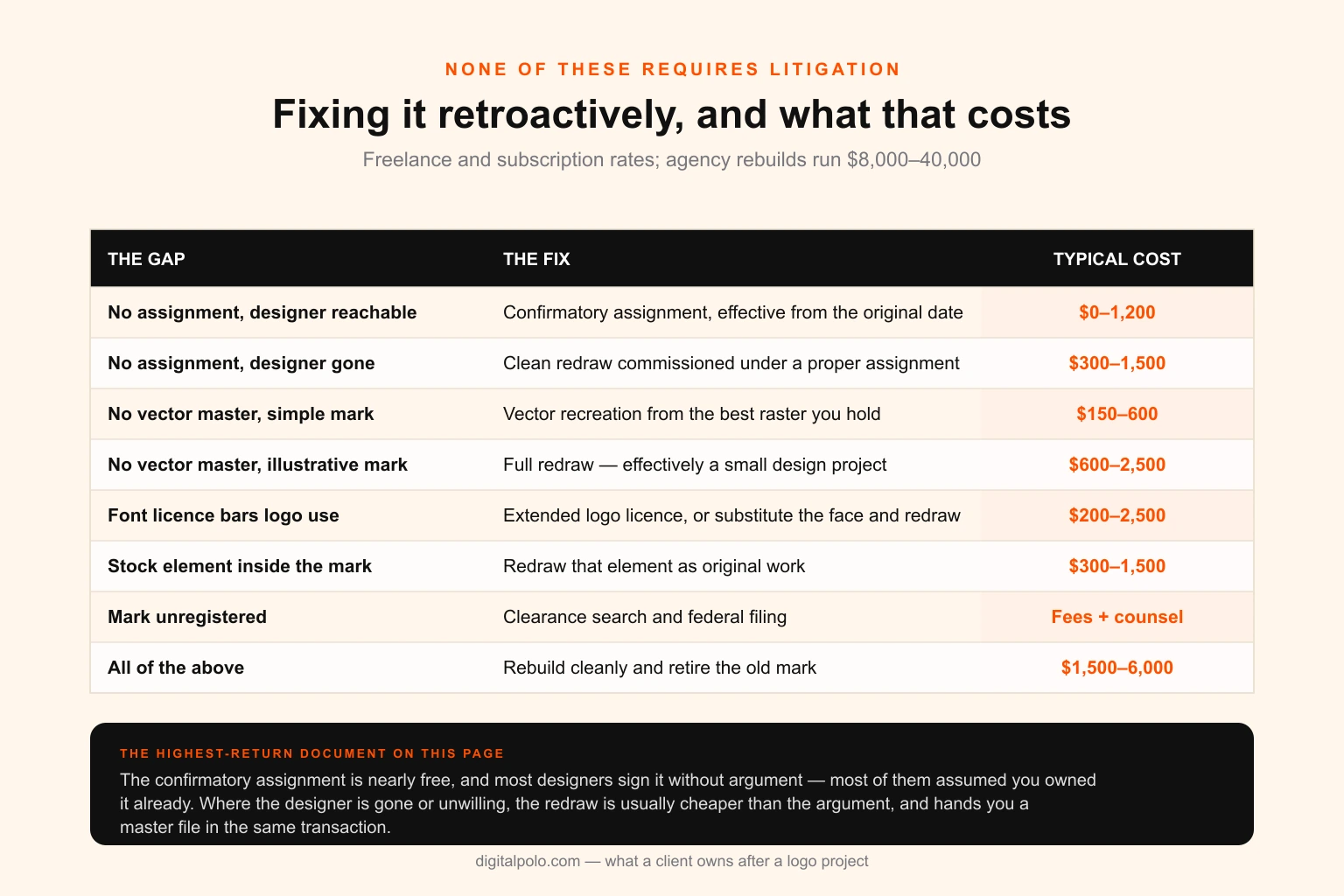
Every gap in that audit has a standard remedy. None of them requires litigation.
| The gap | The fix | Typical cost |
|---|---|---|
| No signed assignment, designer reachable | Confirmatory assignment — a short signed document confirming the transfer, executed now, expressed effective from the original date | $0–500 in goodwill, or a modest fee; $400–1,200 if an attorney drafts it |
| No signed assignment, designer unreachable or unwilling | Clean redraw commissioned under a proper assignment | $300–1,500 freelance; included in a design subscription |
| No vector master, mark is straightforward | Vector recreation from the best raster you hold | $150–600 |
| No vector master, mark is illustrative | Full redraw, effectively a small design project | $600–2,500 |
| Font licence does not permit logo use | Buy the extended or logo licence, or substitute the typeface and redraw | $200–2,500 for the licence; redraw as above |
| Stock element embedded in the mark | Redraw that element as original work, or buy the extended licence | $300–1,500 |
| Mark unregistered | Clearance search and federal filing | Government fees from a few hundred dollars per class, plus attorney time |
| Everything is broken at once | Rebuild the mark cleanly under proper terms and retire the old one | $1,500–6,000 freelance; $8,000–40,000 agency; one to two months of a design subscription |
Two observations from the right-hand column.
The logo is one asset. If the designer or agency who made it is also the one leaving, the same conversation should cover the files, licences, accounts and record for everything else they touched — the offboarding manifest is that wider list, and the leverage to obtain it decays fast once the final invoice is paid.
The confirmatory assignment is nearly free and it is the single highest-return document in this article. Most designers sign it without argument, because most designers assumed you owned it anyway. The conversation is not adversarial: we're tidying up our records and our lawyer flagged that we never signed a formal assignment — would you mind signing this? People say yes to that.
And the redraw is very often cheaper than the argument. If the original designer is gone, hostile, or simply unresponsive, commissioning a clean replacement under proper terms extinguishes the problem rather than negotiating with it — and hands you a usable master file in the same transaction. Businesses running design on a subscription tend to fold this into an ordinary month's work, which is a meaningful part of why the recurring model suits companies with a long tail of unresolved asset debt. If you're weighing that against a one-off commission, our comparison of subscription design and freelancers covers the trade-offs, and the pricing breakdown covers what each route actually costs.
The clauses to insist on before the next project
Whether it's a new mark, a refresh, or the first project with a new partner, these five lines prevent everything above. They are not aggressive terms and no competent designer will object to them.
- Present assignment with a work-for-hire preamble. To the extent the deliverables are not works made for hire, the designer hereby assigns all right, title and interest, including copyright, on final payment.
- Named source-file deliverables. The layered master vector source file, in a named format, with type converted to outlines.
- Typeface disclosure and licence warranty. Which typefaces are used, under what licence, and a warranty that their use in the mark is permitted.
- Third-party element disclosure. A warranty that the deliverables are original, or a written statement of every licensed component and its terms.
- Portfolio rights, with an embargo if needed. The designer may show the work; nothing published before a named launch date.
Tie assignment and delivery to final payment. It is the term designers will actually agree to, it protects them, and it gives both sides a clean, unambiguous moment at which everything changes hands.
If you are choosing a partner rather than drafting a contract, treat willingness to answer points three and four as a proxy for professionalism generally. A studio that can tell you which typeface your mark uses and whether the licence covers it is a studio that keeps its files in order. That question belongs alongside the others in how to vet a design partner, and it is one of the more revealing ones.
The short version
- Paying does not transfer copyright. In the US, copyright vests in the creator and moves only by a signed writing. What payment buys you is an implied licence to use — enough to trade, not enough to control.
- The work-for-hire clause in your contract probably fails. A logo is not one of the nine statutory categories for commissioned works made for hire. You need an express present assignment as well.
- You almost certainly do own the trademark rights, because in the US they vest in whoever uses the mark in commerce. That is the right that actually protects your brand commercially.
- Your wordmark may have no copyright at all. Names, short phrases and mere variations of lettering sit below the copyright floor — which makes trademark registration the better place to spend.
- A copyright assignment does not get you the files. Delivery is contract, not law. Name the master file as a deliverable or you will not receive it.
- The font never transfers. Get type converted to outlines, and confirm the EULA permits logo use before the mark is registered.
- Nobody can assign you rights in a stock element they only licensed. Ask what is embedded in the mark.
- A purely AI-generated mark may be uncopyrightable. You can still trade under it and still register it; you just lose the copyright remedy against direct copying.
- Six assets, four transfer mechanisms, one project. Run the twelve-point audit and you will know which of the six you're missing within an hour.
Most of the value here is in one afternoon of tidying. Find the contract, search it for "assign", open the file you were sent, and ask three questions about the typeface. If those go well, you are in better shape than most of the businesses that will read this. If they don't, every one of the fixes above costs less this quarter than it will cost during your next funding round, franchise agreement, or acquisition.
Sorting out a logo's paperwork usually surfaces a longer list. A mark with no master file rarely has a clean set of production assets behind it either. Digital Polo works as an ongoing design partner for businesses that need that backlog cleared and kept clear — vector rebuilds, full logo and identity work, and the brand asset systems that keep the next three years of files in order. Everything we produce is delivered with the source files and assigned to you, because that is what a handover is supposed to mean. See how the plans work.