What is design as a service? It's the subscription model for graphic design — a flat monthly fee, unlimited tasks, predictable turnaround, no per-project quotes. Sometimes abbreviated DaaS. Sometimes called unlimited graphic design, design subscription, or creative subscription. All the same model.
The category emerged around 2015 (Design Pickle was one of the first at scale) and has matured into a real alternative to the traditional pay-per-project freelance model and the in-house-designer hire. This is the 2026 explainer.
Quick answer: Design as a service is a monthly subscription for unlimited graphic design tasks. You pay a flat fee (typically $179–$899/month). You submit briefs. The design team delivers each task within an SLA window (24–48 hours). Revisions are unlimited. You pause or cancel anytime. The model replaces project-based freelance billing or full-time hire economics with predictable monthly cost and unlimited throughput.
How the Model Works
Five steps:
- Subscribe to a monthly plan. Most are $179–$899/month depending on tier and provider.
- Submit briefs by email or a shared brief inbox. Some providers also support PM-tool integration (Trello, Asana, ClickUp).
- Receive deliverables within the SLA window — typically 48 hours on entry plans, 24 hours on premium tiers, sometimes same-day for smaller tasks.
- Request unlimited revisions at no extra cost. Most providers iterate until the customer approves.
- Pause or cancel anytime. Plans are month-to-month with no annual lock-in.
The model is built around two structural features that change the economics from traditional design hiring:
- Unlimited tasks for a flat fee — there's no per-piece pricing pressure
- Pause or cancel monthly — you only pay during months you actually need design
What's Typically Included
| Feature | Entry tier | Premium tier |
|---|---|---|
| Unlimited tasks | Yes (queued, one active) | Yes (parallel, multiple active) |
| Turnaround SLA | 48 hours | 24 hours |
| Unlimited revisions | Yes | Yes |
| Source files (AI, EPS, PSD, PDF, Figma) | Included | Included |
| Pause/cancel anytime | Yes | Yes |
| Dedicated team | No (shared production) | Yes |
| Illustration & complex drawings | Limited | Yes |
| White-label / reseller rights | Varies by provider | Yes |
| NDA on request | Varies | Yes |
| 24×7 support | Business hours | Yes |
What's Usually NOT Included
Most design subscriptions are graphic-design-only. They generally do not cover:
- Motion graphics and video editing (separate vendors specialise in this — Vidpros, Wave, etc.)
- Full-stack web development (subscriptions design web mocks; build is separate)
- Copywriting (a few subscriptions bundle this but most don't)
- Photography and videography (production work, not design)
- 3D modelling and rendering (specialised; some subscriptions offer it on premium tiers)
If you need any of these alongside graphic design, pair the design subscription with a specialised vendor for those.
What Design as a Service Costs (2026)
Entry-tier pricing across the major vendors:
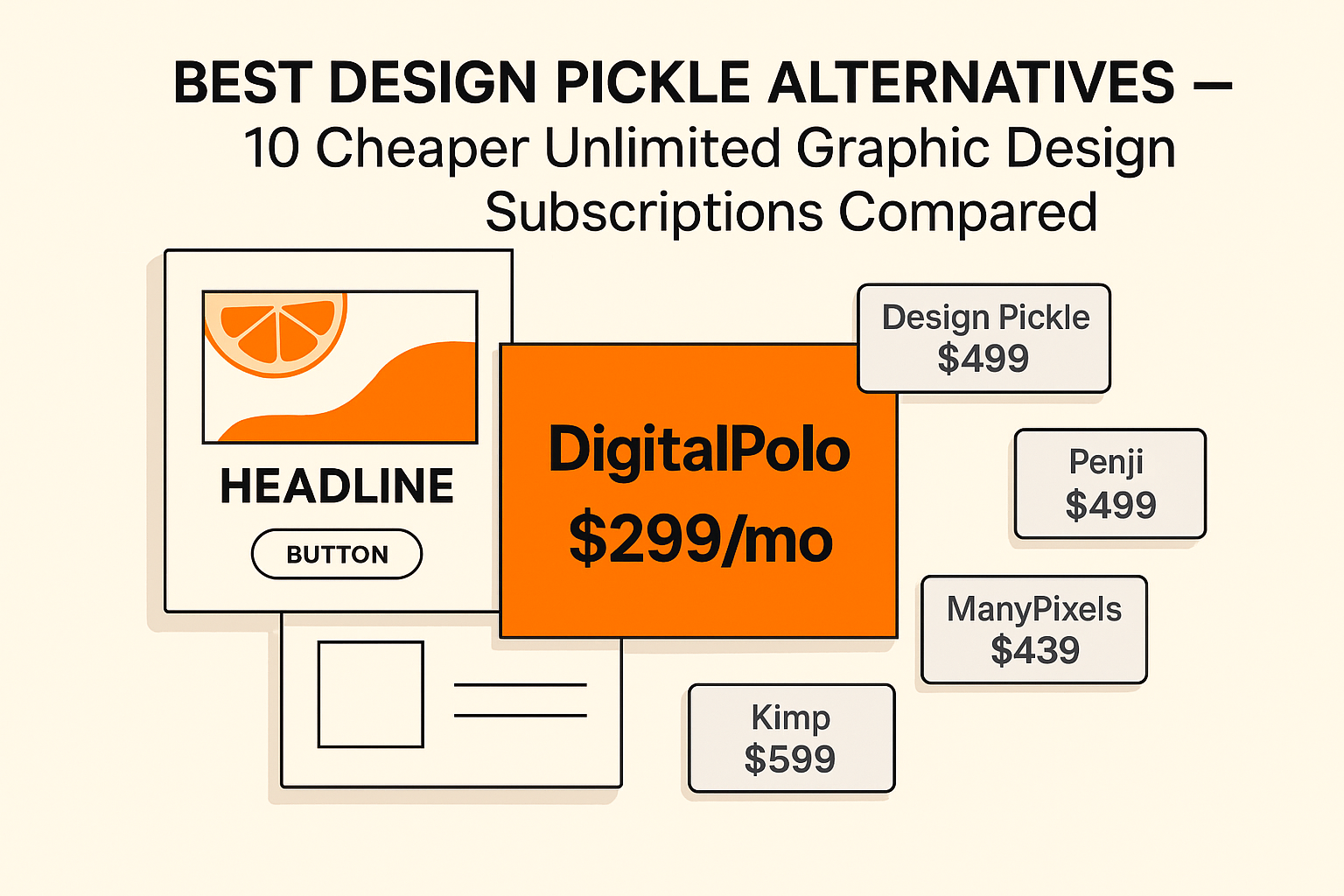
| Vendor | Entry plan | SLA | Founded |
|---|---|---|---|
| Undullify | ~$179/mo | 1–3 days | 2017 |
| Draftss | ~$245/mo | 1–2 days | 2018 |
| Graphically.io | ~$299/mo | 24–48 hrs | 2020 |
| DigitalPolo | $399/mo | 48 hrs | 2010 |
| DotYeti | ~$399/mo | 24–48 hrs | 2018 |
| ManyPixels | ~$439/mo | 1–2 days | 2018 |
| Penji | ~$499/mo | 24–48 hrs | 2017 |
| Design Pickle | ~$499/mo | 1 business day | 2015 |
| No Limit Creatives | ~$499/mo | 1–2 days | 2018 |
| Kimp | ~$599/mo | 1–2 days | 2018 |
Premium tiers (dedicated team, 24-hour priority) typically run $899–$1,499/month with DigitalPolo's Soulmate at $899/month and Penji / Design Pickle / Kimp in the $1,000–$1,500 range.
Who Design as a Service Is For
Best fit:
- Small businesses with consistent 4–10 design tasks per month
- Marketing teams at growing companies that have outgrown one freelancer but aren't yet ready to hire in-house
- Marketing agencies white-labelling design work into their retainers (see /for-marketing-agencies/)
- Print shops, sticker manufacturers, vehicle-wrap installers, sign shops that need print-ready files at high volume (see /for-printers/)
- Freelance designers subcontracting overflow work (see /for-freelance-designers/)
- Subscription resellers repackaging design into bundled offerings
Worst fit:
- Businesses needing fewer than 2–3 tasks/month (project-based freelancers are cheaper)
- Brand identity work where the customer expects multi-week intensive strategy and presentation (subscriptions can do this but it isn't the optimised use case)
- Motion-graphics-heavy or video-heavy workflows
- One-off project work that won't recur
How DaaS Compares to the Alternatives
Vs. Freelancer
- Cost: Freelancer at $80–$150/hour × 10–20 hrs/mo = $1,200–$3,000/mo. Subscription = $399/mo flat.
- Throughput: Freelancer ships what you book; subscription ships everything inside the SLA window.
- Continuity: Freelancers go on vacation; subscriptions don't.
- Senior creative direction: Freelancer wins when you want one specific senior designer's hand on every piece.
Vs. Agency
- Cost: Traditional design agency project work runs $5,000–$50,000+ per project. Subscription = $399/mo flat for unlimited.
- Speed: Agencies have multi-week project timelines; subscriptions are 48-hour SLA per task.
- Strategy depth: Agencies win for deep brand-strategy projects with intensive workshops and stakeholder management. Subscriptions are better for ongoing execution.
Vs. In-House Designer
- Cost: In-house designer = $50,000–$115,000/year loaded ($4,200–$9,500/month). Subscription = $399–$899/mo.
- Predictability: Subscriptions deliver on SLA whether the in-house designer is in or on PTO.
- Hiring overhead: Subscriptions start in 24 hours; hires take 60–90 days plus 30–60 days to ramp.
- In-house wins when: Monthly design volume exceeds ~50 tasks AND parallel work is constant AND you want the designer in product strategy meetings, not just executing.
For most growing small businesses and marketing teams, the subscription path is dramatically cheaper and more flexible than the alternatives until the business genuinely needs a senior creative leader on the team.
When to Choose Each Path
| Your situation | Choose |
|---|---|
| 0–2 design tasks/month | Freelancer, project-based |
| 3–25 design tasks/month, small business | Design subscription Partner tier (~$399) |
| 25+ tasks/month or parallel client work | Design subscription Premium tier (~$899) |
| Big strategic brand project, infrequent | Design agency |
| 50+ tasks/month, ongoing strategy + execution | In-house designer + subscription overflow |
When You're Picking a Design-as-a-Service Vendor
Six things to compare across vendors:
- Price and what's included — does the entry plan cover what you need or is there an upsell to get reseller rights, source files or 24-hour SLA?
- Operating history — older vendors have weathered more market cycles. (DigitalPolo: 2010. Design Pickle: 2015. Most others: 2017–2020.)
- Source files — included by default, or upsold?
- Reseller / white-label rights — included at entry tier or only premium?
- Workflow — email-first or portal-based? Match your team's preference.
- Pause and cancellation — month-to-month with no penalty, or annual lock-in?
Compare DigitalPolo to the top alternatives → | See DigitalPolo's plans → | Read the full guide for small businesses →
Bottom Line
Design as a service is a monthly subscription for unlimited graphic design work, with a flat fee, fixed turnaround, unlimited revisions, and the ability to pause or cancel anytime.
It's the strongest economics for small businesses, marketing teams and agencies shipping 4–25+ tasks per month who don't want to hire in-house but have outgrown one freelancer.
The category has matured since 2015 and now spans ten-plus credible vendors with pricing from $179–$1,499/month. DigitalPolo's Partner plan at $399/month sits in the value-band middle with 16 years of operating history behind it.
That's design as a service.