Every print shop owner knows the job that quietly loses money. A customer walks in, wants 500 flyers, and hands over a phone photo of last year's flyer. Or a Word document. Or a 200-pixel logo pulled off a website. Or nothing at all — just a description and an expectation that you'll "make it look good." The print is the easy part. The artwork is where the order stalls, where your press operator becomes an unpaid designer, and where a 20-minute job turns into two hours you never billed for.
You have three bad options. Turn the work away and lose the sale. Hire a designer and carry a salary through every slow week. Or do the design yourself at the front counter while three other customers wait. None of them scale, and all of them cap how much work your shop can actually take.
There is a fourth option that print shops have quietly used for years: route the artwork to a flat-fee design subscription. You pay one predictable monthly price, send the messy customer files out, and get back a clean, press-ready vector. DigitalPolo has run that model since 2010 — one of the oldest services in the category — with plans from $399/month, 48-hour turnaround, unlimited revisions, and production-ready source files (AI, EPS, PDF) included as standard. For a print shop, that is an art department you can switch on without a single hire.
Why Print Shops Run Out of Design Capacity
A print shop is a production business. Its margin comes from press time, materials, and finishing — not from artwork. But artwork is the gate every job has to pass through, and most shops underestimate how much of it they absorb for free.
Walk through a typical week and the design work hides everywhere:
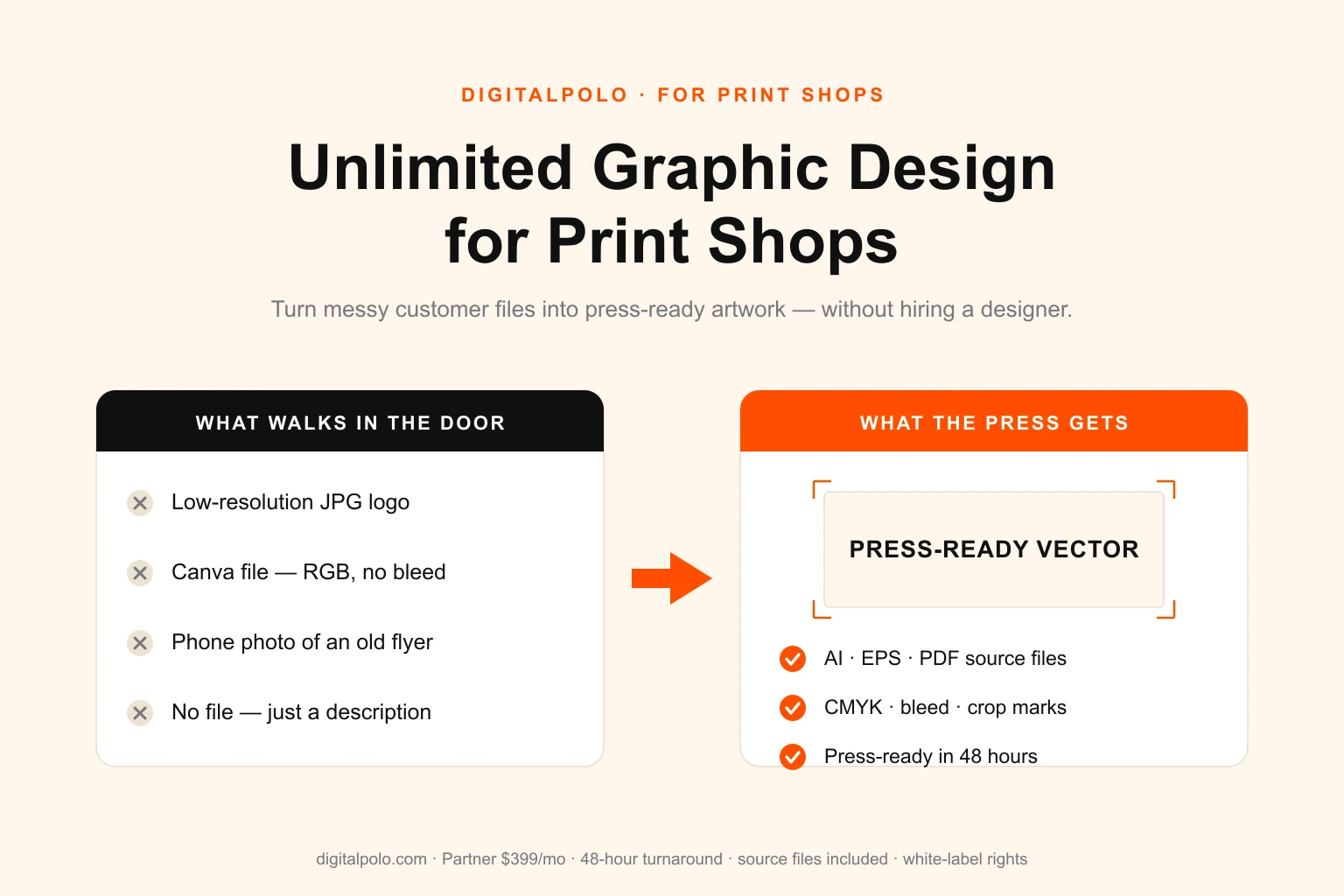
- A customer's logo arrives as a low-resolution JPG that has to be redrawn as a vector before it can go on a banner.
- A business card file is built in Canva with no bleed, RGB colours, and fonts that won't embed.
- A restaurant wants a menu "like the old one" but the old one is a flattened PDF nobody can edit.
- A real estate client needs the same flyer in six sizes for six channels.
- A repeat customer wants seasonal variants of a design your shop laid out two years ago.
None of these are big design projects. They are small, constant, unglamorous artwork tasks — and they pile up faster than a counter staffer or a press operator can clear them. The shop either slows down to handle them or pushes them back to the customer and watches the order go cold.
The capacity problem is structural. Design demand at a print shop is lumpy and unpredictable — three jobs need artwork on Monday, none on Tuesday, six on Friday. You cannot staff for a lumpy load. A full-time designer is idle half the week and underwater the other half. That mismatch is exactly what a subscription solves: it gives you elastic capacity at a fixed price.
The Real Cost of Handling Design In-House
Print shop owners tend to compare a design subscription against "free" — the assumption that handling artwork in-house costs nothing because nobody writes a cheque for it. It is not free. It is just unbilled.
Three hidden costs eat the margin:
1. Operator time at the wrong rate. When a press operator spends 90 minutes fixing a customer file, you are paying a skilled production wage for design work — and the press isn't running while they do it. That is the most expensive design labour in the building.
2. Turned-away revenue. Every "sorry, we'd need a print-ready file for that" is a lost order. Customers who can't supply artwork don't go find a designer and come back. They go to the competitor down the road who said yes.
3. Slow turnaround. A job stuck in the artwork stage is a job not on the press. Design bottlenecks stretch your quoted turnaround, and turnaround is one of the few things customers actually shop on.
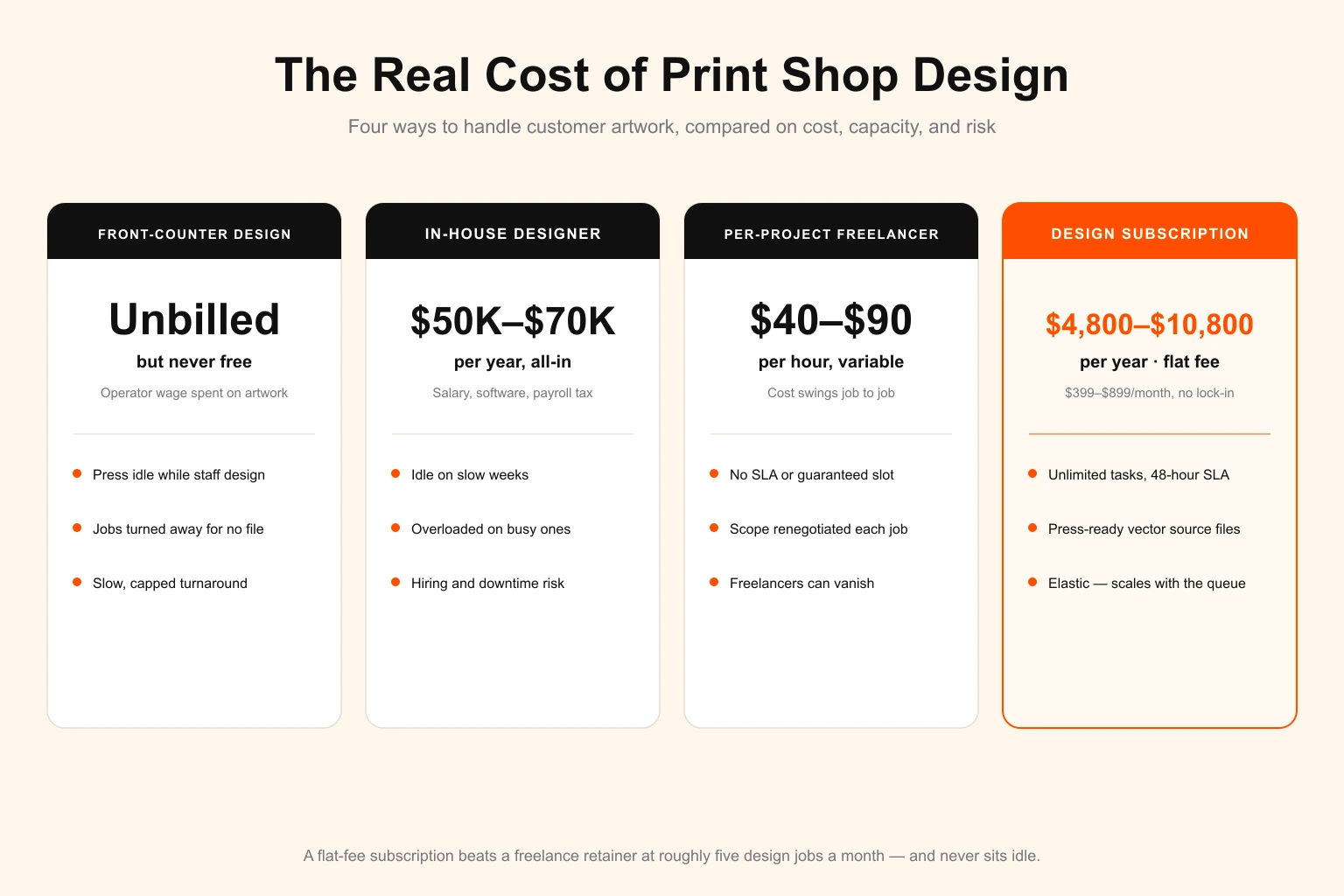
Now weigh the staffing alternative. A full-time junior designer in the US runs roughly $45,000–$60,000 a year in salary, before software licences, a workstation, payroll tax, and the cost of paying them through every slow week. A flat-fee subscription runs $399–$899 a month — and it never sits idle.
| Approach | Annual cost | Capacity | Risk |
|---|---|---|---|
| Front-counter / press operator does design | "Free" — but lost press time + turned-away jobs | Capped, blocks production | Slow turnaround, operator burnout |
| Full-time in-house designer | $50,000–$70,000 all-in | Fixed — idle on slow weeks, overloaded on busy ones | Hiring, payroll, downtime cost |
| Per-project freelancer | $40–$90/hr, unpredictable | Depends on their availability | No SLA, scope renegotiation, vanishing freelancers |
| Flat-fee design subscription | $4,800–$10,800 | Elastic — scales with the queue, not headcount | Predictable; cancel anytime |
For any shop that isn't running a genuine, constant, full-day design load, the subscription wins on cost and on flexibility. You stop paying for idle time and you stop turning away artwork jobs.
How a Design Subscription Fits a Print Shop's Workflow
The model only works if it slots cleanly into how a print shop already operates. It does — because the subscription becomes a back-office step the customer never sees.
Here is the workflow in practice:
- Customer brings a job. They want it printed. Their file is missing, broken, or never existed.
- The shop briefs the design service. You forward what the customer gave you, plus the print specs — final size, stock, finishing, bleed requirement, colour mode. With DigitalPolo this is a plain email; there is no portal for your counter staff to learn.
- The artwork comes back press-ready. A vector file, built to your specs, with bleed and crop marks where you asked for them.
- The shop preflights and prints. The file drops into your normal RIP and preflight process without a rebuild.
- The customer gets the finished print — and, optionally, a design line item on the invoice.
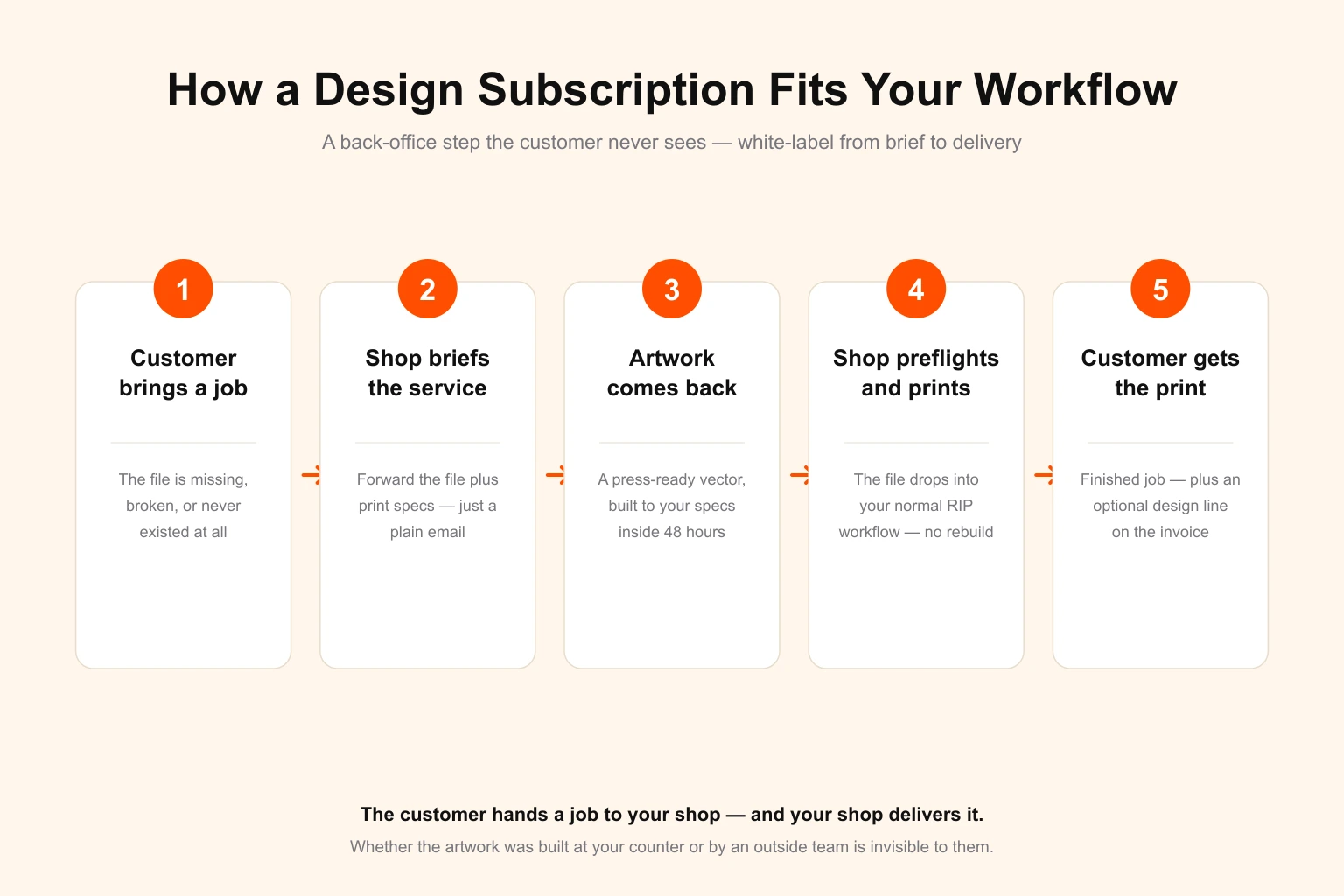
The customer experience never changes. They handed a job to your shop and your shop delivered it. Whether the artwork was built at your front counter or by an outside design team is invisible to them — which is exactly the point of the white-label model.
This is also why an email-based service suits print shops specifically. Your counter staff are not designers and should not have to learn a project-management platform to forward a customer file. If briefing the design service is harder than briefing your own press, it won't get used. A walkthrough of how the model is structured end to end is in our guide to how a design subscription actually works.
Turn Design Into a Profit Line, Not a Cost
The defensive case for outsourcing design is "stop losing money on artwork." The offensive case is better: design becomes something a print shop sells.
Once you have reliable, predictable artwork capacity, you can quote design openly. A customer with no file is no longer a problem job — it's a higher-value order. Charge a design fee, mark it up over your flat subscription cost, and keep the spread. Because the subscription price is fixed no matter how many jobs you route through it, every design job after the first one or two each month is pure margin.
This is the reseller play, and DigitalPolo allows it explicitly on both plans. The shop owns the customer relationship, presents the finished artwork under its own name, and the design provider stays invisible. A shop running 15–20 design jobs a month on a $399 plan is paying roughly $20–$27 per job in design cost while billing the customer $75, $150, or more. The detail of the white-label and reseller setup — what's allowed, how shops price it — is covered in our white-label design overview, and the print-trade specifics live on the page for print shops and printers.
The shops that win here stop thinking of themselves as printers who reluctantly do artwork, and start offering "design and print" as one service. The subscription is what makes that offer profitable instead of a staffing headache.
What Print Shops Should Demand From a Design Service
Most design subscriptions were built for digital marketing teams — social posts, ad creative, web graphics. A print shop has different, non-negotiable requirements. Before committing, confirm the service delivers all of the following:
- True vector source files. AI, EPS, and layered print-ready PDF — not flattened JPGs or PNGs. If the file can't be opened and adjusted, it's not press-ready.
- Correct bleed, crop marks, and CMYK. The artwork should arrive built to print specs, not converted from an RGB web file at the last minute.
- Logo vectorising. Redrawing a low-resolution customer logo cleanly is one of the most common print-shop artwork tasks. The service must do it well.
- Wide-format competence. Banners, signage, posters, and vehicle graphics are built differently from a business card. The designers should understand large-format scale, resolution, and tiling.
- Reseller / white-label rights in writing. You are selling this work to your customers. Make sure the terms allow it.
- A turnaround you can build a promise on. A 48-hour SLA lets you quote a realistic print date. An open-ended "we'll get to it" does not.
DigitalPolo delivers print-ready files — vector source files in AI, EPS, and PDF with correct bleed and CMYK on request — making it a fit for the artwork a print shop actually sees. The same file standard also covers adjacent print verticals a shop may already serve: our guides on design for sticker businesses and vehicle wrap design go deep on those specs.
Who This Works Best For
Strong fit:
- Commercial and digital print shops with steady but unpredictable artwork demand.
- Sign and banner shops handling wide-format jobs where customers rarely supply usable files.
- Print brokers and trade printers who want to add design as a sellable service.
- Copy and quick-print shops fielding constant small-business artwork requests.
- Shops that have lost orders specifically because a customer couldn't provide a print-ready file.
Weaker fit:
- High-volume production printers running a genuine full-day, every-day design load — a dedicated in-house designer may be justified at that scale (though the Soulmate plan's dedicated team often still covers it).
- Shops whose customers nearly always arrive with finished, press-ready files — though even these usually have more preflight rework than the owner expects.
If your shop sits anywhere in the broad middle, the subscription is the lowest-risk way to add design capacity. For a wider comparison of services and plan tiers across the category, see our breakdown of the best design subscriptions for small business.
DigitalPolo Plans and Pricing
| Plan | Price | Turnaround | Delivery | Best For |
|---|---|---|---|---|
| Partner | $399/month | 48 hours | Unlimited tasks, vector source files (AI, EPS, PDF) with bleed and CMYK on request | Single-location print, sign and copy shops; brokers adding design as a service |
| Soulmate | $899/month | 24 hours (priority) | Dedicated team, 24×7 support, all source files | High-volume shops, multi-location printers, trade printers reselling design at scale |
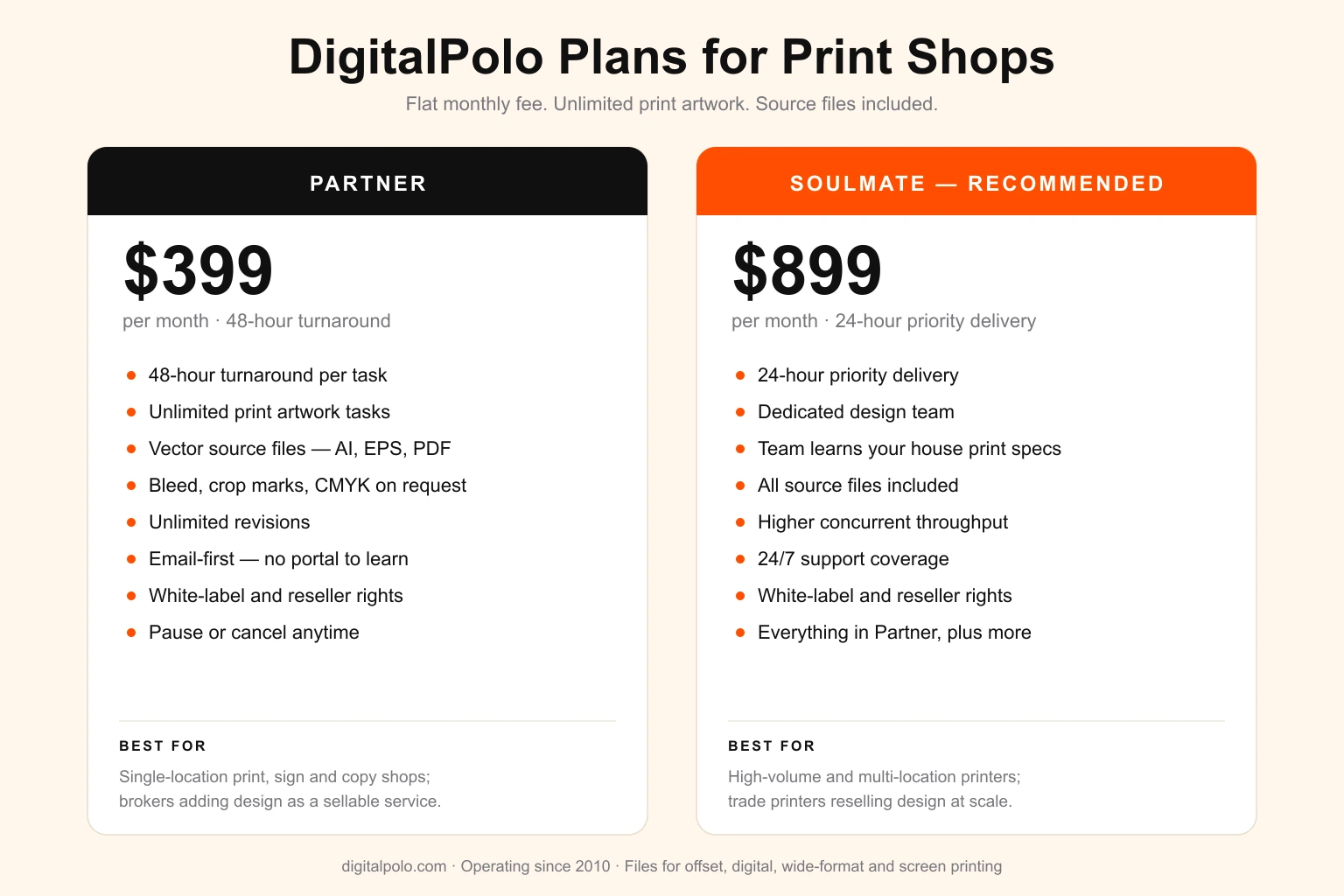
Both plans include delivery of all source files — vector formats (AI, EPS, PDF) suitable for offset, digital, wide-format, and screen print production, supplied with correct bleed and colour mode on request. The Soulmate plan's dedicated team is the right choice for a print shop with enough volume that one or two designers should learn your house specs, your repeat customers' brand standards, and your preferred file setup.
See Digital Polo's full pricing →
Frequently Asked Questions
Can a design subscription handle a print shop's client work?
Yes. A print shop can route any customer job that needs artwork — a customer with no file, a bad file, or a file that fails preflight — to a flat-fee design subscription and get back a press-ready vector. DigitalPolo's Partner plan covers unlimited print artwork at $399/month, with all source files included. It functions as an outsourced art department the shop never has to staff or manage.
How much does it cost a print shop to outsource design?
DigitalPolo charges a flat $399/month for the Partner plan and $899/month for the Soulmate plan. There is no per-job or per-hour billing, so a print shop can fold the cost into its pricing as a fixed overhead line rather than quoting design separately on every order. At even five design jobs a month the subscription costs less than a single freelance retainer.
Is it cheaper to hire an in-house designer or use a design subscription?
A full-time junior designer in the US costs roughly $45,000–$60,000 a year in salary alone, plus software, equipment, payroll tax, and downtime between jobs. A design subscription runs $399–$899 a month — about $4,800–$10,800 a year — with no idle cost. For most print shops below a constant daily design load, the subscription is far cheaper and carries no hiring risk.
Can a print shop white-label or resell outsourced design work?
Yes. DigitalPolo explicitly allows white-label and reseller use on both plans. A print shop can present the finished artwork to its own customer under the shop's name, mark up the design as a line item, and keep the margin. The customer never sees or contacts the design provider — the shop owns the relationship.
What file formats does DigitalPolo deliver for print production?
Every completed task includes the source files — vector formats (AI, EPS, print-ready PDF) suitable for offset, digital, wide-format, and screen printing. Files can be supplied with correct bleed, crop marks, and CMYK colour mode on request, so they drop straight into a print shop's preflight and RIP workflow without rebuilding.
How fast does a print shop get design work back?
The Partner plan delivers each task within 48 hours of a clear brief; the Soulmate plan delivers within 24 hours on priority. Simple jobs — a business card laid out from supplied text, a flyer resize, a logo vectorised — often come back same day, fast enough to keep a normal print turnaround promise to the end customer.
What types of print design can the service handle?
Business cards, flyers, brochures, posters, banners, signage, packaging and label artwork, stickers, vehicle wrap layouts, menus, booklets, trade-show graphics, and direct mail — plus logo design and vectorising low-quality customer logos. It covers essentially every artwork job that walks into a print shop, excluding video, 3D, and animation.
Verdict: The Lowest-Risk Way to Add Design Capacity
A print shop does not need to own a design department. It needs reliable, fast, press-ready artwork on demand — and it needs that capacity to scale with a lumpy, unpredictable workload without carrying a salary through the slow weeks.
A flat-fee design subscription delivers exactly that. It turns the job that used to lose money — the customer with no usable file — into a job the shop can confidently take, and often sell design on. DigitalPolo's Partner plan at $399/month suits a single-location print, sign, or copy shop comfortably. The Soulmate plan at $899/month fits higher-volume and multi-location shops, or trade printers reselling design at scale, where a dedicated team should internalise the shop's house specs and repeat-client standards.
Against the alternatives — unbilled operator time, a $50,000-plus hire, or an unreliable freelancer — the math is not close. The subscription is cheaper, more flexible, and removes the bottleneck that quietly caps how much work a print shop can take.
Need Press-Ready Design Files Without the Hiring Hassle?
DigitalPolo delivers vector source files (AI, EPS, PDF) with every task — built for offset, digital, wide-format, and screen print production, with correct bleed and CMYK on request. White-label and reseller use included as standard. Partner plan from $399/month. 48-hour turnaround. Unlimited revisions.
- See Digital Polo plans and pricing →
- Book a free 15-minute call →
- See the design workflow built for print shops and printers →