
The Blog

Design insights from the Digital Polo studio

Page 2 of 16

Overhead arrangement of blank, unbranded exhibitor collateral — rolled fabric backwall panel, retractable banner cassette, table runner, folded one-pagers, badge holder and tote — laid out on a warm cream surface

The Trade Show Asset Checklist: Every Graphic You Need, With Lead Times and the Deadlines That Actually Govern

Exhibitor checklists tell you to bring business cards and comfortable shoes. None of them tell you that your real artwork deadline is set by the show's advance warehouse cutoff rather than by your printer — and that it usually lands weeks earlier than you think. This is the exhibitor-side asset list: every graphic a booth needs, production lead times by display system, the artwork specs each system demands, and the two independent deadline stacks you have to schedule against.


Six plain unmarked keys on a warm cream surface, two of them threaded together on a small ring and the other four lying loose and unattached, with a plain sealed envelope at the edge of frame

What a Client Actually Owns After a Logo Project

Paying the invoice does not transfer the copyright, and the copyright is only one of six things you either hold or do not hold when a logo project ends. This is the full picture: what vests in whom by default, why the work-for-hire clause in your contract probably does not work, why your wordmark may have no copyright to own at all, the fonts and stock elements that never transfer, what an AI-generated mark does and does not protect, the complete file manifest a real handover contains, and how to audit and fix what you already have.

Overhead view of a warm cream desk with several stacks of blank unmarked documents, some crisply squared and some slumped and misaligned, suggesting a document estate that has drifted out of order

Onboarding and HR Document Systems: The Part Nobody Owns

Every guide to onboarding documents is a compliance checklist telling you which forms must exist. None of them tell you what happens next: that a mid-sized company is carrying sixty to ninety separate HR documents, that the number that breaks you is versions rather than documents, that nobody in the org chart actually owns the artefact, and that a handbook nobody reads is a weaker piece of legal evidence than one they do. This is the production side — the real inventory, the version math, the three-tier template system, the accessibility requirement nobody budgets for, and what a rebuild costs three different ways.

Editorial photograph of a long receding row of identical blank posters in matching brass frames along a warm cream wall, with one smaller hand-cut sheet taped crookedly to the wall between them, unframed and curling at the corner

Brand Compliance at Scale: How to Stop 40 Locations Designing Their Own Posters

Locations do not go off-brand because they ignored the guidelines. They go off-brand because the approved poster did not exist on the Thursday they needed it. This is the supply-side fix — the thresholds where governance breaks, the local request inventory, the three-tier template model, the turnaround maths that makes compliance the path of least resistance, and how to measure whether any of it worked.

Overhead editorial view of a large format print studio bench — blank cream, sage and terracotta print samples in graduated sizes fanned across a warm surface beside a loupe, a steel rule and a roll of unprinted banner media

Resolution for Large Format: DPI by Print Size and Viewing Distance

The complete resolution specification for large format print — why 300 DPI is wrong above a certain size, the acuity maths that produces the real number, effective resolution and the scaling trap that causes most failures, working at scale, the file size ceiling that makes a 300 DPI billboard physically impossible, and the substrate limits that cap resolution no matter what you supply.

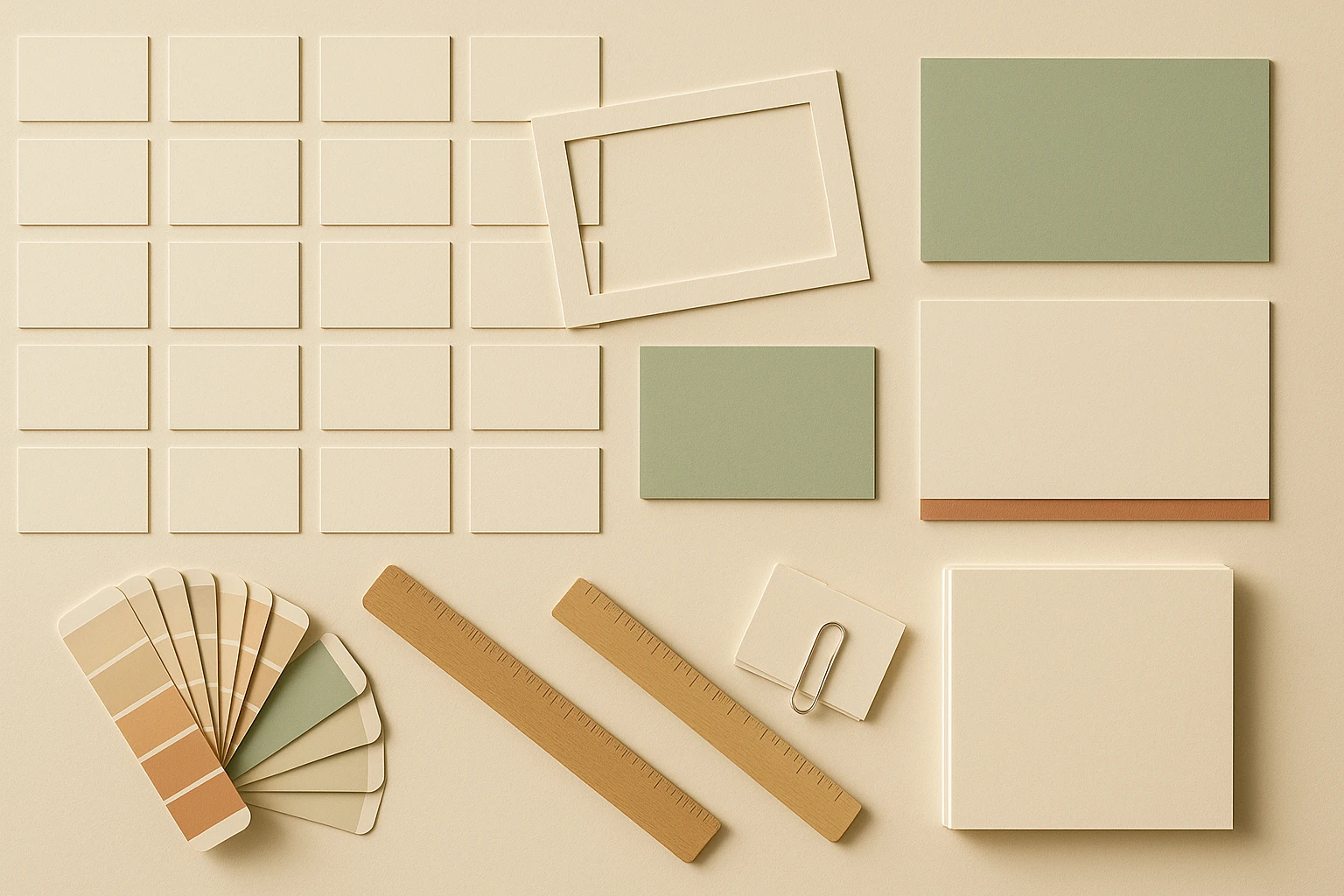
Overhead editorial flat lay of a blog image production desk — a grid of blank printed cards in identical proportions, three larger blank cards set apart, a paper crop frame, a colour swatch fan and a plain ruler on a warm cream surface

Featured Images for 40 Blog Posts a Month: Template System vs Bespoke

Publishing 40 posts a month makes the featured image a production line, not a design decision. This is the arithmetic behind template systems and bespoke artwork, the three-tier model that beats both, the rule for deciding which post gets which tier, the master canvas and crop-safety specs, and the governance that stops a template system rotting in six months.

Overhead editorial flat lay of a vetting desk — a printed checklist, an unsigned agreement, colour swatch fans, a loupe over a printed proof sheet and a folded garment sample, all blank and unbranded, on a warm cream surface

How to Vet a White-Label Design Partner: The Twelve Questions, and the Red Flags

Every guide to choosing a white-label design partner gives you seven or ten questions and stops there. That is the easy half. The hard half is knowing what a good answer sounds like, what a rehearsed answer sounds like, and which single bad answer should end the conversation. This is the twelve-question vetting protocol, the leak surfaces nobody checks, the paid pilot that actually reveals competence, and the scorecard for comparing partners without kidding yourself.

Overhead flat lay of blank unbranded business surfaces — letterhead, folder, business cards, mug, tote, polo shirt, folded carton and signage panel — arranged on a warm cream surface

The Rebrand Rollout Inventory: Everything Still Carrying Your Old Logo

Every rebranding checklist you can find is a phase plan — research, strategy, identity, launch. None of them answer the question that actually sinks rebrands: where is the old logo, exactly, and who controls each place it lives? This is the surface-by-surface inventory, the discovery methods that find the assets nobody remembers, the sequencing matrix that decides what changes on day one, and the long tail that keeps surfacing eighteen months after launch.

Overhead arrangement of blank event collateral — folded programme, delegate badge and lanyard, table tent, rolled banner, signage panel and tote — laid out on a warm cream surface

The Event Organiser's Production Timeline

Every event planning timeline you can find schedules venue, catering, AV and registration — and treats design as a single line item called 'branding'. But the artwork half is the half with immovable deadlines, because fabric takes fourteen days to print and a stage set takes eight weeks. This is the countdown built backwards from doors-open: lead times by asset class, the three lock dates that are not the same date, why sponsors blow the print deadline every time, and what physically cannot be changed once it is made.

WhatsApp
WhatsApp$399/mo