

Somewhere in your company there is a folder called HR, and inside it there is a document called Employee Handbook FINAL v3 (updated) COPY.docx.
Nobody is certain it is the current one. The version that new hires actually receive is a PDF, exported from something, sitting in an onboarding tool that HR set up two years ago. The parental leave section in that PDF describes a policy that changed last March. The offer letter template lives in someone's Google Drive. The IP assignment agreement is a Word file that Legal owns and has never seen laid out. There are two versions of the org chart and both are wrong. And when the company rebranded eighteen months ago, every single one of these documents was missed, because the rebrand asset inventory covered the website, the deck and the business cards, and nobody thought of the paperwork.
This is not a story about a badly run company. This is the normal condition of HR documentation at almost every organisation between fifty and a thousand people, and it persists for a specific structural reason that is worth naming immediately, because it explains everything that follows.
HR documents are the only document class in a company that is simultaneously legally binding, emotionally formative, and completely unowned.
Marketing owns the brand. Legal owns the contract language. IT owns the systems the files sit in. Finance owns the numbers inside them. But nobody owns the artefact — the actual laid-out, versioned, distributable object that a human being opens on their first morning. It falls between four departments, each of which reasonably believes it is somebody else's job, and so it is maintained by accretion: whoever needs a change makes a copy, edits the copy, and sends the copy.
Two years of that produces a document estate rather than a document system. The difference is that an estate has no single source of truth, and a system does.
Why every guide to this is a compliance checklist
Search "onboarding documents" and the results are remarkably uniform. Ten documents you need. Eighteen must-have documents. Twenty-one essential forms. I-9, W-4, state withholding, direct deposit authorisation, emergency contact, handbook acknowledgment, benefits enrolment. The AI Overview at the top of that search assembles the same list from three of them.
Look at who publishes these. Paylocity. Paycom. HiBob. AIHR. Indeed. Rippling. Gusto. They are payroll processors, HRIS vendors and job boards, and they are writing about the problems their products solve: collection, storage, e-signature routing, compliance tracking. The article exists to establish that onboarding paperwork is complicated, immediately before explaining that software makes it less so.
None of that is wrong. It is also answering a question almost nobody past their first hire is still asking.
Because the compliance checklist has a hard ceiling: it tells you which documents must exist, and it says nothing whatsoever about what state they must be in. It does not tell you how many versions of each you are carrying. It does not tell you who maintains them. It does not tell you what happens to a handbook's evidentiary value when it is unreadable. It does not tell you that the I-9 is a federal form you must not redesign while the handbook is a document you own completely. It does not tell you what any of it costs to build or maintain.
That is the gap this article is in. Not which documents — you can get that from any of the twenty pages above — but the estate: how big it actually is, why the version count breaks before the document count does, how to structure it so a policy change is not a reprint, what the accessibility floor is, who has to own it, and what a rebuild costs three different ways.
If you have already read the employer brand asset kit, this is the document that picks up where it stops. That one covers everything you produce to attract a candidate. This one starts the moment they sign, and it is a substantially less glamorous and considerably more legally consequential body of work.
The real inventory: six layers, not one checklist
The checklists undercount by a factor of three to five, because they only count what a new hire signs in week one. The actual estate spans the entire employment lifecycle, and most of it is invisible until you go looking.
Here is what is really in there, in six layers.
Layer 1 — Pre-employment and offer. Offer letter templates, usually three to six variants by seniority and employment type. Employment agreements. Contractor and consultancy agreements. Background check consent. Reference request forms. Relocation and sign-on bonus agreements with their repayment clauses. Pre-start welcome pack.
Layer 2 — Statutory and payroll. Form I-9 and its retention file. W-4 and state equivalents. Direct deposit authorisation. Benefits enrolment forms and the summary plan descriptions behind them. State-mandated notices, which vary sharply — California's Wage Theft Prevention Act notice, New York's equivalent, city-level sick leave notices. Workers' compensation notices. These are largely fixed federal or state templates. You must not redesign them. They are the one part of the estate where the correct design decision is to leave it entirely alone and simply ensure the correct current version is the one being served.
Layer 3 — Policy and governance. The employee handbook. The code of conduct. The individual policy documents behind the handbook: anti-harassment, equal opportunity, leave, remote and hybrid working, expenses and travel, acceptable use and IT security, social media, data protection, conflicts of interest, whistleblowing, health and safety, drug and alcohol. Confidentiality and IP assignment. Restrictive covenants where enforceable.
Layer 4 — Onboarding experience. The welcome pack and day-one guide. The 30-60-90 plan template. Org charts and team directories. Systems and tools guide. Benefits explainer — distinct from the enrolment forms, and the single most under-designed high-value document in most companies. Glossary of internal terms and acronyms. Office and facilities guide. Manager's onboarding checklist. This layer is the handover point into ongoing internal communications, and the two estates should share one template system rather than evolving separately.
Layer 5 — Ongoing lifecycle. Performance review forms and rating frameworks. Objective-setting templates. Promotion and compensation change letters. Internal transfer documentation. Training and certification records. Disciplinary and grievance process documents with their letter templates. Return-to-work and accommodation request forms.
Layer 6 — Exit. Resignation acknowledgment. Termination letters by category. Final pay statements. Benefits continuation notices. Exit interview forms. Return-of-property checklists. Reference policy. And the one that consistently costs real money when it is missing: the asset, access and licence handover schedule — the document that establishes what the leaver had, what they must return, and what they must not take. If your departing designer is walking out with the only copy of your master brand files, that is a document failure, not a personnel failure.
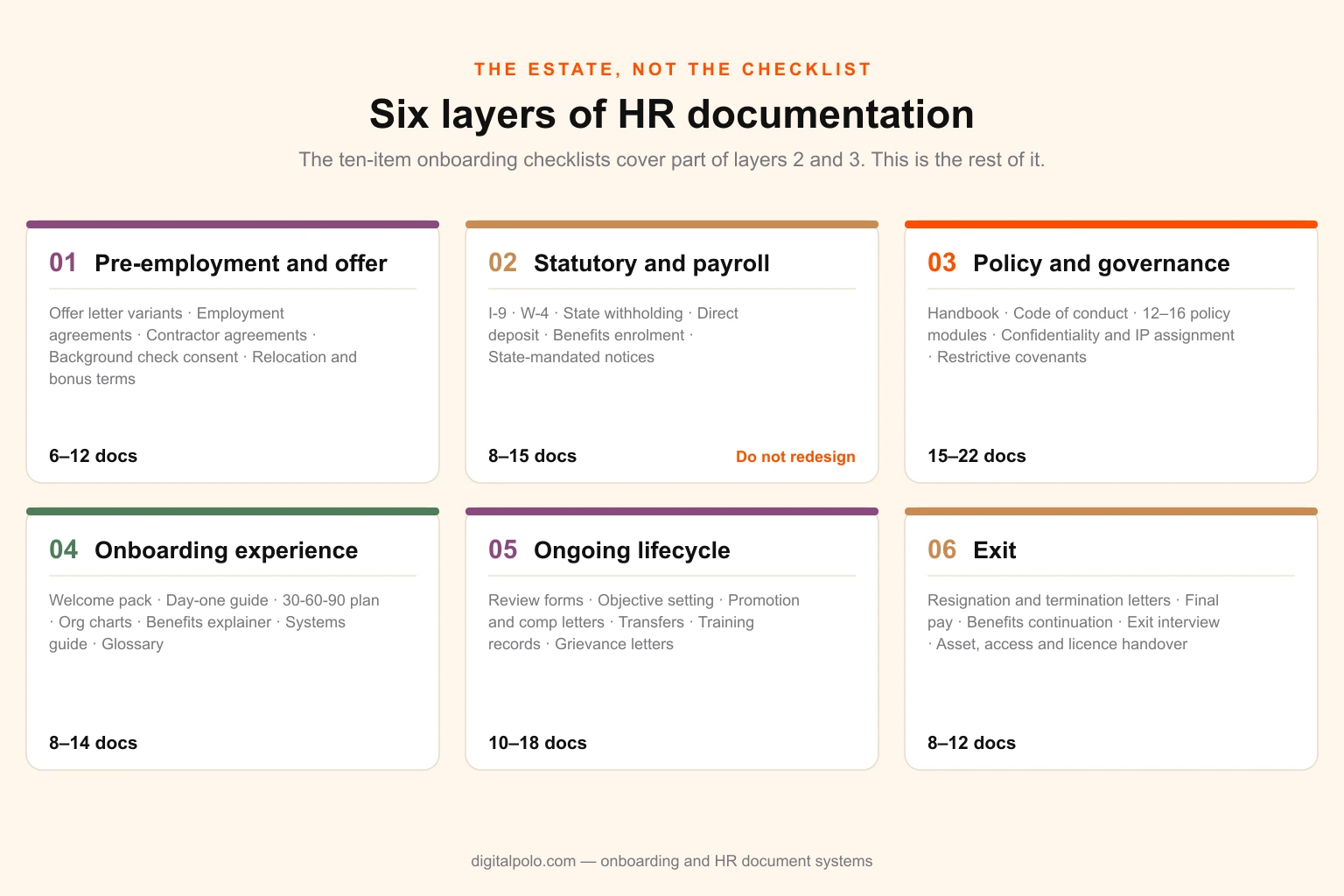
Count that honestly for your own company. Nearly everyone lands well past sixty.
The number that actually breaks you is versions, not documents
Here is the calculation nobody in the search results performs.
A document count is a static figure. It tells you how much you have to build once. The number that determines whether your estate stays coherent is the live version count — every distinct artefact that has to be simultaneously correct, current and findable.
The multipliers are these:
- Jurisdiction. Employment law is state-level in the US and country-level everywhere else. A handbook covering four states is not one handbook with four paragraphs; it is typically one core plus four state supplements, each with its own revision trigger.
- Legal entity. Two entities means two sets of signing documents, two letterheads, two registered addresses, two sets of contract templates.
- Employment class. Full-time, part-time, fixed-term and contractor populations need genuinely different agreement sets, and often different handbook scopes.
- Language. Any workforce with a material non-English-speaking population needs translated policy documents, and translation is a versioning problem before it is a linguistic one — every source revision orphans every translation.
- Revision cycle. Each live version has an annual review plus out-of-cycle legislative changes.
Work an example. A 250-person company, two entities, operating across four states, with a Spanish-speaking population in two of its sites:
The handbook alone is one core document × 4 state supplements × 2 entities = 9 artefacts, then × 2 languages = 18. The offer letter is 4 seniority variants × 2 entities = 8. The policy set is roughly 14 policies, of which perhaps 6 carry state variance: 8 + (6 × 4) = 32, doubled for language on the employee-facing ones. Add the lifecycle and exit layers.
You are maintaining somewhere between 180 and 240 live artefacts with a nominal document count of about seventy.
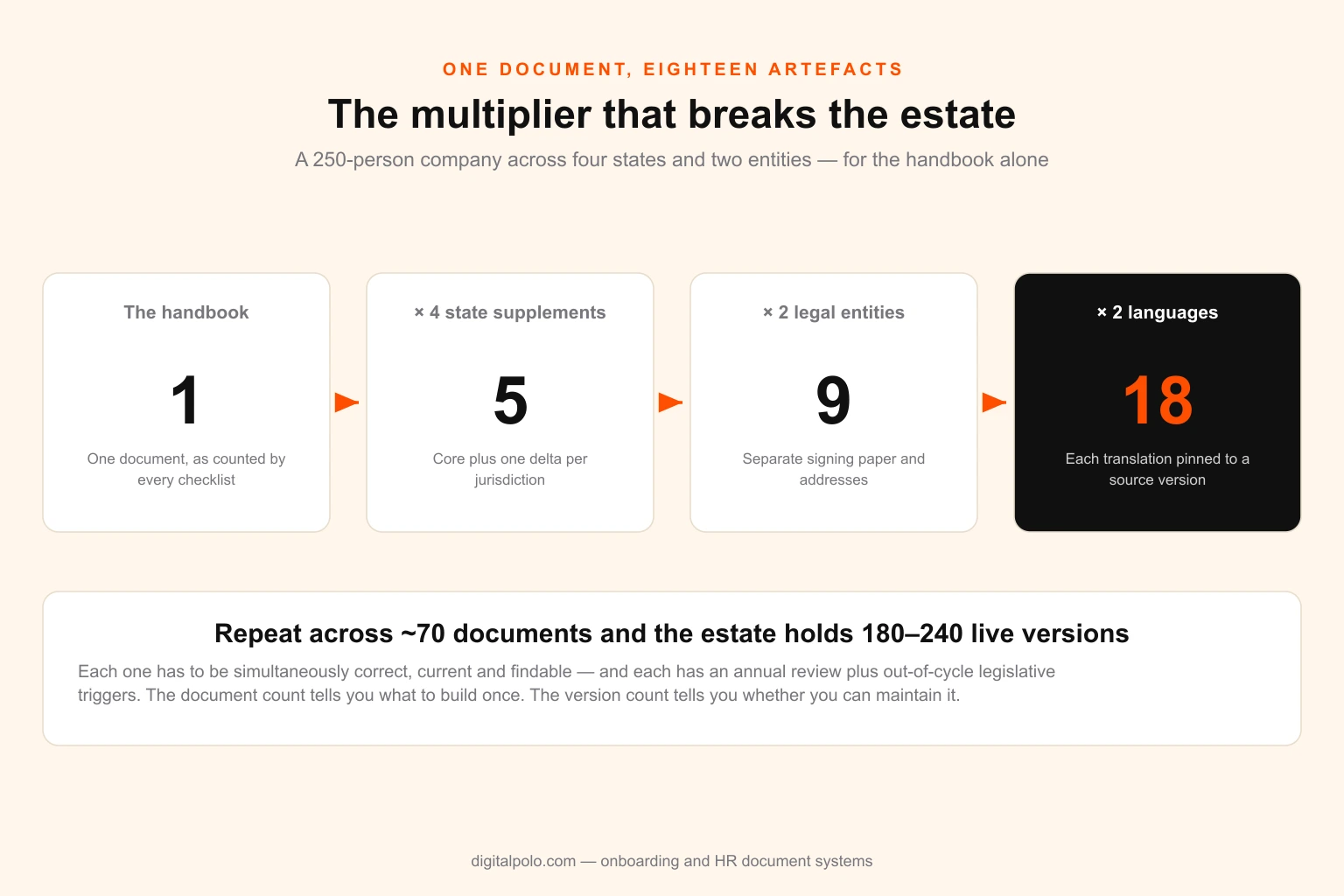
That is the number that explains the folder full of FINAL v3 COPY. No individual is negligent. The estate simply exceeded, quietly and without anyone noticing the threshold, the point at which it could be maintained by hand.
| Company profile | Discrete documents | Live versions | Annual revisions | Realistic maintenance load |
|---|---|---|---|---|
| 25 people, 1 state, 1 entity | 30–40 | 35–45 | 4–8 | A few days a year |
| 50 people, 2 states | 35–50 | 55–75 | 8–14 | ~1 week a year |
| 250 people, 4 states, 2 entities | 60–90 | 180–240 | 20–35 | 3–5 weeks a year |
| 1,000 people, multi-country | 120–180 | 400–600+ | 50–80 | A named full-time role |
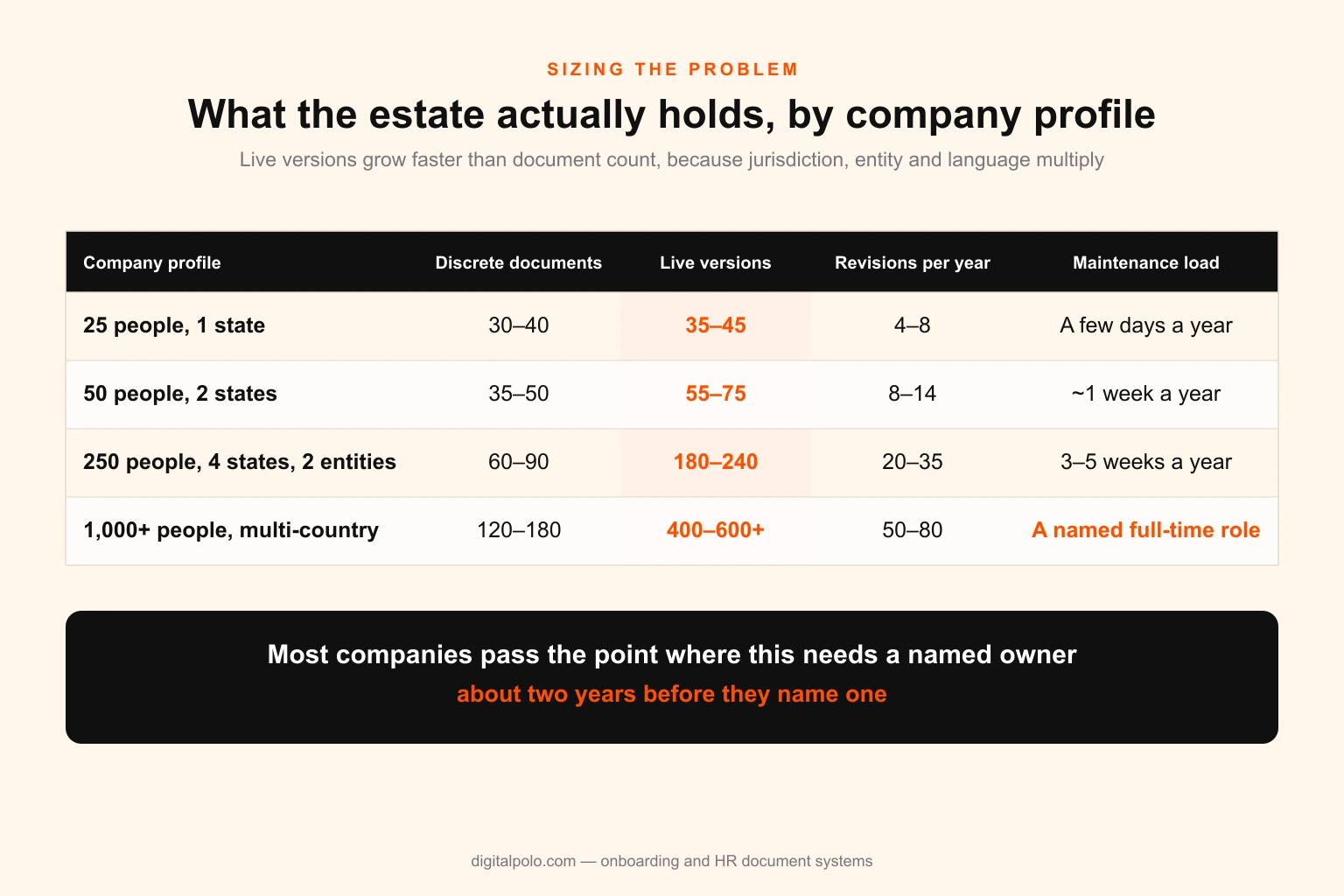
The maintenance column is the one to sit with. Most companies pass the point where this is a named responsibility roughly two years before they name it.
The three-tier system that keeps it from rotting
The instinct, on seeing a number like 200, is to standardise everything onto one template. That is the wrong move, and it fails for a reason worth understanding: the documents in an HR estate have fundamentally different owners, revision cycles and risk profiles, and forcing them into one system means the most constrained document dictates the treatment of all the others.
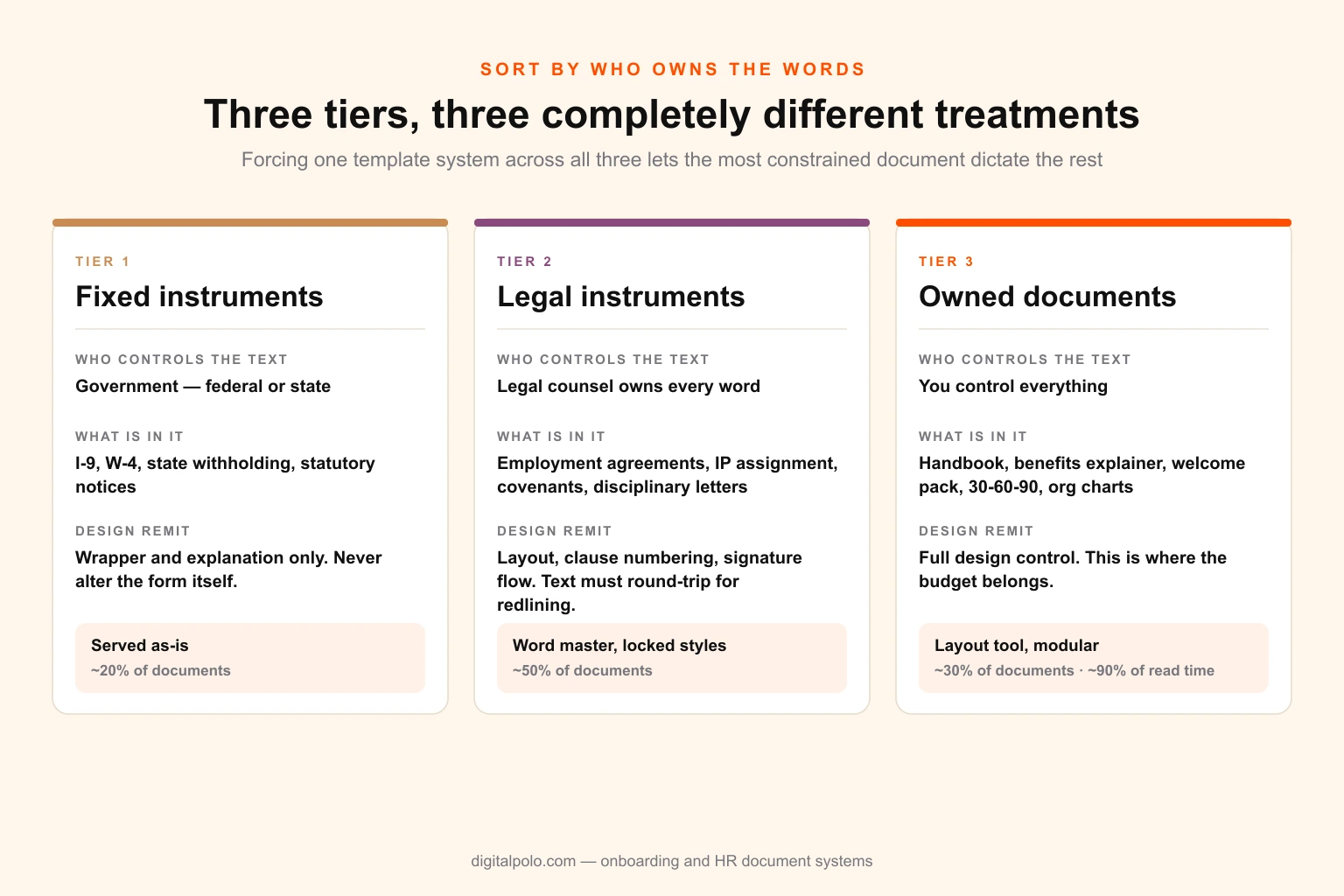
Sort them into three tiers instead, defined by who controls the text.
Tier 1 — Fixed instruments: do not touch
Federal and state forms. I-9, W-4, state withholding, statutory notices. The correct treatment is a wrapper and nothing else: a cover sheet in your typography that explains what the form is, why it is needed and how to complete it, followed by the unaltered official form. Redesigning the form itself ranges from pointless to non-compliant.
The only genuine design work in Tier 1 is the explanation around it, and it is worth doing. Most of the friction and error in onboarding paperwork comes from people not understanding what a W-4 allowance actually does, not from the form's layout.
Tier 2 — Legal instruments: text locked, layout owned
Employment agreements, IP assignment, restrictive covenants, disciplinary letters. Legal controls every word. Design controls legibility, structure and signature flow, and that is a real remit: clause numbering that survives amendment, defined-term treatment, signature blocks that are unambiguous about who signs what, page furniture that makes a 14-page agreement navigable.
The critical constraint is that these documents must round-trip to Legal for redlining. That means the master lives as text in Word or Google Docs, and the designed output is generated from it — never the reverse. The moment a designer is hand-typesetting clause changes into a layout file, you have created a document that Legal cannot amend and that will silently diverge from the approved language. That is a genuine liability, not a workflow annoyance.
Tier 3 — Owned documents: full design control
The handbook. The benefits explainer. The welcome pack. The 30-60-90 plan. Org charts. The onboarding guide. Performance frameworks. Nobody outside the company constrains these. They are the documents an employee actually reads, they carry the entire experience of what it is like to work here, and they are — almost universally — the ones that receive the least design attention, because they are not the ones that feel legally urgent.
This is where the money should go. It is roughly 30 per cent of the document count and close to 90 per cent of the read time. The craft problem is the same one that governs any long-form informational document: holding a reader through dense, obligatory material that they did not choose to read.
The tiering also solves the tooling argument that consumes so much time in these projects. Tier 1 is served as-is. Tier 2 lives in Word with a locked style set. Tier 3 lives in a proper layout tool. You stop trying to find one tool that does all three well, because there isn't one.
The structural mistake: one file instead of a modular set
Most handbooks are a single document containing every policy. It is the obvious way to build it and it is the reason the estate degrades.
When the anti-harassment policy is section 7 of a 62-page file, changing that policy means reissuing the entire handbook, reflowing every page after it, re-exporting, redistributing, and — this is the expensive part — running a fresh acknowledgment round across the whole company for a change that affects two pages.
The result is entirely predictable: companies avoid updating handbooks because updating is expensive, and the estate goes stale for structural reasons rather than negligent ones.
Build it modular instead. Each policy is a self-contained laid-out module with its own version number and effective date. The handbook is an assembly of modules plus its narrative connective tissue. A policy change is then a module revision, a reassembly, and a targeted acknowledgment naming exactly what changed.
This is the same architectural principle behind a component-based design system rather than a static style guide — the value is not the individual pieces but the fact that one can be replaced without disturbing the others. HR documentation needs it more than most brand systems do, because it is revised more often and the cost of a stale version is legal rather than aesthetic.
Three things make modularity work in practice:
- Every module carries its own version block — version number, effective date, owner, next review date — in a fixed position. Not in a document properties field nobody opens. Printed, visible, on the page.
- The contents page is generated, not typed. A hand-typed contents page is a guaranteed future inconsistency.
- Cross-references are by policy name, never by page or section number. Page numbers change on every reflow, and stale internal references are the most common defect in a revised handbook.
Format specifications, document by document
Three outputs, one source. The most common production error is treating them as three documents rather than three renderings, which is how the PDF ends up saying something the Word master does not.
| Document class | Master format | Distributed as | Signature method | Print requirement |
|---|---|---|---|---|
| Statutory forms (I-9, W-4) | Official source, unmodified | Current official PDF | Wet or compliant e-sign | On demand only |
| Employment agreements | Word, locked styles | Tagged PDF | E-sign with anchor fields | Archive copy |
| Handbook | Layout tool, modular | Tagged PDF + web version | Separate acknowledgment | Rarely — on request |
| Policy modules | Layout tool | Tagged PDF, individually addressable | Acknowledgment where required | No |
| Benefits explainer | Layout tool | Tagged PDF | None | Sometimes, for home delivery |
| Welcome pack | Layout tool | PDF, and often physical | None | Yes — real print specs |
| Offer letters | Templated merge | E-sign | No | |
| Org charts | Layout or diagramming tool | PDF and image | None | Sometimes large format |
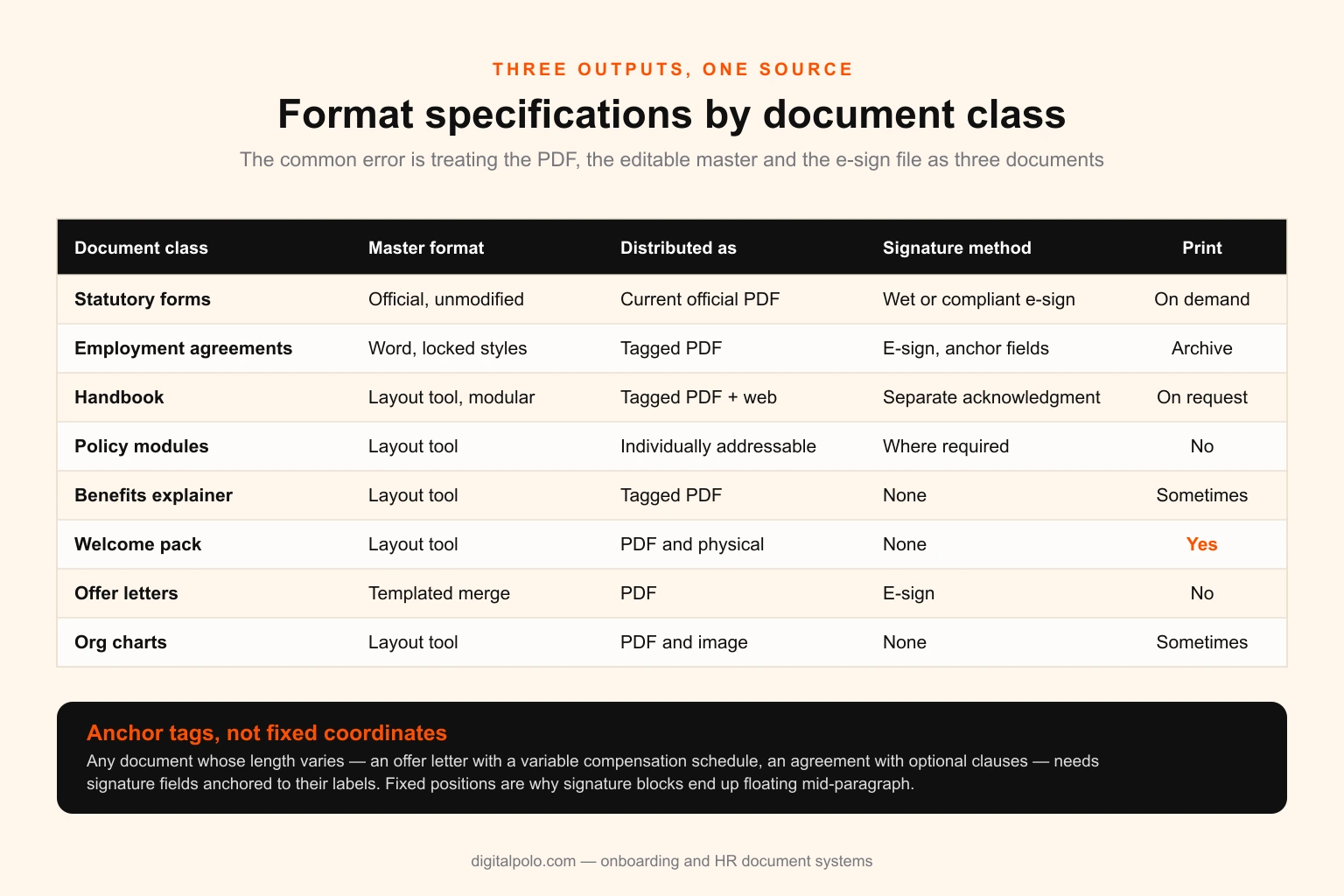
Four specification details carry most of the practical failures.
E-signature field preparation is a design task, and it is almost never briefed as one. Signature, date and initial fields need to be positioned deliberately, and on any document whose length varies — an offer letter with a variable-length compensation schedule, an agreement with optional clauses — they need anchor tags rather than fixed coordinates, so the field follows its label when the text reflows. Fixed-position fields on a variable-length document is the mechanism behind every signature block that ends up floating in the middle of a paragraph. Leave 25mm of clear space below every signature line, and never let a signature block break across a page.
Print specifications apply to fewer documents than people assume, and matter more on those. The welcome pack is the one document in the estate that is genuinely a print artefact, and it deserves proper treatment: bleed, correct colour space, real paper stock. If it is being produced physically, it should go through the same print-ready file checklist as any other production job, because a welcome pack that arrives with a visible white edge from a missing bleed is a poor first impression that costs the same to avoid as to make.
Fonts must be licensed for PDF embedding. This is a genuine and routinely overlooked exposure. A desktop font licence usually permits embedding in a document for viewing and printing, but the terms vary by foundry and some restrict distribution volume or require a separate licence for documents distributed outside the organisation. An employment agreement sent to every candidate is a distributed document. Check the licence before it is embedded in three hundred contracts — the same discipline that applies to font licensing on any distributed asset.
Filename conventions are part of the specification. Handbook_v4.2_2026-03-01_US-CA.pdf is a document you can audit. Employee Handbook (final).pdf is not. This sounds trivial. It is the difference between being able to answer "which version did this person sign in March 2024" in thirty seconds and not being able to answer it at all.
The accessibility requirement nobody budgets for
This is the section most companies wish they had read two years earlier.
An employee handbook is not marketing material. It is a document that every employee is required to receive, read and acknowledge, which means it must be usable by every employee — including those using screen readers, those with low vision, and those with cognitive or reading disabilities. A flat, untagged PDF fails all three, and unlike a marketing page, there is no argument that the affected person could simply go elsewhere.
The working standard is PDF/UA (ISO 14289) together with WCAG 2.2 at AA. In practice that means:
- Tagged structure with a correct reading order. Not visually correct — logically correct. A two-column layout that reads across rather than down is a common and completely invisible failure.
- Real heading hierarchy. H1 through H3 as actual structural tags, not text styled to look like headings. This is what lets a screen reader user jump to the harassment reporting procedure instead of listening to forty pages.
- Alt text on every diagram, chart and org chart. An org chart delivered as a flat image with no alternative text conveys nothing at all.
- 4.5:1 contrast for body text, 3:1 for large text. Light grey body copy on cream is the single most common failure in designed handbooks, and it is usually introduced by a designer working from a brand palette that was never contrast-tested for long-form reading.
- Selectable, searchable text. Never a scan. A scanned signed policy is an archive artefact, not a distribution copy.
- Table headers marked as headers, so a benefits comparison table is navigable rather than a stream of disconnected cells.
- Document language set, and set per-passage where a document mixes languages.
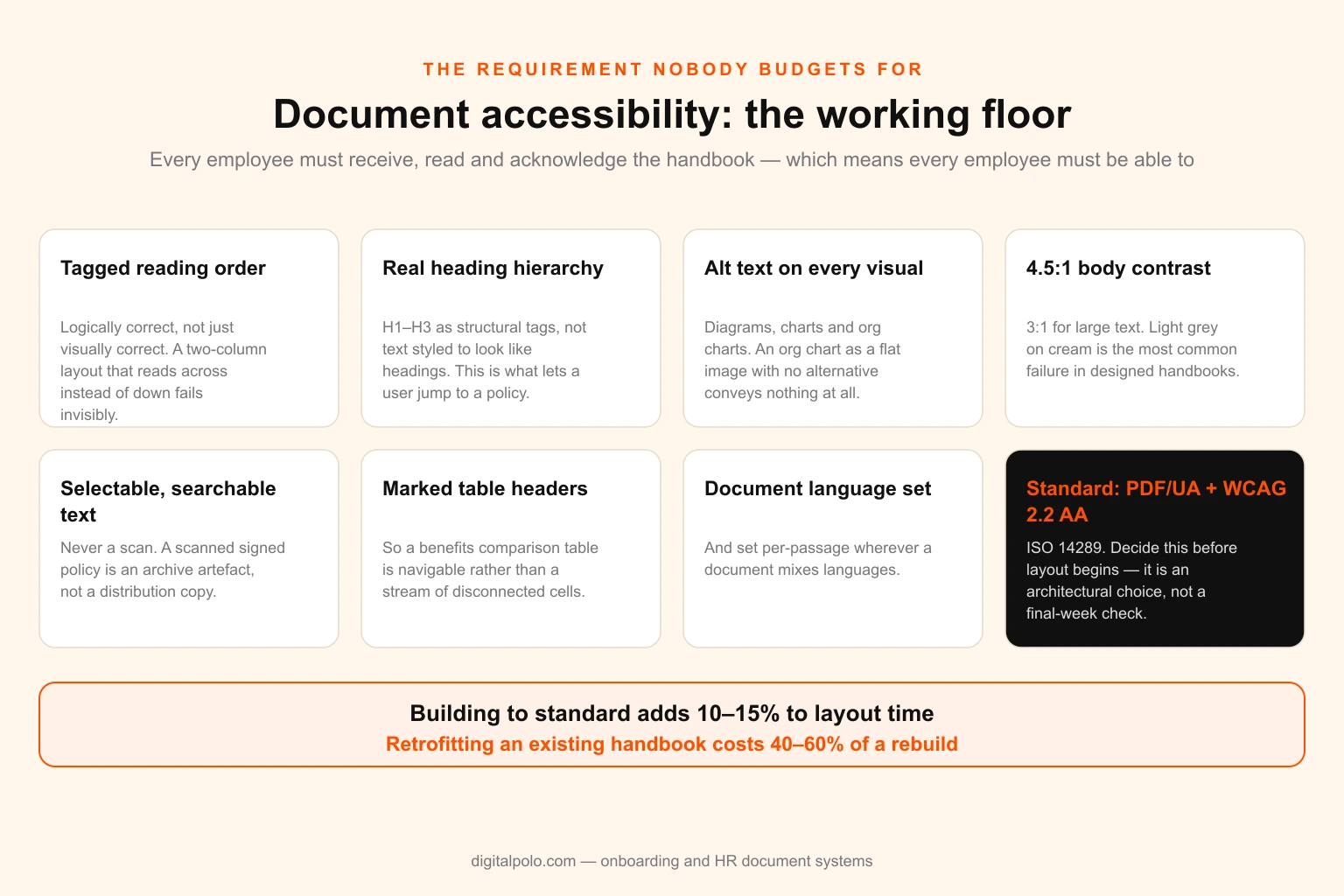
Two things about the economics. First, building to this standard from the outset adds perhaps 10 to 15 per cent to layout time. Retrofitting an existing 60-page handbook typically costs 40 to 60 per cent of a rebuild, because tagging a document that was laid out without structural intent frequently means rebuilding the layout anyway. It is one of the clearest cases in document production where the cheap decision and the correct decision are the same decision, and only if it is made early.
Second, the regulatory direction is one-way. The European Accessibility Act's obligations came into application in June 2025, WCAG 2.2 has superseded 2.1 as the reference standard, and procurement requirements at enterprise and public-sector clients increasingly cascade accessibility obligations down the supply chain. No jurisdiction is loosening this.
Why a readable handbook is a stronger legal instrument
This is the argument that justifies the budget, and it is entirely absent from the twenty pages currently ranking for this topic.
A handbook's protective value in an employment dispute does not come from its existence. It comes from the acknowledgment — the signed statement that the employee received the handbook, read it, and understood the policies in it. That signature is evidence, and like all evidence it has a strength.
Consider what that signature is worth against two different documents.
The first is 62 pages of 9-point justified text, no contents page, no heading hierarchy, policies in no discernible order, the harassment reporting procedure buried on page 41 in a paragraph indistinguishable from the paragraph about parking. The second covers the same policies with clear structure, a navigable contents page, each policy findable in under fifteen seconds, and reporting procedures set apart typographically because they are the passages someone will read under stress.
Both produce a signature. They do not produce equally strong evidence. Opposing counsel arguing that an employee could not reasonably have located or understood a policy has considerably more to work with in the first case, and the design decisions are the evidence they will point at.
There is a second, quieter version of the same effect. The passages in a handbook that matter most — how to report harassment, how to raise a grievance, what the escalation path is — are read by people in distress, quickly, often on a phone, often for the first time. A document that is hard to navigate under calm conditions is unusable under those. Whether the reporting procedure is findable in fifteen seconds is not a typographic nicety; it is a determinant of whether an incident gets reported internally or externally.
So the case for spending money here is not that a well-designed handbook is nicer. It is:
- Acknowledgments are stronger when comprehension is plausible.
- Policies get followed at a materially higher rate when they can be found.
- Reporting procedures get used when they are legible under stress.
- Onboarding time drops, because a findable answer is not a question to a manager.
- The document survives revision, because a structured document can be modified and an unstructured one is rewritten.
None of that is decoration. All of it is why the company's brand system needs to extend into documents that legal and HR own, rather than stopping at the marketing boundary where most brand guidelines quietly do. If your guidelines are a static PDF rather than a working system, the distinction between a brand book and a style guide is worth settling first, because a document estate needs the operational half. Where no usable system exists at all, that is a brand identity problem to solve before it is a document problem.
Ownership: naming the three roles
The estate rots because ownership is assumed rather than assigned. Three distinct roles must be named, and in most companies only two of them are.
The words. Legal, or external employment counsel. Owns policy language, risk and statutory compliance. Almost always clearly assigned.
The decisions. HR or People Operations. Owns what the policies actually say, the revision calendar, and the acknowledgment process. Usually clearly assigned.
The artefact. Owns the master files, the template system, the version register, production of every revision, accessibility conformance, and the archive. Almost never assigned. It defaults to whoever last touched the file, which is precisely how four versions come to exist in three tools.
That third role does not require a full-time person below about a thousand employees, but it requires a name against it. It is roughly three to five weeks of work a year at 250 people — enough to matter, not enough to hire for, which is exactly the profile of work that gets dropped.
There are three workable models for it. An internal owner in HR with document production skills, which works if that person genuinely has the layout capability and the time protected. A named external partner holding the master files under a retainer, which is what most companies at this size actually end up doing. Or a hybrid where HR owns the register and triggers, and production sits externally — usually the most robust arrangement, because it separates the person who knows what changed from the person who has to implement it.
Whichever model, one artefact makes the difference between a system and an estate: the version register. A single table listing every live document, its current version, effective date, owner, next review date, where the master lives, and which jurisdictions and entities it applies to. It is unglamorous and it is the entire control mechanism. A company with a current version register has a document system. A company without one has a folder.
What it costs, three ways
Costs below assume a mid-sized company rebuilding a genuinely neglected estate: roughly 60 to 90 documents, a 40 to 70 page handbook, two entities, a few states. Legal fees for drafting and reviewing the language are excluded throughout — that is a separate budget and it is not what is being priced here.
| Freelance designers | Branding agency | Design subscription / white-label partner | |
|---|---|---|---|
| Handbook design and build | USD 4,000–9,000 | USD 12,000–30,000 | Included in monthly |
| Full policy module set | USD 3,000–7,000 | USD 10,000–22,000 | Included in monthly |
| Onboarding and welcome pack | USD 1,500–4,000 | USD 6,000–14,000 | Included in monthly |
| Template and letter system | USD 2,000–5,000 | USD 8,000–18,000 | Included in monthly |
| Accessibility remediation | USD 2,000–6,000, often subcontracted | Usually included | Depends on partner — confirm before starting |
| Initial build total | USD 12,500–31,000 | USD 36,000–84,000 | ~USD 400–900 per month |
| Annual maintenance | Rehired per change, quoted each time | USD 8,000–20,000 retainer | Same monthly rate |
| Master files | Must be contractually required | Usually released on request | Confirm in terms |
| Continuity if the person leaves | The main risk in this model | Low | Low |
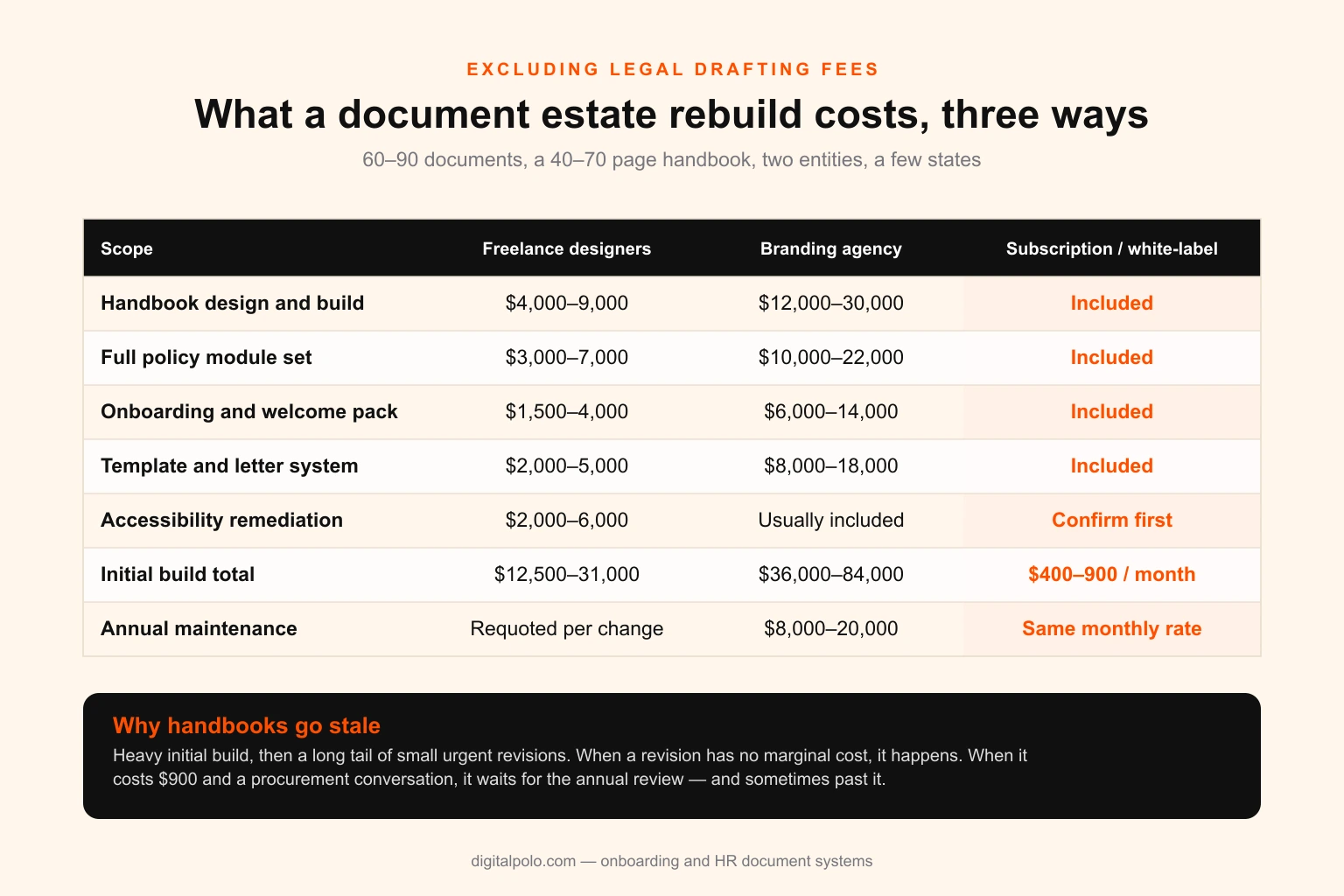
The three-way comparison is the same one that governs any recurring design workload, and HR documentation sits in a specific and unusual place within it.
The work has an unhelpful shape for freelance engagement: a large initial build followed by small, unpredictable, urgent changes spread across years. A freelancer is efficient for the build and structurally poor for the maintenance, because the person who holds the context is not on retainer and may not be reachable when a legislative change forces a two-week turnaround. Agencies handle continuity well and are expensive relative to the actual craft difficulty of the work, which is high-volume and systematic rather than conceptually demanding.
That shape — heavy build, long tail of small revisions, continuity mattering more than brilliance — is the profile that subscription design fits better than most categories of work. The initial build consumes a few months of capacity, and the maintenance tail then costs nothing incremental, which removes the specific dynamic that causes handbooks to go stale: the fact that every update currently requires someone to approve a new invoice. When a revision has no marginal cost, it happens. When it costs USD 900 and a procurement conversation, it waits until the annual review, and sometimes past it. Our pricing and the fuller breakdown of design costs by model set out where the thresholds fall.
Two contractual points to settle before any of the three models starts.
Master file ownership must be explicit. Not the PDFs — the layout files, the linked assets, the style definitions, the fonts and their licences. A handbook you cannot edit is a handbook you will pay to rebuild. Put it in the engagement terms, not in an email after delivery.
Font licensing has to be resolved at the start, because the licence for embedding in distributed documents is not always the licence the brand was built with, and discovering the gap after three hundred contracts have gone out is an expensive conversation.
The 90-day rebuild sequence
The order matters more than the pace, and the most common failure is starting at week 4.
Weeks 1–3 — Inventory and register. Find every live document. Every one. Search shared drives, HRIS, the onboarding tool, email attachments, individual managers' folders. For each, establish which copy is authoritative, when it was last reviewed, who believes they own it, and which entities and jurisdictions it covers. Build the version register. Expect to find documents nobody knew were still in circulation, and at least one contradiction between two live versions of the same policy.
This phase is boring and skipping it is fatal. You cannot template a set you have not finished finding, and the contradictions you surface here are the ones that would otherwise surface in a dispute.
Weeks 4–6 — Structure and system. Assign the three tiers. Define the modular architecture and what a module is. Build the template system: type scale for long-form reading, contrast-checked palette, table styles, signature block components, version block, cover systems. Set the accessibility standard now, before any layout exists. Write the brief properly — the same discipline as any design brief that has to survive execution.
Weeks 7–10 — Production, in tier order. Tier 2 legal instruments first, because they have the longest review cycles and will block you if left late. Then Tier 3 owned documents, handbook first as the system's proving ground. Tier 1 wrappers last — they are quick and they depend on the type system being settled.
Weeks 11–13 — Conformance, rollout, handover. Accessibility validation on every distributed PDF. The acknowledgment round, with a clear statement of what changed rather than a blanket re-signature request. Archive the superseded versions properly — you need to be able to prove what was in force on any past date. Then hand over the maintenance model: register, owner, review calendar, and the trigger list that says which events force an out-of-cycle revision.
If the company is doing this alongside a rebrand, sequence it inside that programme rather than after it. HR documents are the most consistently missed category in a rebrand rollout, and rebuilding them twice — once for the rebrand, once for the document system — is pure waste.
Multi-entity, multi-state and translation
Three complications that turn a manageable estate into an unmanageable one, and the design decisions that contain each.
Jurisdictional variance is best handled as core-plus-supplement, never as parallel full documents. One handbook containing everything universal, plus a state or country supplement carrying only the delta. Parallel full versions guarantee divergence: someone updates the California handbook and not the Texas one, and eighteen months later they are different documents that were meant to be the same. The supplement model also makes the delta auditable, which matters when counsel asks what is actually different.
Multiple legal entities need a template system where entity identity — name, registered address, letterhead, signing authority — is a variable rather than a hard-coded layout element. If changing entity means rebuilding a document, someone will eventually send a contract on the wrong entity's paper, and that is a real problem rather than a cosmetic one.
Translation is a versioning problem before it is a linguistic one. Every source revision orphans every translation, and an out-of-date translated policy is worse than none, because employees relying on it are relying on superseded terms. Two rules: translated documents carry the source version number they were translated from, so a mismatch is visible on the page; and layouts must accommodate expansion, since Spanish and French commonly run 15 to 25 per cent longer than English and German substantially more. A layout built tight to English text will break, and it will break in the version nobody on the review team reads.
Companies operating across many sites face the same underlying control problem as multi-location brand compliance — the failure mode is not that local versions are bad, it is that nobody can see them.
Nine mistakes worth naming
- One monolithic handbook file. Guarantees the estate goes stale, because every change costs a reissue.
- Designing around unfinished copy. The single most reliable way to double the hours. Every clause change reflows everything beneath it. Lock the text, then lay it out.
- Redesigning statutory forms. Ranges from wasted effort to non-compliance. Wrap them, do not touch them.
- Layout files as the master for legal text. Legal cannot redline a layout file, so the approved language and the distributed document silently diverge.
- Accessibility as a final-week checklist item. It is an architectural decision. Retrofitting costs 40 to 60 per cent of a rebuild.
- No version block on the page. File properties do not survive copying, printing or emailing. Print it.
- Cross-references by page number. Every reflow invalidates them, and nobody re-checks.
- No master file ownership clause. You will pay to rebuild a document you already paid for.
- HR documents missing from the rebrand inventory. The most consistently forgotten asset class in the company, and the one where a stale logo sits in front of every new hire on their first morning.
Measuring whether it worked
Four measures, none of which require a survey platform.
Time to find a named policy. Give five employees a stopwatch and ask them to find the grievance procedure. Under 30 seconds is a working document. Over two minutes is a document that exists for the auditor rather than the employee.
Acknowledgment completion rate and time. Both should improve. A long tail of un-acknowledged handbooks usually indicates a document people are avoiding rather than a compliance attitude problem.
Onboarding questions to managers. Track the recurring ones for a quarter. Every question answered five times a month is a document that failed, and it names precisely which section to fix.
Revision cycle time. From "the policy changed" to "the current version is live and acknowledged". Before a rebuild this is commonly six to twelve weeks. After a proper modular build it should be under two. This is the measure that tells you whether you built a system or just a nicer-looking estate.
Where to start
If the whole programme is not fundable this quarter, the sequence that returns the most for the least is narrow and specific.
Build the version register first. It costs days, not money, and it is the only artefact that converts an estate into something manageable. It will also surface the contradictions and orphaned versions that are your actual current risk.
Then rebuild the handbook, modularly, to the accessibility standard, with the version and cross-reference discipline described above. It is the highest-read, highest-risk, most-neglected document you own.
Then the benefits explainer, which is consistently the largest gap between how much money a document describes and how much design attention it receives.
Everything else can follow the annual review cycle.
If your design capacity is already committed elsewhere — and in most companies of this size it is committed to marketing, permanently — HR documentation is close to the ideal candidate for external production. The work is systematic rather than conceptual, it is high-volume in bursts, its maintenance tail is long and unpredictable, and continuity matters far more than creative range. That is why it fits a white-label or subscription arrangement better than it fits either a hire or a project engagement, and why it so rarely gets prioritised when it competes with campaign work for the same in-house hours.
Digital Polo builds and maintains document systems of exactly this shape — handbooks, policy module sets, onboarding packs, agreement templates and the print-ready production behind them — as part of a flat monthly subscription, with the master files yours and no per-revision cost. If you want a view of what your own estate actually contains before committing to anything, send us the folder and we will map it against the six layers above and tell you where the gaps and the stale versions are.
Start with the register. Everything else is easier once you know what you actually have.