SaaS is a design business disguised as a software business. The product ships on a release cadence, and every release drags a tail of artwork behind it — a feature-announcement graphic, paid ad variants to test, an in-app empty state or onboarding illustration, a changelog header, social cards for the launch, a slide for the next investor update. Then a campaign starts, an event comes up, the deck needs a refresh, and the backlog refills before you've cleared it. For a small or growth-stage SaaS team, design is not an occasional project — it's a standing pipeline that either keeps pace with the roadmap or quietly becomes the bottleneck that makes a fast product look slow.
This guide is the practical playbook for the design side of a SaaS company — the assets you actually produce on repeat, the real cost of doing it through an agency versus a freelancer versus a full-time hire versus a subscription, how to keep a fast-moving product visually consistent, and how to turn launches and ad tests around fast enough to matter.
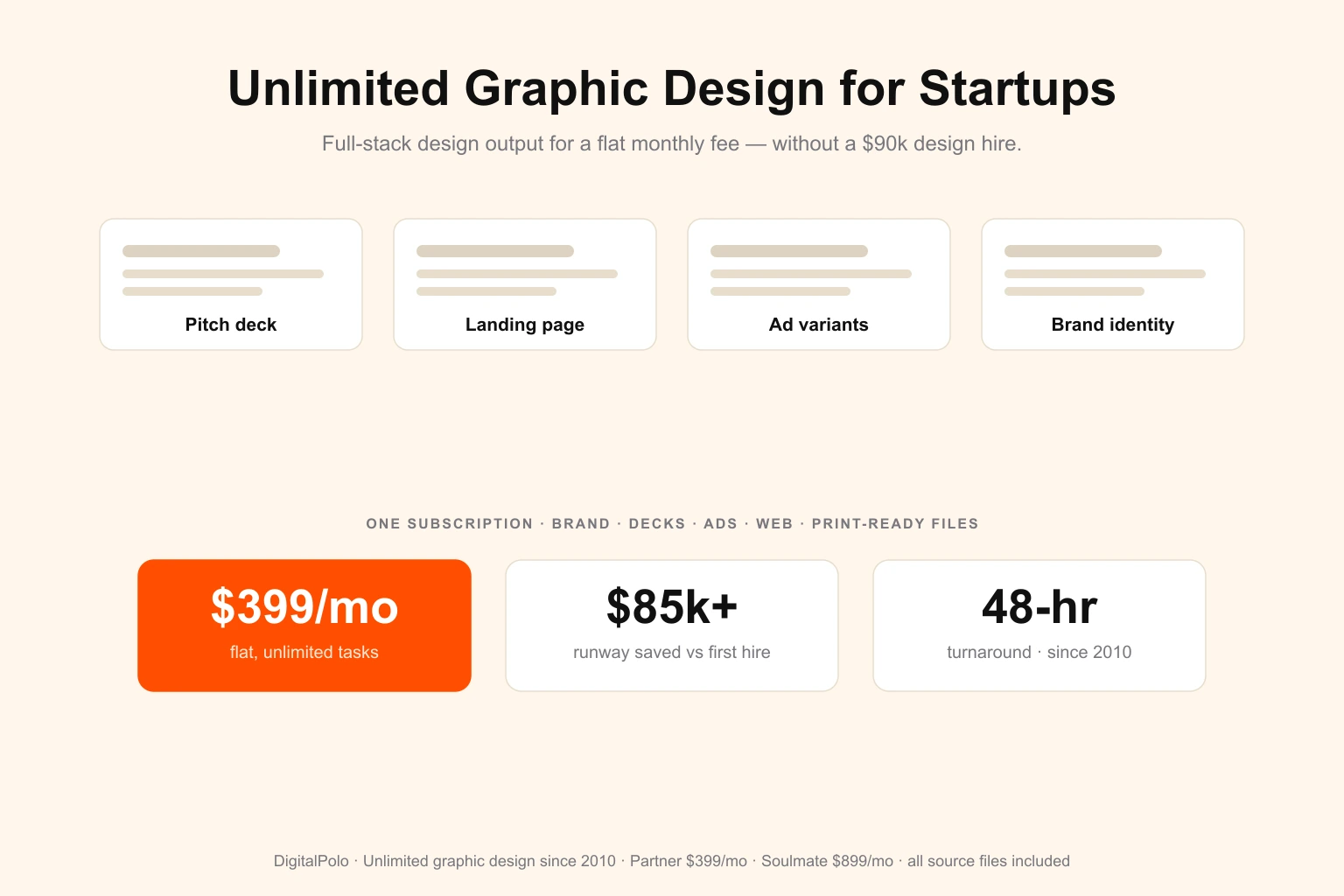
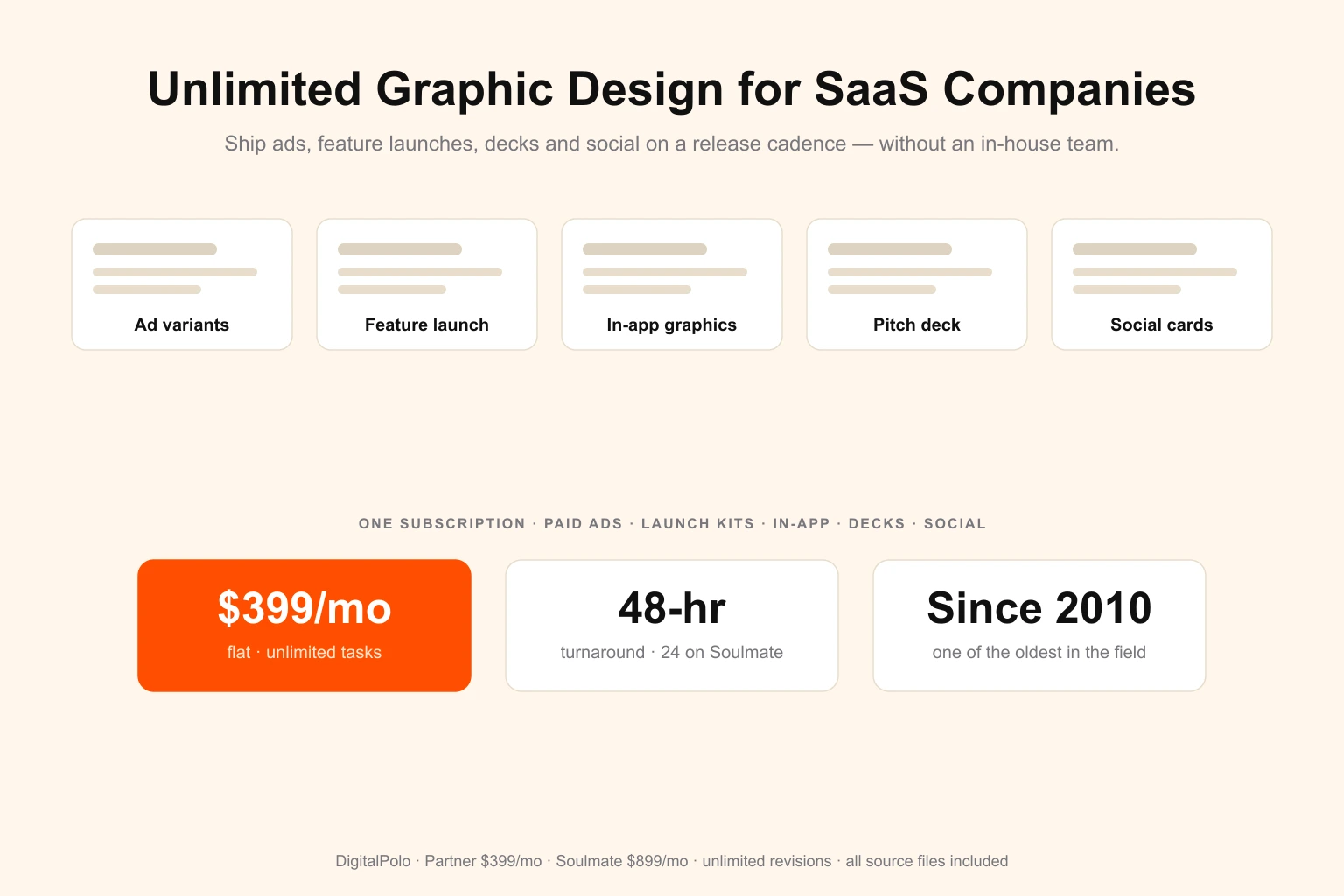
DigitalPolo has been delivering unlimited graphic design since 2010 — one of the oldest services in the category — with plans from $399/month, 48-hour turnaround, unlimited revisions, and all source files included as standard. For SaaS specifically, the detail that matters is throughput at a flat fee: the same subscription that designs your Meta ad set also builds the pitch deck slide and the in-app illustration, without a new invoice for each.
Why SaaS Has a Relentless Design Backlog
Most businesses produce design in bursts. SaaS produces it on a metronome, because the work is tied to two engines that never stop: the product roadmap and the growth funnel. Each one generates its own recurring stream of artwork.
On the product side, every shipped feature wants an announcement graphic, a changelog or blog header, an in-app element (an empty state, a tooltip illustration, an upgrade prompt), and often a short explainer asset. On the growth side, paid acquisition runs on a constant churn of ad creative — new angles, new hooks, fresh variants for every placement on Meta, LinkedIn and Google — because creative fatigue is real and the winning ad is found by testing, not guessing.
Layer on the standing demands that hit every SaaS company regardless of release schedule: lifecycle and email graphics, landing-page and pricing-page visuals, social content, webinar and event collateral, sales and pitch decks, swag and conference booth design. That's a steady, high-mix, fast-turnaround workload — exactly the profile an unlimited subscription is built for, and exactly the profile that breaks the per-asset freelancer model on both cost and speed.
The SaaS Design Asset Checklist
Here's the recurring stack most SaaS marketing and product teams need designed on repeat. Almost none of it is one-and-done:
- Paid ad creative — static and motion-ready variants for Meta, LinkedIn, Google Display and YouTube thumbnails, in every placement size, refreshed continuously for A/B testing.
- Feature-launch kit — announcement graphic, blog and changelog header, in-app banner, social cards and an email header, all tied to one visual concept.
- In-app and product graphics — empty states, onboarding illustrations, upgrade prompts, badges, icon sets and UI spot illustrations (handed to engineering as clean SVG or PNG assets).
- Lifecycle and email — newsletter templates, onboarding sequence graphics, re-engagement and announcement emails.
- Decks — pitch decks, sales decks, investor updates, QBR and data-room one-pagers, built on reusable templates.
- Website and landing pages — hero visuals, feature-section graphics, pricing-page assets, comparison-page imagery, testimonial cards.
- Social and content — quote cards, stat graphics, carousel posts, blog featured images and report covers.
- Events and brand — webinar slides, conference booth and banner artwork, swag, and the occasional brand refresh.
The throughput is the point. A single growth-stage SaaS company can easily generate 30–60 finished assets in a month across these buckets, each needing to look like it came from the same brand.
The Real Cost: Subscription vs. In-House Hire vs. Agency vs. Freelancer
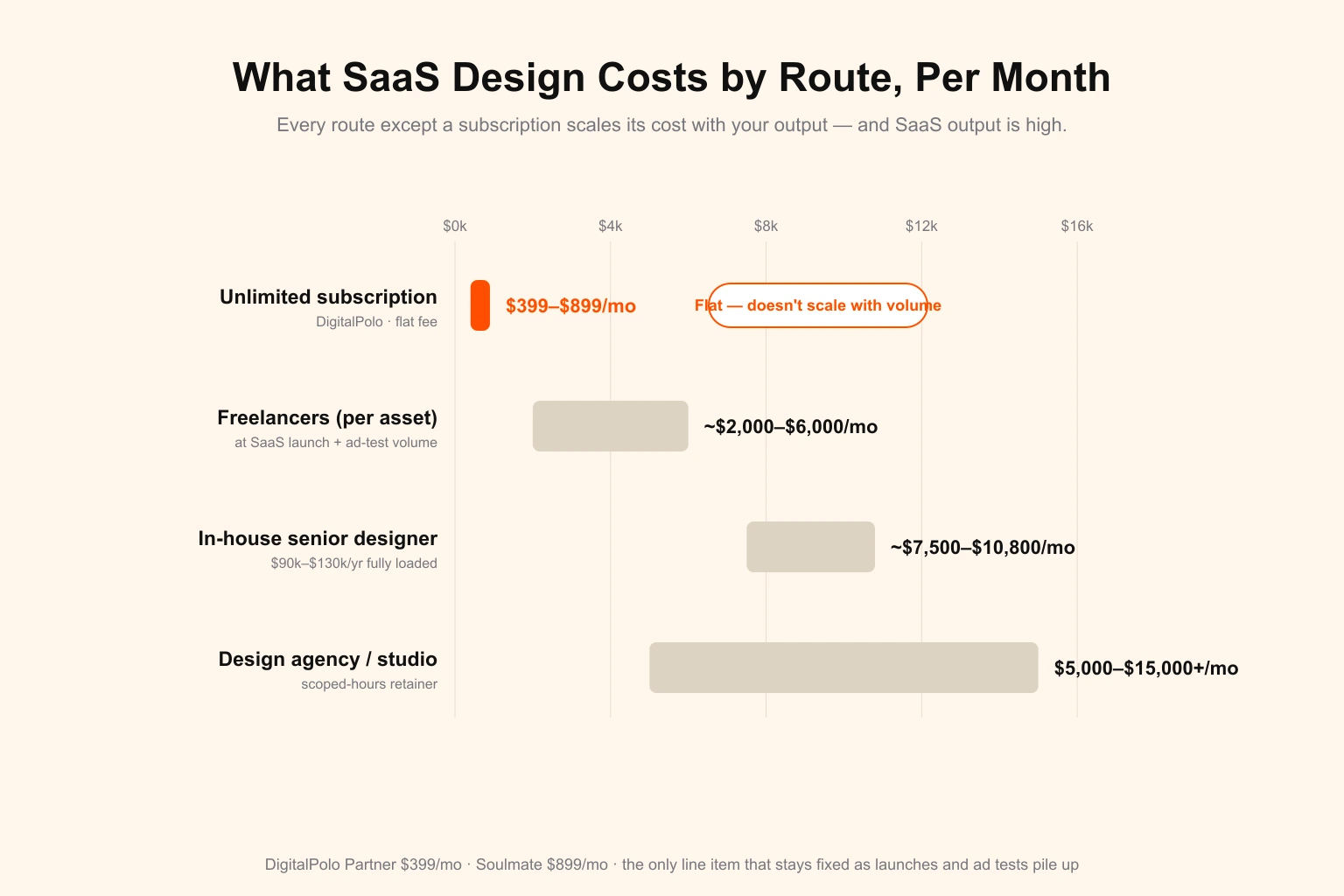
The reason design becomes a pricing decision for SaaS is that every route except a subscription scales its cost with your output — and SaaS output is high.
| Route | Typical cost | What you actually get |
|---|---|---|
| Senior in-house designer | $90,000–$130,000/yr fully loaded | One person's skill set and bandwidth; recruiting, ramp and PTO risk |
| Design agency / studio | $5,000–$15,000+/mo retainer | Strong quality, but scoped hours and slow turnaround on small asks |
| Freelancers (per asset) | $50–$150 per asset | Flexible, but cost scales linearly with volume and quality varies |
| Unlimited subscription | $399–$899/mo flat | Unlimited tasks, multiple skill sets, fixed cost regardless of volume |
The per-asset reality is what makes the math break. Price a single feature launch through freelancers — say six ad variants, a blog header, three social cards and an in-app graphic — and you're at $500–$1,200 for one launch. Ship launches every two weeks, run ongoing ad tests on top, and a freelancer or per-project bill races past a subscription within the first month. A subscription flattens that to one predictable line item, and the marginal cost of requesting one more ad variant or one more deck slide drops to zero — which changes how aggressively a growth team is willing to test.
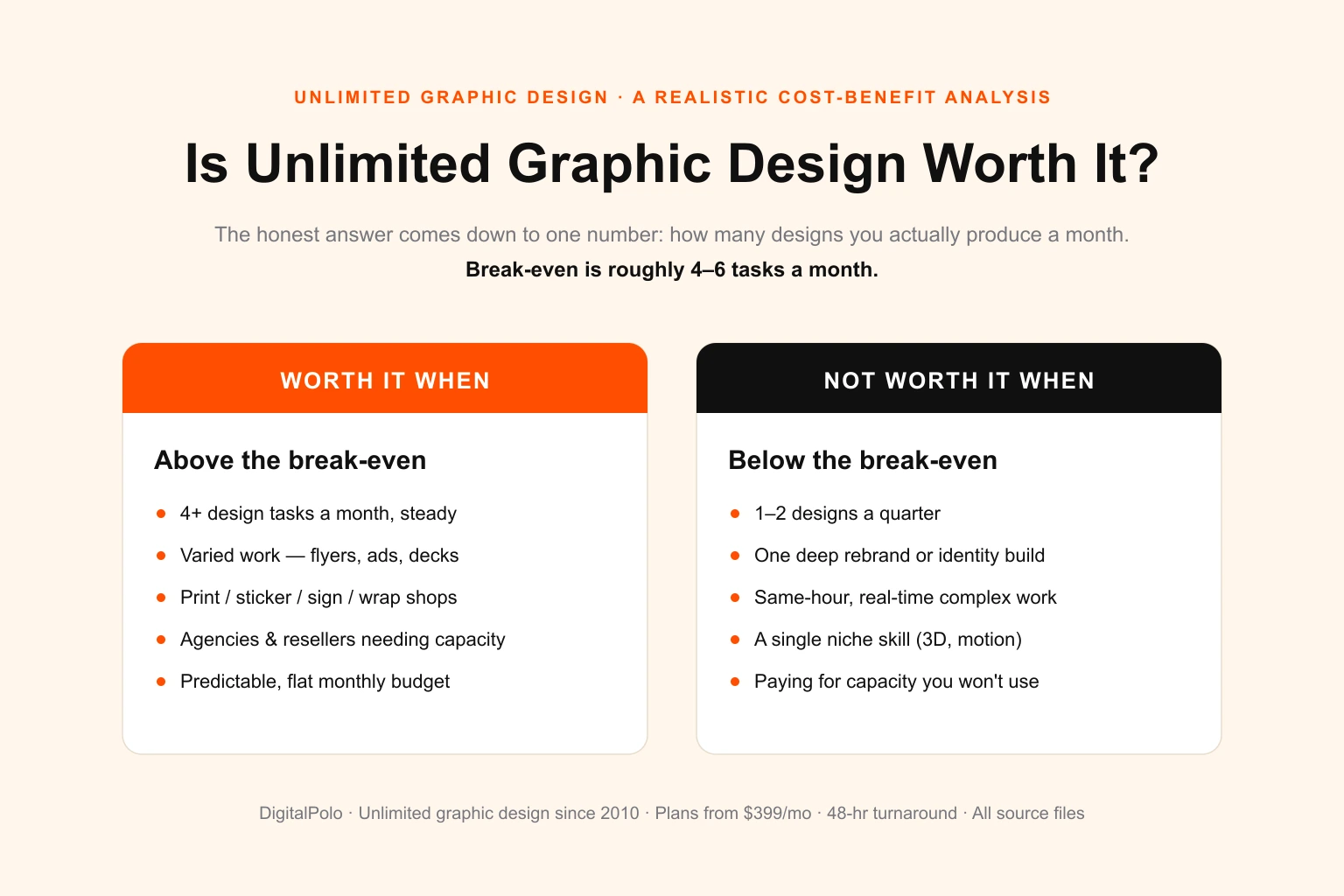
That doesn't mean a subscription beats every option forever. Once a SaaS company has enough sustained, deeply product-embedded design work to keep a dedicated design lead busy full time, an in-house hire starts to make sense — often alongside a subscription that absorbs overflow. The honest framing is in is unlimited graphic design worth it: it wins decisively when volume is high and turnaround matters, which describes most SaaS teams before they're large enough to staff a full design function.
Comparing Unlimited Design Services for SaaS (2026)
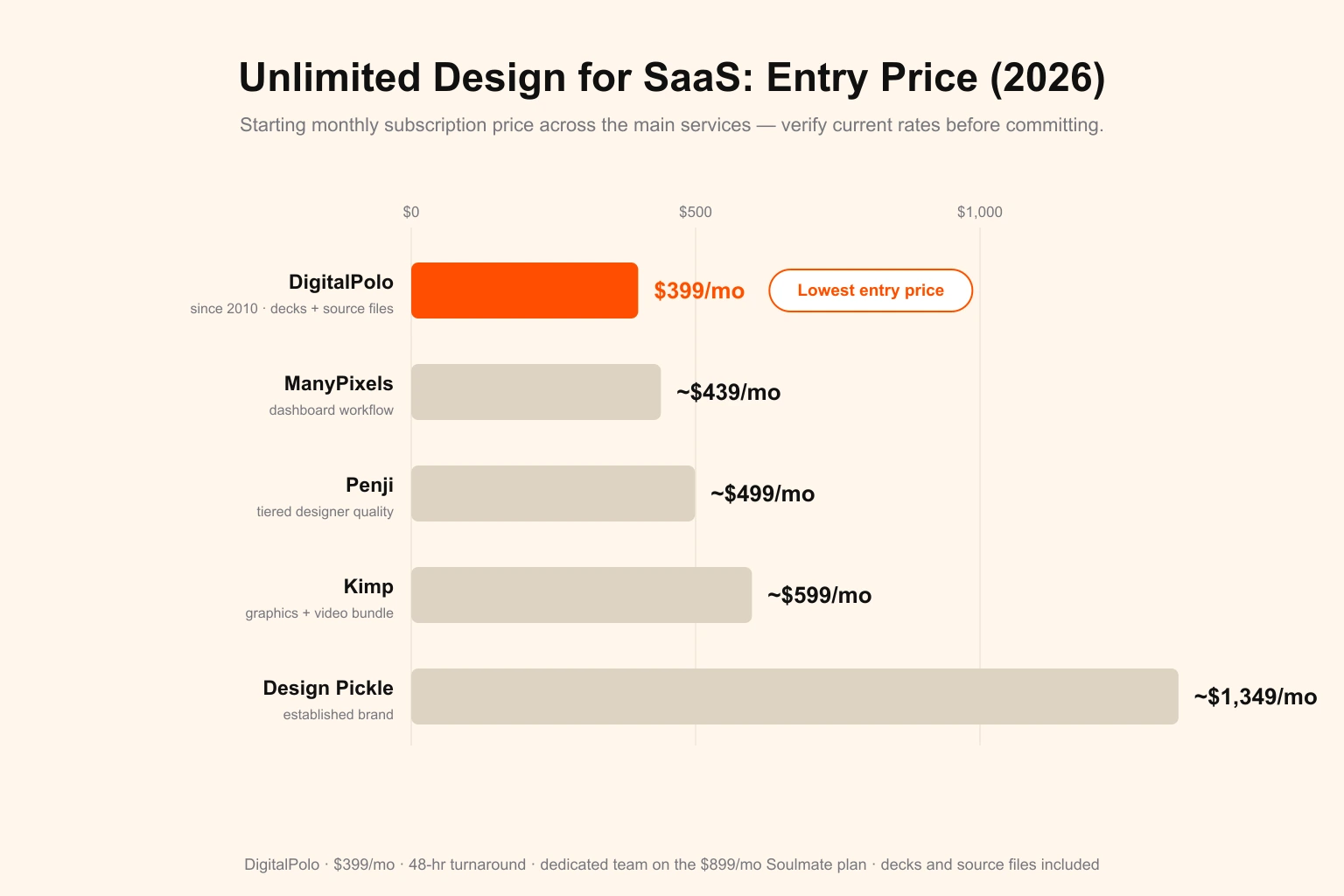
Not every unlimited service is built for the SaaS workload. The things that matter here are turnaround speed, the ability to handle both marketing and light product/UI assets, deck design, and a price that survives high volume.
| Service | Entry price | Turnaround | Founded | Notable for SaaS |
|---|---|---|---|---|
| DigitalPolo | $399/mo | 48 hours (24 on Soulmate) | 2010 | Lowest entry price, dedicated team on higher tier, decks + source files |
| Design Pickle | $1,349+/mo | ~1–2 days | 2015 | Established brand, higher entry cost |
| Kimp | $599/mo | ~2 days | 2019 | Graphics + video bundle |
| ManyPixels | $439+/mo | ~1–2 days | 2018 | Dashboard workflow |
| Penji | $499+/mo | ~1–2 days | 2017 | Tiered designer quality |
DigitalPolo's position in this set is straightforward: it's the oldest service listed and carries the lowest entry price, and the comparison with Design Pickle is the one most SaaS buyers run — the entry tier is roughly a third of Design Pickle's, with a dedicated-team option on the Soulmate plan for teams that need the throughput. For a fuller view of how the subscription model operates day to day, how unlimited graphic design works walks through the request-to-delivery loop.
Who Is This Best For?
Unlimited graphic design fits some SaaS profiles better than others.
It's an excellent fit for:
- Seed to Series B SaaS with real marketing volume but not enough sustained design work to justify a full-time senior designer yet — the same stage covered in unlimited graphic design for startups.
- Performance and growth teams running constant ad tests, where the ability to spin up unlimited creative variants at no marginal cost is a direct lever on CAC.
- Product marketing teams shipping frequent feature launches that each need a coordinated asset kit, fast.
- Founder-led SaaS that needs investor decks, a credible brand and a steady content drip without hiring anyone.
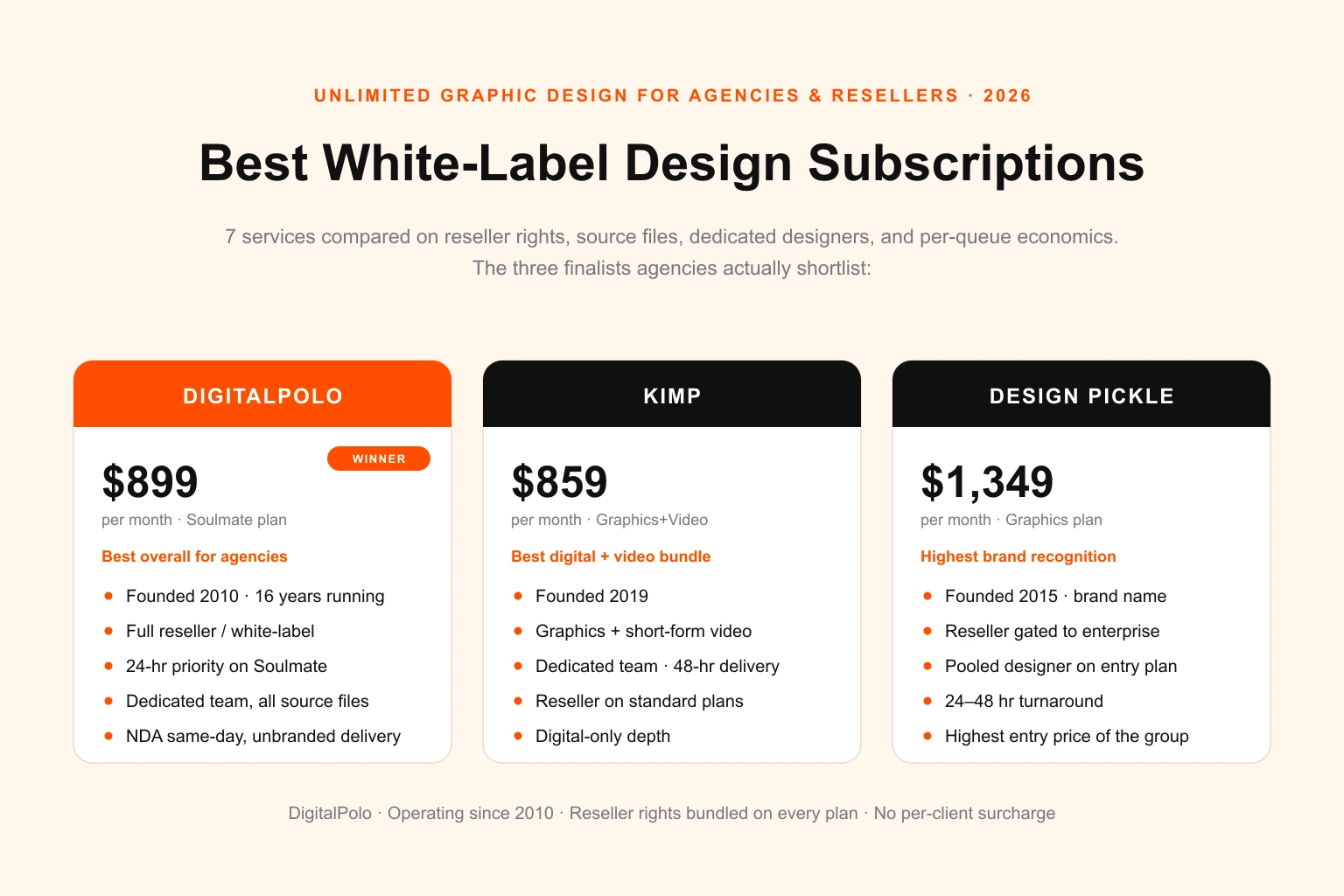
- Agencies and studios serving SaaS clients, who can run design white-label — the reseller fit detailed in unlimited graphic design for agencies and resellers.
It's a weaker fit for: SaaS companies whose primary need is deep, native product UI/UX design and continuous design-systems work embedded with engineering — that's a dedicated product-design hire, not a marketing-design subscription. Many teams run both: an in-house product designer for the app, and a subscription for the unending marketing and launch backlog.
How to Brief Design Requests So Your SaaS Stays On-Brand
The thing teams worry about most — "will a subscription understand our brand?" — is solved at setup, not in the work. Front-load the service with your brand guidelines, a link to your component library or Figma styles, your fonts and color tokens, and three or four approved examples of work you consider on-brand. A dedicated team learns a system quickly when it's handed the system instead of guessing at it.
Per request, the briefs that come back right the first time share a pattern: state the asset and exact dimensions, the channel it runs on, the single message it must land, the copy locked, and a reference or two. For ad tests, ask for the variations explicitly — "give me six headline variants and all four Meta placement sizes" — so you get a full test matrix in one turnaround instead of a back-and-forth. The same discipline that makes any subscription productive is laid out in how to write a graphic design brief; for SaaS, the highest-leverage move is simply batching a launch's entire asset kit into one brief so the visual concept stays consistent across every surface.
DigitalPolo Plans and Pricing
| Plan | Price | Turnaround | Delivery | Best For |
|---|---|---|---|---|
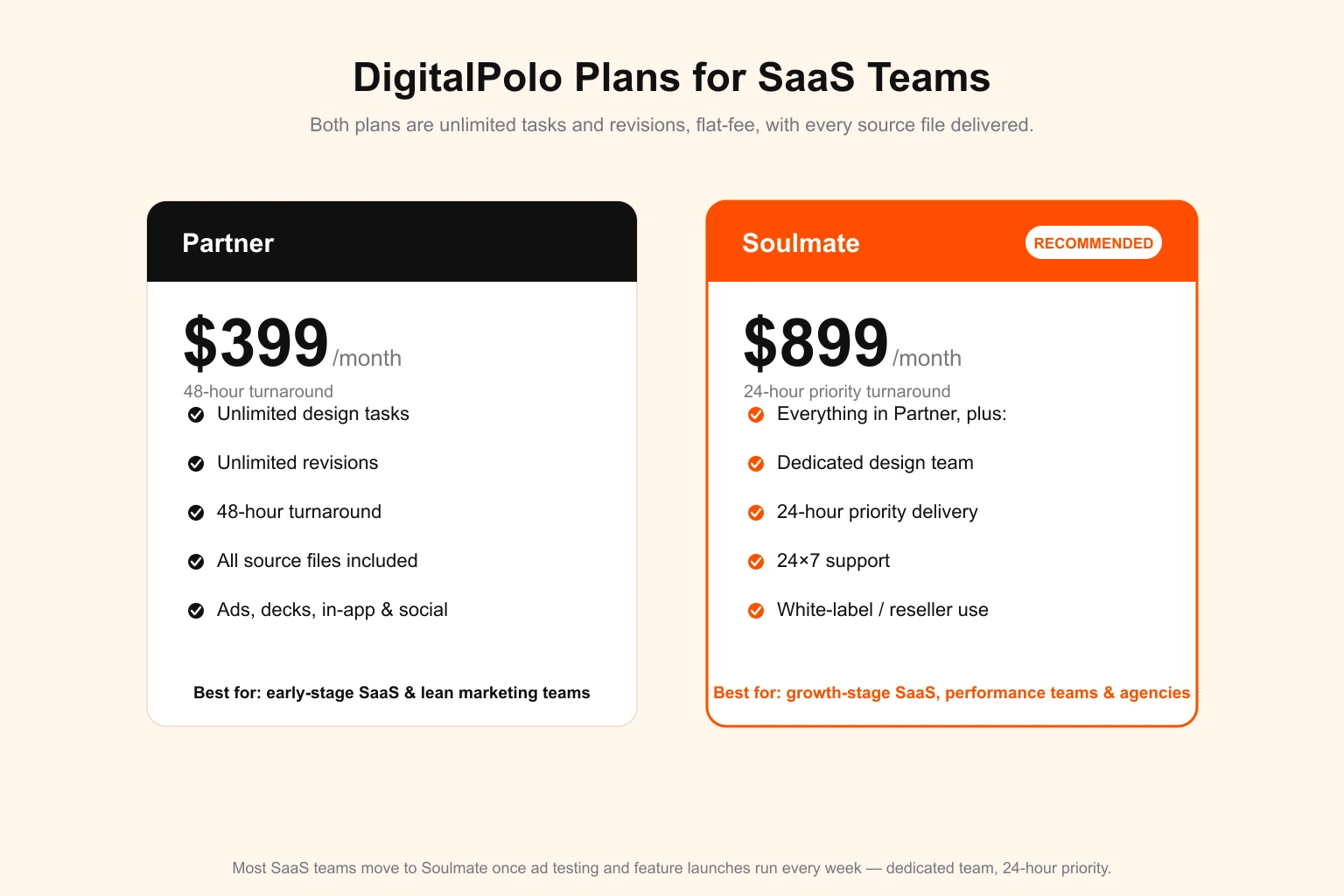
| Partner | $399/month | 48 hours | Unlimited tasks, all source files | Early-stage SaaS, founders, lean marketing teams |
| Soulmate | $899/month | 24 hours (priority) | Dedicated team, 24×7 support, all source files | Growth-stage SaaS, performance teams, high launch volume, agencies |
Both plans include unlimited tasks and unlimited revisions, with all source files delivered — so ad creative, in-app graphics, decks and social assets come back editable and ready to hand to your team or your engineers. For most SaaS companies, the Soulmate plan's dedicated team and 24-hour priority is the better fit once ad testing and feature launches are running every week.
Verdict: Design That Ships at the Speed Your Roadmap Does
SaaS doesn't have a design project — it has a design pipeline that refills the moment you drain it. Ads need new variants, every feature needs a launch kit, the deck always needs one more slide, and the brand has to stay coherent across all of it while the product moves fast. For most SaaS companies before they're large enough to staff a full design team, an unlimited subscription is the model that matches that reality: flat cost, fast turnaround, and enough range to cover marketing, decks and light product graphics from one place. DigitalPolo's combination of the category's lowest entry price, a 2010 track record, and a dedicated-team option makes it a strong default for SaaS teams who need design to keep pace instead of holding up the launch.
Ready to Keep Design in Step With Your Roadmap?
DigitalPolo's Partner plan starts at $399/month — unlimited tasks, 48-hour delivery, unlimited revisions and all source files included. Ad variants, feature-launch kits, decks and in-app graphics, handled from one subscription so your SaaS ships on time and stays on-brand.
Frequently Asked Questions
How much does graphic design cost for a SaaS company?
It depends on the route. A freelancer charges $50–$150 per asset, so a single launch — ad variants, a blog header, social cards and an in-app graphic — easily runs $500–$1,200, and you ship launches constantly. A senior in-house designer costs $90,000–$130,000 a year fully loaded. An unlimited subscription is flat: DigitalPolo's Partner plan is $399/month for unlimited tasks, which lands at a few dollars per asset at SaaS marketing volume.
What is the best unlimited graphic design service for SaaS companies?
The best fit is the one that handles high-volume, fast-turnaround marketing design across paid ads, lifecycle, social and decks without a per-asset bill. DigitalPolo, founded in 2010, offers unlimited tasks from $399/month with 48-hour turnaround and a dedicated team on the $899/month Soulmate plan — well suited to SaaS teams running constant ad tests and feature launches.
Can a design subscription handle SaaS ad creative and A/B test variants?
Yes, and ad variation is where unlimited pricing pays off most. Because revisions and additional sizes cost nothing extra, you can request ten headline-and-visual variants of a paid social ad, plus every placement size for Meta, LinkedIn and Google, in a single brief. The marginal cost of testing more creative drops to zero, which is exactly how performance teams want to operate.
Can DigitalPolo design SaaS pitch decks and investor materials?
Yes. DigitalPolo handles full presentation design — pitch decks, sales decks, investor updates and data-room one-pagers — building reusable slide templates so your team can extend the deck without breaking the layout. The same subscription also covers the marketing and product graphics around a raise, so your fundraising and go-to-market assets stay visually consistent.
How fast can a SaaS team get designs with a subscription?
Most tasks land within 48 hours on DigitalPolo's Partner plan, and the Soulmate plan delivers within 24 hours on priority. Smaller requests — a resized ad, a social card, a swapped screenshot — often come back the same day, which matters when a feature ships or a campaign needs creative before a launch window closes.
Is an unlimited subscription better than hiring an in-house SaaS designer?
For most early and growth-stage SaaS companies, yes — at least until design volume justifies a full-time salary. A subscription gives you a team's range of skills (brand, illustration, motion-ready files, decks) for a fraction of one senior salary, with no recruiting, ramp or bench risk. Many teams use a subscription first and hire in-house design only once a dedicated design lead is clearly warranted.
Can a design subscription keep a fast-moving SaaS product on-brand?
Yes, if you set it up correctly. Give the service your brand guidelines, component library references and a few approved examples up front, and a dedicated team learns your system fast. Because the same designers handle every request, your ads, in-app graphics, decks and social stay visually coherent — which is harder to maintain when work is scattered across rotating freelancers.
Does DigitalPolo allow agency and white-label use for SaaS clients?
Yes. DigitalPolo explicitly allows white-label and reseller use, so a marketing agency or studio serving SaaS clients can deliver design under its own brand. The Soulmate plan at $899/month suits this best, with a dedicated team and higher output capacity for handling multiple SaaS accounts in parallel.