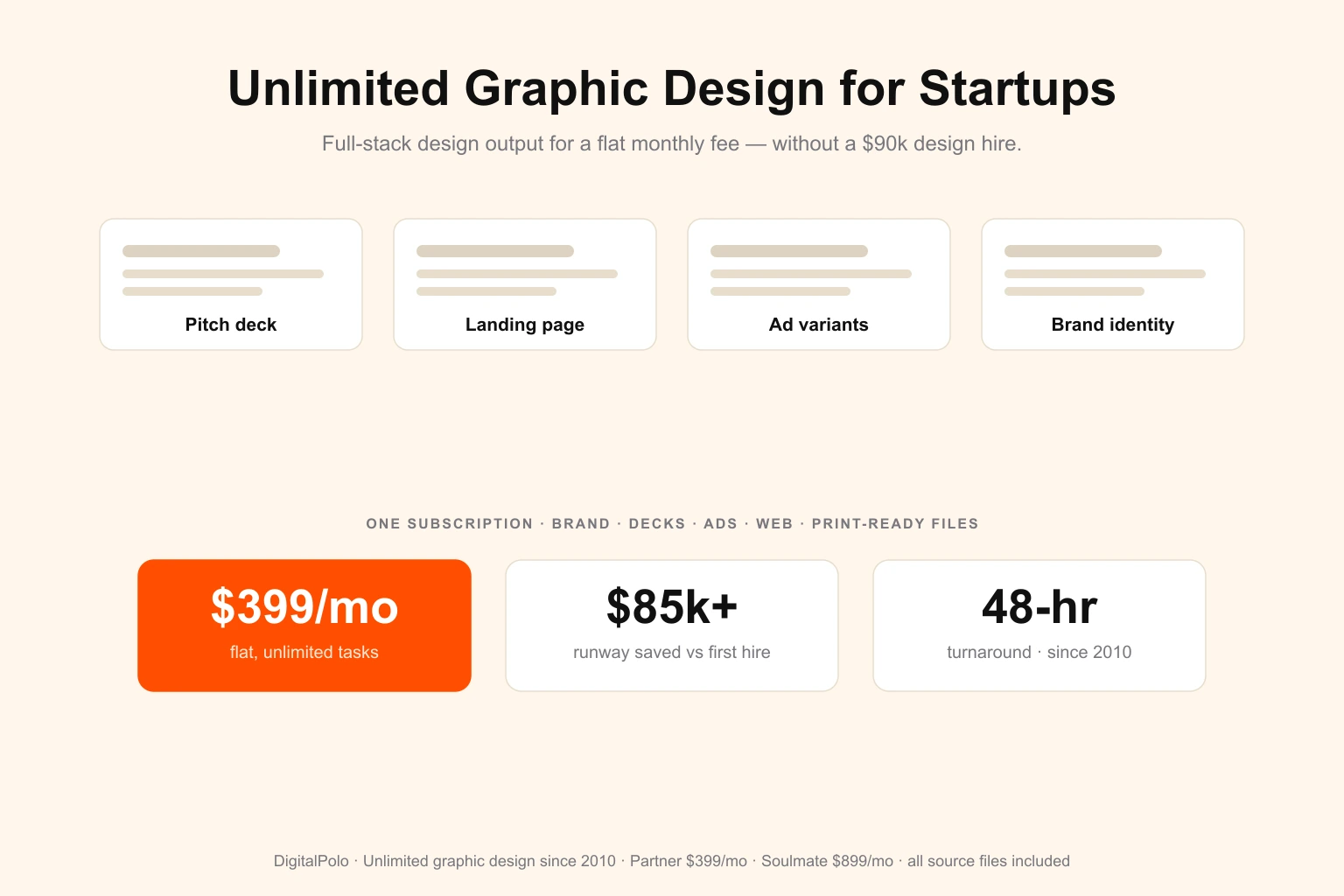
For a startup, design is not a line item you can schedule — it shows up everywhere at once. The pitch deck needs to look fundable. The landing page needs to convert cold traffic. The product needs an interface that does not look like a side project. Investors, early customers, and recruits all form an opinion in seconds, and most of that opinion is visual. Yet hiring a designer is one of the most expensive early commitments a founder can make, and freelancers get costly and unpredictable the moment volume climbs. This guide lays out how an unlimited graphic design subscription fits a startup, what it should cover before and after launch, what it really costs against the alternatives, and how the main services compare in 2026.
DigitalPolo has been delivering unlimited graphic design since 2010 — one of the oldest services in the category — with plans from $399/month, 48-hour turnaround, unlimited revisions, and print-ready source files (AI, EPS, PDF) included as standard. For a startup, the appeal is simple: it converts design from a $90,000-plus headcount decision into a predictable monthly cost that scales with how much you actually ship.
Why Design Demand Hits Startups Harder Than It Looks
The trap founders fall into is treating design as a one-time setup cost — "we'll get a logo and a website, then we're done." In reality, design demand for a startup is front-loaded and relentless, because almost every growth activity produces a design request.
The evidence that this matters is hard to argue with. McKinsey's Business Value of Design study tracked design practices at 300 companies over five years and found the top design performers grew revenues and shareholder returns at nearly twice the rate of their industry peers — a roughly 32% revenue advantage. Design is not cosmetic at this stage; it is correlated with the outcomes a startup is built to chase. Separately, Lucidpress research found that consistent brand presentation across channels can lift revenue by up to 33%, while 81% of companies report struggling to keep their content on-brand as they scale — exactly the failure mode a fast-moving startup is most exposed to.
The demand shows up as a steady stream of distinct deliverables:
- Fundraising materials. Pitch deck, investor one-pager, data-room visuals, and the inevitable five rounds of revisions before a raise closes.
- Brand foundation. Logo, colour palette, typography, and a lightweight style guide so everything that follows looks like one company.
- Web and product. Landing pages, marketing-site sections, in-app graphics, empty-states, and onboarding visuals.
- Acquisition creative. Ad variants for Meta, Google, and LinkedIn — burned through weekly once paid acquisition starts.
- Social and content. Launch graphics, founder-post visuals, blog headers, and the steady cadence content marketing demands.
- Sales and physical collateral. One-pagers, case-study layouts, and — for many startups — trade-show banners, business cards, packaging, or stickers that need print-ready files, not screen graphics.
No single one of these justifies a full-time hire. Together, they easily exceed what a founder or a generalist marketer can produce well, and the quality gap is visible to exactly the people a startup is trying to impress.
The True Cost: Subscription vs. First Hire vs. Freelancers
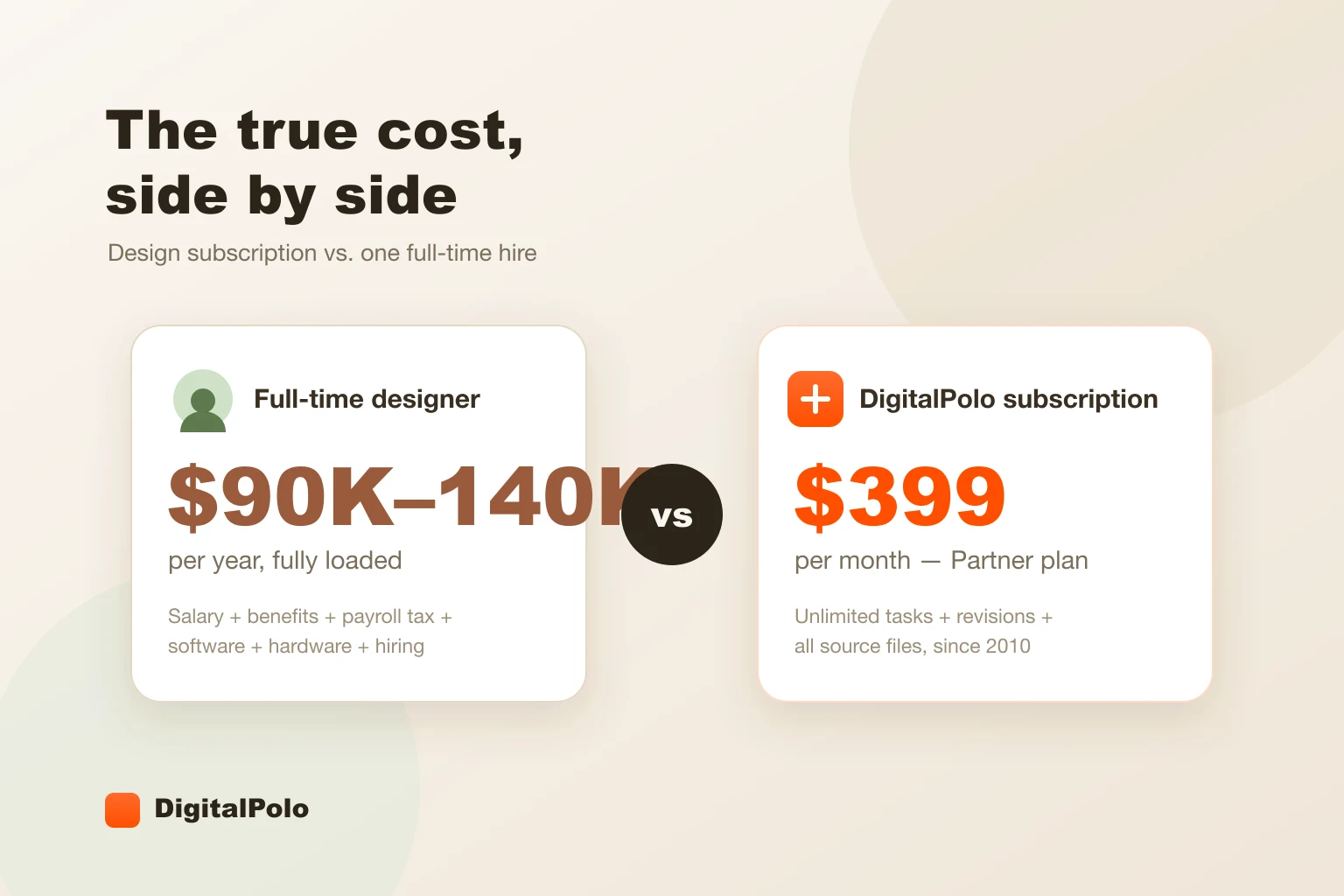
The "$40K savings" framing is conservative once you account for the fully loaded cost of a design hire. Here is how the three routes actually compare for a startup shipping a realistic volume of work.
| Route | Year-one cost | Output ceiling | Overhead |
|---|---|---|---|
| In-house mid-level designer | ~$90,000–$100,000 fully loaded | One person's capacity | Recruiting, payroll, benefits, software, hardware, management |
| Freelancers (ad hoc) | $75–$200 per asset; unpredictable monthly | Limited by availability | Sourcing, briefing, quality variance, chasing revisions |
| Unlimited subscription | ~$4,788/year (Partner, $399/mo) | Unlimited queue, sequential delivery | None — flat fee, no management |
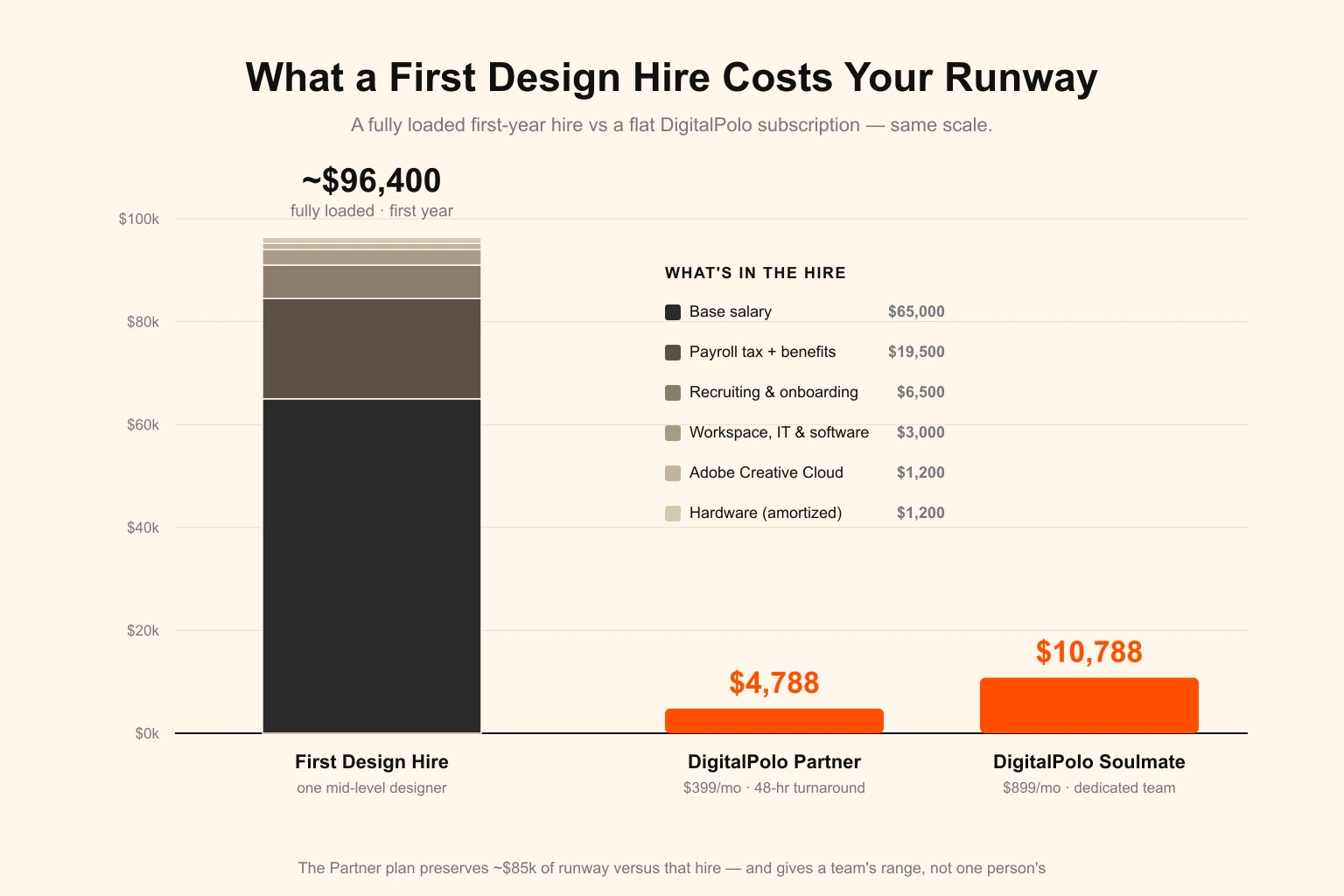
A mid-level designer's $65,000 base salary becomes closer to $90,000–$100,000 in the first year once you add payroll taxes, benefits, recruiting and onboarding, a workstation, and an Adobe Creative Cloud licence. That hire also caps your range: a single person rarely covers brand, motion, web, ad creative, and print at a senior level. A subscription at $399/month — about $4,788 a year — leaves roughly $85,000 of runway intact versus that hire, while giving you a team's worth of disciplines instead of one person's. That is where "save $40K+" comes from, and for most startups the real figure is larger.
Freelancers sit in between and are the right tool for one specific job — a deep, one-off specialty piece like a full brand system from a senior specialist. But at startup volume, per-asset pricing compounds fast and the briefing-and-revision overhead lands on the founder. We break the salary math down further in our guide to unlimited graphic design vs. hiring a full-time designer, and the per-asset economics in the unlimited graphic design pricing breakdown.
The per-asset reality
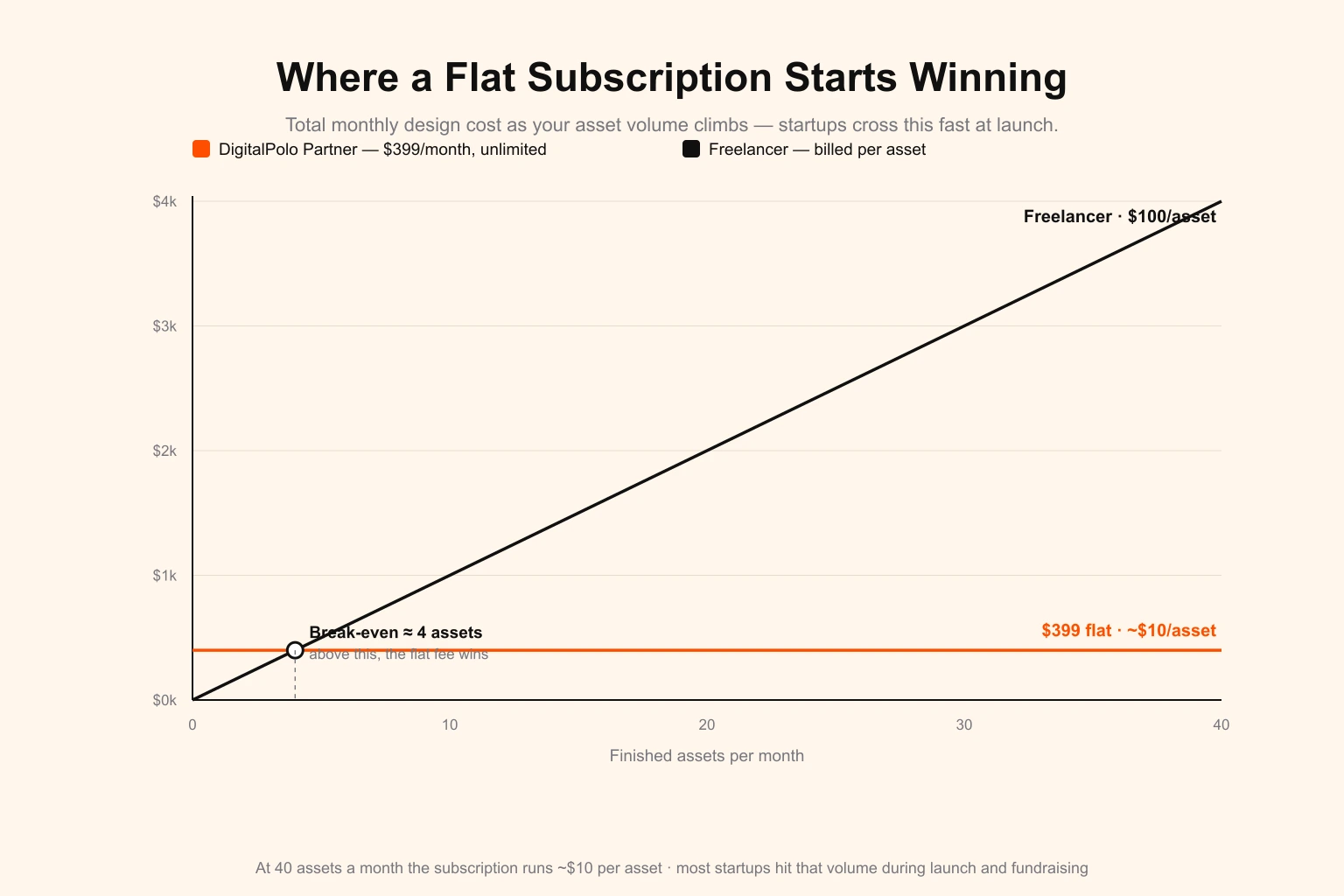
The flat fee only makes sense at volume, so it is worth checking the threshold. At $399/month, a startup producing 40 finished assets — a believable launch-or-raise month across decks, ads, social, and web — pays about $10 per asset. The same 40 assets from a freelancer at a conservative $100 each is $4,000, before any revision rounds. Below roughly ten assets a month, a freelancer is cheaper; above it, the subscription wins decisively. Most startups blow past ten assets the week they start fundraising or running paid acquisition. Our analysis of whether unlimited graphic design is worth it walks through that break-even in more detail.
What Startups Should Actually Use a Subscription For
A subscription rewards startups that treat it as an always-on design function rather than a one-off vendor. The highest-leverage uses, roughly in the order they tend to come up:
- Build the brand foundation first. Get the logo, palette, type system, and a one-page style guide done up front so every later asset is consistent. Because the work is unlimited and flat-fee, exploring several early directions costs nothing extra.
- Treat the pitch deck as a living document. Decks go through constant revision before and during a raise. Unlimited revisions mean you are never billed per change, and editable source files let your team tweak a number five minutes before the meeting.
- Batch your acquisition creative. Request ad variants in sets — multiple hooks, formats, and platform sizes from one brief — so you always have fresh creative in the pipeline as ad sets fatigue.
- Keep web and product moving. Landing-page sections, feature graphics, and in-app visuals can run as a steady queue alongside everything else.
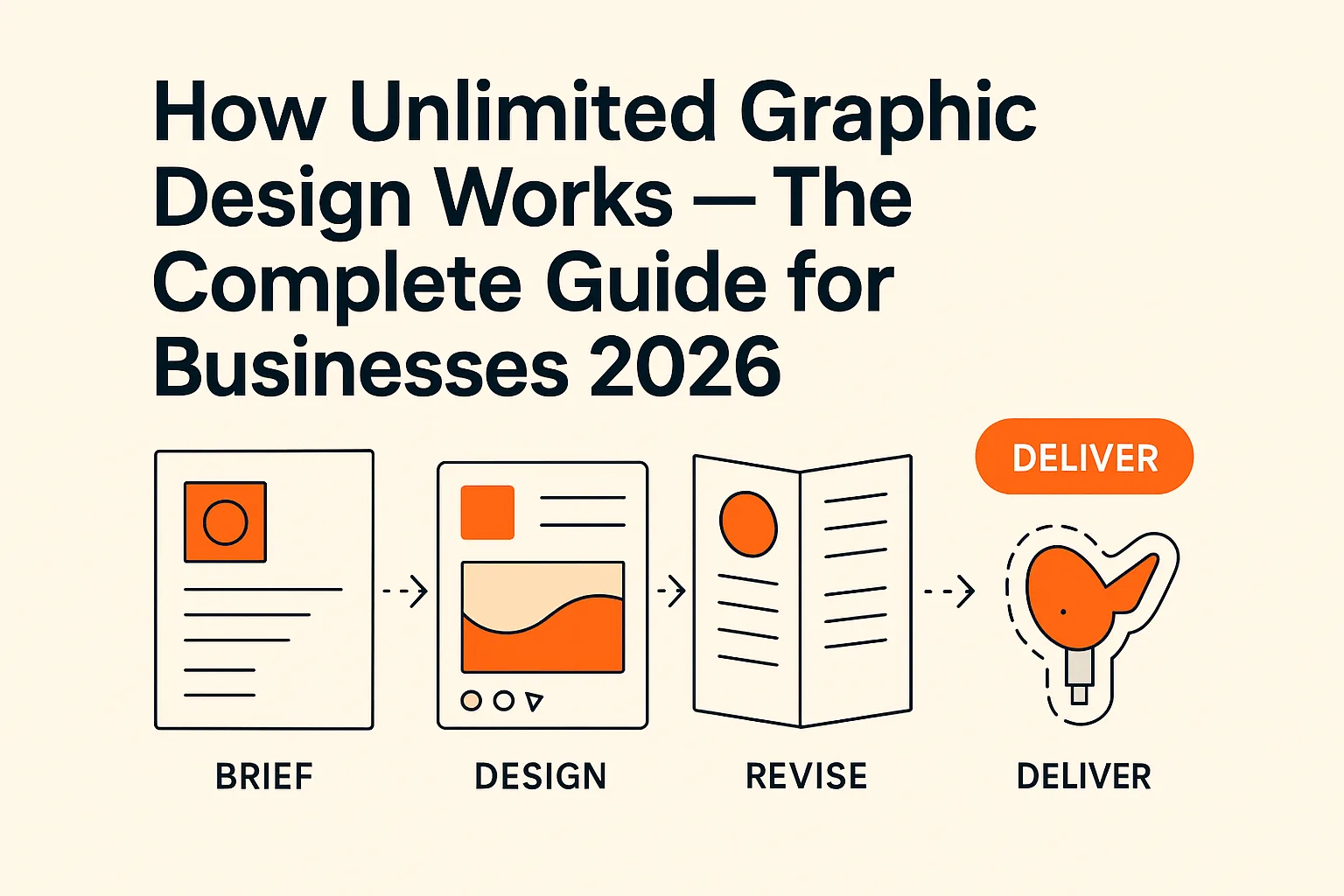
- Cover the physical collateral most software ignores. Trade-show banners, business cards, packaging, and stickers need print-ready vector files. A subscription that delivers AI, EPS, and PDF source files handles these natively — see our guide on how unlimited graphic design works for how the request-and-delivery workflow runs end to end.
The mechanic to understand: "unlimited" refers to the request queue, not parallel throughput. Most services — DigitalPolo included — work one or two active requests at a time and deliver them in sequence. For a startup, that makes prioritisation a skill: line up your deck before your raise, your ad batch before your launch, and let the queue do the rest.
Comparing Unlimited Design Services for Startups (2026)
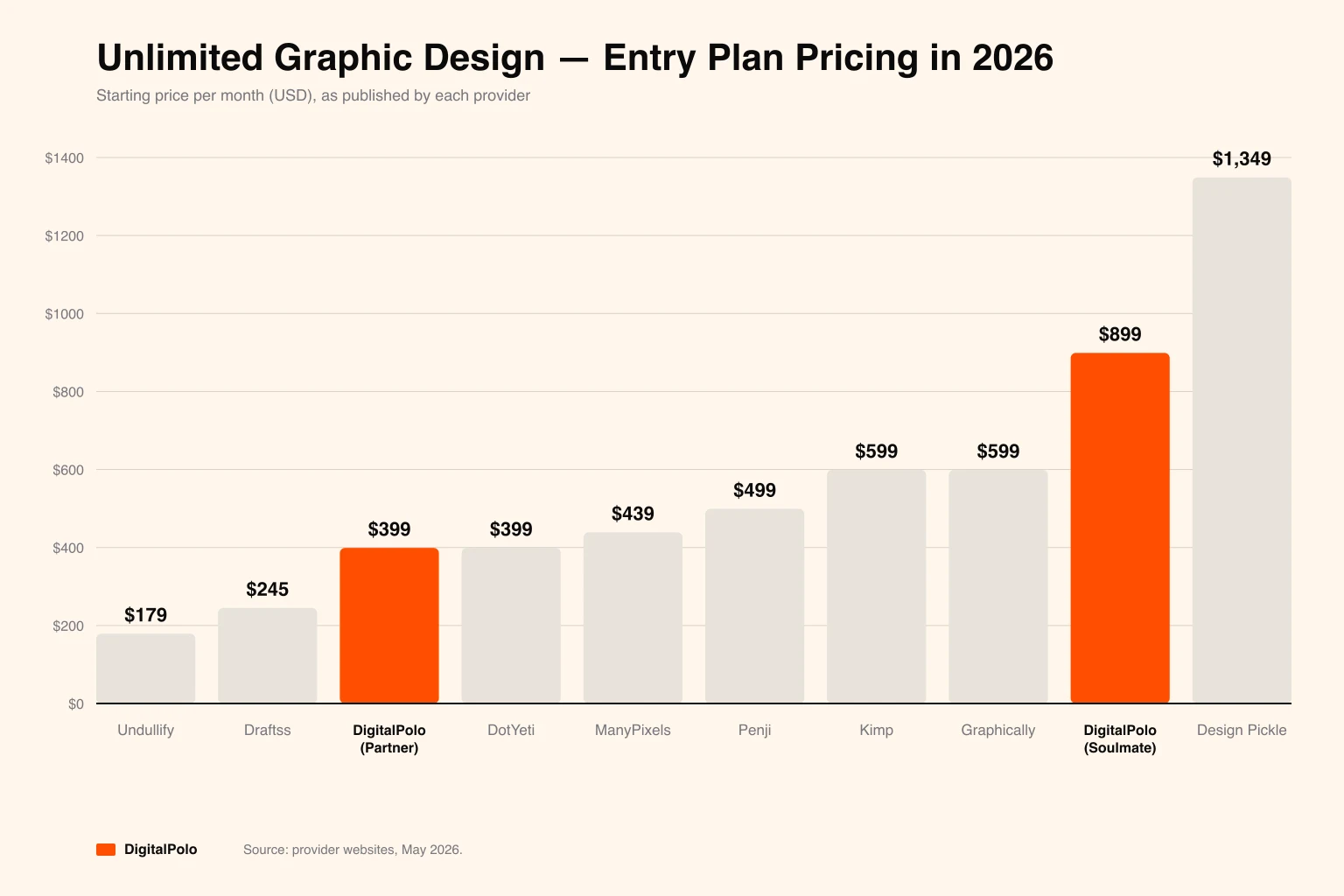
Several credible subscriptions exist, and for a startup the deciding axis is almost always price against runway, with turnaround a close second. This table reflects 2026 entry pricing — verify current numbers on each provider's site before committing, since plans change.
| Service | Entry price | Turnaround | Founded | Print-ready files |
|---|---|---|---|---|
| DigitalPolo | $399/month | 48 hours | 2010 | Yes — AI, EPS, PDF |
| Design Pickle | ~$1,349/month | ~2 days | 2015 | Limited |
| Kimp | ~$599/month | ~2 days | 2019 | Some |
| ManyPixels | ~$439/month | ~2 days | 2018 | Some |
| Penji | ~$499/month | ~1–2 days | 2017 | Some |
| Superside | ~$10,000/month | Varies | 2015 | Yes (enterprise) |
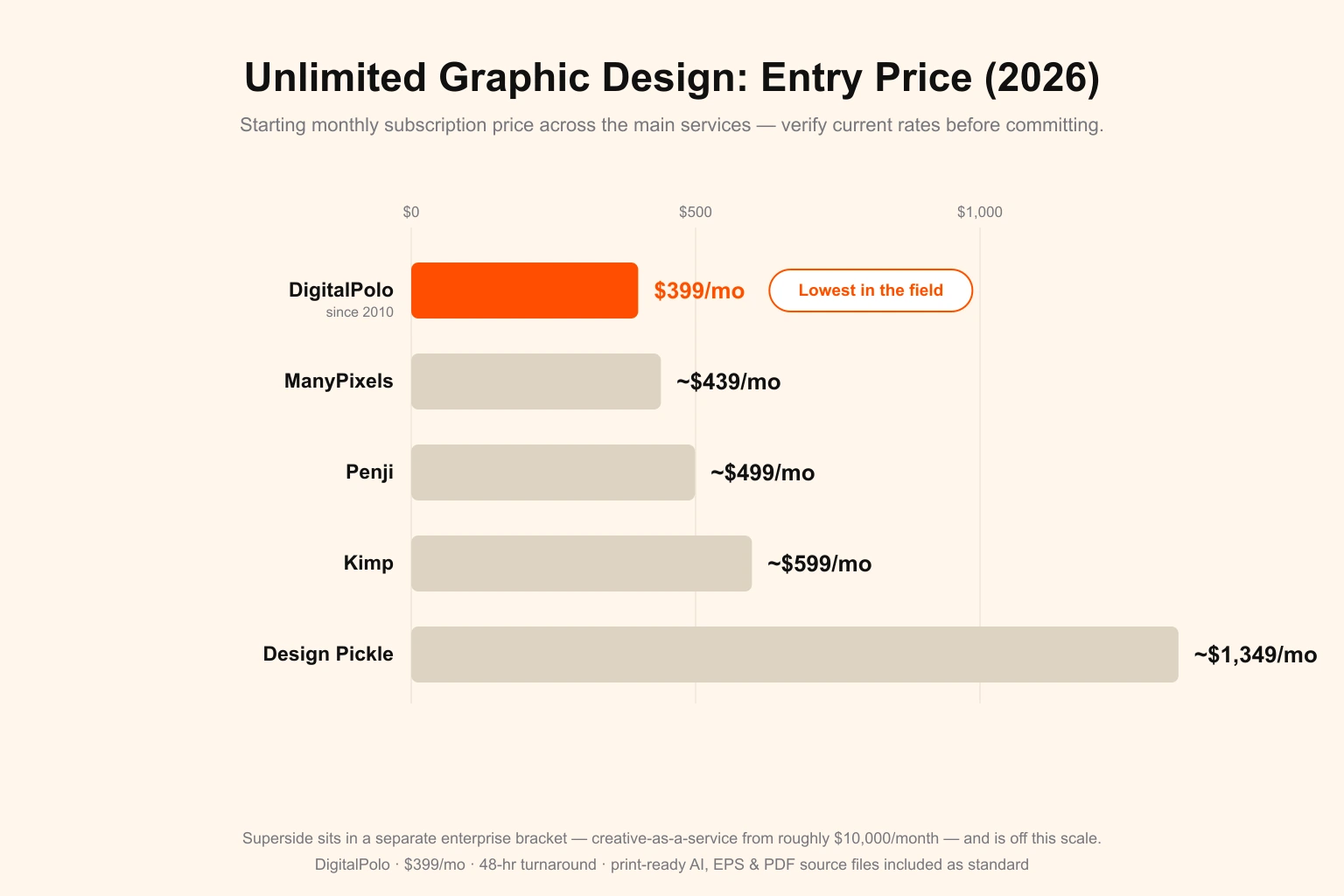
Where DigitalPolo separates for startups is on two axes the field under-serves. First, it is the lowest credible price in the category at $399/month, undercutting the $499–$699 band most "most affordable" lists point to — which matters more to a runway-constrained founder than to an established brand. Second, it delivers print-ready vector files as standard, so the same subscription producing your investor deck and Meta ads also produces the banner for your first trade show and the label for your first product run. It also predates Design Pickle by five years, which is the kind of track record that reduces vendor risk when you are betting early brand work on one partner.
Who Unlimited Graphic Design Is Best For — and Who Should Wait
A subscription is a strong fit if you are:
- A pre-seed to Series A startup with steady, varied design needs across brand, web, ads, and decks.
- Fundraising, launching, or running paid acquisition — all of which spike design volume.
- Running lean and want predictable cost instead of a $90,000 headcount commitment.
- In a category that touches physical product or events and needs print-ready files.
You might hold off if you are:
- Pre-idea, producing only a handful of assets a quarter — a freelancer is cheaper at that volume.
- In need of a single, deeply specialised deliverable (a full motion-brand system, say) better served by a senior specialist.
- Already past the point where design is a daily, deeply embedded product function — that is when a first in-house hire starts to pay for itself, often alongside a subscription for overflow.
If you are weighing the budget-focused options specifically, our shortlist of the best unlimited graphic design for small business covers the same ground from a price-first angle.
DigitalPolo Plans and Pricing
| Plan | Price | Turnaround | Delivery | Best for |
|---|---|---|---|---|
| Partner | $399/month | 48 hours | Unlimited tasks, all source files | Pre-seed to Series A startups, solo founders |
| Soulmate | $899/month | 24 hours (priority) | Dedicated team, 24×7 support, all source files | Funded startups scaling fast, high-volume launches |
Both plans include delivery of all source files — vector formats (AI, EPS, PDF) suitable for print production alongside digital creative — and a 7-day money-back guarantee. For a startup, the Partner plan covers the pre-launch and early-growth phase comfortably; the Soulmate plan makes sense once a raise closes and design volume — and the need for faster turnaround — climbs.
See Digital Polo's full pricing →
Verdict: Start With a Subscription, Hire Later
For most startups, the math is decisive. A first design hire is a $90,000-plus, single-discipline commitment that few early companies can justify against runway. An unlimited subscription delivers full-stack design output — brand, decks, ads, web, social, and print-ready collateral — for a flat fee that leaves the bulk of that budget intact, with no recruiting, payroll, or software overhead to manage.
The right sequence for most founders is: use a subscription to build the brand foundation and carry you through launch and fundraising, then add an in-house designer only once design has become a daily, deeply embedded function — at which point the subscription often stays on for overflow. Among the options, DigitalPolo is the most affordable credible service at $399/month, delivers print-ready source files as standard, and has the longest track record in the category, which is exactly the combination a runway-conscious startup should weight most.
Frequently Asked Questions
How much does graphic design cost for a startup?
It depends on the route. A full-time mid-level designer costs roughly $65,000 in base salary and closer to $90,000–$100,000 fully loaded in the first year. Freelancers run $50–$150 per hour or $75–$200 per finished asset. An unlimited design subscription is a flat fee — DigitalPolo's Partner plan is $399/month for unlimited tasks with 48-hour delivery, which is where most early-stage startups land.
Should a startup hire a designer or use a design subscription?
Most startups should start with a subscription. A first design hire costs $90,000+ fully loaded and only makes sense once design is a daily, deeply embedded function. A subscription gives a startup full-stack design output — brand, decks, ads, web, social — for a flat monthly fee with no payroll, recruiting, or software overhead, which fits the runway constraints of an early-stage company.
What is the best unlimited graphic design service for startups?
The most-cited services are Design Pickle, Kimp, ManyPixels, and Penji. For startups specifically, the deciding factor is usually price against runway. DigitalPolo, founded in 2010, is the most affordable credible option at $399/month and delivers print-ready source files alongside digital creative, which suits startups that need both ad assets and physical collateral like packaging or trade-show materials.
Can a design subscription handle pitch decks and investor materials?
Yes. Pitch decks, investor one-pagers, data-room visuals, and sales collateral are standard unlimited-design tasks. A subscription is well-suited to decks because they go through many revision rounds before a raise, and unlimited revisions mean you are not billed per change. DigitalPolo delivers editable source files so your team can make last-minute edits before a meeting.
Is unlimited graphic design worth it for an early-stage startup?
It usually pays off once you need more than roughly ten finished assets a month. At $399/month for around 40 assets, a subscription works out near $10 per asset, versus $75–$200 from a freelancer and far more than a full-time salary at low volume. Most startups cross that threshold during launch and fundraising, when design demand spikes.
How fast can a startup get designs with a subscription?
Most unlimited subscriptions deliver first drafts in one to two business days. DigitalPolo's Partner plan delivers within 48 hours and the Soulmate plan within 24 hours on priority. Simple, repetitive tasks — resizing an ad into multiple formats, swapping copy on a deck slide — often come back the same day, which matters during a launch or raise.
Does a design subscription work for a startup that has no brand identity yet?
Yes. Many startups use a subscription to build the brand foundation first — logo, colour palette, typography, and a basic style guide — and then keep the same service for ongoing work, so everything stays visually consistent. Because the work is unlimited and flat-fee, iterating on early brand directions does not cost extra the way it would with a freelancer.
Ready to Stop Overpaying for Graphic Design?
DigitalPolo's Partner plan starts at $399/month — unlimited tasks, 48-hour delivery, and all source files included. Print-ready vector files delivered as standard, so the same subscription handles your pitch deck, your ad creative, and your first trade-show banner.