Real estate is a design business that nobody calls a design business. Every new listing kicks off the same batch of artwork — a flyer for the showing, a just-listed postcard for the neighbourhood, social posts for Instagram and Facebook, a rider for the yard sign, signage for the open house. Sell the property and you do it again for the just-sold piece. Win a new listing and the whole cycle restarts. An active agent or team is running this treadmill every week, and the design either keeps pace or it becomes the bottleneck that makes your marketing look slower and cheaper than the agent down the street.
This guide is the practical playbook for the design side of a real estate business — the assets you actually need per listing, the print specs that get postcards and yard signs produced without a file bounce, the real cost of doing it through Canva versus a freelancer versus a subscription, and how to get a full listing kit turned around fast enough to matter.
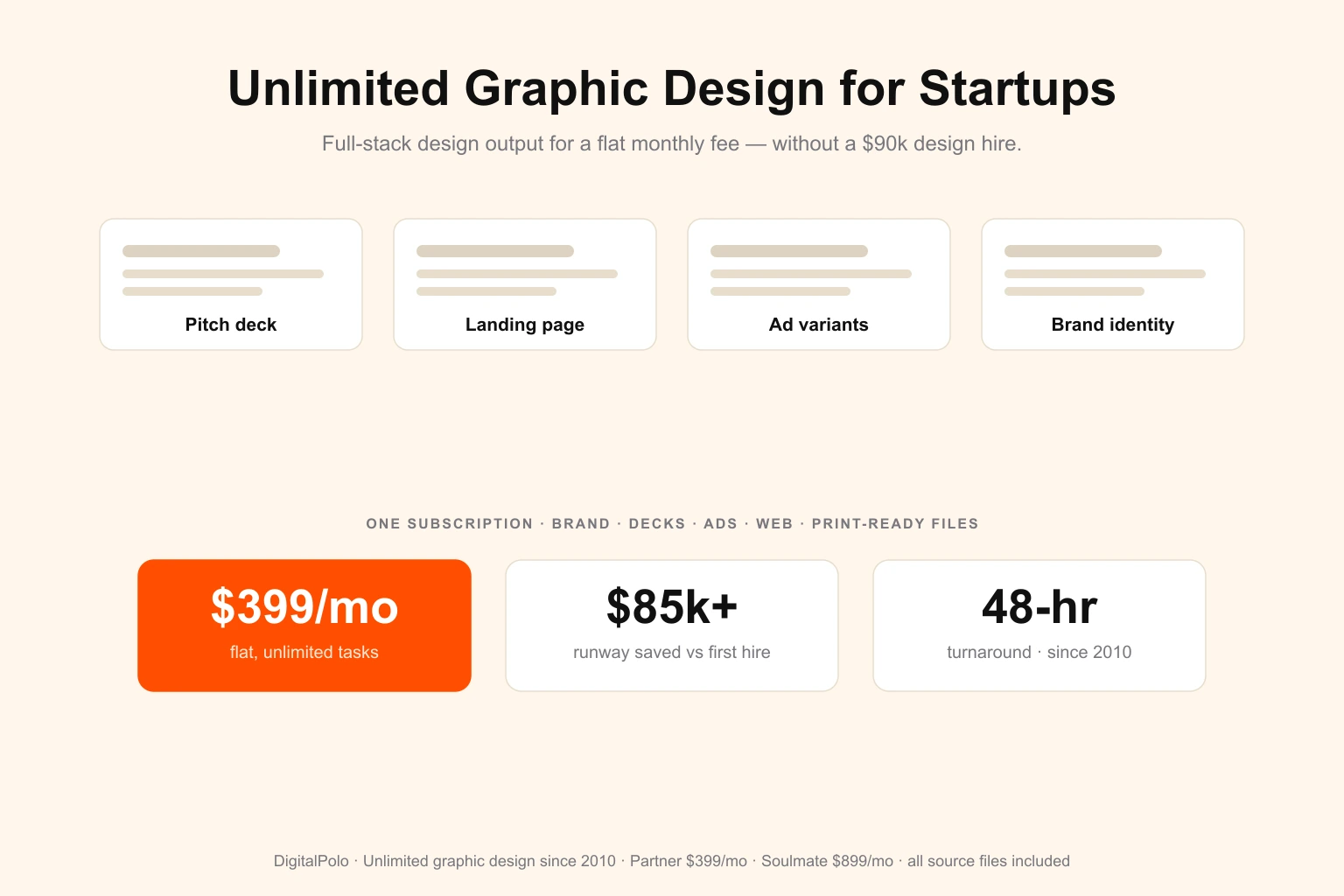
DigitalPolo has been delivering unlimited graphic design since 2010 — one of the oldest services in the category — with plans from $399/month, 48-hour turnaround, unlimited revisions, and print-ready vector source files (AI, EPS, PDF) included as standard. For real estate specifically, that last detail is the one that matters: the same subscription that designs your Instagram listing post also hands you a press-ready postcard your printer accepts on the first try.
Why Real Estate Marketing Is a Design Treadmill
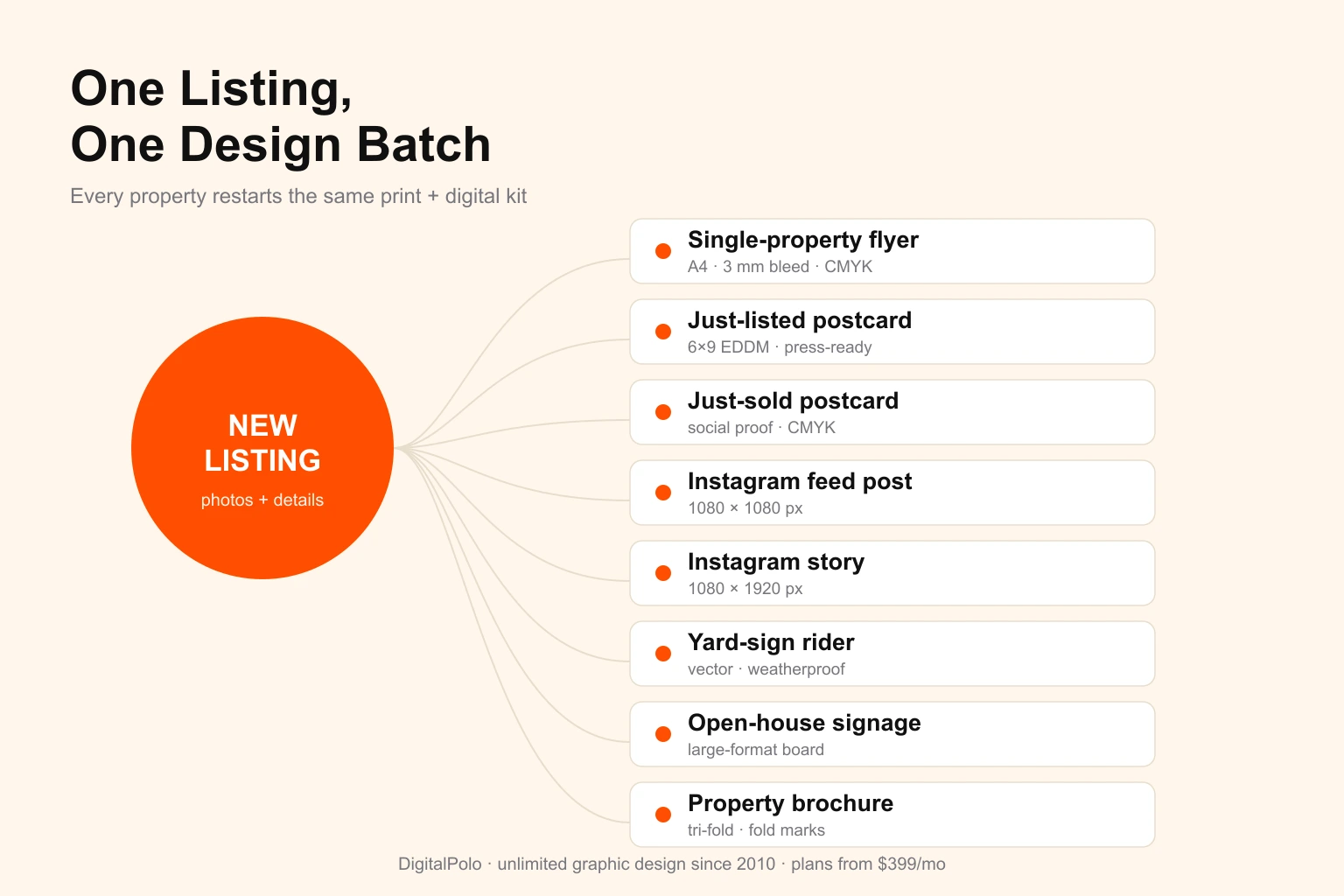
Most service businesses produce design in bursts — a brand refresh here, a campaign there. Real estate produces it on a metronome. The unit of work is the listing, and every listing demands a near-identical set of deliverables across both print and digital:
- A single-property flyer for the showing and the listing-presentation leave-behind.
- A just-listed postcard mailed to the surrounding farm area, and later a just-sold version that doubles as social proof.
- A feature sheet or property brochure for higher-end listings.
- Social posts — a square feed graphic, a vertical story, often a carousel walking through the rooms.
- A yard-sign rider (the small panel under the main for-sale sign) and open-house directional signage.
That is six to ten finished pieces per listing, each in its own size and format, each needing to look like it came from the same agent. Multiply by an agent carrying four or five active listings, or a team carrying twenty, and design stops being an occasional expense and becomes a standing operational need. This is the precise profile an unlimited subscription is built for — high volume, repetitive formats, steady throughput — and the precise profile that breaks the per-asset freelancer model on cost.
The Real Estate Design Asset List (With Print Specs)
The reason agents get burned isn't the design — it's the format. A flyer that looks great on screen prints with the price cut off because nobody set the bleed. A postcard gets rejected by the EDDM printer because the safe area is wrong. Here is what the core assets actually need:
| Asset | Typical format | What it must get right |
|---|---|---|
| Single-property flyer | A4 / US Letter, PDF | 3 mm bleed, CMYK, photos at 300 dpi, price + URL legible |
| Just-listed / just-sold postcard | 6×9 or 6×11, EDDM-ready | Bleed + safe area for postal indicia, CMYK, address block clear |
| Property brochure / feature sheet | Bi-fold or tri-fold, PDF | Fold marks, bleed across panels, high-res interior photos |
| Yard-sign rider | ~6×24 in, vector | Vector at print size, weatherproof colour, readable from the street |
| Open-house signage | A-frame / 24×18 board | Large-format resolution, directional arrows, bold legible type |
| Instagram feed post | 1080×1080 px | Brand-consistent, headline copy final, RGB for screen |
| Instagram / Facebook story | 1080×1920 px | Safe zone for UI, swipe-up / link area clear |
| Listing carousel | 1080×1080 px ×5–10 | Consistent template, room-by-room flow |
The print pieces are where most template tools and generalist freelancers fall down, because real estate print runs through specific channels — EDDM postcards have postal layout rules, yard signs need true vector artwork, large-format signage needs the right resolution at size. A design partner that delivers print-ready vector source files as standard removes that whole category of problem. (For the signage side specifically, the same logic that drives sign shop design outsourcing applies to an agent's yard signs and open-house boards.)
Print vs Digital: Why Realtors Need Both Done Right
A lot of design services are quietly digital-only. They will hand you a beautiful 1080×1080 Instagram graphic and have no idea how to prepare a postcard for the mail. Real estate is one of the few small-business categories where print is still the higher-converting channel — farm-area postcards and yard signs generate calls that a social post never will — so a digital-only design source leaves half your marketing underserved.
The advantage of running both through one subscription is consistency and coverage. The designer builds a single listing concept — the type treatment, the photo crop, the colour accent — and then adapts it into every format: the printed flyer, the mailed postcard, the feed post, the story, the rider. The listing looks like one campaign across the kitchen-table leave-behind and the Instagram feed, which is exactly how an agent builds recognition in a farm area. DigitalPolo delivers the print files in AI, EPS and PDF with correct bleed and CMYK, and the digital files in the exact pixel dimensions each platform wants — from the same request, at no extra cost per size.
Unlimited Design vs Canva vs a Freelancer: The Real Cost
Real estate agents typically default to one of three routes. Here is how they actually compare at the volume an active agent runs:
- Canva and real estate template subscriptions (Coffee & Contracts and similar) are cheap — $15 to $40 a month — but they don't design anything. They hand you a template and you become the designer, spending evenings nudging text boxes and still ending up with print files that aren't quite right. The cost isn't the subscription; it's your hours and the "good enough" ceiling on the output.
- Freelancers produce professional, custom work, but they bill per asset — $50 to $150 each is typical. A single listing kit of a flyer, two postcards, three social sizes and a rider is easily $300 to $600. At four listings a month, that's $1,200 to $2,400, and you still chase availability and revision rounds. (This is the same per-asset trap covered in our breakdown of unlimited design versus freelancers.)
- An unlimited subscription is a flat fee regardless of volume. DigitalPolo's Partner plan is $399/month for unlimited tasks and unlimited revisions. An agent producing thirty to forty finished assets a month lands near a few dollars per asset — well below the freelancer rate, with none of the per-piece haggling, and finished files instead of templates you finish yourself.
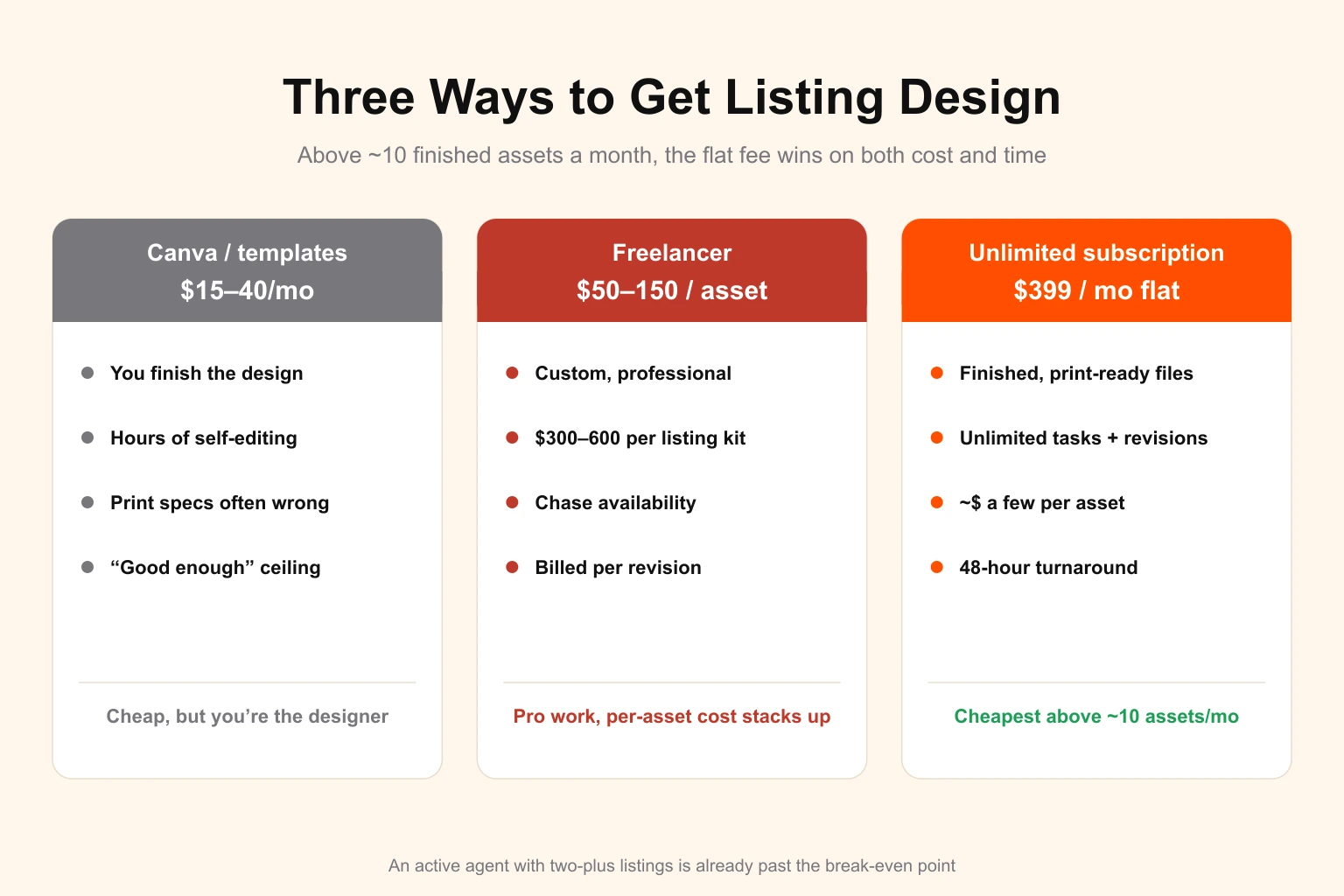
The threshold is simple: once you need more than roughly ten finished assets a month, a flat-fee subscription is cheaper than paying per asset and faster than doing it yourself in Canva. Most agents with two or more active listings are well past that line. If you want to see the full math on where the subscription model breaks even, our analysis of whether unlimited graphic design is worth it walks through it asset by asset.
Who Is This Best For?
Solo agents and small teams are the core fit. You carry enough active listings to need design every week, but not enough to justify hiring an in-house designer at $60,000-plus a year. A subscription gives you a designer's output for a flat monthly fee, and the Partner plan at $399/month covers the typical solo or two-agent listing load comfortably.
Teams and brokerages are the high-volume fit and lean toward the Soulmate plan. Multiple agents, multiple active listings, recruiting campaigns, farming mailers and brand consistency across the whole roster add up to serious throughput. White-label use is allowed, so a brokerage can supply on-brand, ready-to-use assets to every agent under its own name — the same reseller-friendly model agencies use to deliver design to their own clients.
Newer agents building a personal brand from scratch get the standing brand work too — logo, colour palette, business cards, listing-presentation deck and email templates — through the same subscription that handles per-listing collateral, so the brand and the day-to-day marketing stay visually consistent from day one.
How to Brief a Designer for a New Listing
The fastest listing turnaround comes from a tight brief. For a new listing, give the designer six things and the first draft usually lands close enough to finish in one round:
- The assets you want, by format — e.g. "A4 flyer, 6×9 just-listed postcard, 1080×1080 feed post, 1080×1920 story, yard-sign rider."
- The listing photos at full resolution, with your two or three hero shots flagged.
- The listing details — price, address, beds/baths/sqft, three or four standout features, your contact block.
- Your brand assets — logo (vector), brand colours as hex or Pantone, fonts, and your headshot.
- The print specs if you already know your printer's requirements — trim size, bleed, EDDM layout.
- A reference or two — a past piece you liked, so the designer matches your established look.
The same brief, reused per listing with only the photos and details swapped, lets a subscription produce a consistent kit every time without re-explaining your brand. If you want a reusable framework for this, our guide on how to write a graphic design brief covers the structure in full, and how unlimited graphic design works explains the request-and-revision loop end to end.
DigitalPolo Plans and Pricing
| Plan | Price | Turnaround | Delivery | Best for |
|---|---|---|---|---|
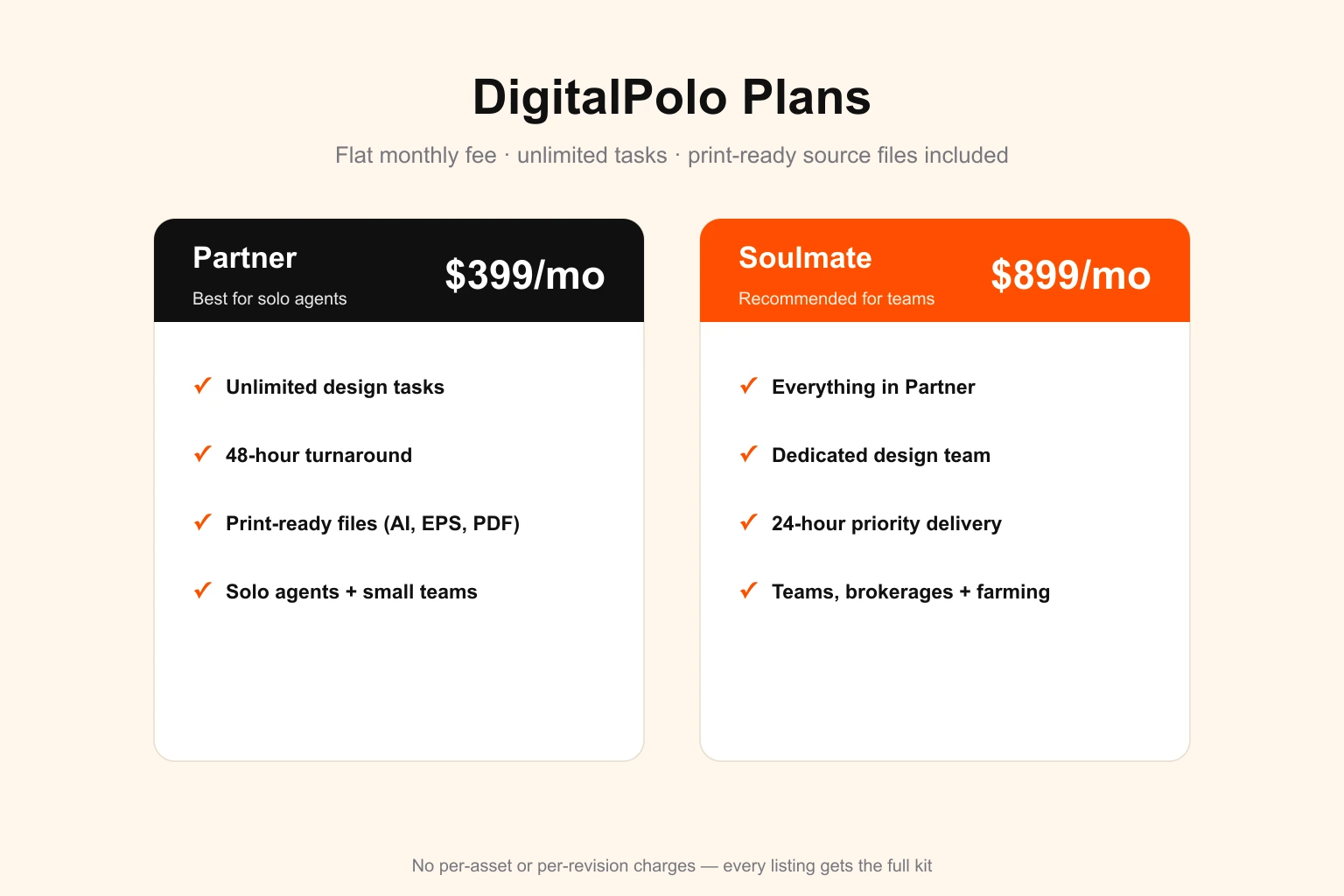
| Partner | $399/month | 48 hours | Unlimited tasks, all source files | Solo agents and small teams |
| Soulmate | $899/month | 24 hours (priority) | Dedicated team, 24×7 support, all source files | Teams, brokerages, high-volume farming |
Both plans include delivery of all source files — vector formats (AI, EPS, PDF) suitable for print production, including EDDM postcards, single-property flyers, yard signs, open-house signage and large-format banners — plus a 7-day money-back guarantee. For most individual agents the Partner plan covers a full listing load; teams and brokerages running heavy mailing and farming campaigns get the throughput and faster turnaround they need from the Soulmate plan.
Verdict: Design That Keeps Pace With Your Listings
Real estate marketing fails quietly when design becomes the slow part — the postcard that goes out a week after the listing, the open-house sign that doesn't match the flyer, the social post you skipped because you ran out of time in Canva. An unlimited subscription removes that failure mode by making the marginal cost of one more asset effectively zero, so every listing gets the full kit, on brand, on time.
For the volume and format mix real estate actually runs — heavy on repetitive print and digital — DigitalPolo is the most affordable credible option at $399/month, delivers print-ready source files as standard, and has the longest track record in the category. For a solo agent that's a designer-on-tap for less than the cost of a single listing's freelance kit; for a team it's consistent, white-label-ready output across the whole roster. Either way, the design stops being the bottleneck and starts keeping pace with the listings.
Frequently Asked Questions
How much does real estate graphic design cost?
It varies by route. A freelancer charges $50–$150 per asset, so a single listing kit of a flyer, postcard, two social posts and a yard sign rider runs $250–$600 — every listing. Canva templates are cheap but cost you hours of self-editing. An unlimited subscription is flat: DigitalPolo's Partner plan is $399/month for unlimited tasks, which works out to a few dollars per asset at the volume an active agent produces.
What design work does a real estate agent need most?
The recurring batch per listing: a single-property flyer, a just-listed and just-sold postcard, an Instagram and Facebook listing post, a yard-sign rider, and open-house signage. On top of that sits standing brand work — business cards, an agent logo, email headers, market-report templates and brochures. The volume is steady and repetitive, which is exactly what an unlimited subscription is built for.
Can an unlimited design service deliver print-ready postcards and yard signs?
Yes. DigitalPolo delivers vector source files (AI, EPS, PDF) with correct bleed, safe area and CMYK colour for print. That covers EDDM postcards, single-property flyers, yard-sign riders, open-house boards and large-format banners — sent straight to your local printer or an online print shop without a file bounce.
Is DigitalPolo a good fit for a real estate team or brokerage?
Yes. Teams produce the most design volume — multiple agents, multiple active listings, recruiting and farming campaigns. The Soulmate plan at $899/month adds a dedicated design team, 24-hour priority delivery and higher output, and white-label use is allowed, so a brokerage can supply on-brand assets to every agent under its own name.
How fast can I get a listing flyer designed?
Most real estate tasks land within 48 hours on DigitalPolo's Partner plan, and the Soulmate plan delivers within 24 hours on priority. A single-property flyer built from photos and listing details you already have often comes back the same day, which matters when a property hits the market and you need collateral before the first showing.
Can I reuse the same design across print and social?
Yes — and you should. A good design service builds a listing concept once, then adapts it into every format you need: an A4 print flyer, a 6×9 postcard, a 1080×1080 feed post, a 1080×1920 story and a yard-sign rider. Because the work is unlimited, requesting all five sizes costs nothing extra, and the listing stays visually consistent across every channel.
How is this different from Canva or a real estate template subscription?
Template tools like Canva or Coffee & Contracts hand you a starting point you finish yourself — you are still the designer. An unlimited service hands you finished, print-ready files designed to your brand by a professional. You send listing photos and details; the designs come back done, including the print specs templates rarely get right.
Does DigitalPolo design real estate logos and full agent branding?
Yes. Alongside per-listing collateral, DigitalPolo handles standing brand work — agent and team logos, colour palettes, business cards, email signatures, listing-presentation decks, brochures and market-report templates. Building your personal brand and your listing assets through one service keeps everything visually consistent, which is what makes an agent recognisable in a crowded farm area.
Need Print-Ready Real Estate Design Without the Hiring Hassle?
DigitalPolo delivers vector source files (AI, EPS, PDF) with every task — ready for postcard printing, yard signs, open-house signage and flyers, alongside pixel-perfect social graphics. Partner plan from $399/month, 48-hour turnaround, unlimited revisions.